




Abstract
In order to investigate the acoustic radiation characteristics of underwater, a pipe casing was introduced and the effects of its main structural characteristics on underwater combustion acoustic radiation were studied by acoustic testing. The results show that the addition of the pipe casing significantly increased the sound pressure level of underwater pyrotechnic combustion, especially the peak of sound pressure level that was increased by 15.9 dB from 155.5 to 171.4 dB at the frequency of 125 and 100 Hz. But the addition of the pipe casing had little effect on the frequency. These results indicated that adding a pipe casing is effective for improving sound pressure level in underwater pyrotechnic combustion. An increase in nozzle diameter from 10 to 12.5 mm resulted in an increase of gas volume, so the peak of sound pressure level and broadband sound pressure level is higher. Changing the pipe casing direction to vertical downward will make the bubble formation period shorter, which will generate more bubbles and strong wake; the interaction between bubbles and wake results in a higher intensity of turbulence, which accounts for the coalescence and breakup of bubbles in the fluid. Besides, changing the diameter of pipe casing can be used to lower the frequency of underwater noise.
Introduction
Pyrotechnics composed of oxidant, combustible agent, and adhesive are self-contained oxygen systems as the oxidant provides oxygen for the combustion, 1 and through continuous and steady underwater combustion, it can produce a large amount of high temperature gases and solid residues which produce certain sound effects and could be used for interfering sonar or against mines, and so on. Chapman and Harris 2 measured surface backscattering strengths in octave bands using explosive sound sources. In ship exhaust system, the bubble formation and the exhausted bubble cloud are major noise sources. 3 The interaction between bubbles (coalescence and breakup) has a great effect on sound generation, and the sound is much louder than that produced by a single bubble.4,5 The coalescence and breakup of bubbles depend largely on bubble size, and large bubbles are more prone to coalescence and breakup.6,7 However, relevant studies on the mechanisms of underwater acoustic radiation focus on bubble-induced noise, which is generated from the dynamics of bubbles including growth, deformation, coalescence, breakup, and vibration. 8 The noise radiation of bubbles has received much attention since 1917. 9 The bubble-generated sound is induced by intense pressure fluctuation, with frequency close to that of bubble volume resonance. 10 The interaction between bubbles (e.g. coalescence and breakup) will greatly affect sound generation and produce a much louder sound than that produced by a single bubble.4,11 He also studied that the acoustic radiation characteristics of the addition of the feedback cavity significantly improved the sound pressure level (SPL) of underwater pyrotechnic combustion. According to previous studies on the effects of pyrotechnic charge nozzle noise and thermite content on the acoustic radiation characteristics during underwater pyrotechnic combustion, the pyrotechnic exotherm has an impact on the underwater sound radiation at the broadband SPL of about 150 dB. 12 In order to further enhance the SPL of underwater pyrotechnic combustion, we have introduced a pipe casing structure into the underwater pyrotechnic combustion system and so far, there is little research on a pipe casing structure device that affects acoustic radiation characteristics of underwater pyrotechnic combustion.
These experiments in the research were to apply the pipe casing structure which comprises an elongated tubular chamber having one end open and the other end closed and to study its effectiveness, as well as the changes in the SPL and frequency, as a function of its main structural characteristics, including the diameter of nozzle, the orientation of pipe, and the diameter of pipe.
Experiments
Preparation of pyrotechnic samples
The pyrotechnic composed of oxidant, combustible agent, and adhesive was compressed into grains with a density of 1.8 g cm−3, diameter of 18 mm, and the total mass of sample 5 ± 0.01 g, combustion heat (
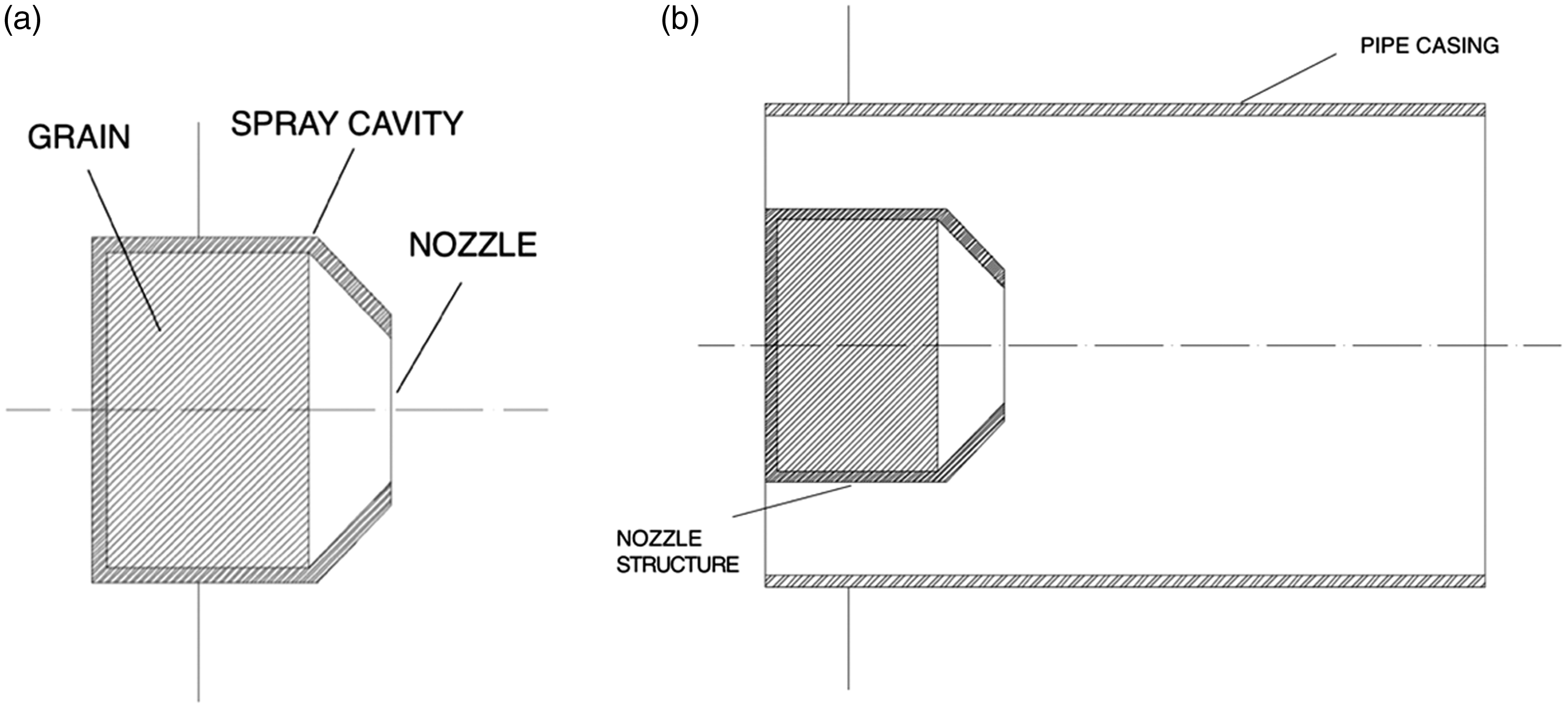
The diagram of nozzle structure (a) and pipe casing structure (b).
Methods
A schematic diagram of the underwater pyrotechnic combustion test is shown in Figure 2. The test sample was placed in an acrylic cube tank (950 mm × 750 mm × 1100 mm), located 0.7 m from the water surface and ignited by electric firing. A hydrophone placed in the tank transformed the captured sound pressure into electrical signals, which were then conditioned by Brüel & Kjaer Type 2692 charge amplifiers and transferred through a Pulse Front-end 3560C. The data were collected and processed by the software PULSE LABSHOP. The sensitivity of a Brüel & Kjaer type 8104 at 250 Hz is ±0.25 dB. The distance between the hydrophone and the charge nozzle was 100 ± 5 cm. The pipe casing has an outside whose diameter is 37 mm and thickness is 1.5 mm. The distance between the hydrophone and the testing sample was 0.5 m. The spectra were calculated over one-third octave band (


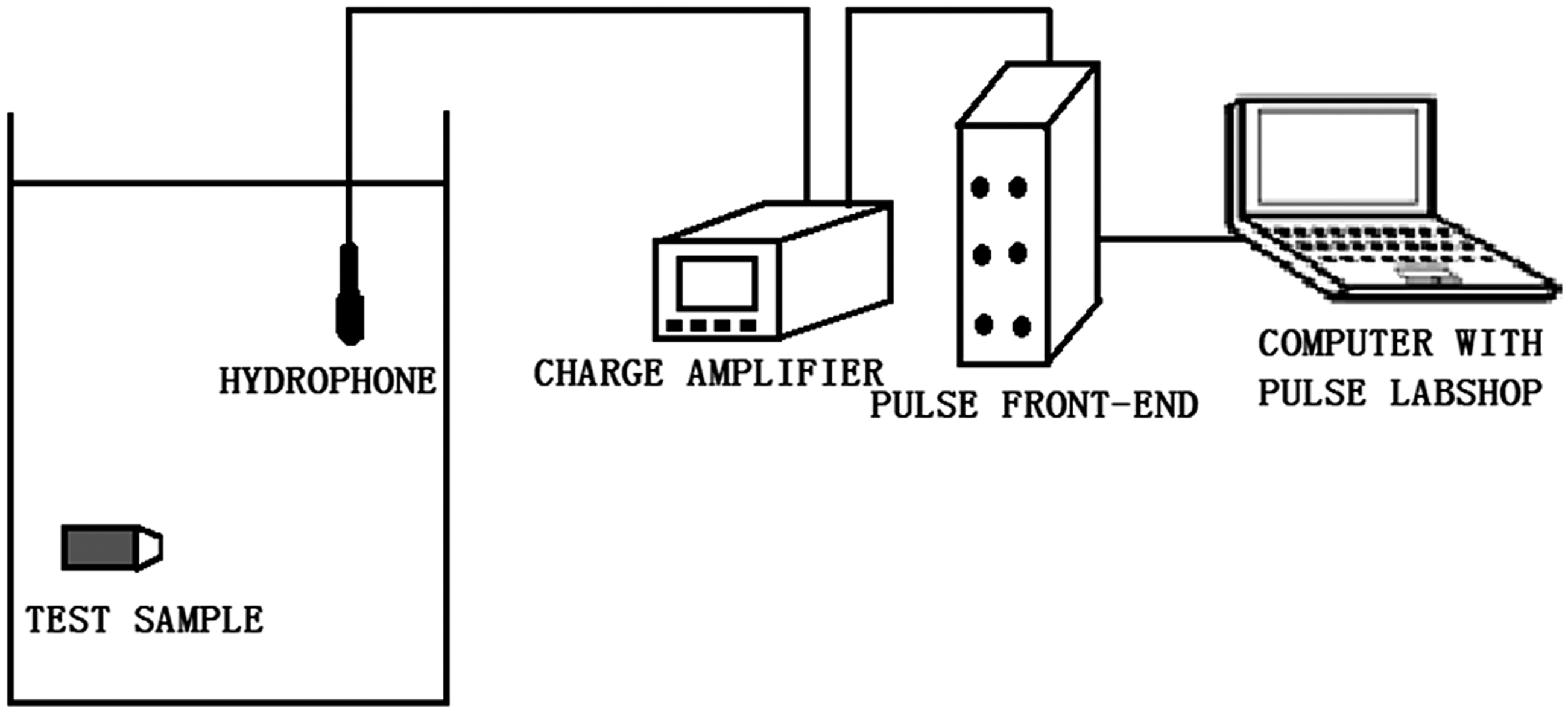
Diagram of experimental system.
Results and discussion
Differences of acoustic radiation characteristics between the nozzle structure and the pipe casing structure
Figure 3 shows that the acoustic radiation characteristic differs greatly between these two structures, primarily with regard to frequency, peak SPL, and SPL. First, peak SPL frequency of the nozzle structure is 125 Hz, while the frequency of the pipe casing structure is 100 Hz, demonstrating that the addition of the pipe casing shifts sound generation to lower frequencies. Second, the addition of the pipe casing can significantly increase the SPL produced by underwater pyrotechnic combustion, especially the peak of SPL, which increased by 15.9 dB from 155.5 to 171.4 dB at the frequency of 125 and 100 Hz, with the growth of 10.2%. Third, the broadband SPL of the pipe casing structure is 174 dB, which is higher than that of the nozzle device (158.9 dB) within 0–1000 Hz. However, the trend of SPL variation with frequency is nearly the same whether the pipe casing is present or not. In addition, the spectra of acoustic radiation characteristics show that the noise of underwater pyrotechnic combustion is mainly at low frequency, reflecting the characteristics of exhaust during underwater combustion.
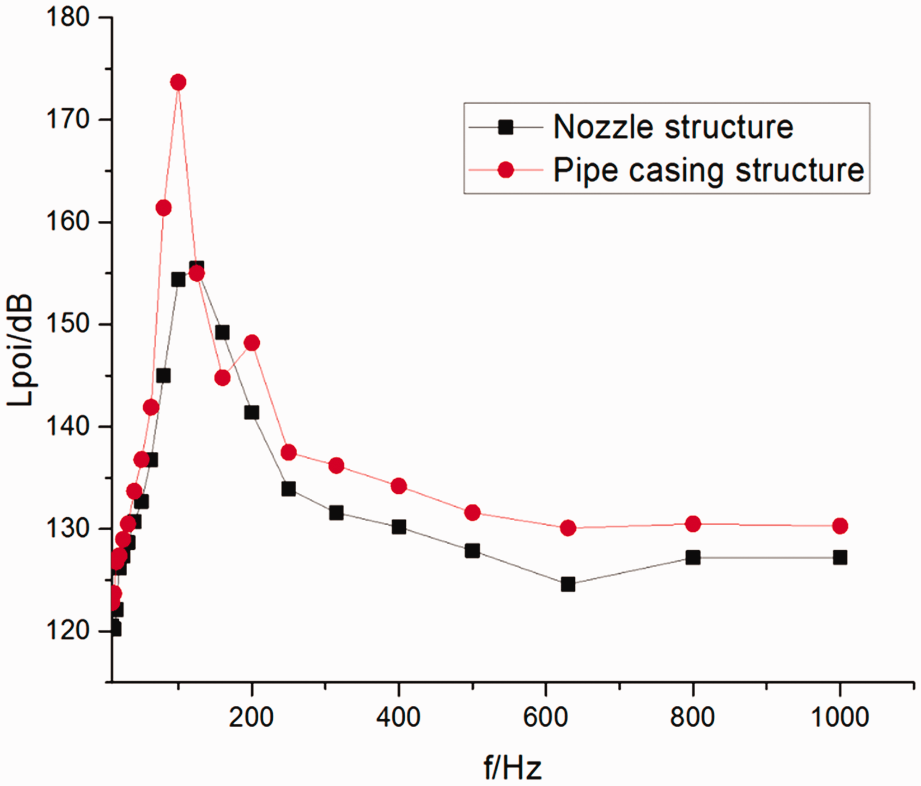
Acoustic radiation characteristics of underwater pyrotechnic combustion of the nozzle structure and pipe casing structure.
Closely related to the acoustic radiation characteristic is that of bubble formation. Thus, it is necessary to research the bubble formations by these two structures (Figure 4).
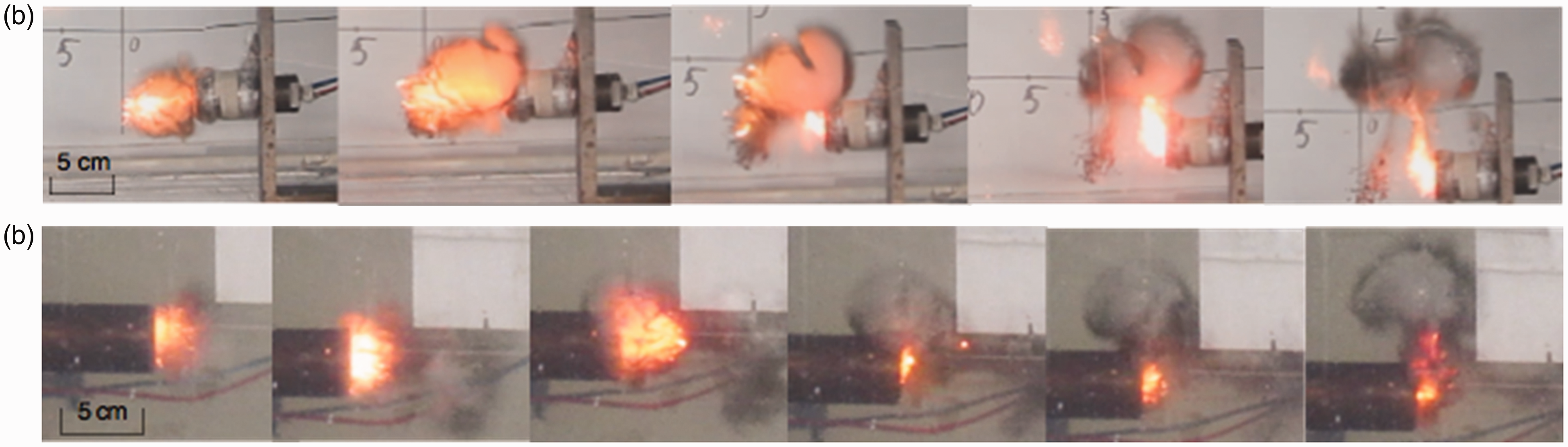
Bubble formations of two structures. (a) Bubble formation by the nozzle structure (intervals of 66 ms) and (b) bubble formation by the pipe casing structure (intervals of 33 ms).
As shown in Figure 4, the bubble formation time of the two structures is different, 330 ms for nozzle structure and 198 ms for pipe casing structure. Gas combustion products accumulate and generate bubbles at the nozzle after the pyrotechnic charge is ignited in the pipe casing, then bubbles disperse from the nozzle under the combined effects of viscous resistance, buoyancy, gravity, and inertial resistance. However, when there is no pipe casing, the gas produced does not accumulate and discharges into the water directly, and is thus subjected to more inertial resistance. Hence, bubble formation time is different for the two cases leading to difference in bubble numbers. The result is that the bubble number of the pipe casing structure is more than that of the nozzle structure. The bubbles produced by the underwater pyrotechnic combustion were treated as approximately spherical, and their diameters were 60 and 86 mm, respectively, because the pipe casing structure has a wider nozzle diameter.
Due to shorter bubble formation time, larger bubble diameter and more bubble numbers, interaction between bubbles becomes more violent from the device with a tube. As well, the bubbles are prone to rupture and merge in turbulence of a greater wake region. These factors strengthen bubble volume change rate which determines the monopole source of sound. Crighton and Williams
13
showed monopole of sound arises from the forced response of the bubbles at the frequency characteristic of the turbulence. The Lighthill theory of aerodynamic
11
noise showed a turbulent eddy radiates sound waves. The mean square acoustic pressure (

Effects of nozzle diameter on pipe casing structure on the SPL of underwater pyrotechnic combustion
These tests are aimed to investigate the relationship between the acoustic radiation characteristics of underwater pyrotechnic combustion and the nozzle diameter (10, 12.5, 15, and 20 mm) with pipe casing structure (Figure 5).
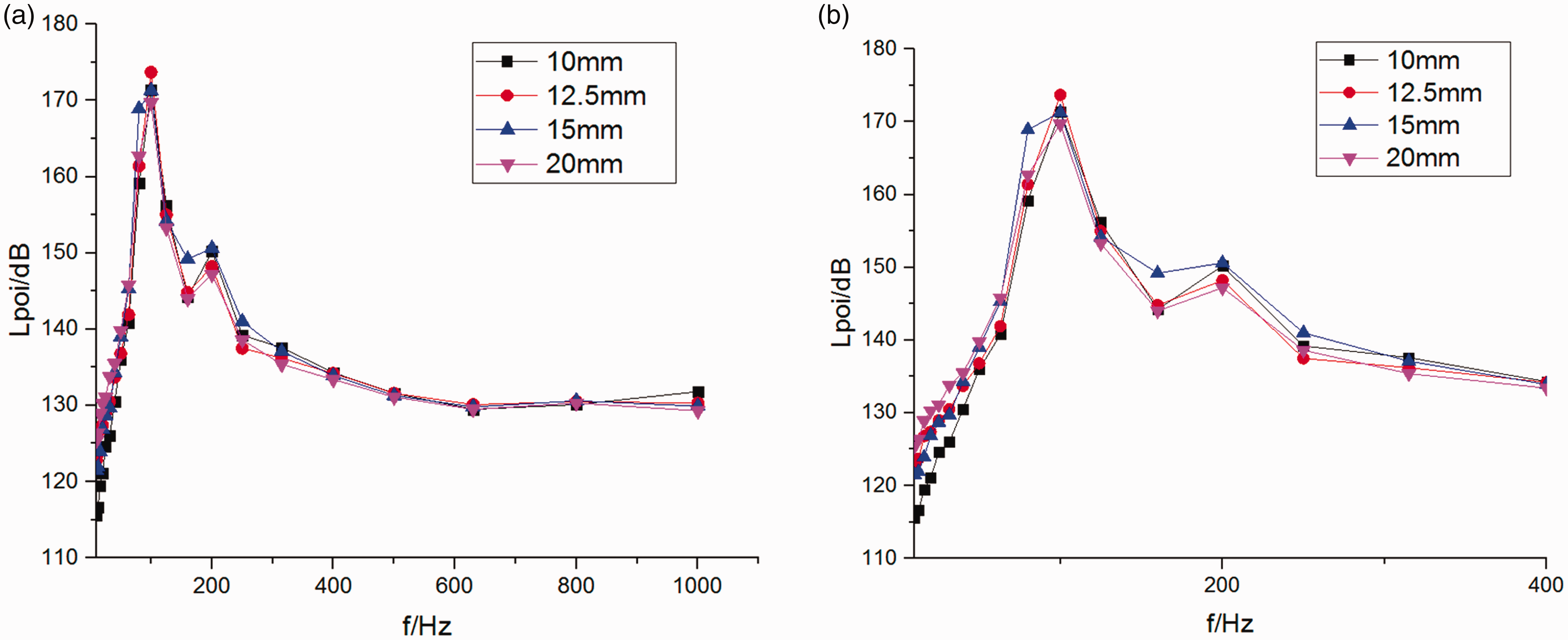
Effect of nozzle diameter of pipe casing structure on the SPL of underwater pyrotechnic combustion (a) frequency of 10–1000 Hz and (b) frequency of 10–400 Hz.
Figure 5 and Table 1 show that the peak of SPL is 171.4, 173.7, 171.3, 169.7 dB at the frequency of 100 Hz, and the broadband (10–1000 Hz) SPL is 171.8, 174, 173.4, and 170.6 dB, respectively, as the nozzle diameter is increased. The peak of SPL and broadband SPL at 12.5 mm is the highest. The mean velocity and the shearing area at the exit of nozzle are different with different diameter of nozzle. The larger the diameter of nozzle is, the smaller

Acoustic radiation characteristics of pyrotechnic combustion with different nozzle diameters.

Effects of pipe casing direction on the SPL of underwater pyrotechnic combustion
Bubbles with different shapes, diameter, and amount are generated by several directions of pipe casing. Figure 6 shows the acoustic radiation characteristics of underwater pyrotechnic combustion with different pipe casing directions.
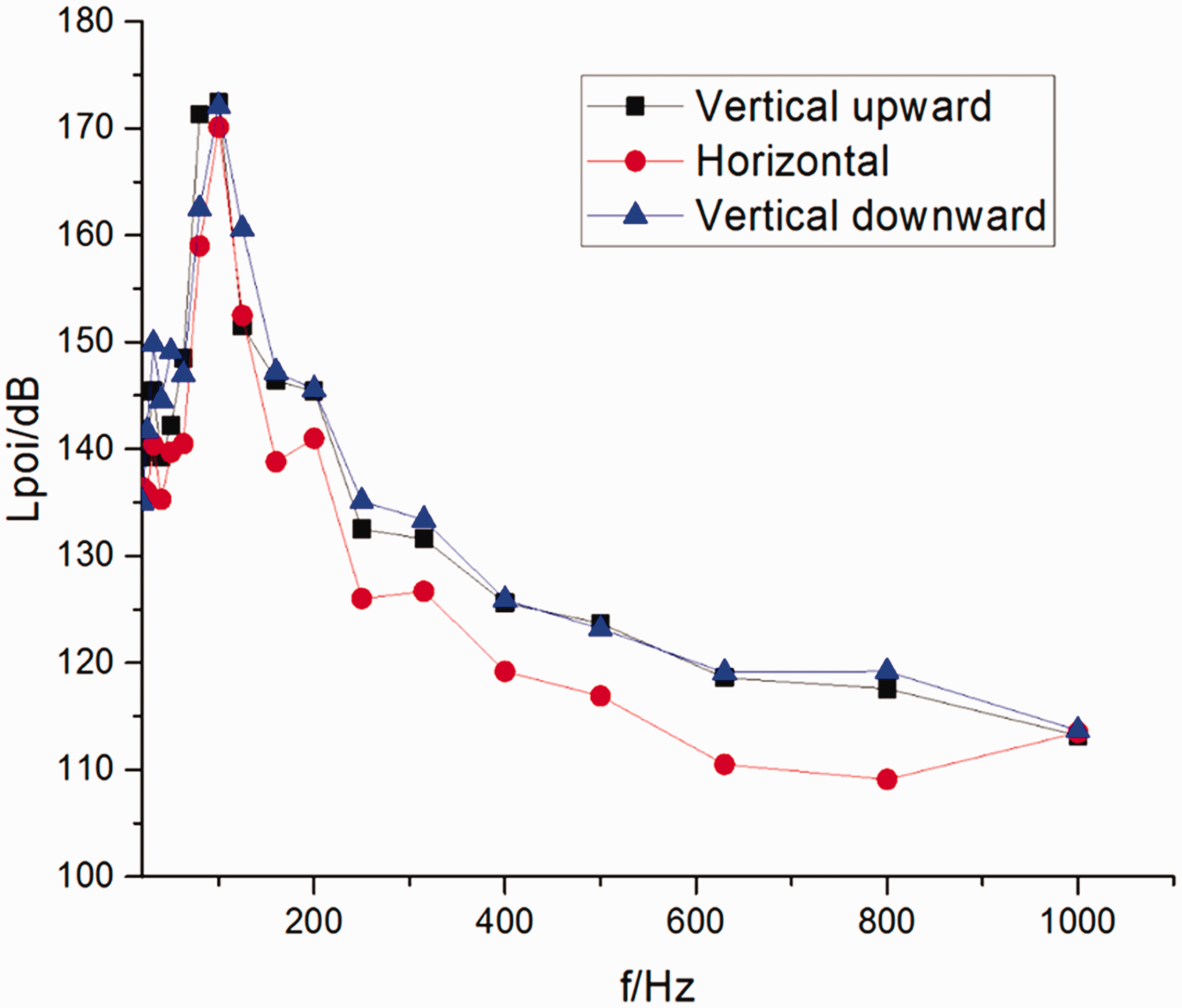
Acoustic radiation characteristics of underwater pyrotechnic combustion with different pipe casing directions.
Figure 7 and Table 2 show that the peak of SPL is 172.1, 170.1, and 172.4 dB at the frequency of 100 Hz, and the broadband (20–1000 Hz) SPL is 172.9, 170.5, and 175 dB, respectively, for vertical upward, horizontal, and vertical downward directions of the pipe casing, respectively. The peak of SPL and broadband SPL at vertical downward direction of the pipe is the highest. But the direction of pipe casing has no effect on the frequency of peak SPL and the trend of the acoustic radiation characteristics is similar. Acoustic radiation characteristics of underwater pyrotechnic combustion appear to depend on the nozzle bubble formation. Figure 8 shows the bubble formation process of different pipe casing directions (time interval of 33 ms).
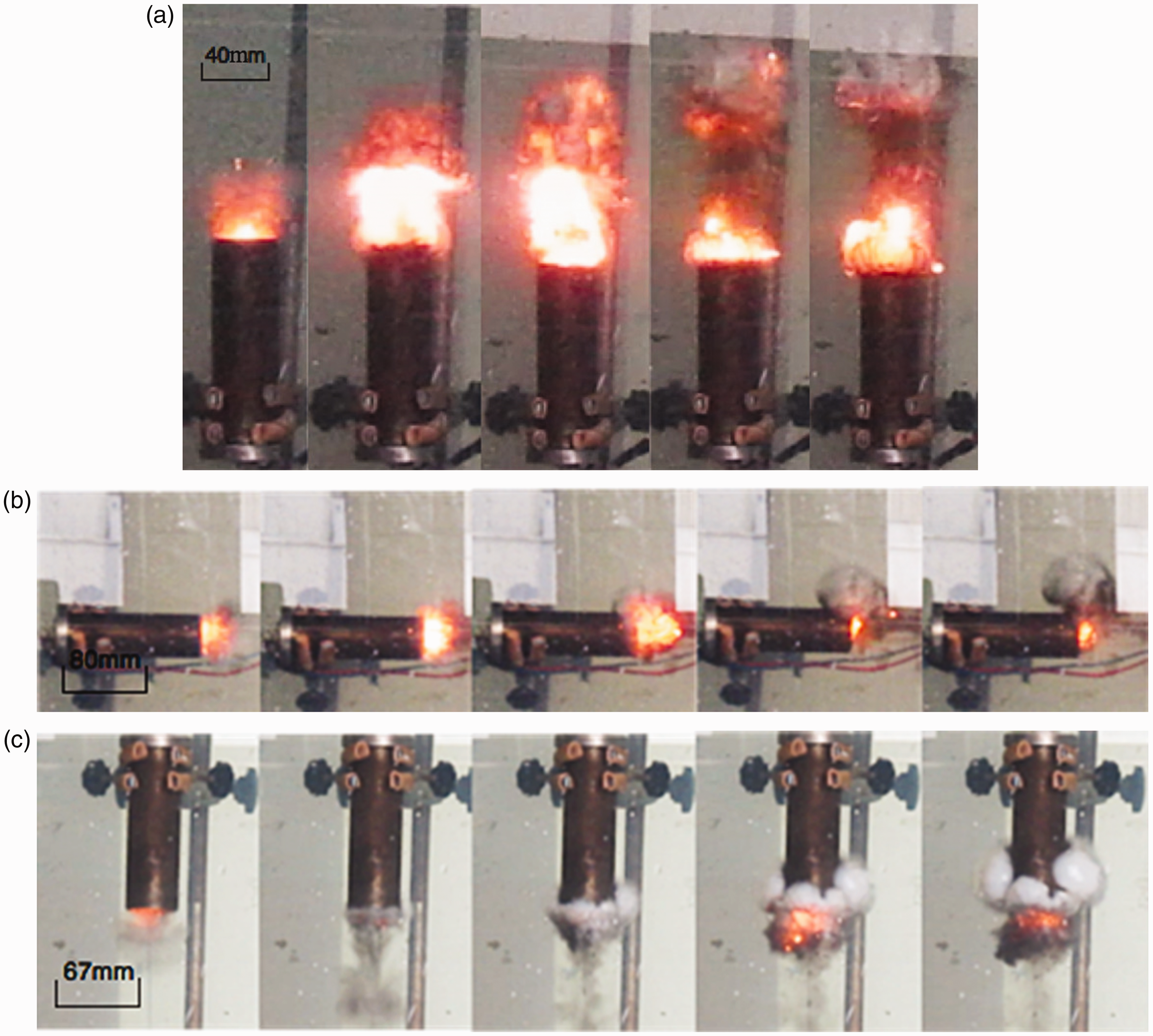
Bubble formation of different directions of pipe casing. (a) Vertical upward direction, (b) horizontal direction, and (c) vertical downward direction.
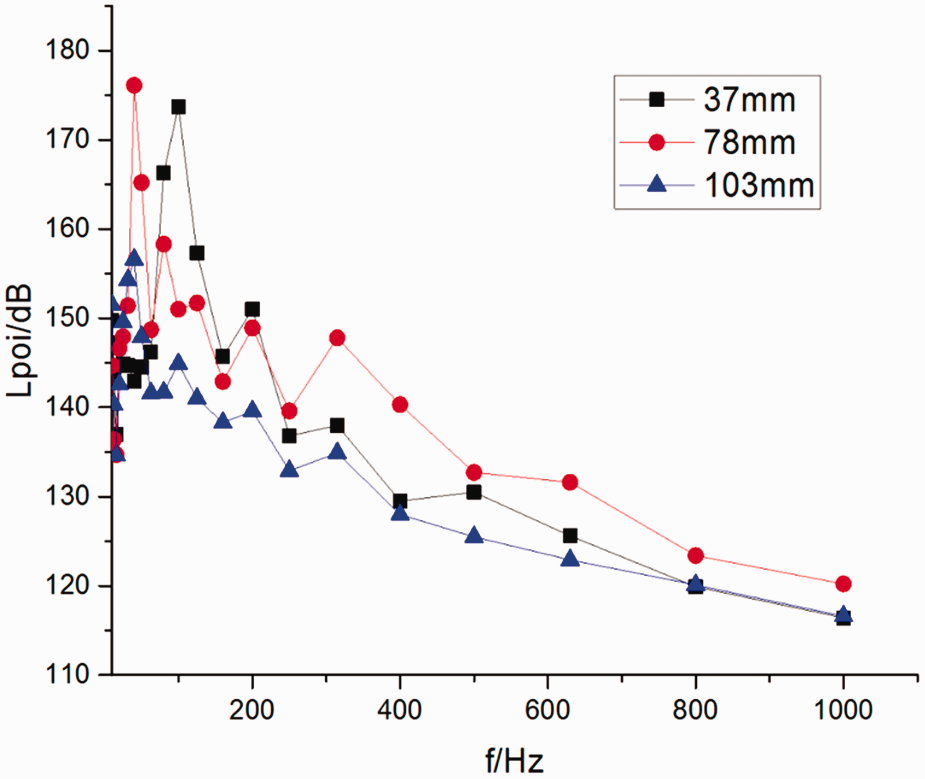
Acoustic radiation characteristics of underwater pyrotechnic combustion with different diameters of pipe casing.
Acoustic radiation characteristics of underwater pyrotechnic combustion with different pipe casing directions.

Figure 7 shows that the processes of bubble formation are basically the same. The solid residues generated during combustion are sprayed into bubbles along with the gas, making the bubbles darker. Also the flames, heat, and solid residue generated during combustion make the shapes of bubbles more irregular. As the bubbles at the nozzle of pipe are in irregular shapes and prone to coalescence and breakup during their rising, the maximum diameter of nozzle bubble is viewed as the bubble’s diameter, whose diameters were approximately 75.6 and 69 mm, respectively, from Figure 8(a) and (b). Quantitative experimental studies14,15 confirm that the generation of underwater exhaust noise is closely related to the size of the accompanying bubble, which separates from the nozzle of pipe casing, the breakup and coalescence of which generate an acoustic effect strongly dependent on their size. The bigger the bubble becomes, the more gas the bubble contains, making it less stable and producing severe deformation.
Figure 7 also exhibits different bubble formation period, which is 132 ms for vertical upward, 165 ms for horizontal, and 99 ms for vertical downward, respectively. So changing the pipe casing direction to vertical downward will make the bubble formation period shorter. Though it is difficult for us to measure the bubble diameter in vertical downward direction, which is smaller than that of other two directions. It has a shorter bubble formation period, so it will generate more bubbles and strong wake. The interaction between bubbles and wake results in a higher intensity of turbulence, which accounts for the coalescence and breakup of bubbles in the fluid, so broadband SPL and peak of SPL are higher than that of two directions.
Effects of diameter of pipe casing on acoustic radiation characteristics of underwater pyrotechnic combustion
In order to investigate the effects of different pipe casing diameters on acoustic radiation characteristics of underwater pyrotechnic combustion, the diameters used are 37, 78, and 103 mm, respectively, with vertical downward direction. Figure 9 shows the acoustic radiation characteristics with different diameters of pipe casing.
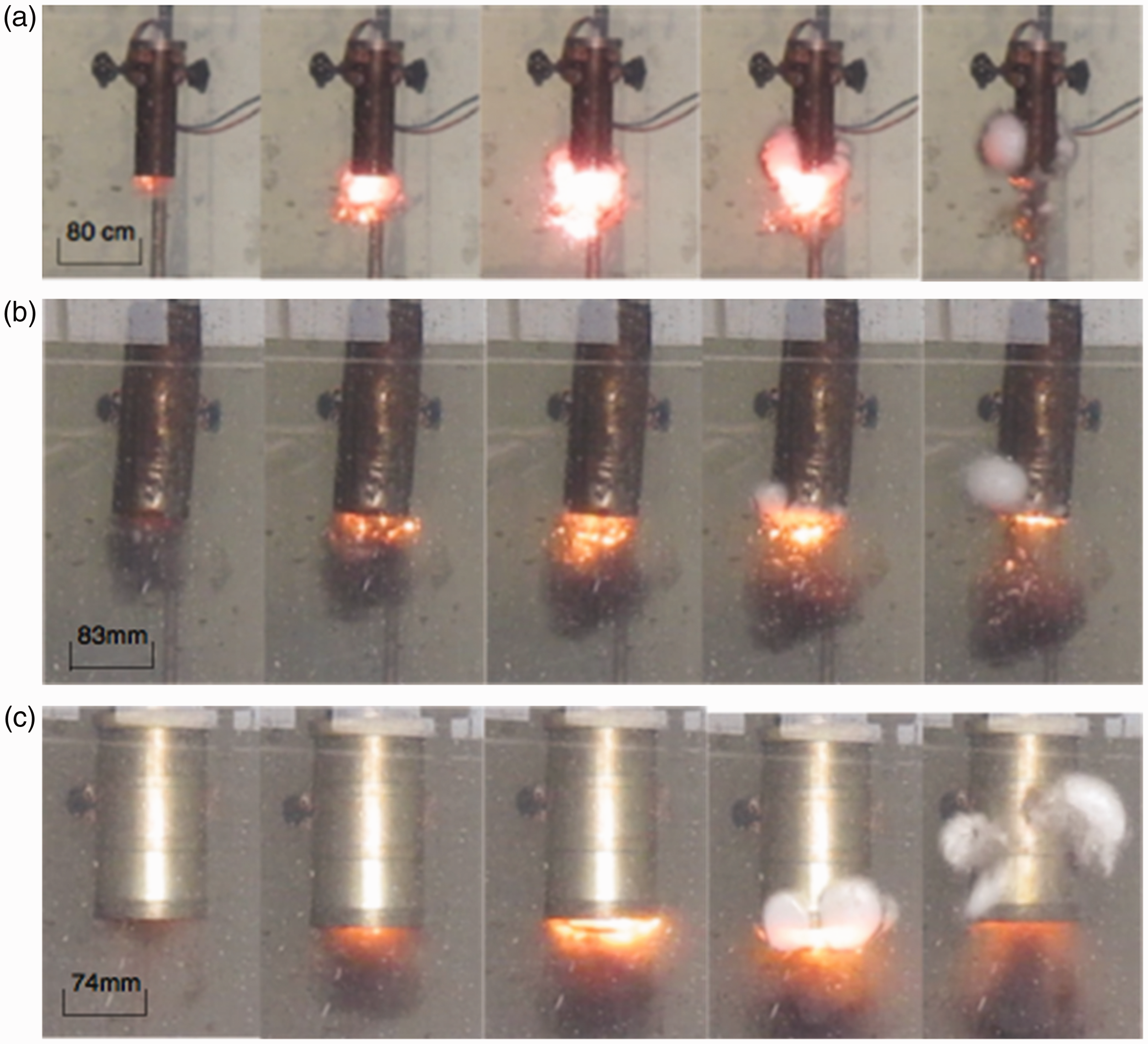
Bubble formation of different diameters of pipe casing: (a) pipe casing diameter of 37 mm (time interval of 33 ms), (b) pipe casing diameter of 78 mm (time interval of 66 ms), and (c) pipe casing diameter of 103 mm (time interval of 132 ms).
As shown in Figure 8, the frequency of peak SPL is 100, 40, and 40 Hz, for pipe casing diameter of 37, 78, and 103 mm, respectively. This means changing the diameter of pipe casing makes the frequency become lower. So it can be used to lower the frequency of underwater noise. However, the variation behavior of SPL with frequency is nearly the same whether the diameter of pipe casing changes or not. Besides, Table 3 shows that the peak of SPL is 173.7, 176.1, and 160.6 dB at the frequency of 100, 40, and 40 Hz, and the broadband (10–1000 Hz) SPL is 174.6, 176.5, and 160.6 dB, respectively, as the diameter of pipe casing changes. Thus, the peak of SPL and broadband SPL for the 78 mm pipe casing is the largest among three pipe casing diameters considered here.
Acoustic radiation characteristics of underwater pyrotechnic combustion with different diameters of pipe casing.

Figure 9 shows the time period of bubble formation is different from each other by the accumulation time of gas in the pipe casing, which is 165, 330, and 660 ms, respectively. The bubble diameter is 64, 75, and 67 mm, respectively, which means the bubble diameter increases first and then decreases as diameter of pipe casing increases. Because the bubbles are hardly covering the nozzle of pipe casing, such as diameter of 103 mm. The generating noise is closely connected with bubble diameter because the relatively large bubbles are more prone to breakup and coalescence.
Conclusions
An experimental setup was developed to study the effect of pipe casing structure on the acoustic radiation characteristics of underwater pyrotechnic combustion. The results show that the addition of the pipe casing shifts sound production to lower frequencies and the peak SPL increased by 15.9 dB from 155.5 to 171.4 dB at the frequency of 125 and 100 Hz, with the growth of 10.2%. And the bubble formation period of pipe casing structure is shorter than that of nozzle structure. Besides, an increase in nozzle diameter from 10 to 12.5 mm resulted in an increase of gas volume, so the peak of SPL and broadband SPL is higher. But when the nozzle diameter increases to 15 and 20 mm, the flow rate of gas and turbulence intensity decrease which is a factor of generating noise. The bubble formation period of vertical downward is shortest among three directions. It is effective to lower frequency by increasing the diameter of pipe casing, and the peak of SPL and broadband SPL of 78 mm is largest among three diameters of pipe casing.
This study can be considered as the first investigative step since it concerns a single application of the method to specific type of structures and to unique specimens and therefore its effectiveness has to be proved with further investigations.
Footnotes
Author’s note
The affiliation of Xian Chen now is China Aerospace Science & Industry Corp.
Declaration of conflicting interests
The author(s) declared no potential conflicts of interest with respect to the research, authorship, and/or publication of this article.
Funding
The author(s) received no financial support for the research, authorship, and/or publication of this article.