




Abstract
An axially moving printing web with variable density in a printing process causes a geometric nonlinear vibration, and a nonlinear vibration system is established using the von Karman nonlinear plate theory and the D’Alembert principle. The time and displacement variables are separated using the Galerkin method. The ordinary differential equation of a web is solved using the method of multiple scales. The amplitude–frequency response equation of a moving web is obtained. The time histories, phase–plane portraits, and amplitude–frequency curves of the system are obtained by numerical calculations. The influence of different dimensionless speeds and variable density coefficients on the nonlinear vibration characteristics of the printing web is analyzed. The results show that the overprinting accuracy can be ensured by making a reasonable choice of web speed in the stable region.
Introduction
In printing, each printout varies in its image distribution. As a result, the surface density of the printing web that corresponds to each printout is different. In addition, the ink and fountain solution used during the printing process will affect the density of the web, and the vibration characteristics of a rapidly moving web will change. In this manner, the web is prone to wrinkling, tearing, and surface scratches. As a result, the overprinting precision and printing quality will decrease. 1 Therefore, to establish an efficient and stable form of vibration control for a web during printing, it is of vital importance to investigate the nonlinear vibration characteristics of a web with varying density.
Many researchers have published articles on nonlinear vibration characteristics and stability of an axially moving system. Chen et al.2,3 analyzed a system of strings in axial motion. Kesimli et al. 4 analyzed the characteristics of nonlinear vibration produced by an axially moving string with multiple supports. Additional investigations were performed on variable speed using the multi-time scaled method. Ghayesh and Amabili5,6 examined the nonlinear vibration of an axially moving beam with an intermediate spring support and a time-dependent axial speed. Tang et al. 7 investigated the steady-state and oscillating responses and the stability and bifurcation of a beam using the method of multiple scales. Liu et al. 8 developed an optimal delayed feedback control method to mitigate the primary and superharmonic resonances of a flexible simply supported beam using piezoelectric sensors and actuators. Nonlinear vibration control of electrostatically actuated nanobeams with nanocapacitive sensors was studied, and the primary and superharmonic resonances were considered by Gong et al. 9 Iman et al. 10 presented his findings with regard to free vibrations and rotational dynamics of rotating annular circular thin plates, and the research used the von Karman nonlinear plate theory as a basis. Yuan et al. 11 studied precise solutions with regard to non-axisymmetric vibrations of radially inhomogeneous circular Mindlin plates with variable thickness. The method of multiple scales was used by Tang et al. 12 to study the dynamic stability of accelerated plates with longitudinally varying tensions. The translating speed, aspect ratio, and boundary conditions had significant effects on the free in-plane vibration, and the out-of-plane vibration of a moving membrane was investigated by Shin et al.13,14 Banichuk et al. 15 studied the dynamics and stability of a moving web subjected to tension that was not homogeneous. The results showed that tension inhomogeneities can reduce the critical velocity, and even a slight inhomogeneity in the tension may largely affect the divergence forms. Marynowski16,17 applied the Galerkin method and fourth-order Runge–Kutta method to analyze the nonlinear vibration and stability of an axial paper web. Kulachenko et al. 18 studied the dynamic behavior of a paper web by considering transport velocity and the surrounding air by a finite element procedure. Lin and Mote 19 investigated the vibration produced by an axial web with a small bending stiffness subjected to transverse loading based on membrane theory and linear plate theory. Soares and Gonçalves 20 examined the nonlinear vibration of a pre-stretched hyper-elastic annular web under finite deformations by the shooting method and the finite element method. Gajbhiye et al. 21 studied a large deflection vibration of a rectangular, flat thin membrane using the finite element method. Li et al. 22 presented findings on the stochastic dynamic response and reliability of a web structure subjected to impact load by using the perturbation method and the moment method.
Of the studies reported in the literature, only a few have studied the nonlinear vibration characteristics of a moving printing web with varying density. Recently, there have been many publications dealing with linear vibration of a membrane with variable density. Subrahmanyam and Sujith 23 investigated the vibration of an annular membrane with continuously changing density. Jabareen and Eisenberger 24 applied the dynamic stiffness method to analyze the transverse vibration of a non-homogeneous membrane with variable density. Willatzen 25 established a general quasi-analytical model based on the Frobenius power series expansion method to analyze the vibrations of solid circular and annular membranes with continuously varying density. Buchanan 26 analyzed the stability of a circular membrane with linearly varying density in the radial direction. Ma et al. 27 employed a sub-optimal control method to control the linear vibration of a moving web with variable density.
In addition, many studies have developed advanced methods of nonlinear equations, such as the homotopy perturbation method. El-Dib 28 developed the multiple scales homotopy perturbation method, and the method could solve various nonlinear oscillators effectively. He29–31 investigated some advanced asymptotic techniques to solve nonlinear equations, such as the variational iteration method and the homotopy perturbation method. The asymptotic techniques were valid not only for weakly nonlinear equations but also for strongly nonlinear equations. Li and He 32 investigated the enhanced perturbation method, and the results showed that very high accuracy of the solution was obtained by the higher-order homotopy perturbation method, and the obtained frequency was valid for the whole solution domain. Yu et al. 33 applied the homotopy perturbation method to solve the homotopy equation with one or more auxiliary parameters; this method can be extended to other nonlinear problems. Wang and An 34 used fractional oscillators to describe noise in nonlinear vibration systems, and they discussed that fractional nonlinear oscillators can also be solved by the homotopy perturbation method.
In the following research, nonlinear vibration and stability of a moving printing web with variable density based on von Karman nonlinear plate theory are investigated. The method of multiple scales is adopted to solve the differential equations, and the effects of the density coefficient and moving speed on the nonlinear vibration of a web with variable density are analyzed.
Nonlinear vibration model of a moving printing web
Figure 1 shows the principle model of a moving paper web. The web is soft and has no bending stiffness. The web moves in the x direction with a speed of v; the width direction of the web is in the y direction; and the transverse vibration direction is in the z direction. Supposing
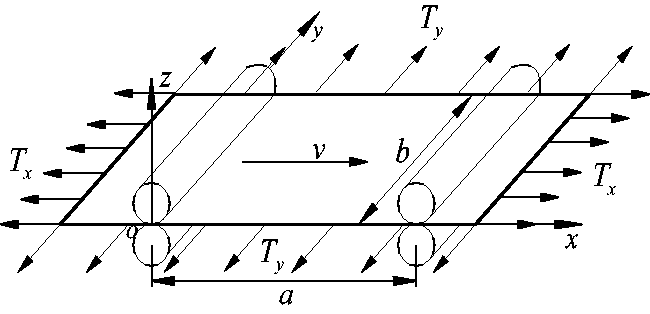
The mechanical model of an axially moving paper web.
Figure 2 shows the law of a moving paper web with varying density, where
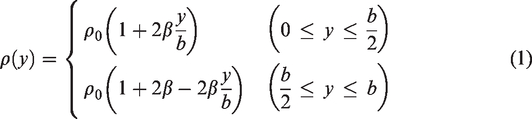
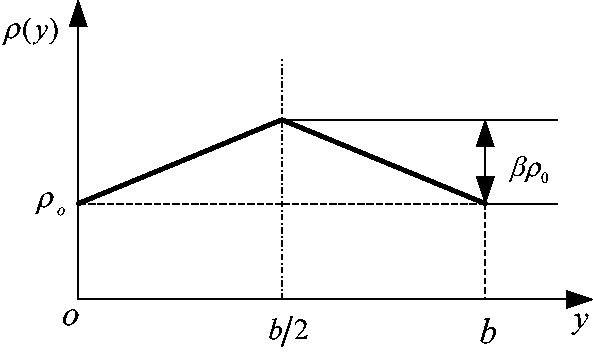
Moving paper web with varying density in the lateral direction.
Another form of ρ (y) is

According to von Karman nonlinear plate theory,
35
nonlinear vibration equations can be stated as follows, and nonlinear oscillation equations can also be obtained by the variational principle36–38
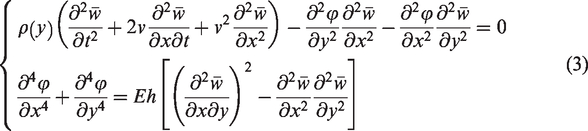
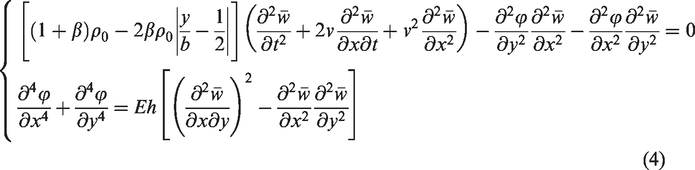
Substituting equation (2) into equation (3), the differential equations of the nonlinear vibration of a moving paper web with varying density are obtained
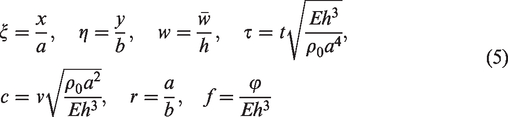
The dimensionless quantities are defined as
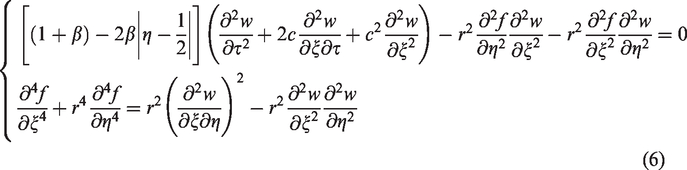
The dimensionless form of equation (4) is
The boundary conditions of a moving web can be given as


Separation of variables by the Galerkin method
When considering partial differential equations of a nonlinear system, the Galerkin method can be used to separate the time variable and displacement variables. Respectively, they are as follows


The displacement function that satisfies the boundary conditions is defined as

Substituting equation (11) into equation (4) yields

The solution of equation (12) is

Substituting equations (9) to (13) into equation (6) by adopting the Galerkin method, we obtain

The state equation of the nonlinear vibration of a printing web with varying density is obtained





Equation (15) can be written as

The method of multiple scales analysis
The method of multiple scales3,28 is used to solve the ordinary differential equation of the nonlinear free vibration of a printing web with variable density.
Equation (17) can be written as

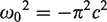

Suppose that

Supposing the solution of equation (20) is

Substituting equation (21) into equation (20) yields

The same power coefficients of


The solution of equation (23a) is written in the plural form
28


To eliminate the secular terms, the function A should satisfy

The solution of equation (25) can be expressed as

The derivative of the amplitude A with respect to t is expressed as


The amplitude function A can be written in exponential form

Substituting equation (30) into equation (29) yields

Then first-order ordinary differential equations of


Equations (32a) and (32b) are integrated to obtain


The integral constants a0 and θ0 in equation (33) depend on the initial conditions, and then substituting equation (33) into equation (30), we have

Substituting equation (34) into equations (24) and (27) yields



An approximate solution of the nonlinear differential equation of a printing moving web is obtained by substituting equations (35) and (36) into equation (21)

Therefore, the frequency formulation is

Comparing the equation (39) to the variational iteration method given by He 29 and using the same method to calculate equation (18), the frequency formulation is the same as equation (39), and the results are given in Appendix 1. The results show that the present method in this paper gives exactly the same results as the method of He. 29
In addition, the method of multiple scales gives exactly the same results as the Lindstedt–Poincare method in Chen and Cheung. 39
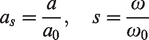
The amplitude–frequency response equation of the system can be expressed as

Analysis of results
The nonlinear free vibration characteristics of the printing web are calculated and analyzed. The basic parameters of the paper web are those commonly used in printing.
Amplitude–frequency characteristics
Nonlinear free vibration amplitude–frequency curves of the axially moving printing web with variable density are shown in Figure 3, when a0 = 1, θ0 = 0, r = 0.5, c = 0.8, and the density coefficients are 0.3, 0.6, and 0.9. Figure 3 shows that when the frequency
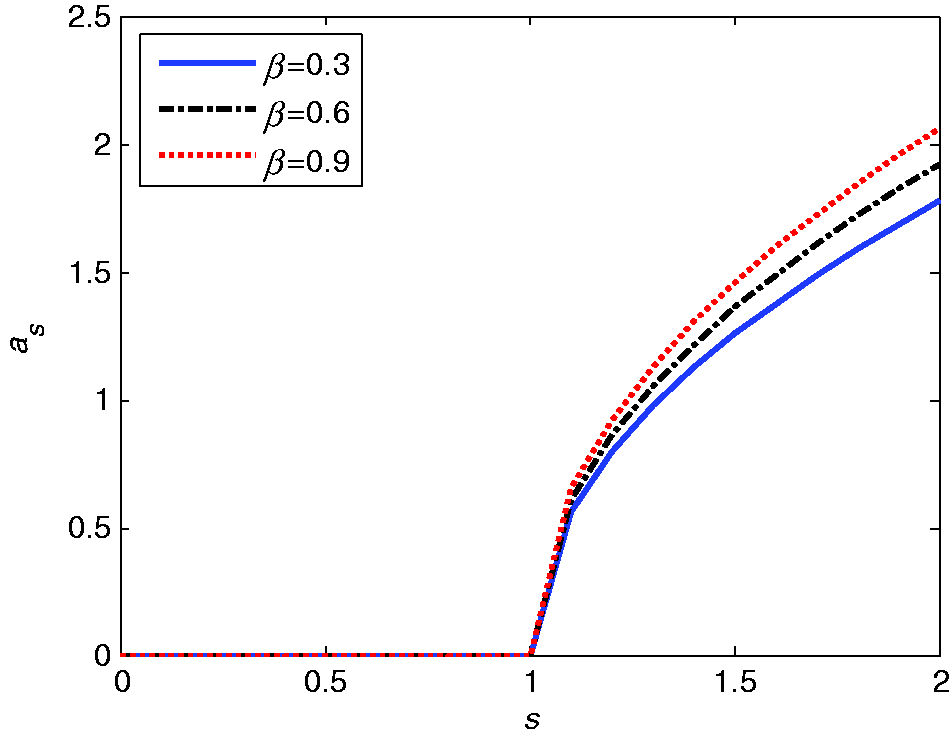
The amplitude–frequency curves of the system for different density coefficients.
Figure 4 shows the nonlinear free vibration amplitude–frequency curves of the axially moving printing web with variable density when a0 = 1, θ0 = 0, r = 1,
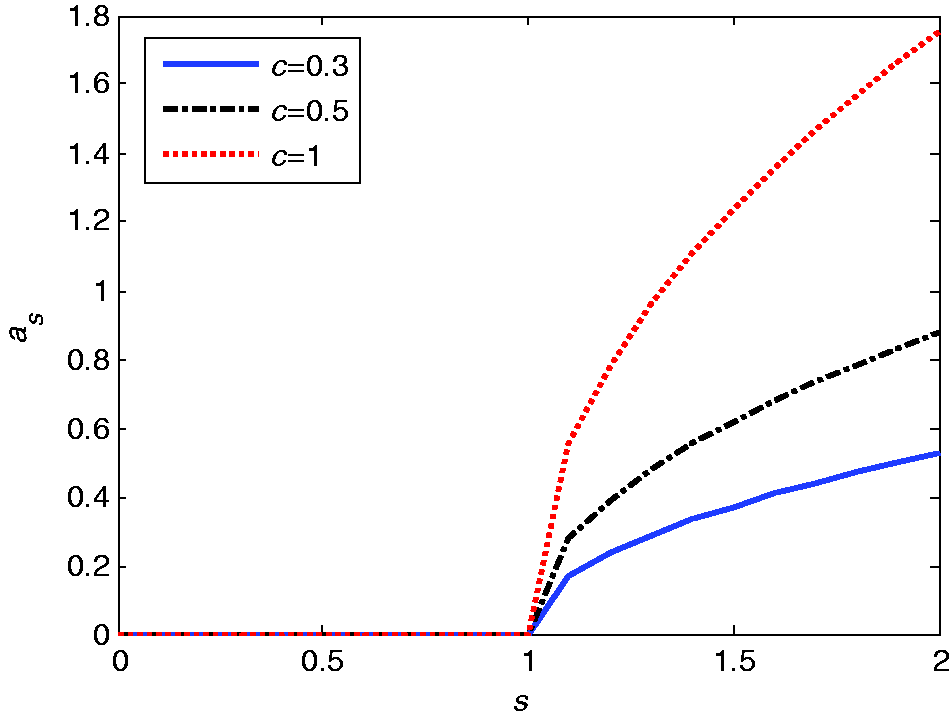
The amplitude–frequency curves of the system for different speeds.
Time histories and phase–plane portraits
Figure 5 shows the time histories and phase–plane portraits of the axially moving printing web with variable density when a0 = 1, θ0 = 0, c = 0.5, β = 0.6, and the aspect ratio is 0.5, 1.3, and 1.5. It can be seen from Figure 5 that when the dimensionless speed c remains constant and the aspect ratio r gradually increases, the system moves from single periodic motion into multiple periodic motion.
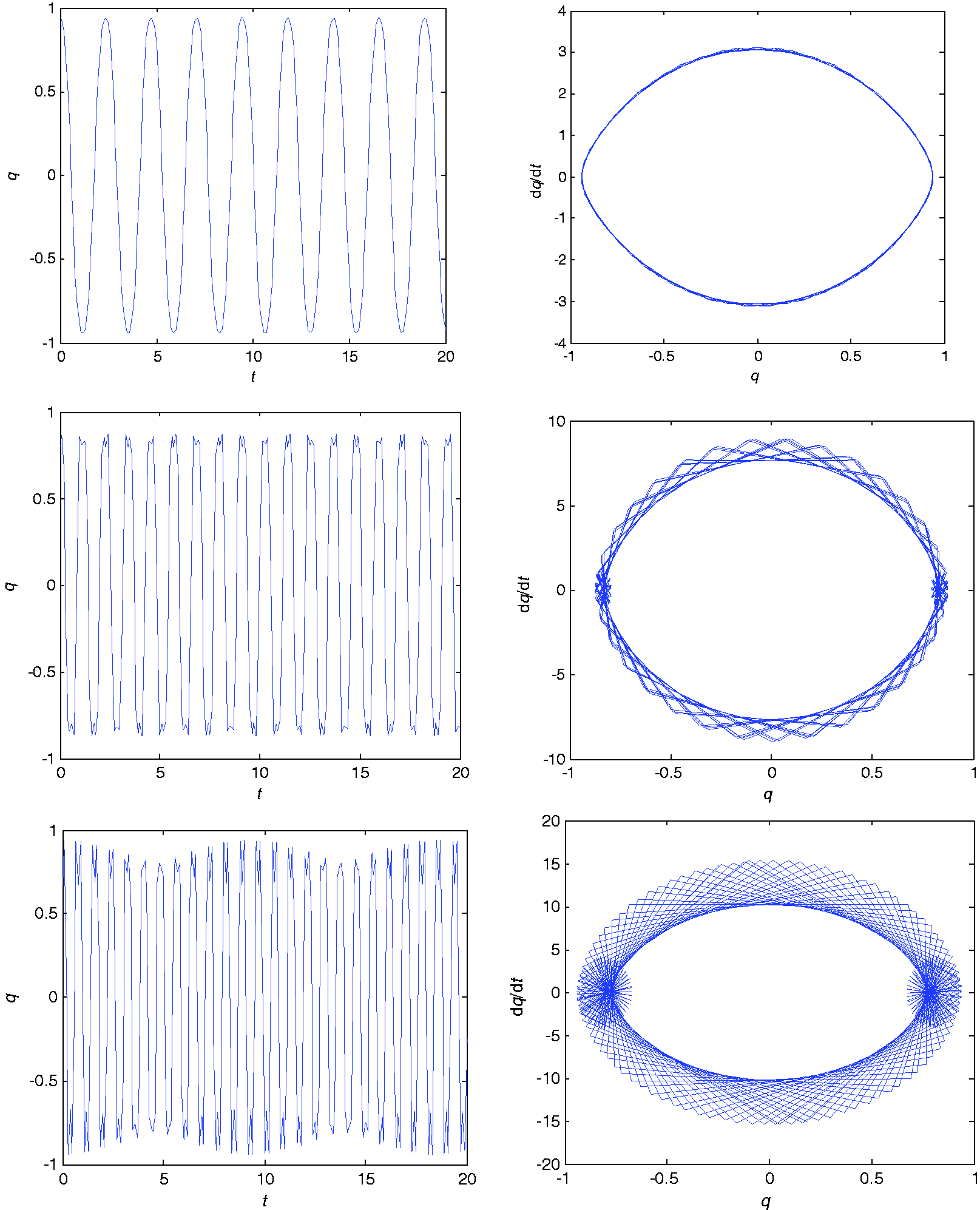
The time histories and phase–plane portraits for different aspect ratios: c = 0.5, r = 0.5; c = 0.5, r = 1.3; c = 0.5, r = 1.5.
Figure 6 shows the time histories and phase–plane portraits of the axially moving printing web with variable density when a0 = 1, θ0 = 0, r = 0.3, β = 0.6, and the dimensionless speed is 0.5, 1.5, and 2.5. It can be seen from Figure 6 that when the aspect ratio r remains constant and the dimensionless speed c increases, the system gradually moves from single periodic motion to multiple periodic motion.
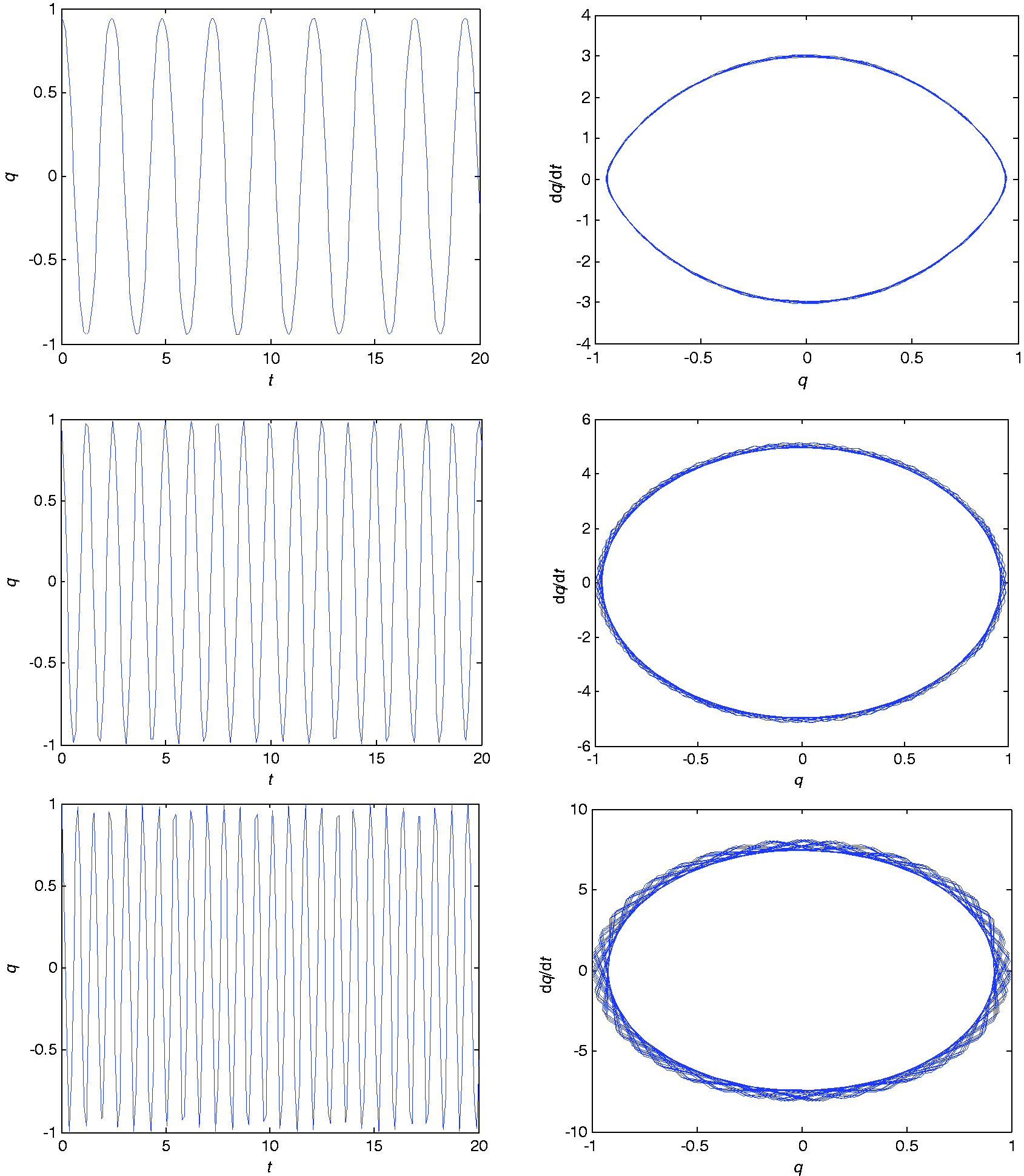
The time histories and phase–plane portraits for different dimensionless speeds: r = 0.3, c = 0.5; r = 0.3, c = 1.5; r = 0.3, c = 2.5).
Conclusions
In this paper, the nonlinear vibration characteristics and stability of a moving printing web with variable density are studied by applying the method of multiple scales. The conclusions are as follows:
The system becomes more and more stable with decreasing density coefficient and dimensionless speed. When the dimensionless speed c remains constant and the aspect ratio r gradually increases, the system moves from single periodic motion into multiple periodic motion. When the aspect ratio r remains constant and the dimensionless speed c increases, the system gradually moves from single periodic motion into multiple periodic motion.
According to the above analysis, it can be concluded that to reduce the influence of transverse vibration on the overprint accuracy and quality of a printing web, we can make a reasonable choice of web speed in the stable region.
Footnotes
Declaration of conflicting interests
The author(s) declared no potential conflicts of interest with respect to the research, authorship, and/or publication of this article.
Funding
The author(s) received financial support from National Natural Science Foundation of China (No. 11272253), the Natural Science Foundation of Shaanxi Province (No. 2018JM5023, No. 2018JM1028, and No. 2018JM5119), and the PhD Innovation fund projects of Xi’an University of Technology (No. 310–252071702) for the research, authorship, and/or publication of this article.