




Abstract
In this study, He’s frequency–amplitude formulation is modified for the fast estimation of the frequency–amplitude relationship of a nonlinear singular oscillator. The simple approaches give good approximate solutions with short calculation.
Introduction
It is necessary to get a simple and effective approach to nonlinear singular oscillators on their amplitude–period relationship in engineering1–5 because the amplitude–period relationship is one of the most important properties of a nonlinear oscillator. There are some useful amplitude–period formulae, e.g. He’s amplitude–frequency formula,6–11 García’ amplitude–frequency formula, 12 and Suárez-Antola’s amplitude–frequency formula. 13 Tian and Liu 14 gave a system review on various amplitude–frequency formulae. In this paper, we will also apply two modifications of He’s 15 amplitude–frequency formula to a singular oscillator.
Consider a nonlinear oscillator in the form

with initial conditions

We will treat the problem formed by equations (1) and (2) when
Modification of He’s frequency–amplitude formula-I
Consider an oscillator where the force is inversely proportional to the dependent variable16,17

Rewrite the first equation in system (3) as

Choose two trial solutions in the form
18


The residuals for two trial solutions are, respectively


with constants

For simplicity, we set


By He’s frequency–amplitude formulation,18–20 we have
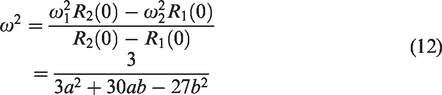
To obtain an additional equation, we set

with

That is
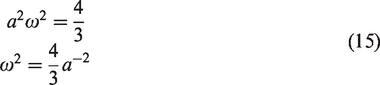
Solving equations (9), (12), and (15) simultaneously, we are able to determine
If we assume the solution can be expressed in a more general form18, 21 with constants

With the same idea as above, we will arrive at any accuracy of the frequency of a nonlinear oscillator.
Modification of He’s frequency–amplitude formula-II
Filobello-Nino et al. 22 proposed the basic idea for improving the order of the original equation in their enhanced perturbation method, and this idea was extended to the homotopy perturbation method. 23 We will extend the idea to He’s frequency–amplitude formula.
Reconsider the problem (3) by improving the order of the equation.
Get equation (4) in this form

Differentiating the equation twice with respect to time, we obtain the following equations
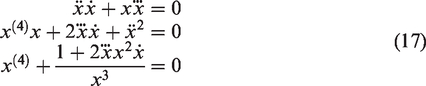
Denote

Suppose the approximate solution of problem (3) be the form

Then, inserting equation (19) into equation (17) leads to the residual
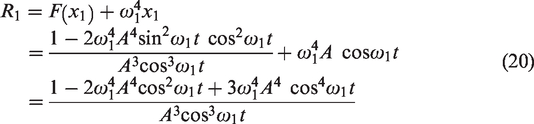
Let

with

Specially, assume the location point be


Get along with the modified frequency–amplitude formulation18–20

Taking equations (23) and (24) into equation (25), it is not difficult to get

This is the same as equation (5.19) in He. 15
If the location point happened to be


From equations (25), (27), and (28), it is easy to have

This result is between equation (5.19) and equation (5.37) in He. 15
There exists flexibility in the location points. When necessary, different frequency–amplitude relationship results, such as equations (26) and (29) can be utilized to get an average one. Furthermore, combined with equation (19) or (21) we get the acceptable period solution.

Conclusions
Fast estimation is necessary in engineering. This is especially useful before starting a new project. Sometimes, the simpler the better. Two modifications of He’s frequency–amplitude formula are used here to treat a nonlinear singular oscillator with good solutions. Moreover, more use of estimation23,24 is available today. We are convinced that the method used here have wider range of application.
Footnotes
Declaration of conflicting interests
The author(s) declared no potential conflicts of interest with respect to the research, authorship, and/or publication of this article.
Funding
The author(s) received no financial support for the research, authorship, and/or publication of this article.