




Abstract
In this paper, we apply the global error minimization method to nonlinear oscillators with fractional terms for determining the first- and second-order approximate frequencies and solutions. The estimation problem is transformed into a minimization problem which leads to a simple yet precise scheme for finding the frequency of oscillation and the solution of the ordinary differential equation.
Keywords
Introduction
Nonlinear differential equations are fundamental in physics, applied mathematics and engineering. The last two decades have seen a surge of interest in analytical tools for studying such equations to provide a more accurate solution. In particular, the nonlinear oscillator has received considerable attention where the aim is to jointly approximate the frequency of oscillation and the solution of a nonlinear equation.
There are plenty of analytical techniques that could be used to acquire the approximate solution of a nonlinear system, for example, the parameter-expansion method, 1 the harmonic balance method,2–5 the energy balance method,2,3 the Hamiltonian approach,6,7 the use of special functions,8,9 the amplitude–frequency formulation, 10 the max–min approach,11,12 the variational iteration method13–17 and homotopy perturbation.18–24 We refer the reader to He’s survey 25 for a discussion of these methods. In literature,26–28 a modification of the homotopy perturbation method has been discussed.
Differential equations with boundary or initial conditions and variational principles are two fundamental ways to describe a physical problem.29–34 The differential model involves strong local differentiability (smoothness) of the physical field, while variational principles involve weaker local smoothness or only local integrability. Among the analytical methods, variational methods have two benefits. First, they yield a physically meaningful interpretation of the solution and second, the possible trial functions are optimal. Some approximate variational methods, including approximate energy method35–37 and variational iteration method 15 have received considerable attention. A modified variational approach called the global error minimization (GEM) method has been developed in Farzaneh and Akbarzadeh Tootoonchi 38 which modifies He’s variational method using the least squares method. To demonstrate the method, the author developed the first-, third- and fourth-order approximate solution and frequencies of the Duffing oscillator.
In this paper, the GEM method is applied to oscillators with fractional terms with the use of Fourier series and linearization. In the proposed method, the nonlinear differential equation is converted to an equivalent minimization problem. A simple sine or cosine term is chosen as the trial solution in the first step of the GEM method. The unknown parameters are identified via the minimizing the global error using the least squares criterion. Next, more sine or cosine terms are added to increase the desired accuracy of the approximated solution. We demonstrate that by using only a few terms a solution with high accuracy is obtained.
The rest of this article is ordered as follows. In Section ‘The basic idea of GEM method’, the key idea with the essential definitions and theorems is discussed. The applicability and efficiency of our method are discussed in Section ‘Numerical experiment’ by solving a nonlinear differential equation with a fractional nonlinear term. In Section ‘Results and discussions’, the conclusions regarding the overall study are discussed.
The basic idea of GEM method
Let the general form of the nonlinear oscillator can be expressed by

Such that


Minimize

Numerical experiment
This section elucidates the application of GEM method in the following two examples.
Example 1:
Consider the following nonlinear oscillator


In order to begin the solution procedure using GEM method, let the first-order approximate solution can be expressed by

The minimization problem corresponding to equation (5) with initial condition (6) is given by
Minimize

Present work of applying GEM method is concerned with the application of Fourier series to nonlinear term in equation (5).
Rewrite the minimization problem (8) in the following form
Minimize


In order to get approximate first-order frequency and solution of equations (5) and (6), the Fourier series is truncated at
Truncate the Fourier series and minimization problem (9) can be expressed by
Minimize

By using equation (9), the coefficients


Substituting the coefficients
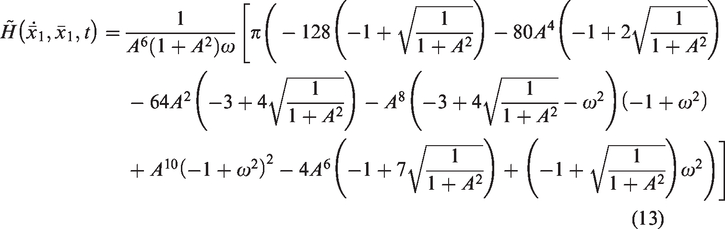
By imposing the optimal condition
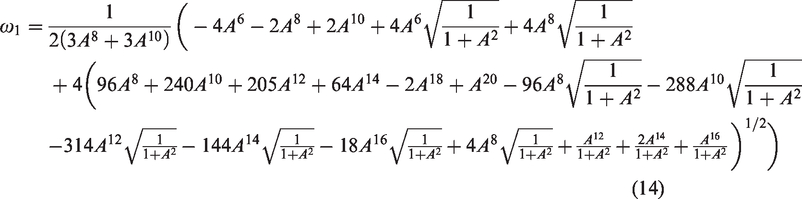
To get second-order approximations of frequency and solution using GEM method, consider the following trivial solution

For the satisfaction of constraint in the minimization problem (10) substitute

Thus, the following form of a trivial solution can be achieved

By truncating the Fourier series for

where



By using linearization of the term
Imposing the optimality conditions
The exact amplitude of the problem (5) and (6) is given by
1

Let


Consider the following equation which can be obtained by using equation (5) with the same initial conditions as in (6)

The relative error in approximate frequencies using first- and second-order GEM method is given by


The relative error using the standard GEM method for second-order approximate frequency is more accurate than the modified GEM method or variational approach using the least square. Comparisons are shown in Table 1.
Percentage relative errors in first- and second-order GEM frequencies and values of the parameter ‘
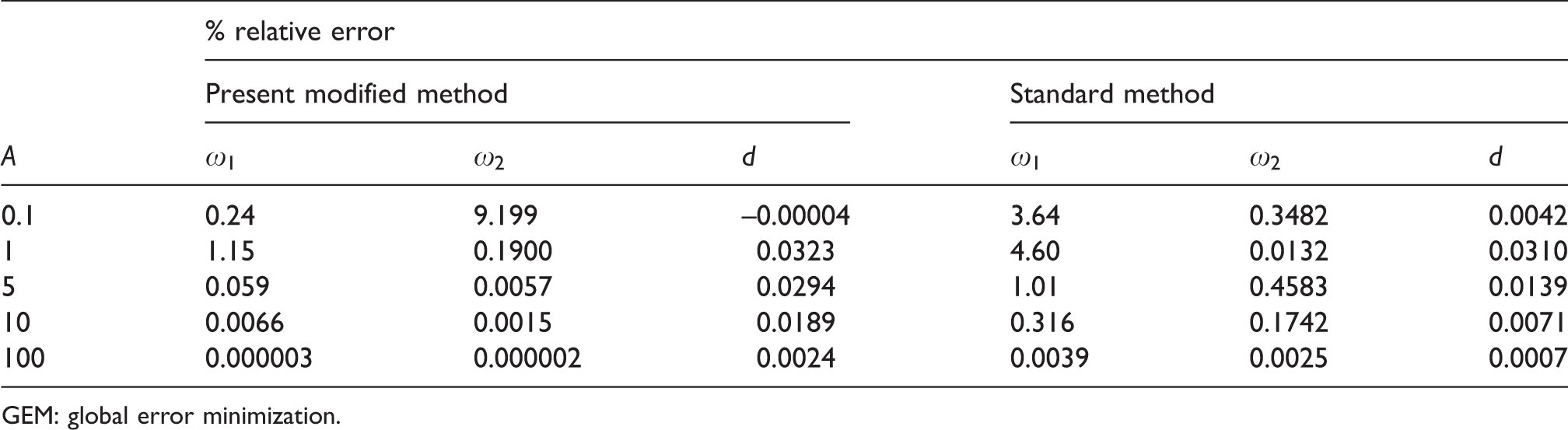
GEM: global error minimization.
Example 2:
Consider the following oscillator,

With the following initial conditions

In order to apply GEM method or variational approach using the least square, construct the following minimization problem corresponding to equations (22) and (23),

Assume that the following first-order approximate solution

The minimization problem corresponds to equations (22) and (23) can be constructed as;
Since the present work is dealt with the modified form of GEM method, so the rational term in minimization problem (24) can be expressed by the Fourier series and the new minimization problem corresponding to equations (22) and (23) is given by

For 
In this example, only the first term of the Fourier series is used for finding the first-order approximate solution and frequency of equation (22) with initial condition (23).
Since the first-order trial solution already satisfies the constraint in minimization problem (26), so the following minimization problem can be constructed;
Minimize

By evaluating the integral, the following equation can be obtained

By applying the optimality condition 
In order to get second-order approximate frequency using modified GEM method, assume the following trial solution of equation (22) with initial conditions (23)

The solution procedure for second-order will be preceded by considering the first two terms of the Fourier series in the minimization problem (26). To get the first two components of the Fourier series, linearize the rational term in equation (22) in the following manner.
Let
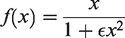
Then using Taylor series with first two terms gives

where
The following minimization problem can be constructed by using first-two components of the Fourier series

The coefficients 
and
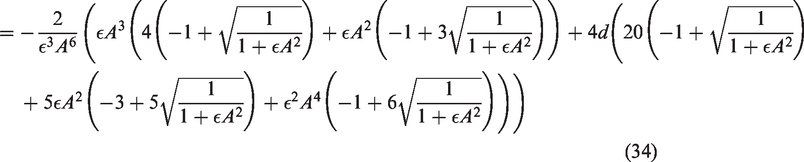
Now minimization problem (32) can be expressed by

By applying the optimality conditions
The problem in Example 2 can be solved by GEM method in a different way if the equation (22) can be written as

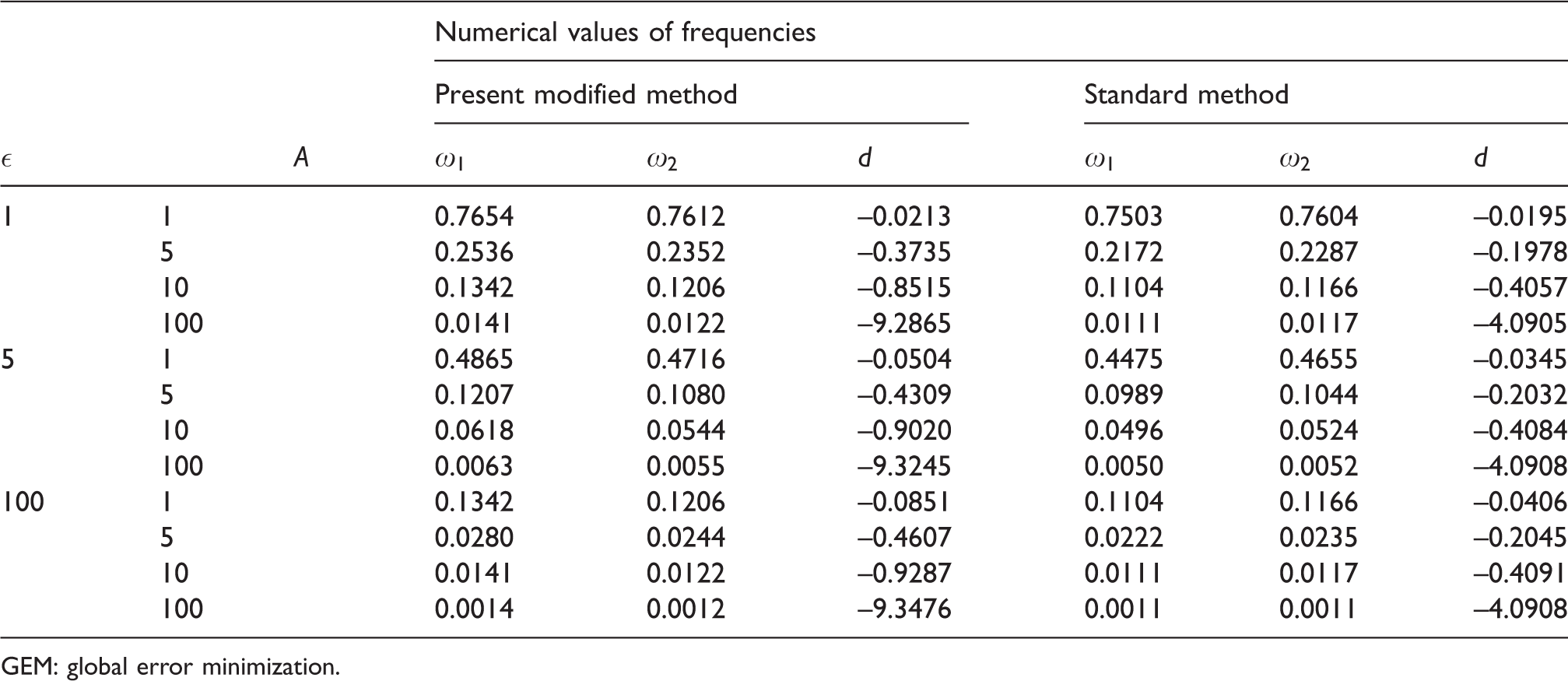
The minimization problem of the above equation can be constructed and its first- and second-order approximate frequencies can be found and some of the approximate frequencies are given in Table 2 with fixed values of the
Percentage relative errors in first- and second-order GEM frequencies and values of the parameter ‘
GEM: global error minimization.
Results and discussions
Tables 1 and 2 show the percentage of relative errors in first- and second-order GEM frequencies in Examples 1 and 2, which shows that the percentage relative error in first-order GEM frequencies has dual behavior with the increase of the amplitude. But after one increase it decreases when the amplitude is enhanced. The percentage relative error in second-order approximate frequencies decreases with the increase in amplitude. Table 2 shows that first-order GEM frequencies also decreases with the increasing values of the amplitudes at fixed values of the parameter ‘
Figures 1 and 2 show the comparison of first- and second-order GEM solutions with the numerical solution obtained from the Matlab solver ‘ode45’ for different amplitudes of Example 1. In these figures, it can be concluded that the first-order GEM solution is improved by increasing the value of the amplitude. So the error of the first-order GEM solution can be reduced by choosing the larger value of the amplitude but second-order is more accurate for small and large amplitudes. Figures 3 and 4 show the phase portraits of first- and second-order GEM solutions and numerical solutions. These figures can be used to observe the difference between the phase plots of numerical solutions and GEM solutions. The phase portraits show that whether the limit cycle is present for particular chosen values of the amplitudes. So limit cycles are present for the mentioned values of the amplitudes. Similarly, phase portraits can be drawn for different finite values of the amplitudes and comparison of the GEM first-order and second-order solutions with the numerical solutions can be seen for those values of the amplitudes.
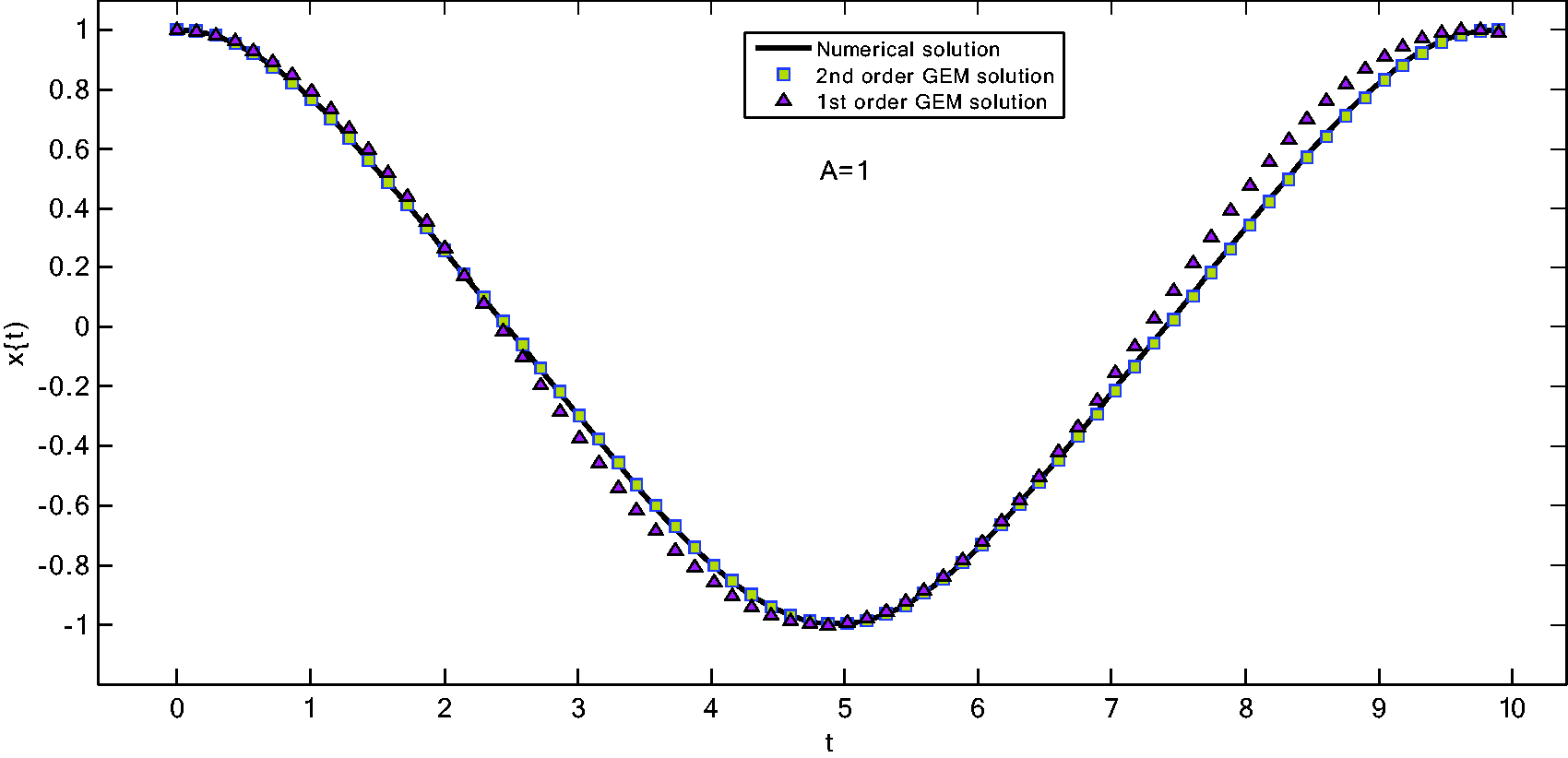
Comparison of the numerical solution with first- and second-order GEM solutions of Example 1.
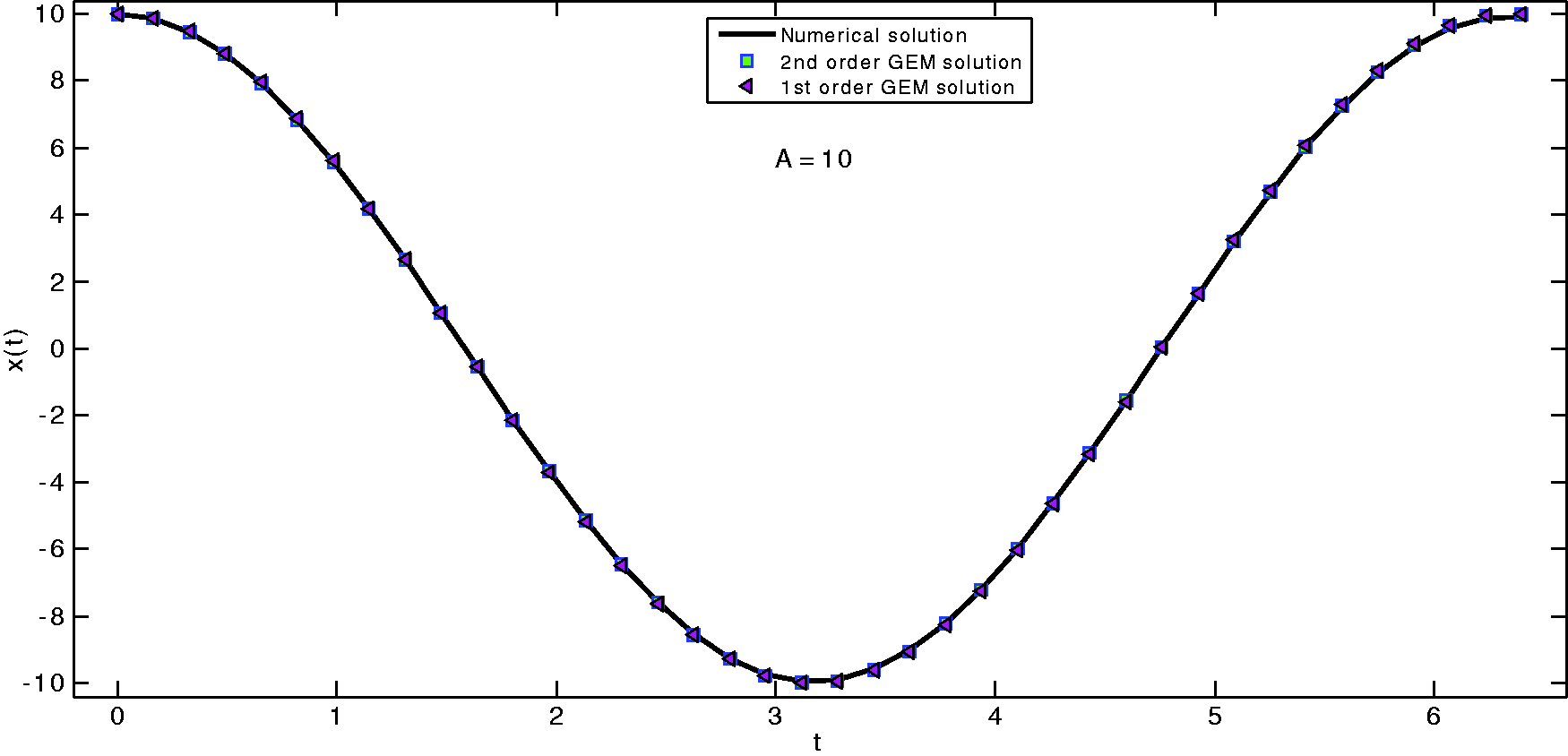
Comparison of the numerical solution with first- and second-order GEM solutions of Example 1.
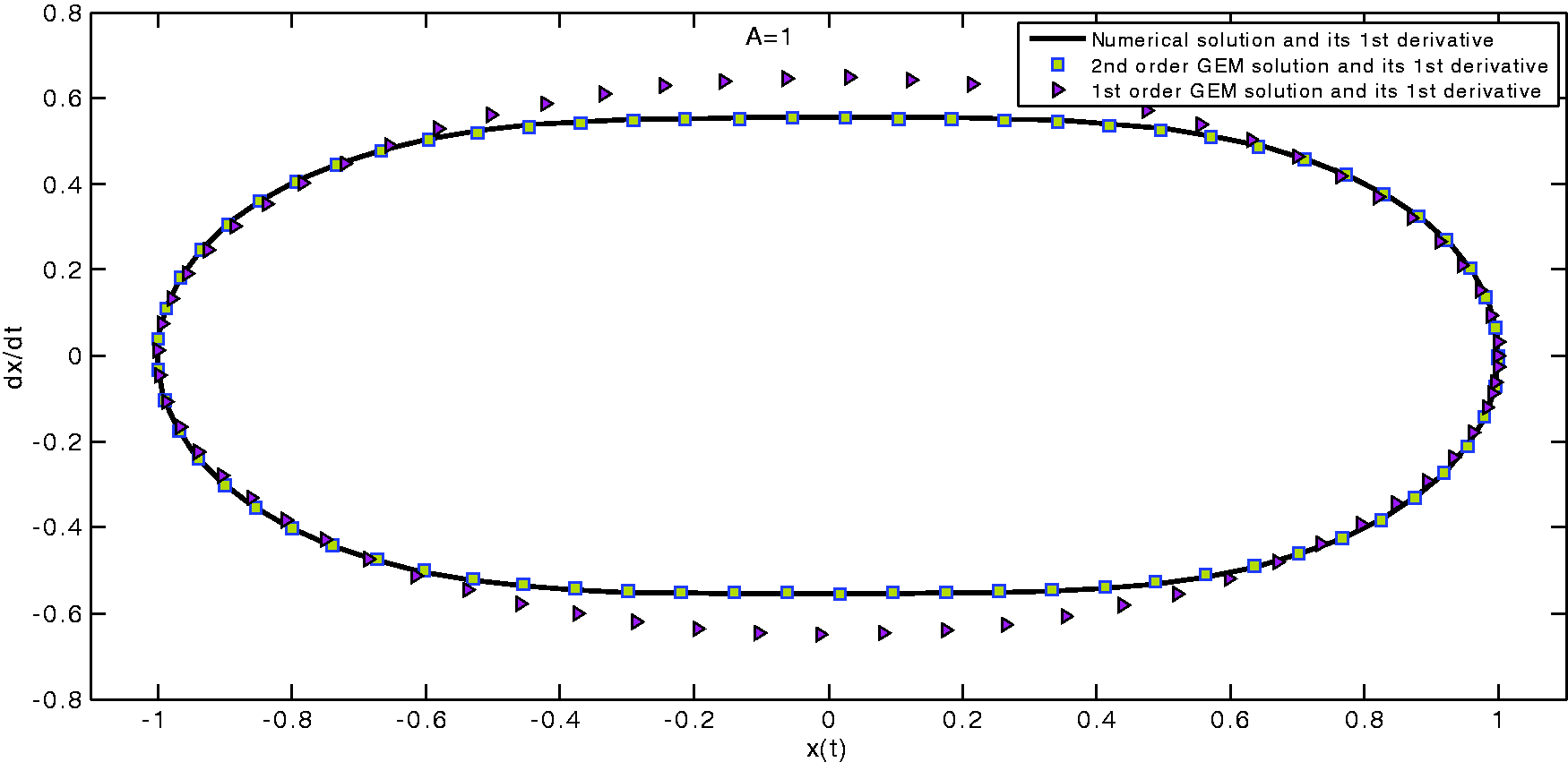
Comparison of the phase portraits from numerical solution with phase portraits obtained from first- and second-order GEM solutions of Example 1.
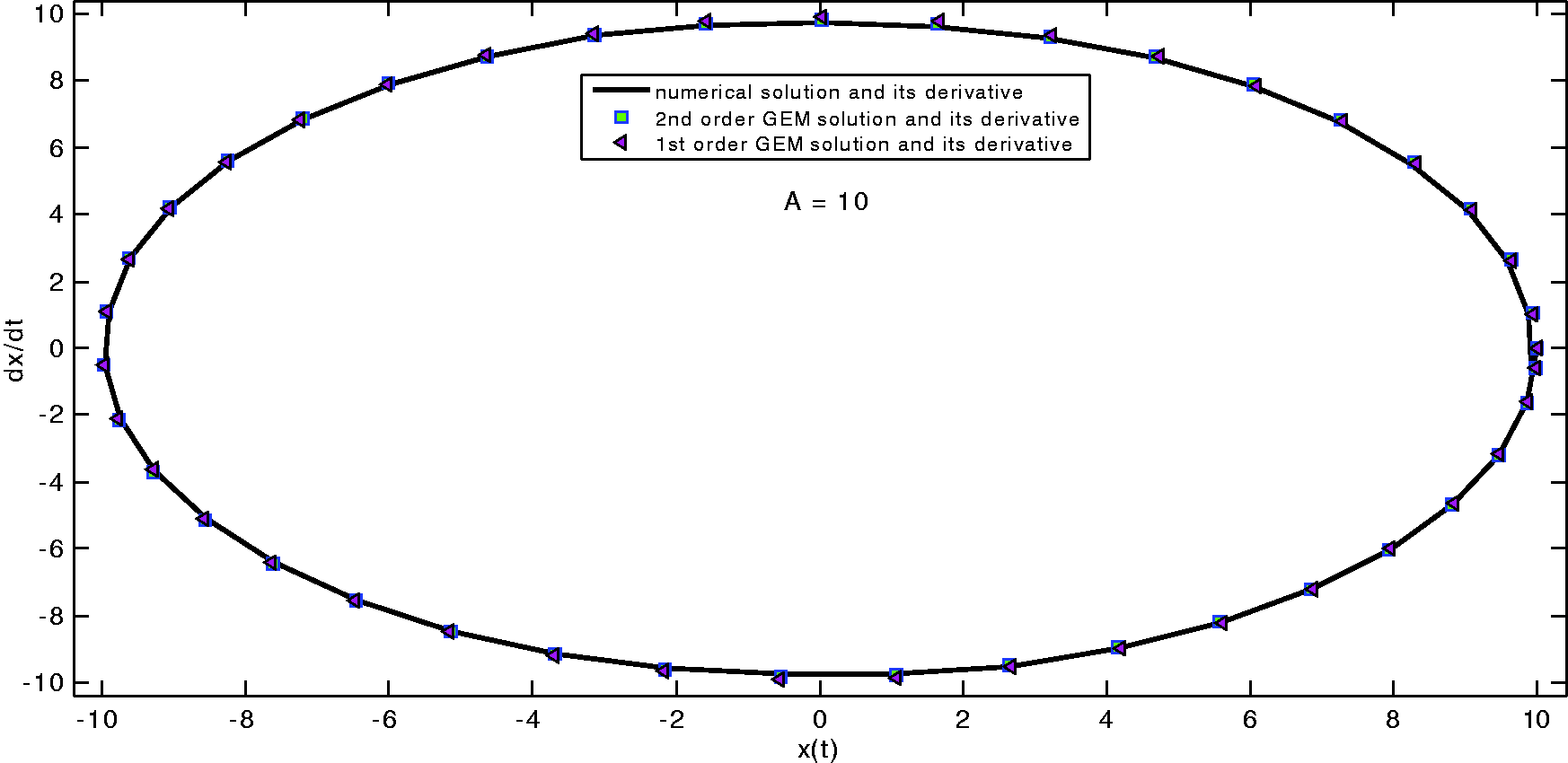
Comparison of the phase portraits from numerical solution with phase portraits obtained from first- and second-order GEM solutions of Example 1.
Figures 5 and 6 show the comparison of numerical solutions and comparison of phase portraits obtained from Matlab solver ‘ode45’ with GEM first and second-order solutions and phase portraits for the mentioned values of the amplitudes of Example 2.
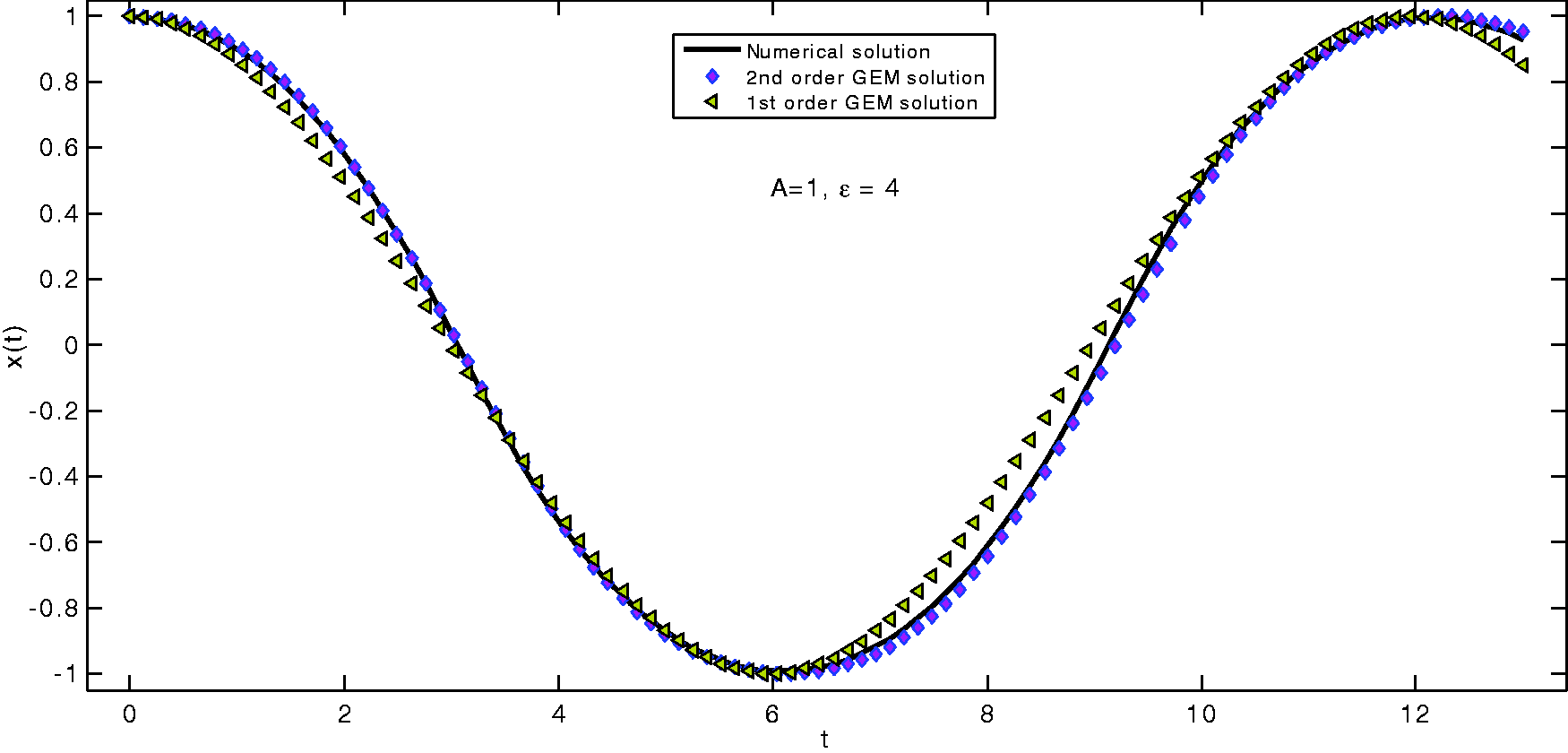
Comparison of the numerical solution with first- and second-order GEM solutions of Example 2.
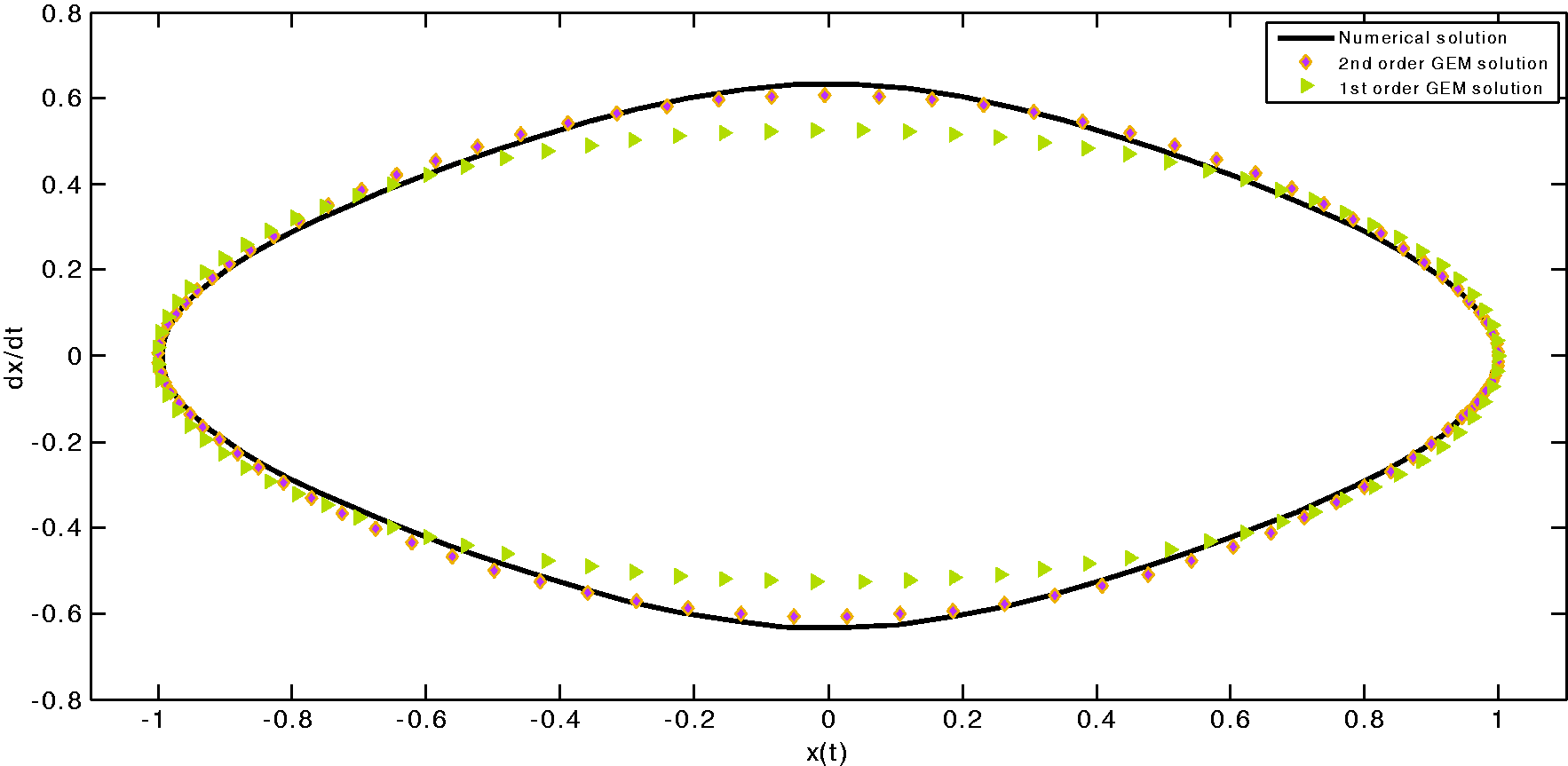
Comparison of the phase portraits from numerical solution with phase portraits obtained from first- and second-order GEM solutions of Example 2.
It can also be noted from the solution procedures of both solved problems above that linearization of the nonlinear term is performed instead of adopting the whole nonlinear term to carry out the integration which is performed during the procedures of determining the coefficients of Fourier series. So, the first step of the present solution procedure is to approximate any rational, fractional and discontinuous term of the oscillator to Fourier series and coefficients of the Fourier series are found by performing the integration for the same rationale, fractional and discontinuous term and linearized form of the rational, fractional and discontinuous term which is evaluated at the trial solution chosen, i.e. if the first-order solution is needed to find then no need to linearize the rational term and in order to get second order or high order of the solutions then linearization of the rational term will be performed and linearized form of the rational term can be used to carry out the integration which would be needed for determining the coefficients of the Fourier series.
Conclusion
The GEM method is extended using Fourier series for oscillators with fractional terms. In our proposed extension of the GEM method, Fourier series has been adopted to approximate the fractional term. Also, in order to get the second-order approximate frequencies and approximate solutions, linearization of the fractional term in the variational principle is performed. The linearization leads to a computationally efficient integration. Two examples have been presented to demonstrate our proposed method. The proposed approach generalizes to nonlinear oscillators with discontinuity and fractional power.
Footnotes
Acknowledgements
The authors are grateful to Vice Chancellor, Air vice Marshal Faaiz Amir (Retd.), Air University, Islamabad and Dr Raheel Qamar, Rector Comsats University, Islamabad, Pakistan for providing excellent research environment and facilities. Exclusively I would like to thank Dr Syed Pasha Ahmed, Electrical Department, Air University for his guidance to improve the language of the paper.
Declaration of conflicting interests
The author(s) declared no potential conflicts of interest with respect to the research, authorship, and/or publication of this article.
Funding
The author(s) received no financial support for the research, authorship, and/or publication of this article.