




Abstract
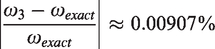
This paper is concerned with the application of the variational principle to nonlinear oscillators with fractional power. In the proposed approach, high-order trial solutions are assumed with unknown parameters that are estimated using conditions by the variational theory. To perform integration in the proposed approach, linearization of the nonlinear term is carried out for simple calculation. The proposed approach delivered an estimate of the oscillator frequency with a relative error as small as 0.009%.
Introduction
The study of nonlinear differential equations is important in physics, applied mathematics, engineering, as well as other disciplines. There has been considerable interest in developing analytical approximation methods for nonlinear oscillators that yield accurate estimates of the frequency of oscillation as well as the solution. The problem is quite challenging for the class of nonlinear oscillators with a fractional power.
The homotopy perturbation method (HPM), as well as some other methods,1–4 has been used to solve such nonlinear equations. The Tanh method 5 is an effective approach for solving the nonlinear equations. This method was applied for solving the Kolmogorov–Petrovski–Piskunov equation and the (3 + 1)-dimensional Kadomtsev–Petviashvili equations. 6 The transformed rational function method provides an analytical approach for solving the nonlinear partial differential equations. This method appropriately deals with the (3 + 1)-dimensional Jimbo–Miwa equation. 7 In the literature on nonlinear oscillators, the Hamiltonian approach has been discussed by He and co-workers.8–10 This method has been used for solving nonlinear equations by some researchers.11–17 Khan et al. 18 used this method for examining nonlinear vibrations of a rigid rod on a circular surface. This method was also used by Yildirim et al. 17 to study nonlinear oscillators with rational and irrational terms. Xu14,15 has used the Hamiltonian method to solve an equation from plasma physics and vibration analysis of a simple pendulum. Cveticanin et al. 16 considered a nonlinear oscillator with a fractional power and Yildirim et al. 17 considered the nonlinear oscillation of a point charge in the electric field of a charged ring. In Li and He, 19 the basic idea of an enhanced perturbation method is adopted in the HPM resulting in a more accurate solution. A modified HPM for nonlinear oscillators with a discontinuity was discussed by Pasha et al. 20 In Wang and An, 21 He’s amplitude–frequency formulation is used to solve a fractional Duffing equation. Tian and Liu 22 gave some simple formula for finding a fast approximate solution for a nonlinear oscillator and the estimated frequency with relatively high accuracy.
The variational principle characterizes a physical phenomenon and places a weaker condition on the smoothness of the physical field. The trial solution is assumed to contain one or more unknown parameters and the value of the unknown parameters is found by imposing the stationary condition on a variational functional. He 23 applied the variational principle to nonlinear oscillators for deriving first-order approximate analytical expressions for the frequency of oscillation and the solution. The trial solution is assumed to be a scaled cosine function with an unknown frequency to be determined by imposing conditions on the variational principle.
He’s 23 variational iteration method requires an evaluation of an integral for higher order terms. For computational efficiency, we introduce linearization in the variational principle. The proposed approach can be applied to obtain high-order approximate frequencies and high-order approximate solutions for any smooth nonlinear oscillator.
The rest of this article is organized as follows. In the next section, the key idea is discussed. The applicability of the proposed method is discussed in “Results and discussions” section by solving a nonlinear differential equation with a fractional power. In the final section, the conclusions regarding the overall study are discussed.
The mathematical formulation for the variational approach
In order to apply the variational approach for finding the approximate frequencies and solutions of nonlinear oscillators, consider the following form of linear and nonlinear oscillators


By using,
6
construct a variational principle for the general form of the oscillator (1) is given by

In one of the previously done works,
6
the variational approach has been applied for oscillators in which the first-order approximation was considered in the following form

In view of trial solution (4), a variational principle for the oscillator (1) can be constructed as

By using the transformation

If the high-order approximations are carried out, then the general

In view of trial solution (7), a variational principle for the oscillator (1) can be established as

By using the transformation

It is mentioned in Fereidoon et al.
1
that the first-order approximate frequency can be obtained by solving the equation

Set of equations (10) can be used to get
The

In order to evaluate integral (9), the linearization is carried out. So, linearize the nonlinear term


In order to elucidate the solution procedure using a modified variational approach, consider the following oscillator


Let the first-order trial solution which satisfies the initial condition (15) can be expressed by

In view of trial solution (16), a variational principle for the oscillator (14) can be expressed by

By using the transformation


Imposing

By solving equation (19), the expression for squared frequency can be obtained as

The exact frequency of the oscillator (14) with initial condition (15) is expressed by
2

So, the relative error in first-order approximate frequency using the variational approach is given by

He23 has also obtained the accuracy for first-order approximate frequency. Since the solution procedure of modified variational approach is the same as obtained by the variational approach23 for first-order approximation.
In order to find second-order approximate solution and frequency, assume that second-order trial solution can be expressed by

Since the present work is concerned with the linearized approach so linearize the term

So, using the linearized form of

In view of second-order trial solution (22), a variational principle (24) can be expressed by
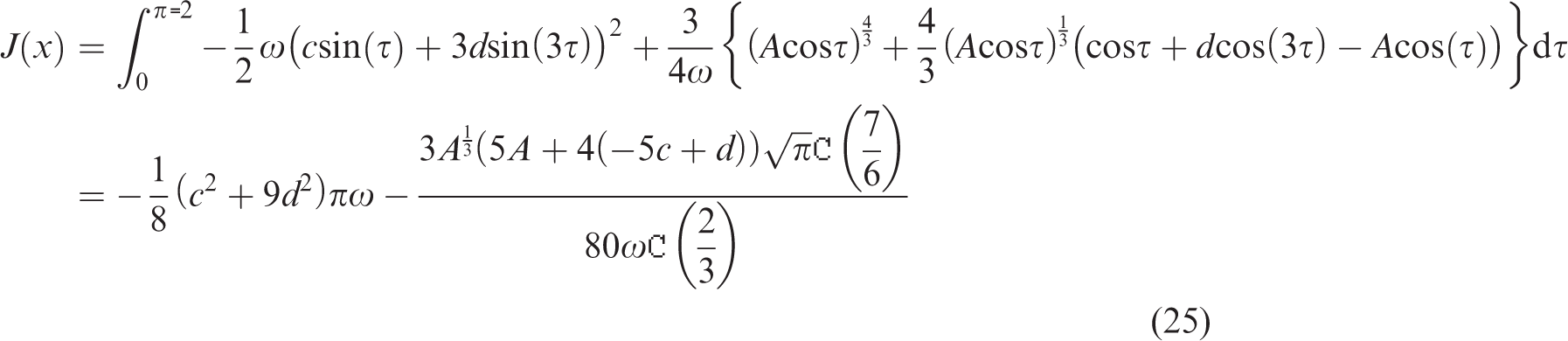
By imposing one of the initial conditions (15) to the second-order trial solution (22) gives

Imposing the conditions

The percentage relative error in second-order approximate frequency is given by

Similarly, the third-order trial solution is chosen with three parameters as

The variational principle can be constructed and in view of third-order trial solution (28), a variational principle is formulated as

By using optimal conditions
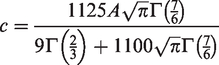

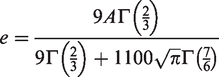
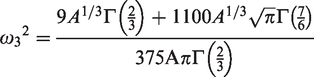
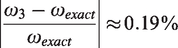
The relative error in the third-order approximate frequency is given by
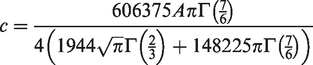
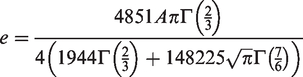
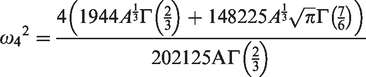
Similarly, the expressions for the parameters in fourth-order trial solution and squared fourth-order approximate frequency using modified variational approach are given by


The relative error in fourth-order approximate frequency using modified variational approach is given by
Results and discussions
The effectiveness of the presented modified method for approximate frequencies has been shown when the obtained frequencies are compared with the exact ones. The obtained solutions using linearized variational approach are graphed in Figures 1 to 6. The comparison of the approximate frequencies obtained by the present application of the modified variational approach with the exact ones is made and the relative errors have been found and these relative errors do not depend upon amplitude. So, the percentage of relative errors is the same for any value of the amplitude. It can also be noted that the percentage relative error decreases with the increase in the order of approximation. The disadvantage in use of the present approach for more than fourth order is that relative error increases with the increase of the order of approximate frequencies. This behavior of the obtained frequencies is checked for some orders after the fourth order and Mathematica software has been considered for these computations. Figures 1 and 2 show first- and fourth-order solutions obtained by present implementation of variational approach with different values of the amplitudes. The variation between the graphs of first order and fourth order can be seen from these figures. Figures 3 and 4 show the comparison of the numerical solution with first- and fourth-order approximate solutions over a small interval. Since the numerical solution does not converge over the large domain, so the comparison is performed over a small interval for different values of the amplitudes. The numerical solution is obtained by
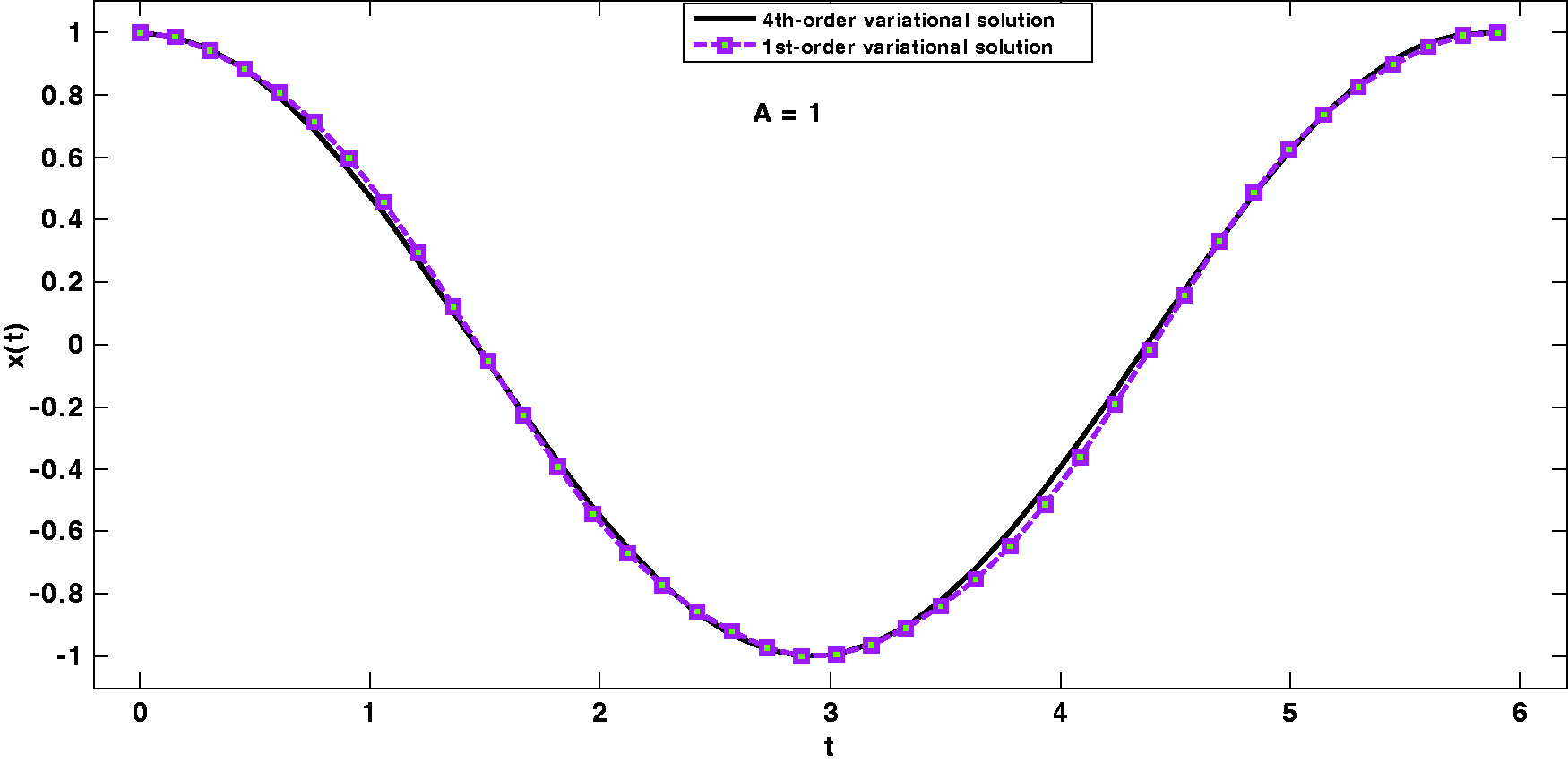
First- and fourth-order solutions using variational approach using
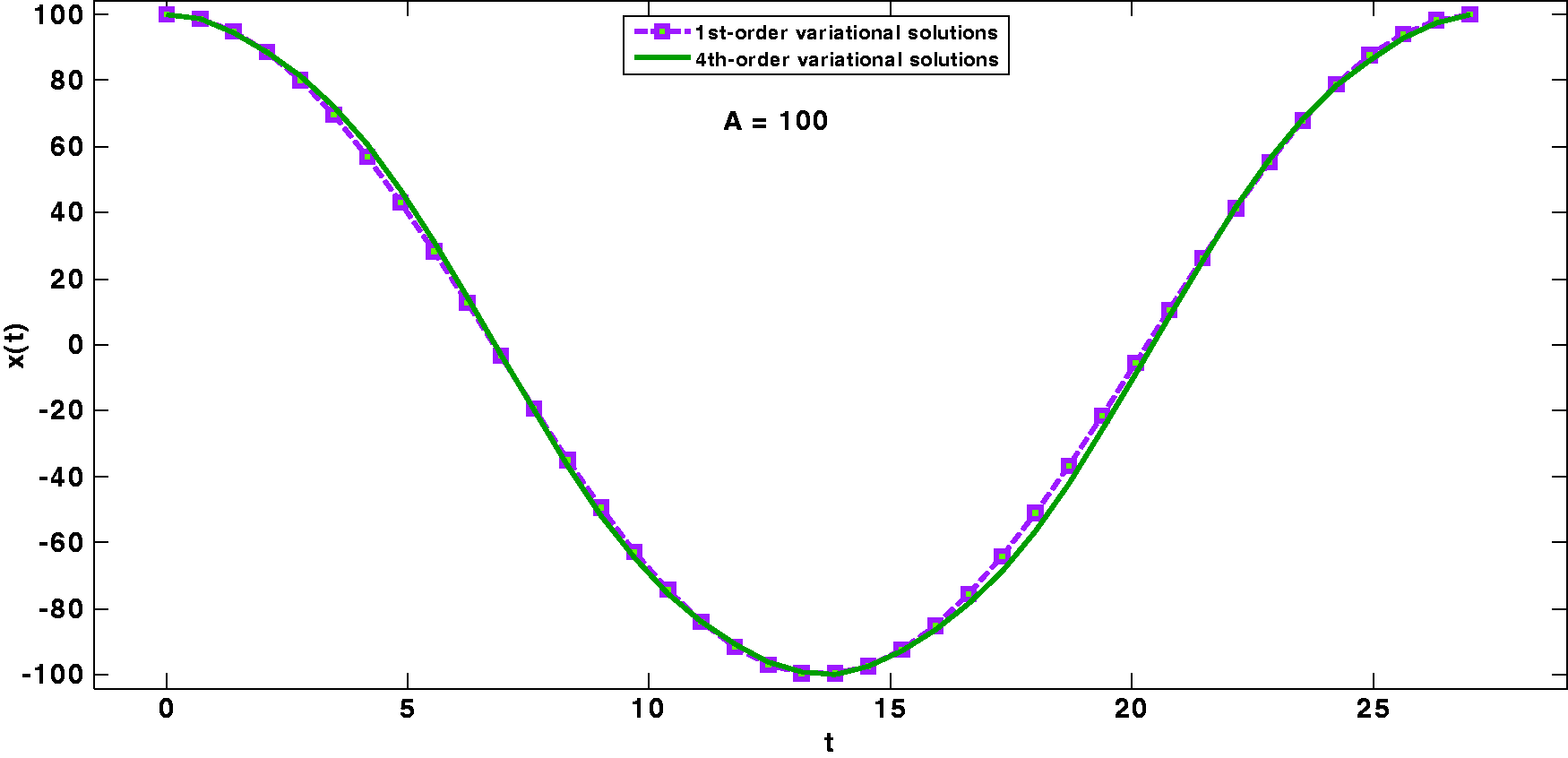
First- and fourth-order solutions using variational approach using
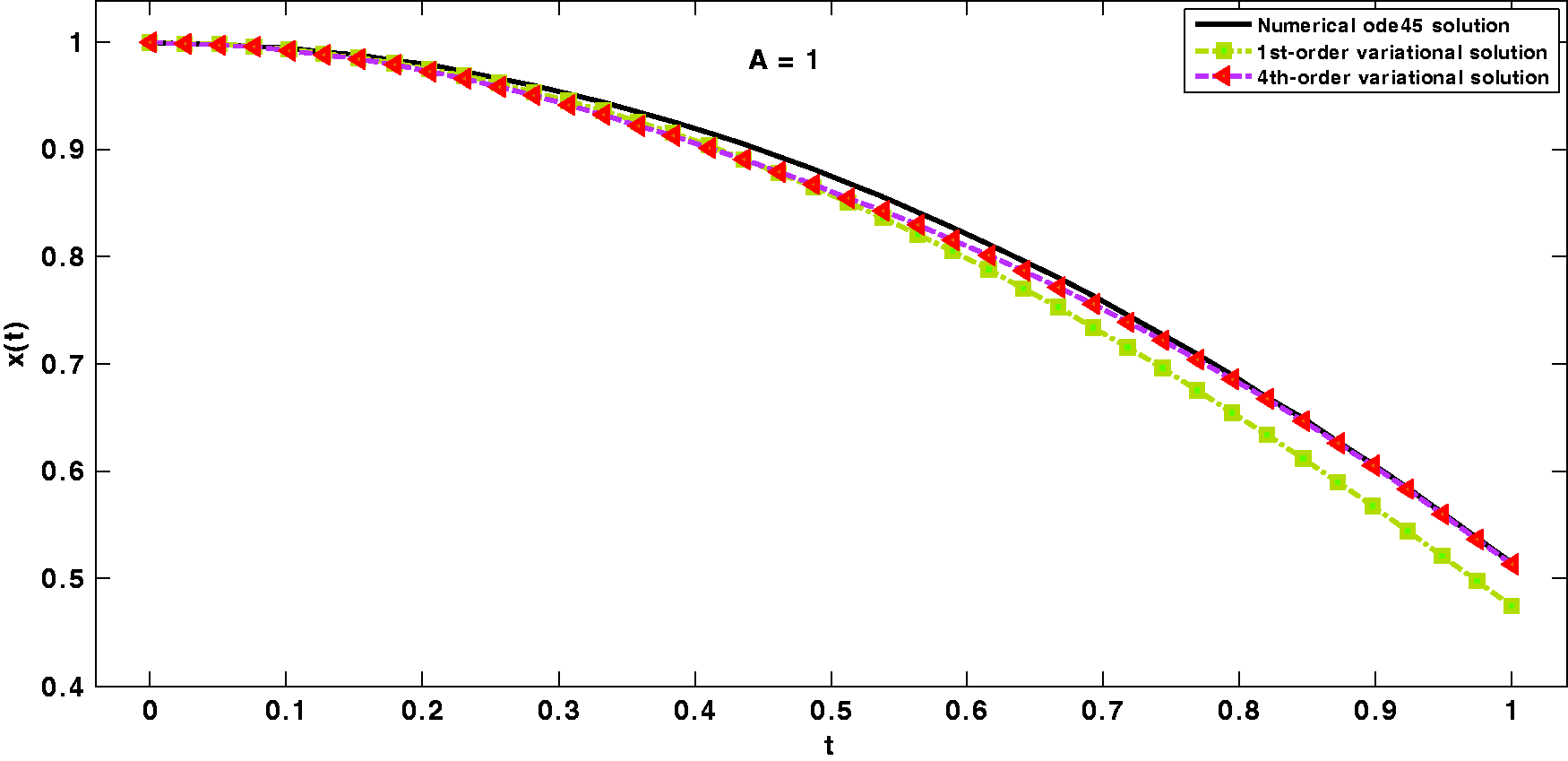
Comparison of numerical solution with first- and fourth-order solutions using variational approach using
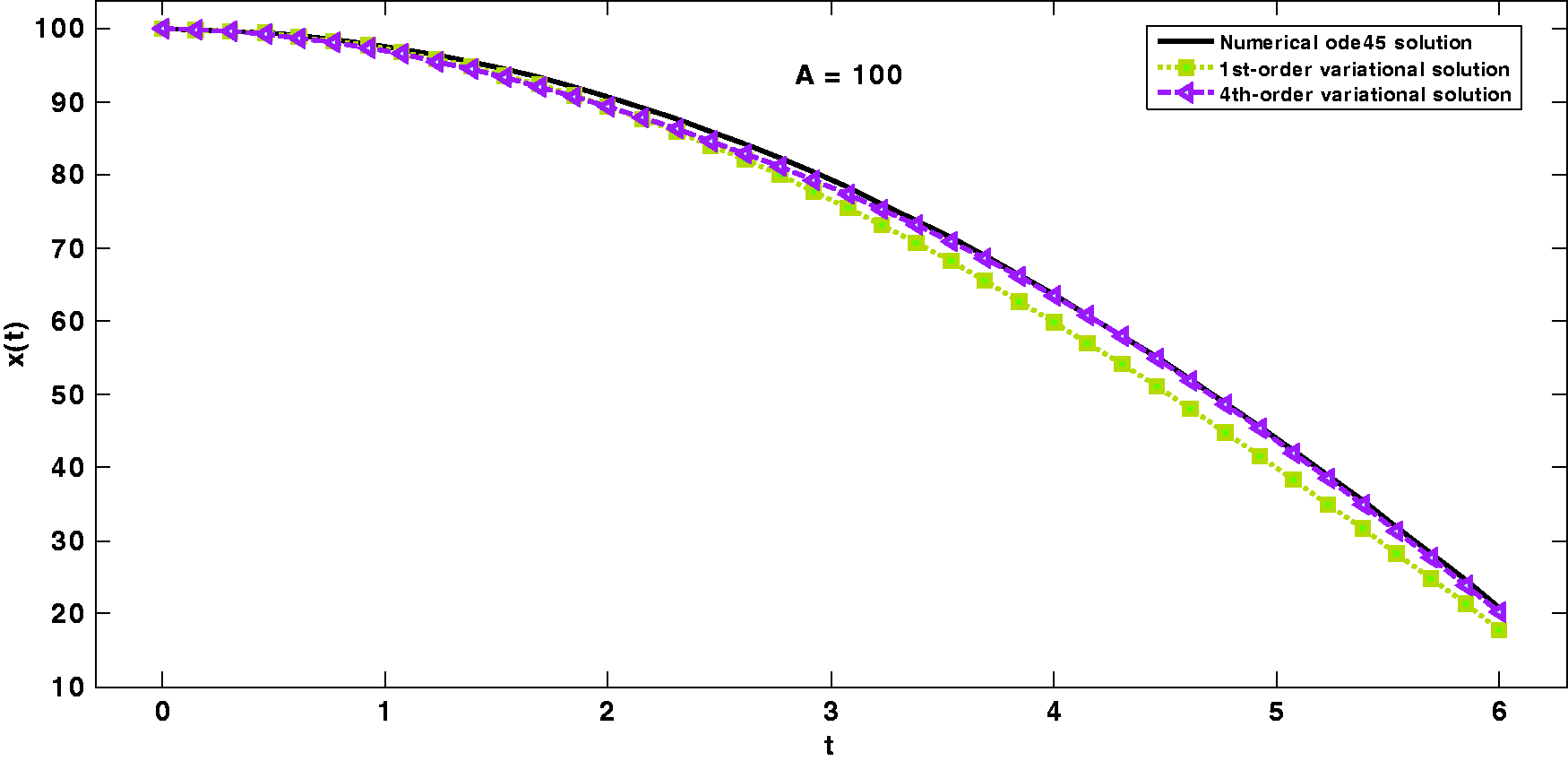
Comparison of numerical solution with first- and fourth-order solutions using variational approach using
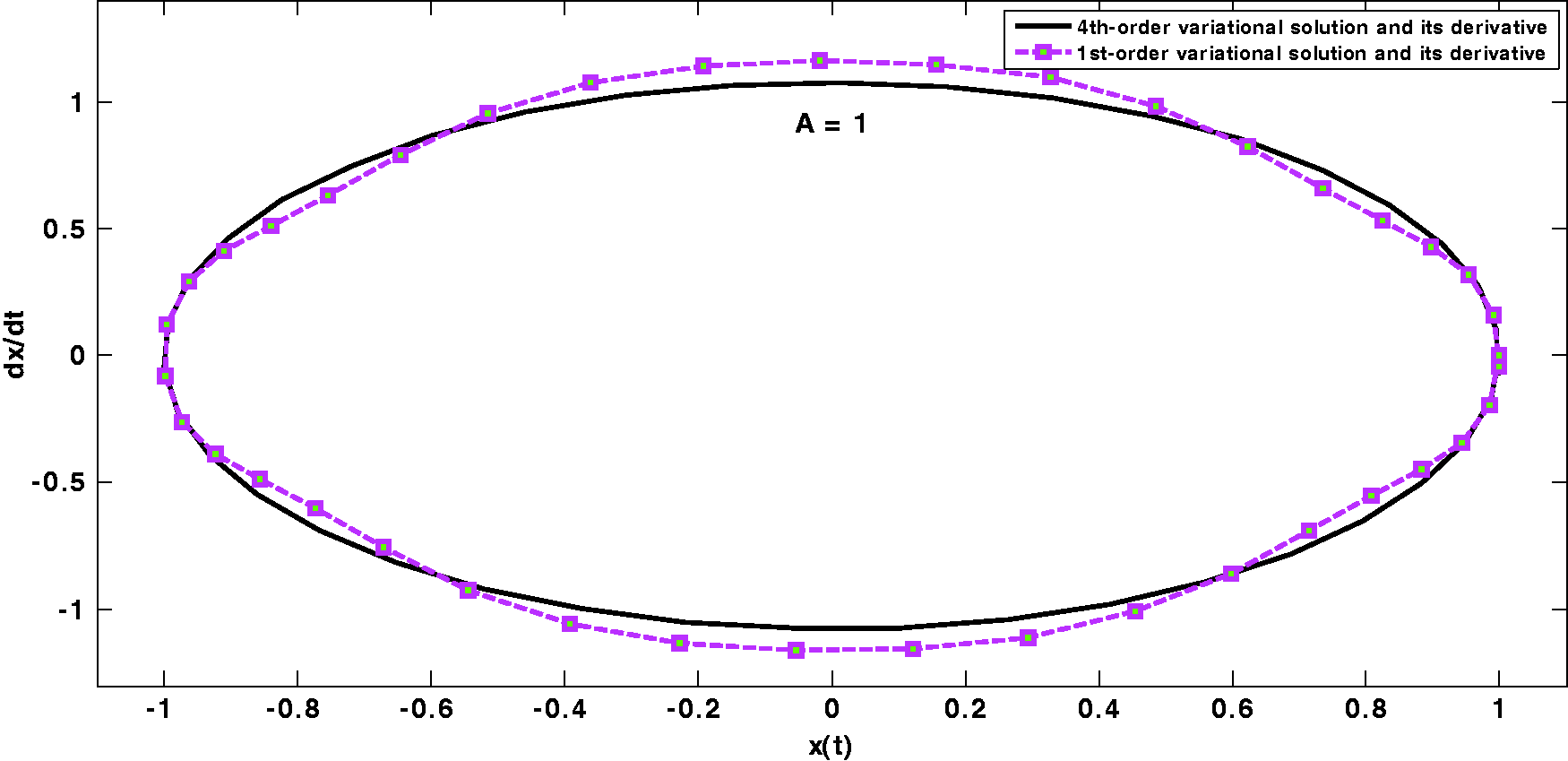
Phase portraits from first- and fourth-order solutions using variational approach using
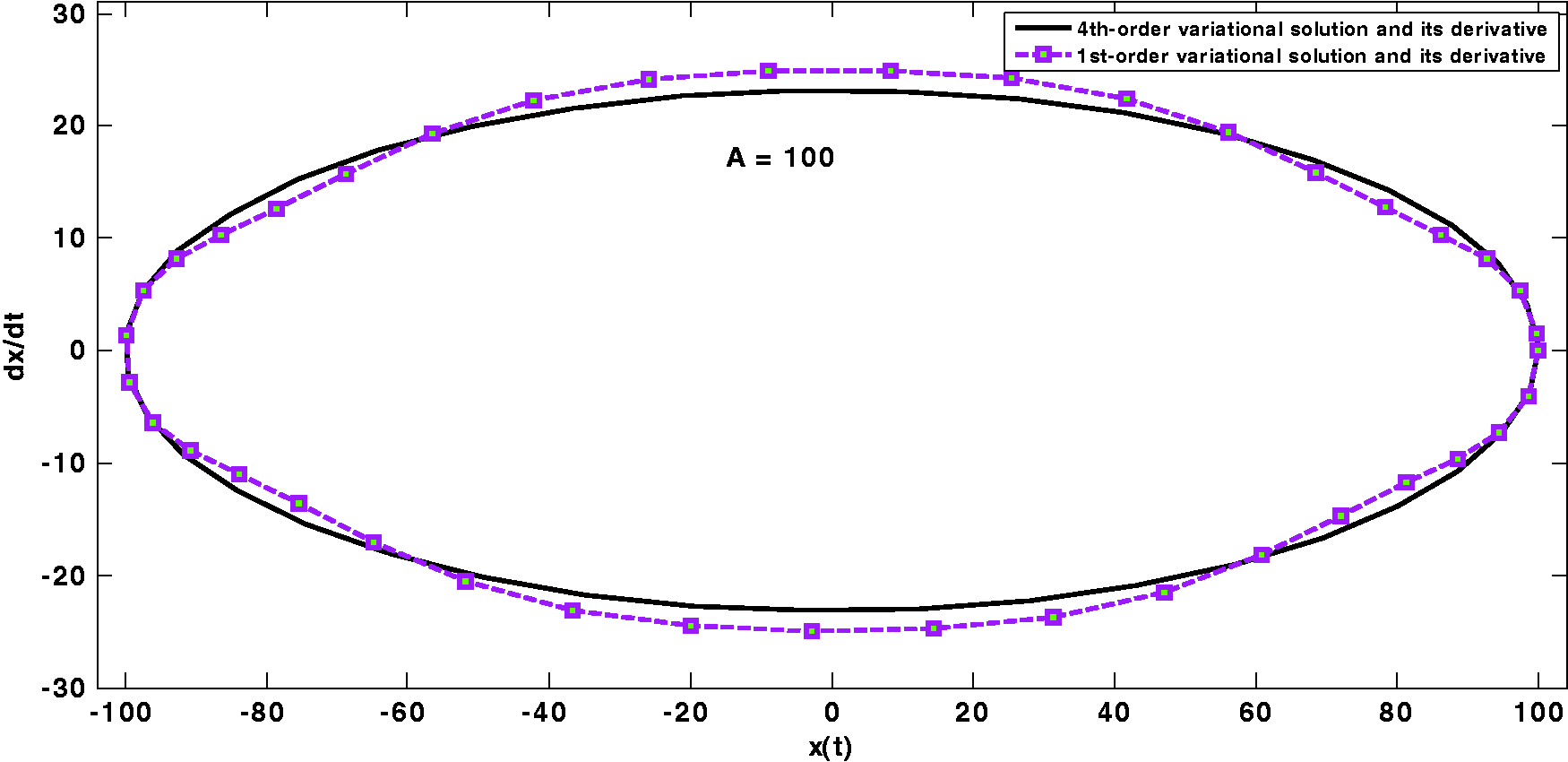
Phase portraits from first- and fourth-order solutions using variational approach using
This extended version of the variational approach has been applied in the present work which is the same for other variational approaches for first order and then linearization is carried out for high order. In order to use the present approach to get second- or high-order approximate solutions and approximate frequencies, linearization of one or more terms present in variational principle is performed and then using the trial solution, integration is performed. So, linearization procedure can open the path to find high-order approximate solutions and approximate frequencies using a variational approach. This linearization procedure depends upon the use of Taylor series for just first two of its terms.
Conclusions
The variational approach has been implemented for finding high-order approximate solutions and approximate frequencies of an oscillator with a fractional power. The first-order procedure of the proposed method is the same as the standard variational approach for oscillators. But for a second- and high-order approximation, linearization in the variational principle is performed. The fourth-order approximation using the proposed approach gave an approximate frequency with the smallest relative error recorded in the literature. Since the Hamiltonian approach can prove intractable due to the computation of an integral, the proposed method can be applied to yield high-order approximations.
Footnotes
Acknowledgements
The authors are grateful to Vice Chancellor, Air vice Marshal Faaiz Amir (Retd.), Air University, Islamabad and Dr Raheel Qamar, Rector Comsats University, Islamabad, Pakistan for providing excellent research environment and facilities. Exclusively, we would like to thank Dr Syed Ahmad Pasha from the Electrical department, Air University for his valuable suggestions to improve the body language of the paper.
Declaration of conflicting interests
The author(s) declared no potential conflicts of interest with respect to the research, authorship, and/or publication of this article.
Funding
The author(s) received no financial support for the research, authorship, and/or publication of this article.