In many vibration problems, it is very important to know precisely the bounds of the stability/instability frequencies and the associated amplitude ranges. This paper investigates the solvability and control of some weighted pseudo almost periodic solutions of abstract nonlinear vibration differential systems. Some sufficient conditions for the solvability and exponential stability of these systems are obtained. Moreover, the precise bound of Lyapunov exponents is estimated.
Nonlinear vibration problems arise everywhere in engineering, such as in oil pipelines, nuclear reactors, marine risers, heat exchangers and so on.1 Analytical methods for various nonlinear oscillators arising in practical applications have been studied extensively in the past few decades. Very recently, Li and Yang2 studied the vibration analysis of conveying fluid pipe via He’s variational iteration method.3,4 They transformed the governing equation of the pipe conveying fluid to the following abstract equation
For dynamical systems, the authors5–7 studied the oscillation/nonoscillation of solutions of different classes of differential systems; the authors8–11 investigated the stability of neural networks by constructing suitable Lyapunov functionals and combining with fixed-point technique.12 Zhang13–15 firstly studied the pseudo almost periodicity. The authors16–27 studied the existence, uniqueness and/or stability of the solutions to the abstract differential equations.
In this paper, we shall study some new sufficient conditions for the existence of the solutions of the following evolution equation with a bounded nonlinear term
which is the differential form of (1). Moreover, we also investigate the stability of some weighted pseudo almost periodic (WPAP) solutions of abstract nonlinear vibration differential systems. Some sufficient conditions for the solvability and exponential stability of these systems are obtained. Meanwhile, the precise bound of Lyapunov exponents is estimated.
Preliminaries
Let be Banach spaces, R real number set. Denote U the collection of weights functions , which are locally integrable over R with for almost each For and for we set
It is obviously that
Let be the space of all W-valued bounded continuous maps. The space with the sup norm is a Banach space. Let AP(W) be set of Bohr almost periodic maps.Let
Let
Define
A map is called WPAP if in which and The set of all WPAP maps is denoted by Meanwhile, a map is called by WPAP in and uniformly in if in which and The set of all such maps is denoted by
Remark 1 Let If then is also in Moreover, the decomposition of a WPAP map is unique since (for more denotes and details, please see literature13–15,26,27).
Lemma 2 Let W be a real Banach space, Ω be a bounded open subset of W, is a completely continuous operator. Then, either there exists such that or there exists a fixed point
Theorem 3 Assume that such that
where the nonnegative . If then
Proof. The proof is similar with the one given in Zhang,15 so we omit it.
Main results
This section, we will devote to the existence of a WPAP solution to the abstract differential equation
where is a parameter, A is the infinitesimal generator of an exponentially stable C0-semigroup T(t) on a Banach space W and is a WPAP function.
In the following, we need the condition
(B), and there exists a function such that
and there exists such that . Moreover, we assume that for all
Remark 4 By the results in Zang,15 if is a WPAP function, then α is bounded. So, our assumption for all is reasonable. Moreover, since is an exponentially stable C0-semigroup, we may assume that .
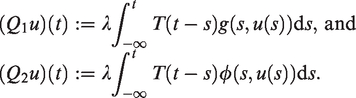
Define a mapping Q by
Lemma 5 If u(t) is WPAP, then Qu is also WPAP.
Proof. Since u(t) is WPAP, we have and in which and Using (B) and Theorem 3, it follows that where and Thus
Let
Because then for each one has such that
for every interval of length containing a τ and for all It is easily obtained that
for all and thus Now, we show that
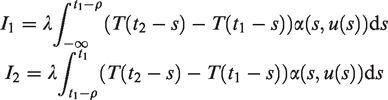
We write that
where
and
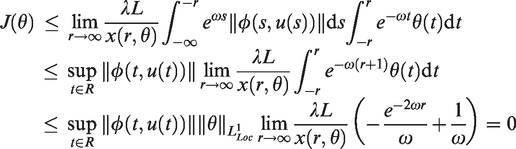
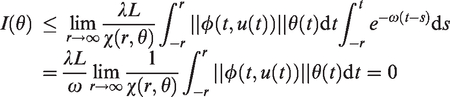
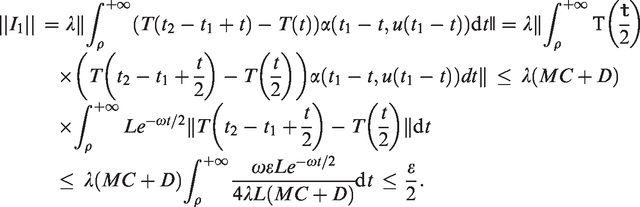
Since , we have
Similarly,
This completes the proof.
Lemma 6 Assume that (B) holds. Then the operator is completely continuous.
Proof. Let such that in as Then there exists a bounded set s.t. for all By (B), given there is such that and . Then
For the above δ, there exists N s.t. for all and Then . Hence
for all and any It follows that Q is continuous.
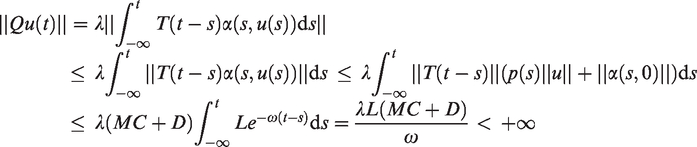
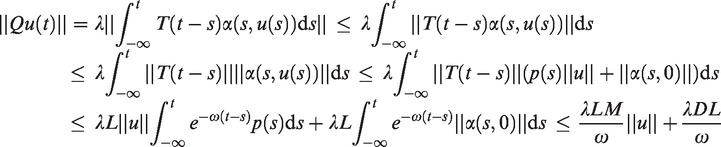
Let be bounded, i.e. there exists a constant C > 0 such that for all Then, for we have
Hence, is bounded.
Let and , setting , where
and
Since is a C0-semigroup and , there exists s.t. implies Then, one has
By a direct calculation, we have
and
Then, for and
That is to say, is equicontinuity.
By the Arzela-Ascoli theorem, we have
is completely continuous. The proof is complete.
Theorem 7 Suppose that (B) holds. Then there exists a constant such that for any , equation (6) has at least one nontrivial WPAP solution.
Proof. It is well-known that problem (6) has a solution if and only if u solves the operator equation
in W. So we need to seek a fixed point of Q in . By Lemma 6, the operator is a completely continuous operator.
Since , we know . Let
Suppose such that . Then
Since
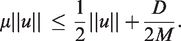
Choose Then when , we have
Consequently
This contradicts . By Lemma 2, Q has a fixed point . Then when , equation (6) has a nontrivial WPAP solution. ◊
Example 8 Consider the following nonlinear oscillator system which generalizes the one in He et al.28
with the initial value If we choose , by a simple computation, we have
Then, by Theorem 7, equation (6) has one nontrivial WPAP solution for any .
Theorem 9 Suppose that, and
Then, there exists a constant such that for any , equation (6) has at least one nontrivial WPAP solution.
Proof. Let such that . By (7), there exists such that
Let . Then for any , we have
From Theorem 7 we know that equation (6) has at least one nontrivial WPAP solution. ◊
In this end, we consider the exponential stability of the solution for the following system with nonlinearity
If there exist constants and such that any solution x(t) of equation (8) satisfies the inequality
for any . In this paper, the infimum of for which the above inequality exists is called the Lyapunov exponent.
As is well known, the solution x(t) of equation (8) can be written as
where the exponentially stable C0-semigroup T(t) is generated by operator A. Suppose that there exist positive constants m and β such that
by Theorem 7, we have the following theorem.
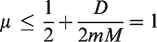
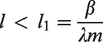
Theorem 10 Suppose that then there exists a constant such that for any , equation (8) has at least one nontrivial WPAP solution. Moreover, the general exponent μ of (8) satisfies the inequality,
Thus, for such equation (8) is exponentially stable if
Proof. From
and
we have
The substitution
reduces (11) to the form
where
Thus, it follows from the known Gronwall inequality that
which along with (12) imply that
Then, (10) is obtained and the proof is complete.
Remark 11 Noting that m and β become very more complex when , and the technique here does not work.
Remark 12. Even slight nonlinearities in vibrating dynamics can cause instability bands and unstable amplitudes. By the works of Peleg and Hing,24 in many vibration dynamics or vibration problems, it is vital to know precisely the bounds of the instability/stability frequencies and the associated amplitude rang. In this paper, we calculated the precise Lyapunov exponents of vibrating dynamics with bounded or unbounded nonlinearities. Thus, our results can be used for vibration dynamics or vibration problems.
Conclusion
In this paper, we considered some WPAP solutions for vibrating dynamics. Firstly, we obtained some sufficient conditions for at least one nontrivial WPAP solution. Secondly, we studied the exponential stability and the precise bound of Lyapunov exponents for the systems with bounded or unbounded nonlinearities.
Declaration of conflicting interest
The author(s) declared no potential conflicts of interest with respect to the research, authorship, and/or publication of this article.
Footnotes
Funding
The author(s) disclosed receipt of the following financial support for the research, authorship, and/or publication of this article: The project was supported financially by Natural Science Foundation of Shandong Province under Grant No. ZR2017MA045.
References
1.
IbrahimR.Overview of mechanics of pipes conveying fluids Part I: Fundamental studies. J Pressure Vessel Technol2010;
132: 034001
2.
LiY-DYangYR.Vibration analysis of conveying fluid pipe via He’s variational iteration method. Appl Math Modell2017;
43: 409–420.
3.
HeJH.Variational iteration method some recent results and new interpretations. J Comput Appl Math2007;
207: 3–17
4.
HeJHWuXH.Variational iteration method: new development and applications. Comput Math Appl2007;
54: 881–894
5.
GuoYWangJ.Oscillation criteria based on a new weighted function for linear matrix Hamiltonian systems. Discrete Dyn Nat Soc2011; 1–12. DOI: 10.1155/2011/659503
MengFHuangY.Interval oscillation criteria for a forced second-order nonlinear differential equations with damping. Appl Math Computat2011;
218: 1857–1861.
8.
GuoYXuCWuJ.Stability analysis of neutral stochastic delay differential equations by a generalisation of Banach’s contraction principle. Int J Contr2017;
90: 1555–1560.
9.
GuoY.Exponential stability analysis of traveling waves solutions for nonlinear delayed cellular neural networks. Dynam Syst2017;
32: 490–503.
10.
GuoY.Globally robust stability analysis for stochastic Cohen-Grossberg neural networks with impulse control and time-varying delays. Ukr Math J2017;
69: 1220–1233.
11.
GuoYXinL.Asymptotic and robust mean square stability analysis of impulsive high-order BAM neural networks with time-varying delays. Circuits Syst Signal Process2018;
37: 2805–2823.
12.
GuoYXueM.Characterizations of common fixed points of one-parameter nonexpansive semigroups. Fixed Point Theory2015;
16: 337–342.
13.
ZhangCY.Pseudo almost periodic solutions of some differential equations. J Math Anal Appl1994;
181: 62–76.
14.
ZhangC. Almost periodic type and ergodicity. New York: Kluwer Academic Publishers and Science Press, 2003.
15.
ZhangCY.Integration of vector-valued pseudo almost periodic functions. Proc Amer Math Soc1994;
121: 167–174.
16.
DiaganaT.Weighted pseudo almost periodic functions and applications. C R Acad Sci Paris Ser I2006;
343: 643–646.
17.
DiaganaT.Existence and uniqueness of pseudo almost periodic solutions to some classes of partial evolution equations. Nonlinear Anal2007;
66: 384–395.
18.
FinkAM. Almost periodic differential equations. In: Lecture notes in mathematics, vol. 377, New York, Berlin: Springer-Verlag, 1974.
19.
NGurkataGM.Almost automorphic and almost periodic functions in abstract spaces.
New York, London, Moscow:
Kluwer Academic Publishers, 2001.
20.
LiangJZhangJXiaoTJ.Composition of pseudo almost automorphic and asymptotically almost automorphic functions. J Math Anal Appl2008;
340: 1493–1499.
21.
ZhaoZ-HChangY-KNietoJJ.Almost automorphic and pseudo-almost automorphic mild solutions to an abstract differential equation in Banach spaces. Nonlinear Anal2010;
72: 1886–1894.
22.
GuoY.Mean square exponential stability of stochastic delay cellular neural networks. Electron J Qual Theory Differ Equ2013;
34: 1–10.
23.
ZevinAPinskyM.Exponential stability and solution bounds for systems with bounded nonlinearities. IEEE Trans Automat Contr2003;
48: 1799–1804.
24.
PelegKHingS.Simplified determination of stability bounds in nonlinear vibration systems. J Vib Acoust1992;
114: 319–325.
25.
GuoY.Nontrivial periodic solutions of nonlinear functional differential systems with feedback control. Turkish J Math2010;
34: 35–44.
26.
HeBWangQ-R.On completeness of the space of weighted Stepanov-like pseudo almost automorphic (periodic) functions. J Math Anal Appl2018;
465: 1176–1185.
27.
CoronelAPintoMSeplvedaD.Weighted pseudo almost periodic functions, convolutions and abstract integral equations. J Math Anal Appl2016;
435: 1382–1399.
28.
HeWKongHQinY-M. Modified variational iteration method for analytical solutions of nonlinear oscillators. J Low Freq Noise Vibr Active Contr 2018. DOI: 10.1177/1461348418784817