




Abstract
In this paper, an acoustic method is presented for measuring the porosity and the viscous tortuosity of air-saturated-porous materials at low frequencies. The proposed method is based on a temporal model of the direct and inverse problem for the reflection of low-frequency waves by homogeneous isotropic slab of porous material having a rigid frame. Reflected coefficient for a slab of porous material is derived from the responses of the medium to an incident acoustic pulse where a simple relation between flow resistivity, porosity, viscous tortuosity and the reflected waves is obtained. A numerical method and efficient tool for the estimation of the porosity and the viscous tortuosity are presented and discussed.
Introduction
Good acoustic performance is a desirable attribute in almost all types of buildings and is particularly important for residential buildings, places of worship, schools and hospitals. In this context, several studies have been carried out1–6 to predict the acoustic behavior of the materials used in these buildings. Porous materials such as plastic foams, fibrous, granular materials, rocks and ceramics are among those materials frequently used in our daily lives and in the buildings’ construction to reduce noise and vibration pollution. The effectiveness of the porous acoustic materials in sound insulation is mainly based on their intrinsic properties. The porosity ϕ is one of the most known parameters which appear in the theories of sound propagation in porous media. This parameter intervenes in the description of the viscous coupling between the fluid and the structure. The porosity ϕ refers to the ratio of the fluid volume occupied by the fluid phase to the total volume of porous material. It is also important as one of the several parameters required by acoustical theory to characterize the porous materials. For acoustical materials, its range of values is generally between 0.70 and 0.99. The porosity can be measured directly and there are several methods to do so.7–11 For example, porosity can be determined by measuring the change in air pressure that occurs with a known volume change in the chamber containing the sample. The practical implementation of the direct methods for measuring the porosity could be complex and expensive. There are other methods that are faster and less expensive to measure the porosity, the so-called indirect methods12–16 that use sound waves transmitted or reflected by the porous material. The second known parameter which appears in the theories of sound propagation in porous media in low frequency is the viscous tortuosity α0, namely also inertial factor, introduced by Norris 17 and Lafarge 18 ; the viscous tortuosity α0 has been used recently in the literature 19 to determine the acoustic absorption of multi-periodic composites; it describes the fluid structure interaction in the low frequency, and this parameter has not been yet measured experimentally. Therefore, it is of some importance to devise experimental methods to estimate this parameter.
In this paper, an acoustical method is proposed for measuring the porosity and the viscous tortuosity using reflected waves by air-saturated porous materials at low frequencies (100–400) Hz. The advantage of this method is the use of a simplified expression of the reflection coefficient which depends on the flow resistivity, the porosity and the viscous tortuosity. The results of the inversion method proposed are reasonable and consistent with those found in the literatures.
Acoustical model
The porous material is a bi-phase medium consisting of a solid part saturated with a fluid. Due to the coupling between the solid skeleton and the fluid, the propagation of acoustic waves within the material is well described by the Biot theory.20,21 Result of this theory – three waves propagate within the material: two compression waves, one related to the fluid phase and the other to the solid phase, and one shear wave in the solid phase. The porous medium is considered rigid22–24 when the coupling between the solid and fluid phase is so low that little energy is transferred or when the density or stiffness of the solid phase is high, which requires a significant amount of energy to cause a displacement under acoustic excitation; in this case, the wave can be considered to propagate only in the fluid, and the porous medium is considered as a fluid equivalent22–23 with effective density
In low frequency range, the expressions of the dynamic tortuosity and the dynamic compressibility of the medium are related to different geometrical parameters of the porous medium which are the static viscous permeability


η is the fluid viscosity, ρ is the saturating fluid density, γ is the adiabatic constant.
The objective of this work is proposed to estimate the porosity and the viscous tortuosity of rigid porous medium using the reflected signal at low frequencies. A schematic of the problem under consideration is depicted in Figure 1. It consists of a homogeneous porous material that occupies the region 0 ≤ x ≤ L. An incidence acoustical wave impinges normally on the medium. It generates an acoustic pressure field p(x) and an acoustic velocity field v(x) within the material. To derive the reflection coefficient, it is assumed that the pressure field and flow velocity are continuous at the material boundary




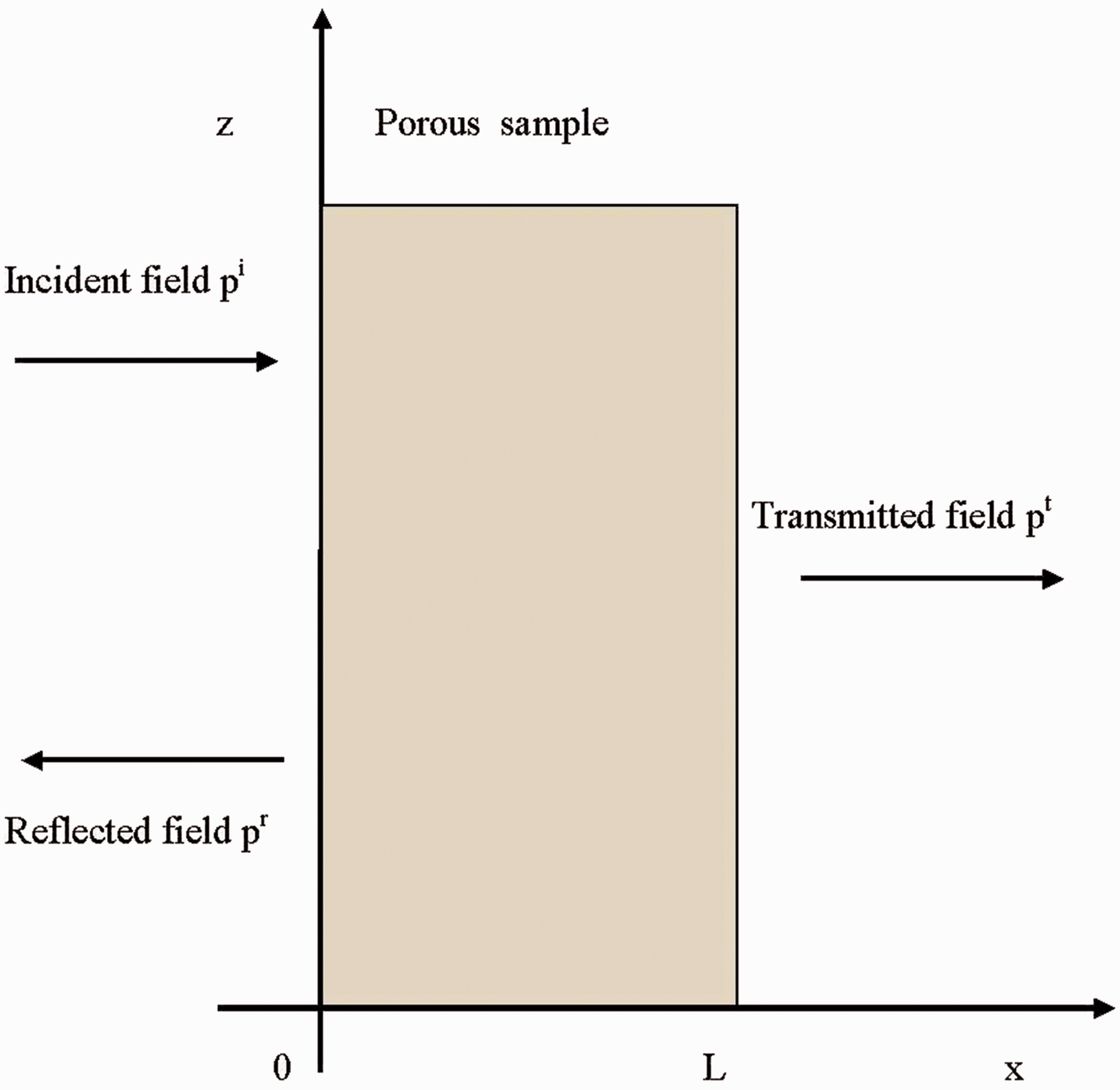
Geometry of the problem.
The Darcy’s regime15,23 corresponds to the range of frequencies such that viscous skin thickness


As a first approximation, at very low frequencies (ω → 0), the reflection coefficient (7) is given by the first term

This simplified expression of the reflection coefficient is independent on the frequency and porosity of the medium and depends only on its resistivity σ. As a second approximation, at low frequencies, the reflection coefficient (7) is given by the first and second term

In addition to the resistivity, the expression (10) of the reflection coefficient also depends on the porosity ϕ and the viscous tortuosity α0.
The incident and scattered fields are related by the reflection operator for the material. These are integral operator represented by

In equation (11), * denotes the convolution operation,

Inverted values on the porosity and the viscous tortuosity
The reflected acoustic waves by porous material established in low frequency domain are characterized, in addition to the flow resistivity, by two parameters namely, porosity ϕ and viscous tortuosity α0, the values of which are crucial for the behavior of sound waves in such materials. It is of some importance to work out new experimental methods and efficient tools for their estimation. The determination of these two parameters is done by minimizing between the experimental reflected signal and the simulated reflected signal given by equation (11) using the expression (12) of the reflected kernel. A numerical solution of the least-square method can be found, which minimizes



The inverse problem is solved by the last-square method. For its iterative solution, we used the simplex search method 29 which does not require numerical or analytic gradient. The tube length of the experimental setup is adaptable to avoid reflection, for measurements in the frequency range (100–300) Hz, a length of 50 m is sufficient but it is useful to use an anechoic device placed at the end of the pipe. The tube diameter is 5 cm (the cut-off of the tube fc ∼ 4 kHz). A sound source Driver unit “Brand” constituted by loudspeaker Realistic 40–9000 is used. Tone-bursts are provided by Standard Research Systems Model DS345–30 MHz synthesized by the function generator. The signals are amplified and filtered using model SR 650-Dual channel filter, Standford Research Systems. The incident and reflected signals are measured using the same microphone (Bruel and Kjaer: 4190). The incident signal is measured by putting a total reflector in the same position as the porous sample.
The inverse problem is solved for two cylindrical samples of plastic foam S1 and S2 of a diameter of 5 cm. These materials are frequently used in automotive, aerospace and building applications for thermal and sound absorption. The first sample S1 is less resistive with thickness L1 = (5.00± 0.10) cm, porosity ϕ1 = (0.92 ± 0.02) and resistivity σ1 = (6500 ± 500) Nm−4s. The second sample S2 is more resistive with thickness L2 = (4.15 ± 0.10) cm, porosity ϕ2 = (0.82 ± 0.02) and resistivity σ2 = (30,000 ± 2000) Nm−4s. The porosity and the flow resistivity of the samples S1 and S2 are measured using direct methods7–10,12–13,30–33 and indirect methods by solving the inverse problem.14,15 Figure 2(a) and (b) shows the experimental incident signal (dashed line) generated by the loudspeaker in the frequency bandwidth (170–210) Hz, and the experimental reflected signal (solid line) and their spectrum (at right) of the samples S1 and S2, respectively. After solving the inverse problem numerically for the porosity ϕ and the viscous tortuosity α0, we find the following optimized values presented in Table 1. We present in Figure 3(a) and (b), the variation of the minimization function U with the porosity and viscous tortuosity of the samples S1 and S2. In Figure 4(a) and (b), we show a comparison between an experimental reflected signal and simulated reflected signal for the optimized values of porosity and viscous tortuosity. It can be seen that the agreement between experiment and theory curves is good for both the samples S1 and S2, which let us to conclude that the inversion results are best.
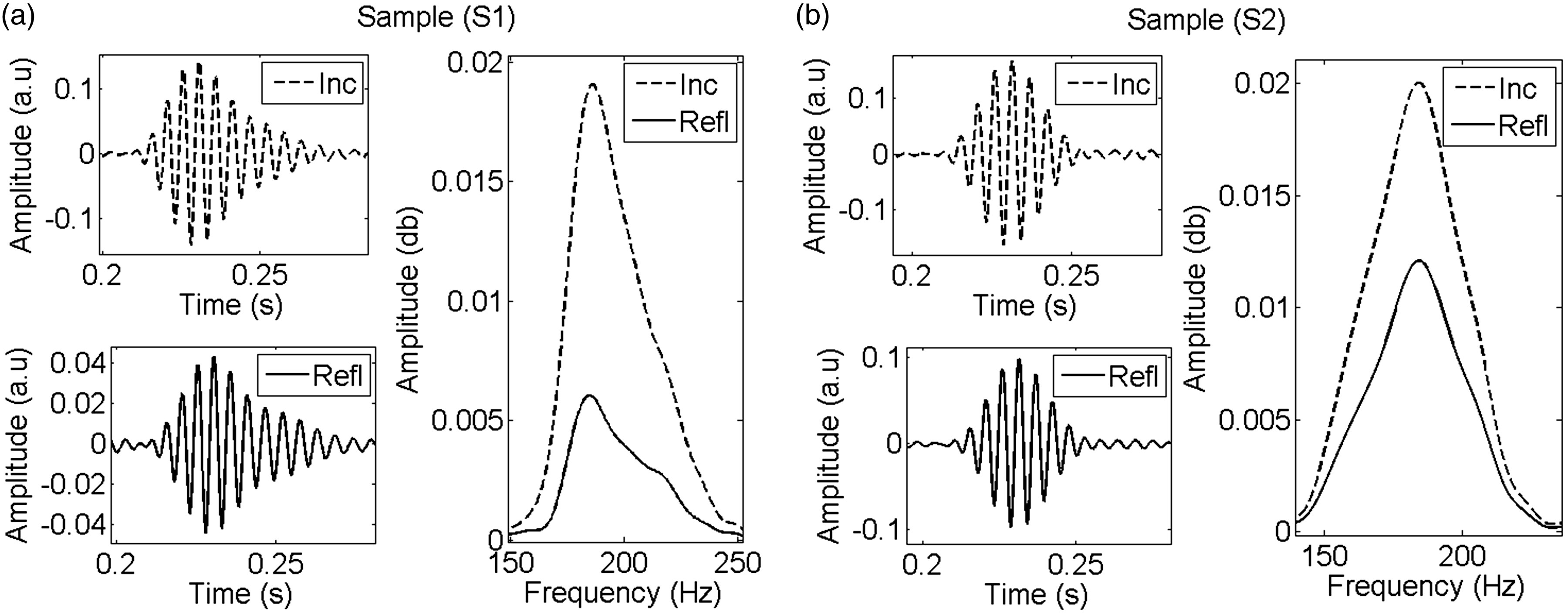
(a) Experimental incident (dashed line) and reflected (solid line) signals at left and their spectrum at right of the sample (S1). (b) Experimental incident (dashed line) and reflected (solid line) signals at left and their spectrum at right of the sample (S2).
Inverted values on the porosity and viscous tortuosity of the samples (S1) and (S2) in different low frequencies.

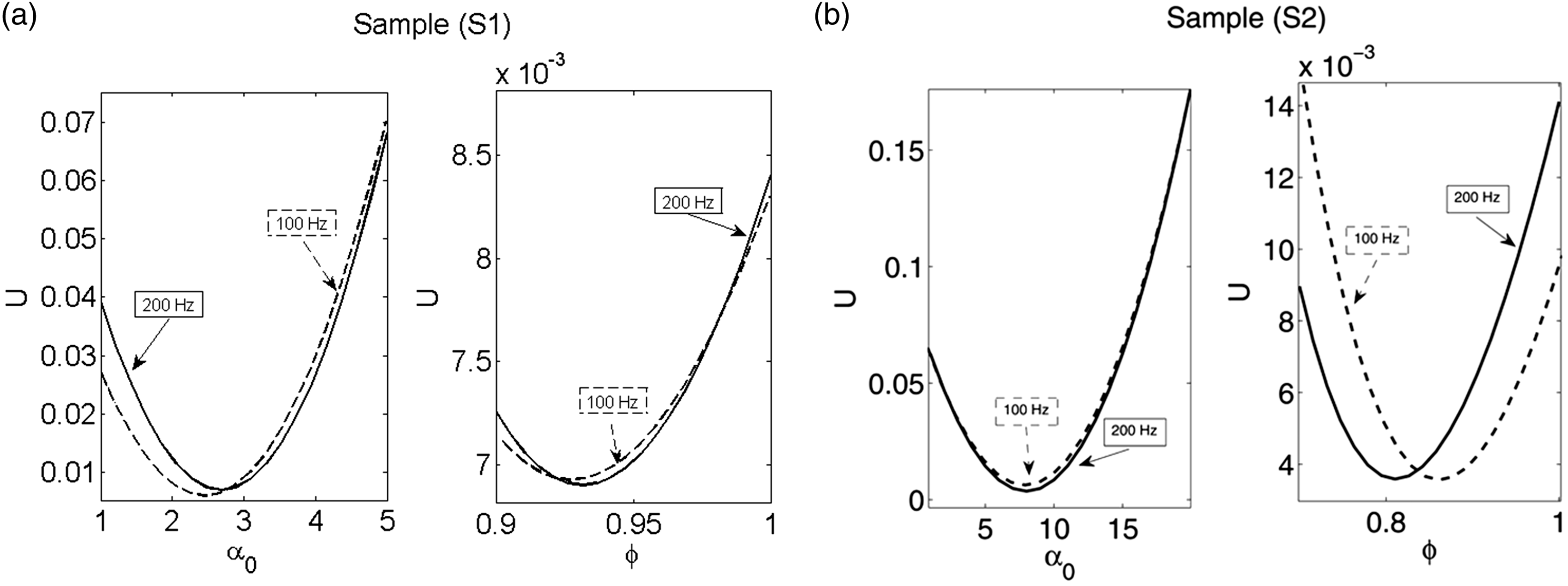
(a) Variation of the cost function U with the porosity ϕ and the viscous tortuosity α0 for the sample (S1). (b) Variation of the cost function U with the porosity ϕ and the viscous tortuosity α0 for the sample (S2).
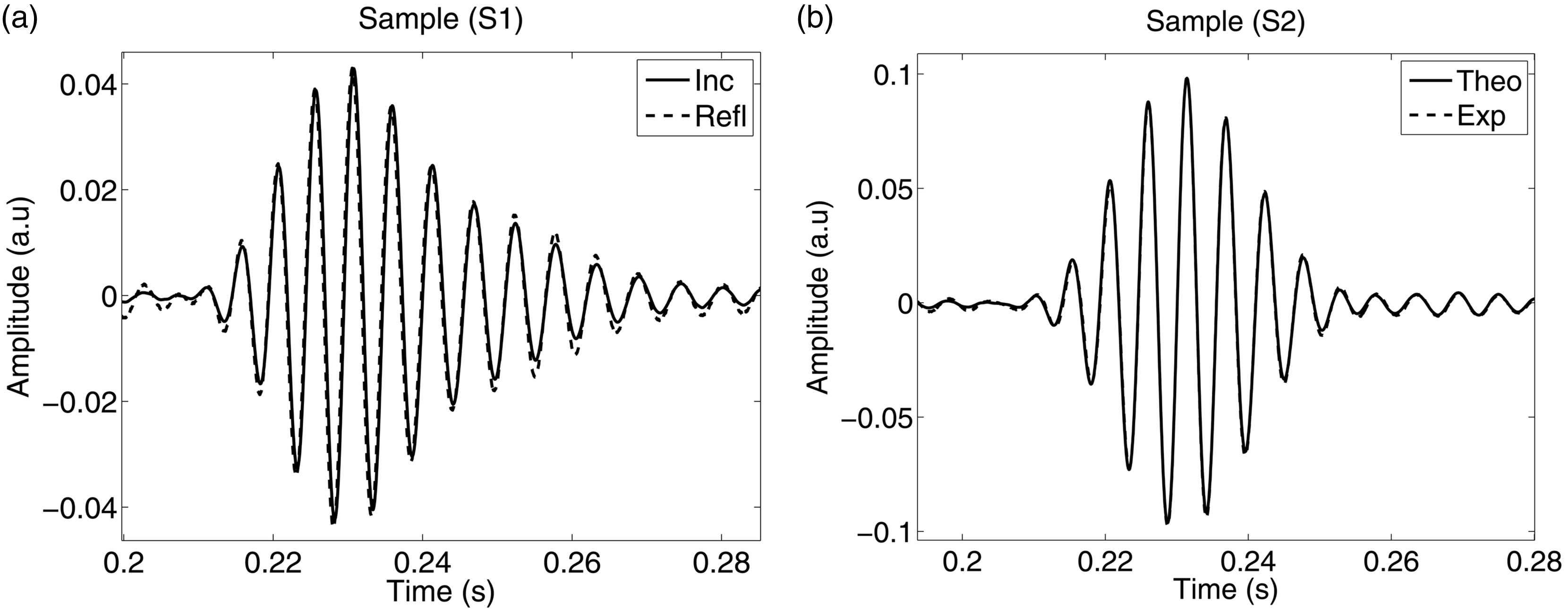
(a) Comparison between experimental reflected signal (dashed line) and simulated reflected signal (solid line) for the optimized values of the porosity and the viscous tortuosity of the sample (S1). (b) Comparison between experimental reflected signal (dashed line) and simulated reflected signal (solid line) for the optimized values of the porosity and the viscous tortuosity of the sample (S2).
Conclusion
In this work, a simplified expression of the reflection coefficient that depends on the flow resistivity, porosity and viscous tortuosity is established at low frequency, an experimental determination of the porosity and the viscous tortuosity of air-saturated porous sample is given by solving the inverse problem using experimental reflected signals. The simulated signals reconstructed using the optimized values found are in good agreement with the corresponding experimental signals. The most important result in this study is that it is now possible to measure, simultaneously, the porosity and the viscous tortuosity by just using the experimental reflected waves at low frequencies.
Footnotes
Declaration of conflicting interests
The author(s) declared no potential conflicts of interest with respect to the research, authorship, and/or publication of this article.
Funding
The author(s) received no financial support for the research, authorship, and/or publication of this article.