



Abstract
Introduction
Evidence-based practice (EBP) originated in the 1980s within the medical field to improve healthcare quality. 1 This model was introduced through initiatives promoting systematic observation of clinical experiences, critical evaluation of treatment efficacy, and effective interpretation of evidence. 2 Florence Nightingale pioneered EBP in nursing by actively collecting and analyzing patient data. 3 The International Council of Nurses (ICN) defines EBP in nursing as a problem-solving approach to clinical decision-making that incorporates the best available evidence, clinical expertise, and patient preferences to provide safe and standardized care. 4 Evidence-based nursing emphasizes integrating research findings into clinical practice 5 to bridge the gap between theory and practice. 6
Nurses are essential in bridging research findings to patient care by adopting EBP, which requires developing relevant knowledge and skills in clinical settings. 7 Degu et al. (2022) found that nurses’ attitudes toward EBP influence its implementation. 8 Having an open and receptive attitude toward EBP-driven changes is crucial and cultivating this positive attitude should begin early in nursing education. 9
Nurses play a crucial role in clinical decision-making, relying on valid information sources and robust evidence to make informed choices. 10 Clinical decision-making is a dynamic process that requires constant evaluation of new information and adaptation to changing patient situations. 11 Inadequate clinical decision-making skills can lead to incomplete data collection, reliance on outdated information, misinterpretation of data, and potential patient harm. 12
Clinical settings rely heavily on information and communication technology to collect and analyze patient data, which is essential for informed decision-making by healthcare professionals. Nursing informatics has emerged as a specialized area within nursing. 13 Nurses toady utilize a wide range of clinical technologies that require strong informatics competencies. 14
Nursing Informatics (NI) is a vital tool for enhancing patient care quality 15 by leveraging technology to improve information management and communication among healthcare providers. 16 It supports EBP (Jouparinejad et al. 2020), fosters patient trust, and improves nursing outcomes.14,17 Batran et al. (2022) found several benefits of nursing informatics, including improved patient safety, enhanced care quality, reduced healthcare costs and workload, facilitated information exchange, and strengthened patient-nurse relationships. It also helps patients, nurses, and other healthcare provides make appropriate decisions and achieve positive outcomes. 18
Considering the significance of clinical decision-making skills for nurses in enhancing safe care and achieving optimal outcomes, and the importance of EBP in improving the quality of care and standardizing nursing services, research into factors affecting these skills is essential.3,19
In recent years, in the context of Iran, we have witnessed an increasing growth in postgraduate nursing education programs. Graduates with MSc and PHD degrees are employed in various healthcare settings, including hospitals. These nurses are expected to possess advanced informatics competencies compared to previous generations. Examining the relationship between nurses’ informatics competency and related factors such as EBP and clinical decision-making can provide valuable insights into the factors affecting health informatics among clinical nurses. The results of such a study can inform policymakers on whether to prioritize improving nurses’ informatics competency or focus on other effective factors.
No prior studies have examined the correlation between clinical decision-making skills, attitudes toward EBP, and informatics competency among nurses. Therefore, this study aimed to explore the relationship between informatics competency, attitudes toward EBP, and clinical decision-making skills in nurses.
Methods
The aim, design, and setting of the study (study design)
This study aimed to investigate the relationship between informatics competency, attitudes toward EBP, and clinical decision-making skills in a sample of nurses working in hospitals. This descriptive correlational study was conducted in five general educational hospitals affiliated with Birjand University of Medical Sciences, Iran, in 2024. These hospitals, with bed capacities ranging from 195 to 260, shared similar characteristics in terms of types of ward and patient populations.
The characteristics of participants and data collection tools (research participants)
This descriptive correlational study included 300 nurses from hospitals affiliated with Birjand University of Medical Sciences. The sample size was determined utilizing Krejcie and Morgan’s table, 20 which indicated that 300 participants were sufficient for an estimated eligible population of around 1300 nurses. These nurses were selected through quota sampling approach. Inclusion criteria were willingness to participate, a minimum bachelor’s degree, at least 1 year of clinical work experience, and no management position. Exclusion criterion was incomplete questionnaire submission. Ethical approval was obtained from the Vice Chancellor for Research, and coordination with hospital managers facilitated data collection, conducted from August to October 2024.
Data were collected using questionnaires on demographic information, informatics competency, attitudes toward EBP, and nursing decision-making skills. - The demographic questionnaire covered age, sex, marital status, education level, clinical work experience, and type of ward. - The informatics competency instrument, developed by Farzandipour et al. (2021), was used to assess nurses’ informatics competencies in this study. This instrument has 48 items with three subscales: basic computer skills (17 items), informatics knowledge (15 items), and informatics skills (16 items). Participants rated each item on a four-point Likert scale (1 = very low, 4 = completely). The total score ranges from 48 to 192, where higher scores indicate better informatics competency. This instrument has shown good psychometric properties in ...ian nurses.
21
The reliability of this questionnaire in our study was evaluated using Cronbach’s alpha, which was 0.79. Subscale Cronbach’s alpha values were 0.70 for basic computer skills, 0.71 for informatics knowledge, and 0.75 for informatics skills. - The attitude towards EBP questionnaire, developed by McKenna et al. (2004), was used to investigate participants’ attitudes toward EBP. This 26-item questionnaire uses a five-point Likert scale (1 = strongly disagree, 5 = strongly agree), with total scores ranging from 26 to 130.
22
Authorization to utilize this questionnaire was obtained from the developers prior to the study. Subsequently, the questionnaire was translated into Persian using the forward-backward method. Two experts fluent in English and Persian translated the questionnaire into Persian, resolving minor discrepancies through consensus. A third expert back translated the Persian version into English, and items were refined to account for minor differences between the two translated versions, resulting in an initial Persian version. 12 faculty members from the Nursing and Midwifery College in Birjand University of Medical Sciences, Iran, evaluated the content validity index (CVI) of the questionnaire items, with item-level CVI scores ranging from 0.8 to 1.0, signifying acceptable content validity. Moreover, the reliability of this questionnaire in our study was evaluated using Cronbach’s alpha, which yielded a value of 0.78. - The nursing decision-making questionnaire, developed by Lauri (2002), was used to measure clinical decision making among nurses.
23
Lauri’s 24-item instrument for assessing clinical decision-making represents a shortened adaptation of the original 56-item questionnaire which uses a 5-point Likert scale from 1 = never to 5 = always for each item, with total scores ranging from 24 to 120. The questionnaire is a valid and reliable instrument for evaluating nurses’ clinical decision-making, with scores below 67 indicating analytical decision-making, 78-68 indicating intuitive-analytical decision-making, and above 78 indicating intuitive decision-making. In Iran, this questionnaire has demonstrated desirable psychometric properties.
24
In our study, the reliability of this questionnaire was evaluated using Cronbach’s alpha, yielding a value of 0.75.
The validated Persian versions of the attitude towards EBP and nursing decision-making questionnaires were piloted with 20 nurses who were eligible for the study before full-scale data collection to ensure clarity and reliability.
Permission to use all data collection tools in this study was obtained from the scale developers via email.
Statistical analysis
All statistical analyses were conducted using SPSS version 25 (IBM Corp., Armonk, NY). Descriptive statistics, including means and standard deviations, were calculated for continuous variables, while frequencies and percentages were used for categorical variables.
In this study, absolute z-values of kurtosis and skewness were below 3.26 for all main study variables, including informatics competency, its components, clinical decision-making, and attitudes toward EBP, suggesting normal distribution. 25 Similarly, absolute z-values for age, work experience, and main study variables across demographic characteristics (e.g., marital status, gender, education level, and type of ward) were below 3.26, indicating normal distribution. Therefore, independent t-tests were used to compare mean scores for informatics competency, its components, clinical decision-making, and attitudes toward EBP based on marital status, gender, and education level. One-way ANOVA was used to compare mean scores for main study variables and their dimensions regarding work experience and type of ward. When the one-way ANOVA results were significant, post hoc Bonferroni test was used for group comparisons. Assumptions of homogeneity of variances for independent t-test and one-way ANOVA were checked using Levene’s test. Pearson correlation coefficient was used to assess the relationship among main study variables, their dimensions, and participants’ age. Assumptions of linearity, normality, and absence of significant outliers were assessed through scatterplots and normal probability plots. Stepwise multiple regression analyses were carried out to determine the best predictors of attitudes toward EBP and decision-making, including variables with a significance level below 0.1 in the univariate analyses. Before regression analyses, assumptions of linearity, homoscedasticity, independence of residuals, normality of residuals, and absence of multicollinearity were evaluated. Linearity and homoscedasticity were assessed through scatterplots of standardized residuals versus predicted values. The Durbin–Watson test confirmed the independence of residuals, with values of 1.74 and 1.77 for the two models, which were in the acceptable range (1.5-2.5). Normality of residuals was examined using histograms and normal P–P plots. Multicollinearity was evaluated using Variance Inflation Factor (VIF) values, all of which were 1, well below the threshold of 10. All statistical analyses were conducted using SPSS version 25, with a significance level of α = 0.05.
Ethics approval and consent to participate
The study proposal received approval from the Ethics Committee of Birjand University of Medical Sciences, Birjand, Iran [ethics code: IR.BUMS.REC.1402.544]. Participants provided written informed consent to engage in the research and were informed that their involvement in the study was voluntary. Additionally, they were assured that all shared information would remain confidential.
Results
Descriptive statistics
The mean scores of main variables and their relationships with demographic characteristics.
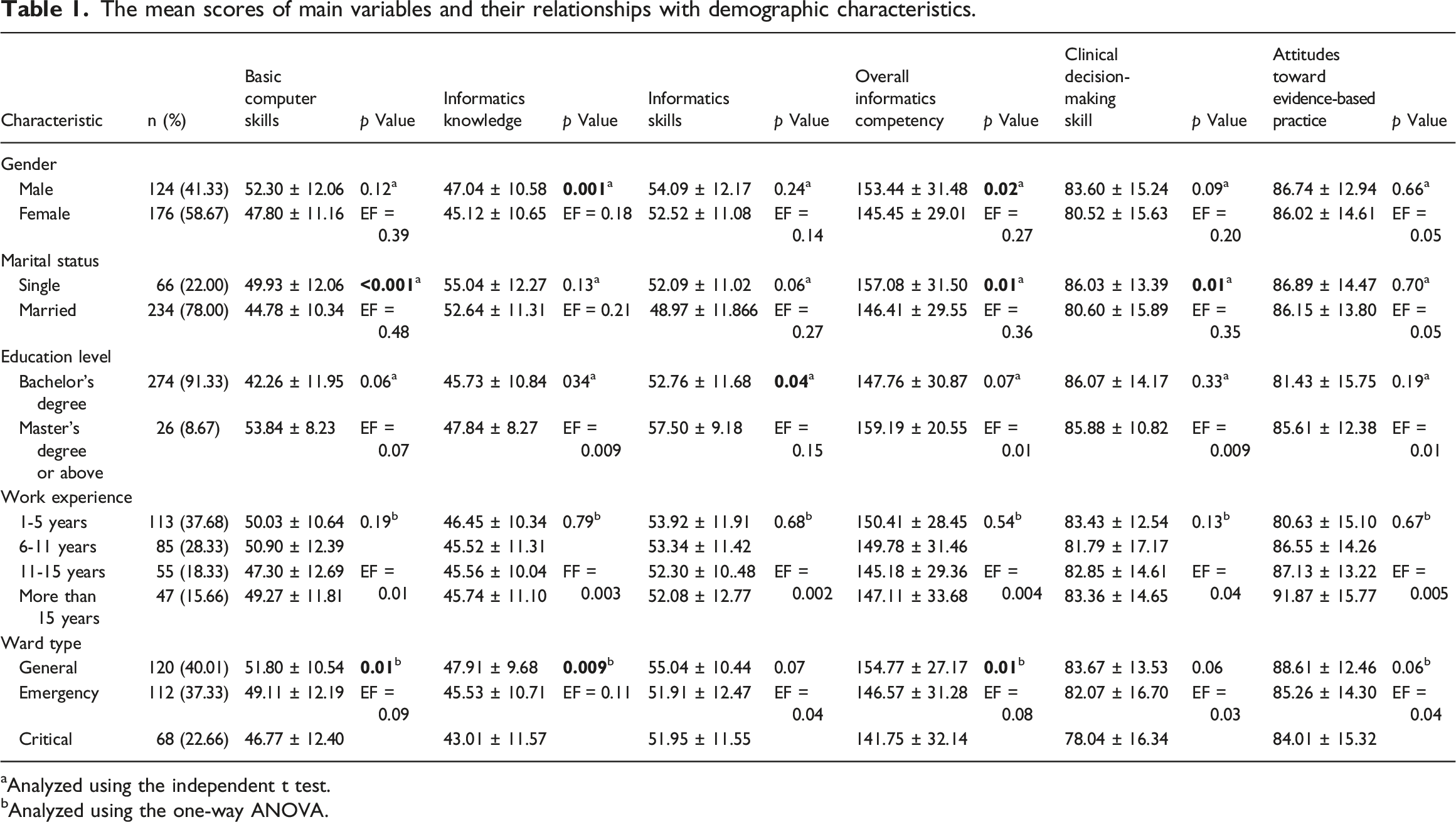
aAnalyzed using the independent t test.
bAnalyzed using the one-way ANOVA.
Descriptive analytical
In our study, no significant associations were found between age, informatics competency or its dimensions, and clinical decision-making skills (p > 0.05). However, a positive and significant correlation was observed between age and attitudes toward EBP among the studied nurses (p < 0.001).
As shown in Table 1, the mean informatics competency scores were significantly higher in male nurses compared to female nurses and in single nurses compared to married nurses (p < 0.05). Additionally, informatics competency differed significantly by the ward type (p = 0.01). Bonferroni’s post-hoc test revealed that nurses working in general wards had significantly higher informatics competency scores compared to those working in critical wards (p = 0.01).
The mean scores for basic computer skills were significantly higher in single nurses compared to married nurses (p < 0.001). Similarly, a significant difference in basic computer skills was observed based on the ward type (p = 0.01; Table 1). Bonferroni’s test revealed that nurses working in general wards had significantly higher basic computer skills than those working in critical wards (p = 0.01).
In our study, the mean informatics knowledge scores were also significantly higher in male nurses compared to female nurses (p = 0.001). One-way ANOVA revealed a significant difference in informatics knowledge by the ward type (p = 0.009; Table 1). Post hoc analysis showed that nurses working in general wards had significantly higher informatics knowledge than those working in critical wards (p = 0.007).
The mean scores for informatics skills in this study were significantly higher in nurses with a master’s degree or above than nurses with a bachelor’s degree (p = 0.04).
According to Table 1, statistical analysis indicated that single nurses had significantly higher mean clinical decision-making skill scores than married nurses (p = 0.01).
Descriptive analysis of overall informatics competency and its components, clinical decision-making, and attitude towards EBP in the studied nurses.

Correlational analysis
Results of Pearson’s coefficient correlation between main variables.

^ Significant at p < 0.001.
Predictive analysis
Summary of regression analysis of variables predicting attitudes toward EBP (N = 300).

R2 = 0.20; adjusted R2 = 0.19; F = 75.45; p < 0.001; effect Size = 0.25
Summary of regression for the analysis of variables predicting clinical decision-making (N = 300).

R2 = 0.26; adjusted R2 = 0.26; F = 106.16; p < 0.001; effect Size = 0.35
Discussion
This study aimed to determine the relationship between informatics competency, attitudes toward EBP, and clinical decision-making skills among nurses. We found a positive correlation between informatics competency, attitudes toward EBP, and clinical decision-making skills. Informatics competency plays a crucial role in modern nursing practice, as it enhances the quality of patient care by improving the speed and accuracy of documentation, accessing real-time patient data, and reducing errors, leading to better decision-making by nurses.14,21,26
This study found that the mean informatics competency score of the nurses was moderate (148.76 ± 30.26/228), consistent with previous studies by Farzandipour et al. (2021) 21 and Jouparinezhad et al. (2020). 17 Similar to findings by Blowska et al. (2020), 27 nurses’ attitudes toward EBP were moderate (86.32 ± 13.93). However, Alqahtani et al. (2020) reported a positive attitude toward EBP among nurses in Saudi Arabia. 28 These results suggest that while nurses are willing to engage in EBP, specialized training in EBP knowledge and skills is essential to enhance their active participation.28,29
The study results found that nurses used an intuitive-analytical model of clinical decision-making, consistent with a 2022 systematic review conducted on Iranian nurses’ decision-making (2022). 30 Analytical decision-making relies on explicit knowledge with low tacitness, while intuitive decision making involves high tacitness rooted in personal experiences.31,32 The intuitive –analytical decision-making observed in the study nurses is an ideal form, enabling optimal patient care through critical decisions based on evidence and experience.
The study results showed a significant positive relationship between nurses’ informatics competency and attitudes toward EBP. This aligns with findings from Elsayed et al. (2017) in Egypt and Khezri et al. (2019) in Iran, which also demonstrated a significant positive relationship between these variables.14,29 High levels of informatics competency enhance nurses’ ability to access and use current evidence, fostering a positive inclination to integrate EBP into clinical practice. Therefore, the development of informatics skills is essential for promoting evidence-based care, improving patient outcomes, and advancing the nursing profession. 33
The results indicated that informatics competency components can explain about 20% of the variance in nurses’ attitudes toward EBP. A key barrier to a positive attitude towards EBP is poor basic computer skills, 34 highlighting the need for targeted educational programs to enhance informatics competencies and cultivate an effective, evidence-based healthcare environment.
Furthermore, the study results demonstrated a significant positive relationship between nurses’ informatics competency and clinical decision-making skills. Batran et al. (2022) and Jensen et al. (2016) supported the study results, showing a positive relationship between nurses’ informatics competency and clinical decision-making skills.18,35
Reid et al. . (2021) concluded that nursing informatics supports data‐driven decisions that enhance the quality of care. 36 The study showed that the components of informatics competency can predict about 26% of the variance in nurses’ clinical decision-making skills, with informatics knowledge being the primary contributor. Previous research also supports a relationship between informatics competency, especially informatics knowledge, and clinical decision-making skills.37,38 As healthcare increasingly relies on technology, targeted educational programs are crucial to develop nurses’ informatics competency, directly enhancing clinical decision-making and patient care quality.17,18,39 Therefore, healthcare managers and policymakers should prioritize integrating these initiatives into nursing curricula and professional development programs.
Our study demonstrated a significant positive correlation between nurses’ age and attitudes toward EBP, which is consistent with the study by Ashktorab et al. (2015). 40 However, Tomotaki et al. found no such relationship, 41 which may be due to cultural or educational differences among clinical nurses. The significant positive relationship between attitudes toward EBP and age suggests that experience shapes nurses’ behavior. The Canadian Nurses Association (2000) defines continuing competence as the ongoing acquisition of new skills and knowledge through formal and informal learning, aimed at expanding expertise and enhancing existing competencies throughout a nurse’s career. 13
The study’s strength lies in its comprehensive analysis of the relationship between informatics competency, attitudes toward EBP, and clinical decision-making skills. While previous research has explored factors associated with informatics competency, there is limited evidence on how informatics competency relates to attitudes toward EBP and clinical decision-making skills.
Given the relationship between informatics competency, evidence-based practice, and clinical decision-making, nursing education programs should be revised to incorporate structured training in informatics competencies. Healthcare managers in hospitals and other organizations can help improve evidence-based practice and clinical decision-making of nurses by designing in-service training focused on informatics competency, ultimately improving the quality of care. At a broader level, health policymakers should develop and implement national informatics competency standards and integrate these into nursing curricula to improve the quality of nursing care.
Data collection was performed using self-report instruments, which may be influenced by social desirability and self-approval biases. As a cross-sectional study, it provided no reliable information about causal relationships or directions among informatics competency, attitudes toward EBP, and clinical decision-making among nurses. Variations in the adoption and application of digital technologies across countries may limit the generalizability of these findings to nurses throughout the world.
Conclusion
Informatics competency is positively associated with nurses’ attitudes toward EBP and clinical decision-making skills. Enhancing nurses’ informatics competency is crucial for improving their ability to make evidence-based decisions and provide high-quality care. Therefore, nursing education planners should revise curricula to include robust informatics training, hospital managers should design targeted in-service training programs, and policymakers should develop national standards for informatics competencies to advance nursing practice.
Footnotes
Acknowledgements
This article is result of a research project approved by Birjand University of Medical Sciences. We would like to thank the Vice Chancellor for Research of Birjand Univeristy of Medical Sciences and all the nurses who participated in this study. Our special thanks goes to all nurses who participated in the current study.

Ethics approval
The proposal for the current study was granted approval by the ethics committee of Birjand University of Medical Sciences, Birjand, Iran [ethics code: IR. BUMS.REC.1402].
Consent to participate
Participants provided written informed consent to engage in the research. They were made aware that their involvement in the study was entirely voluntary. Additionally, participants were guaranteed that all information they shared would remain confidential.
Author contributions
Study design: HS and AS; data collection: AS; analysis and statistics: HS and SAV, manuscript preparation: HS, AS and SAV. All authors approved the final version for submission.
Funding
The authors received no financial support for the research, authorship, and/or publication of this article.
Declaration of conflicting interests
The authors declared no potential conflicts of interest with respect to the research, authorship, and/or publication of this article.