



Abstract
Introduction
Access to digital technologies among homeless and at-risk populations is increasingly important in the modern world for healthcare, social connection, employment, purchase of goods and services, and other everyday activities. A 2013 systematic review found 16 studies that examined use of information technologies among homeless individuals, reporting that mobile phone ownership ranged from 44%–62%; computer ownership ranged from 24%–40%; computer access and use ranged from 47%–55%; and Internet use ranged from 19%–84%. 1 However, all of these studies are dated now, nearly all were based on small samples, and only a few studies included homeless veterans. For example, the largest study based on a survey of 106 homeless veterans was conducted in 2012-2013 finding that 89% reported having a mobile phone, of which one-third were smartphones; 76% reported using the Internet; and over 85% were willing to receive mobile phone reminders about medical appointments and for provider outreach. 2 As digital devices become cheaper to manufacture and more widely used, they are becoming an important part of social integration. However, there continues to be broad concern about a ‘digital divide’ experienced by individuals experiencing social dysfunction.3,4 Thus, it is important to study contemporary data on access and use of digital technologies among homeless veterans to inform program and policy efforts.
Homelessness among U.S. veterans is a nationally recognized public health problem that affects communities across the U.S. and has incurred tens of billions of federal dollars. Multiple federal agencies, including the Departments of Veterans Affairs (VA), Housing and Urban Development (HUD), and Labor are focused on solving this complex, interdisciplinary issue. 5 The U.S. Department of Veterans Affairs (VA) operates the largest continuum of homeless programs in the country with an annual budget of over $2 billion dollars. To guide continued development of programs and services for veterans, the VA, in partnership with local communities, conducts an annual national survey of veterans served at various homeless service sites to assess their needs around health, housing, and other resources related to homelessness. The survey is called Project Community Homelessness Assessment, Local Education and Networking Groups (CHALENG; 6), which was begun in 1993 in response to Public Law 102-405 with the goal of enhancing services for homeless veterans provided by VA healthcare facilities and community service agencies. The CHALENG survey has been conducted every year for over two decades. For the first time, in 2022, the CHALENG survey included questions about access and use of digital technologies (e.g., computers, smartphones, cell phones). The current study analyzed data from the 2022 CHALENG survey.
It became apparent during the Coronavirus Disease-2019 (COVID-19) pandemic that access and use of digital technologies were essential for vulnerable populations. During the COVID-19 pandemic, the VA healthcare system quickly shifted to providing virtual care in many service lines, including in homeless programs. 7 The VA also has been able to provide digital devices to many veterans who need them to enhance their communication modalities. It became important to understand the needs of homeless veterans around their digital access to ensure the continuity of their services. Beyond the COVID-19 pandemic, access to digital technologies may be important for homeless veterans to access opportunities for housing, jobs, health care, and social networks. 8
Homeless veterans can be considered a marginalized group in society and a framework to consider for this study is the theory of marginalization-related diminished returns, which posits that marginalized groups experience diminished health gains from economic and social resources due to structural factors. 9 Homeless veterans who receive education or Internet access may experience diminishing returns even when they have resources or when they exit homelessness, which is important to consider in serving this population. In addition, with a broad continuum of homeless services available to veterans, many veterans exit homelessness but remain engaged with services to receive the care they need and to prevent any returns to homelessness. It is unknown whether formerly homeless veterans have greater access to digital technologies since they have exited homelessness, and no prior study has compared currently and formerly homeless veterans on their digital access.
The current study used data from the 2022 CHALENG survey to (1) describe and compare digital access among currently and formerly homeless veterans; (2) identify characteristics associated with never using the Internet among homeless-experienced veterans; and (3) compare characteristics between currently and formerly homeless veterans who never use the Internet. While there are many digital devices available, ultimately, most are designed to connect to the Internet where most digital activities occur and so we focused on Internet use. Results of this study may provide information about the extent of the ‘digital divide’ among homeless veterans, and to help identify which veterans may need targeted assistance with digital literacy and resources.
Methods
The CHALENG survey is the only ongoing comprehensive national effort to request input from homeless-experienced veterans (HEVs), VA staff, community partnership agencies, and local, state, and federal government representatives about the needs of HEVs. 6 We refer to HEVs as consisting of veterans who are currently or formerly homeless who have stayed engaged in homeless-related services. The cross-sectional survey is distributed annually by VA and community staff at multiple times throughout the year to homeless and at-risk veterans at Stand Down and other veteran-driven events, VA homeless assessment centers, and in VA homeless programs or partnering community agencies. Broad inclusion criteria are used, including self-reported veteran status and being homeless (i.e., not having a regular nighttime residence) or at-risk of being homeless (i.e., may lose their housing soon) based on self-report. The survey is anonymous. Hard copies of the survey are distributed to veterans, and there is an online portal for veterans to complete the survey online as well. A copy of the CHALENG veteran survey is included as a Supplementary Document. In this study, data on 1992 HEV (988 currently homeless veterans and 1004 formerly homeless veterans who participated in the 2022 CHALENG survey were analyzed.
The CHALENG survey asks HEVs for information about their demographic characteristics and housing situation (i.e., current housing, history of homelessness). The veterans’ geographic location is also recorded, which was categorized into one of four VA’s geographic districts: Northeast, Southeast, Continental, and Pacific. 10
For this study, homeless veterans were operationally defined as veterans who reported their current living situation as “literally homeless (on streets, in shelter, in car, etc.) in “emergency housing” or in “transitional housing (Grant and Per Diem housing, community contract housing).” In contrast, formerly homeless veterans were operationally defined as veterans who had previous or ongoing interaction with homeless programs and reported their current living situation as in “permanent subsidized housing (including VASH and Section 8 or Housing Choice)” and “unsubsidized housing (private apartment/condominium).” CHALENG participants are asked to rate their level of need on 53 items across six categories: housing, treatment, income/benefits, legal assistance, education/job services, and VA and community coordination. The question prompt is: “Within the past 3 months (or 90 days) how well are your needs being met” and veterans rate items on a scale from 1 (Never Met) to 4 (Always Met) or 0 (N/A). In this study, the mean score in each category was calculated as a scale score, with lower scores reflecting greater unmet needs. A copy of the CHALENG survey is available upon request from the authors.
In the 2022 CHALENG survey, there were five new questions about digital access that were included. These questions were adapted from the National Survey of Veterans 11,12 and they asked HEVs whether they use the Internet, how often they accessed the Internet, and whether they have a cell phone, smart phone, and computer or laptop. Collection and use of data from the CHALENG surveys were approved by the VA and the U.S. Office of Management and Budget in accordance with the Paperwork Reduction Act. Respondents provided verbal consent after they were provided information that their participation in the survey was completely voluntary and would not impact the benefits they are entitled to. Collection and analyses of the CHALENG data were conducted for quality improvement purposes and were exempt from the VA institutional review board per Regulations 45 CFR 46 104 (d). 4
Data analysis
First, bivariate analyses were conducted to compare currently and formerly homeless veterans on sociodemographic, psychosocial, and digital access characteristics. Second, using the total sample of HEV (currently and formerly homeless veterans), multivariable analyses were conducted to identify characteristics associated with Internet use. To examine race/ethnic specific associations, these multivariable analyses were repeated with subsamples of only black veterans and only Hispanic veterans. Third, bivariate and multivariable analyses were conducted to compare currently and formerly homeless veterans who never used the Internet. Fourth, among only currently homeless veterans, bivariate and multivariable analyses were conducted to compare those who used and never used the Internet. Analyses were conducted as two-tailed tests at the p < .05 significance level. A cursory power analysis was conducted, using an estimated small effect size (d = 0.20), statistical power of .80, and the other parameters of the study, a total sample size of 788 was determined to be adequate, which this study exceeded.
Results
Comparison of demographic, psychosocial, and digital access characteristics of currently and formerly homeless veterans.
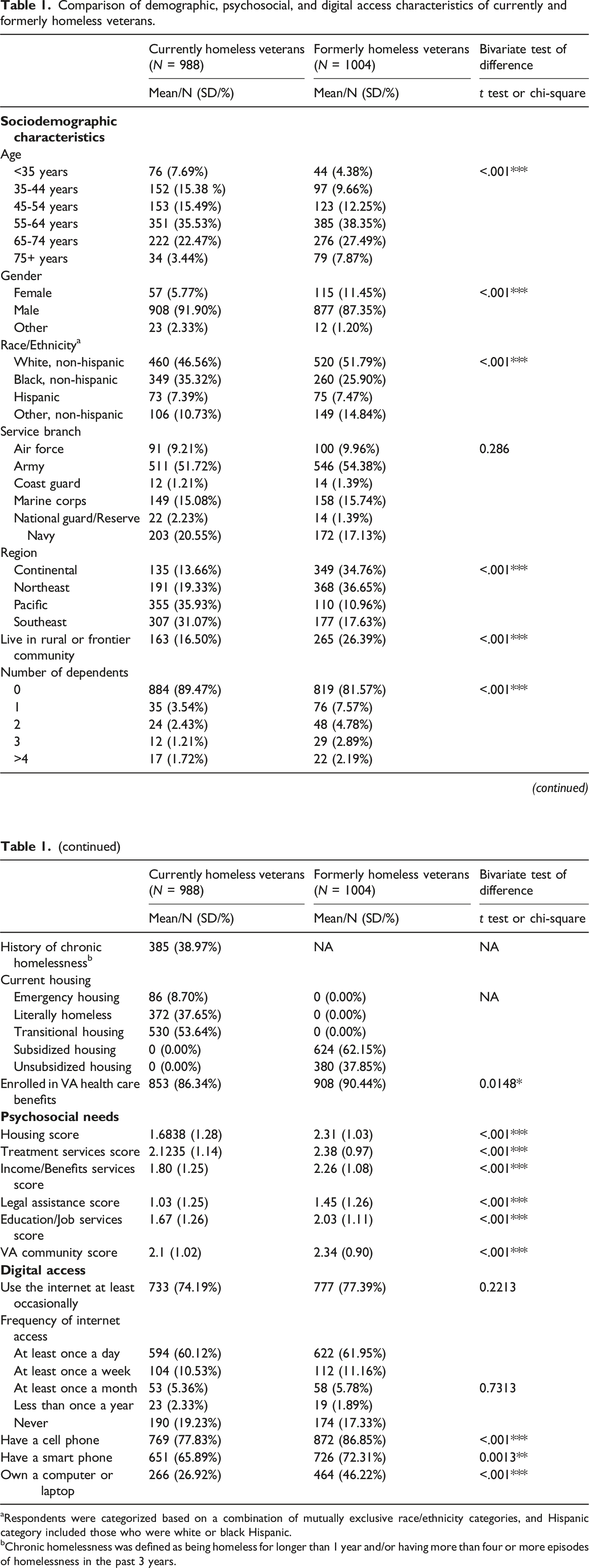
aRespondents were categorized based on a combination of mutually exclusive race/ethnicity categories, and Hispanic category included those who were white or black Hispanic.
bChronic homelessness was defined as being homeless for longer than 1 year and/or having more than four or more episodes of homelessness in the past 3 years.
In terms of digital access, more than 70% of currently and formerly homeless veterans reported using the Internet with about 60% indicating they use the Internet at least once a day. Moreover, over 75% of currently and formerly homeless veterans reported having a cellphone and over 65% reported having a smartphone. There was no significant difference between currently homeless and formerly homeless veterans on their use or frequency of use of the Internet. However, currently homeless veterans were significantly less likely to have a cell phone and a smartphone than formerly homeless veterans; the largest difference was that currently homeless veterans were much less likely to have a computer or laptop than formerly homeless veterans (∆19.30%).
Multivariable analyses examining characteristics associated with Internet use in the total sample of homeless-experienced veterans.
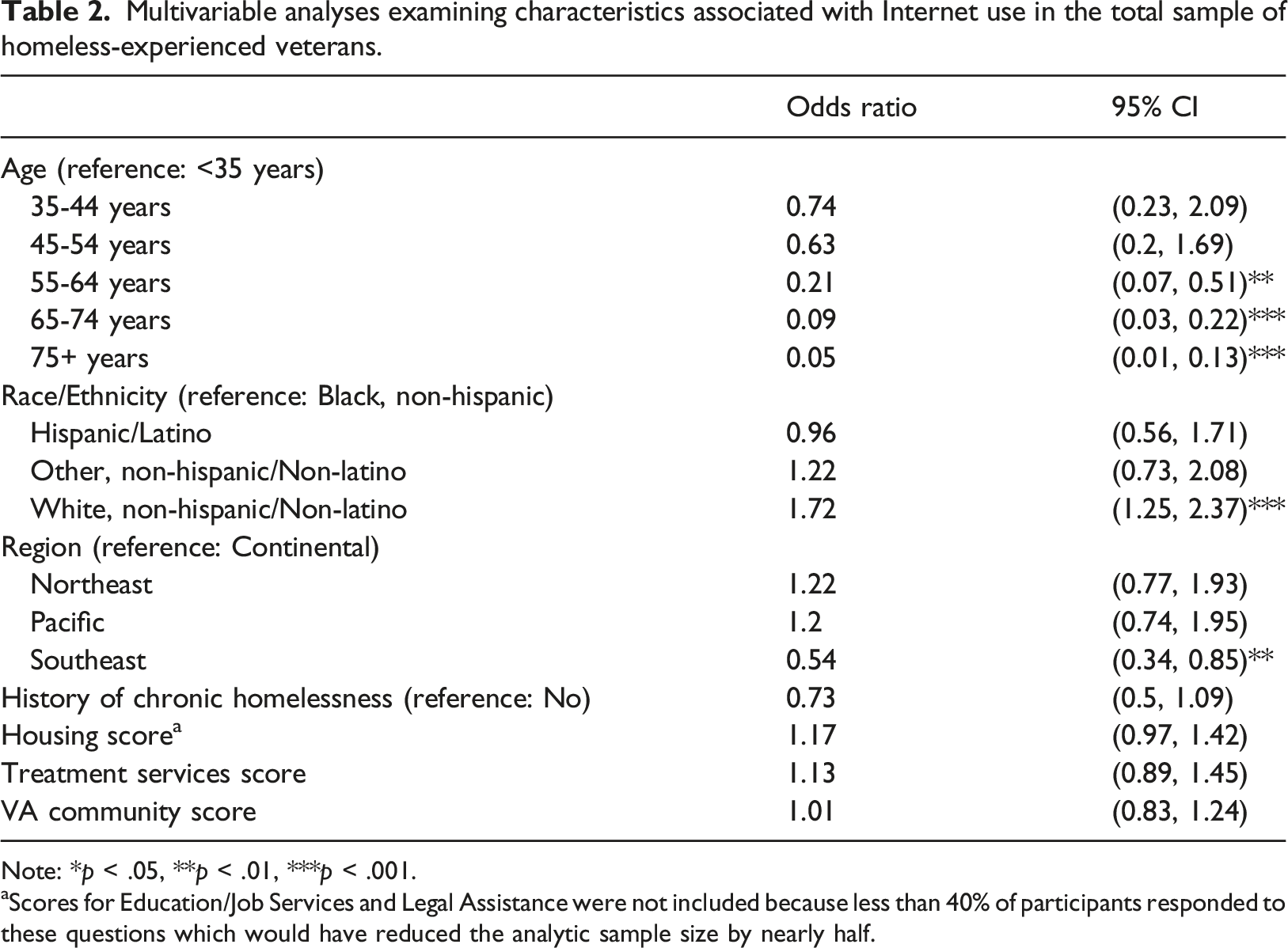
Note: *p < .05, **p < .01, ***p < .001.
aScores for Education/Job Services and Legal Assistance were not included because less than 40% of participants responded to these questions which would have reduced the analytic sample size by nearly half.
Multivariable analyses comparing currently and formerly homeless veterans who never use the Internet.
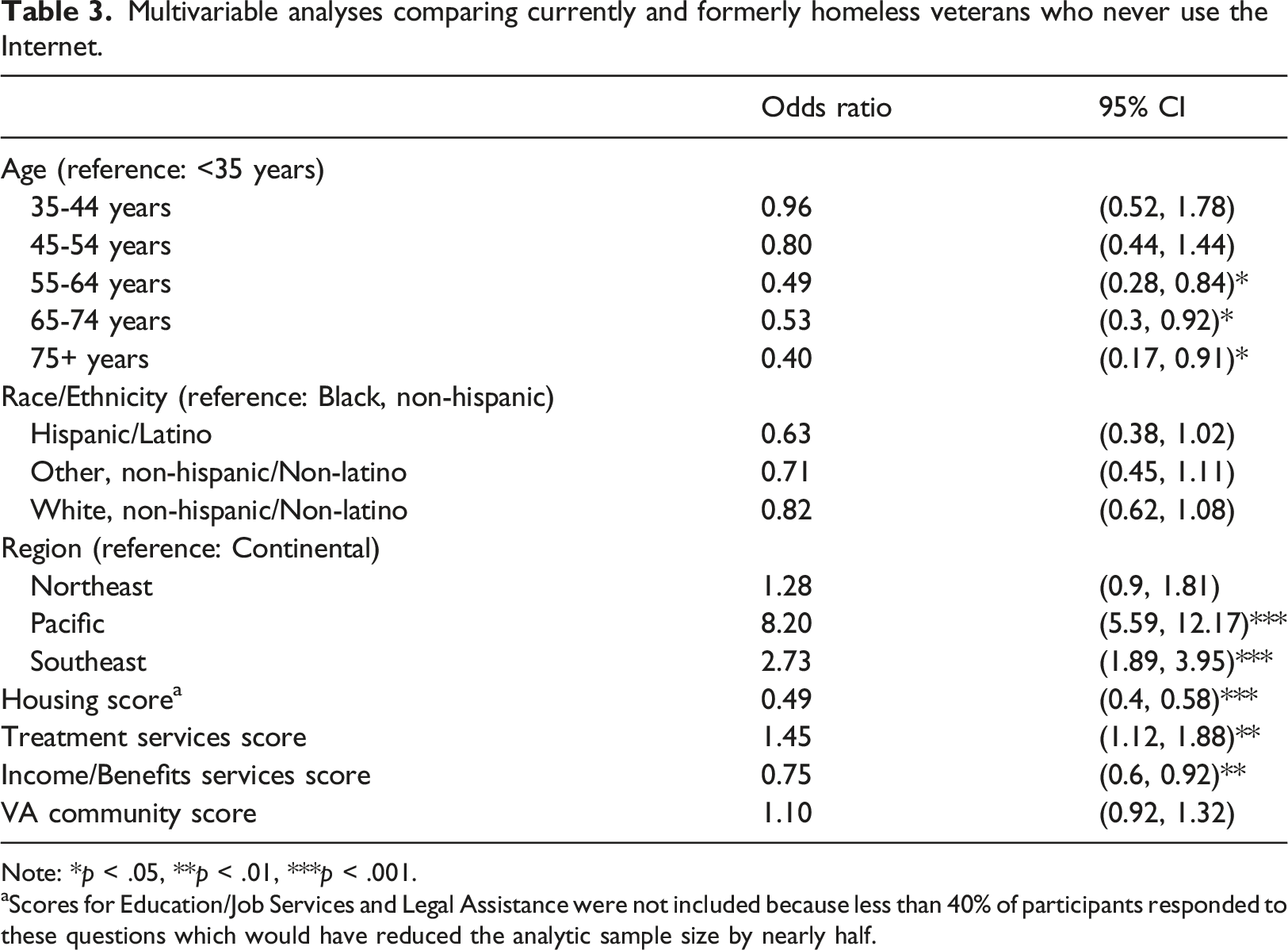
Note: *p < .05, **p < .01, ***p < .001.
aScores for Education/Job Services and Legal Assistance were not included because less than 40% of participants responded to these questions which would have reduced the analytic sample size by nearly half.
Multivariable comparison of currently homeless veterans who use and never use the Internet.
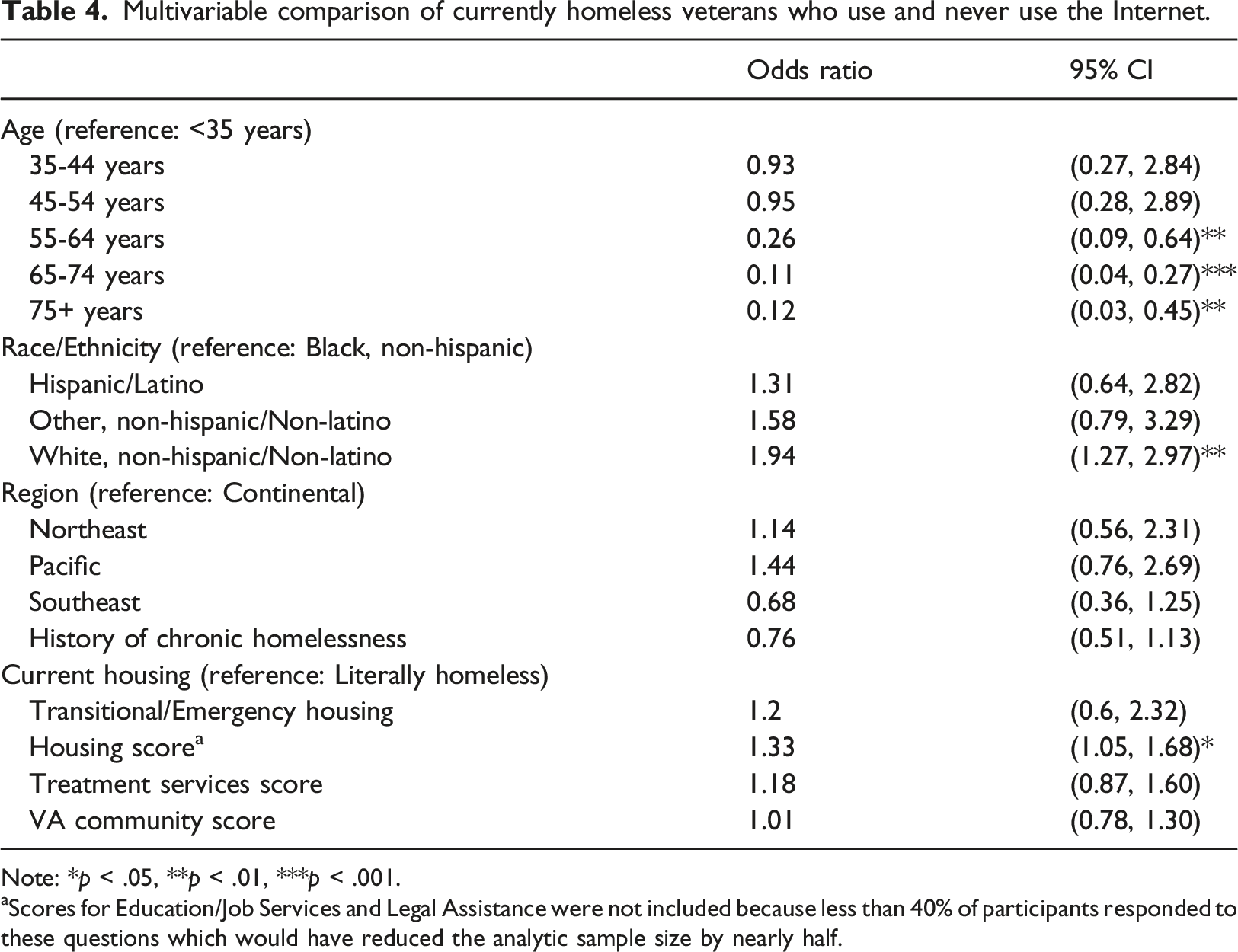
Note: *p < .05, **p < .01, ***p < .001.
aScores for Education/Job Services and Legal Assistance were not included because less than 40% of participants responded to these questions which would have reduced the analytic sample size by nearly half.
Discussion
Using a national sample of HEVs, this study reports 74% of currently homeless veterans and 77% of formerly homeless veterans use the Internet at least occasionally. And among HEV who use the Internet, over 70% reported using the Internet at least weekly. There was no significant difference in overall Internet use or frequency of use between currently and formerly homeless veterans. Our estimates of digital use are much higher than those reported in previous studies of other veteran populations, such as a national study of a general population sample of veterans that reported 71% reported using the Internet 11 and smaller local surveys of veteran subgroups, such as a study that reported 57% of veterans with severe mental illness use the Internet. 4 Our estimates are also generally higher than previous studies of homeless individuals in general, as reported in a 2013 systematic review 1 or a more recent study that surveyed a select sample of older homeless adults and found that 55% had ever accessed the Internet and 72% owned or had access to a mobile phone. 13 However, the vast majority of these cited studies are over a decade old and so our study provides some contemporary data on the topic.
We cannot determine exactly whether digital use has changed for HEVs over the past decade (i.e., more HEVs have access to and are using digital technologies). But given the high rates of Internet use found in our sample relative to previous studies, the findings suggest that perhaps the ‘digital divide’ between HEVs and the general population has reduced over time. This may due to decreasing costs of digital technologies for the mass market and efforts to make them widely available to veterans, has increased access to all veteran. e.g., numerous VA program offices including the Homeless Programs Office, Office of Rural Health, and Office of Connected Care, have distributed free digital devices (e.g., smartphones, tables) to veterans who need them.14–17
Interestingly, we found there was no difference in Internet use between currently and formerly homeless veterans. Because the majority of veterans who are currently homeless are already using digital technologies, there may be little change in their digital use after they exit homelessness. While there may not be much of a ‘digital divide’ between currently and formerly homeless veterans, there were other characteristics found among the overall HEV sample that was associated with never using the Internet. Specifically, older and black HEV were more likely to never use the Internet, which may be interpreted in the context of the marginalization-related diminished returns theory. 9 These two identified characteristics have also been reported in previous studies of digital technology use among veterans in the general population 11 and other homeless populations, 1 and may reflect broad disparities to economic and social resources including access to digital technology.
However, we did find currently homeless veterans who never used the Internet reported significantly greater unmet needs around housing and income/benefits than formerly homeless veterans who never used the Internet. Compared to formerly homeless veterans, currently homeless veterans may have greater overall needs and may face various barriers to care including stigma and transportation barriers in addition to their lack of housing and income. 18 So our findings may reflect the greater needs of veterans who are currently experiencing homelessness, but they also underscore the potential importance of helping these veterans access to the Internet to help with these unmet needs which can be facilitated through digital resources. It is important to differentiate access to digital technologies from uptake of these technologies for healthcare purposes. For example, many HEVs have access to the Internet but there has been low uptake of secure messaging with providers. 19 Moreover, studies have found that use of digital technologies does not ensure social integration. 20 Nonetheless, numerous studies have reported there is great interest among veterans to gain digital literacy and use technology-based therapies for severe mental illness, 4 substance use disorders, 21 posttraumatic stress disorder, 22 and other mental disorders.23,24 There may also be opportunities to deploy the suite of phone apps that VA has developed, 25 along with new virtual reality products for behavioral health. 26 Efforts are needed to help HEV utilize these digital mental health resources, and some studies have begun to examine how best to do that using peers and client-centered approaches. 27
This study had several limitations that can be improved upon in future research. We only had cross-sectional data, and longitudinal data on changes in digital access among HEV is needed. The CHALENG survey items have face validity, but have not been formally validated and may need evaluation of its psychometric properties. We could not infer causality between any variables and could only conclude there were associations. The CHALENG survey consists of a number of single-item measures for various constructs and a more comprehensive survey assessing different dimensions of clinical and psychosocial status may provide more insights. Lastly, our sample only included HEV and so we do not know whether the results are generalizable to other homeless adults. These limitations were outweighed by the strengths of the study which include use of a national heterogeneous sample of HEV; comparisons between currently and formerly homeless veterans; survey items that included multiple questions about access and use of digital technologies; and findings that update the literature on this topic.
Conclusions
The majority of HEV use common digital technologies in the general population, such as smartphones and the Internet. But there are a minority of HEV from certain demographic groups who reported never using the Internet and may need assistance to address health disparities and bridge the digital divide.
Supplemental Material
Supplemental Material - Digital access among a national sample of currently and formerly homeless veterans in 2022
Supplemental Material for Digital access among a national sample of currently and formerly homeless veterans in 2022 by Jack Tsai, Austin Lampros, Jessica Blue-Howells in Health Informatics Journal.
Footnotes
Acknowledgements
Thanks to the for their support of this work.
Declaration of conflicting interests
The author(s) declared no potential conflicts of interest with respect to the research, authorship, and/or publication of this article.
Funding
The author(s) disclosed receipt of the following financial support for the research, authorship, and/or publication of this article: This work was supported by the Veterans Health Administration, Homeless Programs Office. J. Tsai conceptualized and wrote the paper. A. Lampros conducted the analyses. J. Blue-Howells helped edit and review the paper.
Ethical statement

Supplemental Material
Supplemental material for this article is available online.
References
Supplementary Material
Please find the following supplemental material available below.
For Open Access articles published under a Creative Commons License, all supplemental material carries the same license as the article it is associated with.
For non-Open Access articles published, all supplemental material carries a non-exclusive license, and permission requests for re-use of supplemental material or any part of supplemental material shall be sent directly to the copyright owner as specified in the copyright notice associated with the article.
