



Abstract
Introduction
The internet is inundated with questionable information on oral health, leading to a concerning surge in the dissemination of incorrect data and the adoption of harmful beliefs by the general population.1–3 It is noteworthy that people can accept and share such information, contributing to the propagation of detrimental concepts related to oral health.4,5 Additionally, cultural traditions and popular values significantly shape beliefs about health in various societies, further influencing individual and collective perspectives.6,7
A striking example of this influence is evident in the search for antibiotics to alleviate toothache. It is a debilitating symptom stemming from various oral conditions, significantly impacting both oral health and overall quality of life. This burden is particularly pronounced among socioeconomically vulnerable populations, especially in developing countries, exerting a disproportionate influence on essential facets of existence such as sleep, nutrition, and academic and professional performance. 8 Many individuals, seeking immediate relief, consult non-dental professionals such as general practitioners and emergency services. Moreover, self-medication is prevalent among those experiencing toothache,9,10 often driven by the information available on social media,8,11,12 where the wide spectrum of information quality and accuracy heightens the risk of inaccurate self-diagnosis and self-medication. Furthermore, amid the backdrop of the COVID-19 pandemic, while misinformation on social media predominantly focused on vaccines due to political polarization,13,14 the state of social isolation prompted many individuals to seek remedies for toothache online, encompassing home treatments, medications, and guidance on finding a dentist.8,10,11 However, the subpar quality of available online information about toothache may lead individuals to adopt inappropriate approaches, exacerbating dental issues. 15
Consequently, this complex landscape presents a considerable challenge for public health stakeholders. It underscores the critical need to comprehensively understand the impact of digital platforms on healthcare decisions, specifically on seeking pain relief and engaging in self-medication. It can adversely affect oral health, jeopardizing the relationship between patients and healthcare professionals and impeding shared decision-making.16–18 In this sense, the conduction of infodemiology studies is imperative to determine the contributory features of authors and posts to the dissemination of digital oral health information, particularly on Facebook, the world's largest social media available and one of the most prolific platforms for the propagation of misinformation.19–22 Although it is frequently utilized for accessing and disseminating health-related information, the absence of robust content validation mechanisms can propitiate the spread of misinformation. 23 A previous study showed that toothache-related misinformation was associated with positive sentiment and financial motivation on Facebook posts from developed countries. 24 However, there is a lack of research on this subject in developing countries with other native languages, such as Brazil.
Therefore, this study aimed to identify Portuguese-language posts on Facebook related to toothache, discerning specific factors that drive misinformation production and user engagement. Active production and consumption of information on social media can be explained by factors demonstrated in the Theory of Planned Behavior. 25 It encompasses five determinant constructs: external variables, attitude, injunctive and descriptive norms, perceived behavioral control, and intention. External variables include individual and environmental characteristics. Attitude refers to the degree to which a person evaluates the behavior of interest as favorable or unfavorable. Injunctive and descriptive norms are the customary codes of behavior within a group or larger cultural context, encompassing beliefs about whether most people approve or disapprove of the behavior. Perceived behavioral control is a person's perception of how easy or difficult it is to perform the behavior of interest. Intention refers to the motivational factors that influence a specific behavior. Together, these constructs shape an individual's volitive actions.
Methods
Regarding the definition of infodemiology (or information epidemiology), the study of the determinants and distribution of health information and misinformation, 26 that is, in congruence with the distribution of health and disease in a defined population, the authors followed the Strengthening the Reporting of Observational Studies in Epidemiology (STROBE) guidelines 27 to accurately and comprehensively report the methods and findings of this cross-sectional digital study.
Study design
In this infodemiology study, 500 posts in Portuguese related to toothache published on Facebook between August 2018 and August 2022 were analyzed. Using CrowdTangle, posts with the highest number of user interactions were selected, and information regarding their publication dates, total interactions, and top overperforming scores was collected. Two independent investigators, who were blinded to peer review, conducted a qualitative analysis of the posts to categorize them based on their motivation, author profile, content type, sentiment, facticity, and the format of the post. The statistical analysis followed the methods described later.
Ethics
For this study, there was no need to get approval from the institutional ethics committee since it only used publicly available data from the Internet and did not directly involve people. 28 To protect user privacy, all the posts went through a process to hide personal information, such as names, profiles, and faces in pictures. The raw data, with the personal details removed, is shared on the Figshare repository.
Search strategy, data collection, and preprocessing dataset
The collection of posts related to toothache on Facebook was carried out using the CrowdTangle tool, developed by Meta Inc to track and analyze public content on social media. It is important to note that access to CrowdTangle is restricted to a selective group of qualified organizations, which includes researchers and university academics. Our research group obtained specific authorization to use this tool, aimed at studying misinformation in the area of Dentistry.
In the search process for relevant publications, keywords related to toothache were inserted, using associations with Boolean terms and hashtags in Portuguese, through the CrowdTangle search bar. The search strategy “toothache” + “tooth pain” + “toohaches” + “sore tooth” + “sore teeth” + “aching tooth” + “throbbing tooth” + “throbbing teeth” was developed after an exploratory analysis of terms and hashtags, aiming to maximize the retrieval of relevant data on Facebook. 1 On October 26, 2022, we downloaded a dataset containing 10,000 posts in Portuguese published between August 2018 and August 2022 in .csv format, including Facebook pages, public groups, and verified profiles. To ensure we include the most relevant posts, we classify posts based on total user interaction, which encompasses reactions, shares, and comments. We also use the overperforming score to evaluate the reach of posts relative to the last 100 posts on the same account.29,30
Data was collected following the previously mentioned strategy, resulting in the automatic generation of a .csv file by CrowdTangle. This file contained detailed information, such as the name, category, description, country, and number of followers of the profiles from which the publications originated. Additionally, it included details of the posts themselves, such as content, date, time, number of reactions, comments, shares, video views, and URLs to web pages. Each post was accompanied by a direct link that made it easier for researchers to access information about the user who created it, including name and photo. All of this data has been carefully compiled and stored in an open-access Figshare repository, available for further analysis.
For in-depth qualitative analysis, a sample size of 500 posts with the highest total interaction was determined according to previous studies.24,29,31 For that, we analyzed 899 Portuguese-language retrieved posts, resulting in the exclusion of 39 posts not related to toothache, 5 posts produced by authors from non-native Portuguese speakers' countries, 7 posts with inaccessible links, and 348 repeated posts. As part of this process, two independent researchers (TSM and MMM) conducted a manual assessment of the raw data. At this stage, posts that did not meet the predefined inclusion criteria were excluded, resulting in the selection of 500 relevant posts for analysis (Figure 1). To ensure uniformity and avoid inconsistencies, an independent researcher (TSM) numbered the posts and arranged them in sequential order in Google Slides (Google, Mountain View, CA, USA), and converted them to pdf format. This systematic procedure provided an ethical analysis of the messages by different researchers at different times. Flowchart depicting the process of selection of posts.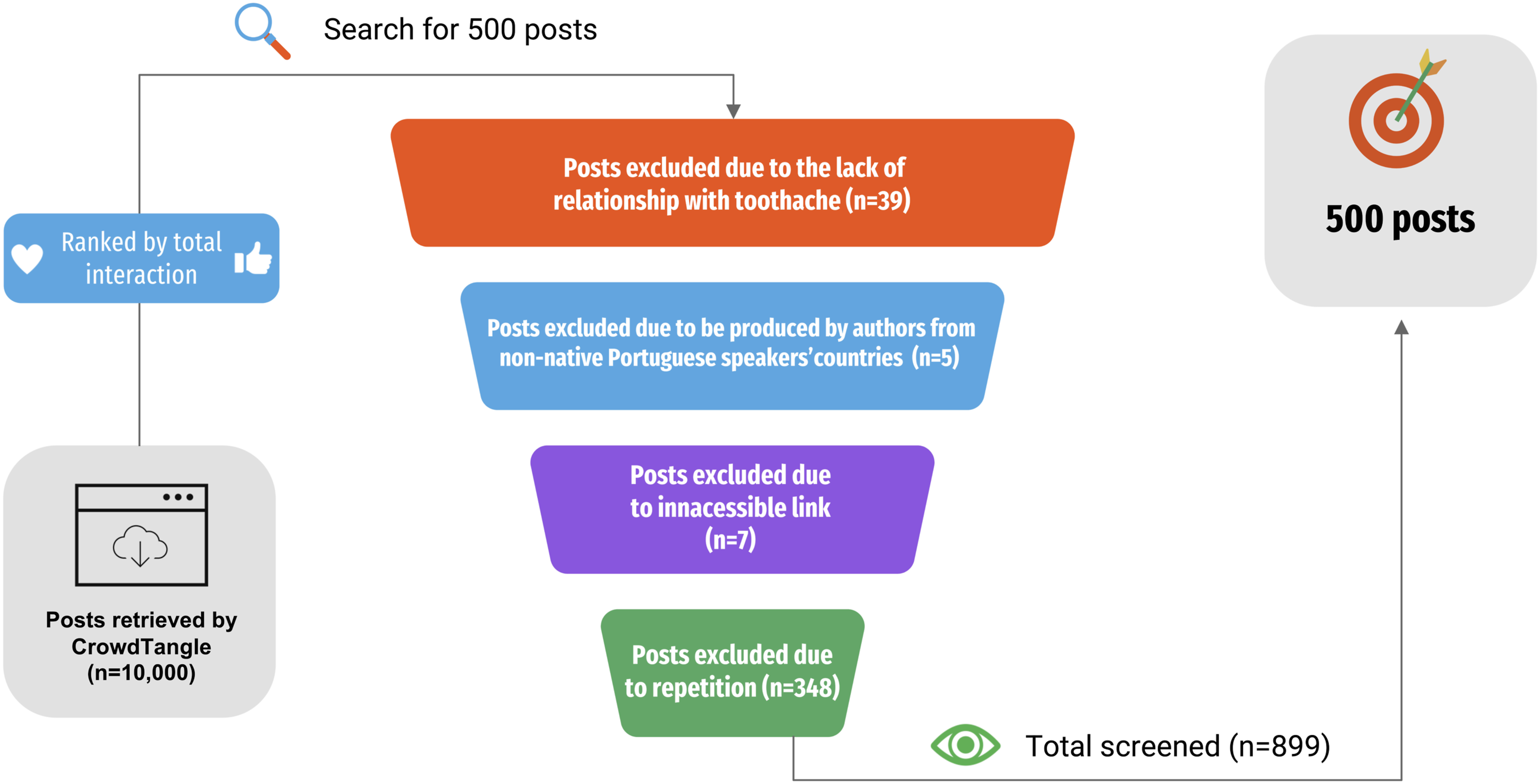
Data analysis
Qualitative analysis
Two independent investigators ( TSM and MMM) received comprehensive training to conduct a critical analysis of the content, including in-depth discussions about the key elements for characterizing the posts. To ensure precise calibration, we implemented categorization criteria based on criteria such as facticity (whether they contained reliable information or misinformation), author’s profile (regular users, companies, dental offices, or healthcare professionals), type of content (non-commercial or commercial), motivation (financial or non-financial), sentiment (positive, neutral, or negative), and format (photo, status, link, or video). This calibration process involved classifying 50 randomly selected posts from the sample and continued until the inter-examiner agreement reached an adequate level, defined as an Intraclass Correlation Coefficient (ICC) greater than 0.7. The ICC values for all parameters in this analysis ranged from 0.710 to 1.000, demonstrating a high degree of reliability. This rigorous training and calibration process was crucial in ensuring the accuracy and consistency of the investigators’ content assessments.
In cases of disagreements, researchers jointly reviewed the posts to reach a final consensus, ensuring the quality of the analysis. The analysis of the author’s profile considered the description of profiles and pages on Facebook, classifying them as regular users (including digital influencers or blogs), companies (commercial entities, stores, or profiles with posts from media outlets or news agencies), and dental offices (dentists, healthcare professionals, clinics, or hospitals).
‘Misinformation’ was defined as an overarching term encompassing content that is either false or misleading, irrespective of any intent to deceive or cause harm. This approach integrates two distinct types of information pollution: ‘misinformation,’ which involves the unintentional spread of false information, and ‘disinformation,’ which involves deliberate deception.32,33 The accuracy of the content was evaluated against current scientific evidence, including guidelines, consensus statements, and systematic reviews related to toothache management.34,35 A post was considered to contain misinformation only if it unequivocally presented false or misleading information with the potential to harm Facebook users.
Posts were categorized as commercial if they originated from profiles whose primary aim was to sell products or services. 36 Moreover, the motivation behind false or misleading digital content can stem from various interests that can be shortened to financial (profit-driven and sales-related messages) and non-financial (including other intentions such as social, political, and psychological). 32 Both classifications were mutually exclusive.
To reduce the subjectivity, a predefined protocol was used to classify sentiment content based on visible indicators. Posittive sentiments were identified by smiles, words related to disease prevention, motivational messages, and happy emojis. Negative sentiments were indicated by expressions of sadness, text with negative connotations, references to illness, pain, suffering, tooth loss, or negative emojis. Content considered neutral, such as journalistic news, scientific research findings, or clinical case reports, expressed no particular sentiment. The categorization of positive emotions as a distinct category was based on the theory that positive emotions correlate with higher user engagement on social media.24,29,31
The classification of format was automatically determined based on data collected from CrowdTangleTM. Each post was classified into a single format. If a post included a video, it was categorized as a video format, even if other media forms were present. The same classification method was applied to posts containing links. Consequently, posts categorized as photos or statuses did not include links or videos.
Statistical analysis
Statistical analysis was performed using Stata SE 17.0 software (StataCorp., College Station, TX, USA). Initially, variables were transformed into dichotomous categories based on the following criteria: motivation (non-financial or financial), author’s profile (regular user or business/health), type of content (non-commercial or commercial), sentiment (negative/neutral or positive), facticity (information or misinformation), and format of post (photo/status or link/video).
The dichotomization of continuous variables time of publication, total interaction, and overperforming score was done by categorizing them based on their median values. Dental practices, news agencies, and business profiles were grouped due to their similarities in financial histories.
Previous evidence of the connection between positive sentiment and increased social media engagement rates 37 determined the dichotomization of this classification. Since a post presents only one predominant sentiment (positive, neutral, or negative), the neutral and negative sentiments were dichotomized in the same side to test the influence of positive sentiment on the users’ engagement with toothache messages.
The normality and homogeneity of the data were assessed using the Kolmogorov-Smirnov and Levene tests, respectively. As the data did not follow a normal distribution, the Mann-Whitney U test was applied to compare total interaction and overperforming scores between the categorized variable groups.
Path analysis using generalized structural equation modeling (GSEM) was employed to assess the association between the dichotomized categories mentioned earlier concerning the Theory of Planned Behavior.
25
In this study, the ‘author’s profile’ represented individual characteristics, ‘motivation’ represented intention, and the ‘sentiment,‘ ‘content,‘ ‘format’, and ‘facticity’ of posts represented behavior. Since the volitional behavior (published post) was already consummated, the constructs ‘attitude’ and ‘perceived behavioral control’ were equated to ‘favorable evaluation of the behavior’ and ‘perception of the ease of performing the behavior,‘ respectively. Environmental characteristics and injunctive and descriptive norms were represented by the internal latent variables ‘social environment’ (differences in societies) and ‘normative beliefs’ (differences in sense of cohesion), as these influences could not be adequately measured due to the lack of variability in these criteria from only including posts in Portuguese. Interaction metrics were also incorporated into the model as a result of the behavior, considering that the characteristics of posts can attract the audience at specific times. The internal latent variable ‘social media structure’ was included in the model since processes within social media can influence total interaction (e.g., algorithmic sorting of searches and feeds, artificial interaction mechanisms). Additionally, the overperforming score varies according to audience interactions with posts from the same author, influenced by the time frame that affects trends in the total number of followers and posts over time (Figure 2). Path analysis by generalized structural equation modeling. Rectangles represent observed variables and ellipses represent latent variables. Red arrows indicate significant statistical associations between factors.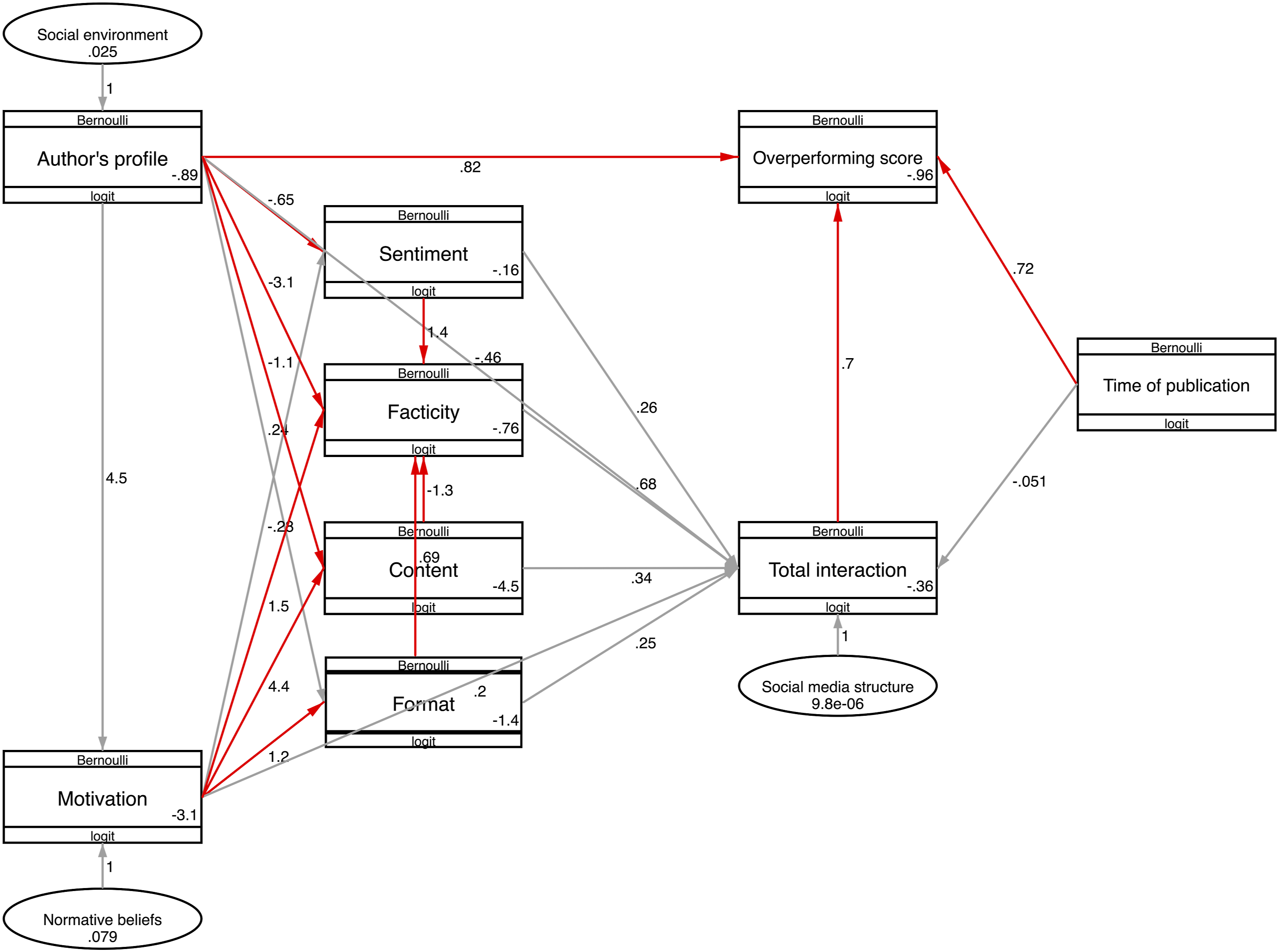
A significance level of p < .05 was adopted for all analyses.
Results
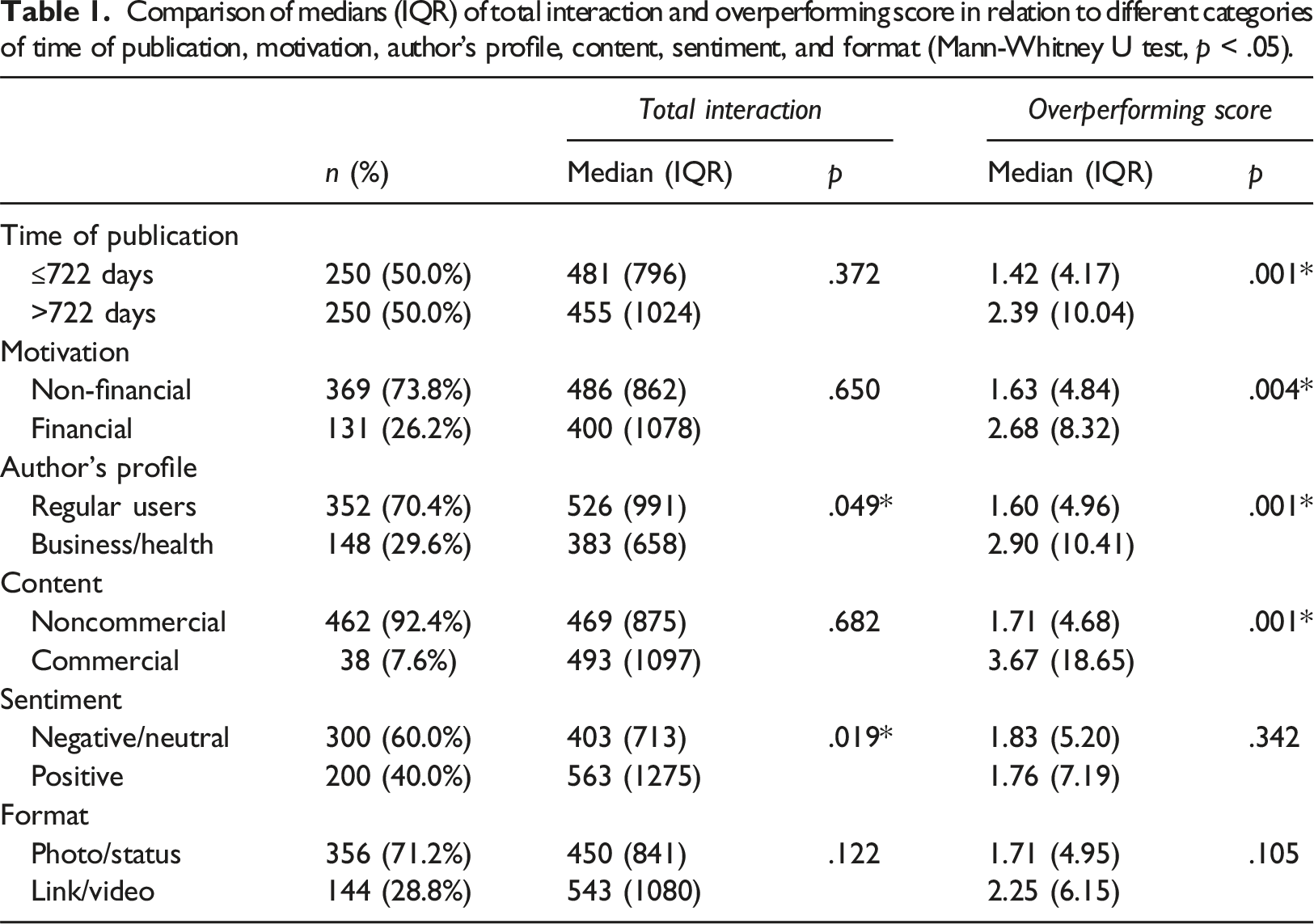
Comparison of medians (IQR) of total interaction and overperforming score in relation to different categories of time of publication, motivation, author's profile, content, sentiment, and format (Mann-Whitney U test, p < .05).
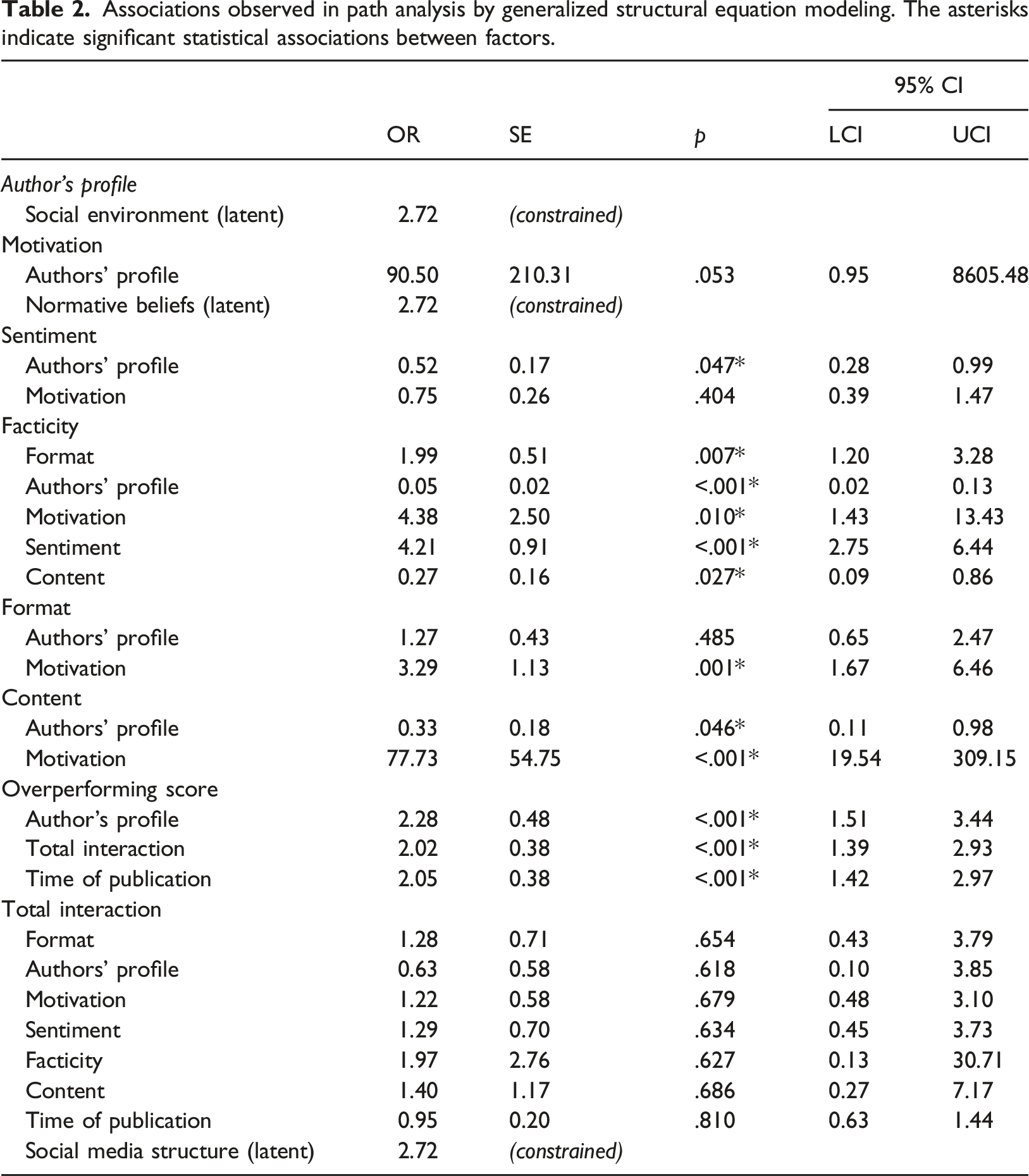
Associations observed in path analysis by generalized structural equation modeling. The asterisks indicate significant statistical associations between factors.
Discussion
This study provides an in-depth analysis of toothache-related information disseminated in Portuguese on Facebook, concentrating on metrics gauging misinformation and user engagement. The results reveal that 39.6% of posts (n = 198) contained misinformation. This phenomenon was significantly associated with noncommercial posts with positive sentiment and containing links and videos, produced by regular users with financial motivation. However, it was not associated with user engagement with posts, which was positively associated with business/health authors’ profiles and their total interaction and time of publication.
The association between older posts and increased overperforming scores can be attributed to the sustained availability of content on social media, enabling users to actively access materials according to their interests over an extended period.13,25 Additionally, the association of misinformation with financial motivation can be explained by the promotional and communication efforts to forge emotional connections with consumers using persuasive discourses,38,39 expanding their reach among social media users, particularly when endorsed by celebrities. 40 In such instances, medications and treatments were recommended by companies and dental clinics to influence or attract individuals.
A noteworthy observation is that misinformation-containing posts were usually shared by regular Facebook users, underscoring the allure of digital content on social media imbued with a personal touch and positive sentiment. Internet users connect with those who share their health-related interests, such as people seeking advice on tooth pain relief. Sharing experiences of stress and distress related to toothache fosters understanding and acceptance within the target audience, 5 facilitating social connection and offering a sense of belonging and validation. 41
Despite national statistics indicating a reduction in cases of toothache in Brazil, 42 online searches on the topic are on the rise, reflecting increased internet access in developing countries that encourages people to seek information even for mild symptoms, often influenced by alternative treatments, home remedies, or medication-related posts. 8 Users are naturally drawn to this type of content due to information and observation bias, reflecting the human tendency to seek excessive information when confronted with problems. This often results in the validation of content based on confirmation bias.41,43
The connection between misinformation and positive emotions can be elucidated by the tendency of deceptive content to endorse alternative treatments, home remedies, and pain relief strategies, perpetuating the notion that seeking dental treatment is unnecessary. Some instances even employ satire, enhancing the appeal of false information to those who engage with the content. 36 In contrast, trustworthy information guides people in locating healthcare professionals, providing insights into treatment costs, medication alerts, or a more holistic exploration of diseases.
This analysis demonstrated that posts featuring links and videos were associated with misinformation. This phenomenon can be explained by the need of content producers to convince their audience about the quality of homemade remedies or natural products, to entice potential customers and drive sales within specific groups.44,45 While videos evoke emotions in individuals grappling with toothache, thereby fostering engagement and content dissemination on Facebook, links offer the opportunity to buy the respective products. Although these approaches aim to increment the interaction with the public, influencing decision-making, 46 posts containing links and videos were not associated with higher interaction metrics.
These findings emphasize the importance of devising methodologies for identifying and evaluating the spread of misinformation on social media, particularly in Dentistry. Inaccurate information about toothache can cause detrimental effects on patients, exacerbating their clinical conditions. The free availability of information underscores the need to advocate for digital literacy and share reliable oral health information to counteract the impact of misinformation. Researchers and dental professionals must be aware of the widespread dissemination of unreliable information and enhance patient-professional communication patterns. This study also underscores the necessity of implementing regulations to combat the proliferation of misinformation, including the content verification mechanisms on social media.
These findings should be approached with caution, considering certain limitations. Firstly, our analysis focused exclusively on posts in Portuguese, potentially constraining our grasp of cultural nuances and specific characteristics unique to this language and region. Moreover, it failed to consider regional variations that might influence factors associated with the diffusion of information about toothache. Secondly, the sample size for this study was constrained, primarily due to the challenges of conducting content analysis through human assessment and the time constraints inherent in the project. The manual creation and classification of datasets also contributed to the limitation in sample size, despite adhering to a methodology rooted in prior studies.29,47 Thirdly, the engagement analysis did not consider activities from artificial metrics amplification mechanisms, such as boosts and bots, which could have offered a more comprehensive view of the reach of posts. Fourthly, the thematic of posts were not examined in this study. Such qualitative analysis requires additional methodological approaches, highlighting the need for future research to understand the engagement mechanisms more comprehensively. Fifthly, the subjectivity of the classification process of motivation and sentiment was minimized by duplicate assessments and consensus among trained and calibrated investigators, thereby enhancing the reliability of our findings.24,29,31 Finally, these data covered toothache-related content published on Facebook until August 2022. Updating the data would be cumbersome due to the difficulties in manually collecting and analyzing post content. However, in infodemiology studies, information is understood as an entity to be epidemiologically analyzed, regarding contexts such as space and time. Further infodemiology studies can then detect changes in the patterns and determinants of misinformation characteristics, similar to how epidemiological studies detect changes in the patterns and determinants of diseases over time.
Conclusion
In conclusion, the frequency of toothache misinformation on Facebook is a cause for concern. Misinformation was primarily shared by regular users in links and video formats, often tied to positive sentiments, and generally with financial motivation. To address this issue, it is crucial to enact policies geared towards elevating the overall quality of information on social media platforms. Initiatives promoting solutions for verifying information accuracy and enhancing digital health literacy, including educational electronic interventions, fact-checking strategies, and warning messages alongside posts to discredit falsehoods are imperative in mitigating the impact of misinformation in oral health.
Footnotes
Acknowledgements
The authors are grateful to Meta Platforms Inc for granting the use of the CrowdTangle.
Author contributions
TSM: Investigation and Investigation, Writing - original draft. MMM: Investigation and Writing - review & editing. ML: Formal analysis and Investigation and Writing - review & editing. OSJ, AMJ, and PEAA: Writing - review & editing. TC: Conceptualization, Methodology, Investigation, Writing - review & editing, Supervision, Project administration.
Declaration of conflicting interests
The author(s) declared no potential conflicts of interest with respect to the research, authorship, and/or publication of this article.
Funding
The author(s) disclosed receipt of the following financial support for the research, authorship, and/or publication of this article: This study was funded by the National Council for Scientific and Technological Development (grant # 406693/2021-8) and by the São Paulo Research Foundation (grants #2021/10893-9 and #2022/08823-5).
