



Abstract
Introduction
About 80 % of adults have all four wisdom teeth in their dentition. However, only 50 % of these teeth are expected to erupt into the oral cavity, making their removal the most common surgery for developmental conditions. 1 Solely in the United Kingdom (UK), around 150.000 patients undergo this procedure annually. 2 Therefore, wisdom teeth extraction is a routinely conducted procedure in the field of dentistry and maxillofacial surgery. 3 With an incidence of under 10 %, there is a low risk of complications during and after the intervention.4–7 Wisdom teeth extraction is indicated for therapeutic purposes (e.g., carious decay, root resorption) in patients with problems caused by the wisdom teeth and prophylactic reasons (e.g., orthodontic cause, prosthodontic treatment).8,9 The most common indication for the removal of wisdom teeth is an inflammation of the periodontium called pericoronitis. 10 This circumstance is often associated with severe pain, inflammation, and even functional limitations such as jaw lock. When treated insufficiently, inflammations of the orofacial system can quickly spread to the brain or the mediastinum and become a life-threatening emergency. 11 Therefore, early symptoms must be taken seriously, and professional assessment should be conducted.
The browser Google (Google LLC, Montain View, CA, USA) is frequented my millions of people daily, making it the most used search engine worldwide. 12 A free available feature offered by Google is Google Trends (GT). This tool allows regional and seasonal trends in Google search inquiries to be easily analyzed.
In many cases, given the availability of the world wide web, affected patients “google” for symptoms first rather than seeking out health professionals. 13 Expressly for wisdom teeth extraction, the published data analyzing online search patterns as well as regional and seasonal differences is still deficient. To the best of the authors’ knowledge, only one study has been identified so far that investigates the public interests related to wisdom teeth related search terms. 14 Hence, it is highly relevant to further study the web-based interest in wisdom teeth-related search terms to identify patterns in the general population’s search behavior.
However, numerous authors have employed Google Trends analysis to evaluate public interest in specific terms or conditions.15–17
This study aimed to assess the public inquiry interests for wisdom teeth-related search terms as well as possible patterns (e.g., seasonal variations) regarding this topic. Therefore, a Google-based search query was utilized to identify infodemiological aspects. Infodemiology is the scientific study of the dissemination and determining factors of information within electronic media, particularly on the Internet. 18
Material and methods
We conducted an infodemiological study to analyze the public interest in wisdom teeth-related search terms using Google Trends.
Google trends (GT)
Google trends offers the possibility to analyze the online search interest worldwide. The dynamic and real-time analysis tool is publicly available and can conduct investigations specified by the timeframe (real-time or customized timeframe) dating back to 2004. In addition, the online search interest can be particularized by category (e.g., business, health, and entertainment,), geographical region (e.g., worldwide, country or state), and content (e.g., web search).
By normalizing search volumes, GT can show interest in specific search terms and compare them. Thereby, a comparison between up to five different search terms is possible simultaneously. This GT feature is termed the relative search volume (RSV). Essentially, the RSV function divides the number of searches for a specific term by all queries made and thus returns a value between 1 and 100. Accordingly, a higher score indicates amassed interest. Invariably within the selected time frame, a point in the curve representing a day, a week, or a month, will have a value of 100. This value reflects the point in time when the search term had the highest proportion of all inquiries.
Related search terms is an another tool within GT. When entering a specific term on GT the tool shows the user further search terms, which were entered together in the same query session in the Google browser. There are two categories in which this data can be sorted. The most popular related search terms are listed in the “top category” while the “rising category” displays queries with the most significant increase since the beginning of the selected period.
In GT, search analyses at different time points lead to different results for each analysis, despite fixed specifications (e.g., time point, geographical region) having been set. This seems to be linked to the cause that out of the total of available data, a different sample is selected for each GT analysis. This have been previously discussed by several authors.15–17
Search strategy
Regarding the search methodology the study strictly followed the principles described in a previous work by Mavragani et al.. First, the study team set “wisdom teeth” as the primary search term of interest. In order to examine health-specific interests, the category “health” was selected for each analysis. With this setting, the analysis was conducted from January 1st, 2004, to September 31st, 2021, in order to cover the longest available time frame.
The GT function related search terms was used in a second step. All relevant search terms found in the top category of each country after entering the primary search term “wisdom teeth” on GT were listed. These search terms were compared with one another in each country. For each country the search term with the highest RSV was used for all further steps.
An additional aim of the study was to assess seasonal variations of wisdom teeth-related search inquiries. Therefore, the study included countries from the northern and southern hemispheres. The United States of America (USA), the United Kingdom (UK), Canada, and Australia represented English-speaking countries from both hemispheres. December to March were considered winter months in the northern hemisphere and summer months in the southern hemisphere. Conversely, June to September were regarded as summer months in the northern hemisphere and winter months in the southern hemisphere. To assess the validity and reproducibility of the extracted data, the most representative search term from each country was entered (i.e., the one with the highest RSV) on seven consecutive days starting on October 26th, 2021 and compared the reported metrics. The downloaded survey results for each term, country, and day resulted in 204 data points.
Statistical analysis
The intraclass correlation coefficient according to Shout and Fleiss (ICC) was applied to assess the reliability of the retrieved GT data and interpreted as follows: ICC <0.5 was appraised as poor, ICC ≥0.5 and <0.75 as moderate, and ICC ≥0.75 to <0.9 as good reliability. The reliability was rated excellent with an ICC ≥0.9. 19
The “season” and “psych” packages in R 3.5.1 (R Development Core Team, 2008; R Foundation for Statistical Computing, Vienna, Austria) aided the analysis and visualization of the data. All data from the first-day retrieval (single time series) and the calculated mean value of data extracted from seven consecutive days (averaged time series) was marked out in RSV using Cosinor analysis. The cosine model uses sine and cosine parameters to fit a sine wave based on a linear model. These two parameters can determine the sinusoid’s annual seasonal fluctuations amplitude A (size) and phase P (peak).
The cosine model assumes that the seasonal pattern is symmetrical and stationery. However, since this study investigates seasonal variations, a peak and a low point (peak +6 months) had to be defined once a year.
The statistical significance was tested in the context of the generalized linear model. The p-value was set to 0.025 to control the type I error rate.
Ethical considerations
Since the current study only manages publicly accessible data, there was no need for ethical approval.
Results
Related search term analysis
As mentioned above, to ensure that the most relevant search term was used for subsequent searches, we compared all wisdom teeth-related search terms with each other using the comparison function. The most representative search term (highest RSV) was picked for each country. Not only a different RSV, but also different related search terms were found when comparing the investigated countries.
In Australia, the RSV for “wisdom teeth” was 54.4. The two most popular related search terms were “wisdom teeth removal” with a RSV of 15.6 and “wisdom tooth” with an RSV of 23.5. Furthermore, the RSV for the search term “wisdom tooth” was analyzed. The term showed an RSV of 46.8 and was entered less frequently on the Google search engine in Australia.
Australia’s results varied to those found in Canada where “wisdom teeth” had an RSV of 49.7. Nevertheless, the related search terms with the highest value were also “wisdom tooth” (RSV = 17.9) and “wisdom teeth removal” (RSV = 14.9). Analyzing “wisdom tooth” as the primary search term, the RSV was 43.9. However, the related search terms of “wisdom tooth” showed a higher RSV than the plural (“wisdom teeth removal” RSV = 36.5 and “dry socket” RSV = 21.5).
The highest RSV for our primary search term was found in the United Kingdom (RSV = 60.3). Related search terms of inquiry were “wisdom tooth pain” (RSV = 14.6) and “wisdom teeth removal” (RSV = 10.9). For “wisdom tooth” as the primary search term, an RSV of 44.3 was found in the United Kingdom.
For “wisdom teeth” an RSV of 52.9 was reported when analyzing search inquiries in the United States of America (USA). The most popular related search terms of the USA were “wisdom tooth” (RSV = 19.2) and “wisdom teeth removal” (RSV = 15.2). The primary search term “wisdom tooth” was less popular in the USA. However, with an RSV of 50.1, the USA was the only country where “wisdom tooth” had a comparable volume to “wisdom teeth”.
Reliability of the data from GT
Reliability of single and averaged time series data on the search terms “wisdom teeth” in Australia, Canada, the United Kingdom, and the United States of America.
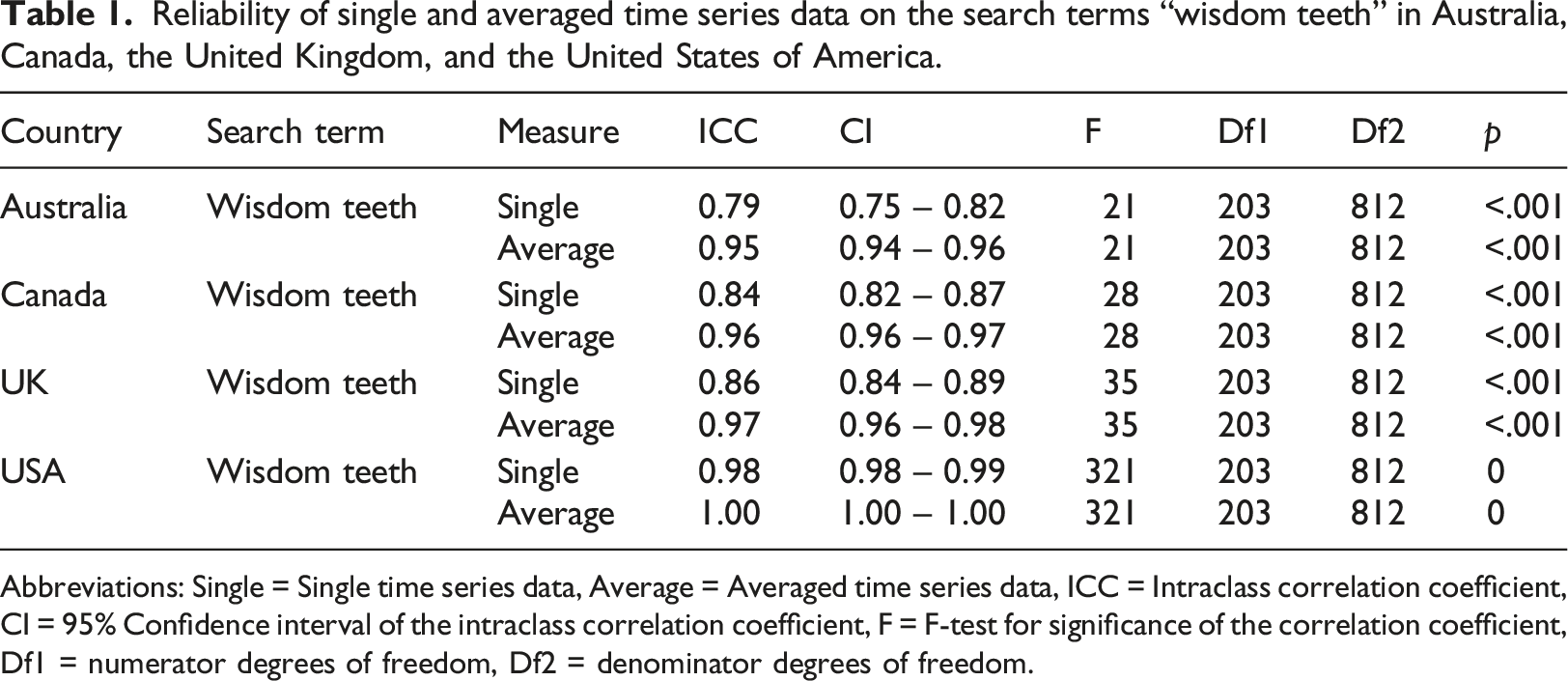
Abbreviations: Single = Single time series data, Average = Averaged time series data, ICC = Intraclass correlation coefficient, CI = 95% Confidence interval of the intraclass correlation coefficient, F = F-test for significance of the correlation coefficient, Df1 = numerator degrees of freedom, Df2 = denominator degrees of freedom.
Seasonal variations (peaks and nadirs)
Cosinor analysis on seasonality of the search term “wisdom teeth”.
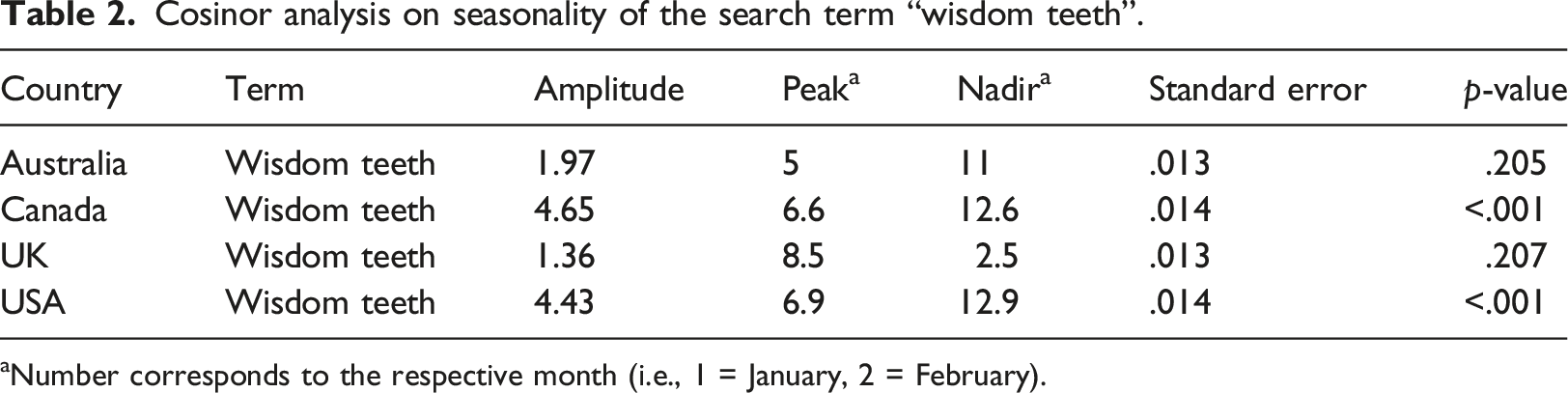
aNumber corresponds to the respective month (i.e., 1 = January, 2 = February).
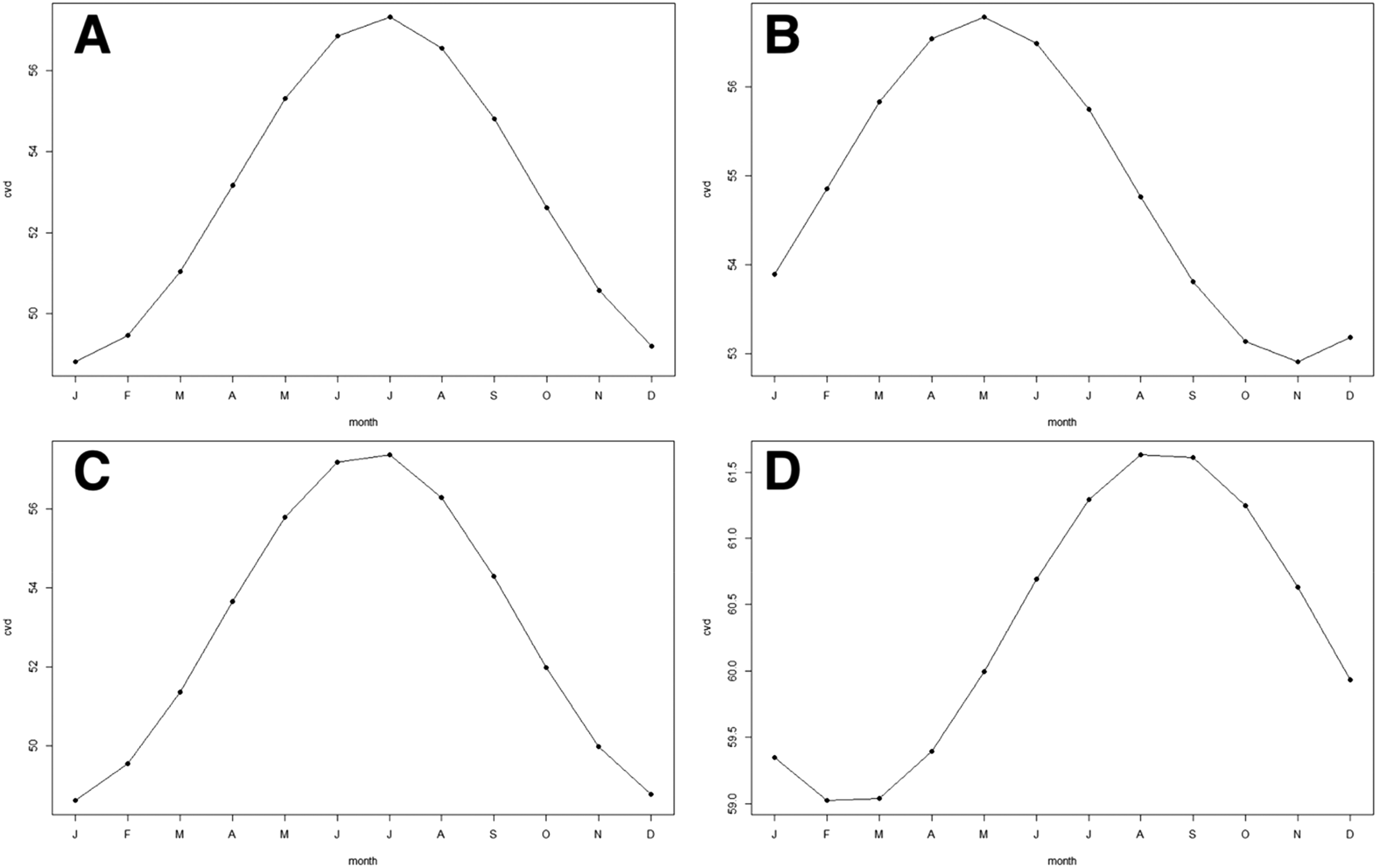
Results of the Cosinor analysis with seasonal variations regarding the investigated countries (A = USA, B = Australia, C = Canada, D = UK). The black dots mark the monthly mean relative search volume (RSV). The x-axis represents the corresponding months (e.g., J = January, F = February).
Discussion
An increasing number of patients search for their symptoms on Google before seeking professional consultation.13,20,21 Likewise, this phenomenon is applicable to orofacial issues such as cavaties, dental implants, facial aesthetic interventions, and wisdom teeth removal. 14 Through the utilization of GT, these search queries can be systematically analyzed to acquire novel insights across diverse domains within the field of medicine.14–17,22,23 The extraction of wisdom teeth is one of the most frequent interventions in oral and maxillofacial surgery. Besides preventive extractions, a number of cases are indicated due to acute symptoms. Acute wisdom teeth-related symptoms are a common cause for consulting outpatient dental emergency services. While some of these cases, such as odontogenic abscesses, have life-threatening risks and need urgent intervention, others are insufficient of emergency indications and could be easily handled electively.24–26
Utilizing GT as a novel tool in infodemiology enables the observation of both seasonal oscillations and trends arising from diverse influencing factors in health-related search queries on Google.15–17,27,28 The significance of internet data in this context lies in its capacity to provide real-time insights into public health dynamics, aiding in the identification and response to emerging health concerns with timely and relevant information. 18 In this study, seasonal differences in Google search queries were reported for wisdom teeth-related search terms in various countries from both hemispheres indicating that the search frequency of wisdom teeth-related search terms follows a seasonal pattern. It should be emphasized that although collected data indicated seasonal variations in Google search volume for wisdom teeth-related terms, the present findings need to be interpreted with caution, as this data type does not determine biological causalities.
It has been contentiously discussed whether the incidence of inflammations and abscesses is correlated with seasonal changes.29–33 Besides climatic aspects that could subserve bacterial growth, the amount of absorbed UV radiation and vitamin D levels, which also underly seasonal oscillations, affect the immune system directly.34–37 The findings of this study demonstrate significant summer peaks for wisdom teeth-related search terms in the USA and Canada. Given the populations tendency to google their symptoms shortly after they are affected, the correlation of observed interest peaks with the incidence of symptoms caused by the respective disease should be discussed. Therefore, it is necessary to elucidate the etiology of wisdom teeth-related symptoms.
The majority of wisdom teeth-related complaints are associated with a hindered dentition of the third molars.38,39 This can be caused by displaced or retained teeth. An incomplete eruption often leads to remaining gingival flaps on top of the tooth (operculum) and deep recessions that cannot be cleaned during conventional oral hygiene procedures. This plaque stagnation area can cause a bacterial accumulation, leading to inflammation around the tooth, also known as pericoronitis.10,38,39 However, not every contaminated periodontal pocket leads to acute inflammation. Besides endogenic circumstances such as immune suppression or diabetes, another determining factor could be a shift of the oral bacterial flora. Following the author’s findings it could be hypothesized that seasonal changes trigger this pathogenic shift. This assumption has been previously investigated in patients with peritonsillar abscesses. 40 In a prospective study, Klug observed the peritonsillar microbiome of 116 patients and reported a seasonal shift of associated bacteria. 40 Several other studies suspect the impact of seasonal oscillations and surrounding atmosphere on the microbiome in different organ systems.41–43 The question is therefore raised as to whether seasonal changes also affect the microbiome of the gingival sulcus, the saliva, and other parts of the oral cavity, causing pericoronitis and other oral infections. What kind of seasonal changes would lead to an alteration of the microbiome remain unclear. One of the many suspected parameters underlying seasonal oscillations is the climate. The weather’s influence on health conditions and the exacerbation of different diseases has been discussed in many studies.29,31,32,44–46 Nonetheless, few have investigated the association between climate and the oral microbiome. Li et al. analyzed saliva samples from Alaska, Germany, and Africa, displaying three different climate zones. The group found distinct differences between the respective regions, corroborating the hypothesis that climate affects the oral microbiome. 47
Additionally, temperature differences throughout the seasons are more pronounced in the United States of America and Canada compared to those of the United Kingdom and Australia. Evidence which further reinforces the assumption that climate may cause seasonal variation in the public interest. Countries with more distinct temperature changes showed a significant seasonal pattern of wisdom teeth-related public inquiry.
Another possible influencing factor is the fact that adolescents and young adults tend to perform their prophylactic wisdom teeth extractions especially during times, where they are out of school or college. Moreover, not every wisdom teeth-related google search is accompanied by toothache, so it is not possible to understand the individual backgrounds of each search.
Due to its infodemiological design the study has certain limitations. Without traditional sample justification, certain demographic groups, particularly those not using the internet, may be underrepresented, introducing bias into the results. Additionally, the reliance solely on Google search data introduces bias, as it predominantly captures internet users and may exclude non-Google search engine users. Further, the fact that people from a higher income group are more likely to use the internet for any kind of information represents another selection bias. This study cannot include demographic factors, since Google Trends data is pulled from a random unbiased sample of Google searches. The lack of strict inclusion and exclusion criteria in infodemiologic research may also lead to the unwanted inclusion of irrelevant data, which could further compromise the accuracy of the current study.
Conclusion
The study complements the current literature regarding web-based global public interest in wisdom teeth-related search terms and additionally provides extension of a Cosinor analysis regarding the seasonality of wisdom teeth-related search terms for countries in both hemispheres.
The observed correlation may provide further evidence for the seasonality of wisdom teeth-related complaints. However, further research should investigate causalities with apparent factors such as meteorological variables and microbiological analysis.
Footnotes
Acknowledgements
The authors would like to thank Isabel Segriff for proofreading the manuscript.
Declaration of conflicting interests
The author(s) declared no potential conflicts of interest with respect to the research, authorship, and/or publication of this article.
Funding
The author(s) received no financial support for the research, authorship, and/or publication of this article.
