




Abstract
This study aimed to provide an understanding of nursing students’ self-reported eHealth literacy in Sweden and Poland. This cross-sectional multicentre study collected data via a questionnaire in three universities in Sweden and Poland. Descriptive statistics, the Spearman’s Rank Correlation Coefficient, Mann–Whitney U, and Kruskal–Wallis tests were used to analyse different data types. Age (in the Polish sample), semester, perceived computer or laptop skills, and frequency of health-related Internet searches were associated with eHealth literacy. No gender differences were evidenced in regard to the eHealth literacy. Regarding attitudes about eHealth, students generally agreed on the importance of eHealth and technical aspects of their education. The importance of integrating eHealth literacy skills in the curricula and the need to encourage the improvement of these skills for both students and personnel are highlighted, as is the importance of identifying students with lacking computer skills.
Introduction
The increasing number of lifestyle-related non-communicable diseases (NCD) puts great pressure on the current healthcare system, 1 which requests innovative person-centred interventions to empower people to live a healthier life. 2 Today’s healthcare systems are going through a transformation that involves rapid digitalisation and integration of different types of technology, including information and communication technology (ICT), and eHealth into healthcare services.3,4 It is vital that healthcare workforce, like registered nurses (RN), have a high level of eHealth literacy competency so that they can enable patients to co-create technology-based solutions to ensure that they meet their needs and lead to improved health outcomes. 5 As people seek help to maintain their health and well-being via digital devices such as computers or smartphones, healthcare organisations need eHealth literate RNs that can use and prescribe digital therapeutics to promote health and/or support patients in improving health outcomes. eHealth literacy competence is also necessary during periods like the COVID-19 pandemic, when nurses were under high demand to perform remote care to patients using ICT. 6 According to Wong et al., 7 eHealth tools will be first effective when healthcare workers possess a common knowledge base enabling them to incorporate their respective competencies into a shared understanding. Although RN shortages is major concern worldwide 8 and RN in the European Union (EU) have the freedom of movement in accordance with EU Directive on the recognition of professional qualifications 9 study that compare different aspects of nursing education between European countries are still rare. There is a lack of European comparative research about nursing students’ self-reported eHealth literacy. Such research is required as RN movement between countries has implications for the care of patients that have the right to equal, person-centred and efficient healthcare across the EU. 10
In the Digital Agenda for Europe the eHealth strategies are a priority with the purpose to empower citizens to improve their health and to enable healthcare workers to deliver eHealth services, with the use of ICT for exchange of current and valid information in relation to disease prevention, diagnosis and treatment, as well as for continued health education.11,12 The Digital Decade policy programme authored by the European Commission sets targets for Europe’s digital transformation by 2030. One of its main goals is to encourage a digitally-skilled population, including a highly-skilled digital healthcare workforce. 13 Countries like Sweden and Poland have expressed and defined plans related to the European Commission’s goals. The Swedish Government 14 stated their vision for eHealth in Sweden that: “In 2025, Sweden will be best in the world at using the opportunities offered by digitization and eHealth to make it easier for people to achieve good and equal health and welfare and to develop and strengthen their own resources for increased independence and participation in the life of society” (p. 3). In Poland, the “Digital Competence Development Program until 2030” aims at raising the digital competencies of the general population according to individual needs.15,16 This is an initial step for the development of eHealth initiatives, which were already addressed and promoted by previous plans like The Plan of the Informatisation for e-Health for the years 2010-2015. 17
To achieve these and, as mentioned in the earlier plans pertaining to eHealth, it is imperative to strengthen the knowledge, skills, and competencies related to eHealth in the nursing profession in the education of both existing and future nurses. Although health informatics is one of the six core competencies in nursing,
18
there is a hesitation among nursing faculty to fully implement standardised criteria for nursing informatics.
19
The teaching of health informatics is still dependent upon the knowledge and skills of faculty members who teach these components.
20
As the digital transformation in health- and social care is increasing rapidly and globally, RNs need eHealth literacy skills and competencies. eHealth literacy is “the ability to seek, find, understand, and appraise health information from electronic sources and apply the knowledge gained to addressing or solving a health problem” (p. 2).
21
eHealth literacy comprise six core domains: traditional literacy, health literacy, information literacy, scientific literacy, media literacy, and computer literacy.
22
Traditional literacy includes basic capabilities such as the ability to read and understand written text, speaking and writing a language, e.g., foreign languages. Health literacy refers to the competencies necessary to interact with the healthcare professionals and involve in adequate self-care, i.e., the person in question can read, understand, and deal with health care information. Information literacy is understanding how knowledge is organised and how to obtain and utilise information properly so people can learn from it. Scientific literacy refers to understanding the aims, methods and limitations of generating knowledge in a structured and methodological way. Media literacy is about thinking critically about media content and put the information in a proper social and political circumstance. Computer literacy refers to the ability to use computers and electronic resources to solve problems, including the ability to adjust to new technologies and software and access to eHealth resources. Understanding of eHealth literacy from nursing students’ perspective is of importance as they need to take the responsibility of the digital transformation of healthcare services in the future. The existing literature describing nursing students’ perspectives on eHealth literacy originates predominantly from countries outside Europe.23–27 To our best knowledge the eHealth literacy studies from Swedish and Polish nursing students’ perspective are lacking. Even if RNs still rank their peers as the most important source of information guiding their daily practice, Fossum et al.
28
showed in an integrative review the possible shift to conventional sources of information such as digital resources. Therefore, the present study aims to provide an understanding of nursing students’ self-reported eHealth literacy in Sweden and Poland. The objectives of the cross-sectional multicentre study were: • To determine Swedish and Polish nursing students’ eHealth literacy and its association with sociodemographic and Internet use factors. • To determine the association between Swedish and Polish nursing students’ attitudes and opinions about eHealth at different stages in their education and eHealth literacy.
Materials and methods
Context
This study took place at two universities in Sweden, the Blekinge Institute of Technology (BTH) and the Swedish Red Cross University (SRCU); and one in Poland, namely the Medical University of Bialystok (MUB) that all provide nursing education in accordance to EU directive 9 that give guidelines for nursing education in European Countries. 29 In accordance with the Swedish Higher Education Ordinance, 30 undergraduate nursing education in Sweden involves 180 ECTS (European Credit Transfer and Accumulation System) credits, of which at least 60 ECTS must be within the subject of nursing. Since 2002, nursing education in Poland has been adjusted to EU requirements, which at the university level comprises 180 ECTS. 31 These educational programs, in both countries, results in a professional degree (i.e., a diploma degree) and an academic degree (i.e., a bachelor's degree), qualifying for a license as a RN. At the time of the study, the Swedish nursing programme involved in this study was comprised of both theoretical and clinical practice courses, comprising 60% and 40% of the total curricula, respectively. At BTH, eHealth was taught and examined in separate courses in the nursing programme curricula, but at the SRCU there was an optional course comprising 7.5 ECTS in digitalisation and eHealth in semester five. However, this started 5 weeks after the present study’s data collection. At the time of the study, the involved Polish nursing programme was comprised of 52% theoretical courses and 48% clinical practice courses. eHealth was not a separate subject in the Polish study programme but was incorporated into other nursing subjects.
Data collection
The data gathering for this cross-sectional, multicentre study was done through the application of a questionnaire to nursing students in the participating universities. The questionnaire was distributed in paper to all undergraduate students from the first, third, and fifth semesters, from December 2019 to April 2020. The reasoning behind the choice of these specific semesters was to obtain a sample which would characterise the beginning, middle, and end of nursing education, which comprises six semesters. Research members applied the questionnaire and had no educational ties to the students.
Questionnaire
Statements about eHealth in the data collection questionnaire in relation to the education and future role.
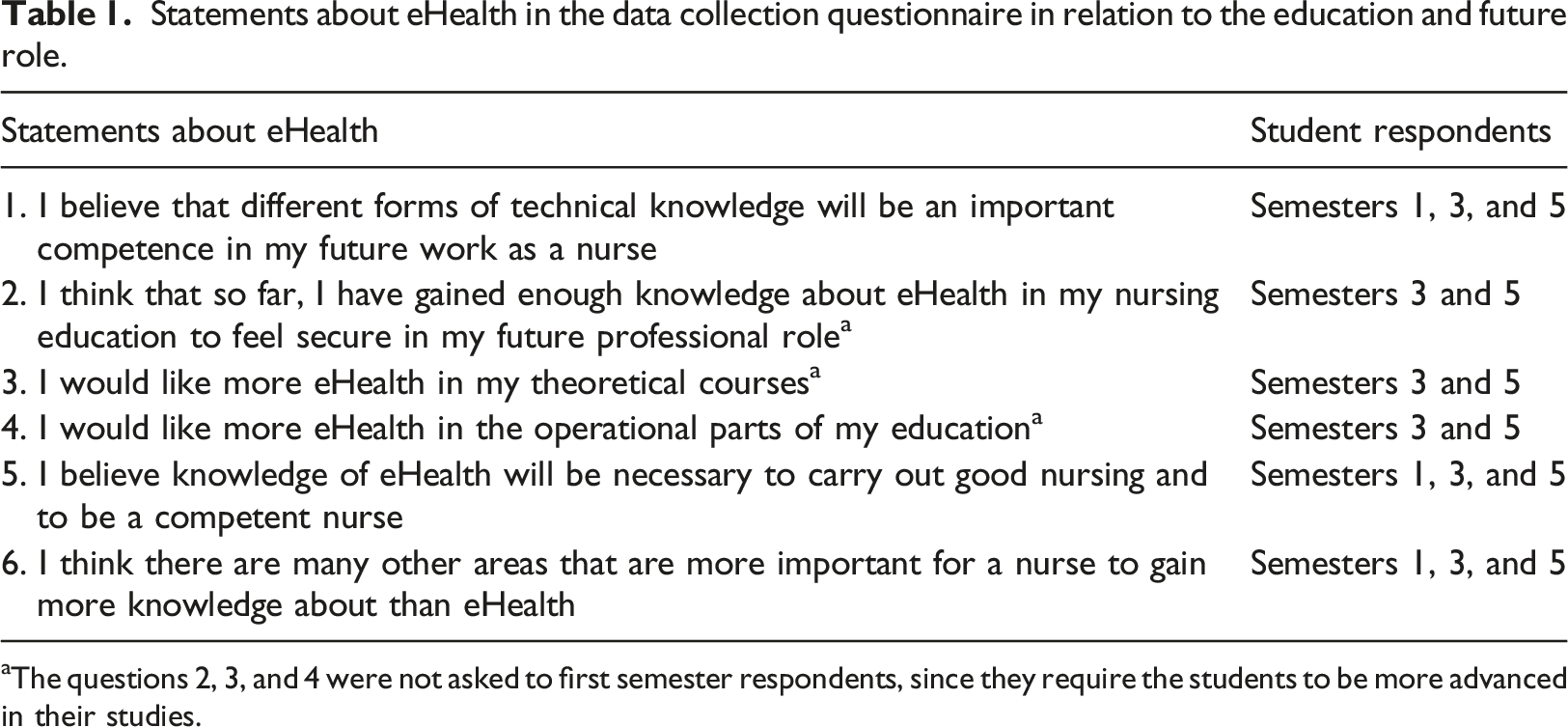
aThe questions 2, 3, and 4 were not asked to first semester respondents, since they require the students to be more advanced in their studies.
Data analysis
Descriptive statistics were used to analyse the collected data's frequency, mean, and standard deviation (SD). The Shapiro–Wilk test was used to assess data distribution. Since the data were not normally distributed, non-parametric tests were used in the statistical analyses. Spearman’s Rank Correlation Coefficient was used to measure the association between age, semester, perceived skills in using computers or laptops, frequency of using computers or laptops and frequency of using the Internet for searching health information, via the self-reported eHealth literacy (eHeals score). The Mann–Whitney U test was used to assess gender differences regarding students’ eHealth literacy. The Kruskal–Wallis test was used to assess differences regarding students’ high school focus, previous work experience, and eHealth literacy.
Entries with missing data were omitted from the analyses. An alpha value of 0.05 was used in all analyses. Differences between Polish and Swedish students were assessed in both analyses. The analyses were carried out in R (RStudio Version 1.4.1717).
Data privacy and ethical considerations
The Ethics Committee of the Medical University of Bialystok, Poland approved the study (no: R-I-002/148/2017). Permission to conduct the study was obtained from Department Heads at involved universities. In Sweden, the study did not require any ethical review, in accordance with the Swedish Ethical Review Act. Nevertheless, the study was conducted in accordance with ethical guidelines in the Declaration of Helsinki. 34 Participation in the study was voluntary. All participants received both written and verbal information concerning the aim of the study, that they could choose to not submit the questionnaire, their right to withdraw from the study, and that completing and submitting the questionnaire was an expression of consent to participate in the study. The protocol for this study was registered prior to the beginning of the study activities. 3
Results
A total of 646 of 920 students answered the questionnaire. On the Swedish sites, 342 out of 542 students and on the Polish site, 304 out of 378 students responded to the questionnaire. The overall response rate was 70.2%; Swedish students’ response rate was 63.1% and Polish students’ response rates was 80.4%.
Sample characteristics
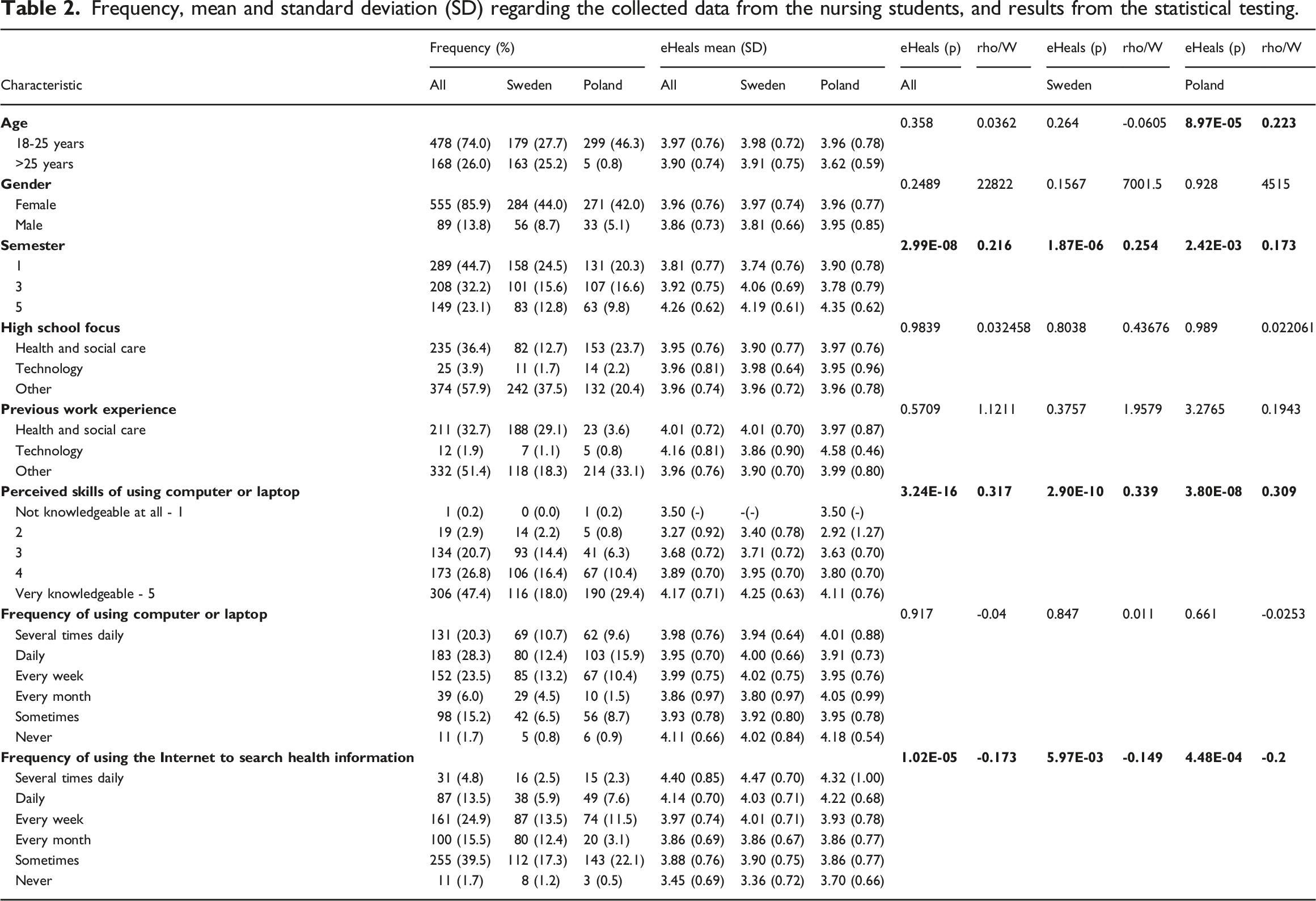
Frequency, mean and standard deviation (SD) regarding the collected data from the nursing students, and results from the statistical testing.
Self-reported eHealth literacy
The self-reported eHeals mean score for the overall, Polish and Swedish samples was consistently high, accounting for scores of 3.95 ± 0.75, 3.96 ± 0.78 and 3.95 ± 0.73, respectively. Table 2 shows the mean eHeals score and standard deviation for the overall, Polish, and Swedish samples for different sample characteristics.
Factors associated with eHealth literacy
Spearman’s Rank Correlation Coefficient was used to investigate the association between the eHeals score and age, semester, computer/laptop skills, computer/laptop frequency of use, and frequency seeking out health information. These results for terms of Polish, Swedish and overall samples are shown in Table 2. Significant associations were found between age (for Polish students), semester, computer/laptop skills, and frequency seeking out health information.
A significant association with age for Polish students (p <.05, rho =.223) indicated that the higher age implies higher eHealth literacy. This association did not hold for the Swedish or overall samples. The results on the semester variable (p <.05, rhoAll =.216, rhoSweden =.254, rhoPoland =.173) suggests that the further students are in their studies, the higher eHealth literacy they report. Higher perceived computer/laptop skills were also associated with higher reported eHealth literacy (p <.05, rhoAll =.317, rhoSweden =.339, rhoPoland =.309). All the while, the frequency of using these technology tools was not significantly associated with the eHealth literacy score. Finally, the frequency of seeking out health information was significantly associated with higher scores (p <.05, rhoAll = –.173, rhoSweden = –.149, rhoPoland = –.200) implying that the higher the frequency of this activity, the higher the reported eHealth literacy.
The Mann–Whitney U test was used to assess gender differences regarding students’ reported eHeals score. No significant differences were found.
The Kruskal–Wallis test was used to assess differences regarding students’ high school focus and previous work experience. No significant differences were found for either of these variables.
Students’ opinions on eHealth
Descriptive statistics and results from the Spearman Rank Correlation tests.
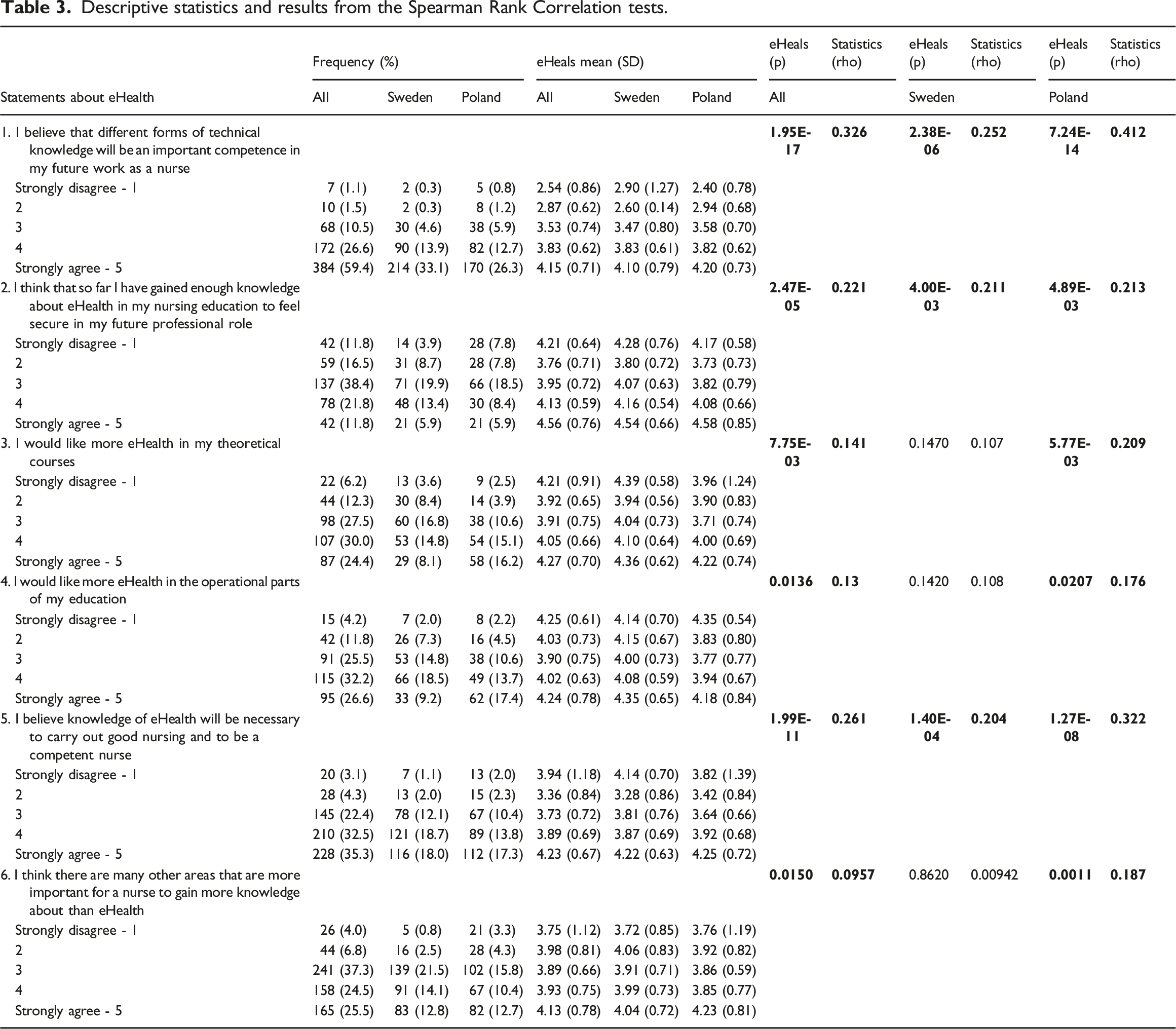
There is an overall agreement about the importance of technical knowledge for the nursing profession throughout the sample (question 1). Regarding whether they felt they had gained enough eHealth knowledge (question 2), students in their third and fifth semesters were either neutral or tended to disagree (66.7%). Regarding statements pertaining to wanting more eHealth in theoretical and clinical practice parts of the education (questions 3 and 4), students tended to either agree or be neutral (81.9% and 84.3%, respectively). Of the sample, 67.8% either agree or strongly agree with the statement that eHealth is a necessary competency in the nursing profession (question 5). Half of students either agree or strongly agree with the statement regarding the importance of eHealth in comparison to other areas of knowledge (question 6). However, a meaningful number of individuals were neutral in response to this question (37.3%).
Spearman’s Rank Correlation Coefficient was used to investigate the association between students’ opinions and their self-reported eHeals score. A significant association was found in regard to the importance of technical knowledge (p <.05, rhoAll =.326, rhoSweden =.252, rhoPoland =.412) implying that the higher importance given to the technical aspects of the education, the higher its reported eHealth literacy. The higher the agreement with the statement regarding having gained enough eHealth knowledge and feeling secure in this knowledge, the higher the eHeals score (p <.05, rhoAll =.221, rhoSweden =.211, rhoPoland =.213). Significance was evidenced by the statement regarding the wish for more eHealth in theoretical courses for Polish students, and for the overall sample (p <.01, rhoAll = .141, rhoPoland =.209). This result may be interpreted as Swedish students’ belief that they already have sufficient training in eHealth. The same pattern occurred regarding clinical courses (p <.01, rhoAll =.130, rhoPoland =.176). Agreement regarding the necessity of eHealth for the nursing profession was associated with higher reported eHealth literacy (p <.01, rhoAll =.261, rhoSweden =.204, rhoPoland =.322). Finally, a significant association between the statement that other areas of knowledge are more important than eHealth and higher levels of reported eHealth literacy was found for the Polish students and the whole sample (p <.01, rhoAll =.150, rhoPoland =.187).
Discussion
This cross-sectional, multicentre study aimed to determine Swedish and Polish nursing students’ eHealth literacy and its associations with factors related to sociodemographic data, frequency, and perceived skills in using a computer or laptop, use of the Internet to search for health information, and opinions about eHealth in their education.
Although the sample included Swedish and Polish nursing students, the descriptive analysis showed no significant difference between these groups, besides age. Polish students were younger than Swedish students.
The main findings of this study are as follows: (i) higher age is significantly associated with eHealth literacy scores in the Polish sample; (ii) higher eHealth literacy scores are associated with being further along in one’s education, which could indicate the inclusion of such skills in courses; (iii) the higher the perceived skills in using a computer or laptop, the higher the eHealth literacy score, which is a basic skill incorporated in the eHealth score; and finally (iv) a higher frequency in seeking out health information online was associated with higher eHealth literacy scores. No gender differences were seen in regard to eHealth literacy scores. However, this result should be interpreted with caution, since 85% of the sample of this study was composed of female students, which is a limitation of the present study. Additionally, no significant association with eHealth literacy scores was found based on the students’ prior experiences.
The association between age and eHealth literacy in nursing students is sparsely addressed in the literature and findings are inconsistent. Some studies,35,36,26 which applied the eHeals instrument on undergraduate nursing students, report no significant association between age and eHealth literacy, whilst the study by Macedo et al. 37 shows a positive association with age. Another study 38 done on RN who work in military hospitals also shows a positive association of eHeals score and age. In the study presented herein there was a positive association between age and eHealth literacy with the eHeals score in the sample of Polish students, but not for the Swedish students. These results should be interpreted with caution since the two samples are different in terms of age, with only 1.6% (5 out of 304) of Polish students were older than 25 years, whilst this number was 47.7% (163 out of 342) for the Swedish students, which is a limitation to the study. It is intuitive to think that experience with eHealth is acquired with higher age, which can also be related to being further on the nursing education. This aspect is consistent with the results about higher eHealth literacy associated with being further on the nursing education (higher semesters), since these students may have had the coursework, clinical practice experiences, seminars, and other approaches to the education regarding eHealth literacy. In this study, being further on the education was associated with higher eHeals scores in both Polish and Swedish samples.
The findings presented herein align with Park and Lee’s study, 24 which highlighted the importance of implementing an eHealth literacy-enhancing program into the nursing education, as the role of future nurses includes support for both patients and their families, to make available and use Internet health information provided by governmental institutions as well as health organisations with the goal to enhance patient safety and improve quality of care. Tubaishat and Habiballah 26 emphasise the need to integrate eHealth literacy into nursing curriculums, which will not only prepare nurses to support health-promoting activities, but also inspire persons to stay healthy as well as give assistance to patients and their families to properly get access and locate health resources to make decisions concerning their own health. The ultimate outcome could then improve patient safety and care. Consequently, nursing informatics competencies need to include eHealth literacy skills. Tubaishat and Habiballah 26 continue to point out the need for nursing students to be well equipped to use Internet resources in order to identify and evaluate eHealth information. A study by Jeon and Kim 23 shows that competence enhancement, measured as eHealth literacy, is a vital task in ensuring that complex patient care and health promotion are of high-quality. Further research is suggested to be necessary to provide evidence as to what interventions will be most efficient in meeting the eHealth literacy needs of nurses. 39
Computer skills are a necessary competency for eHealth literacy, which emphasises the need to identify the students’ lacking knowledge in this area. While most students in the sample perceived themselves to be either “knowledgeable” or “very knowledgeable”, a noticeable 23.9% felt differently. Designing a way to identify individual needs in this area is important, as many other technologies are becoming prevalent in healthcare scenarios, e.g., smartphones, tablets, or wearable devices. Lokmic-Tomkins et al. 40 highlight the need to establish a baseline for digital literacy and assessment, arranging individualised student consultation with strategies and tools to improve their digital literacy and capability.
The frequency with which students use a computer or laptop does not seem to influence their eHeals score. This may happen because a whole range of activities can be performed on a computer that does not improve proficiency or is related to eHealth literacy. A study by Rathnayakea and Senevirathna 35 showed the need for extended eHealth literacy competency within nursing education through the inclusion of the concept in nursing curricula, interventions to improve competency, and access to adequate IT facilities. Nes et al. 41 suggested in a review that technological literacy, as a concept, apparently is underutilised in nursing training and the concept varied depending on the investigated phenomenon and level of complexity. Nes et al. 41 further point out that to ensure that students successfully develop technological skills and abilities, nursing informatics needs to be implemented throughout the education. Nursing students need to have the skills to identify, assess, and use technology as a valuable resource to succeed in their role as students and in their future professional roles as RN. Additionally, educators’ competency should be improved, and nurse educators need to ensure future nurses’ technological literacy.41,42
This study also surveyed the nursing students’ opinions about eHealth and their relation to eHealth literacy. The results show that recognizing eHealth knowledge as necessary to the nursing profession is associated to a higher eHealth literacy. However, the opinion statement that other areas of knowledge are more important than eHealth also have a positive association with the eHealth literacy score. These findings could be due to the field of nursing being composed of a vast and broad range of knowledge and skills. Students who aspire to become RN are committed to patient care. Traditionally, nursing has been synonymous with close caring relationship, rather than direct involvement with technology. eHealth has gained recognition as an essential topic and informatics is recognized as a core competence in nursing that can contribute to quality improvement and safety of care. 18 Students acknowledge that other facets, such as the caring, hold significant higher importance within the nursing profession. Caring stands as the foundation of nursing responsibilities, where the human connection takes precedence. 43 As the discussions on the nursing education improvement continues to evolve, it is suggested that further qualitative studies could delve deeper into the nursing students’ perceptions of the uses of technology in caring.
One possible limitation of this study was a considerably disproportionate number of female participants in comparison with male participants. Another possible limitation is the uneven distribution of participants across age groups, with a disproportionally majority of participants younger than 25 years old in the Polish sample. The survey contained a limited number of student socioeconomic variables, which could be of importance when investigating factors that influence attitudes toward eHealth and literacy, e.g., income information.
Conclusion
The importance of skills related to eHealth in nursing education and future professional role as an RN have been emphasised in this cross-sectional, multicentre study. Accordingly, it is essential to improve eHealth literacy competencies in nursing students. This study investigated features associated with eHealth literacy and highlights the importance of integrating eHealth literacy skills in the nursing curricula and the need to strengthen these skills for both students and personnel. eHealth should be introduced early in the education (trained both theoretically and practically in clinical placement) and deepened, practiced, and examined during all six semesters. Thereby, the students will be prepared to use its potential in clinical practice after graduation. Identifying students with gaps in computer skills at the beginning of nursing education is essential in order to offer tailored tools to improve these skills. Additionally, considering the increasing trend towards patient home care, nurses must be prepared to utilize eHealth tools in diverse settings. The impact of scenarios like the COVID-19 pandemic, highlights the importance of this preparedness. By integrating eHealth in education, graduated nurses will be empowered to apply these tools in real care situations, in the todays’ incessantly evolving healthcare. Future studies can attempt to offer suggestions for integrating eHealth into nursing education, introducing eHealth into nursing curricula, planning interventions, and providing essential IT facilities in educational environments to improve digital literacy among nursing students.
Footnotes
Acknowledgments
We would like to thank the nursing students for taking time to participate in this study.
Author contributions
EKA, DB, PA, conceived the study design. EKA, DB, LS, GB, LM performed the data collection, ALD performed the data analysis. EKA, ALD, DB drafted the manuscript. All authors have contributed to the authorship and approved the final version submitted here.
Declaration of conflicting interests
The author(s) declared no potential conflicts of interest with respect to the research, authorship, and/or publication of this article.
Funding
The author(s) disclosed receipt of the following financial support for the research, authorship, and/or publication of this article: This study is supported by Linnaeus University
Ethical statement
The Ethics Committee of the Medical University of Bialystok, Poland approved the study (no: R-I-002/148/2017). Permission to conduct the study was obtained from Department Heads at involved universities. In Sweden, the study did not require any ethical review, in accordance with the Swedish Ethical Review Act. Nevertheless, the study was conducted in accordance with ethical guidelines in the Declaration of Helsinki.
