



Abstract
The purpose of this study is to analyze the characteristics, content, and quality of information available on YouTube regarding amyotrophic lateral sclerosis (ALS), and explore the search results and number of views and quality of the videos. A search was performed on YouTube on 10 June 2020, using the search term ‘‘Lou Gehrig’s disease” in the Korean language, and the first 100 videos were targeted for analysis. General characteristics (e.g., number of views, video length, etc.) were collected, and upload source, target audience, subject of the video, and quality of the videos using a global quality score (GQS) were assessed. About two-thirds of the videos were for the general public (62.0%), while the other third were made for patients and their families with ALS (38.0%). The mean GQS was 3.70 ± 1.42, and 60 videos were classified as high-quality videos. ALS-related videos on YouTube play a role in raising awareness among the general public of this devastating disease, however, practical information regarding disease management for patients and family is relatively insufficient. The quality and characteristics of the videos varied greatly and sometimes the lowest quality videos were shown in the top pages of search results.
Keywords
Introduction
Amyotrophic lateral sclerosis (ALS) is a progressive neurodegenerative disease that affects both upper and lower motor neurons, leading to progressive muscle weakness throughout the course of the disease. 1 Currently, there is no cure for ALS and the median survival is 2–4 years after the onset of symptoms, and the reason for death is mostly due to respiratory failure, but up to 10% of ALS patients survive for more than 10 years 2 Patients gradually lose the ability to stand or walk and use their hands and arms; and in late stages they develop respiratory insufficiency. Despite the desperate course of the disease, the rarity of the disease makes it difficult for patients and their families to find information. 3 Additionally, new information is constantly needed for self-care because of the nature of this progressive disease. 4
Patients with chronic illnesses, including ALS are increasingly relying on internet-based information, in particular social media, to manage their conditions.3, 5-8 YouTube™ (http://www.youtube.com) is a dominant source of health information, with two billion users around the world, which places this database as the second-most popular in the world after Google. 9 Similar trends are also observed in South Korea; YouTube has become the most-used smartphone app in South Korea, with users here spending an average of 882 min per month watching videos. 10 These resources can provide novel ways for people to gain information about a disease. Compared with other social media platforms, YouTube videos have the benefit of being easily accessible to individuals from all demographic backgrounds. 11 Online information can promote patient self-care and support medical decision-making, and it also allows persons to share disease experiences and facilitates peer support. 12
Due to the unregulated nature of the internet, however, the information available online is often criticized as being untrustworthy and low in quality.7,13 One of the main features of YouTube is that anyone can upload and share a video, regardless of their qualifications and background. Unfortunately, the use of incorrect or irrelevant information and misunderstanding of relevant and valid information can be physically, emotionally, and financially harmful. Thus, a number of recent studies have analyzed the content of YouTube videos, and in particular, looked at the quality of content regarding various health conditions including neurological diseases such as dementia, 14 Parkinson’s disease, 15 and stroke.16,17 A few studies have analyzed information on ALS from online patient communities,3,18 but little is known regarding ALS video content.
Amyotrophic lateral sclerosis is a rare disease, making it difficult to obtain health-related information from traditional media, such as text media or primary healthcare institutions compared to other chronic diseases. 4 A previous study 3 reported that ALS patients not only gain information support by obtaining information through social media, but also gain emotional support by sharing emotions. Therefore, the purpose of this study is to analyze the characteristics, content, and quality of information available on YouTube regarding ALS, and explore the search results and number of views and quality of the videos.
Materials and methods
Selection of videos
A search was performed on YouTube (http://www.youtube.com) on 10 June 2020, using the search term ‘‘Lou Gehrig’s disease” in the Korean language with the default filter by relevance. Because the term Lou Gehrig’s disease is much more commonly used than ALS among the general Korean population, we used the term Lou Gehrig’s disease for the search. The Google Chrome web browser was used, with the history and cookies deleted before each search as this can affect the search results. This search produced about 180 results, and the first 100 videos were targeted for analysis as done in previous studies.15,19–21 Information about the videos such as URL and title were recorded in an Excel spreadsheet. None of the videos were excluded in this procedure.
Assessment of the videos
The number of views, number of ‘‘likes” and ‘‘dislikes”, video length, posted duration, number of views per day, and number of comments were collected for each video on 10 June 2020 by one author (JO). Upload source, target audience, and subject of the video were assessed by three authors (JO, SHM, KP) independently, and in case of disagreement, the three raters afterwards discussed each statement until an agreement was reached. All researchers were professors of nursing with extensive clinical and research experience on chronic diseases. One author (JO) has been a coordinator nurse in an ALS multidisciplinary clinic for several years; while the other two authors (SHM, KP) are experienced gerontological nurse practitioners; all the authors have experience in ALS research. Upload source was classified into broadcast, health-related entities (e.g., hospital, health-related association), and individuals (e.g., patient, caregiver, layperson). Target audiences were classified into patients or families with ALS, general public, and healthcare professionals. Subject of the video were coded into diagnosis/treatment, symptom management, alternative therapy, personal experience, advertisement, Ice Bucket Challenge, miscellaneous, and not related to ALS. Miscellaneous videos that did not fall under the above classifications included celebrities suffering from ALS or events related to ALS; and not related to ALS videos included those that had nothing related to the disease such as introductions of stocks for new ALS drugs.
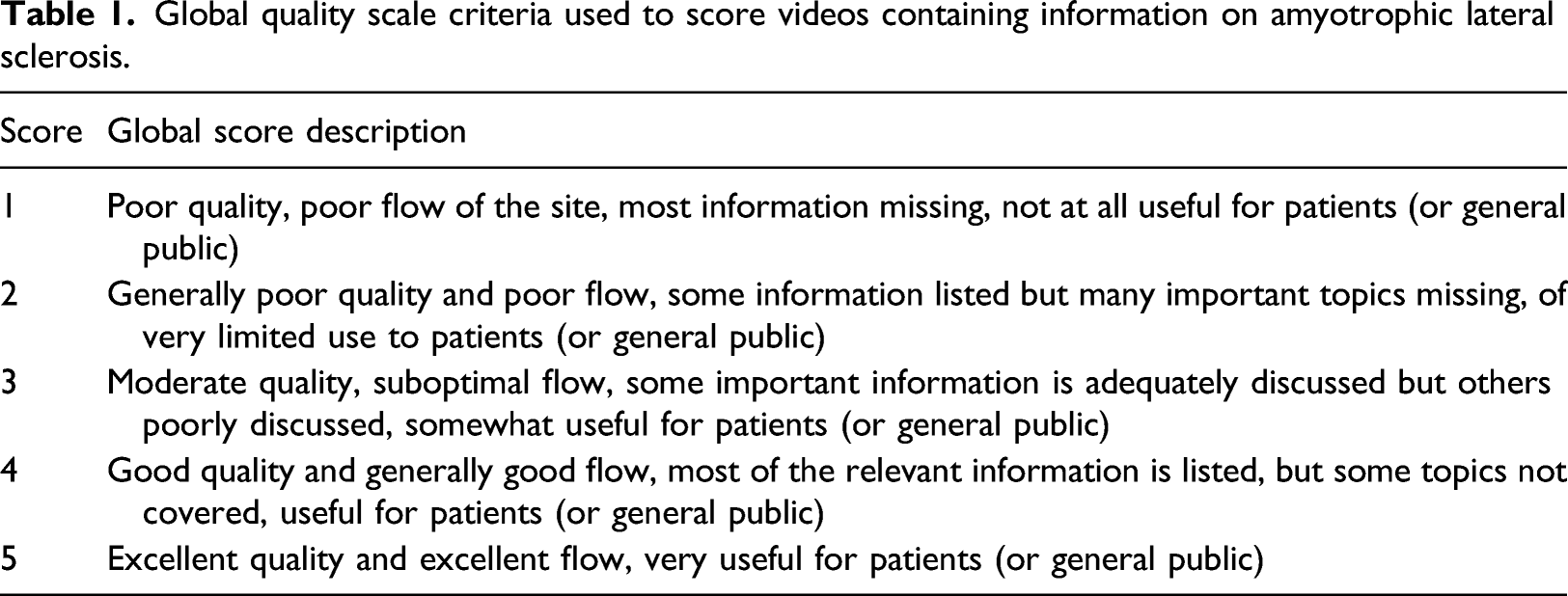
Global quality scale criteria used to score videos containing information on amyotrophic lateral sclerosis.
Statistical analysis
The analyses were conducted with Excel 2016 (Microsoft, Redmond, WA, USA) and IBM SPSS Statistics ver. 22.0 (IBM Corp., Armonk, NY, USA). Descriptive statistics were calculated to describe the overall characteristics of the videos. Continuous variables were compared using independent sample t-test or ANOVA followed by Tukey’s post hoc test; nominal variables were compared by chi-square test to assess differences between groups. The level of statistical significance was set at p < .05.
Ethics considerations
This research did not involve human subjects, so neither institutional review board approval nor informed consent was required.
Results
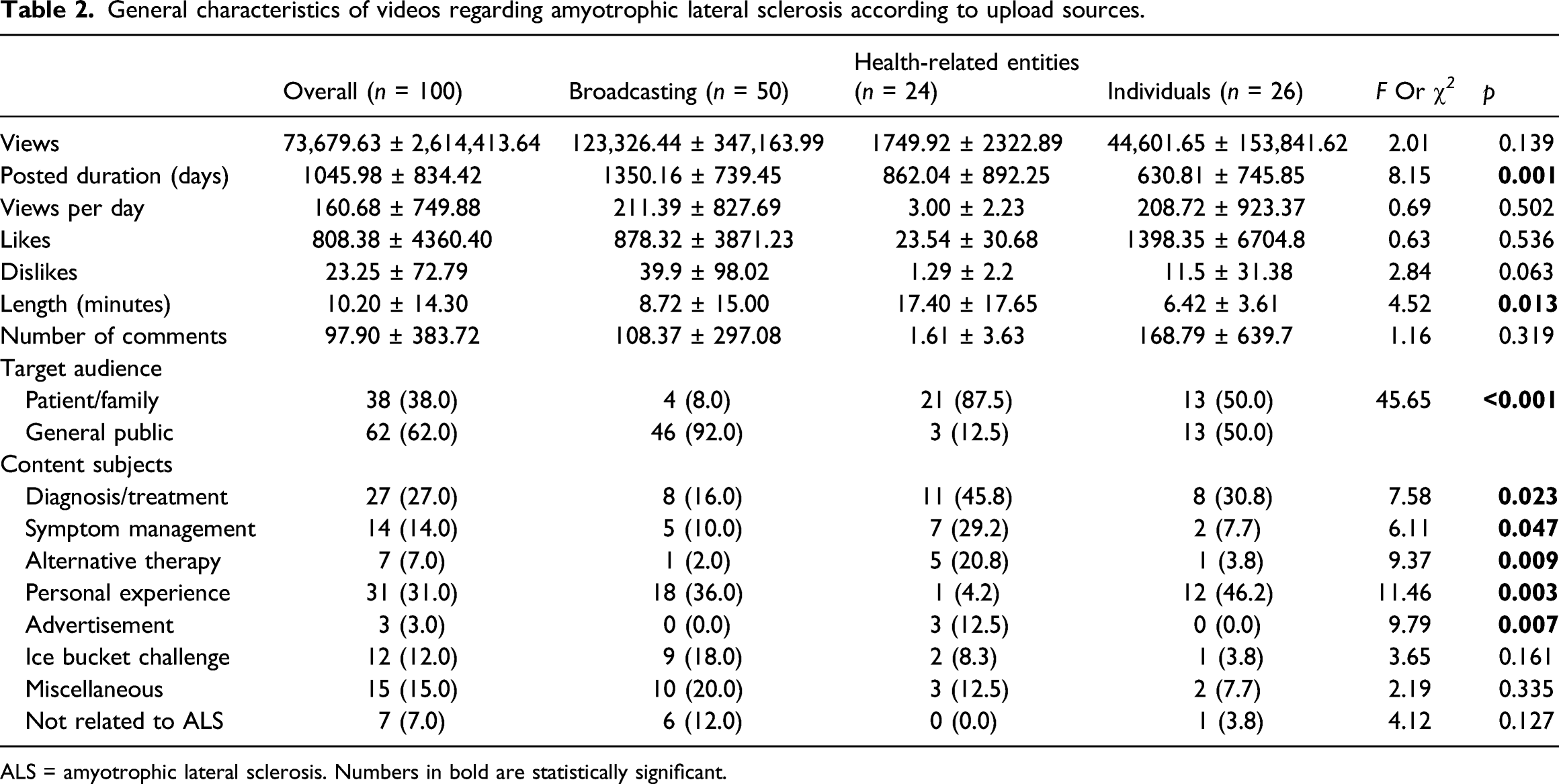
General characteristics of videos regarding amyotrophic lateral sclerosis according to upload sources.
ALS = amyotrophic lateral sclerosis. Numbers in bold are statistically significant.
There were statistically significant differences in the posted duration (F = 8.15, p = .001), length of videos (F = 4.52, p = .013), and target audience (χ2 = 45.65, p < .001), according to the upload source. Videos from broadcast entities had longer posted days and more content for the general public, whereas videos from health-related entities had a longer length and more content for a patient or family with ALS. Content subjects were different according to the upload source. Specifically, more content on diagnosis and treatment (χ2 = 7.58, p = .023), symptom management (χ2 = 6.11, p = .047), alternative therapy (χ2 = 9.37, p = .009), and advertisement (χ2 = 9.79, p = .007) and less contents on personal experience (χ2 = 11.46, p = .003) were found in the videos from health-related entities.
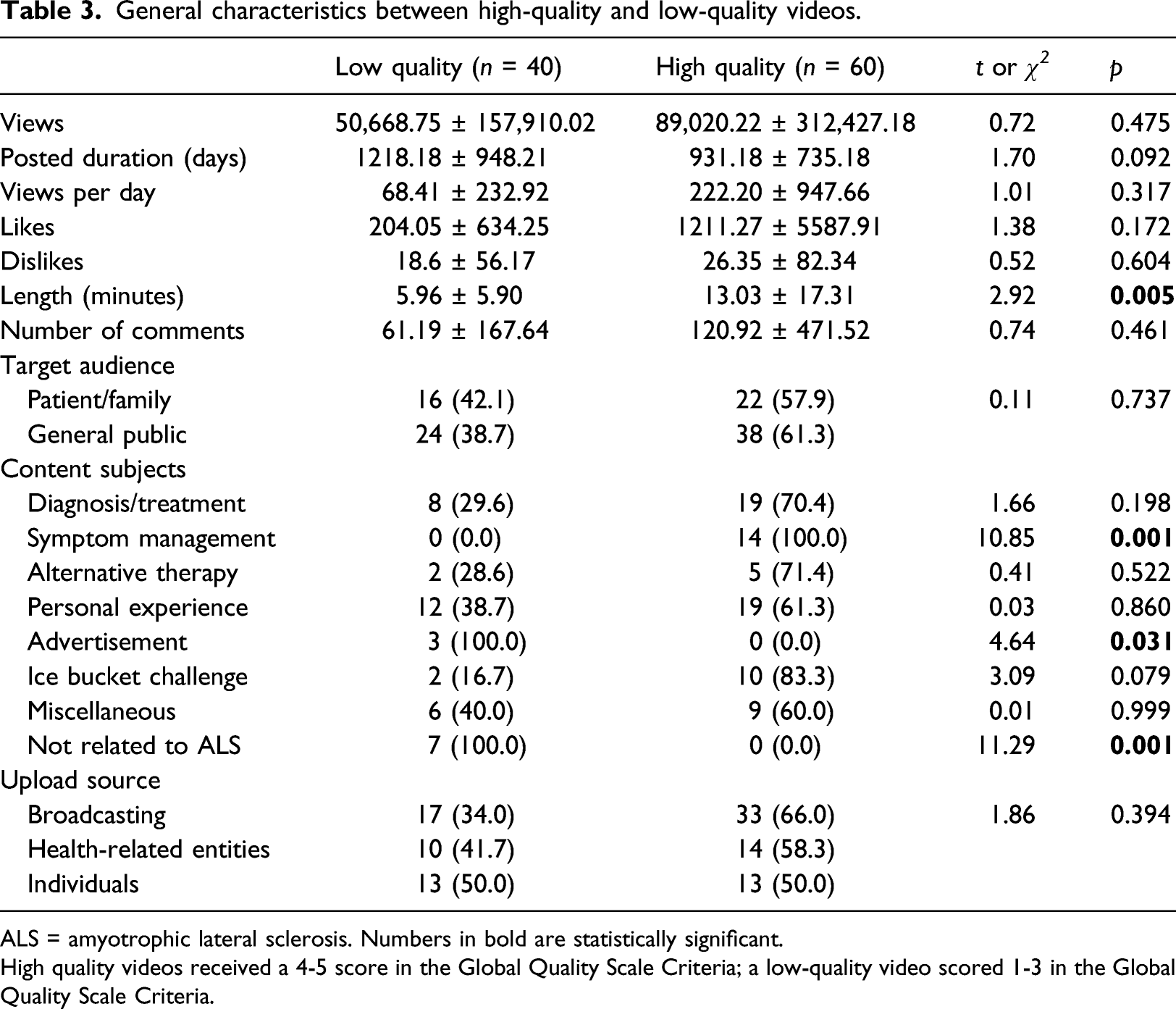
General characteristics between high-quality and low-quality videos.
ALS = amyotrophic lateral sclerosis. Numbers in bold are statistically significant.
High quality videos received a 4-5 score in the Global Quality Scale Criteria; a low-quality video scored 1-3 in the Global Quality Scale Criteria.
Figure 1 shows a visualization of the video quality and the number of views in the order in which it appears on YouTube. The blue color indicates a higher score in GQS, and the red color a lower score. Several low-quality videos with a GQS score of 1 were in the top pages of the search with a high number of views. YouTube search results on amyotrophic lateral sclerosis. The blue lines represent a GQS score of 5 for a video, light blue a score of 4, gray a score of 3, light red a score of 2, and red a score of 1. When searching with the keyword Lou Gehrig’s disease, six out of the first 20 videos (30%) were the lowest quality videos (GQS of 1) with a relatively high number of views. GQS = global quality score.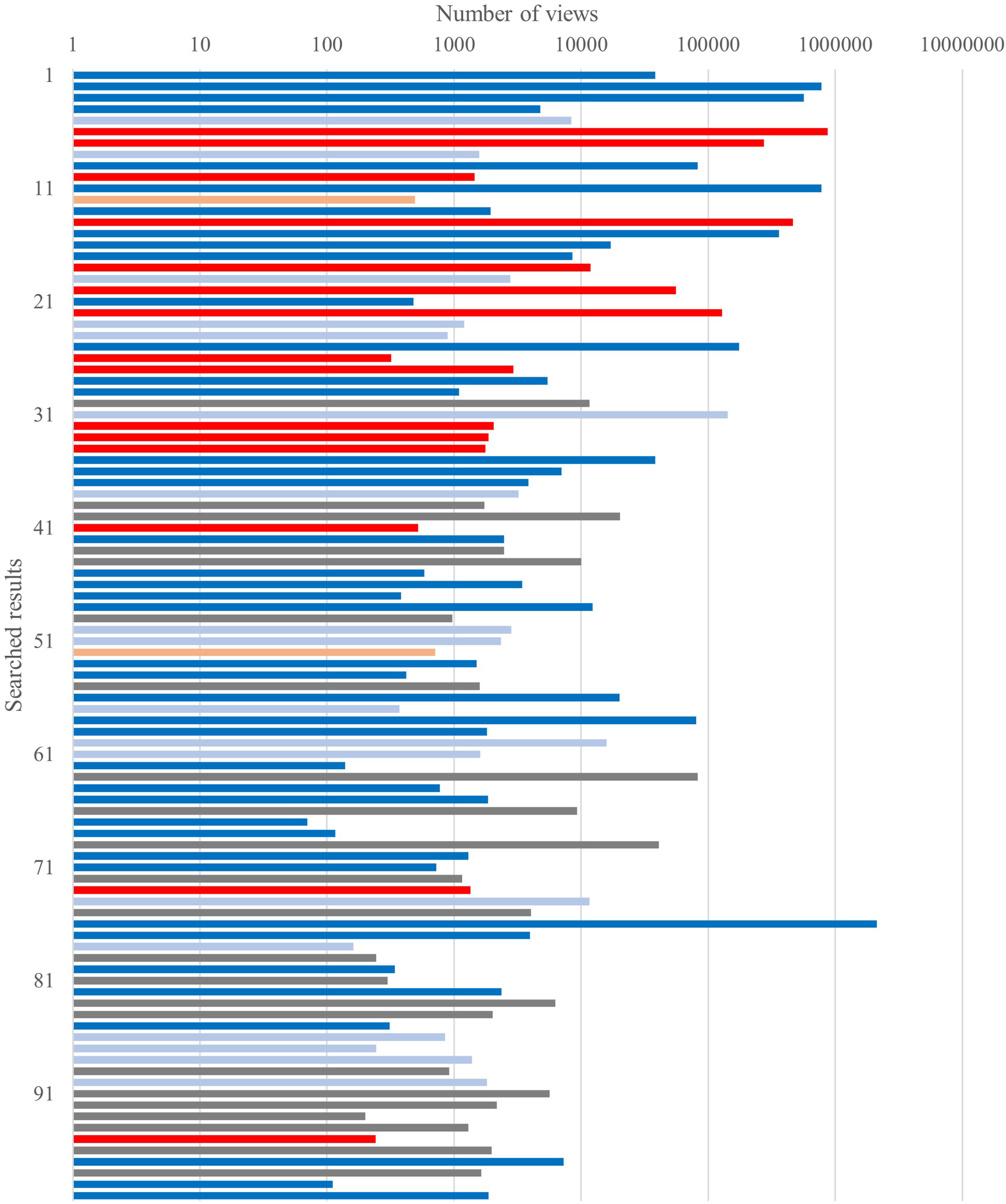
Discussion
The present study aimed to analyze the characteristics and quality of YouTube videos regarding ALS. To the best of our knowledge, this study is the first to investigate video content regarding ALS. Because many patients get health-related information through the internet including YouTube, it is important for clinicians and researchers to understand the current situation on characteristics and quality of such video content. Our findings suggest the videos were quite heterogeneous in both quality and characteristics such as upload source, number of views, and subject of the content. Due to the public nature of YouTube, it is likely that misinformation will be disseminated, and high-quality videos can be masked by low-quality videos. In particular, the desperate characteristics of the disease can be exploited to increase popularity, making it even more difficult for patients and families who need information. Therefore, it is necessary to develop higher-quality video education materials and to have patients and families selectively refer to these materials.
Interestingly, more videos were targeted for the general public than patients with ALS. Regarding the subject, most videos addressed personal experiences. Our results suggest the YouTube videos, especially clips on the Ice Bucket Challenge and clips on patient experiences with ALS in documentaries could increase awareness of ALS in the general public. ALS is a rare disease with an incidence rate of approximately 1.68 per 100,000 people, 23 and raising awareness of the disease is particularly important in rare diseases for early diagnosis and for the development of treatments. Moreover, public engagement makes a positive impact on people with neurological disease, as it advocates for policy changes as well as prioritizing this condition in the research agenda. 24 The Ice Bucket Challenge taught us the appropriate use of social media and the importance of public engagement as it increased incredibly both public awareness and the amount of research funding. 25 Also, these contents in documentaries can be a source of emotional support for patients. 26 Knowing that others have dealt well with the disease can provide hope and relief, which has a positive effect on adaptation to the disease.27,28 On the other hand, this suggests that it is difficult to obtain practical information related to symptom management that patients and families actually need for self-care. Among the supportive needs categories the highest need in patients with ALS was information from previous studies,29,30 and these people frequently seek information regarding symptoms/management of symptoms, 3 thus it is imperative to develop more content that provides practical information through online videos.
The quality of videos evaluated by GQS was higher than that of previous studies.13,31–35 This is probably because the videos included in this study include a large proportion of videos uploaded by broadcasting organizations or university hospitals. However, in all cases, only 60% of videos were classified into high quality videos with over 4 points in GQS. Additionally, 15% of videos rated as 1 point, the lowest point in the GQS, and some videos had the lowest score because they were not related to ALS at all, but contained advertisements for medical institutions or alternative therapies. In particular, some videos included false information that could deceive patients. For example, a Korean medicine (traditional Korean medicine) doctor insisted on treating ALS patients using acupuncture while interviewing several patients, but it actually was an advertisement for the hospital; in another video, a religious person introduces a case, without any scientific evidence, of someone who was cured after praying. These videos can entice patients into making erroneous medical decisions, and further increase the socioeconomic burden from the disease. 36 More importantly, our findings showed that some of the low-quality videos appeared in the first few pages of the search results, thus people could be easily exposed to incorrect information. This is a common and inevitable problem for YouTube content, because anyone can upload videos and anyone can view any video. There are few restrictions and the videos are displayed according to a recommendation algorithm. Moreover, these easily found videos in our study had a high number of views, up to 869 thousand, which was second highest among the included videos. In our analysis, there were no significant differences between higher quality and lower quality videos in terms of number of views, likes, dislikes, and comments, which means high quality videos were neither easily found nor frequently viewed compared to lower quality videos.
Therefore, both healthcare professionals, creators, and platform operators need to work to the benefit of patients by utilizing high quality and evidence-based health information. Healthcare professionals need to advise patients or their families to select and view high-quality videos when they want to acquire information online. For example, patients could use YouTube video content collaboratively with healthcare professionals. Information seeking via online had the potential to help patients be more actively involved in decision making, aid communication with healthcare professionals, and improve the patient–doctor relationship, which was reported in a previous meta-analysis. 37 In general, people prefer short videos, but interestingly, our results show the video length of the high-quality video group was statistically significantly longer. It appears that videos that were longer in length contained sufficiently detailed explanations. In this study, it is possible that statistically significant results could not be derived due to the small number of videos targeting patient/family, but several previous studies indicate that educational materials produced by university hospitals or associations were of high quality. In our data, several individuals and small-sized hospitals posted misleading information such as advertisements. Thus, it would be ideal for a professional society or foundation such as the ALS Association or a university hospital to develop and distribute content. This is particularly important for Korean patients, who may find it difficult to utilize online information in English due to language barriers. High-quality online videos would be helpful to the most Korean ALS patients, especially in vulnerable rural areas. It would also be helpful to develop guidelines for YouTube creators that develop health-related content. More importantly, it is necessary to apply stricter regulations on health-related information in video sharing platforms. For example, labeling videos containing health-related information may influence the quality and content. The video platform needs to create an algorithm that considers not only the popularity of a video, but also the quality of the video, such that higher-quality videos gain better exposure.
This study has the following limitations. First, this study included only the first 100 videos that appeared when searching for ALS in Korean, and there is a possibility that this sample would not derive statistically significant results because of the variability of the data, such as number of view and likes. Second, in previous studies,38,39 reliability as well as video quality was included as an important variable, but a reliability evaluation was not conducted in this study. Many of the videos included in this study simply focused on a patient’s experience such as in a documentary or for the Ice Bucket Challenge, and were not educational materials, thus the reliability assessment was not appropriate. Therefore, future research is necessary to systematically analyze patient education materials in various languages including English.
In conclusion, ALS-related videos on YouTube play a role in raising awareness among the general public regarding this devastating disease, however, practical information regarding disease management for patients and family is relatively insufficient. The quality and characteristics of the videos varied greatly and sometimes the lowest quality videos were shown as the top pages in search results. Accordingly, for videos regarding patient self-care, it is important to be selective in referencing particular videos. To better address this deficiency, it is important for more health experts to give advice, and video producers need to make more effort to develop high-quality content.
Footnotes
Declaration of conflicting interests
The author(s) declared no potential conflicts of interest with respect to the research, authorship, and/or publication of this article.
Funding
The author(s) disclosed receipt of the following financial support for the research, authorship, and/or publication of this article: This work was supported by the National Research Foundation of Korea (NRF) grant funded by the Korea government (MSIT) (No. 2022R1F1A1064038).
