




Abstract
Cities with their innovative capacity are key places to address critical climate, environmental and health challenges. Urban experimentations, such as Living Labs, can represent a starting point to reintroduce resources into the production cycle and reduce environmental impacts, embracing the paradigm of the circular economy (CE). According to recent studies, Living Labs at a city scale could generate significant environmental benefits, improvements in quality of life and positive impacts on citizens’ health.1 This paper aims at presenting the case of the Torino Living Lab on Sharing and Circular Economy (LLSC) to point out possible future scenarios of urban sustainable policies. The case study is analysed in five sections: (1) the description of the new permanent laboratory proposed by the City of Turin; (2) the past experiences of Living Labs in Turin; (3) the birth of LLSC and the involvement strategy; (4) the introduction of the eight admitted experimentations. In the light of the results collected, the last paragraph (5) came up with the Strengths, Weaknesses, Opportunities, Treaths (SWOT) analysis in the LLSC. Eventually, it deals with the research question by offering a common ground for global and local policies focused on sustainability and CE.
Introduction
Cities are the main field of experimentation to tackle climate change and face environmental challenges. According with the Sustainable Development Goal 11 of United Nations, in the next years cities should become creative ground of collaboration between different stakeholders to improve the urban environment and preserve the health of citizens. 2 Likewise, urban experimentations, such as Living Labs in the field of circular economy, are considered of fundamental importance to build innovative long-term policies by finding out new products, platform and solutions. Nonetheless, the recent literature on policies and urban studies claims that the experiences of urban experimentations are hardly deepened and the possible scenarios for structural policies are seldom outlined. 3
In the Autumn 2018, the Municipality of Turin launched the Torino City Lab as an initiative-platform aimed at creating simplified conditions for companies interested in urban experimentations. The City officially committed itself to enable public and private initiatives aimed at improving the urban ecosystem and proposing ideas in different fields of innovation: from Internet of Things (IoT) to Sharing and Circular Economy (CE). This effort was deemed to be necessary by the City, to redesign urban environments and guarantee benefits for the citizens’ health, in the short period as well in the long one. 4 Therefore, the platform was conceived as an opportunity to create a new context of experimentations based on environmental preservation and community building. To this end, the Torino City Lab started from a preliminary in-depth analysis of the socio-economical conditions.
The urban area of the City of Turin is characterized by an high rate of small and medium-sized enterprises (SME) operating in social and environmental field with less than 10 employees. 5 In 2018 the City recorded the lowest result in the last decade in terms of creation of new companies. 5 This context leads SME to seek the support of public players, especially in the taking off phase of their market. This dynamic of local market is being progressively combined with the expressed commitment at national level to develop practical policies to foster and accompany development of start-ups considered innovative, as regulated in the Growth Decree 2.0. 7 Accordingly, the City is planning to become a laboratory in which companies can establish direct contact with the final users of their products and services. As the first project launched on the platform, the Torino Living Lab on Sharing and Circular Economy (LLSC) seems to be an innovative tool for environmental policies on local and global scales. In this framework, the paper aims at understanding what indications and insights has LLSC offered to improve long-term circular economy policies on global and local scales.
The paper is divided into five sections: (1) the description of the new platform designed by the City of Turin to host experimentations; (2) the past experiences of Living Labs in Turin; (3) the birth of LLSC; (4) a brief introduction of the admitted experimentations in LLSC; (5) the SWOT (Strengths, Weaknesses, Opportunities, Threats) analysis and the consequent reflections on future policies aimed at supporting the CE through the involvement of local and global actors.
Method
In order to face the question, the paper adopts both the theoretical study and the research on field approach. The framing and reconstruction of the policy process has been carried out on the basis of three main sources: the literature on Living Labs and the CE; the institutional materials of the European Union and the official reports provided by the City of Turin. In order to face the research questions, qualitative data were collected adopting both participant observation and semi-structured interviews. Five open-workshops organized by the Managing Authority (MA) were attended, reporting the most significant results. Between October 2018 and December 2019, twelve semi-structured interviews were conducted by involving two public officials of the City, two experts of the MA and eight representatives of the experimenting companies. This methodology allowed the authors to gather different perspective on the case of study. The collected data represented the basis to design the SWOT analysis and provide final findings.
Torino City Lab: A permanent platform for experimentation
Living Lab in urban contexts is defined as an innovative policy instrument open to integrate people into the entire development process as users and co-creators to explore, examine, experiment, test and evaluate new ideas and creative solutions in complex and everyday contexts. 8 Within Living Labs, municipalities can play the role of promoter, enabler or partner with the final goal of learning how to improve transformative urban policies on sustainability and CE.
Embracing this strategy, the Torino City Lab presents itself as a platform which aims to generate four main outputs in the urban ecosystem. First of all, the Lab ensures the access to public spaces through streamlining the administrative process. The initiative is promoted by adopting a new strategy on the part of the local authority, which is capable of acting by making all its sectors work with an integrated perspective. More specifically, the Innovation Area of the City is committed to working in agreement with the Environment and Green Spaces Area. This cooperative management is born from the desire to quickly coordinate all the local offices, matching all of the needs expressed by companies and associations.
Secondly, the Laboratory is addressed to create a network of actors committed in several innovative fields. Through the experimentation, SME have the opportunity to create partnerships with public and private multiutilities of service sector. Moreover, the experimenting subjects have the chance to deal directly with the world of research, obtaining feedback and suggestions on their products. Adopting this approach, local SME might collaborate with big local multiutilities as SMAT (management company of hydric sector), IREN (management company of energy sector), AMIAT (management company of waste) as well as with the University and the Politecnico of Turin.
According to the transnational co-creation strategy, all experimentations in the Lab are not planned to fill out only local needs, whereas they should be designed to be fitted on wider scale. 4 Hence, the involvement of citizen is addressed to create a public-private-people partnership, adopting the quadruple helix approach.9,10 Adopting this pattern, the City identifies specific mission, vision and values (Table 1).
The features of the Torino City Lab (City of Turin, translated and adapted by the authors from https://www.torinocitylab.it/it/).
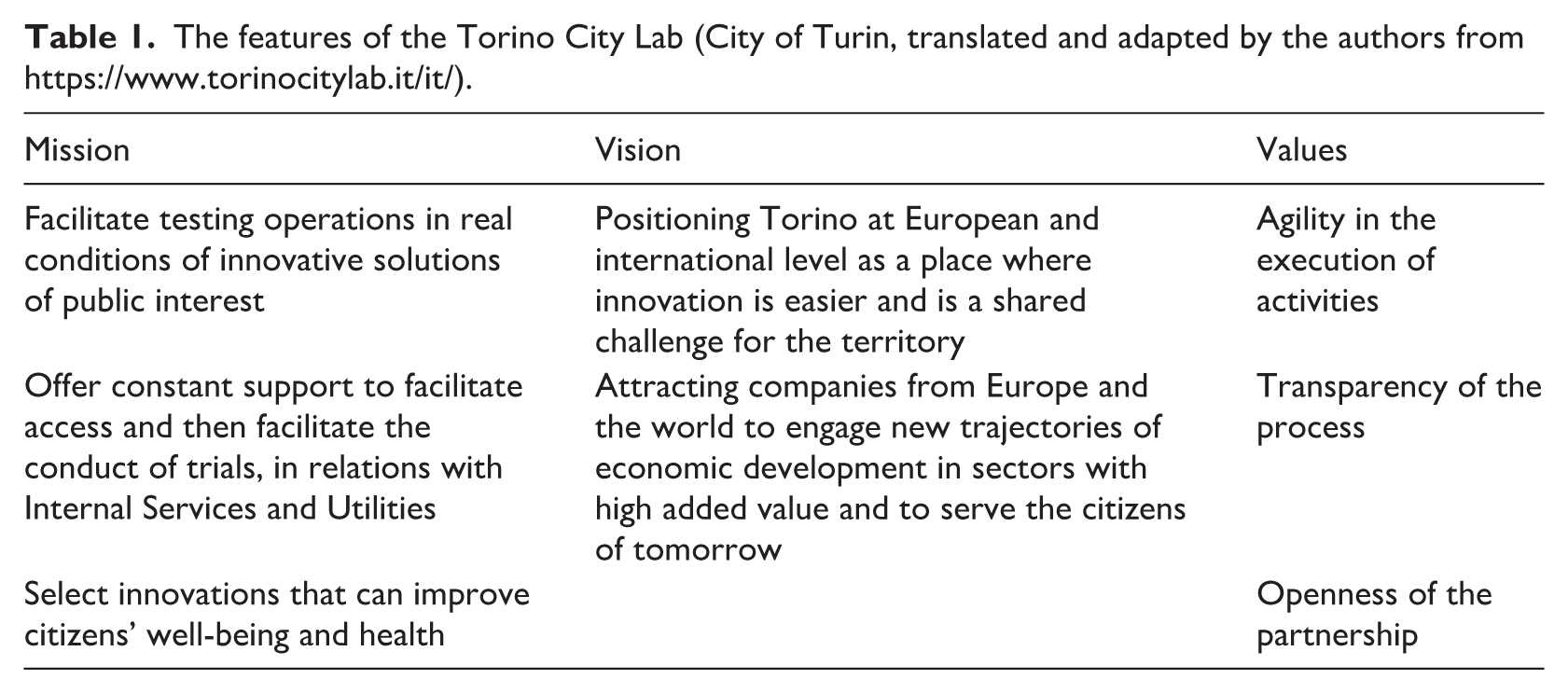
This platform enables the City to promote new challenges in environmental and health fields, which are difficult to address with classic regulatory tools, involving a huge variety of public and private actors as well as citizens. Eventually, the Municipality decides to promote one of the policy areas considered most important to offer new opportunities for local development and to match European goals: the CE. 11 Inside this framework, the City opened its spaces to host innovations in fields such as waste and pollution reduction, food redistribution, water recovery and regenerative farming, which are considered to be key-levers to improve environmental and citizens’ health policies.
City of Turin and living labs
As previously described, the Torino City Lab foresees the chance of hosting actors from different innovative fields. The City has decided to adopt the tool of living labs as effective tools to boost sustainable activities to achieve a long-term goal: becoming a CE hub.
At the end of 2015, for the first time the European Commission designed a CE Action Plan. 12 On the one hand, it claimed the necessity to change the economic model to face the lack of resources in a sustainable way. On the other, it set up almost 10 billions to boost the transition towards a new plan of development, financing projects based on redesign, reuse and recycle values. 13 Nevertheless, as stressed by Ellen MacArthur Foundation, those top-down regulations are not a sufficient factors to embrace the CE paradigma. The R (Reduce, Reuse, Recycle) model 14 has started from the capability to choose and act of the purchasers and end users of all services: the citizens. According to this model, citizens should represent the engine of change and should be involved in co-design and co-production of new circular services and ideas. As stressed by Girard and Nocca, 16 this process would improve the citizens’ health from both physical and psychological reasons. Firstly, the reduction of consumption and pollutions could enhance the environmental and agricultural quality, thus decrease hearth and respiratory diseases. Secondly, citizens’ involvement in CE policies could strengthen the sense of community, through positive impacts on moods and daily life.
Adopting this perspective, in recent years the City of Turin began to imagine the Living Lab tool as a potential stimulus for CE and regeneration projects. In 2016, the City launched the first Living Lab in its history in the Campidoglio district, providing the urban area for an experimentation of technologies and innovative ideas related to the Smart Cities sector 17 . For a whole year the neighborhood became the home of 32 experimentations which changed the area ecosystem through data sharing technologies and air quality monitoring systems, as well as urban farming and food recovery.
In 2017, the local Public Administration decided to open another Living Lab spread over several suburbs of the city, focusing on the more specific issue of IoT. As in the previous laboratory, technological innovations were brought into contact with citizens with the clear aim of boosting new companies committed to environmental sustainability and improving the quality of life in urban contexts. Therefore, IoT experimentations were selected among several fields: (a) the quality of the urban ecosystem; (b) mobility; (c) energy efficiency; (d) security and management of buildings; (f) culture and social inclusion.
LLSC
Framework
Although both the described laboratories had a close link with environmental sustainability, neither of them had been specifically focused on CE. The real chance of implementing LLSC was opened in the summer of 2017, when the City of Turin received a budget of 18 million euros to implement the AxTo (Actions for the Turin suburbs) program through a Presidential Decree from the Council of Ministers aimed at fostering urban regeneration. 18 Through this broad program, the City was committed to implementing 44 specific interventions in the selected suburbs of the City, focusing on five areas of action: Public Space; House; Work and Innovation; School and Culture; Community and Participation. Within the third pillar, which combined the challenge of stimulating businesses and employment with innovation, the idea of planning the LLSC was born. Therefore, this specific laboratory was inserted as action 3.02, focused on innovation in the suburbs as mechanism capable of dealing with the crisis of local businesses. 19 Innovation was interpreted from the point of view of recovering the craft heritage of the reference areas to keep alive sectors of the craft industry that are strongly linked with CE (i.e. shoemakers, carpenters, smiths).
For these reasons, four main goals were identified by the City: boosting the local private sector; stimulating new ideas of business; creating a network of sustainable development composed by entrepreneurs; planning conditions to host in public spaces innovative experimentations. Hence, the project was planned by the Development and Innovation Area of the City over 18 months, from May 2018 to December 2019, with a maximum time allowed of 9 months for each experimentation. In the spring of 2018, an external MA of technical support to companies and communication with citizens was identified through a public call for tenders. This initiative of the City was addressed to non-profit companies, associations and foundations specialized in development strategies and activities of territorial promotion. In the meantime, the City published the call for the selection of private experimenters, open for 2 months (May–June 2018) to companies in partnership with community associations or Universities and research institutions. The contribution made available by the City amounted to 100 thousand euros. Each testing action could receive a grant up to a maximum of 15 thousand euros, equal to 50% of the total eligible investment to cover the costs of experimentation.
The experimentation area were mainly bounded in the North and South neighborhoods. However, proposals which provided actions spread throughout the city area were also allowed.
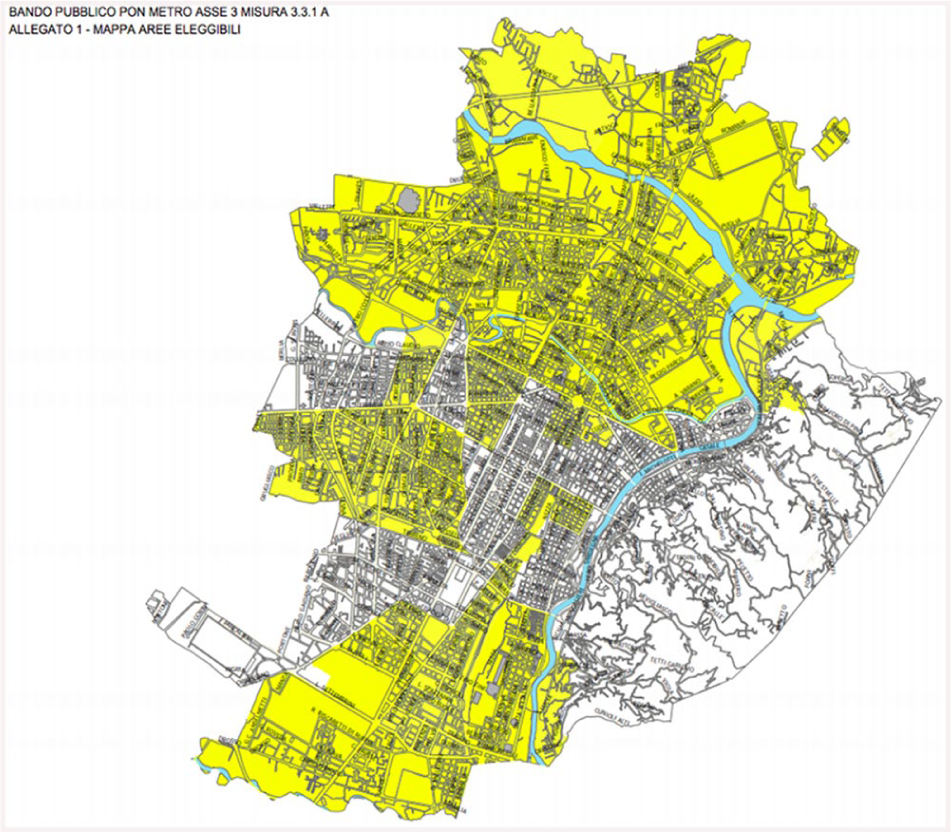
The map of admissible areas of LLSC (City of Turin, retrieved from http://www.comune.torino.it/sfogliato/axto/files/assets/basic-html/page-1.html#).
The City set up an ad hoc evaluation committee composed bringing together experts in the different fields of activity. Five criteria were considered decisive for access to public funding: (1) Technical Feasibility; (2) Uniformity; (3) Level of Innovation; (4) Level of Engagement; (5) Economic Sustainability. The shape of contract chosen by the City to start the testing phase with the selected subjects was the Partnership Agreement. This latter turned out to be the most suitable to start the LLSC, since it clarified the conditions and shortened the administrative process related to the transfer of grants.
Involvement and support strategy
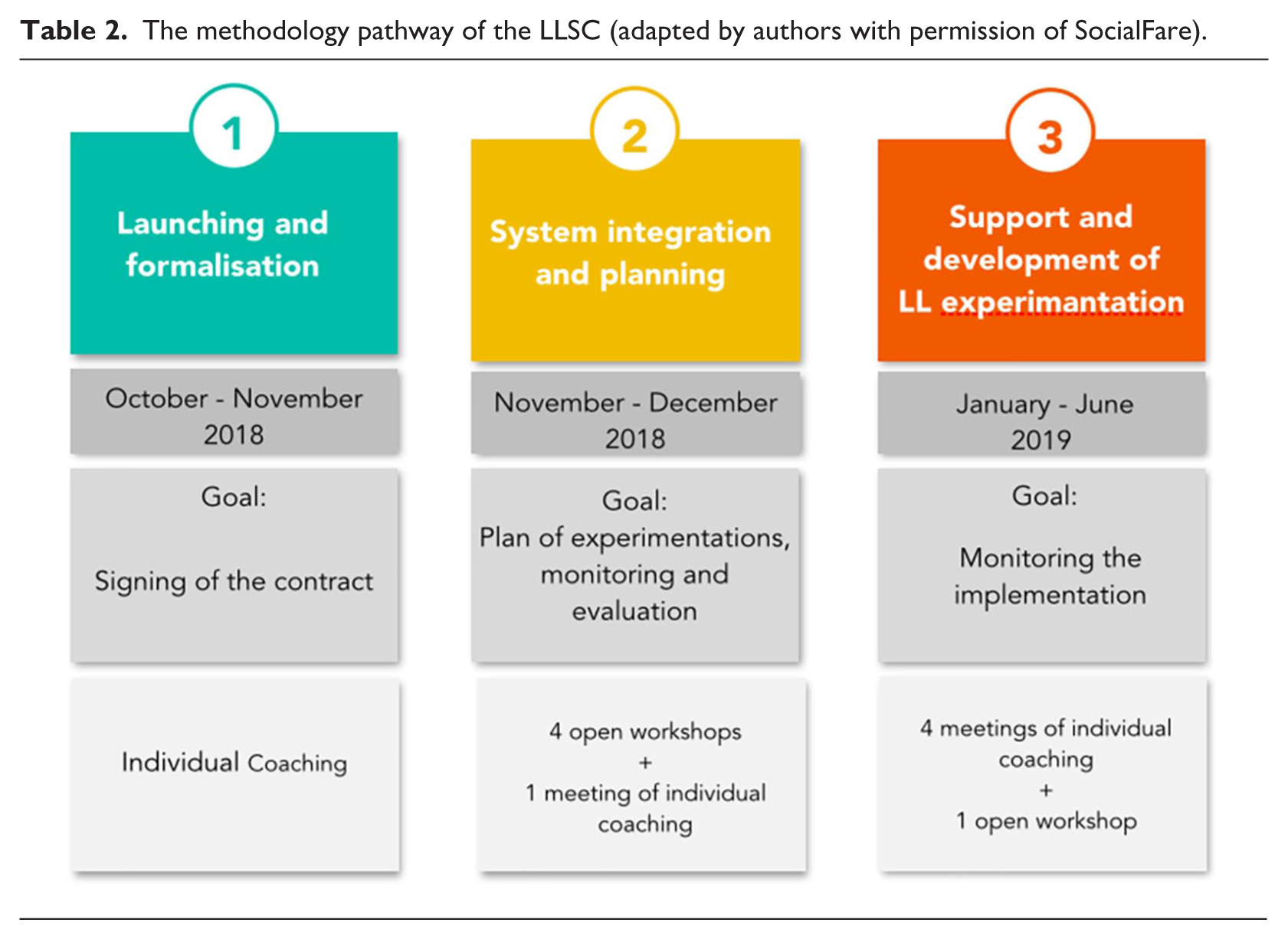
Planning living labs could represent a tough task for local governments. 20 For this reason, the City wanted to include a MA, composed of three freelance professionals in the field of social innovation, with the twofold aim to help the experimenters to develop their ideas as well as to achieve the maximum result in terms of improvements of the circular products. Experts of MA was selected by the City through a public tender and an assessment process, on the basis of curricula and past-experiences in co-creative projects and citizen’ involvement. Since October 2018, the MA had been adopting a strategy split into three main phases: (1) launching and formalisation; (2) system integration and planning and (3) support and development (Table 2).
The methodology pathway of the LLSC (adapted by authors with permission of SocialFare).
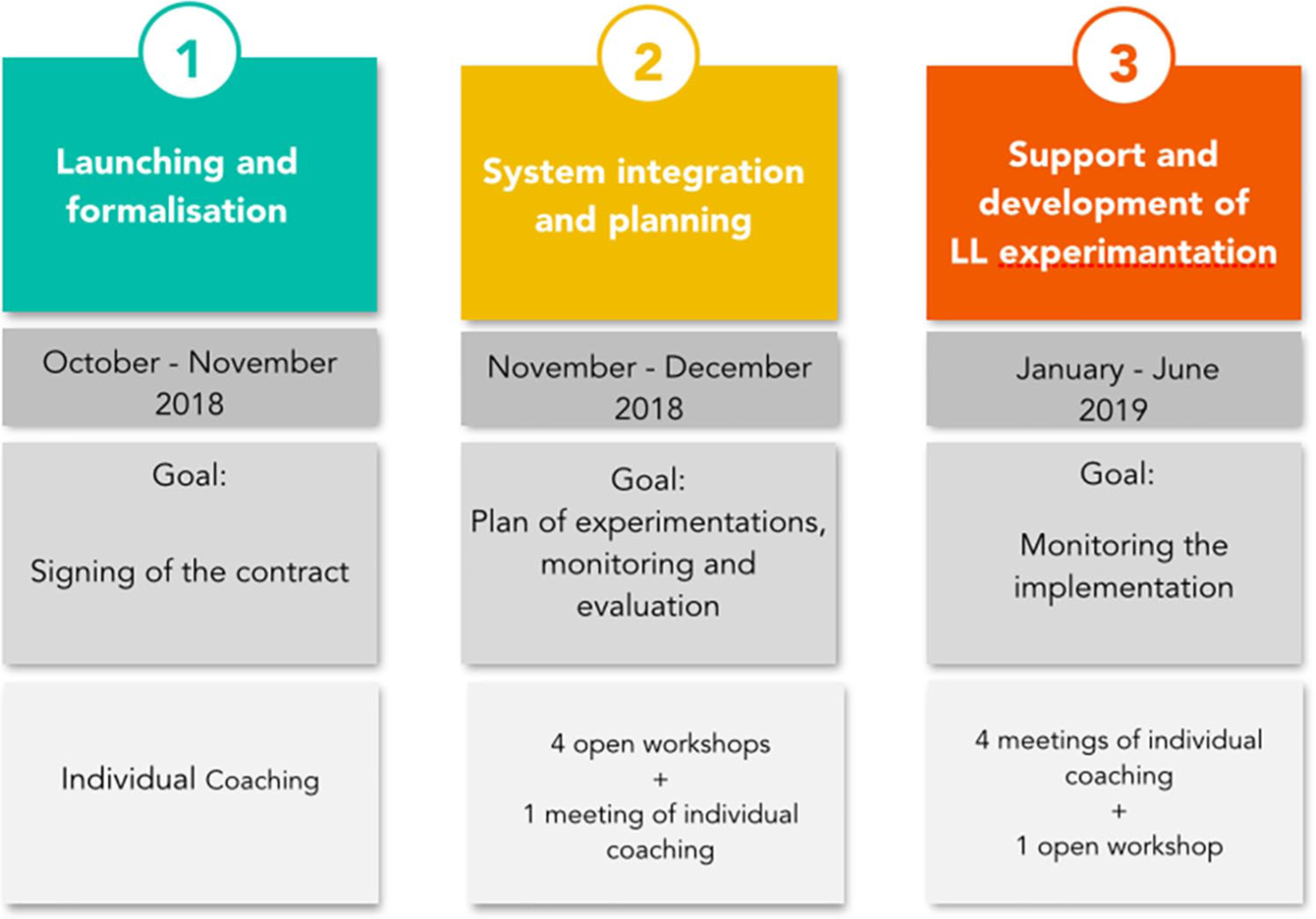
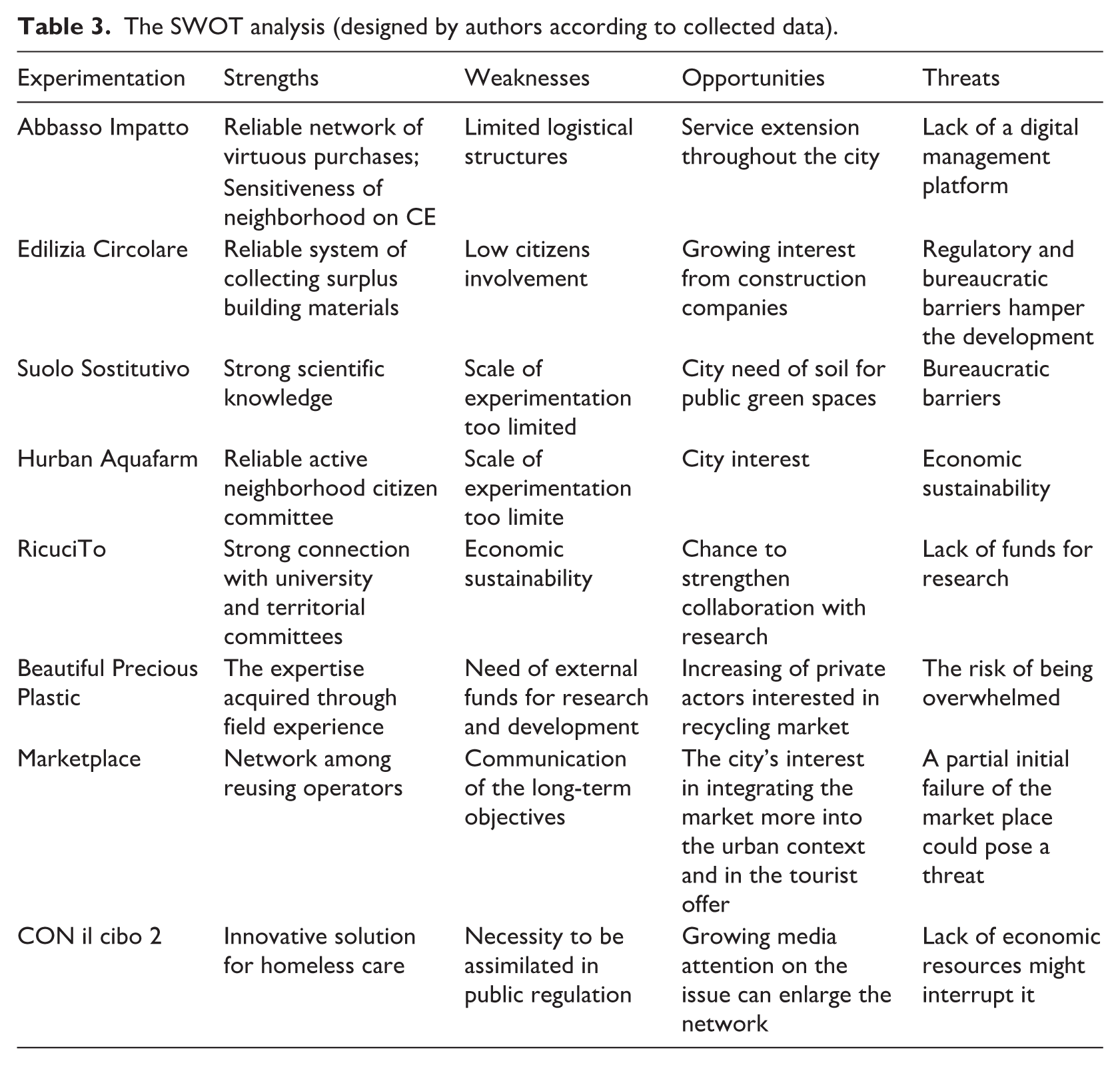
The SWOT analysis (designed by authors according to collected data).
In the launching and formalization phase of the LLSC, the MA’s experts met the proponents with the aim of informing and encouraging new collaborations. These preliminary meetings were an opportunity to share ideas and encourage their development. This action enhanced the strengths and highlighted the weaknesses of projects in terms of technical feasibility and economic sustainability, urging subjects to improve specific aspects.
In the evaluation process realized by the commission, the MA constructed a summary table in which the strengths and weaknesses of presented projects were indicated with reference to each specific assessment criteria. Moreover, the three MA’s experts attended all of the evaluation gatherings, to help the work of the evaluation commission.
In the last two phases, the system and the development of LL experimentations, the proponents followed a structured training course in five workshops with the aim of validating the idea; identifying evaluation and impact indicators; choosing community engagement methodologies; developing a specific action plan. Design thinking and systemic design were the theoretical basis of the working method as well as system map and Social business model canvas represented the main tools used. The output of the whole process was a roadmap for each of the eight projects admitted to the trial. In the support and development phase the team specialists met the proposers, individually or with the whole project team, on at least four different occasions with the coaching methodology. In LLSC, explaining the difference between monitoring as a form of support instead of control represented one of the most challenging goal for MA. After the beginning phase, participants understood that sharing their weaknesses could represent a value LLSC as well as insisting on the identification of precise indicators of success or failure.
Due to the skepticism to invest in non-essential action, usually SME of CE have not a connection with activities from different business sectors. 21 LLSC prompted the activation of unusual relationships: with Universities, with software producing agencies, with communication agencies, with subjects such as the Chamber of Commerce, normally seen as inaccessible or whose potential is not clear. Moreover, the launching phase built a bridge among profit companies and non-profit entities, cooperatives and territorial associations: it actually tried out a new ecosystem of CE.
Eight experimentations of CE
The time frame for developing the eight selected projects is from January to December 2019. To have a better understanding of the characteristics of the LLSC it is necessary to present the projects admitted to experimentation on the urban territory.
Abbasso Impatto (lower impact)
Abbasso Impatto is a project conceived to reduce the environmental impacts in the consumption of catering and hospitality establishments and to guarantee sustainable prices for supplies thanks to collective purchasing. 22 The experimentation area identified is the San Salvario district of Turin. In order to carefully choose the suppliers of the necessary products and services, it draws up minimum environmental criteria to select the suppliers which had to guarantee a circular production process. In LLSC, Abbasso Impatto involves 20 among commercial enterprises and receptive structures.
Edilizia Circolare (circular building)
Edilizia Circolare, a project conceived and developed by the Emmegi company, was born with the aim of applying the concept of reuse and recycling in the construction sector. 22
A board of experts identify potentially reusable materials donated by citizens, businesses and local artisans, to be transformed and come back to life in new furnishings and finishes. The final product of the trial will be the restyling of a room located entrusted by the City to the Paradigma Social Cooperative, to host a café for members and new laboratories. The process of restyling involved a total amount of 186 citizens, considering private donors, partners, event and workshop participants, and members of the team.
Suolo sostitutivo (replacement soil)
The project, conceived and developed by Horizon srl, aims at the re-use, in the context of territorial planning, of inert material, following an appropriate treatment, coming from excavations carried out in the city for infrastructural works. 24 Normally, in fact, this material is classified as waste and is stored in landfills.
The main objective of the project is the development of a technical protocol for the constitution of a soil capable of replacing the natural one, suitable to sustain a plant substrate over time. In this experimentation were contacted 40 companies. Eight of them expressed their interest in the project results and their will to collaborate.
UrbanAquaFarm
UrbanAquaFarm, an experimental project proposed by Carlo Prelli Service, wants to develop and test innovative systems for horticulture. 25 Within the framework of the “Orti Urbani Torino” system, a pilot project is proposed that creates a collaborative system of production and consumption of plant products based on “hydroponic” culture techniques. Specifically, the project builds prototypes and experiment with circular horticulture practices, in the area of the “urban gardens” inserted in the Parco dei Laghetti in the north of the city, inaugurated during the 2018 spring in an area currently undergoing redevelopment. It shapes a new group of 10 citizens and enables them to handle hydroponic.
Humana, RicuciTo project
Humana has chosen to build a pilot project capable of dealing with one of the main components of this quota, denim. 26 The experimentation involved 7 inmates from Lo Russo Cutugno prison in the production of slippers and potholders with waste textile material. The work was carried out thanks to the support of 2 professional seamstresses from the Gelso cooperative engaged in training and 250 students from the Polytechnic who designed the products. These have been put on sale at Humana stores.
Izmade, Beautiful Precious Plastic project
Izmade creates design objects and furniture, working wood and metal. Beautiful Preciuos Plastic aims to include the Precious Plastic open source machine in the laboratory, so as to expand the range of materials and objects. 27 The machine consists of a shredder, an extruder, an injector and a press. To carry out the process it was necessary to engage 30 citizens who were called to participate in a dedicated collection of plastic and that will then be able to access the workshops dedicated to specialists and amateurs in the multifunctional centres of Barriera di Milano area.
Magma, the Balon’s Marketplace project
The project plans to create a marketplace dedicated to vintage goods and antiquities marketed in the traditional Balôn market in Turin, which has been held since 1857. 28 The marketplace has two main objectives: on the one hand it is aimed at strengthening the commercial skills in a traditional sector by opening it to a foreign clientele or resident far from Turin; on the other supporting evolution in a conventional sector, traditionally closed to innovation and comparison with wider and more developed markets. In order to set-up the market place, 75 operators are involved in the designing and implementing phases.
Stranaidea, project CON il cibo 2
The project is the evolution of a previous experimentation with which the Stranaidea Social Cooperative had already begun to distribute hot meals in one of the three night shelter facilities it manages. 28 The objectives of the project are to guarantee at least one hot evening meal to the guests of the facilities managed directly by the cooperative and to encourage the empowerment of guests by involving them in food collection preparation and distribution. Different categories of citizens have been reached. Inside the LLSC’s experimentation are involved 25 small retailers and 2 distribution entities. Furthermore, it guarantees for 9 months a daily meal for 120 guests.
Building an hub of CE
Cities are in a critical position with respect to the transition to the CE. 29 On the one hand they play a key role in preserving the quality of urban spaces and thus the health of citizens. On the other, they can take the first step towards a circular transition. 30 In order to disrupt the linear paradigm, cities have a twofold challenge: (a) building a community committed in the transition; (b) establish clear and shared governance mechanisms. In this perspective the LLSC could represent a fruitful pattern to design circular policies and transform Turin into an Hub of CE. These two goals require an in depth analysis of the strengths, weaknesses, opportunities and threats shown by CE activities in experimentation such as LLSC, to improve long-term policies.
The SWOT analysis provides food for thought to the City. CE experimentations have shown that bureaucratic barriers in waste management are difficult to tackle without an active role of the public administration. In addition, most of the products in the experimental phase feel the lack of incentives to get into the market. However, with a view to creating a CE Hub, LLSC has succeeded in expanding the community of actors and experimenting with a new working approach capable of bringing together businesses, citizens and public administration on reuse, recovery and recycling of materials. In order to function at its best, this ecosystem has to plan an inclusive governance capable of effectively connect several fields of CE. Starting from LLSC, the City is planning to create an inter-council Control Room to manage the huge variety of needs pointed out by CE companies. Concerning the involvement, it is necessary to consider that the CE concepts does not overlap with recycling, entailing an active role of users. 31 Rather it includes all the phases of the realization of a good and service: the design, the production, the distribution, the modality of fruition and of transformation. It relies on second raw material as productive inputs; recovery and recycling; upcycling; extension of product life; sharing platforms; product as a service. Finally, the concept of Hub is strongly linked with network paradigm. 32 The constituting Hub is to be understood both as a new network of territorial actors and at the same time connection of existing ones. Additionally, the Hub has to be meant as a node of a wider network, connected to supra-local scales of action. With regard to the connection with the supra-local networks, the work of the CE Manager Group could play a strategic role: it could share and scale-up the experience of LLSC with international bodies.
Conclusion
Analysis of practical cases of Living Labs on CE, can play a key role to improve long-term policies related to the environment and citizens’ health. LLSC suggested three main aspects which could be stimulating and useful to design future policies. First of all, the LLSC has shown how there is an emerging network of local businesses, associations and committees of citizens increasingly active in the field of sustainable entrepreneurship. Through the facilities made available by the City and the guidance of the MA, these bodies have managed to get in direct contact with citizens. This direct approach provided through LLSC could be a tool to improve their innovative ideas to better match needs and necessities of citizens. Secondly, the case study has suggested how the Living Lab tool allows to build the foundations to turn cities into innovation hubs. In the last decades, none of classic regulatory or business incentive tools has ever managed to bring together the City of Turin, research institutions, businesses and citizens on such a key-issue as CE. Therefore, the LLSC may represent the starting point to transform Torino City Lab into an effective hub of CE. Finally, the case has highlighted how local action is directly linked to global policies. The need to find sustainable business solutions that preserve the environment and the health by working on reuse, material recovery and recycling is shared by most of the world’s institutions. However, too often shared policies crash through barriers in practice. Living Labs could be key-tools to connect cities and to scale policies from local to global in support of CE, to reduce consumptions and improve well-being.
To sum up, City of Turin is going to identify one or more significant places in the urban area, which could be regenerated and become hub to host companies, citizens, schools and universities. By adopting this perspective, the City wants to find a place that can gather all the activities of CE, exploiting the huge spaces left empty by the industrial crisis and following up the results of LLSC. A common goal shared by cities, which can be pursued through dialogue on Living Labs, conceived as new tools of innovative policies to face environmental and citizens’ health challenges.
Footnotes
Acknowledgements
This work is the result of the involvement and the effort of all the LLSC participants. Particularly, we we could rely on support and suggestions of the City of Turin official’s and the European Network of Living Labs (ENoLL). We would like to thank all the interviewees for their direct commitment.
Author’s Note
The publication’s fee was waived by the Editor in Chief.
Declaration of conflicting interests
The author(s) declared no potential conflicts of interest with respect to the research, authorship, and/or publication of this article.
Funding
The author(s) received no financial support for the research, authorship, and/or publication of this article.
