




Abstract
Sufficient information and support for breastfeeding mothers is vital to encourage optimal infant feeding practices. Infant feeding apps give breastfeeding instructions and access to information however, little is known about mothers’ perceptions about these resources. This study investigated mothers’ use and experiences of infant feeding apps with a feeding tracker component, including how information within these apps is used, initial reasons for downloading, the role of the app in infant feeding, and perceived benefits and disadvantages of infant feeding apps. In-depth interviews were conducted with nine Australian breastfeeding mothers who had used an infant feeding app in the last year. Interviews were recorded, transcribed verbatim and coded prior to thematic analysis. The findings revealed that infant feeding apps provide mothers with objective information to guide their breastfeeding decisions and other aspects of baby care. This objective approach to infant feeding gives mothers a perception of greater control, confidence and efficacy at a time of transition and stress in the early stages of parenting an infant. While, overall, the mothers were positive about infant feeding apps, they also expressed concerns regarding overreliance on the app, feeling overwhelmed with the data and questioning the credibility of the information.
Introduction
Optimal infant feeding (IF) is important to support healthy development within babies and infants. Current Australian guidelines from the National Health and Medical Research Council recommend exclusive breastfeeding for the first 6 months. 1 However, maternal IF decisions are complex and breastfeeding is not always easy, impacted by internal and external influences such as practical support, lifestyle choices, social influences, self-perceptions, beliefs and knowledge.2–5 Difficulties or perceived problems, both physical and psychological, can occur and often require community and health professional support. 1 For example, Wagner et al. 6 found that 92 per cent of mothers experienced breastfeeding complications, including difficulty, pain and concern of milk quantity. One of the most frequently reported problems is insufficient breastmilk supply, which is difficult to address as milk output cannot be easily measured at home without semi-invasive procedures such as test weighing or expressing milk.3,4 Health professional involvement and peer support can ameliorate the situation but are not always immediately accessible.3,4,7
The near universal presence of mobile phones allows users instant access to information via the Internet and mobile phone applications (apps) have great potential to support healthcare.
Mobile health (mHealth) is commonly defined as ‘medical and public health practice supported by mobile devices, such as mobile phones, patient monitoring devices, personal digital assistants (PDAs) and other wireless devices’ 8 (p. 6). The mHealth app market was valued at US$10 billion worldwide in 2015 and predicted to rise to US$31 billion by 2020. 9 The purpose of mHealth apps is diverse, including interventions and behaviour change, disease or condition self-management, data monitoring and information provision. 10 IF apps are an emerging area within mHealth. In 2016, there were over 108 IF apps listed on the Apple store alone and perusal of these suggests IF apps have three main purposes: track the infant’s intake and output, track infant growth and assist with the introduction of solid foods. Despite being highly popular, IF apps are still relatively new and little is known about how they serve their purpose. 11
A recent quality and content analysis of IF apps found many were of poor quality on measures of comprehensiveness, suitability of information and readability. 12 In addition, the majority were developed by agents without medical expertise, raising further concern about the accuracy of the content and whether mothers and their babies were at risk. 12 To the best of our knowledge, there are no studies which report the experience of mothers who use IF apps when breastfeeding. This study aimed to investigate mothers’ use and experiences of IF tracker apps, including reasons for downloading, the role of the app, how they used and appraised information and the perceived benefits and disadvantages with the apps.
Methods
Study design
Qualitative methods of semi-structured interviews and thematic content analysis were used for this study to elucidate mothers’ experiences of and attitudes towards IF apps. Qualitative methodology allows for exploratory inquiry, clarification of ambiguities, discovery of unanticipated findings and information-rich material which enables a deep understanding of the phenomenon under investigation. 13
Ethics approval was provided by the Flinders University Social and Behavioural Research Ethics Committee (project 7308). All participants gave informed written consent to participate in the study.
Study population and recruitment
Mothers were recruited into the study by word of mouth, a Facebook page, physical flyers and the Flinders University Research Studies webpage. Flyers were distributed to a local shopping centre, public notice boards, local libraries and childcare centres within the Adelaide metropolitan area, specifically the councils of Marion, Campbelltown, Onkaparinga, Mitcham and Holdfast Bay.
Participants were included in the study if they were mothers, English speaking and used an IF app with ability to track feeding within the previous 12 months. We excluded fathers, those unwilling or unable to provide informed consent and those who used apps which did not have feeding tracking capability. The feeding tracker component of apps, which provides feedback on feeding behaviours, was a function of interest in this study to reveal the potential benefits and disadvantages of IF apps. We did not include or exclude participants based on the length of time they breastfed their babies and data on the length of time of exclusive or any breastfeeding were not collected.
Semi-structured interviews
Interview questions explored mothers’ motivations in using IF apps, the role of IF apps to IF, how information within these apps was used and appraised and the perceived benefits and disadvantages of IF app use. An iterative process was used whereby questions were modified to enable deeper exploration of emerging issues. 13 Interviews proceeded until data saturation was achieved; some questions were removed from the schedule as saturation was reached prior to the final interview and in order to deeply explore other emerging themes more relevant to the research question. 14 The same researcher (K.D.) conducted all interviews and, in order to minimise participant burden, interviews were held at mothers’ houses (in metropolitan Adelaide, South Australia) or by phone, according to the mothers’ preference. Interviews ranged between 30 and 70 min.
Data analysis
All interviews were digitally recorded, transcribed verbatim, listened-to, re-read and manually coded immediately after completion of each interview. Initially, interviews were coded deductively against the research questions and inductively from new concepts that emerged from participant responses by two researchers (K.D. and K.M.) to ensure consistency. Verbatim quotes were recorded against each code for accuracy. Codes were combined into categories and further into themes. Coding was compared within and between interviews, then discussed and agreed upon in weekly meetings involving all researchers. An inductive approach to coding was taken with respect to concepts and themes emerging from and being grounded in the data. 13 Throughout the analysis, the data were subjected to interrogation with the theoretical and empirical literature, and further tested with subsequent interviews, in an iterative process. 15 The analysis process involved all researchers in order to ensure rigour. 16 Interviews continued until saturation was reached, which occurred at interview 9. 14
Results
Nine mothers participated in the study. The median age was 35 years, and median number of children was 1–2 (Table 1). The infants for whom the IF app was used were aged from 3 weeks to 2 years. Eight different IF apps were described by mothers; most mothers reported using just one IF app. One mother was unable to recall the name of the IF app used but described the feeding tracker app feature in detail. IF apps used by the mothers had comparable features and functionality, including tracking the length of time of feeding or expressing breastmilk. Apps provided summaries of feeding over time, infant growth charts and tracking of urine and stool output. Some IF apps had additional functionality to track other behaviours, for example, sleep, and the ability to set alerts or reminders for feeding, for example, as push notifications; however, it is not known how much these varying features were utilised by the mothers in the study. Most apps were free with in-app purchases; however, some IF apps mothers used were purchased or were premium versions of free IF apps.
Participant characteristics and IF apps used by mothers in the study.
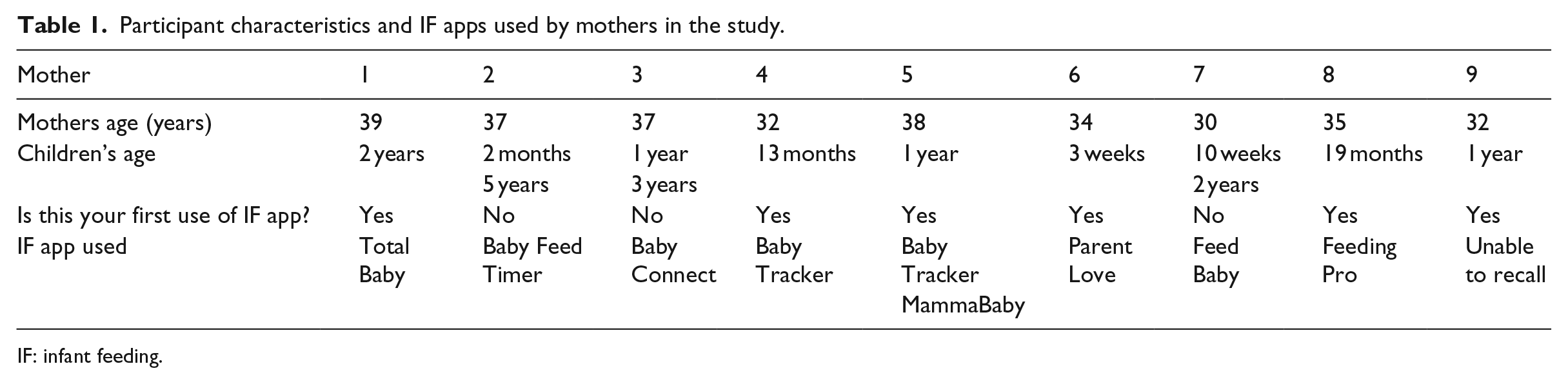
IF: infant feeding.
The findings have been summarised according to the following themes: data-driven IF and other baby care, supporting parental efficacy and confidence, and negative aspects of apps.
Data-driven IF and other baby care
Most of the mothers expressed an appreciation for an objective approach to breastfeeding and general baby care that involved systematic data collection and analysis to make informed decisions. To this extent, their approach to breastfeeding appeared to be ‘data-driven’.
They recognised that monitoring of breastfeeding has been a long-standing practice and that IF apps simply represent a modern method for doing so: like they used to have a . . . nappy pin . . . that they’d just . . . pin it to their bra on the side that they last fed at so then they knew that they had on the other side . . . yeah like they had all these manual ways of doing it. And I was like that’s exactly what I’m doing, I’m just doing it on my iPad. (M3)
They acknowledged that IF apps were part of a broader social trend towards monitoring many aspects of life: The need for logging things, I don’t know, everyone seems to want to see data and information these days . . . umm, and, you know everything from, you know, your exercise apps and all that sort of stuff, you know people are interested in that sort of information. (M9)
The apps provided a convenient way to collect data because of the ubiquity of smart devices for modern mothers: I guess ease of use, the apps you know, on your phone, everyone’s, everyone’s got an app, your phone is so close to you and handy and you know, just ease of use. (M9)
All mothers were concerned about their infant’s development and the IF apps provided data that enabled them to understand their infants’ feeding patterns and thereby predict their feeding needs and reassure what was ‘normal’ for that infant: If he had had 2.5 hours of feeding per day when he was early on, I was like oh, that’s his kind of average and I’d feel comfortable with knowing that that was you know, okay. (M8)
The time taken for breastfeeding was an issue for some mothers and observing natural evolution of quicker feeding was encouraging for them: Even when you think things aren’t going to ever get better or how is this ever going to be quicker you could look and see that actually yes this is, ‘cause you might not see little bits every day but over a period of time you would definitely see that you’re making improvements. (M1)
The data on feeding patterns also assisted mothers to interpret their infant’s crying and decide what crying was likely to be hunger-related: it just helps work out . . . when he was upset or something what was wrong. You could look back and work out what was going on, you know, you could just check, and it generally helped eliminate the issue. (M5)
The data analysis was particularly useful for solving problems that their infant was experiencing: So even though obviously like she [talking about other child] was having symptoms and stuff, which prompted us to look back at stuff more closely and he didn’t, but still, it’s just seems like a safety net to have, umm this record of everything so that you can put it in one of those graphs altogether and see if there’s any patterns. (M7)
A primary value of the IF app was that it circumvented the reliance on memory for storing data which would have added stress to the role of infant caring: So, for me because being a new mother and um, being sleep deprived I was not remembering which side I was feeding [child’s name] on, so for me just pressing the left and right, timing the feeds, knowing what times I had fed him, so I could then know, you know when he’s due for a feed next . . . I think for me I did feel more confident and in control because, I didn’t have to remember this information and then I wouldn’t have remembered it so I would have been flustered and I would have felt stressed and I would have thought well I’m not doing my job as a mum. (M8)
This aid to memory was not exclusive to feeding but also extended to other aspects of infant functioning such as bowel movement: I couldn’t remember did they use their bowels yesterday I don’t really remember or was it the day before, so I was able to look back because I’d put every nappy change in. (M1)
Supporting parental efficacy and confidence
The predominant impact of IF apps was to enable mothers to feel more in control and to reassure them about their breastfeeding and parenting decisions. This was important as breastfeeding is less structured than bottle-feeding and can therefore be more challenging for mothers to feel efficacious: I think, for something that you’ve got so little control over in a baby it made you feel like you had some sort of control and you knew what was going on, to some extent. (M5)
Doing the right thing with respect to their infant’s nourishment was a high priority for the mothers, and the IF apps not only assisted them to carry out this role well but also provided mothers with reassurance that their infant was getting enough milk: I had some issues um, with her breastfeeding to begin with, um so I just wanted to make sure that she was getting enough. (M9)
For some mothers, the reassurance provided by the IF app enabled them to prolong breastfeeding: I do think that . . . there were times that I think I was definitely going to give up earlier, but you know once you can see patterns in the feeding and yourself, like you’re getting right and we can feed . . . then you sort of went, oh well I must be doing it right so I’ll keep going. (M5)
Their use of the IF app varied in response to their changing needs and confidence.
Well I mean when I didn’t need the information . . . once I was confident . . . I didn’t really look at it or use it. (M4)
Negative aspects
While most mothers were enthusiastic about IF apps, some revealed negative impacts from their experience. Over-reliance or addiction to the apps was an issue for one mother and consequently she stopped using the IF app. Following this, her breastfeeding improved: I stopped using it because um I thought I’m being too anal about this . . . being too concerned about it, I just need to stress less, and just go with the flow and just be a bit more relaxed about it . . . so, that’s why I stopped using it completely, and then I think the breastfeeding improved from there ‘cause I was worrying about it less . . . it’s not just the, uh you know, the connection with the child, but it’s a biological thing, it probably helps me with my milk production and that sort of thing as well. (M9)
Some mothers expressed feelings of guilt over the time spent on the IF app: I probably could’ve just gone put the phone down and enjoyed the baby. (M9)
Other mothers described feeling overwhelmed by the volume of data they had to analyse: The day time data is a bit overwhelming in the respect that it’s all over the place and I don’t really know how to interpret it. (M6)
There was also concern over the quality of information in apps, with mothers stating they would still consult a health professional rather than just using the app itself: I still like to talk to someone and probably double check with people that are more qualified like, yeah, so if I had concerns about his feeding I would call the parenting helpline, or I would seek advice from like a, you know someone’s that more qualified than just the app itself. (M8)
One mother did acknowledge that she would probably use information from an IF app more if she knew it was from a reliable source: [discussing using solely app information] Depends who it was written by you know, if the app was written by and had that it was written by Flinders Uni[versity] or something like that I probably would. (M6)
A minority of mothers thought that the IF apps were difficult to use especially in conjunction with breastfeeding: before he’s latched on that is stressful, because he’s screaming at me and I’m trying to get the app to work. (M6)
Discussion
This study highlighted the generational trend away from manual monitoring of IF to digital methods. Phones with app capabilities have only existed within the past decade; thus, the use of apps was non-existent in previous generations. 17 Since then, smartphones are a standard personal item and the mHealth industry has capitalised on their use with the development of apps. 18 This expansion opens a new world of possibilities due to the increased accessibility, portability and convenience of mobile phones, compared to other means of behavioural monitoring. 19 Developments in digital communication have been matched with consumer demand for do-it-yourself self-management apps and virtual healthcare.17,18 Mothers in this study affirmed this societal shift and adoption of app use. Demirci et al. 20 also found that apps were a popular source of postnatal information, including support, information about infant care, and breastfeeding information. As apps offer ease and convenience, this makes them ideal as an aide to breastfeeding mothers. 19
The self-monitoring facilitated by apps provided reassurance which is vital in the early stages of transition to motherhood.5,7,21 Motherhood can be overwhelming and difficult initially, especially for first-time mothers who often need constant support and reassurance. 22 Feelings of anxiety and/or fear of bringing home a newborn and not knowing how to recognise what is ‘normal’ for baby health and behaviour are common experiences for new mothers. 23 Such feelings were also voiced by mothers in this study who often framed their IF app use within the context of worry and uncertainty over their infant’s well-being and their own capabilities. Being a successful and effective parent is associated with recognising cues, understanding a newborn’s state and appreciating a baby’s capabilities. 24 Mothers in this study appeared to seek affirmation in meeting these skills and confirming their maternal efficacy, especially with respect to achieving normal infant development and correctly diagnosing problems. The IF apps seemed to provide the requisite reassurance.
The mothers required confirmation of their breastmilk supply, which is a commonly reported cause of anxiety.1,16,25 Mothers are often concerned about their milk supply, lacking trust in their bodies’ ability to produce the required amounts, and this can lead to early termination or refusal to breastfeed.1,16,25 However, once mothers are confident in their ability to breastfeed, they often commit to this method of feeding. 24 External sources such as midwives are common sources of reassurance, with a recent Australian study finding over 90 per cent of midwife visits involving some form of breastfeeding reassurance. 7 There is limited evidence of the effectiveness of mHealth interventions in supporting breastfeeding, although increasing knowledge of the benefits and providing reassurance in a mother’s abilities appears to yield positive results.26–28 Tracking infant weight gain is an important method for assessing IF. 29 Mothers in this study shared this concern regarding their breastmilk supply. The IF app enabled them to track their infant’s feeding as well as their growth pattern. This visual data helped to improve their confidence and feelings of self-efficacy. In this way, IF apps helped many of the mothers to maintain breastfeeding, which appears to correlate with prior literature where text messaging mHealth interventions supported extended duration of breastfeeding.26–28
The visual display of data by apps was another factor that raised mothers’ confidence levels. Mothers described their analysis of IF app data to find patterns and routines, which verified what was ‘normal’. These data gave mothers a measure of control and supported their establishment of feeding and sleep routines, which consequently reduced their feelings of chaos and stress. Implementing baby-care routines has been shown to ease the adjustment for mothers into their new role and produce higher maternal confidence, which may explain why mothers in this study expressed breastfeeding confidence improvements following IF app use.21,30 The app data also enabled mothers to set IF targets which, when successfully achieved, enhanced their confidence.
Not all app use was positive, and some mothers reported that the complexity of the app data caused them some anxiety. A study by Demirci and Bogen reported that some mothers using a breastfeeding app found it time-consuming and anxiety-provoking, while others had an overall positive experience. 31 The potential for personal health data to overwhelm people is not uncommon. 32 Over-reliance on IF apps was another negative factor identified by mothers. Literature suggests that a reliance on apps may detract from developing personal skills in analytical thinking and problem-solving.33,34 A study of women using a gestational diabetes app to track blood sugar levels found that feedback encouraged obsession with the app. 35
Questions of trust in the credibility of IF apps were raised by the mothers. Mothers were more likely to trust IF apps if they knew the creator was reliable and information came from trusted sources. Consumers of health apps commonly use them in conjunction with information from health professionals or Government sources. 35 One method to improve the credibility of IF apps is the concept of ‘shared care’, where health professionals utilise mHealth apps within their practice. Although current research suggests health professionals demonstrate little knowledge of, and interest in, self-tracking and management apps, there is a growing need for this to change and reach an equilibrium between online/on-demand information and that from health professionals. 35 Both have their advantages, with health professionals offering tailored and holistic advice, developed through years of training and experience, whereas apps offer instant information. 36 Through the combination of services, health professionals could advise against untrustworthy apps and those with incorrect information to avoid potential harm to mother and baby. 34 In turn, this would offer more use of IF apps than just self-tracking and supplemental information.
Strengths and limitations
A key strength of this study is that it lies within an emerging area of public health nutrition (IF apps purpose and use) where there is a paucity of research.
IF apps have great potential for promoting health and self-management to a wide population, but their unregulated content is a cause for concern. It is vital that health professionals are aware of emerging technology trends and have adequate mHealth literacy to respond to clients. 20
Qualitative interviews gave a rich examination of the subject, and data saturation was achieved within the sample of nine mothers. Finally, study rigour was maintained throughout the analyses as multiple members of the research team analysed the data and read codes and transcripts, minimising subjectivity in coding.
However, the study is not without its limitations. First, recruitment was passive and required interested mothers to contact the research team for screening and information about the study. As the study is qualitative, the data cannot be said to represent the wider population. Mothers in this study had a median age of 35 years, which is above the median age of mothers in Australia in 2016 (31.2 years). 37 It may be that older mothers were more likely to respond to recruitment notices, willing to participate in the research study, or more likely to use IF apps. Hence, the prevalence of IF app use in younger mothers and drivers behind IF app initiation and continued use needs to be further explored.
Mothers were included in our study if they breastfed their babies and used an IF app to track their feeding. We did not include or exclude participants based on the length of time they breastfed their babies and data on the length of time of exclusive or any breastfeeding were not collected. However, we acknowledge it is possible that our sample is subject to bias by mothers who may have been more successful at breastfeeding. Future studies to explore whether mothers’ use of IF apps is associated with length of breastfeeding would be pertinent.
Participants in the study did not need to be current users of IF apps, but rather users of such apps within the last 12 months. Hence, participant responses may be subject to recall bias. In addition, we did not collect data on the length of IF app use for either first-time or repeat users of IF apps.
Another potential weakness of the study was that limited sociodemographic data were collected. This was in order to limit the burden of response on participants and was not considered necessary for the purpose of the study.
Conclusion
This study found that IF apps provide mothers with objective information to guide their breastfeeding decisions and other aspects of baby care. This objective approach to IF gives mothers a perception of greater control, confidence and efficacy at a time of transition and stress in the early stages of parenting an infant. While, overall, the mothers were positive about IF apps, they also expressed concerns regarding over-reliance on the app, feeling overwhelmed with the data and questioning the credibility of the information.
Footnotes
Acknowledgements
The authors would like to acknowledge all mothers involved in the study.
Author contributions
K.D. was involved in the study design, recruitment of participants, conducting all interviews, transcribing and coding interviews, undergoing thematic analysis and writing the manuscript. J.M. conceived the concept, was involved in the study design, read and advised on transcripts and reviewed drafts of manuscripts. K.M. conceived the concept, was involved in the study design, read and advised on transcripts, coded some transcripts, advised on thematic analysis and reviewed drafts of manuscripts. C.M. conceived the concept, was involved in the study design, read and advised on transcripts and reviewed drafts of manuscript.
Declaration of conflicting interests
The author(s) declared no potential conflicts of interest with respect to the research, authorship, and/or publication of this article.
Funding
The author(s) received no financial support for the research, authorship, and/or publication of this article.
