




Abstract
Two of the most salient problems in nursing homes are the responsive behaviours and falls of older people living with Alzheimer’s disease and related disorders. Intelligent videomonitoring and mobile applications are potential technologies that may help prevent and manage these problems. However, evidence for the needs for technologies in nursing homes is scarce. This study aimed to explore the perceptions and needs of care managers, and of formal and family caregivers in nursing homes regarding these potential technologies. With an exploratory qualitative design based on Rogers’ diffusion of innovation theory, individual interviews and a content analysis were conducted. Results show that the potential users of these technologies consider them relevant in nursing homes. The characteristics that would make these technologies useful in nursing homes are described. These results could be used to develop useful technologies to improve the quality of clinical practice in nursing homes.
Introduction
Often, the most vulnerable older people live in nursing homes (NHs) because of multiple disabilities and severe cognitive impairment.1–3 Consequently, two of the most salient problems in NHs are responsive behaviours and falls4–7 in older people living with Alzheimer’s disease and related disorders (ADRD).
Up to 97 per cent of older people living with ADRD manifest responsive behaviours (e.g. aggressive, vocal, or walking behaviours). 8 These have underlying meanings but are considered challenging by family and formal caregivers. 9 As for falls, up to 60 per cent of residents in NHs fall at least once a year. 10 Their cause is not identified in 72 per cent of cases. 11
Guidelines exist to manage these problems,5,8,11,12 but are difficult to implement optimally or sustainably in NHs.13,14 For example, one of us (AB) developed an intervention approach based on the meanings of responsive behaviours of older people living with ADRD integrating the recommendation of guidelines for individualized interventions and partnership between family and formal caregiver in decision-making. 15 It could be adapted to fall prevention. However, the implementation of such an approach is a challenge in NHs because of the need to work in partnership and ensure continuity of care.16–20 Technological tools adapted to NHs could help optimize this type of guideline-based intervention.
Few technological tools focus on offering clinical support. Mostly these tools are information technologies (e.g. electronic medical records, administrative information).21,22 Advantages have been noted with the use of these technological tools: more exhaustive notes,23–25 a recognition of the importance of staff observations, 26 and continuity of care by making information available in real time.24,27 For example, a technological tool has improved documentation about malnutrition and pressure ulcers in an NH. 24
As NHs’ clinical goals are different from other clinical settings, technological tools developed must be adapted to them. The main focus in NHs is on quality of life and well-being, rather than on curative care as is the case in hospitals. 28 This requires tools on different problems and care processes. In addition, NHs are unique because of the characteristics of their residents (e.g. cognitive and communication impairment of most residents), of their staff (e.g. mostly nurses’ aides [NAs], high ratio of residents per registered nurse [RN]) and of their organization of care (e.g. routinized, but often unpredictable, highly personalized). They also have limited human and financial resources.1–3, 29 , 30 These characteristics have an impact on the features technological tools must have to be useful to optimize care.
Unlike hospital and home care, few technological tools have been developed and studied in NHs, despite potential to improve the quality of care22,31–34 and the differences between this and other healthcare settings. 29 A study with various health professionals and managers in NHs identified different care processes that could benefit from technology. 35 For example, this includes technologies that offer real-time data collection support at the point-of-care. This type of technology could be innovative solutions for better clinical decision-making, 33 especially for responsive behaviours and falls. However, from a pragmatic standpoint, the perceptions and needs of NH’s caregivers for technologies related to these clinical problems are unknown. More knowledge about these aspects could guide the future development of relevant technologies.
Two promising technologies in NHs
First, mobile applications (apps) are increasingly used in healthcare, given the possibility they offer for bedside use. An app is a computer program developed for a specific purpose that works on mobile devices, such as smartphones or digital tablets. 23 In 2016, a median of 68 per cent adults of developed countries owned a smartphone, and this rate increases annually. 36 Also, as 25–63 per cent of Americans own a digital tablet,37,38 many healthcare professionals and family members are familiar with mobile devices. However, only 7 per cent of medical apps are specific to nursing and very few have been developed for geriatrics. 39 Many advantages have been reported in the use of mobile devices, including improved effectiveness25,32 and continuity of care.24,27 It could therefore be relevant to develop an interactive app to help manage responsive behaviours and falls by improving bedside decision-making and continuity of care that have been reported as being challenging in NHs. For example, to help create dynamically individualized care plans, this app could integrate the above-mentioned approach based on the meanings of responsive behaviours and functional tools (e.g. lexicon, reminders) which could have an impact on the frequency of behaviours and on the well-being of older people.
Second, an intelligent videomonitoring system (IVS) could allow formal caregivers to detect older people’s falls and responsive behaviours and lead to quicker intervention. Such a system was developed for home use by some of us (JR, JM). It consists of small closed-circuit cameras connected to a computer or mobile device via Internet.40–42 When the IVS detects a fall or a responsive behaviour, it alerts caregivers and gives them real-time password-protected access to the images. It also stores images from the minutes leading up to the event for analysis. Studies on potential users’ perception of the IVS at home showed that 87 per cent (n = 30) of older people, 43 83 per cent (n = 18) of family caregivers, 44 and most healthcare professionals/managers (n = 31) were in favour of it. 45 However, the IVS was not developed for NHs or implemented in this type of setting. The characteristics of older people living at home, of their clinical problems, and of their physical home environments are very different from those in NHs. It is unclear if the IVS could be relevant in the context of NHs and what features would be needed to have an impact on the quality of care. However, because of the limited human resources and highly unpredictable care in NHs, the IVS might be useful in that context. As such, there are many potential users of these two technologies, however, their perceptions and needs regarding these potential technologies in NHs are not known.
Aim
To guide their development, our study explored the perceptions and needs of family caregivers, formal caregivers, and care managers regarding a potential interactive app as a clinical decision-making support tool, and an IVS, as a way to detect and analyse responsive behaviours and falls in NHs. The conditions that could influence the integration of these technologies in NHs and the ethical challenges regarding their use have been presented elsewhere.46–48
Framework
This study used Rogers’ 49 Diffusion of Innovation Theory, according to which diffusion of innovation is a social process oriented to the people who will use it. It suggests that the first step of development is recognizing potential users’ and organizations’ needs to ensure the innovation is appropriate to their context. This theory defines five innovation adopter categories: (a) innovators, (b) early adopters, (c) early majority, (d) late majority, and (e) laggards. The variables determining the rate of adoption of innovation by users are the relative advantage of the innovation (i.e. the innovation is perceived as better than their current practice), compatibility (i.e. the innovation is perceived as coherent with their values and needs), complexity (the innovation is perceived as understandable and usable), trialability (i.e. the innovation can be tried on a limited basis), and observability (i.e. the innovation produces results visible to others). These aspects oriented our sampling and data collection.
Method
We used an exploratory qualitative design based on conventional content analysis. 50 Sampling, data collection, and analysis were concomitant. The research protocol was approved by the Institutional Review Board (# CER-IUGM-15-16-13), and we obtained informed consent from all participants.
Sample
We recruited participants in five NHs of a public health network in Montréal, Canada that shared the same managing philosophy and made similar use of technologies. These NHs cared for severely incapacitated older people, the majority of whom have cognitive impairment. Despite our wish to include these older people in our sample, the very characteristics of this population interfered with their capacity to participate in data collection. Therefore, the participants we recruited, using purposeful and snowballing sampling strategies, 51 came from the three groups involved with these older people: care managers, family, and formal caregivers. We used a maximum variation sampling method until overall data saturation 52 was reached (n = 20), to achieve at least a representation of each adopter categories Rogers 49 describes. As the study progressed, it became clear based on the sociodemographic data collected that it was challenging to recruit participants having profiles in the late majority and laggards categories. With head nurses, efforts were made to recruit participants having those innovation-adopter profiles. Three potential participants in these profiles refused to participate, but two accepted. To be included, family caregivers had to have an emotional and social relationship with an older person with ADRD in an NH. Formal caregivers had to be RNs, licensed practical nurses (LPNs), or NAs working in the NH for at least 6 months. Care managers were head nurses, nursing care coordinators, or nurse educators.
Data collection
To assess the participants’ innovation adopter category, we collected sociodemographic data using questionnaires that included statements corresponding to Rogers’ 49 five categories. For example, the statement for the category ‘early majority’ was: ‘Faced with new technologies, I wait to see how it works for others and I ask many questions before adopting them’. Using a guide based on the rate of adoption variables described by Rogers, we conducted semi-structured individual interviews. Each interview had two parts. In the first part of the interview, participants have presented a PowerPoint presentation with potential functionalities of an interactive app that could eventually be developed and that would use the intervention approach mentioned above and then asked about their perceptions and needs for this type of technology. In the second part of the interview, participants viewed a short video on the IVS as used in the home context and were then asked the same questions as in the first part of the interview. For example, the perceptions related to the variable of complexity were explored with the following question: ‘Which elements of this technology seem complex to you? Simple?’. We audio-recorded the interviews (mean = 62 min). The research assistant kept a journal documenting the research process and interactions with participants.
Data analysis
We transcribed the data verbatim and analysed them with the iterative and interwoven strategies proposed by Miles et al. 53 condensing data, displaying similarities and differences in data, and drawing and verifying conclusions. We condensed data by coding verbatim. A code naming convention allowed to track the technology (app or IVS) and the type of participants. The study coordinator carried out the initial coding, which was then refined by one of the researchers to reach consensus. Next, we organized the codes hierarchically to display their similarities and differences. We carried out many iterations of this code display to refine our analysis and identify sub-themes. The research team discussed this organization and initial sub-themes to further refine them and draw conclusions about the themes. We used the various functionalities of Excel™ for the analysis. 54
Results
Key characteristics of the participants are summarized in Table 1. There were participants from each of Rogers’ 49 adopter categories, though most were early adopters or early majority. However, no differences were noted during data analysis on the viewpoint of the various categories of adopter or between family caregivers, formal caregivers and managers. The percentage of women for each type of participants correspond to the proportion usually found in these NHs. As such, the results represent an overall viewpoint.
Sociodemographic characteristics by type of participants.
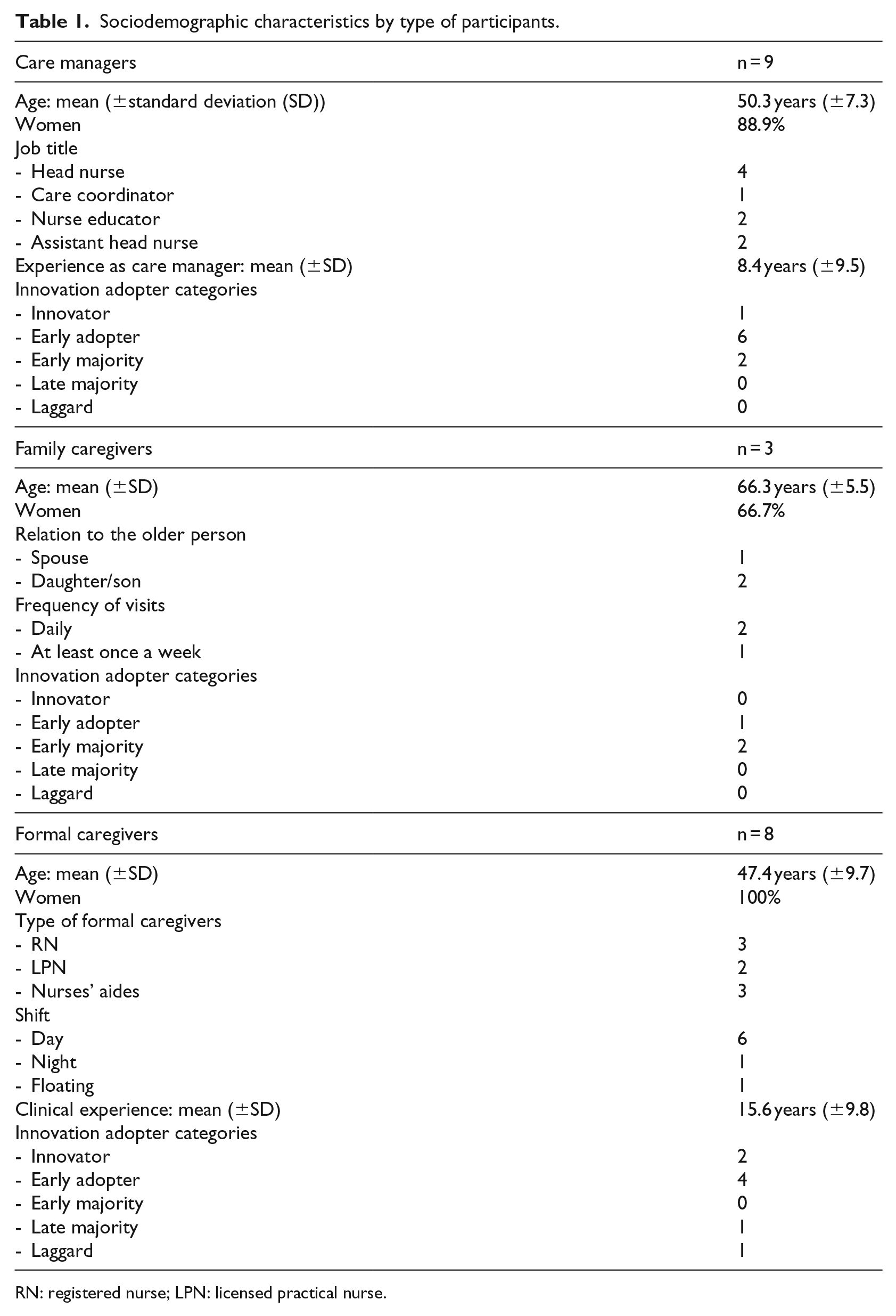
RN: registered nurse; LPN: licensed practical nurse.
Six themes were identified during the data analysis (see Table 2).
Summary of themes.
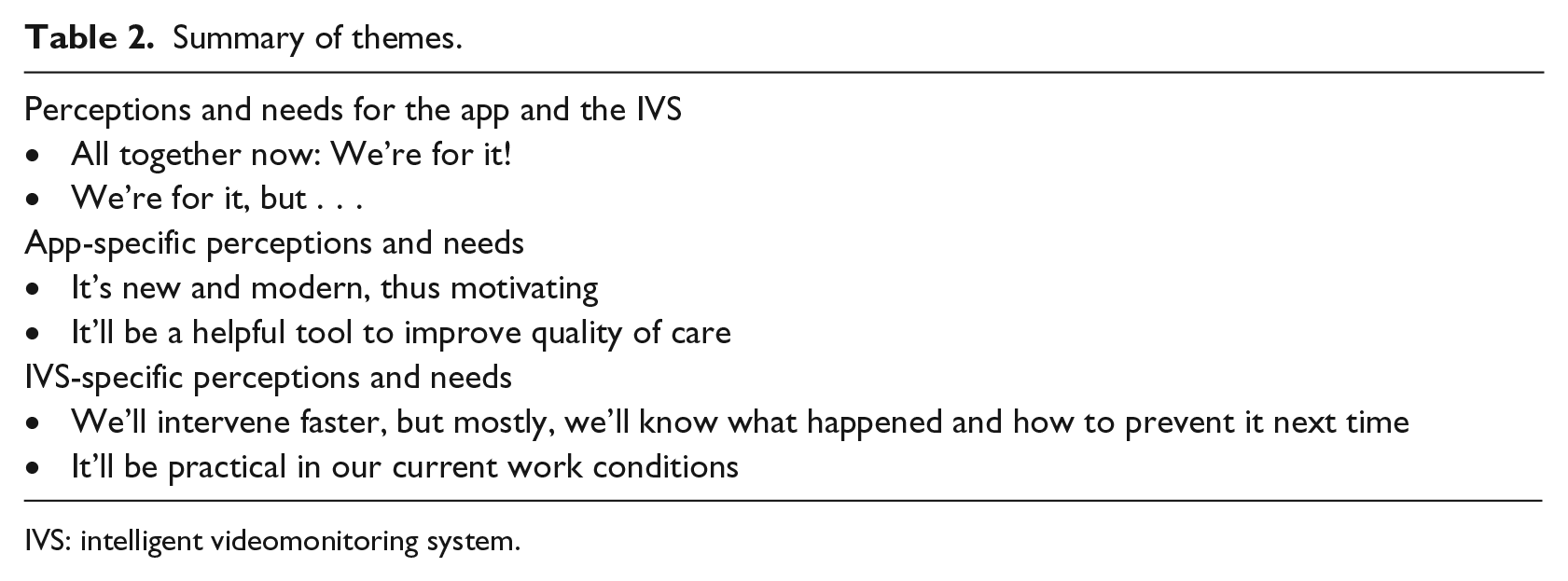
IVS: intelligent videomonitoring system.
Perceptions and needs for the app and the IVS
All together now: we’re for it!
All types of participants agreed that both technologies were needed in NHs. They felt intervening is an ‘art’ when older people manifest responsive behaviours and wish to prevent falls. They thought both the app and the IVS would be helpful to overcome these challenges, especially during the evening and night shifts, where reduced staff makes it harder to provide the required quality of care. Participants thought the proposed technology would make them both more effective and faster in their work: They enter their information, click what they have found [useful], what they say, what they detected, and the plan comes out. For sure, yes, this will save time, it’s obvious. (Care manager 1, line 110)
Participants also mentioned these technologies would provide them with more data, which would improve their assessment of responsive behaviours and fall risk to customize their care to each resident’s specificities.
We’re for it, but…
Some participants who felt these two technologies were needed in NHs nonetheless specified characteristics to make them useful. One such feature is versatility. Indeed, technologies and functions should be adaptable to various types of users, different NHs, and the targeted behaviours. Participants also felt these tools should work on a variety of devices (e.g. smartphones, tablets, personal computers), according to NH and user preferences.
For example, some participants preferred a smartphone because of the convenience of using it anywhere on the care unit, while others favoured a tablet because of its larger screen. The tools should be easy to use since technology skills and familiarity vary among potential users. In addition, the devices would have to be provided by the NH and be washable to prevent infections.
App-specific perceptions and needs
It’s new and modern, thus motivating
Participants perceived the potential app as new and modern, and therefore thought it would help recruit caregivers, especially younger professionals, by making employment in NHs more attractive: I think its advantage is mostly for the young ones who start working in this setting. They are often on smartphones and comfortable with this type of technology. It will motivate them to come and work in our NH [. . .]. Yes, it’s true young ones don’t want to stay because we still work in old-fashioned ways. (LPN 10, line 57)
They considered that using this app would also motivate caregivers already working in NHs, by promoting creativity and encouraging them to seek out reasons and interventions for responsive behaviours and falls. Participants also had the impression these technological innovations would be cutting-edge, like in a hospital: Well, I find this very modern. It’s stimulating we’re going in this direction. I wasn’t expecting that. I’ll stay [in the NH] (laughs) [. . .]. It’s really avant-garde and fun. I think we are moving forward. (RN 19, line 164)
In their opinion, the use of the app could encourage families to work more with formal caregivers by showing caregivers’ proactive and modern care. Participants found the links between the app’s various features to be attractive, as these allow automated individualized care plans to be created and updated based on the data team members enter iteratively. They could also access various tools that influence their assessment and interventions. Participants found this motivating because such access would help them have well-organized data accessible anywhere and apply these individualized plans more. Participants also mentioned the app was an improvement over paper documents since all information would be in one place, which would reduce the risk of losing important data for evaluation.
It’ll be a helpful tool to improve quality of care
Participants considered the app a tool with the potential to improve quality of care, given it would help family and formal caregivers apply a systematic approach to care for older people manifesting responsive behaviours and who are at risk of falls. They thought it would facilitate their assessment and analysis of situations and allow all the caregivers involved in a situation to participate in the process.
They also thought the app would improve continuity of care between staff members and between shifts. For example, the data export feature (from the app to a computer or printer) appealed to them, as it would enable the distribution of care plans created at the bedside to all the professionals involved in caring for a specific resident. For participants, the app’s built-in sharing features seemed conducive to interprofessional teamwork and strengthening partnerships with family members. They believed these features would improve care quality in NHs, among other things, by keeping families informed and allowing them to contribute observations and participate in interventions.
IVS-specific perceptions and needs
We’ll intervene faster, but mostly, we’ll know what happened and how to prevent it next time
Participants felt the IVS would allow them to intervene faster after a fall or dangerous responsive behaviour. They explained how the low staffing ratio in NHs meant they are not always immediately aware of a problem. Yet, delayed responses can have a negative impact on older people’s well-being. If alerted more quickly, they said they would be able to promptly give patients appropriate care.
Participants also believed that the IVS could be an important tool in identifying the causes of events. They explained that they rarely knew what contributed to a fall or a responsive behaviour, and that this impeded preventing such events in the future: Each time I analyze a fall, I’m missing information. [. . .] Did he have his walker? What happened right before the fall? How did he fall? What did he want to do before falling? There are lots of questions I have no answers to. But I need them to analyze the situation. (Care manager 4, line 235)
Participants also often lack information to evaluate the health consequences of falls or responsive behaviours since, most of the time, the cognitive impairment of older people in NHs renders them unable to explain the event. Thus, health professionals are unsure how to target their health assessments and may perform interventions otherwise unnecessary had they had more information. If they could use the IVS to better analyse events, participants felt their interventions after a fall or dangerous responsive behaviour would improve and even that they could prevent these events in the future.
It’ll be practical in our current work conditions
Participants explained that the IVS would be particularly useful in their work conditions since it would allow for a constant monitoring (closed circuit to respect privacy) that caregivers cannot currently provide. They also thought that the IVS was a smarter tool to detect falls than the current mobility monitors (e.g. Tabs™, Smart™) since it would be more user-friendly, have fewer false alerts, and lower noise levels. They also liked the idea that it would detect responsive behaviours.
Participants also felt the IVS would help formal caregivers transfer information more accurately to their colleagues and families. Care managers and formal caregivers mentioned that IVS images could help them relate an event to family members, which in turn might improve families’ trust in them: We could show the family if the patient is being aggressive. As it is now, they say to us, ‘No, it’s impossible. My dad was never aggressive’, like it’s the staff’s fault he’s aggressive. Maybe they would be reassured if we could show them images and say, ‘Here’s what happened and how we intervened’. (Care manager 4, line 237)
Likewise, they considered this tool would help them design interprofessional care plans since it would allow all involved professionals to review the events together. Care managers also pointed out it would also be a tool to target professionals’ learning needs.
Discussion
This study brings a better understanding of the openness of various actors in NHs regarding two potential technologies that could improve the care of older people with cognitive impairment. Notwithstanding their innovation adopter category, the participants were enthusiastic about the potential integration of an interactive app and IVS to support decision-making regarding responsive behaviours and falls.
Few studies have focused on technologies in NHs despite the unique characteristics of these settings. The studies that were conducted in NHs target information technology, such as electronic health records or administrative reports,34,55–57 not clinical decision-making support tools. Our results provide indications on the willingness of potential users to use two decision-making support technologies that could be designed to directly affect clinical outcomes in the specific context of NHs.
Based on the aspects considered in Rogers’ 49 theory as influencing the potential adoption of innovation, the participants described features that could be advantageous in their context, that are compatible with their values and needs, that would be usable in NHs, and that could have a positive impact on older people and their families. For example, the participants mentioned the need for versatility, ease of use, low noise, washable devices, links between features of the technology, automatization in the creation of care plans, easing continuity of care, and teamwork as well as the analysis of the cause of events. Prototypes integrating these features could be developed and implemented to assess their adoption and their outcomes on the quality of care in NHs, for example, on the frequency of responsive behaviours or falls, as well as on the well-being of older people and on the continuity of care.
Also, the results highlight that the perceptions and needs of managers, family and formal caregivers in NHs are convergent, as are the ones of the various types of innovation adopter. While the implementation strategies for these different groups might be diverse, it is possible to conclude that there is a common ground about what is considered useful to them. This could facilitate teamwork in the adoption of technologies in NHs.
The perceptions and needs identified for these clinical decision-making support technologies in NHs might be different in other types of setting and with other technologies, for example with more invasive technologies. However, these needs and perceptions could be similar in other clinical contexts that also care for patients having important communication difficulties or characterized by low staff ratios. Our results might also be applicable to other types of technology, for example, if they aim to analyse clinical events retrospectively or to design intervention plans dynamically.
Regarding the potential technologies that we explored in our study, there seems to be only one existing app for responsive behaviours, providing evidence-based information at the bedside. 58 Our participants expressed the wish to access information anywhere on the care unit but were mostly interested in the possibility of creating a customized care plan as they go and involving everyone, including families. They also liked the idea that the app could increase other professionals’ participation. Their interest in these functionalities corresponds to the advantages of mobile devices in other healthcare settings. For example, Brown et al. 59 mention that these devices are effective because of their multifunctionality, low cost, and potential to increase information sharing. In another study on perceptions of computerized care plans, 60 nurses mentioned they were more likely to adopt this technology if the system was user-friendly and helped organize information. The lack of an automatic linkage between care plans and patient care was seen as limitations. Our study’s results corroborate these wishes, not only by RNs but also by other members of the care team.
Our participants also pointed out that any devices must be washable to prevent nosocomial infection. This practical concern is rarely mentioned in the literature but should be considered by both technology developers and decision-makers implementing such technologies. For example, in a sample of 106 devices physicians used in large teaching hospitals, all devices tested positive for at least one microorganism culture. 61 Although NHs differ from hospitals, they present the same risk of infection. As such, protocols should be implemented to clean these devices (see examples of disinfection methods in Kiedrowsky et al. 62 ).
A systematic review (n = 12) of sensor technologies in care facilities raised some of the same concerns about the technologies mentioned in our study. 63 For instance, sensor technologies must have low false-alarm rates to avoid desensitizing formal caregivers. Our participants also underscored the importance of preventing excessive noise on care units and felt that alerts on mobile devices could reduce noise levels by targeting caregivers according to the event.
Our caregivers’ and managers’ perceptions of the IVS are similar to those of home care professionals in our previous studies. For example, caregivers and managers in both NHs and home care feel the IVS could contribute to faster interventions after fall and reduce their consequences, as well as help document their causes and decrease false alerts. In home care, caregivers expressed concerned about increasing responsibilities, dehumanizing care, and disrupting older people. 45 In comparison, the NHs caregivers in our study saw few disadvantages and described this technology as helpful to adequately monitor vulnerable older people when human resources are limited. Another difference between the two groups is the concern, expressed by home care professionals, that older people living at home may resist the IVS. 45 In an NH context, this worry was not mentioned, probably because the older people in NHs have severe cognitive impairment and are already in a regulated and monitored setting.
Our results also highlight that formal caregivers and care managers want to be perceived as efficient professionals trusted by families and offering cutting-edge care. This is in keeping with Marchesoni et al.’s 64 study on the values associated with technology use in older people’s care. This qualitative descriptive study of 12 RNs or nurse assistants in Swedish care facilities identified four values to consider when proposing technology use: presence (e.g. interacting with the older person without being disturbed), appreciation (e.g. having families’ appreciation), competence (e.g. knowing what to do), and trust (e.g. working in a calm environment). For Marchesoni et al., 64 these values reflect a caring, not a technological, rationality. Technologies developed for NHs should therefore be in keeping with and support this caring perspective, which will increase the rate of technological adoption and contribute to quality of care. Inversely, focus on increased efficiency or economic arguments only may impede the adoption of technologies in NHs. As such, NHs should favour the development and implementation of technologies that are consistent with those values and promote their adoption based on caring objectives. It is possible to assume that this implication is not technology or context dependent and might also be applicable to other types of clinical decision-making support technology that would be used by nursing staff.
The formal caregivers and care managers in our study also thought that introducing technologies to NHs could help attract caregivers to these settings, especially younger caregivers. They drew a parallel with the prestige associated with technology use in hospitals and mentioned these technologies could help staff stay motivated and families perceive the care as innovative. There is a paucity of literature on the impact of technologies in NHs on the attraction and retention of human resources. In a systematic review on the effects of information and communication technologies on recruitment and retention of healthcare professionals, it was shown that technologies can influence retention. 65 No study in NHs was mentioned. Despite the fact that NHs have a persistent human resource recruitment and retention problem, 66 the only allusion found on the potential of technologies to alleviate this problem was in Mueller’s 67 editorial. There, it was mentioned that technology use could make NHs more attractive by providing a more professional work environment. Our results add to this argument. In addition to assessing the direct impact of technological decision-making support tools on the care of older people, future projects developing and implementing technologies in NHs should also assess the impact of these innovations on caregivers’ willingness to work in NH.
There are limitations to our study. The family caregiver sample was small and, as such, may reduce the transferability of results and the possibility to identify differences between the type of potential users. However, a variety of users with different innovation adopter profiles were included to reflect a global perspective, thus potentially compensating for this limitation. Our participants also shared their perceptions based on potential technologies and not on having tried them. This limitation was mitigated by presenting participants with a visual of potential functionalities, which may have influenced the participants’ openness to their adoption since they knew they would not have to use them.
Conclusion
Technologies should be developed and implemented to support quality of care in NHs. They should be developed to answer the needs and perceptions of the various potential users specific in this context and consider the care conditions and staff characteristics (i.e. many NAs) in NHs. With rigorous laboratory development and real-life testing, technologies could decrease the negative consequences of common but complex problems and increase the well-being of older people, families, and staff.
Footnotes
Acknowledgements
The authors would like to thank the family and formal caregivers and the managers of the nursing homes, who generously took part in this project, and also thank Denise Trudeau, clinical nurse specialist at the Centre intégré de santé et de services sociaux du Centre-Sud-de-l’Île-de-Montreal, for her skilful support during the study. The authors applied the sequence-determines-credit approach for the sequence of authors.
Declaration of conflicting interests
The author(s) declared no potential conflicts of interest with respect to the research, authorship, and/or publication of this article.
Funding
The author(s) disclosed receipt of the following financial support for the research, authorship, and/or publication of this article: This work was supported by the Quebec Network on Nursing Intervention Research funded by the Fonds de recherche du Québec - Santé.
