




Abstract
Technology can assist older adults to maintain an active lifestyle. To better understand the effect that technology has on aging perception, we conducted two studies. In the first study, through supraliminal priming, we analyzed the effects of aging- and technology-related stimuli on age estimation. In the second study, we conducted a technological intervention with a group of elders who used four interactive devices and analyzed effects on perceived aging. Results showed that technology-related stimuli did not affect estimated age. From the second study, we generated a sociotechnical model that explains the processes connecting technology use with successful aging. We concluded that the use of technology affects aging perception, although it depends on whether the elder people have a proactive attitude toward their aging process a priori.
Introduction
Within the context of social informatics, a relevant phenomenon of study is the demographic transition characterized by the decline of birth and death rates 1 and its association with an increase in the usage of different technologies to enhance life quality and well-being. According to the United Nations’ World Population Ageing 2013 report, the estimated global number of older adults (over 60 years) for 2013 was 841 million people. This number is expected to increase to 2 billion people in 2050; this will represent 21.1 percent of the global population. 2 Regarding the second element, mobile phone and Internet usage are growing rapidly. Taking Mexico as an example, it has been estimated that the number of older adults who could access Internet services from 2007 to 2015 increased from 2 percent (www.amipci.org.mx/estudios/habitos_de_internet/2007_Habitos_Usuarios_Internet_Mx-1.pdf) to 4 percent (www.amipci.org.mx/images/amipci_habitos_del_internauta_mexicano_2015.pdf) of the total Internet users. Around the world and in places with good access to information and communication services and networks, the presence of technology moves quickly beyond the desktop and starts creating collections of interconnected devices that become part of the entire space where people live. For many people, and in particular for older adults, these technologies can become ambient-assisted living solutions which can help them to improve their health and quality of lives. 2
These forces changing demographics and the pervasiveness of technology would, at the end, result on changes in the way people will experience aging and, in general, their perception of aging. Technology usage by elder people is increasing as it incorporates its needs and worries,3,4 even though negative stereotypes regarding older adults and technology prevail in society.5,6 The fact that designers and developers often fail to consider older adults’ needs is a factor that might contribute to create scenarios where older adults look incompetent when dealing with new technologies.4,7,8
Aging perception is a multidimensional construct that plays a significant role in society since it triggers different attitudes and behaviors toward the older adults and it affects their health and well-being. For example, the dimensions of physical appearance and aging self-perceptions provide significant cues about health, lifestyle or longevity that help us to allocate the person within an age range, therefore affecting the way we talk and behave toward them, and are associated with different elements such as stereotypes and life experiences.9–12 Different studies have shown that older adults with positive “Aging Self-Perception” (ASP) tend to have lower rates of suicide and depression, 13 heart diseases, 14 hypertension disorders 15 and general mortality,16,17 which translate into longer and more joyful lives. Consequently, we need to understand the different dimensions of the relationship between older adults and technology starting from basic aspects such as people becoming used to the idea of technology being used by older adults.
The main purpose of this research is to show the effects that technology produces in two dimensions of aging perception, age estimation and self-perception. This is important for technology-based ambient-assisted living because it would mean that technology could provide a context and a set of tools to improve, on one hand, behaviors of younger people toward older adults (which could mean an enhanced interaction and inclusion to the digital world) and, on the other hand, their own behaviors in order to achieve a successful and healthy aging.
Previous work
Technology has the potential of modifying the way we perceive the world. This encompasses social processes such as the assimilation of a new culture, 18 perceptions toward people with conditions that affect their behavior (e.g. autism), 19 intergenerational interactions, decreasing the stress due to lifestyle changes (e.g. new independence) 20 and life transitions. 21
Several studies have considered how different factors influence age perception. These include subjective and objective age, attractiveness and facial aging cues 12 and stereotypes.22,23 Although scarce, there is prior research that shows that technological tools that promote shared activities can modify people’s perception on aging. Particularly, by creating contexts that promote a more symmetric interaction between young people and elders, thus discrediting some stereotypes related to technology.24,25
Thus, even though there have been numerous studies on how different factors can alter the perception of aging, the use of technology has not been studied as being one of them. Therefore, this article tries to fill this void and generate a better understanding of this relationship. To achieve this, we divided our investigation in two studies. In the first one, we addressed the effect of technology- and aging-related stimuli on age estimation. In the second study, we tried to answer how does technology affects the aging self-perception in a group of older adults and explored a set of technological paradigms as they were used by elderly participants for a number of weeks.
First study
The focus of this study was to determine if technology has an indirect effect on age estimation through supraliminal priming. We formulated two hypotheses to be tested: (1) participants exposed to stimuli related to technology will assign lower age ranges to people depicted in different photographs than those exposed to neutral stimuli and (2) participants exposed to stimuli related to aging will assign higher age ranges to people depicted in different photographs than those exposed to neutral stimuli.
Methodology
The methodology of this first study is fully reported in Juarez; 26 therefore, we will mention it briefly, focusing on its results and how it connects to the next study. We recruited 60 participants (22 men and 38 women, aged 19–88 years) from the student and faculty bodies of a research center in Mexico and from older adults participating in a course. The participants were randomly assigned to one of three groups (technology, aging and neutral) according to the stimulus to which they would be exposed. Each participant had an individual session in which they completed five activities: a priming activity, a decoy activity, a photography test, a debriefing activity and a personality questionnaire. The priming activity consisted of the “Sentence Unscrambling Task,” 27 there was no time limit for this activity in order to guarantee supraliminal priming. To reduce the possibility of recalling the priming words in the photography test, we extended the time between the priming and the real test by implementing a 10-min decoy activity. For the photography test, each participant had to assign an age range to different people depicted in a set of photographs. As exclusion criteria, we measured the degree of awareness about the stimuli through a funnel debriefing questionnaire 28 and the tendency to have sudden mood changes through the “Neuroticism” subscale of the short version of the revised Eysenck Personality Questionnaire Brief Version (EPQ-BV) for adults. 29
Results
Five participants had a score higher than 6 in the “Neuroticism” subscale; therefore, their results were overlooked in the subsequent analysis. Thus, the total number of participants was 55 (18 for the “Neutral” group, 19 for the “Technology” group and 18 for the “Aging” group). Six of the participants noticed that the words used in the priming were related, although none of them realized the association between the priming and the objective or between the priming and the photography test; therefore, according to Aronson et al., 30 none of the remaining participants were excluded. The analysis of the photograph test comprised a chi-square association test among the mode of the age ranges estimated by the participants of each group. Results showed that in 53 percent of the photographs, the mode of the age ranges was the same among the different groups. Although in 47 percent of the pictures the estimated age was different, the statistical test showed that this was not statistically significant (p < 0.05, α = 5%).
Discussion
After the analysis, we rejected both of our hypotheses, since the estimated age ranges from the participants of both experimental conditions did not show statistical significant difference from the estimations of the neutral condition. Considering the conclusions from Ostir et al. 15 and Eibach et al., 23 the results were unexpected, since they found that aging-related stimuli could induce participants to perceive other people as older. The lack of statistical significance from the technology- and aging-related stimuli may be due to the following: technology, by itself, not being a factor that alters the perception of aging, at least unconsciously, prejudices toward technology or cultural factors. Despite these results, previous research 24 shows that it is possible for technology to affect attitudes and perceptions toward aging due to its impact in some of its dimensions such as emotions, learning, satisfaction with life and promoting physical and mental activity. In order to explain the mismatch between our results and previous research, we needed to address the problem from another point of view.
Particularly, among older adults, the effects of prejudices toward technology are more important, since its pervasiveness means that more aspects of their life are now influenced in a negative way. Therefore, the adoption and usage of technology can be used to mitigate or eliminate these prejudices in order to explore how older adults change their aging perception, as a whole, through technology. If technology can have a positive effect on the perception of aging, then technological infrastructure such as ambient computing to support assisted living could be used as a mechanism to promote “active aging” and to increase quality of life. This could produce positive effects such as improving physical and mental health, enhancing communication and socialization, disposing negative stereotypes about older adults and technology and helping them maintaining their independence.
These results lead us to design a new study focusing on the influence that direct contact with technology has on the way older adults perceive and live their aging process.
Second study
Methodology
The objective of this study was to understand how frequent use of technology, even for just a few weeks, could affect the self-perceptions and experiences toward aging. At this point, our investigation aimed to understand the phenomenon from a more open and naturalistic perspective where a number of contextual factors in the lives of the older adult can be considered. Given the nature of the study, we decided to use qualitative methods of data collection and analysis.
Recruiting strategy
Using the purposeful sampling method,31–33 we recruited six older adults (five women and one man) whose ages ranged between 65 and 84 years (µ = 76.14 years, σ = 7.13 years). Three of them attended a basic informatics course, and the rest of them attended to different non-technology activity groups (e.g. cooking), and all of them were mobile phone users. We looked for these two features due to the effects of different technological expertise while coping with new technologies34–36 without resulting any practical advantage37,38 and to ease the adoption of new technologies, as our focus was the use of technology rather than the process of adoption.
Data collection and analysis
Each participant had to use four technological devices representing different technological paradigms (a mobile phone, an online social network, an e-reader and an activity tracker). In order to augment the likelihood that perception change was due to the use of technology, for every device, a series of tasks were defined so that we could monitor the activity of the participants during the period of usage. We conducted four semi-structured interviews with each of the participants (approximately every 2 weeks) at their home or in a waiting room of a social center. We opted this kind of interviews due to the possibility of exploring emerging topics regardless of the possibility of different questions to the participants.39,40 In the first session, the interviews focused on their personal experiences with older adults, ASP, technological background, conceptualization of technology, technology and aging association and subjective age. The following sessions focused on the device usage, conceptualization of technology, technology and aging association and subjective age. Once the interview was over, we showed them how to use the technological device they were going to use for the next couple of weeks.
To analyze the interviews, we used a qualitative approach based on the grounded theory methodology. 41 The interviews were transcribed and analyzed using this methodology, and through constant comparison, we produce a model explaining the phenomenon. This theoretical model is compared to existing related frameworks in order to detect similarities and differences, thus increasing the internal validity and the generality of the new theoretical model. 42
Results
From the data, a model emerged which organizes the findings around three main categories showing that technological use produces a series of effects and benefits that influence the process of aging and its perception (Figure 1). In particular, there is a set of cognitive, social, emotional and health-related benefits that match the effects of different coping strategies that the older adults implement to improve their well-being and achieve a successful aging.
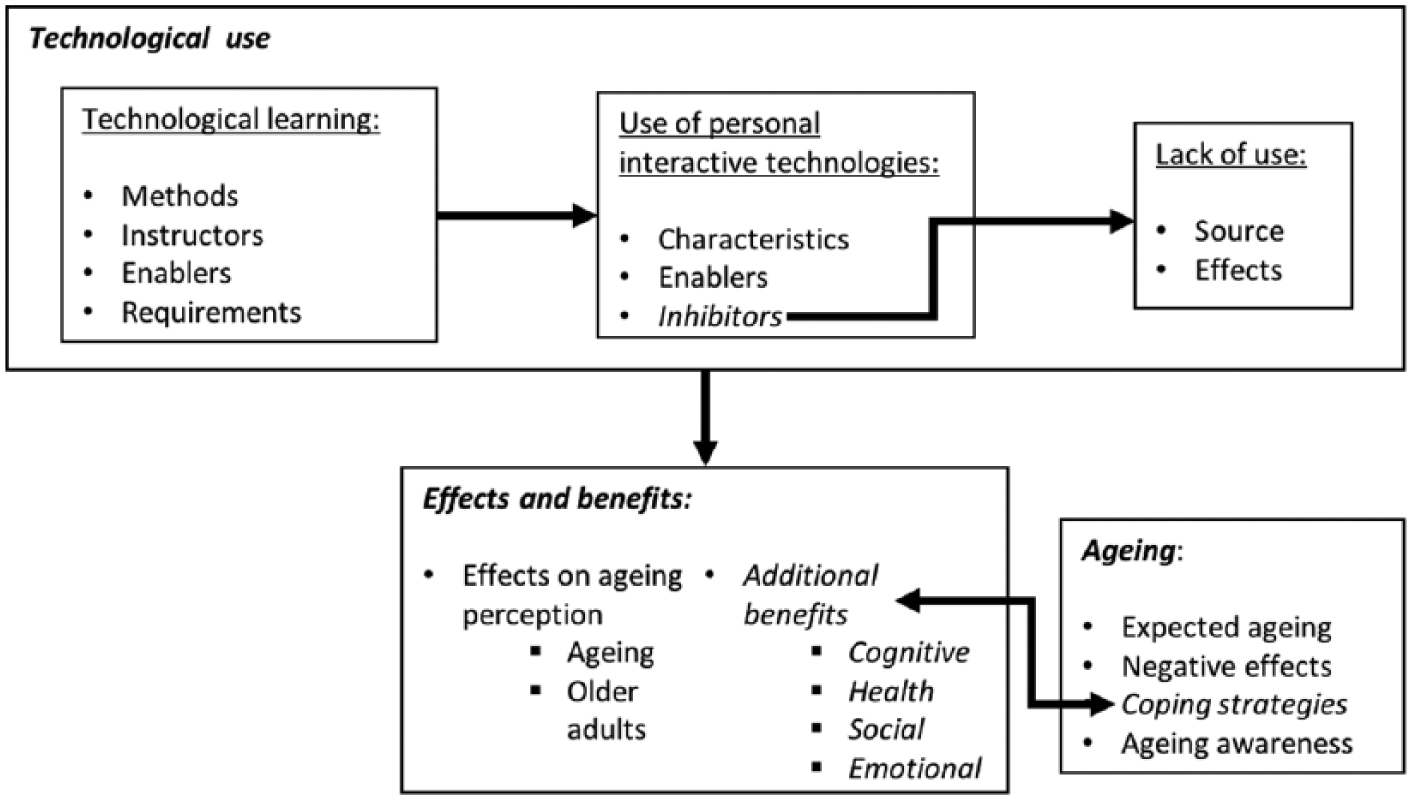
A model of technological use its effects and influence on aging perception.
Technological use
Older adults need a learning process in order to use new technological devices, as one participant exemplifies, … I mean, if you tell me “This is how it is done,” then maybe I’ll practice it and learn how to do it. (Participant 2)
This process can be carried out in different ways, such as attending formal (courses) and informal classes (with relatives or other older adults) or exploring the new technology by themselves. Attending to formal courses exposes the older adults to others; this promotes new interactions and a constant exchange of ideas and experiences to deal with new technologies. One of the most important requirements for this process is the wish to learn new skills; it promotes commitment to get involved in different activities to learn how to use new technologies and helps them remember past periods of their life, for example, their student years, as one participant said, I go to my computer class and I feel young. I grab my backpack, take my bus (laughs) just like any student, raining or not. (Participant 6)
As a result of this learning process, the older adults are able to use new technological devices. Although it is important to notice that this does not represent an end of the learning process, as it can occur while they are learning or as a promoter to learn other technologies.
Their use of technology is characterized by their role as consumer and producer of digital information, additional tools to support them (e.g. user manuals) and the different objectives they pursue while using them. Anonymity is an important enabler because it lets the older adults interact in a virtual context without being subject to ageist attitudes and stereotypes. Environment also plays a significant role in the use of technology as it can work as an inhibitor or an enabler. For example, one participant said that her lack of interest in technology was due to her non-technological environment. This had a significant impact because it hindered the learning and usage process.
Two of the technological devices’ characteristics that inhibit their usage are the difficulty to use and the diffusion of digital contents. When difficulty to use and a limited knowledge (perceived or real) interact, older adults tend to feel uneasy about the technology highlighting their fears to commit errors that could damage the device, as one participant said. Although these fears can decrease, if they own the technology they are using. Excessive usage can also have a negative effect on the attitudes toward technology, as they think that using devices in inappropriate situations can damage the relationship with others. These can produce a lack of use that has important effects, given society’s technological influence. The participants perceived that the older adults who do not use technology get isolated from other people and are left behind in the evolution of society.
Effects and benefits
We found that the use of technological devices produces a series of effects in different areas of self-perception by older adults. The following two quotes illustrate the effects on the perception of an older adult and aging as concepts characterized by a constant effort to keep up with the constant changes in technology and society in order to be connected and included: They (grandchildren) told me that I was very modern (laughs) … (Participant 1) … I told him (husband) that he was old. I think that my husband stayed behind. I think that … I’m more to date with society. (Participant 4)
But one of the most important effects concerns to their role in society. On one hand, these older adults can be a role model for younger generations, showing them that aging is not necessarily a negative stage of life and they need to embrace the new technologies and challenges. On the other hand, they assume the role of being a technology enabler for other older adults, which gives them a prominent position in their communities, as one participant pointed out. Additionally, there are a set of benefits in other areas such as cognition, socialization emotions and health: I feel that I can teach them (other older adults), at least, this (using the FitBit) … I’ve been talking about it and I have noticed a lot of positive reception (sic) on their behalf. Now that this (FitBit) is a novelty I can motivate them to do more exercise … (Participant 1)
Among the cognitive benefits emerged learning something new as an activity to keep using the brain and thus preventing its decay, the access to lots of information about topics of their interest (e.g. news, diseases or new treatments) and a mental challenge to use new technologies.
Using technology also makes them feel younger, active, independent, happier and more satisfied with their lives, and important within their communities, improving their quality of life and well-being.
Given the fact that older adults’ social circles tend to narrow due to illness or death, it is very important for them to create new relationships and to maintain the existing ones. Therefore, technology is considered an important tool for them, as it keeps them included in their relatives’ and friends’ lives. It also helps them to communicate with people they are not acquainted with but who share common interests with them. This helps them reduce the feeling of isolation and abandonment.
We noticed that participants became aware of the need to maintain physically and mentally active, therefore promoting behavior change, as it motivates them to find new activities or retake activities that were abandoned or look for information about their conditions. Although, the use of technology represents a new challenge as they need to maintain those healthy behaviors even without the presence of the technological aids: … I stopped napping, now I walk and one very important thing is that I quit smoking … I restarted walking- Before, about 6 months ago, I jogged but I stopped doing it. (Participant 6)
Aging
The aging perception forms since early life stages. In most cases, it comes from the experiences that people had with their relatives (e.g. grandparents). These experiences made them aware of the negative physical and lifestyle changes that aging involves, which become a point of comparison with their own aging. When we asked a participant about the aging process of one of her parents, she said, … my dad didn’t go out anymore because he had an injury in his foot. Then, he locked himself in his world … (Participant 2)
Then, when asked about how that event had influenced her, she said, … I’m not going to lock myself until I can’t, really, really look out for myself. (Participant 2)
In order to cope with these changes, older adults implement different strategies. These strategies have diverse objectives such as accepting the physical and emotional changes, focusing on the positive aspects of aging, keeping an acceptable activity level and socializing and compensating their losses. These strategies require from the older adult willingness and an open attitude to discover and engage in new activities. As a result of the implementation of these strategies, the older adults achieve a successful and healthy aging. This kind of aging is characterized by factors such as independence, dignity and energy and is perceived as a stage of personal growth.
Discussion
The last phase of the grounded theory methodology involves a comparison between the model developed and related models that exist in the literature. In order to make this comparison, we divided our model in two parts: a technological part (that includes the learning and use of technology process) and the aging part.
The technological part of the model was compared with the diffusion of innovations model (DIM) 43 and the technology acceptance model (TAM). 44 The main differences with DIM 43 are (1) that our model only comprises the process of use of technology rather than the adoption process and (2) that our model considers that the use of technology rather than the technology itself should adjust the social norms and etiquette. Regarding TAM, 44 the main similarity is that the perceived ease of use is not a determinant factor while deciding to use or not a device. This is due to their awareness of their lack of knowledge of new technologies; therefore, difficulties while using it are expected and can be overcome with time and practice.
The aging part of the model was compared with the model of successful aging of elders with late-life disabilities (MSAELD) 45 and the healthy aging model (HAM). 46 The main difference with MSAELD 45 is that our model highlights the awareness of the aging process rather than ignoring it. While with HAM, 46 our model concurs with the effect of the social resources to improve aging, although our model focuses on the technological elements that enhance the communication with those social resources.
One of our main results showed that technology should not be seen as a tool that by itself is capable of producing positive outcomes in older adults’ health and lifestyle. It is a tool that should be coupled with coping strategies in order to amplify and diversify them. This entails that the older adults must adopt an active role in their aging process that drives them to implement the above said strategies, which confirms the results obtained in Salovaara et al. 21 Also, we found that the usage of common technological tools create an anonymous context that promotes intergenerational communication (even with strangers), thus making older adults feel included in their families, and thus generating and consolidating new identities away from social stigmatization; this is in accordance with previous works.18–21,24,25 Despite these benefits, older adults showed different issues related to social norms on digital environments, as they tried to transfer their “real-world” social norms.
In general, our results showed that the use of technology produces different benefits that can derive in a reduction in health-related problems. Among those benefits are greater socialization that is related to fewer depressive events and suicides, the change to healthy habits (such as exercise and better diets) that is related to fewer heart- and pressure-related conditions and, overall, an increased emotional and physical well-being that is related to lower indexes of general mortality.
Finally, our results showed that the lack of usage increases the feeling of isolation and abandonment as people are left behind in a society that constantly evolves.
Conclusion
From the second study, we can conclude that the use of technology affects aging perception disrupting preconceived ideas on the subject (which are heavily negative related), although this effect is not direct. The results showed that these effects occur through the correspondence between the coping strategies that the older adult implements and the benefits they gain from the usage of the technological devices (Figure 2) (such as keeping social circles and accepting physical and mental changes). However, these positive effects depend on different intrinsic factors such as the older adult’s involvement in changing their aging experience and perception, their socioeconomic context and the coping strategies they implement.
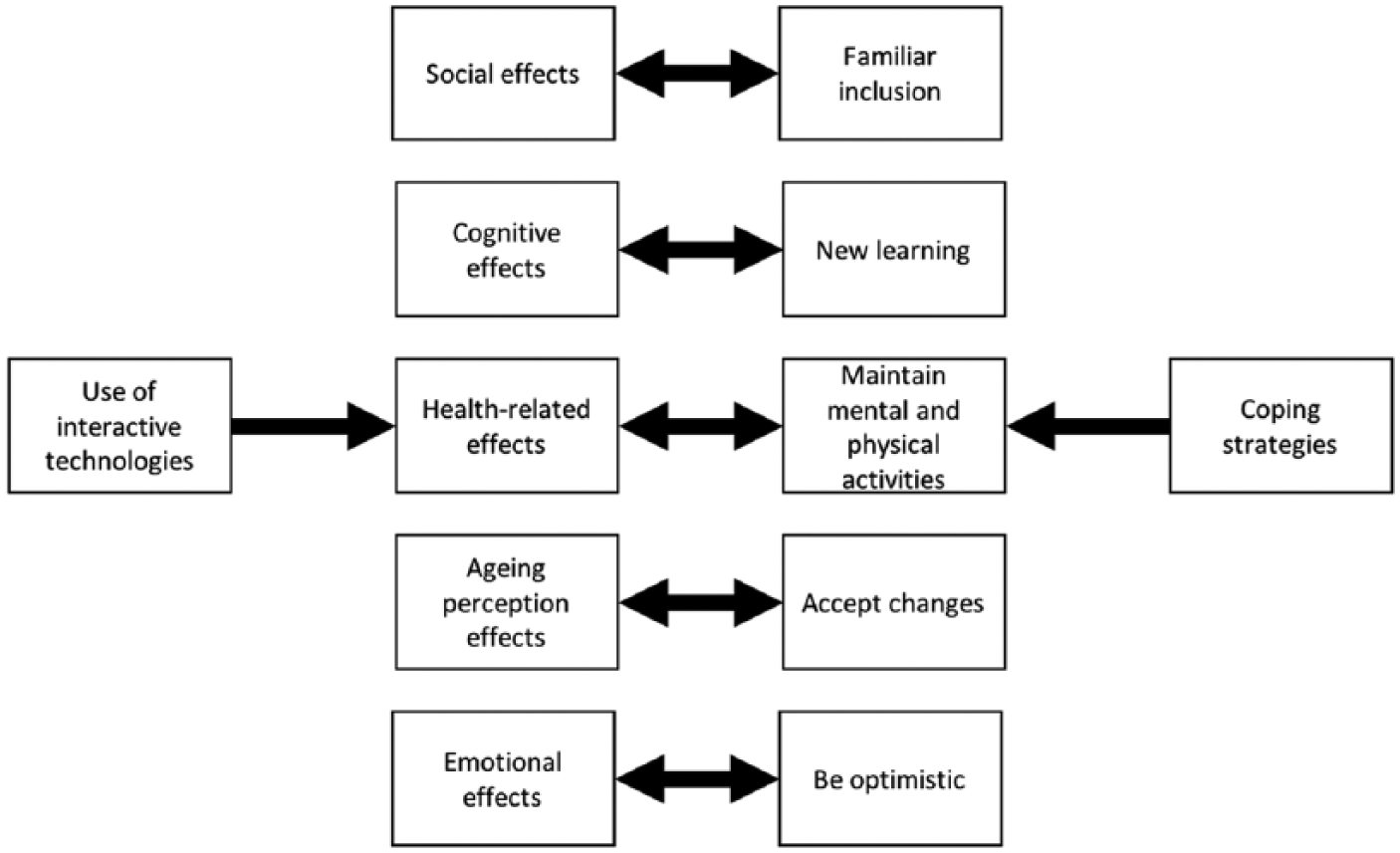
Relationship between use of interactive technologies and coping strategies.
It is important to consider that some of the benefits that emerged may be specific to the kind of technological devices that were chosen, and this may entail that other devices may have other results. Due to time constraints, we focused on the immediate usage and effects of technology rather than in its adoption and long-term effects. Finally, our results showed that the usage of technology produced behavior changes that may lead to a healthier lifestyle (e.g. health awareness, resume physical activity and socialization), although it is necessary to conduct a longitudinal approach that provides conclusive data about these changes and their long-term health effects.
Footnotes
Acknowledgements
The authors want to thank all the participants for their help and enthusiasm during both studies, CICESE and UABC for their help during the recruitment and for letting us use their facilities, ITAM for their help providing the equipment for the second study, INAPAM and the San Francisco Social Center for their support during the recruitment and interviews and the Mexican Culture Association A.C. for their support.
Declaration of Conflicting Interests
The author(s) declared no potential conflicts of interest with respect to the research, authorship, and/or publication of this article.
Funding
The author(s) disclosed receipt of the following financial support for the research, authorship, and/or publication of this article: This work was supported by the Mexican Science and Technology National Council (CONACyT) (grant number 367827).