




Abstract
The Internet supports the peer-to-peer healthcare and the promotion of shared patient narratives. Websites incorporating these narratives or personal accounts are known to offer support to carers of people with multiple sclerosis, but little is known about how carers make choices about what websites to visit and why. In total, 20 carers viewed a range of websites and online personal accounts about multiple sclerosis and subsequently took part in either a group discussion or an individual interview, followed by 2 weeks and 12 months and later by a telephone interview. Data were subjected to thematic analysis with the aim of understanding more about what drives engagement with the stories of others. We found that carers’ interpersonal and coping needs shaped their selection of online narratives, and that they were most likely to engage with online personal accounts that provided a good match in terms of experience and perspective.
Introduction
Multiple sclerosis (MS) is a highly debilitating inflammatory disorder of the central nervous system. As the disease progresses, the sufferer may encounter physical impairments including muscle weakness and compromised use of limbs, dizziness and pain as well as cognitive deficits such as short-term memory loss. 1 The disease is characterised by periods of relapse and remission with some people going on to develop secondary progressive MS where symptoms gradually worsen, and there are fewer or no periods of remission. 2 MS patients face considerable challenges in terms of adjusting to and coping with the disease, 3 but the act of caring for someone with MS brings its own challenges, with carers reporting a wide range of problems, including negative effects on their physical, social and psychological well-being. 4 This is a significant issue, given both the scale and psychological consequences reported. In the United Kingdom alone, there are 100,000 people with the MS and over 2 million people are affected through their role as carer. 5
MS patients have a range of information needs6,7 and there is increasing evidence to suggest that MS patients are starting to choose the Internet as their first port of call for health information 8 searching for information on symptom management, treatment options and the practicalities of day-to-day living.9,10 Over time, MS patients show different patterns of web use and come to ‘self-regulate’ their searches 10 using more selective search terms as their knowledge about their own condition grows or adopting information avoidance strategies at the beginning or the end of the disease timeline. 9
MS patients also use social networks and online groups as a way of seeking social and emotional support8,9 preferring forums which offer consistent information alongside a competent moderator and a clear statement of their objectives. 9 For some patient and carer groups, access to practical and experiential information from ‘like-minded others’ is highly valued11–13 and can play a role in supporting people across a number of health conditions.12,14,15 Narratives (i.e. personal stories about health experiences 16 ) are found across the Internet and social media sites. These vary widely in terms of purpose, content and overall tone, 17 but they are an increasingly important source of information and advice. Reading personal stories can provide people with a sense of ‘being supported’, and affect their behaviour or experience of health services, 18 although their inclusion within certain contexts remains more controversial. 19
We know that MS patients make good use of the Internet in general, and patient narratives in particular, as a source of information, advice and support, 9 but we know relatively little about how MS and other carers use the Internet either in a broad sense or more specifically in relation to online shared experiences. Around three quarters of carers go online for health information, 20 and the resources available online do appear to help them to cope with the stress of being a caregiver. 20 For example, people caring for a friend or relative with cancer make good use of the Internet for information, support and communication 21 and, indeed, can sometimes be more proactive in their information seeking than the patients themselves. 22 A number of studies have assessed the impact of Internet interventions aimed at supporting carers across a wide range of conditions including diabetes, heart disease, cancer and dementia,23–25 yet there is still relatively little known about the ways in which carers in general and MS carers in particular engage with the online health experiences of others.
A number of factors may be relevant here. First, we know from other ehealth studies that people value online stories that resonate with their own experiences. 26 Second, we know from the work by Sillence et al. 27 that the selection of such health narratives takes place in a three-stage process. People first select sites that they consider to be trustworthy before beginning to examine the online stories in more detail, questioning their relevance and similarity before finally noting the impact of the narratives on their decision-making, behaviour or perceived sense of support. Third, carers engage in a form of relationship-focussed coping 28 where both carer and patient work together to deal with stressors, rather than try to cope in isolation. Thus, we might expect a degree of overlap between the values MS patients and carers place on shared experiences. Indeed, we would expect to see carers engaging in a similar process of information self-regulation as has been observed for patients. 10 The changing nature of the disease has important implications for the ways in which both MS patients and their carers cope with daily stressors, 29 which in turn may impact their desire for engagement with online health information. 10 Carers themselves may experience a shifting sense of identity from an initial reluctance to accept the role of carer 30 to recognition that much later on they are also in need of care. 31 This may be reflected in the way they seek out online narratives.
We address this knowledge gap in this study by asking questions about what kinds of online personal accounts are most meaningful to carers at different points in the MS pathway. A better understanding of this process will highlight the kinds of resources carers are likely to turn to for support and provide an important step towards the provision of more appropriate online services to meet the needs of MS carers.
Drawing on a study of 20 relatives of people with MS, we explore the different ways in which carers engaged with peer accounts and how they related these accounts to their own caring experiences. Based on the online engagement framework, 27 we anticipate that carers are most likely to engage with peers who are of a similar age and background and whose problems and experiences are comparable with their own.
Methods
Sample and procedure
This study was approved by the Health and Life Sciences ethics committee at Northumbria University (SUB_103_ES_0711). In total, 20 MS carers were recruited using a number of sources including newsletters, flyers and through various MS charity and carer support groups. Most participants had been carers for several years and, in all but one case, the person with MS (pwMS) was their spouse. All were experienced Internet users (see Table 1). Participants were paid £20 for their participation.
Sample information (N = 20).
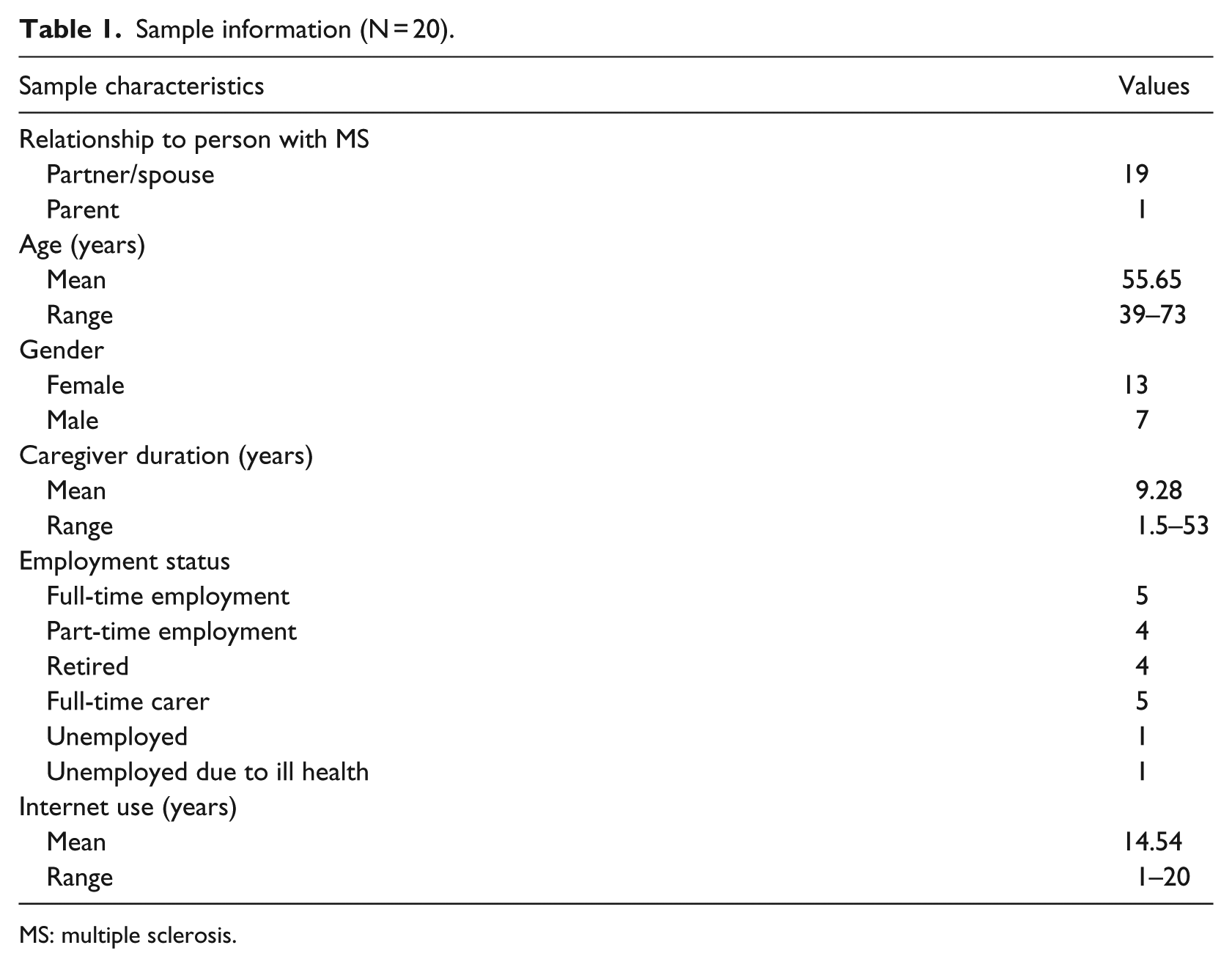
MS: multiple sclerosis.
The studies followed a method established by the research team,32,33 in which participants use the Internet to select websites of interest from a restricted search list. After providing their informed consent, participants were shown a number of websites, representing a range of MS and carer-based information sites and experiences. All sites contained MS relevant material, with some containing personal experiences in different formats (e.g. blogs and forum messages). Participants had an hour to explore these sites freely, followed by a further period to select two sites for further exploration (20 min). While looking at the sites, participants also completed logbooks to record their impressions of the sites, including their likes and dislikes, to aid discussion. Subsequently, participants engaged in either a focus group discussion (C.H.) (N = 11) or an individual interview (C.H.) (N = 9) (1–1.5 h) to discuss their findings and preferences. The discussions began by asking participants to talk briefly about their experiences of caring in relation to the pwMS before asking people for their first impressions of the different websites and peer accounts. The remainder of the discussion centred on participants’ preferences and dislikes of the websites and issues relevant to the literature, including trust in information sources, medical information and offline support.
Sessions were conducted in the United Kingdom either at the university or in the carer’s home. Follow-up telephone interviews (C.H.) lasting approximately 10 min were carried out 2 weeks and 12 months after the initial session to assess the extent to which participants had engaged with the peer accounts over the longer term and to understand how their support needs changed over time. All the discussions were audio recorded and transcribed verbatim for analysis. For ethical reasons, all participants were assigned a unique number, and any identifying information was removed from the transcripts before analysis. Only the authors had access to the participant data, which were treated confidentially in accordance with the University’s ethical guidelines.
Analysis
The transcripts were read repeatedly, and E.S. recorded the raw data thematically 34 after discussion with C.H. about emerging themes in relation to our focus on engagement. All extracts of data relevant to participants’ engagement with peer accounts across a range of different settings were reviewed and summarised independently by two of the researchers E.S. and C.H. All authors discussed the inductive analysis and the emerging themes and any discrepancies between coders were resolved through discussion and mutual agreement. All authors refined the analysis and commented on drafts of this article.
Findings
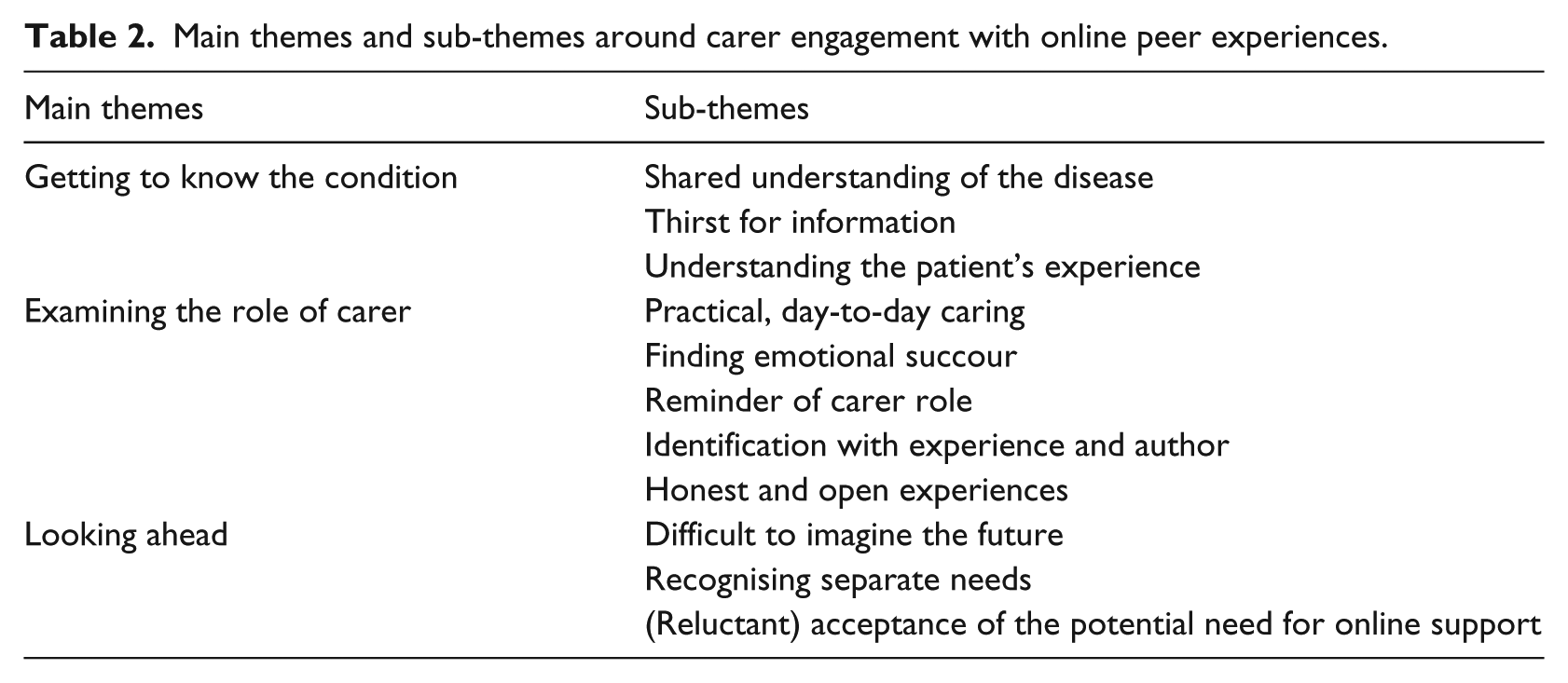
Participants spoke about the challenges of being a carer for a pwMS and the difficulties they often faced when trying to cope with their situation. Although we noted that in keeping with other studies,11–13 the carers broadly valued access to both practical and experiential information from ‘like-minded others’, we also recognised that engagement with peer experiences varied in relation to the timeline of caring. Three main themes (see Table 2) emerged from the data in relation to this sense of changing engagement over the caring timeline are described.
Main themes and sub-themes around carer engagement with online peer experiences.
Getting to know the condition
For those whose partner had recently been diagnosed with MS, the primary focus of engagement with the online experiences centred around a joint coping strategy in which seeking information from other people with the condition was key to their shared understanding of the disease. Carers recognised the value of other people’s experiences and actively sought detailed online accounts from pwMS in order to check symptoms and compare experiences. Patient stories also helped carers to retain a more holistic picture of the pwMS rather than simply focussing on the disease and its symptoms: [The forums] are useful for both carers and sufferers … if they get something that they haven’t experienced before they can find out whether it’s a symptom or not a symptom of the condition. (P1) (I went back to it because) it was just the fact that it was about real people’s lives and it was them describing their own experiences so it wasn’t just a kind of list of symptoms of MS and if they had them. It was people and about things that had happened to them. (P2)
As people were getting to know the condition, the focus was on supporting the pwMS through understanding as much as they could about the disease. In this sense, there was little attention paid to their own role as carer. In fact, at this stage, some people did not see themselves as carers, but did recognise that they were ‘going through this together’.
To these ends, engagement with peer experiences was centred on gaining a better understanding of the pwMS, their experiences and the condition itself: Most of the time the only people who can tell you that (questions about coping with MS) are the people who suffer from MS themselves so I think there is a lot of value in that (websites including the personal experiences of pwMS). (P2) Probably I like the blogs better. Actually somebody living with it (MS) and telling me what goes on because my son doesn’t talk to me to I don’t really know you know what’s going on and what’s in his head, what he’s experiencing. (P10)
Examining the role of carer
People who had been caring for a pwMS for a longer period of time were more likely to begin to engage with other carer’s accounts in addition to reading those of MS patients themselves. Participants described the ways in which they took both practical and emotional comfort from reading other carers’ experiences. Engagement with carer accounts was characterised by a focus on daily caring activities. At a practical level, participants valued ideas and advice from other carers about how to manage day-to-day problems: I suppose if you went on to the forum or something like that, finding out about how other people manage problems that you’ve got … see what they do and think oh right well I’ll try that. Constructive things to make things better I think it could be quite useful – looking at and gaining information from other peoples experiences. (P13) There was one thing about someone who was making a diary and I started doing that which is really good … they sort of suggested that as a way of umm offloading or whatever or jotting down anything funny. (P20)
Participants were keen to understand who was posting the experience. They found it difficult to engage with experiences that appeared to come from individuals who seemed different from themselves in particular rejecting or filtering out accounts from people who were very different in age, or attitude, or did not match their own situation closely enough: They (online experiences) seem to be orientated towards older users, older carers sort of thing. They’re probably at a stage where they do need the extra support as they get older sort of thing but for me it didn’t kind of, it didn’t work. (P12). Maybe it was geared towards a younger person I don’t know but it really didn’t appeal. (P20) The way in which they were portraying things really made me feel not how I wanted to feel. I just felt there was an awful lot of doom and gloom around the carers side and I mean I’m too upbeat for that. (P9) Well all of them (carer accounts) in a way are picking on a certain case which doesn’t apply to … it doesn’t apply to me. (P16)
In contrast, carers found peer experiences more engaging when the person posting the account presented a similar set of experiences or attitudes to the carer themselves. Carers were reassured to hear from such people recognising that they were ‘not alone’: Well it was reassuring, it was nice, it was in a way good to hear that other people have similar issues as myself and similar responses and that you’re not alone, in that respect. (P13) Yeh its very useful (to have the carers’s experiences) otherwise you feel as if you know you’re blinkered. It’s nice to hear from other peoples’ experiences. (P14) I quite liked that one (carers site) because it came out with some things that I identify with so much and it means that other people feel the way you do and it makes you feel well part of a group I suppose. (P8)
Carers found emotional succour in reading other carer’s accounts. For some, hearing about other people’s experiences allowed them to reflect on their own situation and compare their experiences and feelings with those reported online. In some cases, they found the online accounts of caring inspirational and uplifting: He (online writer) took me in with his writing. Yeh I thought it was quite poignant, it got to me a bit. I think he’s wrote it as he’s felt. I’d write something similar. (P15) That makes you think, yeah go on, we can do it. Because some days you think, ‘oh God! Am I going to get him in [the car]’ and I thought ‘yes, I like that’ … that just gives you a boost. (P19)
Participants commented on the honesty and openness they found within online accounts of caring while noting that such experiences were typically not shared in face-to-face support groups: [the carers’ experience online] was very honest as well which of course I guess if we’d gone to the (local MS support group) you don’t hear that. You don’t hear other carers talking about their difficulties. It doesn’t happen. (P20) We really try to you know just stay positive (at the local carers support group) or maybes say we’ve had like a few hard days you know. (P6)
The online accounts of caring acted as a reminder or prompt to participants about their own caring role. This was not always welcomed, as illustrated below, but for others, it allowed them to embrace the carer identity more fully: I think (looking at the personal accounts) it’s highlighted that erm that I do have that role. Previously I didn’t necessarily think of myself as a carer. Although I suppose I did know that it was there but I didn’t feel myself in that role. (P12) I don’t need to be reminded of the downsides because I live them day in day out. (P9)
Looking ahead
The majority of the participants had been caring for a pwMS for more than 10 years, and at this stage of their caring, they were content to focus on the day-to-day aspects of the role rather than looking any further ahead to possible future caring scenarios. The strong focus on day-to-day caring provided participants with some degree of practicality around their role, and accounts that lacked either a practical or emotional sense of support were seen as being less important to the participants at this stage of their caring. In fact, many carers expressed difficulties in coming to terms with the future. There was a strong sense that considering worst case scenarios for patients or carers online, or imaging the future at all, was pointless, counterproductive and to be avoided: I don’t want to see people and think ‘ooh he might be like that … in the future’. It’s pointless looking that far ahead. You’ve got to just carry on … You gotta just deal with it as it is. (P11) I didn’t want to know. I’m quite happy just to flow rather than think that’s what’s coming next. (P7)
Those participants who had been caring for a long time saw little informational value in online stories ‘knowing all that there is to know about MS’, but recognised that carers used the forums and blogs as a way of venting their frustration and sadness or, as one participant put it, ‘therapeutically pouring their hearts out’. While this practice was not universally welcomed, participants recognised that such shared experiences, taking place away from pwMS, were valuable for some carers and were prepared to acknowledge the fact that as their own needs and coping strategies changed, they might value the support offered by online peer-to-peer interaction in the future albeit in some cases reluctantly: Maybe it’s the chat thing where you’re going to be talking to somebody who is caring and you just relate your stories or you could be really frustrated one day and you could take it all off your chest. I think that would be useful. (P17) I don’t want to be able to use them yet. I think that time will come. (P15) But as things progress then yeah I might well find myself doing that kind of thing (using the forums). (P2)
Discussion
The findings of this study illustrate a changing pattern of carer engagement with websites containing other peoples’ experiences. First, we noted that as carers’ conflicting interpersonal demands change over time,4,29 this is reflected in their engagement with peer accounts. In particular, we observed that following diagnosis, MS carers primarily engaged with those forms of peer account offering information about the disease itself. The emphasis here is on responding to information and addressing problems together with people less ready to identify themselves as ‘carers’ but instead as simply the partner of a pwMS. Practical information centred on the patient is seen as being important in the early stages of the disease as carers needed to understand both the symptoms and the behaviours they might expect of someone with MS. As carers became reconciled to the progression of the disease in the pwMS, they became more interested in hearing accounts from other carers, accepting that they already knew about the condition itself. Engagement with carer experiences online reflects findings highlighting the changing information needs of people and carers of MS.6,7 Carer accounts offered more practical advice on establishing daily care routines or understanding entitlements. Consistent with other findings, there was a strong sense that MS carers are highly focussed on the current situation, 29 and that they gain enormous practical knowledge from online interactions with others. 35 However, we saw that the more experienced carers also engaged with carer accounts that provided a sense of emotional support or comfort, and some were able to envisage a time when more interactive online peer support from other carers might become important of their coping strategy. This is a finding consistent with psychological research on coping strategies in which emotion-based coping becomes the norm as a situation or disease becomes more entrenched 35 or less amenable to change. 36
Second, we noted that there are important identity issues at play: the extent to which people view themselves as being ‘a carer’ can have an impact on their ability to cope 26 and engage with the online accounts. Some carers engaged with stories and messages that were aimed at the MS patient as well as those specifically aimed at the carer, essentially seeing both forms of narrative as a resource to support the shared relationship. 24 However, for many participants, the focus had started to shift towards their role as carer. In recognising this role, participants began to engage further with carer accounts, acknowledging the different needs and coping strategies of patients and carers across the timeline of the condition. In this respect, our findings reflect recent observations that long-term carers can reach a point at which they come to see themselves as the ones in need of care 31 and suggest that online opportunities to establish an alternative identity (in which they are not so tightly defined in terms of the needs of another) may be welcome.
Finally, we found support for the notion that carers are more likely to engage with peer accounts that are well matched in terms of peer age and whose problems, experiences and attitudes are comparable with their own. 26 A phased peer-to-peer engagement framework 27 is relevant here in capturing the ways in which carers will ‘filter out’ less relevant accounts and seek out people of a similar demographic, people who have faced similar challenges or people who bring similar values to bear in the ways in which they interpret health information.
The limitations of this study should be noted. Our participants were only those carers who felt able to take time out from their caring role in order to take part in this study. Recruiting carers is in itself a difficult task and although we did manage to include a range of carers in terms of age, gender and confidence with technology, they were likely to differ in terms of their previous experience with online accounts. Also, while data collection took place at three time points, these only provide partial insights into the dynamic nature of a long-term condition. Future consideration should be given to a longitudinal study undertaken over a much longer time period to further understand carers’ engagement with online peer material over the course of their caring.
Conclusion
For MS carers, engagement with online narratives is affected by two important factors: the timeline of caring and the extent to which they view themselves as a ‘carer’. Shared peer experiences that focussed on information about the condition itself were seen as very useful – particularly for those relatively new to the carer role. Those forms of personal accounts that provided emotional comfort were seen as valuable for those more entrenched in the carer role, although we noted that carers found it painful to look too far ahead. Carers found personal accounts engaging and useful in a number of different ways, but accounts were most compelling when they resonated with the carers’ own situation and attitude towards the caring role – in other words, where there was a strong sense of shared identity. The results suggest that websites incorporating personal accounts should offer clear signposting for the carer, facilitating the selection of narratives that are appropriate for their own level of caring experience, and that they should ensure that patient and carer experiences are clearly differentiated.
Footnotes
Author’s Note
The views expressed in this publication are those of the authors and not necessarily those of the NHS, the NIHR or the Department of Health.
Declaration of Conflicting Interests
The author(s) declared no potential conflicts of interest with respect to the research, authorship, and/or publication of this article.
Funding
The author(s) disclosed receipt of the following financial support for the research, authorship, and/or publication of this article: This publication presents independent research funded by the National Institute for Health Research (NIHR) under its Programme Grants for Applied Research programme (RP-PG-0608-10147).