




Abstract
The use of weblogs has had a huge impact within the healthcare sector, and palliative care users have found a way to express themselves using this technology. The objective of this article is to review current research on palliative care service users’ experience of using weblogs. A search was conducted in MEDLINE, PsycINFO and PubMed from 2002 to 2012 focusing on weblogs in palliative care. After extensive searches and assessment, six articles were included in the review. Results show that palliative care bloggers find blogging therapeutic and beneficial. Weblogs empowered individuals leading to health behaviour change while also giving them access to social support thus fostering well-being. However, there is lack of robust evidence showing the benefits of blogging using clinical measures or other scientific methods. Given the growth of these weblogs by palliative care patients, research is required to strengthen evidence for their benefit and to evaluate their effectiveness.
Introduction
The continued developments in information technology and computing have seen a change in the way that people interact. In the last decade, there has been an increase in the use of social media for personal gratification with being authors online and not only reading as was in the past. The interconnectedness of the networks makes it possible to share and receive information, encouraging communication and collaboration. 1 Free platforms, such as Blogger and WordPress, make it possible for people without HyperText Markup Language (HTML) knowledge to create and maintain a weblog easily. This software makes it possible for people to customise blogs to satisfy their personal needs, and thus, different types of weblogs emerge. Weblogs offer the author the freedom to personalise the site according to their needs, making it either public or private. This self-expressive platform is a form of online publishing that promotes interaction as other people can leave comments and can interact with the blogger. According to Pew Internet, blogging is one of the fastest growing types of technology with 7% of US adults having created a weblog, while 27% having read a blog. 2 In 2010, it was estimated that about 450 million English language weblogs existed. 3 A weblog is a website that is also a personal online journal with ‘posts’ that are published with the most recent date at the top. 4 Weblogs differ from other social networking platforms in that they support various media such as text, pictures, voice recordings and videos, 5 increasing their potential for various use and purposes. They also give the author personal control and require higher levels of commitment. 6
In the last decade, there has been an increasing interest in the way that patients turn to social media and the Internet for personalised health information. Technology has become a popular medium for patients with weblogs being used for both sharing and accessing health information. These ‘empathic communities’, as termed by Preece, 7 seem to be increasing as technology affords people the ability to author a blog with no programming knowledge. According to Watson, 8 weblogs promote communication while also offering that personalised space to tell a story, a space that patients seek. The blogosphere acts as a resource for patients and healthcare professionals alike and in other instances, creating a support community. Both the literature and the existence of these weblogs, evidence patients and caregivers telling their stories online, giving information, venting anger, and supporting others in a similar situation. 9 Support offered within the blogosphere is very relevant as the blogger has a lived experience of their health condition and is thus an ‘expert’ of their situation. It is becoming increasingly difficult to ignore the impact the blogosphere is having on patients’ quality of life 8 as well as their potential use for research purposes. Weblogs generate a personal perspective that can help healthcare professionals gain insight into the mental and emotional state of individuals and in some instances, their physical state. Patients have the ability to interact with family and friends, where personal interaction may be restricted due to geographical location and promote real-time discussions. According to Technorati (a blog search engine), more and more patients are using weblogs to discuss their illness, to discuss diagnosis and to share coping strategies. Patients use weblogs to educate themselves and for other therapeutic purposes, including catharsis, with positive outcomes. Central to the health blogosphere are the increasing palliative care blogs.
The few studies that have reported the impact of blogging for palliative care patients are quite promising as patients report how this practice of maintaining a blog helps them cope with their illness. 10 For clarification purposes, palliative patients in this article refer to anyone with a terminal or chronic illness who would receive palliation from a hospice or other healthcare service; illnesses included, but were not limited to, cancer, AIDS, multiple sclerosis and motor neurone disease. These patients have used blogs to share their experiences, give their opinions on their treatment and offered support to other people in a similar situation. Weblogs have become a popular communication medium within palliative care for both service users and healthcare providers. 11 Healthcare professionals use these blogs to share and discuss clinical knowledge and practice. The act of blogging has been compared to expressive writing with bloggers reporting positive benefits of using the blog. 12 Similarly, there is extensive work on the beneficial effects of writing within the oncology and psychology literature.11,13,14
Even so, major questions about the benefits of weblogs within palliative care remain because the data used to support such claims are dispersed across studies of widely differing agendas and diverse clinical contexts. Reported studies are often descriptive, small in scale and reflect anecdotal pragmatic information rather than controlled trials, making them unsuitable for formal meta-analysis. Given these problems, the objective of this review was to address the question of whether the existing literature allows any conclusions to be drawn about the benefits and drawbacks of weblogs in the palliative care setting. A better understanding of these self-reported benefits could improve communication among patients, caregivers and clinicians, thus improving care.
Methods
Inclusion and exclusion criteria
This review sought controlled trials and quasi-experimental and qualitative research to draw conclusions and provide insight into the use of weblogs within palliative care and users’ perceived effectiveness. Observational studies were used to inform the background and discussion of this research. An attempt was made to include both published and unpublished articles. 15 Only studies in the English language that met the following criteria were included. The intervention explored in this research was a weblog, and the focus was on participants who were palliative care service users in the broadest sense, including cancer survivors. Purposive sampling was used where articles that reported the experience of blogging by palliative care users or the narrative content of the weblogs were selected for inclusion. The outcomes measured were any clinical outcomes, including (but not restricted to) participants’ subjective self-reported benefits and adverse effects. Studies that referred to weblogs within a forum or used in conjunction with another web-based intervention were excluded. The multiple components of such interventions would make it difficult to draw conclusions about the specific impact of weblogs due to the confounding variables of the other co-interventions.
Search strategy
Three approaches were used to locate relevant research studies. First, we searched three databases to cover both the medical and social sciences disciplines: MEDLINE (2002–2012), PsycINFO (2002–2012) and PubMed (2002–2012). The search was conducted between April and June 2012. Separate searches were carried out in each database using the following terms (with synonyms and closely related words): ‘weblogs’ combined with ‘palliative care patient’ and ‘therapeutic writing’. An additional search term was used linking specific conditions with weblogs (i.e. cancer adj5 blog). Second, a search was conducted on the Internet search engines Google and Google Scholar resulting in one further result. Finally, a manual search was conducted in the reference lists of the articles obtained. These three approaches yielded 80 articles related to weblogs and palliative care.
Study identification and abstraction
Two reviewers worked independently to screen the abstracts and then jointly decided whether the full article should be obtained. One reviewer then screened the full-text articles, and a final decision on including or excluding a study was made through discussion with the second reviewer. One reviewer then abstracted the included studies electronically according to study characteristics and results. Team discussion of all the abstracted studies ensured consistency and consensus. The selected articles were reread for complete immersion in the data, and during this process, open-coding, as proposed by Glaser and Strauss, 16 was conducted. The codes were categorised and grouped into themes, which are presented as the findings
Results
From all the databases combined, a total of 80 publications, reports and case studies were identified and screened. Nineteen publications were selected, and full-text versions were retrieved; 61 were excluded on the basis of the title and/or abstract. Six articles met the inclusion criteria (see Figure 1). From Google search, one publication was identified and the full-text retrieved. From the reference list of the selected publications, one further article was identified and retrieved, thus, making a total of six articles for review.
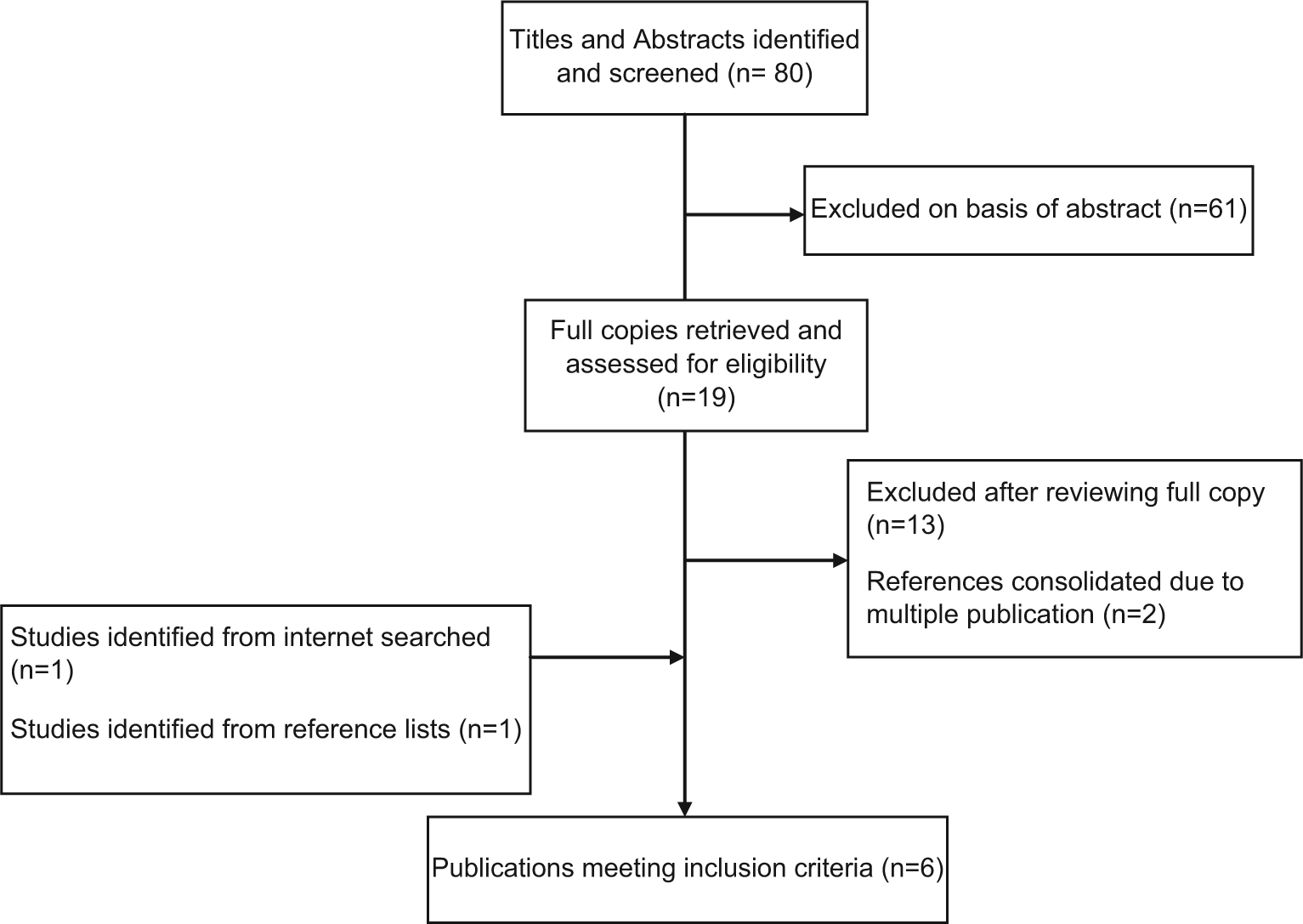
CONSORT flow diagram of studies reviewed.
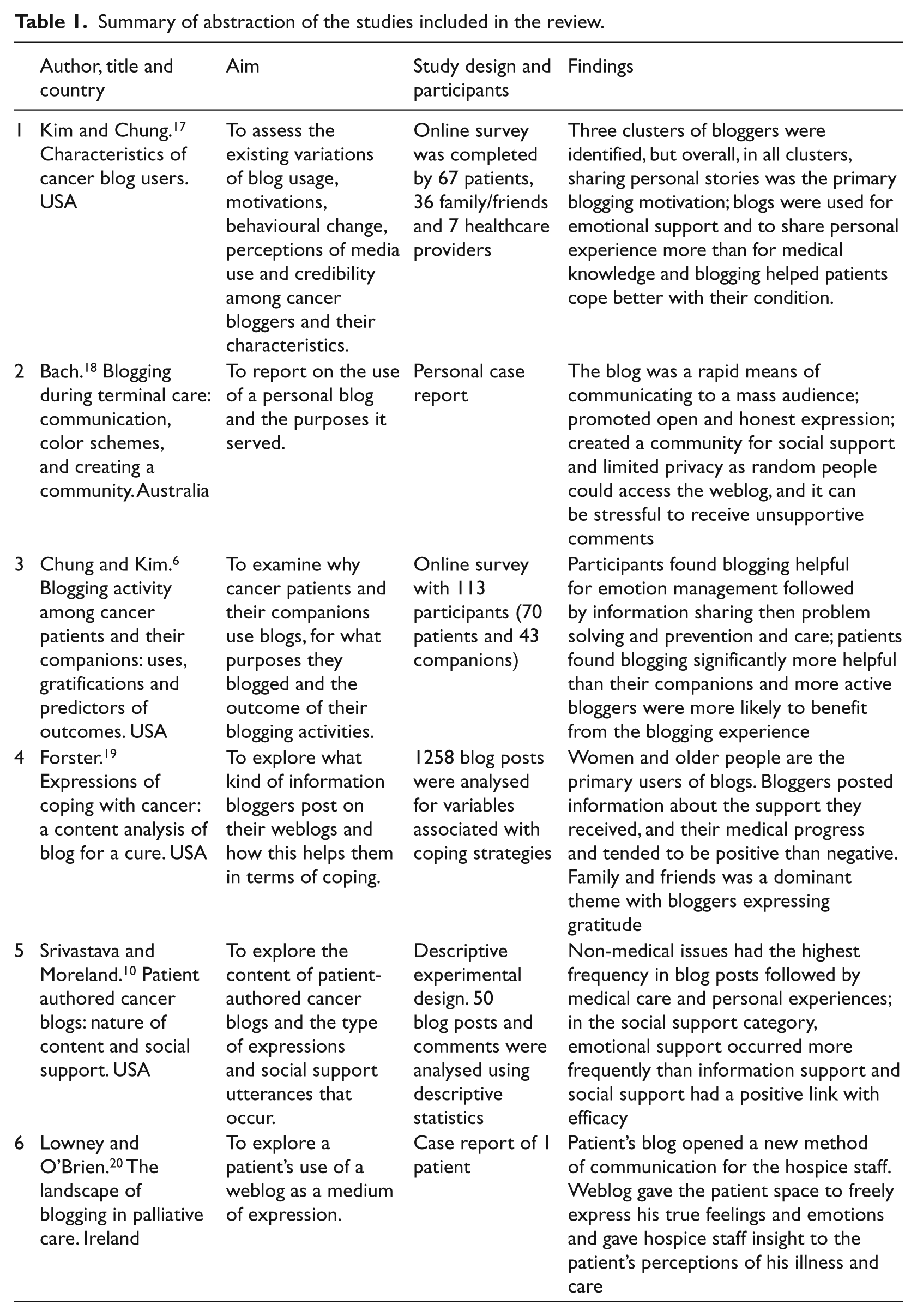
The studies selected included four from the United States, one from Australia and one from Ireland, notably only one from Europe and none from United Kingdom. The approaches of the studies varied: case report, descriptive, observational, qualitative and evaluation. Two of these studies explored the perspectives and motivations of bloggers and their self-reported benefits from the blogger’s point of view. Two studies were case reports that described the content of a particular weblog: one from the author and another from medical staff. The remaining two studies analysed the content of the weblog posts through various ways to explore the language used and the link to various concepts such as coping strategies. The results are presented in Table 1 followed by the identified themes.
Summary of abstraction of the studies included in the review.
Blogging as therapy
All the articles highlighted the issue of blogging being therapeutic in a way. Patients claimed that weblogs encouraged self-reflection of their situation in order to accept their illness. They felt that it was a place where they could experience an emotional release through disclosure. Dealing with a life-threatening illness is a difficult life-changing experience, which involves dealing with a lot of adjustments. In one study, weblogs were used as a coping strategy and helped individuals face this difficult situation. 19 A very pertinent issue related to this theme was how participants blogged to express themselves or to vent out the emotions they thought they could not share with anyone close. There was a general consensus that the weblog offered a space where individuals could be free and experience disinhibition, and thus, it promoted self-expression and disclosure with potential health benefits. 17 Weblogs were being used largely to chronicle the experience of living with or caring for someone with a terminal illness. 20 This journal usage of the weblog seemed to allow users the freedom to express their distress. Four studies reported how the weblogs also gave users the ability to openly express their attitude and true opinions of their illness.
Social connectivity and support
Regarding views on social support, all six articles covered this theme in relation to bloggers negotiating their identity within the blogosphere and building relationships with other people online. As people blogged, their personal and physical identity seemed to diminish, as individuals formed social networks for both emotional support and active coping. 19 Although two studies showed that a large number of weblog posts do not have comments, bloggers suggested that they were encouraged by the possibility of other people having access to the blog and thus the potential of sharing their experience.6,10 Other bloggers also indicated that they did not comment on other people’s posts, but they continued to read or follow weblogs to which they felt connected. One study reported how active blogging increased an individual’s sense of efficacy towards his or her circumstances. 10 This was due to the open discussion with others in the social networks that were found and formed through the weblog. This study also reported how personal and social experiences were among the dominant themes that were revealed by the utterances of cancer patient bloggers. These studies are evidence that blogging within palliative care can be a way for individuals to garner social support. Within a weblog, the social support that one can get is increased by the lack of physical geographical boundaries experienced online.
Empowering
Three studies reported how the weblogs empowered individuals to change their care options. Bloggers played an active role in their healthcare rather than being passive recipients of information and were able to discuss openly with their physicians about their conditions. 17 In the case report, the patient brought his illness to the general public and also showed hospice staff a new communication pathway by using narrative to give them an ‘insight to his emotional and spiritual journey’ (p. 2). 10 With some bloggers, this empowerment led to behavioural change, including healthier lifestyles. 17 The other studies reported how participants felt the weblog gave them control to define their illness according to their experience leading to an acceptance of their condition. This finding corroborates the ideas of Zimmerman 21 who in a review of palliative care literature suggested that open expression of feelings can lead to acceptance, the final stage of Kulber-Ross’ 22 model of grief. Through blogging, patients had a sense of control and also felt that they could work at their own pace increasing their independence in relation to their care. Bloggers used the weblog to control the message and information about their illness and also how people were informed.
Discussion
The identified themes have much overlap in how people experience blogging within a palliative care setting. There is research evidence that empowering patients and carers is a fundamental contribution to improving quality of life and the quality of healthcare and gives patients a sense of involvement. The reviewed literature shows how blogging for this group of individuals is beneficial and has the potential of being empowering as they help individuals construct an expression of their feelings and assist them in dealing with problematic issues. Page and Czuba 23 defined the concept of empowerment as a process that helps people gain control of their lives and assists them to deal with and to overcome challenges or difficult situations. In the past, research24,25 has shown how sometimes dying patients are not given the freedom and power to make decisions on simple things such as their care plan. This review has shown how weblogs make an attempt at entrusting patients with freedom to make decisions such as seeking out information from people in similar situations and forming their own support networks.
Bloggers who interacted with other people in a similar situation expressed how this helped them cope with their illness. 17 They felt that they belonged to a community or group of people with whom they could identify, while helping them gain a new and better informed awareness of their situation. They did not have to pretend but could openly discuss and share their experiences, and thus, in a way, it was a form of emotion management. Within the blogosphere, patients gained a holistic view of their lives as they were able to communicate about everything-else other than their illness. 10 Findings indicate that the weblogs gave people the space and place to vent their frustrations while communicating with others in a similar position. 6 According to Kim and Chung, 17 bloggers used their weblog more for sharing personal stories than for medical reasons. Support provided through narrative storytelling and sharing makes blogs an ideal tool for palliative care users. According to Berkman, 26 social support is very much a part of online communities and is an essential aspect in people’s lives as ‘it is both preventive and curative medicine’ (p. 413). 26
Although an extensive literature review was conducted, it is interesting to note the lack of scientific (medical) knowledge and robust evidence for the health benefits of blogging within end-of-life care. This is not an indication that blogging has no effect but may be due to other reasons including the lack of professional interest in evaluating this phenomena among health professionals. Another explanation could be the difficulty in which self-helping therapies can be studied in a controlled environment popular within the medical discipline.
Limitations
This review focused on health and medical databases, and therefore, there is the possibility that articles on the use of weblogs within the research topic may have been missed if they were in computing databases. The search only covered the last 10 years and could potentially have missed other studies from before that period. However, from the paucity of studies exploring the narrative use of weblogs, it is unlikely that that this review overlooked studies evaluating weblogs within palliative and end-of-life care. Another possible concern with this review is the publication bias, although an attempt was made to search for articles from any source both published and unpublished. The small number of studies included may be another limitation to be considered, although this is directly attributed to the lack of research studies within this topic.
Conclusion
Overall, the findings from this review indicate that weblogs have a potential of being a beneficial tool for palliative care service users as their functions address many needs that these service users have. The studies showed how the blogs helped users cope with their illness, empowering them to be actively involved in their care and in some instances promoting behavioural change. These findings enhance our understanding of palliative care services users’ reasons for blogging. Clearly, more research is needed to evaluate the effectiveness of the weblogs within palliative care, as users already have an interest in this self-help intervention. More quantitative research is also needed to complement the qualitative studies and assess which patients or palliative care users would benefit from this intervention and the best way to encourage them to use weblogs. This review has implications for palliative service providers as weblogs are a low-cost therapeutic intervention that could be offered to service users.
Footnotes
Funding
This research received no specific grant from any funding agency in the public, commercial or not-for-profit sectors.