




Abstract
This study applies social network analysis and quantitative content analysis to messages exchanged within an online support forum of caregivers of children with chronic asthma to examine how peer-to-peer network positions and personal communication styles (seeking and providing support) impact the reception of social support. Content analysis is used to determine rates of giving and receiving informational and emotional support. Network analysis assesses levels of individual betweenness and closeness centrality in the online network. Relationships between network positions, solicitation strategies, and the provision and reception of informational and emotional support are examined. Betweenness and closeness centrality are associated with improved informational and emotional support. The provision of informational support is also improved by providing descriptions of personal experience. Practical implications for the design and use of online support platforms are discussed.
Keywords
Introduction
Asthma is one of the most common chronic diseases in children, often requiring time-consuming and difficult long-term care. Obtaining adequate social support is a challenge for many parents and other caregivers of children with asthma.1,2 Caregivers require not only adequate asthma knowledge,3,4 but also mental health support. 5 Studies show that the caregivers of asthma sufferers benefit from both emotional support that addresses asthma-related anxiety and loneliness1,6 as well as from informational support that bolsters practical home management skills.1,6 As the use of internet technology becomes more widespread, parents and other caregivers of children with chronic asthma are increasingly joining online discussion forums to receive peer support.1,2 By posting and replying to threads, participants of these specialized online communities form networks of support, frequently exchanging messages. 7 Research on asthma-related online social support has focused on its benefits to caregivers and asthma sufferers,1,2 but has not analyzed the structure, functioning, and effectiveness of these online networks.8,9
Although research on social networks indicates that important and influential members of online support groups—those with high betweenness centrality and high closeness centrality, for example—have more access to network resources in offline settings,10–13 it remains unclear how these characteristics contribute to the provision of support in online settings, where messages are viewed by all group members. 14 Indeed, some prior studies suggest that members with high betweenness centrality (i.e., brokers) are more likely to receive social support, 15 whereas other studies show no such correlation in online communities. 16
Moreover, while prior research on social support networks shows that giving and receiving follows the norm of reciprocity, 17 this norm may not function as well in online settings where members’ interactions are generalized rather than reciprocal. 18 Finally, while prior studies have identified a number of social support solicitation strategies such as directly asking questions, 19 describing personal experiences, and disclosing recovery problems,20,21 the extent to which these strategies succeed in eliciting online social support for the parents of children with chronic asthma has not been thoroughly explored.
This study applies social network analysis and quantitative content analysis to messages exchanged within an online support forum of caregivers of childhood asthma. Relationships between network positions and personal communication styles (i.e., support solicitation and provision) and the reception of informational and emotional support are examined. Our findings deepen understanding about supportive communication in online support groups and examine the practical implications for online support group users and system designers seeking to maximize the benefits of online support.
Social support and network positions in online support groups
Of the five functional categories of social support (informational, emotional, esteem, network, and tangible), 22 informational and emotional support are the two most frequently encountered in online groups.23–25 Informational support, which involves advice or guidance on possible solutions to a problem, fosters problem-focused coping and addresses day-to-day practical home management.1,2,24,26 Emotional support, which involves empathy, trust and caring, helps manage emotional states and plays an important role in decreasing feelings of isolation and increasing bonding with other group members.1,2,27 These benefits are observed in the online support group for caregivers of children with chronic asthma. 2
The ability of caregivers of children with asthma to obtain adequate social support can be crucial. Although online support groups facilitate accessibility for all, 28 support may be disproportionately offered to certain group members. Prior research shows that direct or indirect support requests may not be fully answered8,29 as reading and replying to messages takes time, attention, and resources that caregivers of children with asthma may not be able to afford. Prior work also demonstrates that caregivers of children with asthma want to go online to get support from other parents in similar situations as well as receive advice and build friendships online.1,2,30 The impact of network positions and communication styles on support provision remain largely unknown, however.
Prior research conceptualizes networks of users based on reply relationships,7,15,29 in which each participant is an actor. Participants who are the most important actors in the users’ reply network are more active than other group members and have access to and control over social resources. 31 Betweenness centrality and closeness centrality are two important indicators of an individual’s importance in the network.10,11 Betweenness centrality measures the extent to which an actor lies on paths between other members.32,33 Members with high betweenness centrality are brokerage agents or “bridges” of information for different subnetworks. 32 Closeness centrality refers to how close an actor is to all the other actors in a set of actors. 11 Actors with high closeness centrality can spread influence quickly over the entire network.11,33
The relationship between brokerage and the reception of social support is mixed. Individuals working as bridges that connect multiple networks that are otherwise largely separated from each other have more access to more diverse information, ideas and resources.7,12 In offline networks, they often provide the only route for information and other resources to flow from one network to another. Brokers access information and other resources by spanning structural holes that exist in a network when there is a lack of direct contact or tie between two or more clusters.13,34 Brokers acts as mediators between two or more closely connected clusters. Since actors within one cluster tend to know about the same thing at about the same time, actors on either side of the structural hole have access to different flows of information and other resources. Online, members in a large group may form a subgroup that is much more active than outside that subgroup.35–37 Being a broker can boost an individual’s influence in online communities38,39 and cause them to receive more responses.29,40 Moreover, a recent study shows that being broker is positively associated with language style matching between posts and replies, which is a proxy for social support.
15
Brokers may not be as influential in online discussion groups—where information is transparent and accessible by all group members—as they are in offline networks, however. Indeed, prior work shows that being a broker is not associated with the numbers of replies in online communities.
16
Therefore, we propose the following research questions (RQs): Is being a broker in a network (with higher betweenness centrality) associated with receiving more social support, including informational (RQ1a) and emotional support (RQ1b)?
There is a potential positive association between the reception of social support and closeness centrality,29,40 but research has yet to examine this association. Given that an actor with high closeness centrality can quickly interact with all others, they easily have access to more information.
40
Members with high closeness centrality tend to be highly connected with many members of the community, enjoy high levels of trust from group members,
10
exert more influence on group participants,10,11,16 and receive more responses from group members.37,40 Therefore, we propose the following hypothesis (H): Is being an influencer in the network (higher closeness centrality) associated with more received social support, including informational (H1a) and emotional support (H1b)?
Social support provision, solicitation, and reception
The act of giving and receiving social support often follows the norm of reciprocity. 17 Support givers and receivers carry out a dyadic exchange with the expectation that support will be reciprocated. Research shows that in offline settings, there is a correlation between the amount of social support that is given and received.41,42 In online settings, prior works shows group members who reply to others more frequently tend to receive more replies from others. 16 Likewise, the amount of social support received, including emotional and informational support, may vary depending on how much emotional and informational support is provided.
Yet, this reciprocity principle may not work in the text-based format of online groups. Given the lack of social cues such as facial expressions, voice and body language in online groups,
43
anonymous, personally unknown members rely heavily on text for interaction.43,44 Whether a member replies to another member’s question may depend heavily on the judgment of the posted content. Indeed, research shows that in online communities, exchange is generalized rather than dense or reciprocal.14,18 For instance, individual A in online support groups might reply to individual B’s post, while A’s own post is answered by individual C or individual D.
18
Therefore, the provision of social support may not be directly associated with its reception. This situation poses the questions: Is providing informational support associated with receiving more social support, including informational (RQ2a) and emotional support (RQ2b)? Is providing emotional support associated with receiving more social support, including informational (RQ3a) and emotional support (RQ3b)?
The reception of support may also relate to how members seek support. The ways that caregivers of children with asthma seek online support has received little research attention. The “triage model” suggests that social support often goes to individuals who convey that they are most in need.
45
Several studies assessing how support-seekers ask questions
19
and disclose their recovery problems20,21 in online support groups found that such strategies are effective in eliciting informational support among participants with alcoholism,
8
young people with self-harm problems,
20
and victims of sexual abuse.
21
One study investigating an online eating disorder discussion forum demonstrates that portrayals of personal experiences are most frequently used to solicit social support,
46
without assessing the relationship with support reception. This raises another question: Is the practice of asking questions (H2a, H2b) that disclose recovery problems (H3a, H3b) and describing personal experiences (H4a, H4b) associated with the reception of more social support, including informational and emotional support?
Methods
Data collection
The messages examined in this study were from an online QQ support group representing one component within a mobile health application for patients with chronic asthma and their family members who provide care to patients with chronic asthma (apps.apple.com/cn/app/哮喘管家-哮喘控制更简单/id968257136). This asthma health application offers patients with chronic asthma or their caregivers help with symptom monitoring, adherence to medical regimens, and access to informational content, recovery tools, and ongoing contact with peer groups via different QQ support groups. The group we examined in this study is an online QQ support group (group ID:389813129) for parents who provide care to children diagnosed with chronical asthma. Parents join this online group by logging in and sending the request to the admins of the group with essential information (e.g., the age of the child with chronic asthma and their residence city). In this support group, parents can post text, documents, pictures, audio, and video in the group. They can change their user nicknames, but their QQ identifications are unique. The 11,692 text messages examined in this study were posted by 411 unique accounts during the period between March and August 2018. Due to project time constraints, we chose 6 months as a study period. This six-month time period (from March to August) included months with high pollen triggers or temperatures. In addition, 6 months was long enough to have the network developed and posts accumulated. As our study focused on network characteristics, social support provision, solicitation, and reception in an online support group, 6 months was an appropriate and effective time period. The study was approved by the institution’s Institutional Review Board.
Network analysis
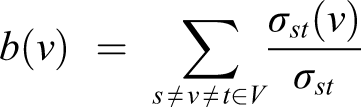
In the QQ support group, each user can post messages to the entire group, or direct messages to specific users by placing an @ symbol before the name. Social networks are created by member conversations, which is indicated by the direct-to relationship of messages. For the purposes of this study, a node represents a unique QQ identification. An edge between two nodes represents a direct-to relationship between two users, whereas general messages (from one user) to the group are not considered as an edge to every other user. The direction of an edge is from the user who sent a message to another user using @. For example, as in Figure 1(a), user A posted a message to user C by using @. There was an edge between A and C and the direction of the edge was from user A to user C. There could be multiple edges between two nodes as there could be multiple conversations. We took into consideration the number of messages between two users. Each user’s network metrics is calculated using Gephi (https://gephi.org/), including betweenness centrality and closeness centrality. Betweenness centrality is calculated as the proportion of the shortest paths between any pairs of two nodes traversing through this node (M = 286.03, SD = 1020.06). Therefore, the measure of betweenness centrality is calculated as
47
Schematic diagram of network centrality metrics and visualization of graphs. (a) A directed graph containing six nodes (solid circles) with seven edges (lines with arrow) representing the mention relationship (using “@”) between two QQ users. (b) For each node, betweenness centrality and closeness centrality are calculated and shown in the table. For instance, betweenness centrality b(D) of node D is computed following the equation: 1+1+1+1 = 4, since D serves as four bridges along all directed shortest paths between pairs of nodes: F→A, F→B, F→C and F→E; and its normalized closeness centrality is computed as: (5 − 1)/(2 + 1 + 1 + 1) = 0.8 for the four outward shortest paths from D to other reachable nodes A, B, C and E. (c) Directed graph of QQ support group visualized with computing betweenness centrality for nodes, where the larger the size, the darker the color of the node, and the larger the betweenness. (d) Directed graph of QQ support group visualized in the same way as subplot c, based on closeness centrality.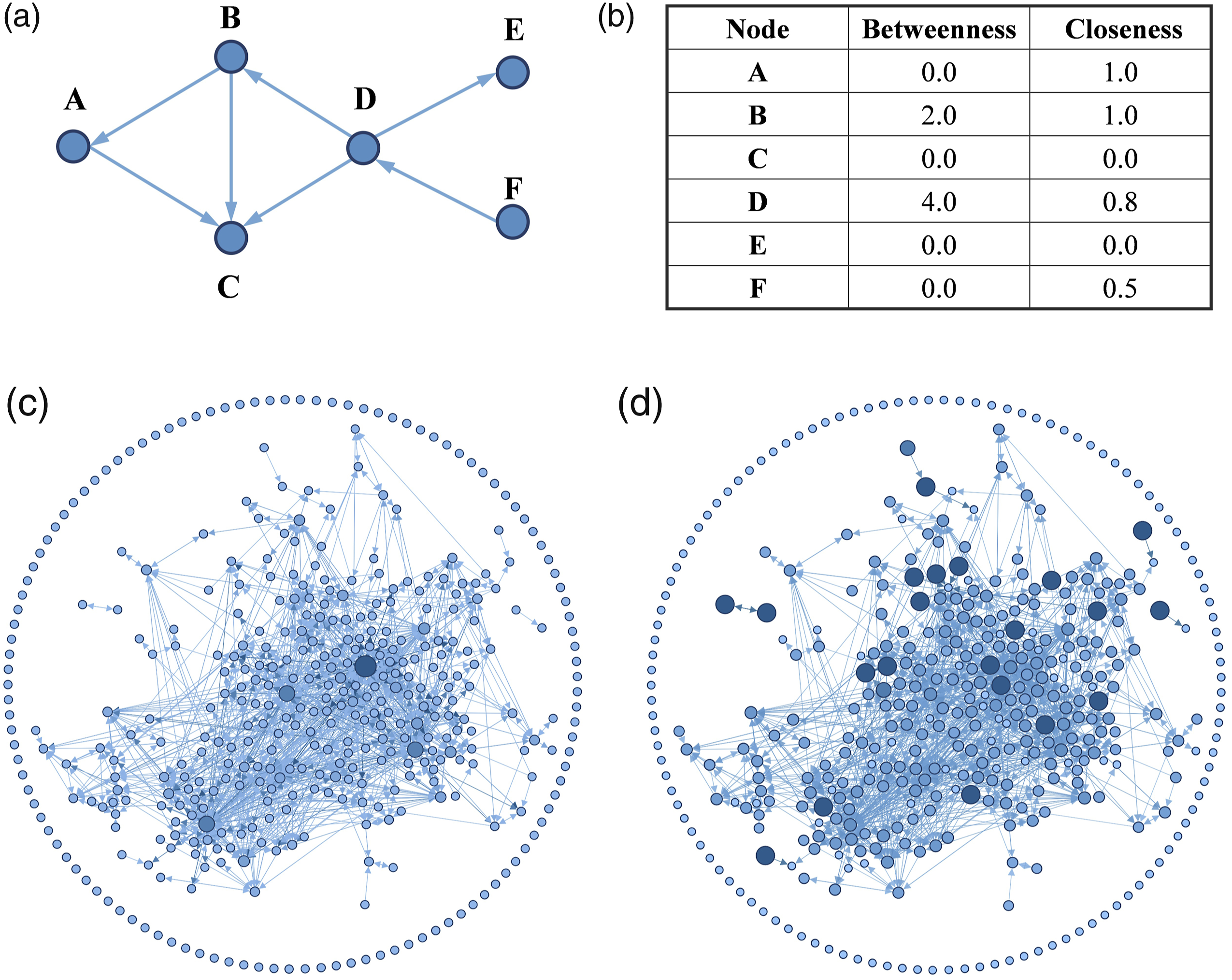
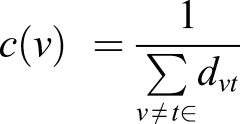
Closeness centrality is a measure of the node’s capacity for transmitting information efficiently through a network. A node with a high closeness centrality means it has a close relationship with other nodes. Closeness centrality is calculated as the reciprocal of the sum of the length of the shortest paths between the node and all other nodes in the social network (M = 0.23, SD = 0.24), as such
48
Coding procedure
Intercoder reliability was acceptably high, 49 with an average Cohen’s Kappa of 0.82 across all of the codes applied.
Coding system
Support solicitation. Three solicitation strategies have been identified by prior work.19,46 In the study, “disclosing recovery problems” refers to messages describing a current or past threat to wellbeing and/or recovery efforts (e.g., “Ugh, I have been really feeling discouraged lately. not sure I can do this at all”).
“Asking questions” refers to messages that ask a non-rhetorical question (e.g., “Can he eat apples when he takes Singulair?”).
“Description of one’s experience” refers to messages that describe personal experience (e.g., “my kid has not eaten snacks and candy for 1 year. Currently, he does not cough. I really see hope”).
Informational support. “Informational support” refers to information, knowledge, or advice that helps the recipient solve their problem, including what treatments to take and when, what triggers to avoid and when (e.g., “House dust and egg white are triggers” and “Allergy shots gradually reduce your immune system reaction to specific allergens”).
Emotional support. “Emotional support” refers to messages showing empathy, compassion and genuine concern for others (e.g., “I feel for you.” and “Persistence will lead to success…”).
For messages that fall into multiple coding categories, such as a supportive message that might include both informational and emotional support, all relevant codes are applied.
Social support provision. “Social support provision” is defined as the proportion of supportive messages posted in the chat group. For instance, if a participant posted 23 messages during the study period and 15 of those messages exhibited emotional support, emotional support provision would be 15/23. “Informational support provision” (M =. 261, SD =. 273) and “Emotional support provision” (M =. 010, SD =. 058) are coded.
Social support reception. “Social support reception” is dichotomous (yes = 1, no = 0), which is defined as if there are supportive messages aimed at a specific individual. For instance, if a participant received any messages exhibiting emotional support during the study period, emotional support reception would be 1. “Informational support provision” (M = 0.433, SD = 0.496) and “Emotional support provision” (M = 0.066, SD = 0.248) are coded.
Analysis
Hypotheses were tested using hierarchical logistic regression analyses, which enabled us to assess the extent to which participants’ social network characteristics, social support provision, and social support soliciting strategies in the group were associated with their social support reception. Unlike machine learning approaches, this approach did not separate the data into train and test datasets for classification or prediction. We did not use a machine learning approach because our study built on integrating concepts from prior theories and empirical studies and was not data-driven. Since we were testing the relationships among different variables with a binary outcome variable, hierarchical binary logistic regression was the appropriate approach. 50 Betweenness centrality and closeness centrality were entered into the first block; informational and emotional support provision into the second block; and directly asking questions, disclosing recovery problems, and descriptions of personal experience into the third block.
Results
Descriptive overview
Frequencies and percentages of social support provision in the online asthma caregivers group a .
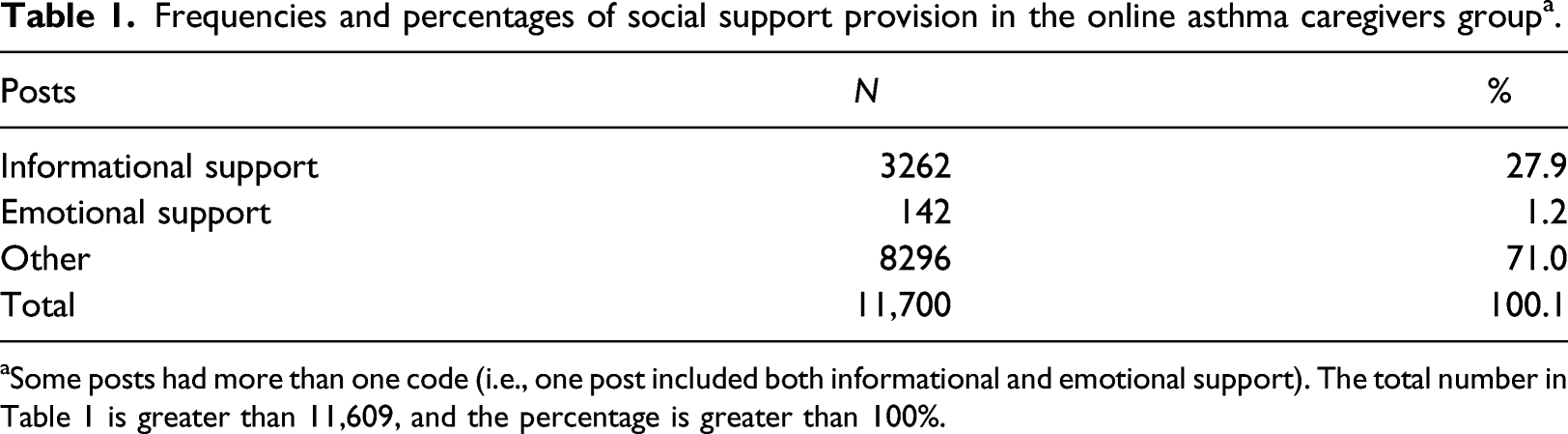
aSome posts had more than one code (i.e., one post included both informational and emotional support). The total number in Table 1 is greater than 11,609, and the percentage is greater than 100%.
Frequencies and percentages of social support solicitation strategies on the online asthma caregivers groupb.
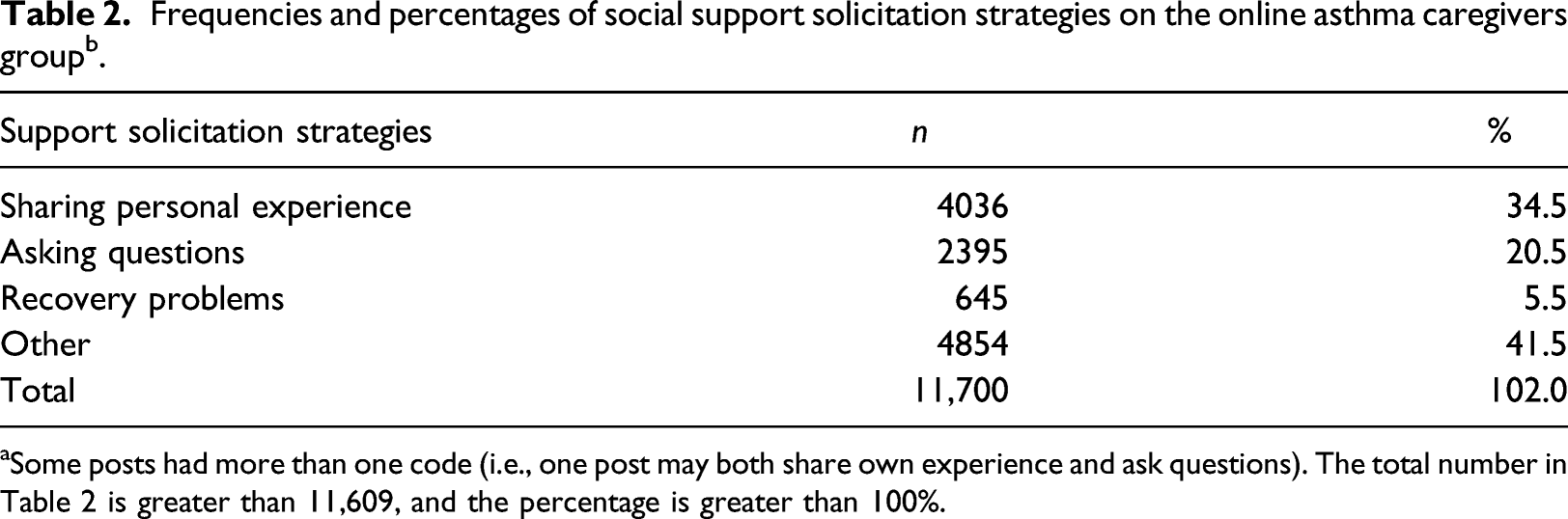
aSome posts had more than one code (i.e., one post may both share own experience and ask questions). The total number in Table 2 is greater than 11,609, and the percentage is greater than 100%.
Hierarchical logistic regressions
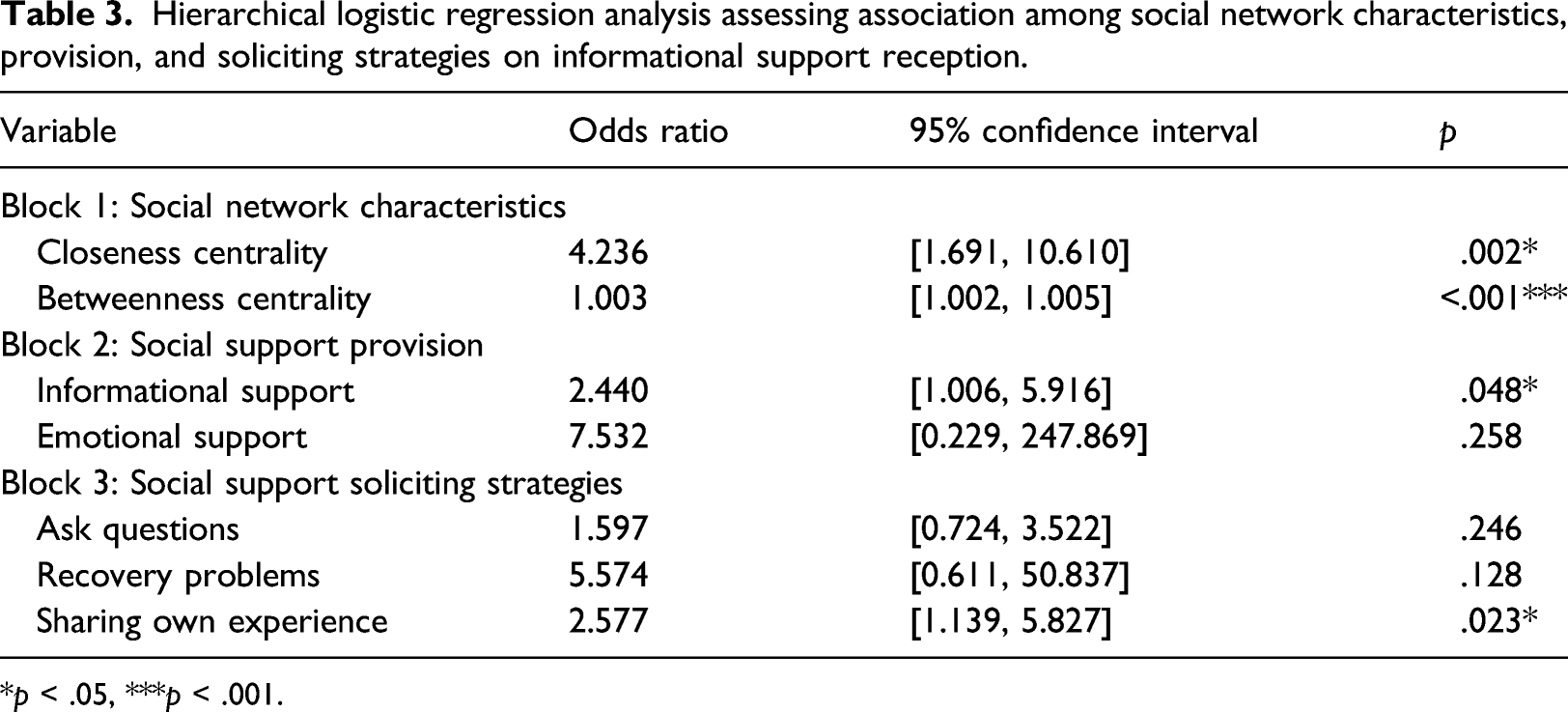
Hierarchical logistic regression analysis assessing association among social network characteristics, provision, and soliciting strategies on informational support reception.
*p < .05, ***p < .001.
RQ1a and RQ1b investigate the relationship between high betweenness centrality and emotional support reception, respectively. We found that high betweenness centrality was significantly correlated with increased reception of informational support (odds ratio [OR] = 1.003, p < 0.001, 95% CI [1.002, 1.005]) (Table 3):
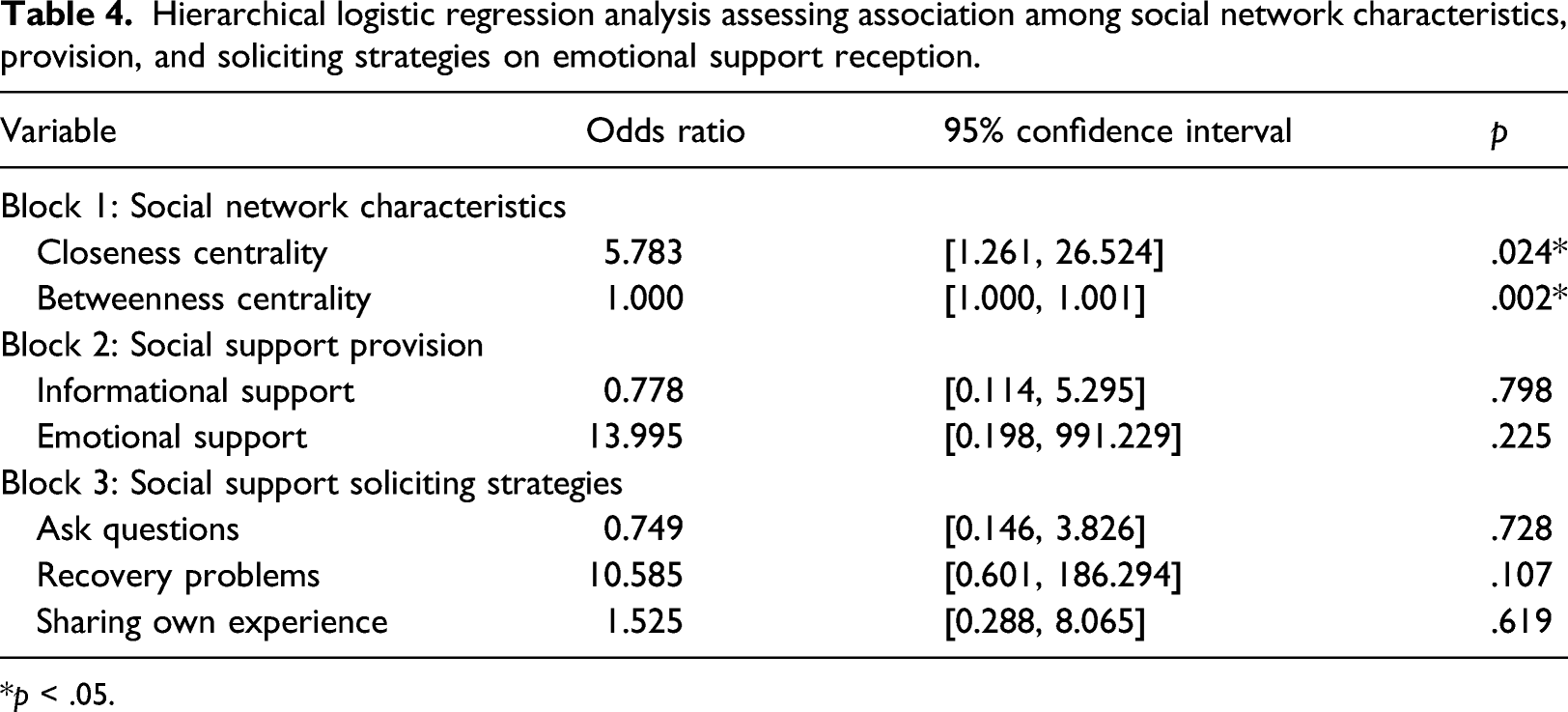
Hierarchical logistic regression analysis assessing association among social network characteristics, provision, and soliciting strategies on emotional support reception.
*p < .05.
High betweenness centrality was also significantly correlated with increased emotional support (odds ratio [OR] = 1.000, p = .002, 95% CI [1.000, 1.001]) (Table 4).
H1a and H1b predict that high closeness centrality in the network is associated with more informational and emotional support reception, respectively. H2a and H2b are supported. We found that high closeness centrality is significantly associated with increased reception of informational (odds ratio [OR] = 4.236, p = .002, 95% CI [1.691, 10.610]) (Table 3) and emotional support (odds ratio [OR] = 5.783, p = .024, 95% CI [1.261, 26.524]) (Table 4).
RQ2a and RQ2b investigates the relationship between providing more informational support and receiving more informational and emotional support. We found that providing more informational support is correlated with increased informational support reception (odds ratio [OR] = 2.440, p = .048, 95% CI [1.006, 5.916]) (Table 3). No association was found between providing informational support and receiving emotional support.
RQ3a and RQ3b investigate the relationship between providing more emotional support and receiving informational and emotional support. We found that providing emotional support is not associated with receiving social support.
H2a, H2b, H3a, H3b, H4a, and H4b predict that asking questions, disclosing recovery problems, and describing personal experience is associated with receiving informational and emotional support. Only H4a is supported: sharing personal experiences is significantly associated with receiving more informational support (odds ratio [OR] = 2.577, p = .023, 95% CI [1.139, 5.827]) (Table 3).
Discussion
Applying network analysis and quantitative content analysis to text messages in an online support group of caregivers of children with chronic asthma, this study investigated the relationship between network positions, communication styles (i.e., support solicitation and provision), and the reception of informational and emotional support. Serving as a group broker or being a center of group is associated with the reception of both informational and emotional support. Online support group members who provide informational support and describe personal experience tend to receive more informational support.
These findings highlight the importance of online support group member positions within the network to the ability to receive social support in online groups. Specifically, we find that occupying a central brokerage position in the network grants access to more informational and emotional support. Our findings show that being an online broker who bridges different subnetworks underlies the overall provision of emotional and informational social support. Though all group members have access to all messages in online groups, as they interact more actively with members in subgroups,35,37 brokers may work as opinion leaders, 39 or “thought-leaders” 38 across different subgroups. This social influence brings them benefits when they need social support, manifested as receiving informational and emotional support. Moreover, our study is partially consistent, with prior research showing that high closeness centrality attracts more replies.37,40 Building on that, our study demonstrates explicitly that group members with high closeness centrality tend to receive more informational and emotional support than others.
The findings provide further evidence that the reciprocity norm function only partially exists in online support groups. Specifically, participants who provided informational support tended to receive more informational support, whereas people who provide emotional support to others may not necessarily receive emotional support or informational support. Our findings are partially consistent with prior research showing that online forum participants may also follow the reciprocity norm,16,41,42 but that the type of support provided varies. The primary role of the examined online asthma caregiver group is sharing and requesting information related to asthma care, and we found that the provision of emotional support is relatively rare. As such, providing emotional support may not match most support seekers’ intentions within the context of this group. 51 Mismatched support needs may help explain recipients’ anticipation and satisfaction concerning emotional support givers52,53 and the lack of reciprocally provided informational and emotional support to emotional support providers.
We did not find evidence supporting a “triage model” suggesting that social support goes to people who express that they need it most by directly asking questions and disclosing recovery problems. By contrast, the more caregivers describe their personal experiences, the more likely they are to receive informational support. These findings may partially reflect the fact that childhood asthma is a highly complex problem and conditions vary among patients over time. 54 Due to time constraints, caregivers of children with asthma want to attend online support sessions only when content is specifically relevant to them. 1 Describing personal experiences may help group members efficiently identify commonalities with other members and, therefore, more effectively solicit informational and emotional support.
Practical implications
Our findings have practical implications for the caregivers of children with asthma and designers of online peer support systems. For instance, it may be helpful for those seeking support from online peer groups to understand that they may receive more support from their peers if they share their personal experiences and actively provide informational support to others. Moreover, given the lack of replies to questions and descriptions of recovery problems in support groups, it may be worthwhile to add features that can automatically provide short answers or web links to group members. 55 Thirdly, given the important role of network positions in obtaining support, system designers may consider features that automatically provide support to group participants who are relatively isolated (e.g., low betweenness centrality or closeness centrality). Finally, given the broad range of benefits that emotional support offers 2 and the lack of reciprocity in emotional support, system designers should consider including features that facilitate the delivery of emotional support.56,57
Limitations and future directions
Our data is limited in that we cannot draw causal conclusions. Many factors not addressed here can impact the provision and reception of social support. Offline contact between members and private messages between members may impact the provision of online social support not considered here. Participants’ age, number of years participants are in a group, and the provision of care to children with chronic asthma, types and severity of asthma may associate with different types 58 and themes 35 of social support reception. Researchers can consider combining other types of data (e.g., user system log, survey, or in-depth interview data) to examine these relationships in the future. We used the volume of informational and emotional support as the measure of social support received. Future studies can also code the quality of social support received. 7 Coding more detailed and thoughtful replies, especially those that respond to the needs of support seekers versus short, simple answers or mismatched supportive messages, can provide deeper insights. Moreover, we did not code non-text data such as the emojis and pictures shared in the online group, which appeared at low frequencies in our dataset but nevertheless deserve further examination in light of the role they play in providing and receiving social support.56,57 Finally, a future study could examine the relationships between seasonal variation in asthma and social support reception in online settings. As chronic asthma is a year-round condition, different months may bring various challenges for asthma patients and their caregivers. For instance, how the volume of social support and the themes of posts differ in September when asthma peaks and hospitalization rises could be a topic of further study.
Conclusions
Although internet technology has facilitated access to support, those most likely to benefit from enhanced informational and emotional support are members of online support groups. In the peer-to-peer online support group for caregivers of children with chronic asthma that we studied herein, members who served as “centers” and “bridges” for other members tended to obtain most social support. Members who provided more informational support to their group peers and those who shared personal experiences were more likely to receive informational support. The caregivers who provided more emotional support did not tend to receive more support in return, however. These findings deepen our understanding of social support exchange in online peer support platforms and have implications for platform feature designs that can facilitate social support delivery.
Footnotes
Acknowledgements
We would like to thank Yefen Zhuang and Wenling Chen for their assistance in message coding.
Declaration of conflicting interests
The author(s) declared no potential conflicts of interest with respect to the research, authorship, and/or publication of this article.
Funding
The author(s) disclosed receipt of the following financial support for the research, authorship, and/or publication of this article: This work was supported by the Shanghai pujiang program (2020pjc056), and Ministry of Education of the People's Republic of China (19YJC860029).
