




Abstract
The increased reliance on Internet use in social functions has presumably left out a part of the population: the oldest-older adults. These are people who have not kept themselves up to date with the technological developments for various reasons. There are, however, exceptions from whom we have something to learn. This study investigates the older people in Sweden who started to use the Internet over a period of 6 years. Cognition, extraversion, openness, functional disability, household economy, sex, age and education were investigated in relation to starting to use the Internet. A chi-square test, Spearman correlation and a logistic regression analysis were conducted. It was found that higher cognition, being male and being between the ages of 60 and 80 years were determining factors in starting to use the Internet for the Swedish older adult. Our results indicate that the oldest-older adults are slow to adapt to using the Internet and more attention should be paid on how to support this group.
Introduction
Being able to follow and keep up with the technological developments is easier when you live in an environment where digital devices are readily available as a natural feature of your daily life. Technological advances tend to exclude older adults who grew up without these facilities.
Social learning theory (SLT) suggests that people learn from external input, such as influences from those around them, society in general or the media. SLT underlines that these influences will make people behave in an imitative fashion according to what they have seen. 1 As the media trends tend to ignore minority groups, it is not surprising that when the Internet became available to the general public in 1995, 2 it did not cater for the older adults at first. Those who were born in the 1920s and 1930s had already retired by then and had little chance of being included as their learning of and exposure to computers and the Internet was minimal. 3 On the other hand, those who were born in the 1940s and 1950s often follow the technological trends and use iPods and iPads as easily as a younger person. 4
Thus, with elderly people, there are both adapters to the technological advances and non-adapters. Difficulties arise for those who do not use the Internet in their daily lives. There will inevitably be a lack of communication, which can be problematic in sectors such as health care. The increase in longevity and an ageing population worldwide 5 will require that the health-care systems adapt their working systems with digital applications in order to meet the increased number of patients. It will also require health-care systems to handle the non-technologically aware older adults by providing alternative solutions. Swedish data have shown that around 80 per cent of people aged 60 years and older are not using the Internet; 6 American studies indicate that 68 per cent of people over 65 years are not using the Internet. 7 Many factors are reported for non-use, namely, that it is too expensive, they are not interested or do not know how. 3 Disabling bodily impairments may lead to either an increase in computer usage, where older adults use virtual media as a means of meeting people8; or a decrease in use if the computer screen or programme is not suitable and may be difficult to use4,9, to totally inhibiting the oldest-old to use or start to use computers 10 .
SLT claims that people are influenced by their generation and specific cohort backgrounds; but a person will bring individual behaviour to the environment, which will influence the environment in turn. 11 Older adults under socio-economic strain may choose not to use new media, such as the Internet. On the other hand, they continue to use media such as the television and the radio, which they are familiar with and on which they do not have to spend much money on. 3
Personality traits, as described by the Five Factor Model (FFM) by Costa and McCrae, 12 have been shown to relate to Internet usage. For example, Landers and Lounsbury, 13 found a negative relationship between agreeableness, conscientiousness and extraversion and Internet usage. Another study showed that extraversion and openness are linked to Internet use by the older adult. 6 It seems likely that personality traits influence change in Internet usage. Extraversion, in a general population, suggests dynamism and self-assertiveness,12,14 and openness has been shown to be significantly related to intellectual curiosity, verbal memory and cognition. 15 These traits may suggest an individual who may be likely to adapt to the Internet and computers, and therefore, they have been selected for this study.
Traits such as openness have a significant relationship with cognition, 15 which concerns the processes of knowing and the content of those processes, such as intellectual and memory functions. The biology of ageing encompasses a decline in cognition. This could mean that taking on a new task and learning to use the Internet is less feasible, a study showed that cognitive age had a large impact on older adults’ Internet use. 16 If mild cognitive impairment causes older adults not to use the Internet it needs to be further investigated. Cognition is therefore explored in this study with Internet usage.
What seems important to note is that the Internet and computers are being used by older adults more frequently. Studies have shown a positive relationship between education and Internet/computer usage. 6 A part of good ageing is to be able to live independently, 17 and the Internet is becoming a more important element for that purpose. Much work is done in order to meet the needs of the ageing population in efficient ways by innovative tools that are tailor-made for the older adult. 18 Yet, those who do not adopt the Internet need to be highlighted as direct personal contact is becoming scarcer in many industries. Banking, public transport and even health care to a great deal rely on the Internet and computers. In Sweden, booking an appointment with dentists or doctors is now done online, causing the older adult who does not use the Internet to be segregated.
So far, limited research has focused on the oldest-older adults and their Internet use within a longitudinal design. This article examines the change in Internet usage by Swedish older adults over a period of 6 years, controlling for the following variables: cognition, extraversion and openness, functional disability, household economy, age, sex and education.
Methods
Sample
The data used were available through the Swedish National Study on Aging and Care (SNAC).
SNAC is a longitudinal study that started in 2001, with the cooperation of central and local governments. A complete outline of the SNAC study is explained in detail in Lagergren et al. 17 The sample in this study includes one of the four regions in the SNAC study, Karlskrona, which is a suburban municipality with 64,140 inhabitants, located in Blekinge county. It is considered representative of the Swedish ageing population. In addition, Karlskrona resembles the other rural and urban sub-samples of the total SNAC study according to age, gender, functional ability and perceived quality of life.
Baseline data collection
The participants were invited by mail to take part in an investigation by trained research staff, on two occasions. The baseline data were constructed by interviews, medical examinations and supplementary questionnaires that were either completed at home or at the research centre. In case of non-completion, reasons were noted. There were 585 men and 817 women (N = 1402) participating. There were 10 age cohorts – 60, 66, 72, 78, 81, 84, 87, 90, 93 and 96 years – with a mean age in the sample of 75 years. The ethical research committee of Lund University approved the study (LU 605-00, LU 744-000), and informed consent from each participant was also obtained.
Follow-up data collection
This baseline data has a follow-up every 6 years where the same individuals are re-examined. Most baseline questionnaires are given again, depending on the formal SNAC procedures and requirements. In the six-year follow-up, the total number was 848 (N= 848); the lower number of people from baseline data to follow-up was due to censoring or death.
The results that are presented in this study are based on a combination of both baseline and follow-up data, where the data are paired.
Measurements and instruments
The questionnaires were given to the SNAC sample on two occasions, 2001–2004 (baseline) and 2007–2010 (follow-up).
Internet use was measured using a questionnaire asking whether computers and the Internet were used, with a possible ‘yes’ or ‘no’ answer. Cognition was measured using the Swedish translation of the ‘Mini-Mental State’ Test (MMT). The instrument (MMT) measures normal cognitive functioning versus the ‘presence of cognitive difficulty’ (p. 192). 19 The maximum score of 30 means that one has normal cognitive functioning.
The personality questionnaire used (SGC-1) was a Swedish version of Costa and McCrae’s FFM questionnaire. The FFM contains 60 questions that can be categorised within the following traits: neuroticism, extraversion, openness, agreeableness and conscientiousness. 12 The answer options range from ‘completely agree’ (7) to ‘completely disagree’ (1). There are questions that are reversed, which were accounted for and recoded. Only two of the traits were used in this study, extraversion and openness. This Swedish version of the FFM has previously been used in published studies, see, for example, Berner et al. 6
Functional Disability was measured using the Instrumental Activities of Daily Living scale (IADL), 20 which was translated into Swedish. The scale is based on a total sum of questions regarding ability to use the telephone, shopping, food preparation, housekeeping, laundry and mode of transportation. The answers were categorised into two categories: ‘no/little help and moderate/total help needed’. This Swedish version of IADL has previously been used in a study investigating determinants of feeling hindered by functional disabilities. 21
Household economy was measured based on a Swedish survey on income and living conditions.22,23 The question is whether one can obtain a sum of 14,000 Swedish Krona (SEK; 1522 euro) within 1 week in 2004, and 15,000 SEK (1630 euro) within 1 week in 2007 (inflation accounted for).
Sex was included as a categorical variable. Age was grouped into two categories: group 1 – the younger-older adults, aged 60–80 years; group 2 – oldest-older adults, aged 81–96 years.
Education was categorised in three groups according to the previous Swedish education system, relevant for the age groups in this study: level 1, those who did not finish secondary school; level 2, those who finished secondary school; and level 3, those with some form of higher education.
Statistical methods
Change in Internet use was categorised into two groups. Group 1 contained those who began to use Internet from baseline (2001–2004) to follow-up (2007–2010). Group 0 contained those who did not start to use the Internet.
Cognition was categorised into good or poor cognitive functioning, in order to understand the scores more easily and to be able to use them in a chi-square test. Those who had good cognitive functioning had a score between 30 (highest score) and 27. Those who had poor cognitive functioning had a score of 26 or less. This is in accordance with other studies that use the cut-off point between 24 and 26. 19
Extraversion and openness were dichotomised at their mode, 38 in both cases. The average score was deemed a less valuable interpretation in reference to Internet usage; therefore, the mode was used as it shows the most frequent score in these older adults.
Functional disability was categorised into no/little need of help (low scores were between 12 and 15) to moderate/total need of help (high scores: 16–24). This categorisation was chosen to handle the scores more easily according to the distribution of the data, where too few people were actually in need of no help at all.
It was decided to first run univariate analyses to see the relationship between the variables and thereafter place the significant outcomes in a multivariate model. Non-parametric tests were used as the data are not normally distributed.
First, a chi-square test was conducted with the new variable (change in Internet usage) and the selected variables (cognition, extraversion, openness, functional disability, household economy, sex, age and education) to see whether there was a relationship between the dependent and independent variables (see Table 1).
Descriptive statistics and chi-square test of change in Internet usage of older adults between 2004 and 2010, with the variables: cognition, extraversion, openness, functional disability, household economy, age, sex and education.
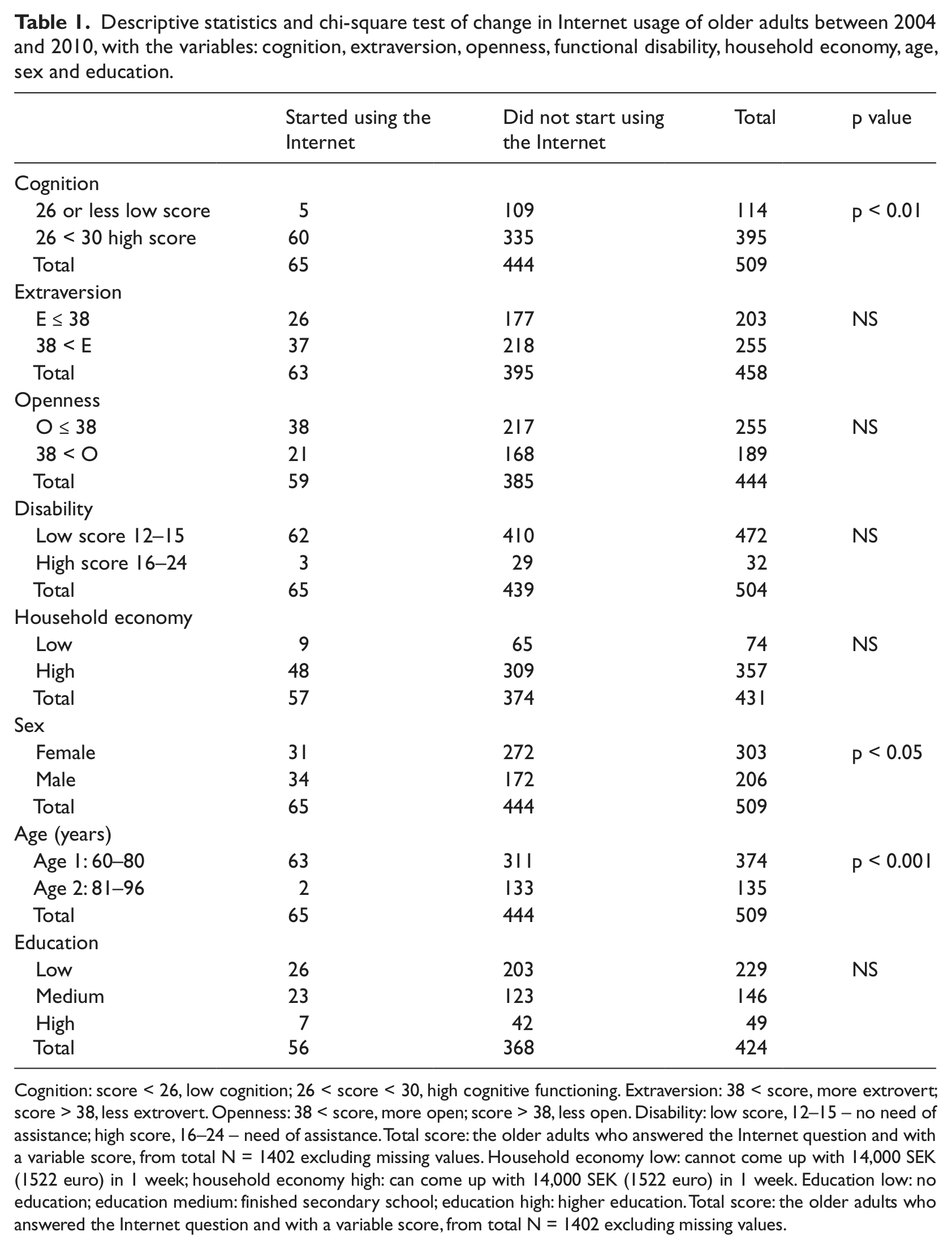
Cognition: score < 26, low cognition; 26 < score < 30, high cognitive functioning. Extraversion: 38 < score, more extrovert; score > 38, less extrovert. Openness: 38 < score, more open; score > 38, less open. Disability: low score, 12–15 – no need of assistance; high score, 16–24 – need of assistance. Total score: the older adults who answered the Internet question and with a variable score, from total N = 1402 excluding missing values. Household economy low: cannot come up with 14,000 SEK (1522 euro) in 1 week; household economy high: can come up with 14,000 SEK (1522 euro) in 1 week. Education low: no education; education medium: finished secondary school; education high: higher education. Total score: the older adults who answered the Internet question and with a variable score, from total N = 1402 excluding missing values.
A Spearman correlation was conducted between the variables cognition, extraversion, openness, functional disability, household economy, sex, age and education to verify that there was no multi-collinearity (Table 2). Correlations below 30 per cent confirm this.
Spearman correlations, all the independent variables showing the correlation coefficients and the significant values.
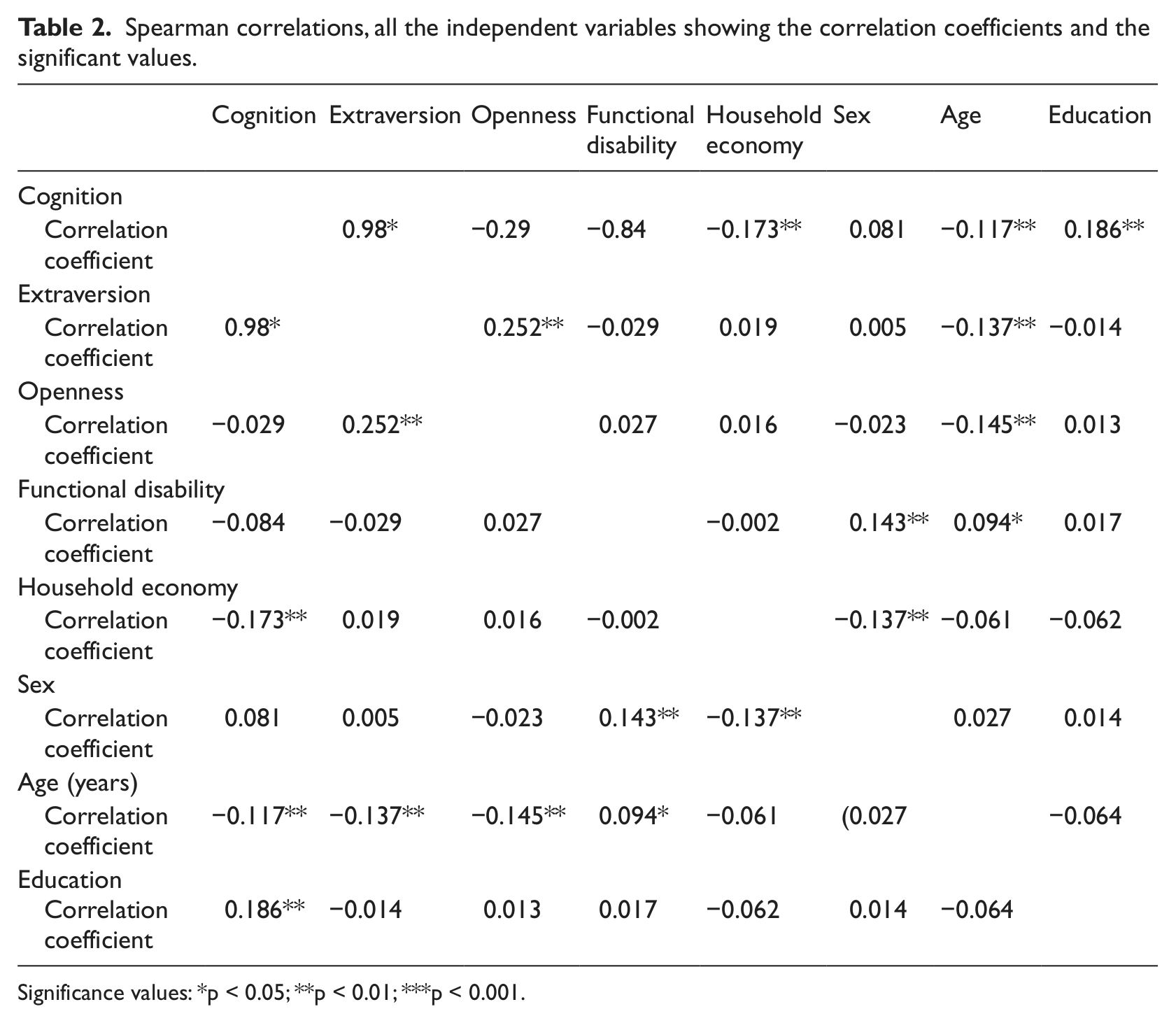
Significance values: *p < 0.05; **p < 0.01; ***p < 0.001.
The significant variables from the univariate analyses (cognition, sex and age) were entered into a logistic regression, which can be found in Table 3. Another logistic regression (Table 4) was done, with the variables cognition, sex and age, selecting only the age group 1 (between 60 and 80 years of age). Age group 2 had such few users of the Internet that it was not possible to run a logistic regression on those older adults. The variable age had to be reversed, so the odds quoted could be compared. Age and cognition were entered as continuous variables.
Logistic regression.
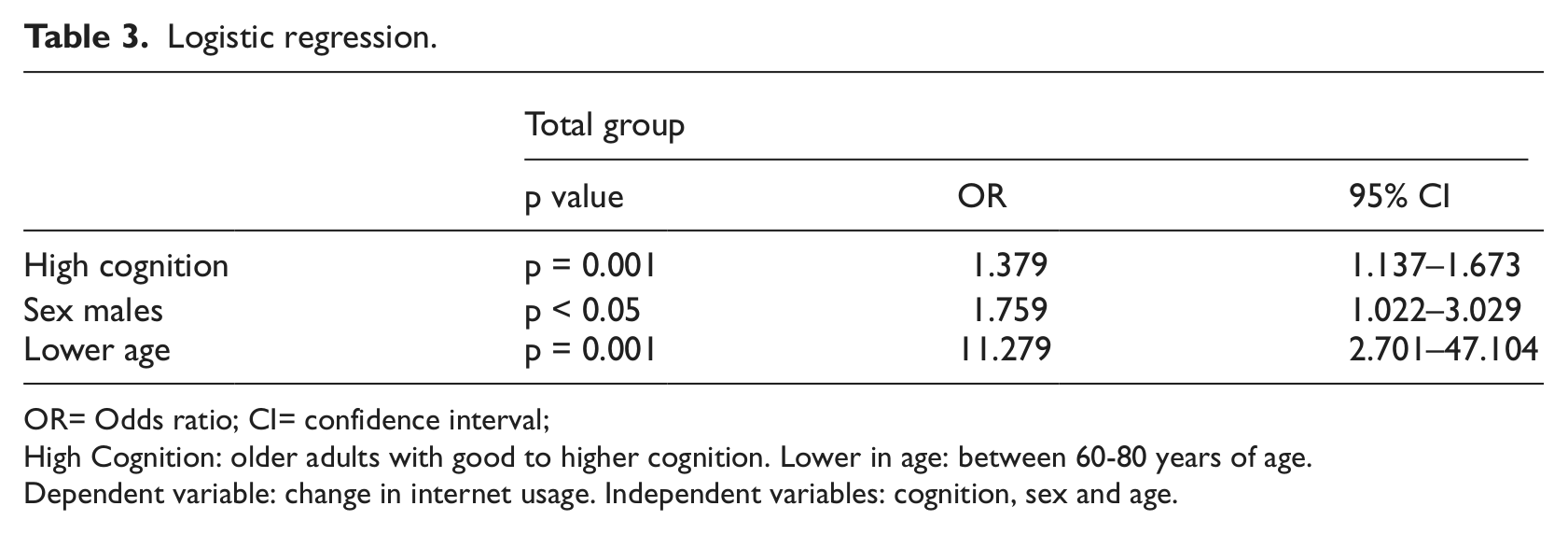
OR= Odds ratio; CI= confidence interval;
High Cognition: older adults with good to higher cognition. Lower in age: between 60-80 years of age.
Dependent variable: change in internet usage. Independent variables: cognition, sex and age.
Stepwise logistic regression, selecting only the older adults between 60–80 years of age.
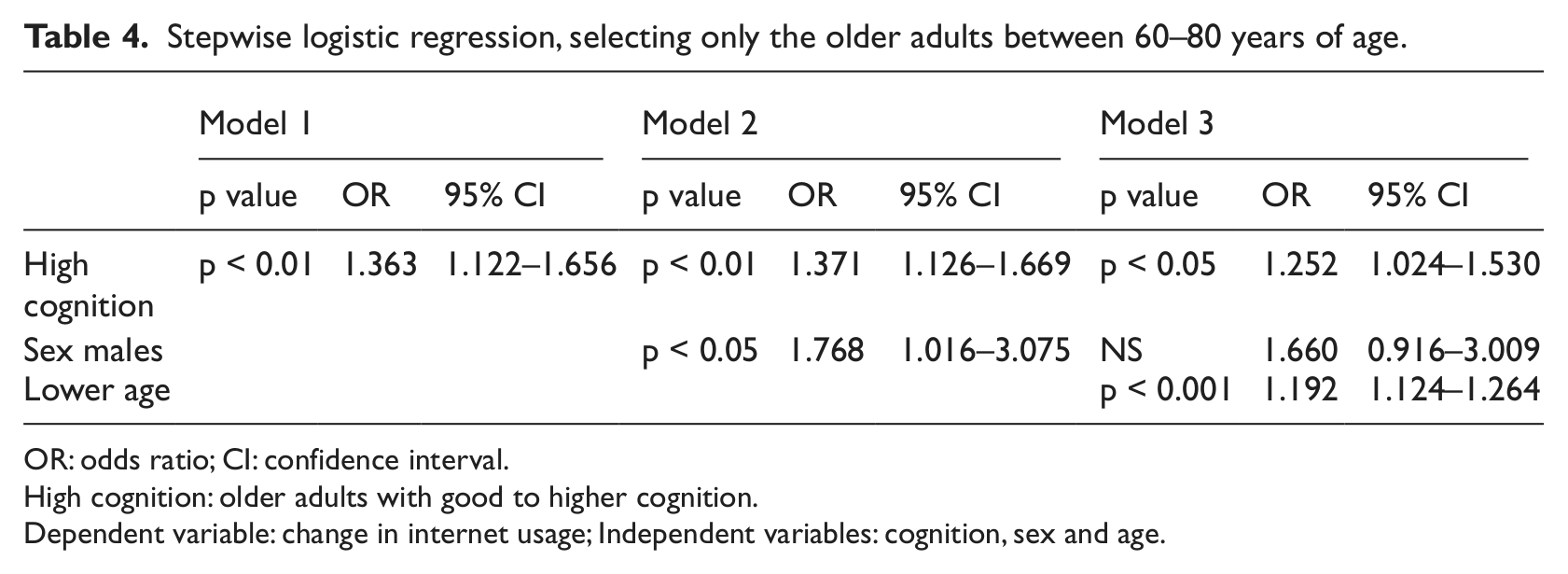
OR: odds ratio; CI: confidence interval.
High cognition: older adults with good to higher cognition.
Dependent variable: change in internet usage; Independent variables: cognition, sex and age.
Results
At the 6-year follow-up, there was an increase in Internet use of 7.7 per cent. Table 1 provides an overview of the number of older adults who began to use the Internet over the 6-year period. Sixty-five older adults started to use the Internet as opposed to 444 who did not. Higher cognitive scores were significantly related to change in Internet usage (p < 0.01). Males in significant numbers started to use the Internet more often than females (p < 0.05), and those who were between the ages of 60 and 80 years (p < 0.001) started to use the Internet more often than those aged 81–96 years. Extraversion, openness, functional disability, household economy and education did not significantly relate to change in Internet usage.
The Spearman correlation test revealed small correlations between variables, as seen in Table 2. Yet, all correlations between variables were 25 per cent and below, and therefore, it appears that there is no problem with multi-collinearity as the correlations do not affect the standard error.
The variables that were univariately related to change in Internet use, cognition, sex and age, were put into a logistic regression analysis resulting in Tables 3 and 4. Table 3 provides a description of the logistic regression analysis, where change in Internet use is observed within the total sample, with the three covariates. It shows how higher scores in cognition (odds ratio (OR) = 1.379***; 95% confidence interval (CI): 1.137–1.673), being male (OR = 1.759*; 95% CI: 1.022–3.029) and lower in age (OR = 11.279***; 95% CI: 2.701–47.104) influence change in Internet usage. Cognition and age were the stronger predictors in the equation of older adults’ Internet usage, compared to being male. However, lower in age showed a 11 times more likelihood of using the Internet.
The second regression analysis was done stepwise selecting only the younger-older adults, since they are more active Internet users. Table 4 shows how at first scoring higher on cognition (OR = 1.363**; 95% CI: 1.122–1.656) influences change in Internet usage by 36 per cent. Thereafter, when adding the first covariate, both cognition (OR = 1.371**; 95% CI: 1.126–1.669) and being male (OR = 1.768*; 95% CI: 1.016–3.075), significantly influence whether younger-older adults begin to use the Internet. The last model shows that when adding age as a covariate, cognition remains significant, yet not as much as before (OR = 1.252*; 95% CI: 1.024–1.530), sex drops out and age influences Internet usage (OR = 1.192***; 95% CI: 1.124–1.264). This suggests that being male no longer influences Internet usage in the younger-older adults like it did with the oldest-older adults. Age is still significant yet not as strong a factor influencing Internet usage in the younger-older adults.
Discussion
This study first examined the change in Internet use of the Swedish older adult after a 6-year gap. An increase was seen from 2004 to 2010; however, 7.7 per cent of older adults began to use the Internet. In general, what seems to characterise the older adults’ adoption of the Internet is the following: good cognitive capacity, being male and lower in age (between 60 and 80 years of age). When observing these younger-older adults more specifically, only scoring higher on cognition and age influence whether one begins to use the Internet. Being male no longer has an impact on whether younger-older adults start to use the Internet.
Factors influencing Internet use
The older adults are a heterogeneous group, where mental decline follows an individual trajectory. A Dutch longitudinal study 24 confirmed that technological advances require the older adults to have cognitive flexibility, speed and memory in order to manage; this is even more so with Internet applications and websites. Similarly, the results in this Swedish study demonstrated that cognition was significantly related to change in Internet use throughout all ages. Some studies have noted that slower responses, less-efficient results in searches and less-confident adults will influence the older adults’ use of the Internet. 25 Therefore, it is possible that as soon as there is slight cognitive decline, such as mild memory loss, this could lead to indifference to, or a choice not to, start using the Internet. A study by Laditka et al. 26 showed that if cognitive decline is thought to be purely genetic and inevitable, new and adaptive behaviours will be less likely to be adopted. Whether one believes that one can influence one’s cognitive decline 1 might also influence the older adults’ Internet usage. Our study confirms that cognition has an influence on whether Swedish older adults start using the Internet.
Sex is a factor that appears to be related to change in Internet use, yet it does not show in the younger age groups. A possible explanation for this could be that Sweden, for several years, has been in the process of closing 80 per cent of the gender gap. 27 This suggests more equality between sexes and that women are as likely as men to be using the Internet. Previously, the gender gap in Internet use was based on socio-economic status, comfort, low computer anxiety and Internet self-efficacy.28,29
The younger-older adults were more frequent in adopting the Internet during the 6-year period. This is consistent with the findings in a Dutch longitudinal study, 24 where the authors partly discovered that the younger-older adults, males, higher educated and less lonely individuals were more inclined to start to use the Internet. Age is a strong factor when it comes to Internet usage. The oldest-older adults do not start using the Internet, contrary to the younger-older adults who are more prone to societal influences of computers and the Internet. In this study, age was less influential as a variable on Internet usage in the younger age group. Some of the younger-older adults have recently retired and may find that using the computer is a way to still do work-related activities, 10 or to remain connected to society.
Factors not influencing Internet use
Extraversion, openness, functional disability, household economy and education did not influence the older adults in this sample. An inverse relationship has previously been found with extraversion and Internet usage. 13 Reduced mobility has previously appeared as a factor that motivated older adults to start to use the Internet as a way to remain independent and have contact with family; 30 the older adult’s financial status has also been strongly linked to Internet use. 10 Under economic strain, the older adult would not spend money on a computer and Internet access that they do not know how to use. Other studies coupled higher education with more income and in turn linked these two factors to the older adult’s adoption of the Internet.31,32 This study showed that none of these aforementioned factors were related to the older adults’ change in Internet use. It appears that those factors have either decreased in importance or they are not important after a certain age in today’s digital era. It is possible that the Internet is a movement that begins with social learning where it might be the case that the environment is much more influential on older adults’ Internet adoption than other previously seen or measured individual factors. For example, as seen in the Swedish context, the social environment of reduced gender inequality was one explanation for gender no longer influencing older adults’ Internet use.
Limitations of the study
The selection of variables was made based on previous research. There are other factors that could be pertaining to adopting the Internet. It may be of interest to observe location and living situation of the older adult. The older adults in this study were not living in larger cities. As urban living is not represented, it may therefore be difficult to generalise the results of this group. Other covariates that may be of interest in future research are self-monitoring technologies, such as taking your own blood pressure, which could either strengthen, promote or hinder Internet usage. Furthermore, change in Internet use could be measured differently. Since change is a subjective and personal endeavour, it is possible that more could be revealed through studying personal communication, where a qualitative study may pick up other variables of interest.
The heterogeneity of the older adults’ cognition can be seen as an analysis on its own; cognitive decline varies enormously both from person to person and within the third and fourth age. A restriction in cognitive measures may mislead results. 33 It may therefore be significant to categorise the cognitive capacity of the older adult more specifically.
Conclusion/clinical implications
The implication noted from this study is that Internet adoption by the older adult is becoming more prominent. This increase over a period of 6 years is comparable to American 7 and Dutch 24 data. Many studies worldwide suggest that the older adults are the largest growing segment of Internet users.25,31,34 Within different age groups good cognitive functioning, gender and age influence whether the older adult begins to use the Internet. The group that is not starting to use the Internet is still large, and mainly the oldest-older adults. On the one hand, it may be of interest to create a good personal experience of learning how to use the Internet/computers 35 as a way to attract the oldest-older adults who today do not have the same relationship and experience of the Internet as the younger-older adults. On the other hand, if the oldest-older adults are not adapting to the Internet, other tailor-made solutions will be inevitable in order to support this segment of the population. Especially as they are the largest consumer of health care, more individual measures are necessary. A suggestion would be to have personal assistants who specifically work for the oldest-older adults and could function as possible information technology (IT) support. Such a solution can be beneficial for both health-care systems and the oldest-older adults.
Footnotes
Acknowledgements
We are grateful to the participants, the counties and municipalities that participated.
