




Abstract
In recent decades, the landscape of pain management has shifted dramatically, particularly in the USA, where the increased prescription of opioid medications has contributed to a national public health crisis. As a reflection of cultural and societal dynamics, fiction literature provides a valuable lens for examining evolving perceptions of pain and its treatment. This study explores the depiction of analgesic use in Stephen King's novels, focusing on the period from 1977 to 2019. By analyzing references to specific medications, including over-the-counter pain relievers and prescription opioids such as oxycodone and hydrocodone, the paper traces a chronological pattern that mirrors real-world changes in medical practice. The analysis highlights a growing presence of more potent medications in King's later works, often presented without moral framing or medical explanation. This neutral portrayal of analgesics, including opioids, may reflect a broader cultural acceptance of pharmacologic solutions to pain. The study also considers how King's personal experience with injury and recovery may have influenced these depictions. By examining the intersection of fiction, health, and culture, this paper contributes to a deeper understanding of how literature reflects and informs public discourse on medical issues.
In recent decades, the landscape of pain management has witnessed a profound shift, marked by an increasing reliance on opioid medications (Cho & Chang, 2022). This trend parallels a growing concern over the opioid epidemic in the USA, a crisis rooted in both the aggressive marketing of prescription opioids and the societal challenges of chronic pain management (Stokes et al., 2019). Within this context, popular literature, such as Stephen King's novels, offers a lens for examining changing perceptions and patterns of analgesic use. With more than sixty novels published, hundreds of millions of copies sold worldwide, and numerous adaptations of his works into films, television series, and theatre productions, King's writing has had a substantial and lasting influence on contemporary popular culture. His extensive body of work often features characters with neurological conditions (Marquez-Romero, 2022) grappling with pain, both physical and psychological, reflecting broader societal trends in their choice of pain relief.
In this study, I discuss the depiction of analgesic usage in Stephen King's novels, focusing on the transition from over-the-counter (OTC) analgesics to opioids, which, unsurprisingly, reflects real-world trends in pain management (Wang et al., 2022). King's work can be seen as part of a broader discourse on pain management and the societal consequences of the opioid epidemic.
Figure 1 presents an overview of analgesic usage among characters in Stephen King's novels from 1977 to 2019. The categories include ibuprofen, acetylsalicylic acid/aspirin (ASA), ASA combined with caffeine, acetaminophen, ASA/caffeine/acetaminophen combinations, triptans, oxycodone, and hydrocodone. An illustration is provided of the evolution of analgesic use across King's literary works, highlighting the progression toward more potent medications and exemplifying broader trends in public discourse on pain management and the increasing normalization of their use.
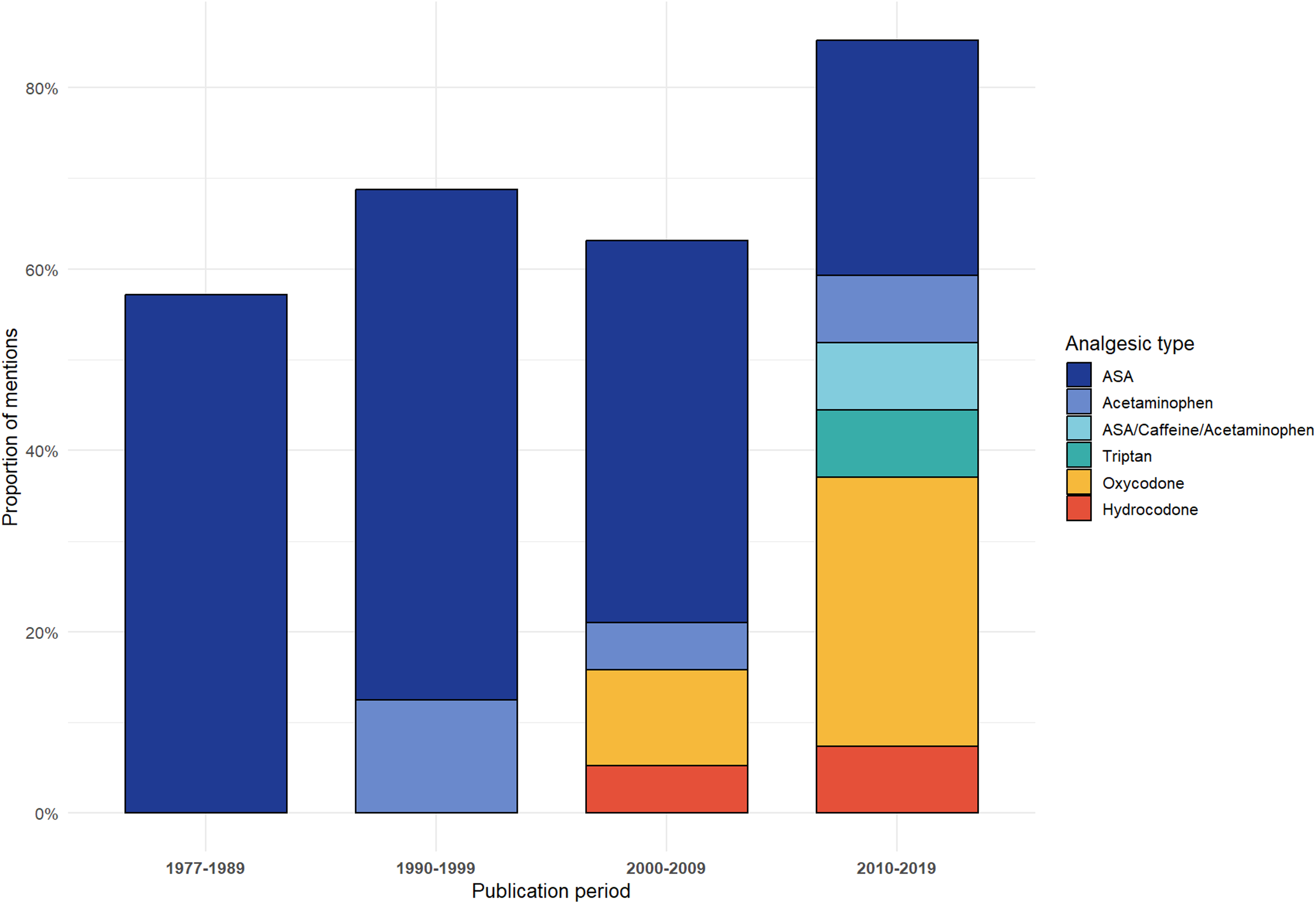
Distribution of Analgesic Types Mentioned in Stephen King's Novels Across Four Publication Periods (1977–2019). Bars represent the proportion of analgesic mentions within each period. The figure illustrates the predominance of over-the-counter analgesics in earlier decades and the progressive emergence of migraine-specific medications and opioid analgesics in later periods. ASA = acetylsalicylic acid.
In the novels published during King's early years as a writer, such as The Shining (1977) and Roadwork (1981), only commonly used analgesics, such as ASA and other early non-opioid pain relievers, appear. This trend continued through the 1980s and 1990s, with ASA frequently mentioned in works such as The Talisman, Thinner (1984), The Dark Tower II: The Drawing of the Three, Misery, and The Tommyknockers (1987). In these novels, characters reach for aspirin or similar medications to relieve mainly headaches and fatigue. For example, in The Shining, Jack Torrance suffers from recurrent severe headache, whereas, in Misery, King introduces the “Annie-dope,” a heavy, opioid-based painkiller called Novril that Annie Wilkes feeds to author Paul Sheldon to keep him addicted, incapacitated, and under her control. Acetaminophen, although widely available at the time, appears only sporadically in Insomnia (1994), The Green Mile, Desperation, and The Regulators (1996). A notable shift begins in the late 1990s and early 2000s, coinciding with the introduction and increased availability of new analgesic classes. Triptans, first approved in the early 1990s for the treatment of migraines, appear in Finders Keepers (2015), where Pete Saubers reflects that when a person is the source of a headache, not even one of his mother's zolmitriptan tablets would provide relief. A comparable reference appears in Sleeping Beauties (2017), where a character avoids eating chocolate because it triggers her migraines and she has no access to zolmitriptan. This reflects the broader medical trend of targeting specific types of pain with more specialized treatments.
The inclusion of opioids in King's novels starting in the 2000s echoes a growing opioid crisis in the USA. Oxycodone, a potent opioid pain reliever approved mid-century but widely prescribed in sustained-release form from the late 1990s onward, is featured in Duma Key (2008) and Under the Dome (2009). Hydrocodone, another widely used opioid, appears in later works, including End of Watch (2016) and Sleeping Beauties (2017). These narratives often touch on the complexities of opioid use, reflecting broader societal anxieties about addiction and dependency. For example, in Duma Key, the protagonist Edgar Freemantle receives opioid analgesics during his recovery from a severe construction accident, and his dependence on pain medication becomes part of his struggle to regain physical and psychological stability.
Notably, there is a delay of several years between the widespread availability of opioids in clinical practice and their first appearances in King's fiction. This lag can be understood not only within the typical timeline for newly introduced substances to show up as a normalized reference in fiction, but also the timeline of writing and publishing a novel: conceptualizing, drafting, revising, and releasing a book often spans multiple years. King's earlier works, developed before the widespread public awareness of the opioid epidemic, naturally reflect the medical practices and societal attitudes of their time. But as the opioid crisis became more prominent in public discourse in the late 1990s and early 2000s, they appear as themes fully integrated into King's storytelling. When novels like Duma Key and Under the Dome were published, the issue had become a clear focal point in society.
The question of when different substances appear in fiction also invites speculation about the author's own personal experiences with pain. In 1999, he was severely injured after being struck by a van while walking along a rural road in Maine. This traumatic event may have introduced King to opioid analgesics firsthand. Significantly, it is in the years following this injury that opioids begin to appear in his fiction. While no direct autobiographical link is made in his texts, the alignment of this timeline with King's recovery lends plausibility to the idea that his experience with pain and its management may have informed his portrayal of more potent analgesics.
Another notable aspect of King's work is the neutral tone in which analgesics are portrayed. Their use is rarely accompanied by moral judgment, ethical debate or legal context. Characters take pain relievers, usually for headaches, with little elaboration or symbolism. For instance, in The Shining, Jack Torrance is described chewing aspirin tablets dry to relieve a headache during moments of stress, reflecting his casual and habitual use of OTC analgesics. This remains consistent across all drug types, from simple OTC medications to opioids. Misuse, dependency, withdrawal or addiction rarely carry narrative weight in relation to analgesics as such. Additionally, analgesics are not used to signal a character's moral trajectory or psychological decline. This neutrality makes the observed shift toward more potent medications particularly noteworthy because the increasing pharmacological strength of the drugs appears without a corresponding change in narrative framing. As a result, the transition from OTC analgesics to opioids is presented as a natural extension of routine pain management within the fictional world, echoing broader real-world concerns about the normalization of increasingly potent analgesics.
The normalization of increasingly potent analgesics is further underscored by the near-total absence of healthcare professionals’ involvement in acquiring these medications in the fiction of Stephen King. Although, in earlier novels, only easily obtained OTC drugs are portrayed, thus not requiring a prescriber, in later works, when opioids are mentioned, there is often little to no explanation of how the character acquired the drug. Prescriptions, diagnoses or medical consultations are generally omitted. While this likely reflects the narrative focus on pain itself rather than the logistics of drug access, it also mirrors how easily these medications became embedded in daily life.
The cultural implications of this depiction are not trivial. With millions of readers worldwide, King's fiction contributes to shaping collective understandings of health and illness. On the one hand, the routine portrayal of pain management helps normalize the legitimacy of treating pain, potentially reducing stigma for those with chronic or acute conditions. On the other hand, the normalization of opioid use, presented without complexity or consequence, may contribute to a broader desensitization to their risks. While not instructional, fictional portrayals such as King's play a subtle role in shaping public literacy about medication, including its appropriate use and potential harms.
This essay shows how analgesic use in King's novels has offered a cultural commentary on the evolving availability of pharmacologic treatments and their social implications. The increasing complexity and seriousness of pain management depicted in these works underscore the broader narrative of the opioid epidemic and the ongoing challenges it presents to individuals, communities, and public health systems. These patterns suggest that literary representations of analgesic use not only reflect, but also contribute to broader public discourse on pain management and the normalization of increasingly potent medications.
Footnotes

Funding
The author received no financial support for the research, authorship, and/or publication of this article.
Declaration of Conflicting Interests
The author declared no potential conflicts of interest with respect to the research, authorship, and/or publication of this article.