




Abstract
Aim:
The present article summarises status and trends in the 21st century in older people’s (60–79 years) drinking behaviour in Denmark, Finland, Norway and Sweden and concludes this thematic issue. Each country provided a detailed report analysing four indicators of alcohol use: the prevalence of alcohol consumers, the prevalence of frequent use, typical amounts of use, and the prevalence of heavy episodic drinking (HED). The specific aim of this article is to compare the results of the country reports.
Findings:
Older people’s drinking became more common first in Denmark in the 1970s and then in the other countries by the 1980s. Since 2000 the picture is mixed. Denmark showed decreases in drinking frequency, typically consumed amounts and HED, while in Sweden upward trends were dominant regarding prevalence of consumers and frequency of drinking as well as HED. Finland and Norway displayed both stable indicators except for drinking frequency and proportion of women consumers where trends increased. In all four countries, the gender gap diminished with regard to prevalence and frequency of drinking, but remained stable in regard to consuming large amounts. In Norway the share of alcohol consumers among women aged 60–69 years exceeded the share among men. During the late 2010s, Denmark had the highest prevalence of alcohol consumers as well as the highest proportion drinking at a higher frequency. Next in ranking was Finland, followed by Sweden and Norway. This overall rank ordering was observed for both men and women.
Conclusion:
As the populations aged 60 years and older in the Nordic countries continue to grow, explanations for the drivers and consequences of changes in older people’s drinking will become an increasingly relevant topic for future research. Importantly, people aged 80 years and older should also be included as an integral part of that research.
Keywords
Literature addressing how older people’s drinking has developed over the past 20 years has often stated that studies on this topic are scarce. It is fair to repeat that claim still today – for both the Nordic countries and elsewhere (e.g., Bye & Østhus, 2012; Frydenlund, 2011; Hallgren et al., 2009). Comparative studies are even scarcer; a recent international comparison showed that there are large variations in older people’s drinking between countries, regions and cities in both use and abuse (Muñoz et al., 2018).
In order to deepen our knowledge of older people’s alcohol consumption in four Nordic countries (Denmark, Finland, Norway and Sweden), the aim of this thematic issue was to analyse the status of four fundamental indicators of people’s drinking habits: the prevalence of users, the prevalence of frequent use, typical amounts of use and the prevalence of heavy episodic drinking. Secondly, we wanted to study recent trends in each of these indicators. Our purpose was to describe rather than explain older people’s drinking habits in the 21st century in four Nordic countries. Since no joint and standardised Nordic drinking habits study exists that could examine older people’s use of alcohol, we carried out four separate country-specific studies presented earlier in this thematic issue (Bye & Moan, 2020; Jensen et al., 2020; Raninen & Agahi, 2020; Tigerstedt et al., 2020). The specific aim of this article is to summarise the results by conducting a relative comparison of the status and trends in the indicators of older people’s drinking habits that were used in the country reports.
Inevitably, several problems emerged at the outset which immediately challenged part of our aims. Some of the indicators either differed between the national surveys or were missing in some countries. Time points and years of data collection varied greatly between countries, thus making it impossible to create a common study period. Moreover, data were gathered in various ways. Hence, we had to lower our ambitions of directly comparing drinking habits across the respective countries, as well as doing so over time. Of course, this can in itself be regarded as one of the results of the study: currently, there is only a limited set of comparable data of older people’s alcohol use available in these four Nordic countries covering fairly short periods.
Such limitations thus call for cautious conclusions. With this in mind, we venture to say that this first attempt to compare status and trends in older people’s alcohol use in four Nordic countries can point to important commonalities and differences, and improve public and research discussions on the topic.
Measures comparing national trends and status of alcohol use
Since the 1960s, Denmark has had the highest recorded consumption of alcohol of the four Nordic countries; in 2018 recorded consumption amounted to 9.1 litres of pure alcohol per capita among those aged 15 years and older. In the 21st century, Finland has almost caught up with Denmark, having in 2018 a recorded consumption of 8.4 litres. The corresponding figures in Sweden and Norway were 7.2 and 6.0 litres, respectively ( Yearbook of alcohol and drug statistics, 2019, 2020). 1 Against this backdrop, it is interesting to compare the status and trends of alcohol use in a sub-population consisting of older age groups. Are differences in per capita alcohol consumption between the countries also reflected in older people’s drinking habits? Or does older people’s alcohol use deviate from conventional national differences?
As mentioned above, we have used data from separate national alcohol and health status surveys conducted in the respective Nordic countries. For the individual country reports presented in the current special issue of the journal, we chose four indicators to describe older people’s drinking habits, with a main focus on status and trends in the first two decades of the 2000s. The indicators and the country-specific measures used were as follows:
Prevalence of current drinking. The proportion of current drinkers or alcohol users was measured by asking whether the respondent had drunk alcohol within the past 12 months. The responses were “yes” or “no”. This question was used in three countries, while in Sweden the question concerned the past 30 days. The periods covered by the national cross-sectional surveys differed: in Denmark the time span was 2010–2017, in Finland 1993–2018, in Norway 1985–2019 and in Sweden 2004–2017.
Prevalence of frequent use. Frequent drinking was measured by calculating the proportion of respondents who had drunk alcohol at least twice a week in the past year. This measure was available for Denmark (2010–2017), Finland (2013–2018), Norway (1985–2019) and Sweden (2004–2017).
Typical amounts of drinking. This indicator was measured in Finland (2013–2018) and Norway (2012–2019) using the question: “How many drinks containing alcohol do you have on a typical day when you are drinking?”. In Sweden (2004–2017), the question concerned the number of drinks consumed on a typical drinking occasion in the past 30 days. The Danish study (2010–2017) measured typical amounts consumed for each day in a typical week.
Prevalence of heavy episodic drinking (HED). The prevalence of HED was defined in Denmark as consuming five or more drinks on one occasion at least monthly (2005–2017). In Sweden, HED was also defined as having drunk five or more drinks on at least one occasion within the time frame of the past 30 days (2004–2017). In Finland (2013–2018) and Norway (2012–2019), the measure was six or more drinks on one occasion at least once a month.
The measures described above were examined in detail in the four country-specific studies included in this issue. In the Results section below, we compare the findings across the countries. First, we point to similarities and differences between the countries with respect to the status of the different indicators of drinking at the most recent time point for each country; i.e. for Denmark and Sweden this was 2017, for Finland 2017/2018 and for Norway 2018/2019. Second, we compare drinking trends that have taken place in the different countries in the 21st century. In both cases we also compare results across different age segments of older men and women in the four countries. In a table we summarise the similarities and differences in drinking trends between the countries. The table is presented at the end of the Results section.
Results
Prevalence of current drinking
Status, men
Current drinking among older men is most widespread in Denmark. In 2017, roughly 90% of older Danish men in each five-year age group between 60 and 79 years of age were alcohol consumers. In Norway the corresponding figures were somewhat lower; i.e., between 82% and 90%, depending on age group. In Finland, in turn, the proportion of male current drinkers was a bit lower than in Norway; and among 75–79-year-old men the proportion was clearly lower; i.e., 66%.
Sweden is difficult to rank since the Swedish measure for current drinking was calculated for the past 30 days, as compared to the past 12 months in the other countries. The proportion of users varied between 77% and 85% among those aged 60–79 years depending on age group. This may be an underestimation since many of those who drink less than monthly are not included among the drinkers.
Status, women
In 2017, the proportion of female current drinkers was highest among older Danish and Norwegian women: 85% of 65–69-year-old and 78% of 75–79-year-old Danish women had consumed alcohol in the past 12 months; in Norway the corresponding figures in 2018/2019 were 87% and 71%, respectively. In Finland in 2017, the prevalence of current drinkers was lower; i.e. 71% among 65–69-year-old women and 50% among 75–79-year-old women. In Sweden, the respective figures in 2017 were higher than in Finland, that is, 75% and 67%, despite the fact that the Swedish measure concerned alcohol use during the past 30 days instead of the past 12 months as in the rest of the countries.
In international comparison, the current prevalence of alcohol users among older people in the four Nordic countries seems quite high. Strictly comparable results are not available, but a recent European study (including Israel) showed that 68% of the overall sample of 65–84-year-old respondents from six cities (Ferrara, Italy; Geneva, Switzerland; Hamburg, Germany; Jerusalem, Israel; London/Canterbury, England; Madrid, Spain) had consumed alcohol during the past 12 months (Muñoz et al., 2018).
Trends, men and women
Regarding trends in the proportion of current drinkers, Sweden differed from the rest of the countries. Since 2004, the prevalence of Swedish drinkers had increased considerably in most older age groups – and more so among women than among men. An increase among the “older” old age groups (70+) was also observed in Denmark in the 2010s, particularly among women. In Norway and Finland, the share of male current drinkers has been stable in the 21st century. By contrast, the proportion of current female users has increased throughout the 21st century in Finland in each five-year age group between 60 and 79 years, as well as for women aged 70–79 years in Norway. Furthermore, we note that in all four countries the proportion of current drinkers among women aged 70–79 years has risen. Among men, only for Danes aged 60–69 years, did the proportion of alcohol users decline.
Prevalence of frequent drinking
The proportion of older people who consumed alcohol at least twice a week was used to estimate frequent drinking. This measure was available for all countries, but for slightly different periods.
Status, men
By far the highest proportion of older men drinking at least twice a week was found in Denmark, where between 61% and 65% of men in each five-year age group between 65–79 years consumed alcohol that often. The corresponding figures in Finland and Sweden were fairly similar; that is, in Finland between 30% and 45%, and in Sweden between 30% and 39%. In Norway the proportion of 65–79-year-old men using alcohol at least twice a week was lowest, varying between 23% and 30% depending on age group.
Status, women
For women, also, frequent drinking was clearly most prevalent in Denmark: between 42% and 48% of Danish women aged 65–79 years drank alcohol at least twice a week. Thus, they constituted a higher proportion of frequent drinkers than Finnish, Swedish and Norwegian men of the same age. The prevalence of frequent drinking for women in the three other countries did not exceed 30% in any of the older people’s age groups: in Sweden percentages ranged between 20% and 29%, in Finland between 16% and 28%, and in Norway between 20% and 23%.
Trends, men and women
Denmark was also different compared to the other countries regarding trends in the prevalence of drinking at least twice a week. Most five-year age groups over 60 years showed a declining trend in Denmark. By contrast, upward trends dominated in Finland and Sweden, particularly among Swedish women. In Norway the trends were increasing until about 2013; after that the trend tended to level out or even decrease.
The long-term increases in the proportion of older people drinking at least twice a week in Sweden and Norway (data not available for Denmark and Finland) implied that in 2017 in Sweden and in 2018/2019 in Norway, frequent drinking was more common among all age groups above 60 years as compared to those below 60 years.
In sum, the most prominent changes in the trends of frequent drinking were found in Denmark (2010–2017), where drinking at least twice a week had decreased among 60–69-year-old men and women, and in Sweden (2004–2017), where especially women had started drinking more frequently.
Typical amounts of drinking
Because the national surveys used differing approaches to calculate amounts of alcohol typically consumed, it was not possible to conduct direct comparisons of the status of such amounts. However, we were able to compare relative changes over time in the countries. The main result was that in Finland, Norway and Sweden typical amounts consumed have remained rather stable among 60–79-year-old men and women. The only exception is Denmark, where an apparent drop in amounts consumed has been found among both men and women.
Prevalence of heavy episodic drinking (HED)
With regard to HED, we also did not have identical measures for all countries at our disposal. But, again, this did not prevent us from comparing the development over time. In Denmark and Sweden trends moved in opposite directions: while HED became less prevalent among older Danish men and women, it became more common among Swedish men and women in all older age groups. Although the measures differed (Denmark: 5+/occasion at least monthly in the past year vs. Sweden: 5+/occasion in the past 30 days), it is clear that in the 21st century the gap between Denmark and Sweden with regard to HED has narrowed.
In Finland, the prevalence of HED (6+/occasion at least once a month) increased among 60–69-year-old men and 70–79-year-old women. Because of the considerable decrease in HED among older Danes, by 2017/2018 the prevalence of HED among both Finnish men and women had reached approximately the same level as in Denmark (despite the fact that the Finnish level for HED was higher than in Denmark). When comparing Finland and Norway, which used the same definition of HED, we found that in 2013–2018, Finland reported a higher proportion of HED than did Norway.
To sum up, we observed some rather remarkable changes in HED within the Nordic countries. Denmark, traditionally the heaviest drinking and consuming country among the Nordics, was the only country in which the prevalence in HED declined in recent years. In all other countries, the prevalence of HED had either increased (as it did for both sexes and all age groups in Sweden) or remained stable.
Summary of trends in the four variables
The following table summarises the trends just discussed with regard to the four key variables of alcohol use among older people by comparing 60–69-year-olds and 70–79-year-olds by gender in the four countries (Table 1).
Overview of general drinking trends among older people in Denmark, Finland, Norway and Sweden, 2004–2019.
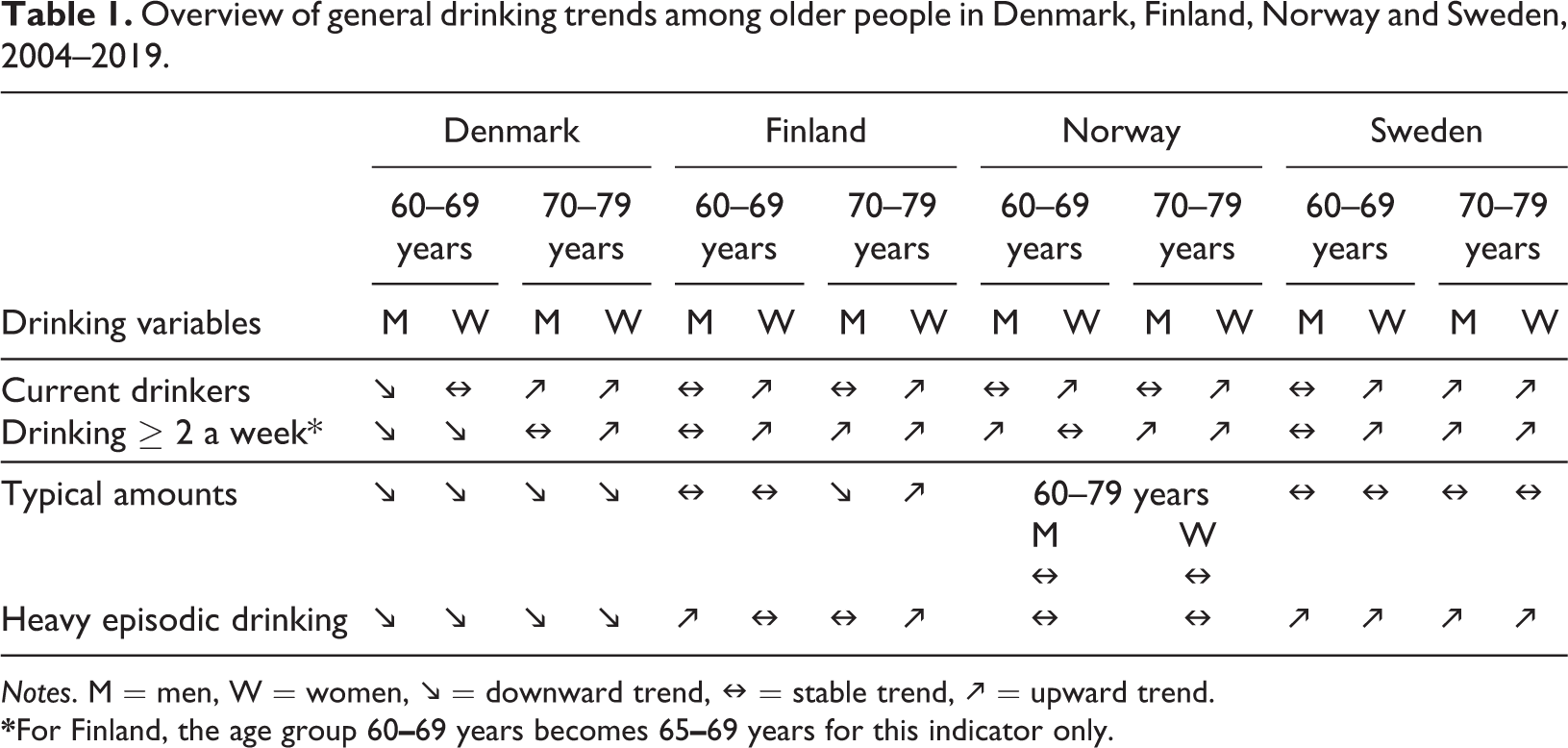
Notes. M = men, W = women, ↘ = downward trend, ↔ = stable trend, ↗ = upward trend.
Discussion
The aim of this special issue was to use a comparative approach to examine recent drinking habits and trends in alcohol use among older people in Denmark, Finland, Norway and Sweden, thus informing policy makers, scientists and the public of basic characteristics of the drinking practices of older Nordic people. This aim was hampered to some extent by methodological differences of the national surveys. These differences made direct comparisons of the prevalence and trends of the four indicators in four Nordic countries not possible. Another limitation was the upper age limits of 79 years in the Norwegian and Swedish country reports. In fact, those over 80 years of age belong to the fastest growing age groups in society and they, too, consume alcohol. Regarding the study period, we were able to cover most years from 2004 to 2019, but in some cases we could only find relevant data for the 2010s.
Nonetheless, we can sketch out the following general picture: older people’s alcohol consumption began to increase in all four countries at the following times: first in the 1970s in Denmark (Bjørk et al., 2006, 2008), and then in the 1980s in the other countries (Ahacic et al., 2011; Bye & Østhus, 2012; Tigerstedt et al., 2018). Cohorts born in the early decades of the 20th century initiated this increase in the prevalence of drinking among older people. By the 2000s, older people’s drinking trends have become more mixed. In Denmark there have been clear signs of a decrease in drinking (regarding drinking frequency, amount typically consumed and HED) among older people. In Sweden, by contrast, upward trends grew more dominant (regarding current drinkers, drinking frequency and HED). Finland and Norway have fallen in between with both stable and, particularly regarding drinking frequency, increasing trends.
In some respects, the difference in older men’s and women’s drinking has narrowed in the 21st century: women in all four countries have reduced the gender gap by increasing their drinking, particularly regarding the proportion of current drinkers. In Norway, the share of current drinkers among women aged 60–69 years in fact has exceeded that of men. Also men’s and women’s more frequent drinking (i.e., twice a week or more often) clearly has been converging, especially in Sweden. On the other hand, regarding amounts of alcohol consumed on a typical drinking occasion convergent trends are marginal or non-existent in the countries studied. This is also the case with HED, except for Sweden, where women’s share of HED has increased substantially in all older age groups. All in all, however, HED remains typically a male behaviour.
Our country reports have focused on older people’s drinking with respect to age groups and gender. In general terms, all four reports also refer to cohort effects concerning rising drinking trends, and especially with regard to women. For example, reference is made to Danish women born between the world wars (Christensen et al., 2012; Storm et al., 2010). Furthermore, it appears that in all countries, women born in the late 1940s and early 1950s experienced a general liberalisation in attitudes towards drinking at an opportune moment in their lives (Ahacic et al., 2011; Bjørk et al., 2008; Horverak & Bye 2007; Johansson, 2008; Mäkelä et al., 2012; Sælan et al., 1992; Simpura, 1987; Sulkunen, 1981). That is, when coming of age in the 1960s and 1970s, the drinking habits of these women were affected in multiple ways: most significantly, women acquired new and independent public roles, drinking became part of domestic life and the use of alcohol, as such, became a marker of gender equality (Bloomfield et al., 2001). In the 2000s, when entering older age, these cohorts brought new behavioural patterns with them into later life.
Importantly, cohort effects may cover different periods for women and men, and may appear differently in different countries. In Finland, for example, women born between the late 1940s and the end of the 1960s have been shown to steadily increase their drinking as compared to female cohorts born earlier in the post-war period (Härkönen, 2013). Women born in the 1960s will probably bring their “wetter” drinking habits with them into their old age in another decade or so.
To the extent that we may compare drinking indicators across countries, we may venture to conclude that Denmark has the highest proportion of current drinkers as well as the highest proportion drinking at a higher frequency. Next in our ranking would be Finland, followed by Sweden and Norway. This overall ordering of our study countries basically holds for both men and women. It is also important to note that Denmark is the country where trends in drinking patterns are on the decline, particularly when measured by amounts consumed per drinking occasion and by heavy episodic drinking.
Considering use of alcohol and attitudes towards drinking, Denmark has, for decades, followed different policies, preventive strategies and cultural practices compared to the rest of the Nordic countries. For example, Denmark has had the highest recorded per capita alcohol consumption, a more liberal retail sales system, lower legal age limits for alcohol sales, and higher levels for drink driving. Moreover, drinking and alcohol-related harm have never gained the kind of public concern as they have in Norway and Finland, and particularly in Sweden (Elmeland & Villumsen, 2013). Such cultural characteristics could explain why the proportions of the study indicators of current drinking and drinking at least twice a week are also the highest among older Danish men and women. As mentioned, however, Denmark is the country where trends in older people’s drinking are falling. That drop may be a reaction to a recent rise in concern about alcohol use and its potentially negative consequences in Danish society in general (Bloomfield et al., 2016). For example, drinking at work has lost its popularity, attitudes of the general population have become more critical of both youth and adult drinking, and age limits for purchasing alcoholic beverages have become increasingly stricter. Furthermore, wide-ranging research on alcohol in Denmark is gaining a firmer foothold (e.g., Bloomfield, 2013; Pedersen et al., 2011).
Again, the aim of our studies in this special issue has been to describe, rather than explain, older people’s drinking habits in the 2000s in four Nordic countries. In the country reports we have suggested only some common societal-level factors that could potentially affect and explain changes in drinking; for example, improved general health and healthcare, increased purchasing power and longer life expectancy. Cohort effects also seem to be a shared factor, although the specific cohorts involved may vary depending on nationally specific conditions. So, as the populations of higher-income countries, including the Nordics, continue to age, explanations for the drivers and consequences of changes in older people’s drinking will become an increasingly relevant topic for future research. Importantly, people aged 80 years and above should be included as an integral part of that research.
Footnotes
Note
Declaration of conflicting interests
The authors declared no potential conflicts of interest with respect to the research, authorship, and/or publication of this article.
Funding
The authors received no financial support for the research, authorship, and/or publication of this article.
