




Abstract
Aims:
Exposure to smoking scenes in films is seen as contributing to smoking initiation among young people. This has triggered calls to include depictions of smoking as a criterion in film ratings. All the same time, little is known about how adolescents interpret different smoking scenes. This study analyses how young people decode smoking scenes by contextualising identification with, and evaluation of, various characters who smoke, as well as the significance of film genres.
Design:
In order to explore how adolescents conceptualize smoking scenes in different film genres, we conducted eight focus-group interviews with adolescents aged 13–17 years (n = 54), using purposive sampling. The discussions were semi-structured with a standard guide, and we used clips from eight films containing various positive and negative moods and character types as stimuli for the discussions. To analyse interpretations qualitatively, thematic coding was applied.
Results:
The adolescents acknowledged that smoking is a narrative ingredient designed to illustrate and amplify character traits and situational moods. Characters who smoked were usually interpreted in terms of smoking stereotypes: stress relief, romantic seduction, social interaction between equals, habitual smoking, and as a symbol of “bad guys”. The adolescents identified more strongly with elegant, positive, and self-assured smoking characters than with negative, anxious, or ambiguous characters.
Conclusions:
Adolescents interpret smoking scenes in accordance with encoded meanings: they tend to get the messages inscribed by the filmmakers. As positive and glamorous representations are more likely to stimulate smoking experimentation and initiation among adolescents than negative representations, future research should distinguish more clearly between exposure to positive and to negative representations.
Background
Exposure to smoking scenes in films is a contributing factor to smoking initiation among young people: the more smoking scenes adolescents see, the more likely they are to experiment with tobacco products and eventually start smoking (National Cancer Institute, 2008). The majority of studies documenting this effect are based on social cognition theory, which assumes that learning occurs through imitation in the form of identification with role models in films (Bandura, 2009). The suggested underlying mechanism is attitude mediation (Sargent, 2006). Exposure to smoking in films will contribute to the development of positive attitudes to smoking, which may increase smoking susceptibility, eventually leading to smoking experimentation (Sargent et al., 2002).
While tobacco use in films has not (yet) been regulated in the same way as tobacco advertising, the body of research mentioned above has triggered calls to include depictions of smoking as a criterion in film ratings, with all films with smoking scenes being given an age limit of 18 (Glantz, 2002). The World Health Organization (WHO) has embraced this initiative, and consequently recommends this measure as part of the implementation of the WHO Framework Convention on Tobacco Control (World Health Organization, 2015). Thus far, no country has taken such a step.
The majority of studies cited as evidence of the need for such policies use a measure of film smoking exposure that fails to distinguish between scenes where smoking is associated with positive values (glamorised accounts of smoking, for instance, by a character, or a situation, which is uplifting or aesthetically appealing), neutral values (depiction of an indifferent character who smokes out of habit), and with negative values (deglamorised accounts of smoking in difficult situations such as poverty or stress). Nor do the studies distinguish between characters who are central to the plot (and therefore easy to identify with) and characters in peripheral roles. The significance of exposure is basically related to the sheer number of smoking scenes displaying smoking behaviour. But is it reasonable to assume that any representation of filmic smoking acts like an advertisement for smoking? Without a more nuanced approach to what smoking scenes mean to viewers, it is difficult to comprehend the cultural and psychological significance of the relationship between rates of exposure and the various smoking behaviour outcomes (cf. Chapman & Farrelly, 2011).
In fact, most existing studies taken as evidence of the influence film smoking overlook how young adults perceive smoking scenes in the films they see. Nor does this research take into account the argument that interpretations may vary according to the mood of the scene and the character’s position in the film’s wider narrative. The level of interpretation is disregarded in this “media effects” research, despite the heuristic model being applied (Sargent, 2006, p. 31). In this study, we explore how young people interpret and evaluate various smoking scenes. The findings problematize the question of how filmic smoking can be seen as influencing adolescents views on smoking.
Perceptions of film smoking
Few studies have looked at how young people interpret the smoking they see on the big screen. The exceptions we have identified are two qualitative projects of young people’s perceptions of film smoking, from Australasia (McCool, Cameron, & Petrie, 2001, 2003; Watson, Clarkson, Donovan, & Giles-Corti, 2003) and China (Davey & Zhao, 2012). These studies find that filmic depictions of smoking are viewed as realistic and portray smoking as a normal aspect of young people’s lives. The informants identify with representations of smoking as a stress-reducing activity, and otherwise express a quite uncritical attitude towards smoking on film. As such, these studies seem to support the argument that film smoking is a powerful influence on both smoking beliefs and behaviour. However, only one of these studies looked at interpretations or perceptions of presented material, and, in that study, film was only one of several media platforms addressed (Watson et al., 2003).
An experimental study, which investigating the significance of scenes in which smoking fulfils different purposes, found that scenes with a relaxed mood triggered a stronger desire to smoke among non-smoking adolescents than did scenes in which the mood seemed unclear or where smoking appeared as a social or rebellious activity (Shadel, Martino, Haviland, Setodji, & Primack, 2010). This indicates that the mood of the scene influences how viewers interpret what they see on film. Genre is likely to come into play as well, as different genres may elicit different expectations and interpretational modes among the audience (McCool et al., 2001).
On the basis of this literature review, we came to believe that the empirical basis underlying the assumption that young people automatically identify with, and want to imitate, any peripheral character or “bad guy” who smokes in a film is perhaps insufficiently robust and should be explored further.
A reception approach to film smoking
There are also theoretical reasons for assuming that the meanings of scenes vary, not least arguments from semiotics (Anderson, Dewhirst, & Ling, 2006) and from reception theory (Morley & Brunsdon, 1999), which aims to provide semiotics with an empirical foundation in audience analysis. Reception analysis assumes that the meanings of texts (including audiovisual representations) are not given as such, but are potentially ambiguous and characterised by polysemy. Texts only come into their own after being encountered by the audience (hence “reception”), who negotiate with the textual stimuli before giving them their own interpretation, based on past experience and expectation horizons (including knowledge of genres). Readers may approve of the encoded meaning (“preferred reading”) or they may provide “negotiated” or “oppositional” readings. A reception approach should thus shed light on the interpretative process and the degree to which adolescents identify with smoking characters – or not.
Research problem
In this article, we analyse how Norwegian adolescents interpret and talk about various smoking scenes in films of different genres. What are the interpretations of scenes with positive, neutral, and negative portrayals of smoking? Which characters do adolescents seem to identify with in the film and why? How do genre characteristics come into play in adolescents’ interpretations?
We conducted a focus-group study to explore these issues (Lunt & Livingstone, 1996). Adolescents aged 13 to 17 years were asked to discuss smoking in films and viewed film clips of smoking scenes from different genres with various moods and character types. This qualitative approach, sustained by reception theory and resembling The Reception Analytical Group Interview (RAGI) (Sulkunen & Egerer, 2009), was used to explore young people’s constructions of meaning related to smoking scenes in films. Our study is thus a contribution to the research on film smoking that hitherto has largely ignored this question.
Method
Procedure
A semi-structural interview format was applied. The first two authors (GS and JS) moderated the eight focus-group interviews, while the third author (RT) managed the presentation of film clips. After we had informed the participants that data would be anonymised and that they could withdraw at any time (as participation was voluntary), interviews started with a general talk about film interest and genre preferences. The discussion was then moderated into conversation about the pupils’ immediate associations with the word “smoking” and perceptions of smokers and smoking at their local school. This was followed by an open talk session about smoking in films, where the informants were asked if they remembered any smoking scenes in films they had seen recently. Eight short film clips were then shown as “stimuli” for a more focused discussion about film smoking. The clips were shown to the groups one at a time, with breaks between each clip to discuss the scene they had just watched. Informants were asked to describe the scene they had just witnessed, their impression of what was happening in the scene, and to state their sympathies/antipathies in relation to the clip as a whole. After seeing all eight clips, the participants in the focus groups were asked to compare the clips against each other and to reflect on whether clips such as these might induce them or their friends to experiment with smoking.
The interviews were conducted between May and October 2011 at the interviewees’ schools during school hours and lasted on average an hour and a half. Each interview was audio recorded, transcribed, and analysed using a thematic approach (Silverman, 2006). Analyses were performed systematically without the use of coding software, beginning with several rounds of transcript reading followed by initial coding with a matrix. This coding was performed by the first author. The initial codes were descriptive and came from the interview guide or from subjects emphasised by the interviewees (for example, “smoking as a social habit”). Following this, relationships between different codes were analysed by all authors into fewer and more analytical themes (such as “smoking as narratively right” and “genre as a mitigating intermediary”). Quotations are marked with the focus-group number.
Selection of participants
Eight schools from the central Oslo region were recruited. Representativeness in the statistical sense (to enable generalisation to larger populations) is not an issue in qualitative research. Nevertheless, we sampled the groups strategically in order to ensure representation of different voices and perspectives, so that each of the groups and all the informants together were balanced in terms of gender, age (13–17 years), education (both grade and type/interest), and socio-geographic location of schools. We stopped recruiting schools after we found that the focus-group interviews did not add anything substantially new, and because we felt a level of saturation. For background details on the focus groups and the 54 participants, see Table 1.
List of focus groups and schools
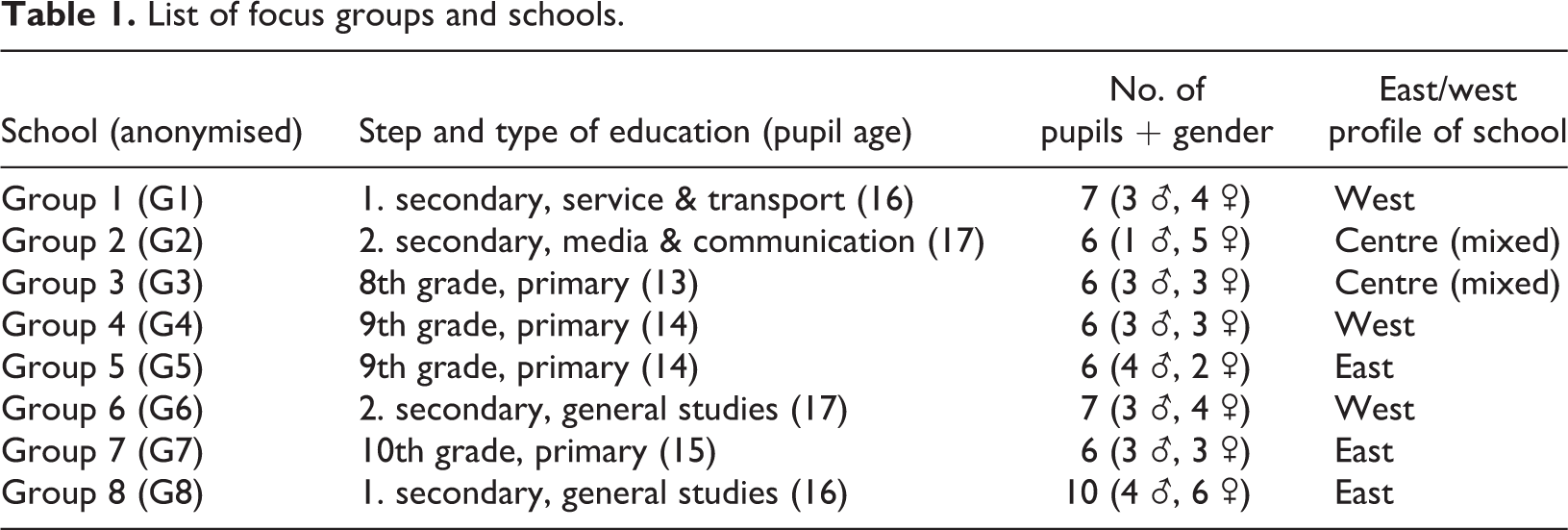
Informants were recruited by the teachers, who distributed information letters and letters of consent to the participants and their parents. Participants and parents were informed about the content of the study, that the study was approved by the Norwegian Centre for Research data, and that all information disclosed in the interviews would be anonymous. Parents were then asked to give their written consent so that their child could participate in the study.
Smoking scenes
As smoking is a polysemous word, narrative excerpts of smoking in films of various genres where smoking played a different role in each clip were selected as stimuli in the interviews. Scenes were selected from recent popular films. Familiarity with the scenes was not considered a prerequisite for the ability to read the scenes, as they were selected and shown as separate short narratives in their own right. Yet, brief introductions to the plots of some of the lesser-known films were given. Characteristics of the chosen scenes are given in Table 2.
Characteristics of the film scenes shown to the focus groups (as “stimuli”)
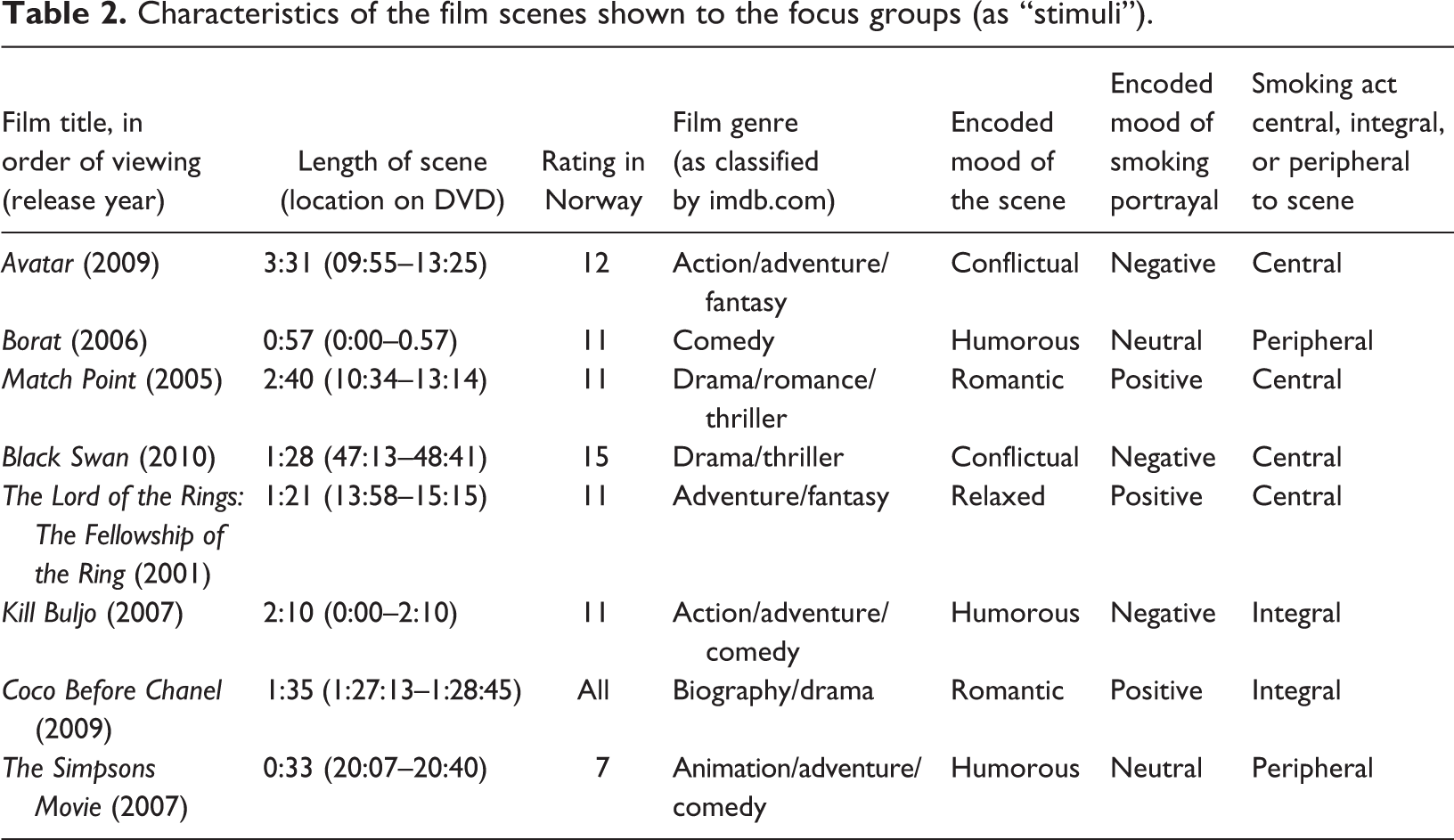
Results
Stereotypical smoking actions
Characters who smoke are usually interpreted by the informants in terms of smoker (or smoking) stereotypes. These views centre on typical character traits and typical situational-contextual traits.
Stress relief among tense characters
Characters feeling stressed due to challenges at work are depicted in the clips from Avatar and Black Swan. Even though the pupils’ interpretations of these scenes varied, smoking in both scenes was construed as stress relief.
In the Avatar scene, the viewer is introduced to Grace Augustine, head of a research team. Her first statement “Who’s got my goddamn cigarette?” puzzles the informants and elicited several comments: It seems like she was really stressed. The first thing she wanted was a cigarette, before she talked to anyone. (G6) She was grumpy and stressed. (G1) She carries [the cigarette] with her while walking around bitching. It’s a kind of stress remedy. (G2)
The absence of self-command is also witnessed in Black Swan, where the main character, the highly-pressured ballet dancer Nina (dressed in all white to dance the “White Swan” in Tchaikovsky’s ballet Swan Lake), is forced into smoking by her understudy Lily (dressed in all black to dance the “Black Swan”). Nina performs the white swan well, but the director criticises her for not performing the black swan as well as Lily does.
Nina is represented as anxious, and the informants consider her unstable, characterless, and easily manipulated. Nina is not a typical smoker though, while our informants consider Lily as suitable to smoke: [Lily] seems somewhat tough. She would like to be a bit of a “bad girl”. What do you think of the other girl then, does smoking suit her? (Several informants) No. Why not? Because she’s more like a perfectionist, and they don’t smoke. (G4) She who plays the leading role, she smokes to get rid of the pain, I think. She doesn’t seem to care as much about [smoking] now, after she received that criticism and stuff. Sort of consolation smoking. Consolation smoking? Yes, to calm down…Smoking to comfort yourself and calm your nerves. (G7)
Romance and seduction
In Match Point, the informants are presented with a seduction scene in which lighting a cigarette is depicted ambiguously, something the informants also consider in their readings. Firstly, the character who smokes (played by Scarlett Johansson) is regarded as elegant and sexy: It was supposed to portray her as sexy…The way she talks and the way she smokes. The fact that she draws attention to her mouth. She’s elegant. They flirt. (G8)
The reason she “needs” to feel empowered is not only because she is a young American girl, aggressively seduced in Britain by a British male, who happens to be a friend of her fiancé, but also because she is – in the context of this scene, at least – a “lower-class” girl: Well, he asked her “what are you doing here among the upper class?” Then she lights the cigarette and thus lays the foundation for what he says, that she doesn’t really fit in. It makes her rebellious and perhaps even more appealing. (G6) I feel that when she lights up a cigarette, you also see the difference, that she’s American and he’s British and that they are from two different worlds. (G1)
In a sense, this clip is read as a cigarette advertisement emphasising how an action-oriented and flirty female in a socially inferior situation uses the cigarette to demonstrate distance and autonomy. Such a reading also applies to the clip from Coco before Chanel. This film portrays the life of Coco Chanel as she worked her way up from a childhood of poverty to her breakthrough as a creative artist. Towards the end of the film, we witness a romantic dinner at a fine restaurant, where Coco’s rich lover courts her. Our participants find this scene to be less ambivalent than the one in Match Point: She’s so attractive with that cigarette. I could see the man was attracted to her. (G8) She smokes elegantly. Yeah, that’s what I thought, too. In the other film, Match Point, that actress or that woman, she tried to be a bit like Coco Chanel here in this film. A bit lady-like in a way. (G4)
The perceived elegance of this scene is, in fact, strongly associated with nostalgia and the contextual element of a bygone age. This interpretation was consistent in all group interviews. Demonstrating a high level of media literacy, the oldest informants were aware of smoking as not only being unhealthy, but that smoking has also become denormalised in the current political climate: Smoking was often seen as more glamorous in the old days. That’s why it’s different today to see films from the past. Think, for example, of Mad Men, where everyone smokes constantly, but which is also from an age when everyone smoked all the time. But when you see people smoking in new films, you tend to immediately think of it as a way to “deal” with stress and stuff like that, since it is much more taboo today. Whereas, previously it was good for you – have a smoke, even if you’re pregnant, then your kid will be healthy! It was much more glamorous before, and that’s why it also gets a little more glamorous in the Coco Chanel film. (G2)
Social interaction between equals
In Avatar, Black Swan, and Match Point, smoking occurs in situations in which the relationships between the characters are conflictual, or at least strained. The smoking scene in The Lord of the Rings differs from these in that the characters are equal. The mood is one of celebration, redolent of traditional village life; it is also slightly humorous. When analysing the data, we find that all these elements are seen and decoded by informants in all group interviews.
Practically all participants use positive adjectives to interpret this scene. Both characters are easy going and viewed by the participants as having a smoke to enjoy themselves: It’s a good mood. It’s a party… It looked sociable to smoke together. (G4)
The characters smoking a pipe are considered by the participants to be highly significant and “narratively right”. Pipes also trigger different bundles of meaning than do cigarettes: It looked really good! Since they are old and they smoked a pipe, it matched very well. (G4) I get a completely different impression from this than scenes in which they light a cigarette. A pipe gives completely different associations; it’s like “no big deal”. It makes me think of a grandfather-like figure who sits in a chair, or the seaman who smokes a pipe. It’s idyllic in a way. The pipe fits in. There’s nothing negative about it; it’s just the way it is. (G2)
It is not only the mood here that differs from other clips, the genre is also different. The Lord of the Rings is a fantasy film, illustrated in this scene by the ancient-looking characters blowing smoke rings that look exactly like a ship. The character-building element is also noted, which in the fantasy genre is expressed by the characters being somehow above ordinary people: They were playing with the smoke in a way. (G5) I also think that it looks extra stylish. They are a class above us in a way. It has a slightly adventurous feel to it, it’s not just a regular pipe, but a huge long one. (G6) We think that these are wise old men or the elderly who know about old stuff. They are people you can ask for advice as they know everything…or, at least, a lot. (G7)
Even if the informants regard the genre aspects of the film as an adventurous story – and therefore unrealistic – they also associate the scene with real life. The characters are described as old friends who have known each other a long time. Their relationship is compared to typical smoking scenes from other films, where people smoke together at work or at parties, to show that they have a relationship.
Smoking as a social habit
Smoking is not always stylised, neither in real life nor in fiction. Nor is smoking necessarily a result of stress or a desire to come across as glamorous or sexy. Sometimes, smoking is simply a habit; one habit among others.
Even if the film Borat is a comic “mock documentary”, the brief shots of roll-your-own cigarette smoking in the film’s introduction seem realistic enough, shot as it is on the actual streets of Kazakhstan. This scene is interpreted by all the groups as “natural”, in the sense that it is normal that some people smoke and others don’t – in any society. However, smoking is also described as saying something about the milieu: I have the feeling that it’s very typical for people to smoke in places like that…Perhaps no one knows any better? (G4) When we see scenes from Arab [sic] countries, we see that older people, almost every one of them, smoke, and it’s quite common to smoke in such countries. (G7) (Two boys simultaneously): Old men! They smoked when they were younger, like young people often do, and then it just becomes a habit that they carry with them throughout their life. (G1) It’s often like that in poor countries. All the men stand together on the corner, smoking and talking loudly. It’s common… Yes, I feel that in most countries like that the mothers are at home with the kids, cooking and so on, while the men just hang around. (G6) The village is dirty and old…You could see that the old man smoking had a slightly dirty face. Everyone was dirty. Everyone wore rather dirty clothes and hats. (G7)
Admittedly, addiction is brought up in the discussion to describe the smokers: “Those who are older didn’t know how dangerous it was. Perhaps they’re addicted now and can’t stop, even if they know about the dangers of smoking” (G1). However, as long as smoking does not appear to be the result of compulsive feelings, it tends to come across as “natural” to our informants. Thus, it is basically the context that gives the habit its aura or quality, not the act of smoking itself.
The element of habitual smoking is also mentioned in relation to The Lord of the Rings. While the genre context is different, the habitual element is sufficiently apparent to warrant interpretations such as the following: “I feel like this is what old men do. They get together to enjoy each other’s company or perhaps reminisce a bit or something. Then they often sit down with a cigar or pipe, not a cigarette, and talk about things” (G7). Moreover, in Coco before Chanel: “It looks very much like a habit. It doesn’t look like she’s thinking about smoking. She acts in a completely regular manner and is eating and talking while she smokes” (G6). Thus, habitual smoking is mainly ascribed by the informants to elderly people and/or to bygone contexts, suggesting that our informants consider habitual smoking practices to be a thing of the past.
Symbol of “bad guys”
The Norwegian low-budget film Kill Buljo is a hilarious parody of Kill Bill, with several “bad taste” smoking and drinking scenes. In the opening scene, shown to the informants, we witness a Sami wedding interrupted by gunmen. This scene is interpreted as over the top, a typical way of ridiculing the characters. The groups do not agree, however, on whether this introductory scene is funny or not. Those who do find it funny, note the following: Strange! He smoked and drank at the same time. Usually when you see people who smoke having a drink, they take the cigarette out of their mouth first, then they drink, whereas he had the cigarette in his mouth while he was drinking. I’ve never seen that before. (G5) While he had the cigarette in his mouth, he sat there shooting vodka, or moonshine, or whatever it was. It looked a bit funny. (G4) It was funny with that priest who had cigarettes in his collar. (G3) It’s the cheapest way to make people appear as “bad-ass” in films. That’s what I thought, too. Yeah, if it’s a low-budget film, just put a cigarette in their mouth and they’re “bad-ass”. (laughter) (G2) This guy’s like a rather thick mafia boss who eat lots of spaghetti and stuff; he also smokes. He has a slick hairstyle and he’s Italian, too. He has all the elements needed to create a mafia person. (G3) If you were to draw a picture of the mafia, then it’s always cigars and dark suits. It just goes with it. (G6). He’s wearing a normal suit, but with his cigar he becomes more mafia-like. (G8) The cigarette makes her more masculine and tough. Very dominant. The cigarette highlights her real personality. (G2)
In Black Swan, on the other hand, smoking is seen as an act of rebellion, as a means of increasing self-esteem and enacting willpower. Informants in most groups note that smoking in this scene emphasises the dark swan, Lily, as powerful, while the white swan, Nina, appears more vulnerable. Lily is considered to be “the sort of tough big sister who enters the room” (G7), while Nina uses her invitation to smoke to get closer to the role she really wants to perform well, using the proffered cigarette as a proxy to make herself a little nastier. This is interpreted by the informants as analogous to peer smoking pressure in secondary school, where the “cool” kids try to tempt other kids to join in, although smoking is not allowed.
Identification with characters
In this section, we address the differences in meaning between the various scenes, as expressed by the adolescents’ varying degrees of sympathy and antipathy, mainly towards the characters, but also towards the moods (context) of the scenes. More precisely, we aim to highlight how adolescents identify with different characters, and why.
The ambiguous attraction of narratively well-matched acts of smoking
As highlighted in the previous section, informants frequently note that the smoking act may be consonant with the character and/or situation, which is why they are concerned about smoking as being “narratively right” for building a character or defining a situation. In Avatar, for instance, it is considered appropriate that Grace Augustine smokes “because she was grumpy and stressed and she had a bit of a smoker’s voice and so on” (G4).
Whoever the character is, smoking or not smoking reinforces the image of that character, especially in interplay with the context: I think they create some personalities. Then they add smoking, because it helps to reinforce the personality they’re trying to get across…For example, if a person is very kind and gentle and suddenly lights a cigarette, then that person becomes a little different. (G6) So smoking may have different meanings? (Several participants): Yes yes. Yes, in Kill Buljo
…in that film, smoking is depicted as utterly charmless, while in Coco Chanel, it is depicted very elegantly, in a way. (G6) It’s possible that if you appear in a real situation that resembles scenes in films in which people smoke, then you subconsciously get the urge to smoke yourself. It’ll be one possible way to go. Personally, I think it looks kind of cool when cool people smoke…but films like Kill Buljo don’t exactly make you want to start smoking. So, it can go both ways. [Cigarettes] are an accessory, in a way. In Match Point, I think it looked good and also in Black Swan, when Lily enters. Then it’s somehow right for the character. But as soon as you start placing the cigarette in the wrong mouth, then it looks strange. As in Kill Buljo, where he had a cigarette in his mouth while he was drinking, then it becomes completely wrong. (G2)
Degree of attraction is also associated with the overall moods of the scenes. All groups pay an unambiguous homage to the scene from The Lord of the Rings, due to its generally upbeat feel-good message. The informants’ positive identification with The Lord of the Rings is partially associated with a stereotypical view of happy old age, in which smoking features as a nice and celebratory act. This triggers statements such as: “I think I’ll grow old just like that – sitting on the porch with some friends I’ve known since I was a kid” (G2). It is also associated with the overall mood of the scene, as this was the only clip that featured an unequivocally positive side to smoking: In all the other clips, it was slightly negative, while this gave us a positive feeling, because the smoking created a positive existence. (G8)
Black Swan, that film, in general, is extremely depressing. There’s a cold atmosphere in a way, while in The Lord of the Rings it’s sort of like warm and cosy, pleasant to look at. It doesn’t get strained. (G7)
A somewhat similar argument appears in the discussion of the scene from Match Point, with many informants stating that they do not want to be like the character who smokes, even if they considered smoking appropriate and even cool in that particular scene. Also, in Coco before Chanel, the smoking act is considered appropriate and narratively right, all the way down to the gendered way of smoking. Insofar as Coco Chanel is regarded as beautiful and elegant and the scene is free of any ambiguity or dramatic friction, she also becomes a positive role model. As one informant says: “Because we now know who she is and that she became famous, it tells us that smoking cannot assert that we’ll fail in life. One can be strong enough to deal with smoking all one’s life” (G8).
Genre as a mitigating intermediary
Another factor that influences the informants’ opinion of the characters and situations is genre. Genre expectations always come into play in mediated communication, not least in relation to the fantasy and/or animated narratives of The Lord of the Rings, Avatar, and The Simpsons Movie. Here, the informants’ knowledge of genres enters the decoding process and may in fact serve as a “mitigating” factor, which in effect may strengthen the potential power of the film to influence viewers’ representations and behaviour.
This applies in particular to The Lord of the Rings. Because the film belongs to the adventure genre, the scene comes across as magical, slightly unreal, and also funny. This makes the clip somewhat similar to a regular commercial. When media-literate adolescents are exposed to advertising, they are likely to adopt a critical stance. As this is a fantasy film, however, their interpretative readiness may be weakened due to the genre paving the way for a largely unconscious naturalisation of the message of smoking at the expense of critical resistance: I think that it’s much better to watch a film in which they [Gandalf and Frodo] smoke than one in which Will Smith smokes. More people idolise him than a hobbit and a sorcerer. I think there are more people who would look up to it… (G3)
A similar receptive mode was triggered by the animated The Simpsons Movie, in which smoking is considered by the informants as simply being supposed to be funny. Informants do not take smoking in comedies as seriously as smoking in drama, because “smoking has more meaning in films with real people than in animation” (G3). This also applies to Kill Buljo. As one girl noted, “if they had used smoking in [the original] Kill Bill, it would’ve been to make the character deeper, to make her more sexy and so on. But here [in Kill Buljo, the parody], it becomes less serious. It is, in a way, more ironic” (G6).
In the biographical Coco before Chanel, however, smoking is depicted realistically. Being the story of a real person who smoked in real life, the smoking scenes in this film are there “to make you think she smokes because she did when she was alive” (G6). Interestingly, and in comparison to The Lord of the Rings, perceived credibility does not necessarily depend on whether the genre is realistic or not: “I think that in Lord of the Rings they did, in fact, enjoy themselves, while [in Coco before Chanel] it’s as if they ‘fake’ it a bit, to look good and to achieve status” (G4). In other words, the smoking scene in The Lord of the Rings is more credible because the characters seem to enjoy themselves, while in Coco before Chanel – a historical drama about a real person – the characters smoked more to impress, perhaps as a form of “conspicuous consumption”.
Even if our informants are aware of genre characteristics, they still seem to interpret the scenes in a literal way. With regard to how informants evaluate the attraction of the clips, the mood of the scene means everything. In terms of fantasy and animation genres, this tendency to provide literal realist readings “overrules” the informants’ insights into genre characteristics and serves to illustrate the limitation of the adolescents’ media-literacy skills to the benefit of ideological media power.
Negotiated readings
Stereotypical representations may be effective in communicating the most intriguing aspects of a character, but to work, they have to strike the right balance between simplicity and credibility. In Black Swan, the stereotypical character-building of the black and white swans is considered by some of the oldest and most media-savvy informants to verge on the incredible: It seems to me that in this scene, they’ve just placed the smoking in there just to do it, just to reinforce the differences and stuff. And that it’s a little too obvious that it’s an effect. I don’t think this is a credible scene. What do others think about it? Does that scene seem credible? It seems credible because it’s a film, but it’s also very clear that it’s an instrument used to reinforce the characters. (G2) As this takes place in the future, it’s strange with the smoking because it gives a slightly old-fashioned association, that she smokes in a place that’s so modern and developed…it would’ve been more natural if she’d asked for something else. (G6)
Discussion
In this study, we have analysed how Norwegian adolescents interpret and retell excerpts from various film narratives. The main findings are that adolescents acknowledge that smoking is a narrative ingredient designed to illustrate and amplify character traits and situational moods. Characters who smoked were usually interpreted in terms of various smoking stereotypes: stress relief, romantic seduction, social interaction between equals, habitual smoking, and as a symbol of “bad guys”. Furthermore, the adolescents identified more strongly with elegant, positive, and self-assured smoking characters than with negative, anxious, or ambiguous characters.
Overall, the findings demonstrate complexity in how adolescents interpret and identify with scenes in which people smoke in films. They also demonstrate how adolescents today are competent readers of media: they read several layers of meaning into the clips, and are able to put the depicted smoking act, and the medium and genre it is communicated within, into context.
When interpretations emphasise how smoking is used as a narrative means by filmmakers to construct simple or complicated characters and glamorous and not-so-glamorous characters/situations, this is line with findings from a previous study (McCool et al., 2001). However, the widespread notion among informants that smoking may be narratively (and thus culturally) right does not equate with an idea of smoking as being morally right or attractive. Rather, smoking is an ingredient in filmic narratives to express dramaturgic opposition and conflicts between characters and specific moods via stereotypical takes on characters/personalities and situations. This is used to position the characters in the narrative and consequently “send a message” about them, allowing spectators to decode and perceive a storyline (Morley & Brundson, 1999). It also means that adolescents may read different meanings, as well as shades of meaning and attraction, into the different smoking scenes. In summary, the potential influences of unique scenes are considered to vary.
Adolescents identify more strongly with elegant and powerful characters who smoke than with anxious or parodied characters who smoke. They are also more sympathetic to smoking scenes that have positive moods. These distinctions suggest that clips may be categorised as positive or negative representations, and that positive representations may be more powerful and influential as smoking models among young people than negative representations. Smoking scenes seem to be most powerful when the characters are interpreted as likeable and the overall mood or context of the scene is perceived as positive – as in The Lord of the Rings and Coco before Chanel. Any dramatic friction between characters and in moods tends to trigger hesitance and resistance towards the scene among the adolescents. These qualitative findings fit well with the results from a previous experimental study (Shadel et al., 2011).
Even though some “negotiated” readings occur, particularly among the oldest and most media-literate informants, the informants’ perceptions are primarily “preferred” readings in line with encoded meanings. These stereotypes are also structurally encoded by the filmmakers, which means that the pupils usually “get” the intended message. No oppositional readings appear in our data. A widespread consensus exists among our adolescents, as there is little interpretative variation both within and between groups, and between the genders.
Even if perceived moods are associated with genre expectations, readings tend to be literal and “realist”, even of fantasy and caricature clips. These interpretations, largely in terms of stereotypes, are also part of a larger process of cultural homogenisation, insofar as international and cross-cultural communication influence how Norwegian youth, from the outskirts of Europe, interpret representations of smoking in Hollywoodian film narratives, in favour of the filmmakers’ encoded meanings, and consequently, ideology (Crane, 2014). This also applies to interpretations made by non-ethnic Norwegians in the data. Shared narrative formats consequently serve to construct common views of smoking practices throughout the Western world.
Preferred readings suggest media power; the clips are likely to influence viewers in the ways the filmmakers intend. Does this mean that all scenes that depict people smoking should count as equal? We think not. Sometimes, smoking is elegant and foregrounded, sometimes it is elegant and integrated; sometimes it is foregrounded and detested, and sometimes it occurs in the background and is barely noticeable. In addition, the contemporary meaning of smoking is neither essential nor static; it is contested, ambiguous and in a state of development. This is due to the historically dominant view of smoking as a normal or glamorous activity having now been overtaken by an increasingly widespread sense that smoking is no longer normal, thanks to influential “denormalisation” campaigns by tobacco control authorities and an ongoing redefinition of smoking norms over the course of the last 50 years (Brandt, 2007). Against this background, and depending on the narrative context, some film smoking scenes may be viewed as promoting smoking, while other scenes may impart disapproval of cigarette use.
The findings in this study (the complexity of interpretations, the media-competent readings of scenes in which people smoke) suggest that the assumption that all smoking scenes in films promote smoking (Glantz, 2002; World Health Organization, 2015) may be too simplistic and reductionist. The initiative to give films in which people smoke an R rating (18 years), with its underlying body of research based on a model of imitation, ignores the possibility that scenes can contain multiple and sometimes conflicting messages and that smoking scenes must, in any case, be interpreted before they can have an effect. Tellingly, a study that distinguished between exposure to “bad guys” and “good guys” found that the amount of exposure predicted smoking initiation regardless of whether the protagonist was positively, neutrally, or negatively portrayed (Tanski et al., 2009). The authors concluded that this illustrates the need to limit exposure to all smoking scenes. However, this is not a study of perceptions and cannot be taken to support this moral classification of the characters not being significant. While the study wisely nuances the crude measure of total exposure by disentangling important sub-patterns of exposure, it adds little to our knowledge about what film smoking means to viewers.
In the eagerness to demonstrate a statistical effect of exposure to the number of smoking scenes on behaviour, public health proponents tend to display a reductionist perspective on the medium of film. By considering films as no more than promotional channels for tobacco (and other unwanted) products, they neglect the fact that film is a medium that is supposed to reflect, and reflect on, social reality (Chapman & Farrelly, 2011). Then we must also accept that films portray the world as it is (i.e., that people smoke), not as it should be (i.e., tobacco free). From the point of view of tobacco prevention, one may also argue that films may contribute to encouraging media-competent adolescents to make informed choices regarding tobacco use, social costs, and health consequences.
Conclusion
In general, adolescents interpret film smoking scenes in accordance with preferred meanings, which means that they tend to decode the scenes in line with the meanings favoured by the filmmakers, grounded in stereotypes, genre expectations, and context. As positive and glamorous representations are more likely to stimulate smoking experimentation and initiation among youth than negative representations, future research should distinguish more clearly between positive and negative representations of smoking where exposure is concerned.
Footnotes
Declaration of conflicting interests
The authors declared no potential conflicts of interest with respect to the research, authorship, and/or publication of this article.
Funding
The authors received no financial support for the research, authorship, and/or publication of this article.