




Abstract
Aims:
The alcohol law change in Finland in the beginning of 2018 was forecast to shift alcohol sales from alcohol monopoly stores to grocery stores. The trend of declining adolescent alcohol use was predicted to end. This study aimed to provide a more detailed view on under-age drinking change through analysing alcoholic beverage use preferences among 14 and 16 year olds in Finland from 2017 to 2019.
Methods:
Nationally representative surveys of adolescent health behaviours in Finland from 2017 (n = 2451) and 2019 (n = 2119) among 14 and 16 year olds were analysed using cross-tabulations and logistic regression modelling. Beverage data were coded from an open-ended question concerning the latest drinking occasion.
Results:
The proportion of 14 and 16-year-old girls reporting drinking alcohol was 41% in 2017 and 45% in 2019. The corresponding proportions among boys were 39% in 2017 and 43% in 2019. The share of alcohol consumed in the form of beer, alcopops and cider increased among girls from 55% to 75%, but the apparent increase among boys from 69% to 76% was not statistically significant. The only beverage type category that increased in popularity from the year 2017 to 2019 was alcopops.
Conclusions:
The law change bringing strong alcopops, beer and cider into grocery stores increased their consumption – especially among the under-aged. Comprehensive measures including taxation, restrictions on advertising and sales affecting the population total consumption are also likely to remain the keys to reducing alcohol consumption among adolescents. In addition, effective age-limit control and sanctions against neglecting age-restriction enforcement are needed.
Alcohol policy in most Nordic countries (Finland, Iceland, Norway and Sweden) has traditionally rested on three main pillars: restrictions on business interests in the alcohol domain, restrictions on the availability of alcoholic beverages, and restrictions on affordability by means of alcohol taxation (Bruun et al., 1975). Finland had an alcohol monopoly from 1932 until Finland joined the EU in 1995: production, import, export and sales as well as supervision and control were in government hands (Mäkelä, Österberg, & Sulkunen, 1981). The only exception was the availability of medium-strength beer in grocery stores from 1969. Relating to EU requirements, the new Alcohol Act (1134/1994) included the abolishment of the monopoly on alcohol imports, exports, production and wholesale. The retail sales monopoly on spirits and wines was retained, whereas lighter beverages could be sold off-premises in grocery shops, kiosks and petrol stations. Alcohol law changes are known to influence population total consumption (Babor et al., 2003; Bruun et al., 1975). In Finland, the 1995 law change resulted in an increase in total population consumption (National Institute for Health and Welfare, 2018) as well as among adolescents (Lintonen, Karlsson, Nevalainen, & Konu, 2013).
Strict alcohol policies have been shown to correlate negatively with population alcohol consumption in OECD countries (Brand, Saisana, Rynn, Pennoni, & Lowenfels, 2007) as well as less alcohol drinking among 15 to 17-year-old adolescents (Paschall, Grube, & Kypri, 2009). As in most Western countries, selling alcoholic beverages to adolescents under the age of 18 years is prohibited in Finland. The alcohol policy changes since the Alcohol Act (1134/1994) up to 2017 have predominantly been aimed at decreasing total consumption and restricting under-age alcohol use (Lintonen, Ahtinen, & Konu, 2018). The alcohol law was changed at the beginning of 2018 (Ministry of Social Affairs and Health, 2018). The most notable change was an increase in allowed ethanol content in beverages sold through grocery stores from 4.7% to 5.5%; the number of points of sale of strong beer, strong cider and strong alcopops increased 15-fold (Mäkelä & Österberg, 2017). In addition, the law change removed restrictions on the sales of alcopops and abolished or reduced several other restrictions on the sales of alcoholic beverages (Ministry of Social Affairs and Health, 2018).
The Finnish Institute for Health and Welfare estimated that the law change would increase population-level alcohol consumption due to increased availability, decreased price and increased marketing (Mäkelä & Österberg, 2017). Statements on the law change highlighted the negative impact the law change had on adolescent alcohol use (STM075:00/2011, 2017). Expert organisations as well as organisations specialising in alcohol treatment stated that the changes have a significant negative impact on the well-being of children, adolescents and families. A new tax on strong alcopops was suggested to balance the increasing availability and expected decreasing price; this would help to control the foreseen increase in harm to adolescents. Due to this severe criticism, a decision was made to counteract some of the expected rise in harm by increasing alcohol taxes simultaneously to the new alcohol law taking effect (HE 169/2017, 2017).
At the population level, the total consumption of alcoholic beverages in 100% ethanol per capita aged 15 years and over in Finland was 10.3 litres in 2017 (National Institute for Health and Welfare, 2018). Recorded consumption (total consumption minus estimated passenger imports, consumption abroad, illegal distillation and smuggling, and home brewing and distillation) figures for 100% ethanol were 8.4 litres per capita aged 15 years or older both in 2017 and 2018 (Valvira National Supervisory Authority for Welfare and Health, 2019). Consumption statistics showed that in the period from January to April 2019, recorded consumption had decreased 0.6% (Valvira National Supervisory Authority for Welfare and Health, 2019). Although little change was seen in recorded consumption, retails sales in grocery stores and other points of sale, excluding the alcohol monopoly (Alko Inc.) stores, increased by 4.6% in 2018 compared with 2017. The law change thus shifted alcohol purchases from the monopoly stores to grocery stores.
The preferred beverage in Finland has traditionally been medium-strength beer, which has accounted for almost half of the total consumption (Tigerstedt, Karlsson, & Härkönen, 2018). This changed towards stronger beer after the law took effect: strong beer accounted for 4.0% of ethanol imbibed in the form of beer in 2017 but 12.3% in 2018 (Valvira National Supervisory Authority for Welfare and Health, 2019). A more notable change was seen in the share of strong alcopops (over 4.7% alcohol) of all alcopops (ready-made mixtures of soft drinks and alcohol): the share of 32.7% in 2017 increased to 70.6% in 2018 (Valvira National Supervisory Authority for Welfare and Health, 2019). Some change was seen within ciders (1.1% to 5.0%). The sales of wine sold exclusively in Alko monopoly stores decreased by 1.8% from 2017 to 2018, and the sales of strong alcoholic beverages decreased by 3.3% (Valvira National Supervisory Authority for Welfare and Health, 2019).
Alcoholic beverages have significantly differing availabilities in Finland. Low-alcohol beverages (beer, cider, alcopops) can be purchased from every grocery store, kiosk and service station. Before the 2018 law change, stronger beverages such as strong beer, wine and spirits were only available through state monopoly stores, which are known to excel in enforcement of alcohol sales age-limits compared with grocery stores and especially smaller businesses such as service stations (Warpenius, Holmila, & Raitasalo, 2012). The law change thus eased under-age access to stronger alcohol.
As in many industrialised countries worldwide (de Looze et al., 2015; Kraus et al., 2018), Finnish under-aged adolescents decreased their drinking (Kinnunen et al., 2019) after the turn of the millennium. Research on beverage preferences among Finnish adolescents has shown that low-alcohol beverages account for most of the alcohol consumed by the under-aged (Lintonen & Konu, 2001). In 1999, alcohol in the form of beer, cider and alcopops amounted to 63% of all alcohol consumed. In 2017, this proportion was unchanged at 62% (Lintonen et al., 2018). Beer has been the favourite among boys but beverage choices among girls have been more mixed with cider and strong beverages on the top of the list (Lintonen et al., 2018; Lintonen & Konu, 2001). During the beginning of the millennium, alcopops more than doubled their share of 100% ethanol consumed by 14 and 16 year olds, but the popularity of strong beverages also increased (Lintonen et al., 2018).
The proportion of 14-year-old adolescents who did not drink alcoholic beverages was 78% in 2017 and 76% in 2019 (Kinnunen et al., 2019). The corresponding proportions among 16 year olds were 42% in 2017 and 37% in 2019. In light of the 2018 alcohol law change making it easier for the under-aged to access stronger alcoholic beverages than before, our purpose is to examine the changes in alcoholic beverage preferences among 14 and 16 year olds in Finland from the year 2017 to 2019. In addition, we will analyse the effects of age, gender and drunkenness severity on beverage preference; from alcohol policy and harm control points of view, it is important to study beverage preference among drunkenness subgroups.
Methods
The Adolescent Health and Lifestyle Survey (AHLS), has been conducted since 1977 with data collections in 2017 and 2019 (Kinnunen et al., 2019). Data were collected using self-administered questionnaires by mail from February to June. Three re-inquiries were sent to non-respondents. In addition to a 12-page paper questionnaire, a digital version was available on the internet. The samples were mutually independent, nationally representative samples of 12, 14, 16 and 18 year olds and were obtained from the National Population Register Centre based on particular dates of birth. The analyses concentrate on data for 14 and 16 year olds.
The procedures performed were in accordance with the ethical standards of the institutional research committees, and with the 1964 Helsinki Declaration and its later amendments or comparable ethical standards (World Medical Association, 1964). The study plan and data collection procedure were reviewed by ethics committees. The Ethics Committee of the Tampere Region (Finland) approved the study protocol. Filling in the questionnaire was considered as adolescents’ consent to participate and no parental consent was required. In case the respondent’s parents wished to inspect the questionnaire, the respondent was instructed to present the questionnaire to his/her parents before answering.
In 2017, 723 14-year-old and 697 16-year-old girls responded, and the numbers for boys were 572 (14 year olds) and 459 (16 year olds). The response rates were 54% and 53% among girls, and 41% (14 y) and 33% (16 y) among boys. In 2019, 580 14-year-old and 630 16-year-old girls responded; the corresponding numbers for boys were 503 and 406. The response rates were 44% among 14-year-old and 47% among 16-year-old girls and 37% (14-year-old boys) and 31% (16-year-old boys). The mean age of the 14-year-old respondents was 14.6 years; the 16 year olds were, on average, 16.6 years old. The proportion of 14 and 16-year-old girls reporting drinking alcohol was 41% in 2017 and 45% in 2019. The corresponding proportions among boys were 39% in 2017 and 43% in 2019.
The frequency of alcohol use was investigated with the question “How often do you use alcohol? Try to include also those times you consumed only small amounts of alcohol”. The response choices were “daily”, “a few times a week”, “once a week”, “a few times a month”, “about once a month”, “about once in two months”, “3–4 times a year”, “once a year or less frequently”, “I do not use alcohol”. Drunkenness was measured with the question “How often do you use alcohol until you are really drunk?” The response choices were “once a week or more often”, “once or twice a month”, “less frequently”, “never”. The measures for drunkenness have been found to be reasonably reliable and valid (Lintonen, Ahlström, & Metso, 2004; Lintonen & Rimpelä, 2001). Answering categories were combined for modelling. An indicator labelled “drinking style” was constructed by combining responses to the questions described above to form mutually excluding categories “drunk weekly”, “drunk monthly”, “drunk occasionally” and “drinks but not until drunk”. The qualities and quantities of alcoholic beverages consumed on the latest drinking occasion were inquired after with the question: “Think back on your latest drinking occasion and describe in your own words as accurately as you can what you drank and how much? (If you shared drinks with other people please try to tell us how much you personally drank)” (Hibell et al., 1997). The rates of valid responses to this question among eligible respondents (i.e., those reporting alcohol drinking) were 79% among 14 year olds and 83% among 16 year olds in 2017, and 78% (14 y) and 80% (16 y) in 2019. The open-ended answers were coded into beverage-type categories and the amount of alcohol in pure ethanol. The cases where the amount on a single occasion exceeded 30 centilitres of pure ethanol were removed from the data sets (13 cases in 2017, 11 cases in 2019) as they were deemed invalid.
The analyses have been adjusted for respondent’s age by calculating the figures first separately for the age groups and then calculating the average of those figures to represent both 14 and 16 year olds. Differences between the groups have been tested using chi-squared tests for categorical and ANOVA for continuous variables with p-value of .05 as the criterion for statistical significance. In analyses presented in Figure 1, the groups were defined by study year and specific alcoholic beverages. In the analyses presented in Figure 2, the groups were based on the different drinking styles and alcoholic beverage types. Differences between the age groups were studied using logistic regression modelling.
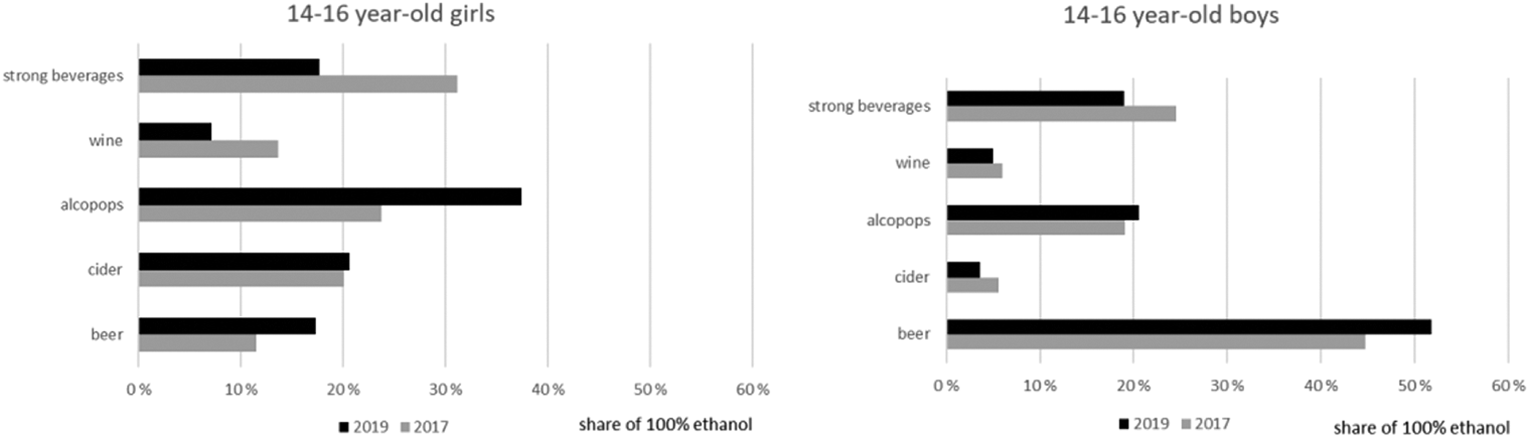
The distribution of 100% ethanol by alcoholic beverage type reported on latest drinking occasion among 14 and 16-year-old girls and boys in 2017 and 2019.
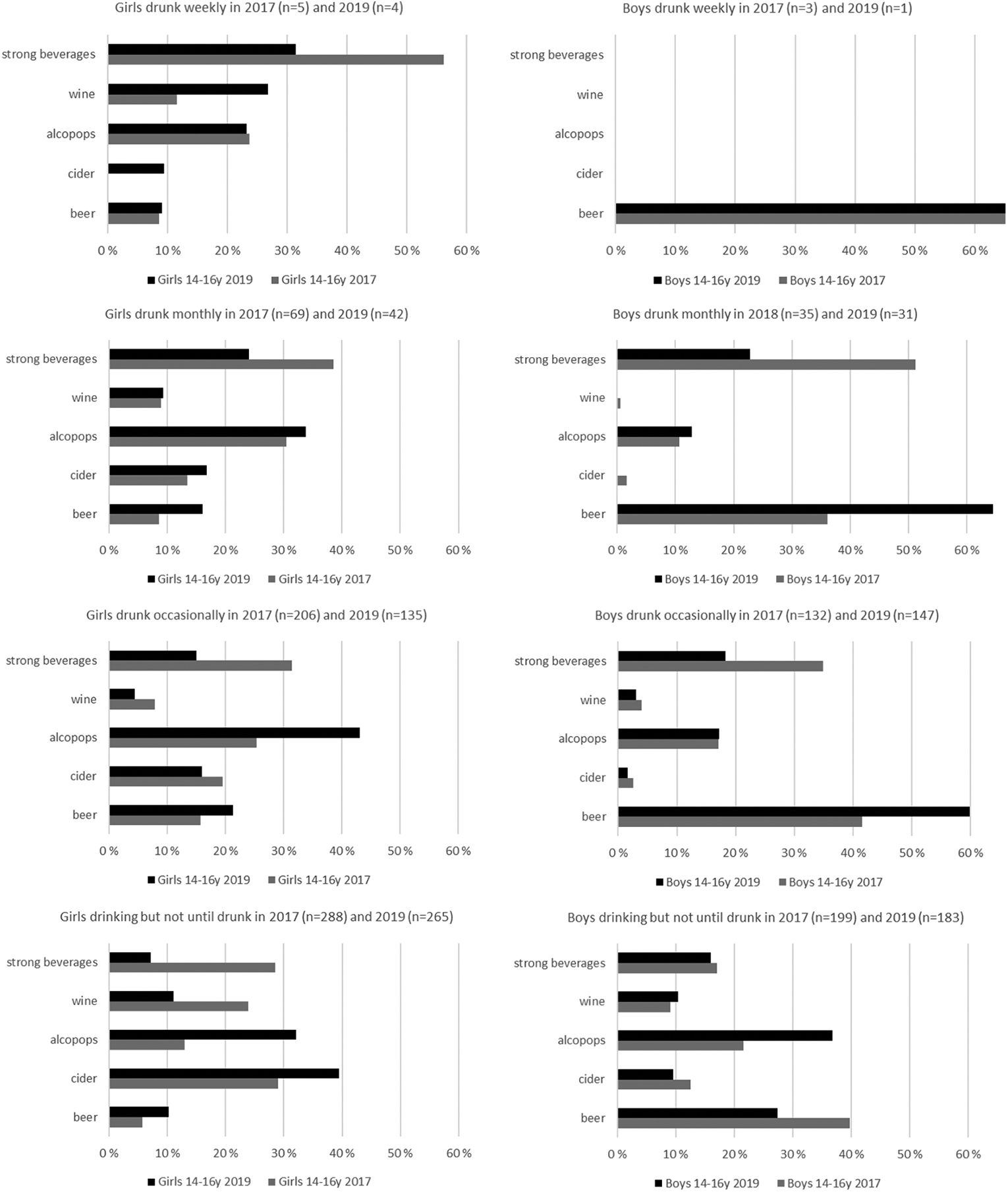
The distribution of 100% ethanol by beverage type reported on latest drinking occasion among 14 and 16-year-old girls (left) and boys (right) by drinking style in 2017 and 2019.
A sensitivity analysis illustrating the effect of different assumptions in alcohol percentage of alcopops, beer or cider was performed in 2019. The responses where the alcohol content of the beverage was not explicitly stated were first calculated for beer and cider as 4.7% and alcopops as 5.5%, corresponding to their dominance in the sales statistics (Valvira National Supervisory Authority for Welfare and Health, 2019). To test for sensitivity to assumptions on ethanol content in cases where the respondent had not explicitly stated the strength, beer and cider were changed to 5.5% and alcopops to 4.7%.
Modelling is used in order to further identify the subgroups, accounting for other factors, where beverage preference has changed. Logistic regression models predicting specific beverage use on the latest drinking occasion were executed separately for the five beverage type categories: beer, cider, alcopops, wine and strong alcoholic beverages. Predictors entered in the models simultaneously were study year, respondent age and gender, alcohol use frequency and drinking style.
Results
The total pure ethanol quantities reported on the most recent drinking occasion were on average 2.30 cl among 14-year-old and 4.24 cl among 16-year-old girls in 2017, and 2.48 cl (14-year-old girls) and 4.45 cl (16-year-old girls) in 2019. For boys, the average quantities were 1.97 cl (14 y) and 5.57 cl (16 y) in 2017, and 2.40 cl (14 y) and 6.04 cl (16 y) in 2019.
Among the girls, the amount of ethanol imbibed in the form of alcopops (ready-made mixtures of soft drinks and alcohol) was, on average, 0.91 cl in 2017 and 1.29 cl in 2019 (p = .02). In 2017, alcopops constituted 24% and in 2019, 37% of the total ethanol consumption reported by girls (Figure 1). No change was observed in the average amount of cider consumed among girls (p > .05). The share of beer among girls was 11% in 2017 and 17% in 2019, but there was no statistically significant change in the amount (p > .05). A significant decrease in amount of ethanol imbibed in the form of wine was observed between 2017 and 2019 (p < .01). No change in average amount of strong beverages consumed was observed (p > .05). All in all, mild beverages, beer, cider and alcopops, accounted for 55% (2017) and 75% (2019; p = .02) of alcohol consumed in terms of 100% ethanol (Figure 1).
Among the boys, beer was by far the most popular source of ethanol both in 2017 and 2019 (Figure 1). Strong beverages were the second most popular beverage group in 2017, but alcopops appeared to have taken their position in 2019. No statistically significant changes from 2017 to 2019 were observed in the amounts of ethanol imbibed by beverage type among boys (p > .05). Among boys, mild beverages accounted for 69% of alcohol consumed in 2017 and 76% in 2019, but this change was not statistically significant (p > .05).
The proportion of girls reporting weekly drunkenness was under 1% both in 2017 and 2019. The choice of alcoholic beverage type consumed on the latest drinking occasion among girls that were drunk weekly was different in 2019 compared with 2017 (Figure 2, p < .01). Monthly drunkenness was reported by 6% of the girls in 2017 and 4% in 2019, and beverage choices in this group did not change (p > .05). Girls reporting occasional drunkenness favoured alcopops in 2019 instead of strong beverages in 2017 (p = .01). Girls who reported drinking alcoholic beverages, but never until drunk, favoured cider and alcopops in 2019 instead of cider and strong beverages (p < .01).
The proportions of boys reporting weekly drunkenness were under 1% both in 2017 and 2019, and they all drank beer on the latest drinking occasion (Figure 2). Monthly drunkenness was reported by 5% both in 2017 and 2019. Favoured beverage changed in this group from strong beverages in 2017 to beer in 2019 (p < .01). There was no change in beverage choice among boys drinking occasionally until drunk (p = .06). Although beer appeared to be replaced by alcopops as the number one choice among boys never drinking until drunk, no statistically significant change was detected (p = .15).
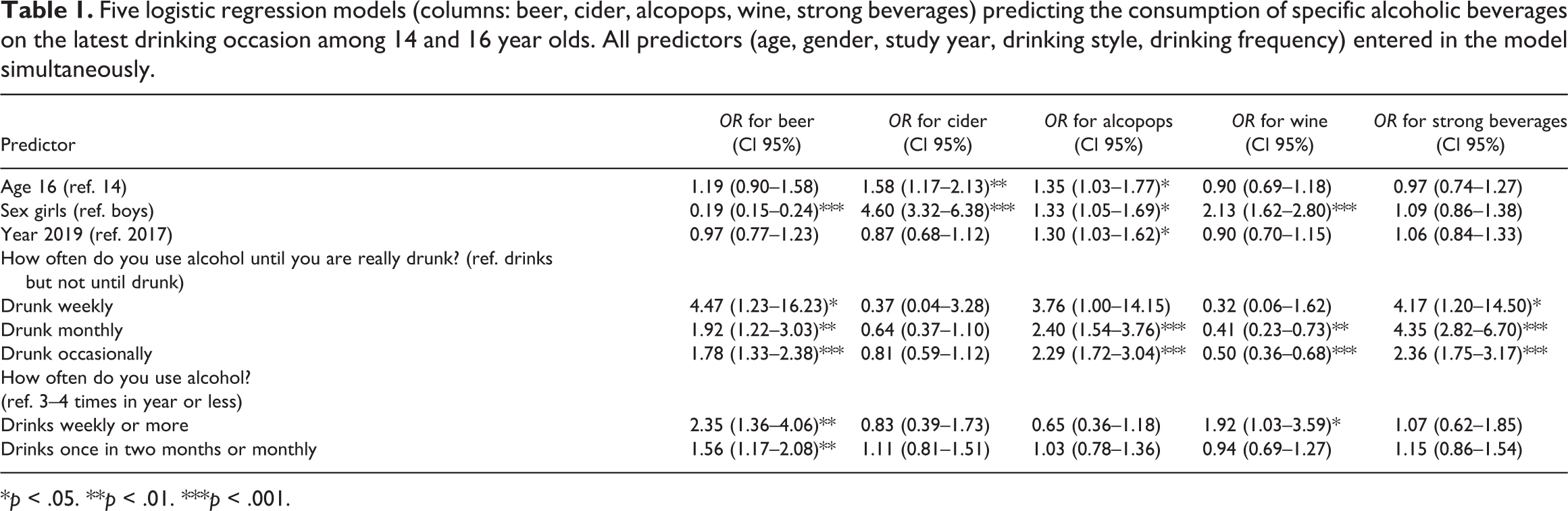
A logistic regression model predicting beer use on the latest drinking occasion showed that boys preferred it more often than girls; those drinking until drunk preferred it more than those drinking only small amounts; those drinking more frequently also preferred beer (Table 1, column 1). Ciders were favoured by 16 year olds compared with 14 year olds, and by girls rather than boys (Table 1, column 2). The logistic regression models showed that the only beverage type category that increased in popularity from 2017 to 2019 was alcopops (Table 1, row “Year”). In addition to becoming more popular, alcopops were favoured by the older age-group, girls compared with boys and those drinking until drunk (Table 1, column 3). Girls were likely to drink wine more often than boys, those drinking more frequently preferred wine, and wine was favoured by adolescents never drinking until drunk (Table 1, column 4). Strong alcoholic beverages were chosen more often by those drinking until drunk (Table 1, column 5).
Five logistic regression models (columns: beer, cider, alcopops, wine, strong beverages) predicting the consumption of specific alcoholic beverages on the latest drinking occasion among 14 and 16 year olds. All predictors (age, gender, study year, drinking style, drinking frequency) entered in the model simultaneously.
*p < .05. **p < .01. ***p < .001.
Sixteen year olds favoured cider and alcopops more than 14 year olds (Table 1, row “Age”). Beer was clearly favoured by boys while cider, alcopops and wine were used more often among girls (adjusting for study year, age, drinking frequency and drinking style). Beer, alcopops and strong alcoholic beverages were chosen by those drinking in a more drunkenness-related drinking style. Beer was a more likely choice among frequent drinkers while wine was more popular among infrequent and moderate drinkers.
The sensitivity analysis illustrating the effect of different assumptions in alcohol percentage in alcopops, beer or cider showed that while the order of popularity was robust among girls in 2019 (Figure 1), the percentage of ethanol from the different types of beverages change slightly: alcopops 32%, cider 23% and beer 20%. Among boys, most of the ethanol came from beer in 2019 (52%, sensitivity analysis: 57%) followed by alcopops (21%, sensitivity analysis: 17%) and strong beverages (19%, sensitivity analysis: 18%).
Discussion
After almost two decades of decreasing under-age drinking, the proportion of 14 and 16-year-old Finns reporting alcohol drinking during the past 12 months seemed to have increased from year 2017 to 2019, but the apparent change was not statistically significant (Kinnunen et al., 2019). The amount of alcohol imbibed on the latest drinking occasion also seemed to have increased, but the changes were not statistically significant in any of the age/gender groups. It is safe to say that the long-term trend showing decreasing drinking has been halted. A similar halt to a long decrease has also been observed in alcohol drinking among 15 year olds in Sweden (Englund, 2019). Among drinkers, the amount of alcohol imbibed in the form of alcopops had increased among girls while wine drinking had decreased among girls. Regression modelling taking into account age, gender and drinking patterns showed that alcopops were the only beverage group that had increased in popularity. The 2018 alcohol law change increased the alcohol content of alcopops available through grocery stores – and these beverages became more popular among the under-aged.
The alcohol law change that took effect at the beginning of 2018 increased the availability of strong beer, cider and especially alcopops (Finlex 1102/2017, 2017; Ministry of Social Affairs and Health, 2018). Even before the law was passed, researchers pointed out that the change was likely to halt the trend of decreasing under-age drinking – or even cause under-age drinking levels to increase (Lintonen et al., 2018; Mäkelä & Österberg, 2017; STM075:00/2011, 2017). The reasoning behind this statement was the proposed increase in ethanol content in beverages sold through grocery stores from 4.7% to 5.5%. The increase in alcopops was seen as a particular concern since these drinks are known to appeal especially to young people (Gale et al., 2015). It seems that both these concerns have materialised: youth alcohol use has stopped decreasing or even turned towards an increase, and alcopops have become a significant source of alcohol among the under-aged. A causal relationship between a law change and changes in drinking patterns and beverage preferences cannot be shown, as experimental designs in populations are not possible. Various other developments may have influenced adolescents’ choices. However, theories on population alcohol drinking support the role of availability in controlling alcohol consumption (Babor et al., 2003; Bruun et al., 1975).
Beer seems to be a masculine beverage choice, at least in Finland, both among adults (Tigerstedt et al., 2018) and adolescents judging from the results presented in this analysis. The favourites among girls were alcopops and cider. Somewhat surprisingly, those drinking until drunk favoured mild beverages as well, alcopops among girls and beer among boys, instead of strong beverages. This may be partly explained by differences in age-limit enforcement. Research has showed that Finnish alcohol monopoly Alko stores are superior in age restriction enforcement compared with grocery stores (Warpenius et al., 2012). It is highly likely that easier availability of beer, alcopops and cider resulting from the new alcohol law (Ministry of Social Affairs and Health, 2018) has affected adolescent beverage choices: alcoholic beverages only available through monopoly stores (wine and strong beverages) have decreased in popularity among the under-aged. The share of alcohol consumed in the form of beer, alcopops and cider increased among girls from 55% in 2017 to 75% in 2019, but the apparent increase among boys from 69% in 2017 to 76% in 2019 was not statistically significant. This is a considerably higher increase than the one observed in population total alcohol consumption (Valvira National Supervisory Authority for Welfare and Health, 2019); under-aged adolescents were affected more by the alcohol law change than adults.
At the population level, the period from 2017 to 2019 witnessed little change in total consumption, 212% increase in strong alcopops, 206% increase in strong beer and 300% increase in strong cider – and decreases in all other beverage groups (Valvira National Supervisory Authority for Welfare and Health, 2019). This picture is mostly reflected in the beverage type preferences among under-aged adolescents: the only exception was that boys decreased their consumption of cider. The explanation seems to lie in the well-known effect of beverage availability (Babor et al., 2003): the law change that made it possible to sell strong alcopops, beer and cider in grocery stores increased their consumption.
In the Nordic context, Finland and Norway are beer territory, while wine is the most popular beverage in Denmark and Sweden (Tigerstedt et al., 2018; National Institute for Health and Welfare, 2018). Finland has been characterised by high consumption of spirits, but the consumption of strong beverages has decreased in popularity both among the adult (National Institute for Health and Welfare, 2018) and under-aged adolescent population. In an analysis of beverage choice change among adolescents between 1999 and 2017, a shift from beer towards wine was witnessed. The latest results presented in this article show that both wine and strong beverages have decreased in popularity. It seems that Finland is not moving towards the wine-centred drinking culture seen in Sweden and Denmark.
The alcohol law change, and especially the changing status of alcopops, received a large amount of publicity during 2017. The media discussed alcopops extensively as part of the process leading to legislation change and this may have worked as a “promotion campaign” for alcopops. Alcopops have been found to appeal more to young people that the population as a whole: in Australia, alcopops were the most popular alcoholic beverage type among adolescents aged 12 to 17 years (Australian Institute of Health and Welfare, 2017). Alcopops appeal to adolescents not only because of their taste, but also their strength and cost (Jones & Reis, 2012).
In line with the trend of decreasing response rates to surveys, the AHLS rates have decreased from around 90% in the 1970s to 45% in 2017 and 40% in 2019. This may have decreased the representativeness of the respondent data set, assuming that the respondents differ from the non-respondents regarding their alcohol use. There is some indication that those drinking more heavily were less likely to respond (Kinnunen et al., 2019). As a result, the figures presented in this article may underestimate the prevalence of alcohol drinking and the proportion of beverage types favoured by those drinking heavily. More importantly pertaining to the results presented here, the response rate did not change notably from 2017 to 2019, and it is highly unlikely that the possible selection bias would have changed between these two years. The item response rate to the question analysed in this study among those that responded to the questionnaire, however, remained high: 78% among 14 year olds and 80% among 16 year olds. Other groups that are less likely to respond may exist – and consequently cause bias in the results. The age and gender-specific subgroups differed in their response rates, but this possible bias was reduced by including age and gender in the models predicting beverage type consumption. An open question describing the latest drinking occasion draws from the idea originating from Klaus Mäkelä (1971). This possibility to use one’s own words in describing the occasion resulted in over a hundred different ways of describing the beverage consumed, and dozens of ways to describe the amount. It is likely that this mode of data collection increased the validity of measuring the beverage choice and amount drunk.
The decade leading to the 2018 alcohol law change witnessed a gradual tightening of alcohol policy in Finland (Lintonen et al., 2018). With the step towards wider alcohol availability brought by the 2018 alcohol law, the situation calls for measures to protect the under-aged from alcohol-related harm. The increased availability of stronger alcopops, products known to appeal to adolescents (Gale et al., 2015), together with a general increase in the popularity of beverages available through grocery stores, kiosks and service stations calls for attention both regarding marketing and the control of age limits. Although some studies have illustrated decreases in alcopop consumption after introducing or raising specific alcopop taxes, consumption of other alcoholic beverages has been found to increase (Doran & Digiusto, 2011; Müller, Piontek, Pabst, Baumeister, & Kraus, 2010). Comprehensive measures including taxation, and restrictions of advertising and sales (e.g., Babor et al., 2003; Skov et al., 2011) affecting the population total consumption are also likely to remain the keys to reducing alcohol consumption among adolescents. In addition, effective age-limit controls and sanctions against neglecting age-restriction enforcement are called for as adolescents increase their purchases of alcoholic beverages in grocery stores.
Footnotes
Declaration of conflicting interests
The authors declared no potential conflicts of interest with respect to the research, authorship, and/or publication of this article.
Funding
The authors received the following financial support for the research, authorship, and/or publication of this article: The data were collected by Tampere University with funding from the Ministry of Social Affairs and Health, Finland.
