



Abstract
Aim:
This article presents cross-sectional data collected from the population of first-year students at the University of Warmia and Mazury in Olsztyn in 2000–2016. The aim of the study was to investigate changes in the following trends among university students after Poland’s accession to the European Union (2004): (1) alcohol consumption, (2) alcoholic beverage preferences, and (3) attitudes towards alcohol.
Method:
The study relied on data from anonymous surveys conducted every two years between 2000 and 2016 among a representative sample of first-year university students. A total of 9778 individuals (4264 males and 5514 females) completed anonymous questionnaires during the period under analysis. Statistical analyses were performed by comparing the frequency of answers given by male and female students in the first and last year of the study.
Results:
There was a steady linear decrease in the percentages of abstainers of both genders and a regular linear increase in the number of female students abusing alcohol to blackout level in the analysed period of 2000 to 2016. The respondents’ preferences for alcohol brands became more diversified (with foreign types of strong liquors becoming more popular), and their attitudes towards alcohol availability on campus were liberalised.
Conclusions:
Our data complement the gaps in empirical research on alcohol consumption among university students in European countries. They point to greater homogenisation of Polish drinking culture and convergence in male and female drinking behaviours.
Keywords
Statistical data indicate that alcohol consumption has decreased in southern Europe and increased in northern Europe in the last 50 years (Allamani et al., 2011), while intermediate behaviour patterns have been noted in Central and Eastern Europe. In Poland, alcohol consumption fluctuated during the period under analysis: it began to increase in the 1960s, reached a peak towards the end of the 1970s, decreased in the 1980s, and began to increase again by the end of the 20th century (Allamani et al., 2011). In 2000–2011, according to the statistical data gathered by the Polish State Agency of Alcohol Problems Solving (PARPA), alcohol consumption in Poland increased by 30% from 7.12 litres (1000 cm3) of 100% alcohol per capita in 2000 to 9.25 litres in 2011. The production of beer and spirits increased by 5% and 56%, respectively, whereas the production of wine decreased by 75–85% (www.parpa.pl/index.php/badania-i-informacje-statystyczne/statystyki). The increase in alcohol consumption in the “newly independent” European countries is attributed to the social changes, political transformations, transition to a market economy, and economic liberalisation that began in the 1990s (Reitan, 2000). In Poland, further changes on the macro level were initiated when the country joined the EU in 2004. Intensified migration flows and international influences may have impacted Polish drinking behaviours and preferences.
University students are a population group at high risk of excessive alcohol consumption (Andersson, Wiréhn, Ölvander, Stark Ekman, & Bendsten, 2009; Wilczyński, Witkowski, Pawlik, Krysta, & Krupka-Matuszczyk, 2013). Numerous studies suggest that college students are more likely to consume alcohol and binge drink than their peers who are not enrolled at university (Ansari, Stock, & Mills, 2013; Danzer, Wardle, Fuller, Pampalone, & Steptoe, 2006; Stock et al., 2009). Young adults who have reached the final stage of identity formation could be particularly susceptible to the influence of foreign cultures. Macro-level changes may have a more rapid and visible effect on university students than on other population groups.
An extensive literature review by Wicki, Kuntsche, and Gmel (2010) revealed that alcohol consumption among US and Canadian students had been widely investigated in more than 1000 articles published in the last 20 years. The authors also noted that far fewer empirical studies had been conducted among university students in Europe, and they expressed doubts as to whether the insights into alcohol use from the US and Canada could be easily transferred to other drinking cultures (Wicki et al., 2010). Thus, the aim of this study was to fill the gap in empirical data, based on observations of Polish university students.
Women drink less alcohol then men and have fewer legal, family, social, clinical, and mortality problems associated with alcohol use (Kerr-Correa, Igami, Hiroce, & Tucci, 2007; Nolen-Hoeksema, 2004). At the same time, women suffer more from cognitive and motor impairments than men after drinking similar quantities of alcohol and appear to be more susceptible to alcohol’s long-term health effects (Mumenthaler, Taylor, O’Hara, & Yesavage, 1999). Women also suffer from negative consequences of alcohol drinking earlier and to a greater degree than men (Andersson, Johnsson, Berglund, & Öjehagen, 2007), and they are more likely to become victims of physical harm and sexual assault when intoxicated than are men (Nolen-Hoeksema, 2004).
Cross-cultural comparisons of adult populations (Wilsnack, Vogeltanz, Wilsnack, & Harris, 2000) as well as studies of students (Danzer et al., 2006; Wicki et al., 2010) confirm the existence of inter-gender differences in alcohol consumption frequencies and in rates of heavy drinking episodes. However, in some cultures the indicators of alcohol consumption among men are much higher than among women, whereas in other cultures inter-gender variations are far less pronounced (Kerr-Correa et al., 2007). Wilsnack et al. (2000) concluded that gender differences in drinking behaviour could be modified by macro-social factors that influence gender roles. Cultures with the most traditional division of gender roles are also characterised by clear differences in male and female drinking behaviours. Women’s and men’s drinking behaviours can be expected to converge when social gender roles become more egalitarian. Empirical evidence for convergence in men’s and women’s alcohol use patterns has been presented by Nolen-Hoeksema (2004).
Poland is a good example of a country where socialisation into traditional gender roles contributes to greater permissiveness for male drinking and more severe sanctions for women for being intoxicated (Nolen-Hoeksema, 2004; Schulte, Ramo, & Brown, 2009). The acculturation process could be an important determinant of changes in drinking patterns (Kerr-Correa et al., 2007); therefore, we anticipated that Poland’s accession to the European Union in 2004, which initiated numerous changes in attitudes and lifestyles, could also have influenced, at least to a certain extent, Poles’ behaviours and preferences associated with alcohol consumption. We expected that such influences would be particularly pronounced among university students who, upon leaving home, become highly susceptible to peer pressure and the influence of foreign cultures in the mass media (Varela & Pritchard, 2011). The university is considered to be an important environmental factor influencing alcohol use among young adults (Andersson et al., 2007).
Our research interests focused on long-term changes in the extent of inter-gender differences in alcohol consumption, preferences, and attitudes towards drinking among university students after Poland’s accession to the European Union. The survey was conducted every two years between 2000 and 2016 among the students of the University of Warmia and Mazury in Olsztyn. The research was replicated at regular intervals over a period of 16 years to capture the slow dynamics of changes in drinking patterns (Simpura, Paakkanen, & Mustonen, 1995) as they reflect social processes of forming new social behaviours and preferences.
Materials and methods
Ethical considerations
The research was carried out upon the prior approval of the Bioethical Committee of the University of Warmia and Mazury in Olsztyn. The volunteers willingly agreed to participate in the study and signed written consent forms.
Research sample
The participants were first-year students of various faculties at the University of Warmia and Mazury in Olsztyn (northeastern Poland). Surveys were conducted every two years between 2000 and 2016, in May, during obligatory physical education classes. Respondents were randomly selected based on statistical tables to ensure that students pursuing different majors had equal chances of participation. In successive years of the study, survey questionnaires were completed by 958 female students in 2000, 583 in 2002, 524 in 2004, 826 in 2006, 641 in 2008, 712 in 2010, 381 in 2012, 514 in 2014, and 375 in 2016; and by 627 male students in 2000, 302 in 2002, 483 in 2004, 512 in 2006, 596 in 2008, 648 in 2010, 411 in 2012, 380 in 2014, and 305 in 2016. The differences in the number of respondents across years resulted from variations in enrolment statistics at the UWM; nevertheless, the surveyed population constituted a representative sample of first-year students at the UWM. Data were gathered from a total of 5514 women and 4264 men aged 19–20 years.
The mid-semester period was chosen as most representative of typical drinking behaviours. According to Gill (2002), the time point during the academic year in which students’ drinking behaviour is recorded is important: pre- and post-examination periods may influence the amounts of alcohol consumed.
In the period 2000–2016, around 30–40% of high school graduates entered university in Poland. The total number of university students has been gradually decreasing since 2005 due to changes in Poland’s demographic structure (demographic depression). Polish students are admitted to public universities in a national competition based on the marks scored in the matriculation exam. Despite the ongoing reforms aiming to modify the content of exams and the examination procedure, entrance exams still heavily rely on the knowledge and competences acquired in the formal education system. Thus, we did not expect noticeable differences between the subpopulations of respondents in particular years of our research.
Methods
There are various approaches to measuring alcohol consumption. This study was based on the premise that confidential and unidentified questionnaires investigating substance use among university students provide valid and reliable results (Ansari et al., 2013). The most basic indicators of drinking pattern are abstinence rates and drinking frequencies (Simpura et al., 1995), and the frequency of risky single-occasion drinking (RSOD) (Wicki et al., 2010).
The respondents filled in an anonymous questionnaire on their general health habits. In the part of the survey dedicated to alcohol consumption, the respondents were asked to indicate the following in a set of closed-ended questions: The frequency of consumption of more than one standard unit of alcohol (on a scale of “never”, “several times a year”, “once a month”, “once a week”, to “every day”). Whether they had ever had a blackout episode induced by drinking (answers: “yes” or “no”). Their preferred type of alcoholic beverage (“beer”, “wine”, “vodka”, or “other”). The number of different alcohol types consumed in general (“one”, “two”, “three”, or “more than three”). This question was designed to probe the respondents’ openness to new flavours and brands of alcohol.
The students’ attitudes towards alcohol consumption were investigated by asking them: Whether they had ever considered abstaining from alcohol (answers: “yes” or “no”). Whether they approved of the general availability of alcohol on campus (answers: “yes”, “I don’t know”, or “no”).
Students who declared abstinence in the first question were asked to skip sections 2–5 and move on to question 6.
Statistical analysis
The statistical analysis was performed using the Statistica PL v. 12 software package. Female and male respondents’ answers were analysed separately. The chi-squared non-parametric (with phi coefficient of effect size) was used to assess the significance of differences between the frequencies of particular answers given by the respondents in the first (2000) and last year (2016) of the study. Descriptive statistics were computed only for the answers given in 2000–2016 (presented graphically in the figures) to investigate the slow social processes of preference shaping and modifications in individual behaviours resulting from changes at the macro level. The data for 2000 were the baseline because the information campaign preceding Poland’s EU accession referendum was launched in the following year. We assumed that in the following years (especially after Poland had joined the EU in 2004), the influence of foreign cultures on Polish people’s preferences would be intensified. The distribution of answers displaying a steady trend (increase or decrease) between 2000 and 2016 was analysed statistically.
Results
Alcohol consumption and alcohol preferences among university students in 2000–2016
The first step of our data analysis was the examination of the respondents’ answers to how frequently they consumed more than one standard unit of alcohol. The frequency distribution of different answers among female and male students during the period studied is presented in Figure 1. The statistical significance of differences in distributions between 2000 and 2016 was analysed for the categories of answers demonstrating steady change trends during the research period, i.e., “I don’t drink at all”, “I drink once a month”, and “once a week”.
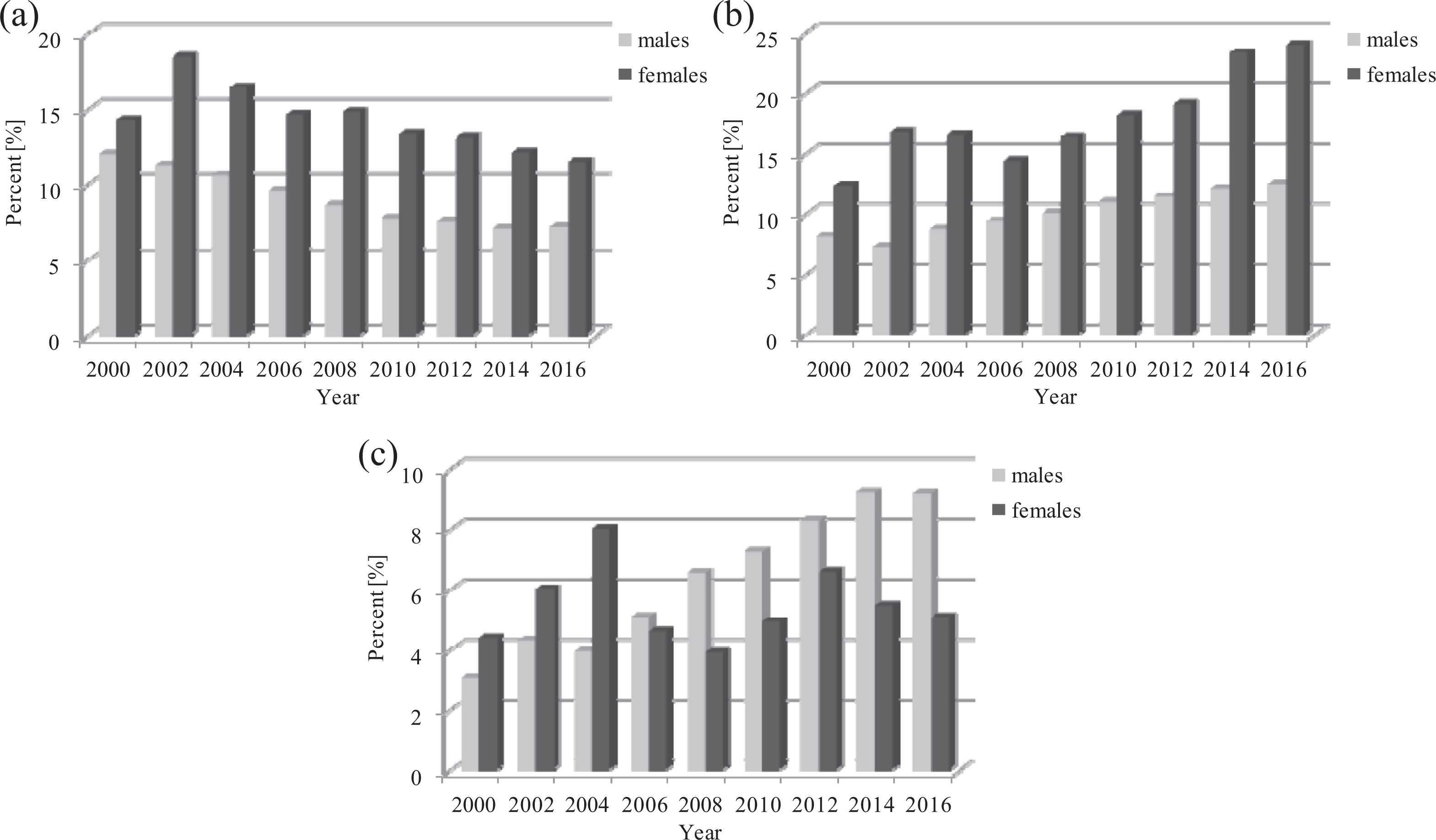
Frequency of alcohol consumption among male and female subjects in the research period.
The effect size coefficient ϕ (phi) was also calculated: χ 2 = 16,14 (df = 5, p = 0.0065) and ϕ = 0.19 for female students, and χ 2 = 19.82 (df = 5, p = 0.0014) and ϕ = 0.29 for male students.
Abstinence was declared by 7–12% of male and 12–18% of female students. In 2000–2016, the percentage of abstainers decreased steadily among both females and males. Among women, the greatest decrease in abstinence (7%) was observed between 2002 (18.5%) and 2016 (11.5%). Among men, the greatest drop (5%) was noted between 2000 (12%) and 2016 (7.2%).
Drinking “once a month” was declared by about 8–12% of male students and 12–24% of female students. The frequencies of such responses significantly increased during the research period.
Drinking alcohol “once a week” was indicated by 3–9% of men, and it increased three-fold among male students from 3.03% in 2000 to 9.18% in 2016. Among female students, the corresponding percentage remained fairly stable throughout the study in the range of 3.90% to 6.56%. The data relating to changes in the frequency of alcohol consumption indicate that alcohol use increased in the investigated period.
The second step of our analysis was the examination of the percentages of students who confessed to excessive drinking to the point of blackout (loss of consciousness). The relevant data are presented in Figure 2: χ 2 = 23.82, (df = 3, p < 0.0001) and ϕ = 0.14 for female students, and χ 2 = 8.36 (df = 3, p = 0.0392) and ϕ = 0.10 for male students.
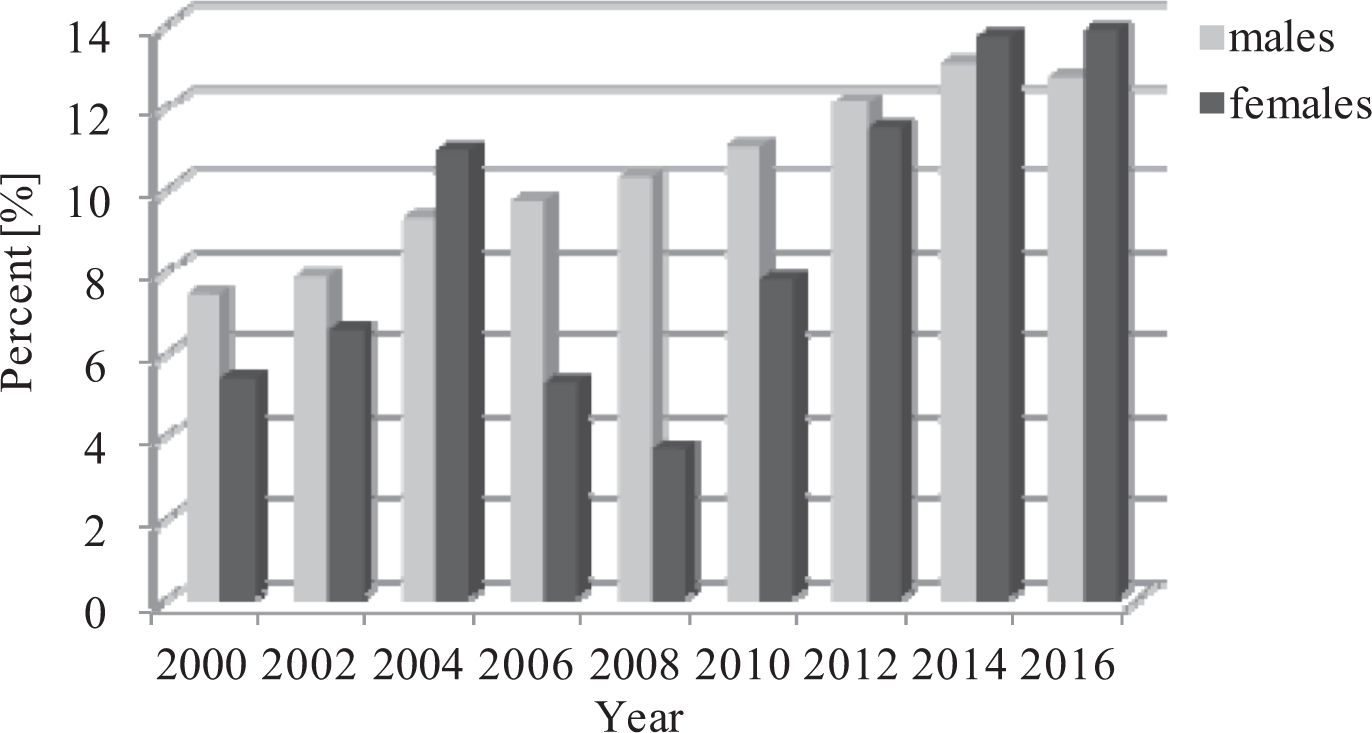
Percentage of students experiencing blackouts as a result of drinking alcohol.
As we can see in Figure 2, 8–13% of males and 4–13% of females declared having lost consciousness as a result of drinking. This finding points to an increase in the percentage of students, both male and female, who experience alcohol-induced blackouts. A higher increase was noted among females: a 2.6-fold increase was observed between 2000 and 2016. The percentage of excessive male drinkers increased 1.7-fold between 2000 and 2016. It is worth noting that in 2014 and 2016, the percentage of women who experienced a blackout exceeded that of men.
The changes in the types of alcoholic beverages preferred by male and female students are presented in Figure 3. The statistical analysis of the significance of changes in beverage preferences between 2000 and 2016 produced the following results: χ 2 = 14.59 (df = 7, p = 0.0416) and ϕ = 0.09 for female students, χ 2 = 179.46 (df = 7, p < 0.0001) and ϕ = 0.36 for male students.
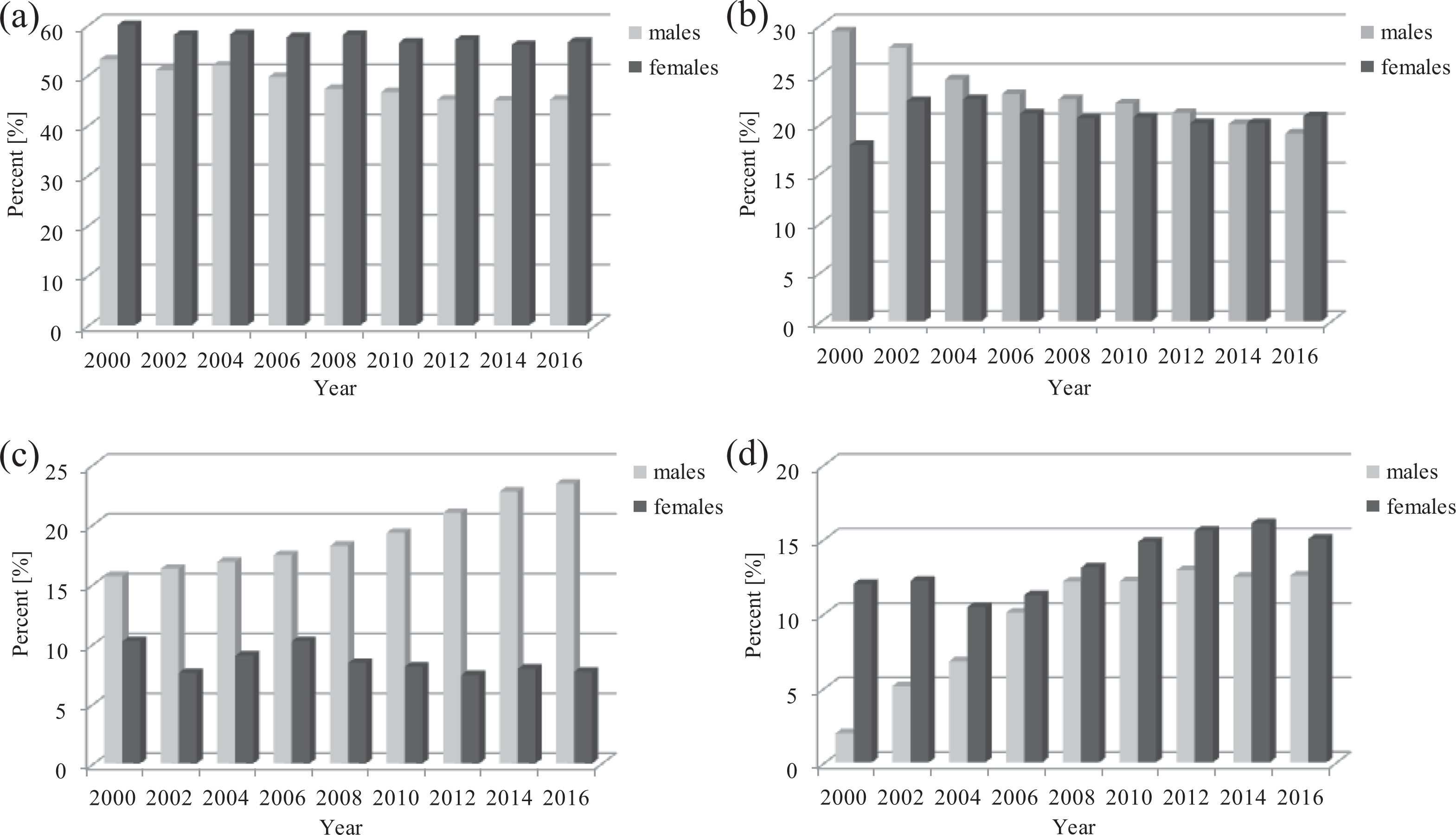
The preferred types of alcoholic beverages among male and female students.
During the entire research period of 2000–2016, beer remained the most popular alcoholic beverage among both male and female students. It was indicated as most preferred by 45–50% of men and this did not change significantly. The popularity of wine among men declined over the research period from nearly 30% in 2000 to around 23% in 2016. The popularity of vodka somewhat increased. The most visible trend in the male subsample was the increase in the popularity of “other alcohols” (including whisky, brandy, and cognac). The popularity of “other alcohols” increased 6-fold from 2% in 2000 to 12.5% in 2016.
Female students’ preferences regarding beer and wine remained fairly stable throughout the study: beer was indicated as the favourite drink by 57–60% of female respondents, whereas around 20% said that their preferred drink was wine. A minor increase was noted in female students’ preference for vodka (to around 8–9%) and “other alcohols” (12–15%).
Figure 4 shows more details on students’ alcohol preferences, indicating the frequencies of answers to the question “How many different alcohol types do you consume in general?”. This question was designed to probe the respondents’ openness to new flavours and brands of alcohol. The statistical analysis of changes between 2000 and 2016 produced the following results: χ 2 = 22.42 (df = 7, p = 0.0022) and ϕ = 0.14 for female students, and χ 2 = 69.54 (df = 7, p < 0.0001) and ϕ = 0.27 for male students.
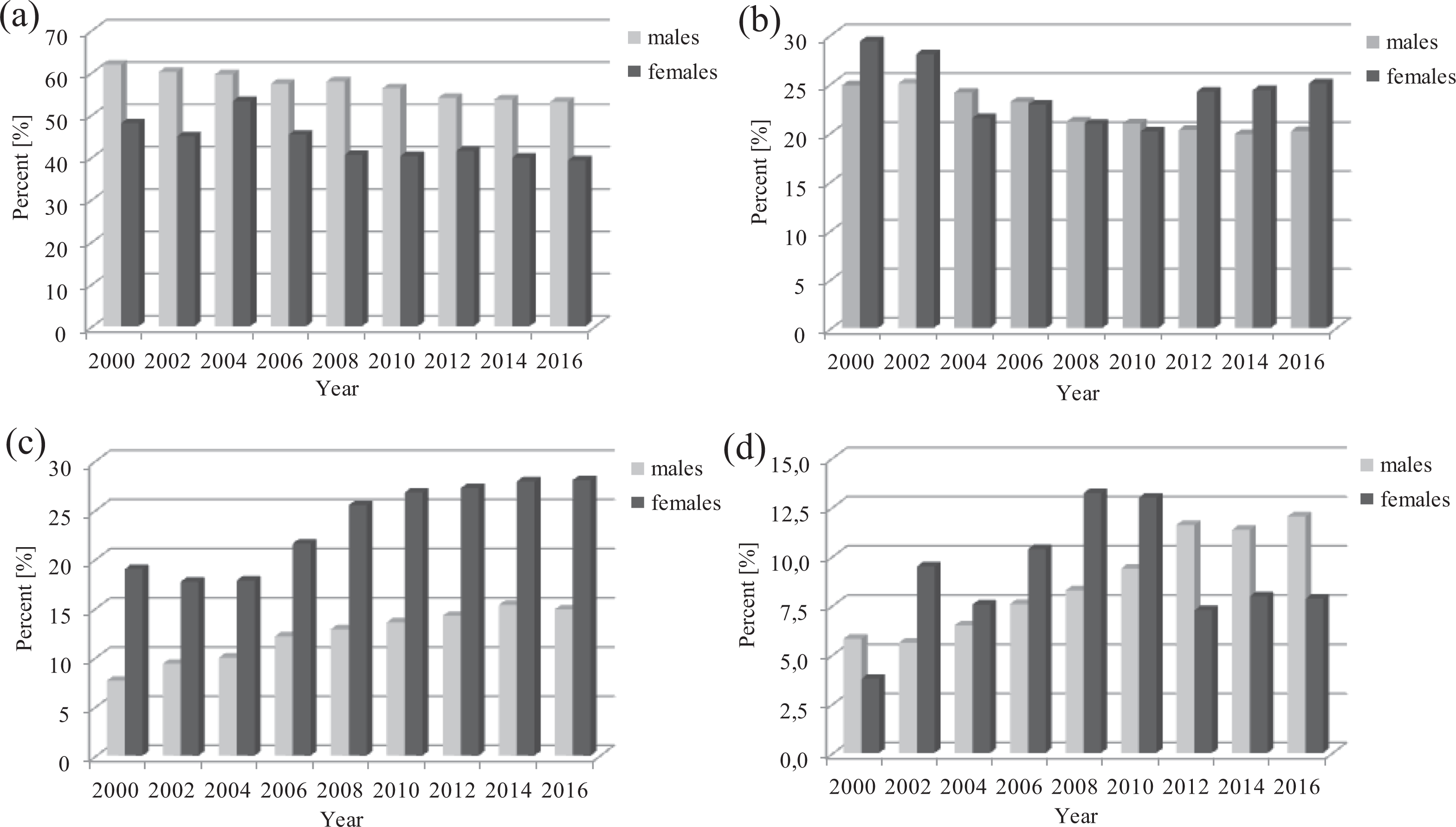
Number of different types of alcohol consumed in general by male and female students as an indicator of openness to new flavours and brands of alcohol.
The majority of male respondents (53–62%) indicated drinking only one type of alcohol, and around 20–24% drank two types of alcohol. These preferences were relatively steady. We observed a linear upward trend in the numbers of individuals consuming three different types of alcohol: from 7.5% in 2000 to 15% in 2016. The percentage of men consuming four different types of alcohol doubled from 5.80% to 12%.
Similar trends were observed among female students. The number of women consuming one (38–45%) and two types of alcohol (20–27%) did not differ considerably. At the same time, we observed an increase in the percentage of women who drank three and four types of alcohol.
Students’ attitudes towards alcohol consumption in 2000–2016
The percentage of male and female students who approved of alcohol being generally available on campus across the years is presented in Figure 5 (χ 2 = 40.19, df = 3, p < 0.0001) and ϕ = 0.19 for female students; χ 2 = 14.27 (df = 3, p < 0.0025) and ϕ = 0.13 for male students.
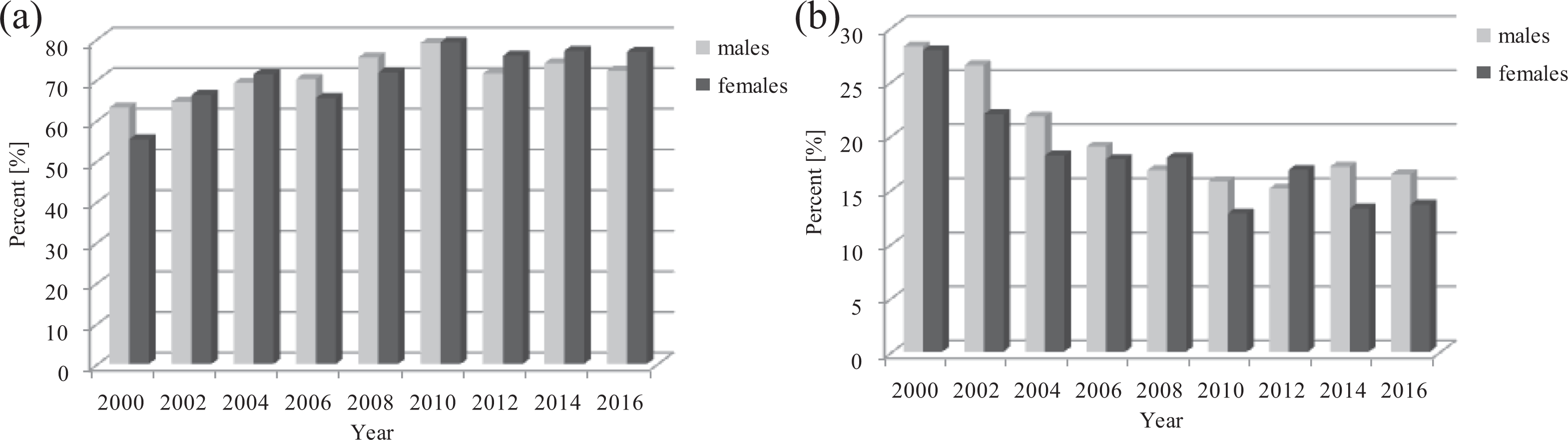
Students’ attitudes to the availability of alcohol on university campus.
These data suggest that students have adopted a more relaxed attitude towards the availability of alcohol on campus over the years. The percentage of males approving of alcohol availability on campus increased by 10% during the study, from 63% in 2000 to 73% in 2016. Among females, acceptance levels increased by 20%, from 55.32% in 2000 to 77% in 2016.
The percentage of students who considered and did not consider abstaining from alcohol during the period of study is presented in Figure 6: χ 2 = 11.82 (df = 3, p = 0.0081) and ϕ = 0.11 for female students; χ 2 = 12.56 (df = 3, p < 0.0057) and ϕ = 0.14 for male students.
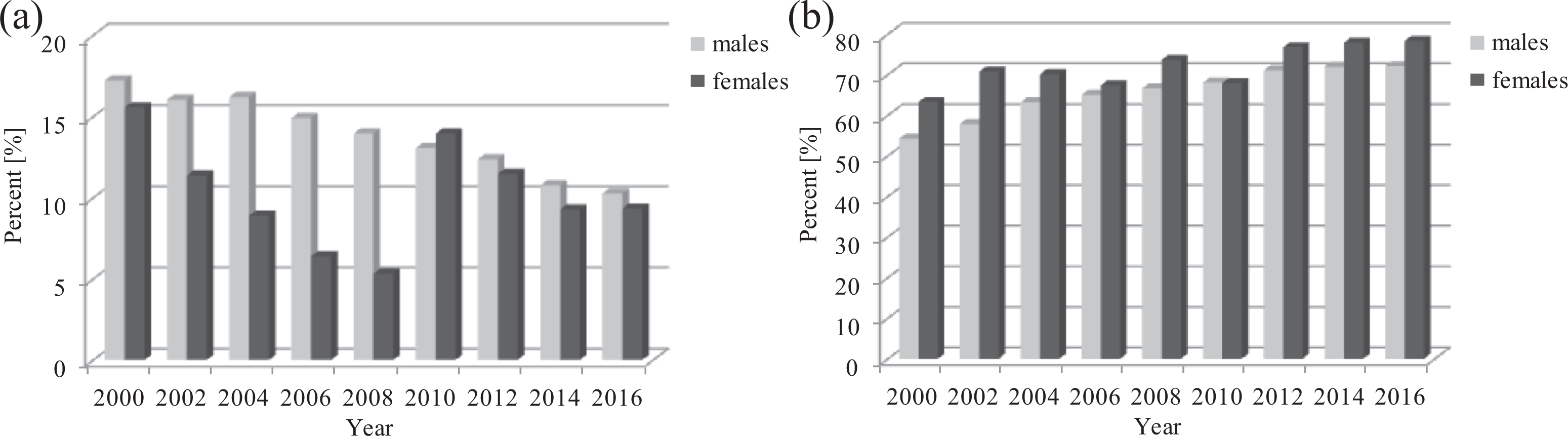
Students’ attitudes to abstaining from alcohol.
Among male students, 10–17% declared willingness to stop drinking alcohol, but this percentage gradually decreased over time. The corresponding answer was given by 5–14% of female students, and a decreasing trend was noted despite some fluctuations.
Discussion
Alcohol consumption and attitudes
The measured indicators point to an increase in alcohol consumption among both male and female students during the period of this study. Still, the respondents surveyed consumed less alcohol than did their peers in other European countries, such as the United Kingdom or Sweden. A study of undergraduates conducted at the University of Gloucestershire in 2008–2009 (Ansari, Stock, & Mills, 2013) revealed that 2.1% of males and 3.9% of females abstained from drinking, and 25% of males and 30% of females consumed alcohol once a week. In our study, the relevant data for 2008 indicate that 8% of males and 14% of females abstained from drinking, and 6% of males and 4% of females consumed alcohol once a week. According to a 2002 survey of Swedish university freshmen, 16% of men and 4% of women consumed more than six drinks at least once a week (Andersson et al., 2007). These findings are consistent with our RSOD indicators, which reached 8% for men and 6% for women in the same year. It should also be noted that the percentages of declared abstainers (3% of males and 4% of females) in the Swedish study were lower than in Poland. Nevertheless, the two-fold increase in the number of Polish male and female students who abused alcohol to blackout level between 2000 and 2016 is alarming.
The students surveyed adopted more relaxed attitudes towards the availability of alcohol on campus in successive years of the study. Similar observations have been made in Finland, “an important sign of modernity in the country, often paralleled with support for closer ties to the integrating Europe” (Simpura et al., 1995, p. 674). Growing acceptance of alcohol on campus poses a significant problem. According to Wechsler, Davenport, Dowdall, Moeykens, & Castillo (1994), individual binge drinking is less likely among students if the institution does not have any alcohol outlets within a mile of campus or if it prohibits any alcohol use on campus.
Homogenisation of alcohol preferences
Our data indicate that a majority of students, male and female alike, remain quite conservative in their alcohol preferences, but the number of individuals seeking new flavours is constantly growing. Poland has been placed on the list of “traditional vodka-drinking cultures” together with Estonia, Latvia, Lithuania, Ukraine, Russia, and the Nordic countries (Finland, Iceland, Norway, and Sweden). These countries are characterised by non-daily drinking patterns, irregular drinking episodes, and the acceptance of drunkenness in public (Popova, Rehm, Patra, & Zatonski, 2007). The results of this study are fully consistent with such observations, and they also indicate that Polish vodka is being gradually replaced by foreign brands of strong liquors. Our data also suggest that the observed changes in Polish drinking culture do not follow the trends characteristic of the Mediterranean region where wine is consumed with meals and public drunkenness is frowned upon (Simpura & Karlson, 2001). Poland is also not a beer-drinking culture (such as the Czech Republic, Slovakia, and Germany), which is characterised by frequent consumption of beer and lack of social acceptance for public intoxication.
The results of this study point to the influence of globalisation on the alcohol preferences of Polish students. In this group of respondents, the popularity of Polish beer and vodka decreased visibly in favour of foreign liquor brands. This finding reflects the trend noted in Western countries where students’ alcohol preferences have changed “with the dominant role of beer being challenged by newer spirit-based mixed drinks” (Dantzer et al., 2006, p. 87).
These observations can also be attributed to globalisation and the resulting “homogenisation” of alcohol preferences. The international homogenisation of drinking is a long-standing issue in alcohol research (Simpura et al., 1995). It was first described by Leifman (2001), who investigated changes in alcohol preferences in 14 European countries in 1950–1995. Other researchers have also found differences in traditional drinking cultures across 31 European states (Popova et al., 2007). The results of our long-term systematic study illustrate the extent of homogenisation in drinking preferences giving the example of University of Warmia and Mazury students.
Convergence of drinking patterns in females and males
Our results point to the global convergence of drinking patterns. After Poland’s accession to the EU, the drinking patterns of female and male university students began to resemble those observed in other countries. The differences in the percentage of female and male abstainers were gradually minimised, and beginning from 2002, a greater decrease was observed in the number of female than male abstainers. In studies conducted in Anglo-Saxon countries, which have high levels of gender egalitarianism, the percentages of female and male abstainers were similar. For example, in a study by Ansari et al. (2011), 7% of male students and 8% of female students in seven British universities claimed not to have drunk any alcohol in the three months preceding the survey. Nearly equal numbers of non-drinkers were reported among male (16%) and female (15%) students in a national survey of students in 140 campuses in the United States in 1993 (Wechsler et al., 1994).
The fact that the incidence of blackouts among women became equal to and, in recent years, even higher than that reported among men, also testifies to the convergence of drinking patterns. This is highly alarming because, as noted by Kerr-Correa et al. (2007, p. 272), “women have great difficulty admitting that drinking harms their health in many different ways, and it is the source of many problems they are facing”; “increased alcohol consumption in women is seen in those who have a higher education level” (Kerr-Correa et al., 2007, p. 269).
The steady elimination of differences between female and male preferences for “other types of alcohol” such as whisky, cognac, brandy, and spirit-based drinks, is the third symptom of convergence. It should be noted that in the early years of the study (2000–2004), women were more likely to consume “other types” of alcoholic beverages than men. In other words, women were more open to novelty, whereas men’s interest in new types of alcohol increased only gradually. The popularity of the most widely consumed types of alcohol in Poland (beer and wine) decreased at a slower rate among men. In this respect, men’s alcohol preferences became similar to those observed in women.
While inter-gender differences in drinking frequency and alcohol preferences were observed in the population studied, our results indicate that some of these differences were significantly minimised in the period surveyed.
Conclusions
The following major conclusions can be formulated from the results of our study:
Alcohol consumption and the frequency of risky single-occasion drinking (RSOD) increased in the surveyed population of Polish university students. Both phenomena were more pronounced among female students, which could point to a convergence in gender-specific patterns of alcohol-drinking behaviour.
The alcoholic beverage preferences of the surveyed students changed over the years of the study, which suggests that Western drinking culture could have a homogenising effect on Poland.
Strengths and limitations of the study
The main strengths of our study are: (1) the size of research cohorts (random, representative samples of first-year students of the University of Warmia and Mazury in Olsztyn in the analysed years) and (2) the longitudinal nature of the study covering the years before and after Poland’s accession to the EU, which brought about major political, economic, and social changes. The study also has certain limitations. The results are based on a single assessment, so they fail to capture longitudinal variations within individuals. Our findings point to convergence in male and female drinking patterns as well as increased permissiveness towards alcohol consumption among first-year university students. However, many young adults outgrow the tendency to drink excessively. The second limitation is that the indicators of alcohol consumption could be more detailed and elaborate, including the frequency of risky drinking episodes, signs of alcohol dependence, and alcohol-related harm (for example, based on the Alcohol Use Disorders Identification Test, AUDIT).
Footnotes
Declaration of conflicting interests
The authors declared no potential conflicts of interest with respect to the research, authorship, and/or publication of this article.
Funding
The authors have declared the following financial support for the research, authorship, and/or publication of this article:
Cross-sectional studies supported by the University of Warmia and Mazury in Olsztyn Conscious University Project.