




Abstract
The growth of influencer marketing has been accompanied by heightened risks for partner brands when influencers face public scandals. This study examines negative brand engagement (NBE) as a key consequence and identifies three mitigating factors: brand forgiveness, perceived brand authenticity, and immediacy of brand response, framed through signaling theory. Data from 254 consumers who had “cancelled” an influencer yet purchased a brand endorsed by them were analyzed using PLS-SEM. Results highlight the central role of brand forgiveness in reducing NBE. Forgiveness of the influencer indirectly decreases NBE via brand forgiveness, while brand authenticity directly fosters forgiveness and indirectly reduces NBE. Moreover, authenticity’s positive effect on forgiveness is strengthened when the brand responds rapidly to the scandal. The study advances influencer marketing literature by shifting focus from drivers that exacerbate NBE to factors that mitigate it, and by applying signaling theory to explain forgiveness mechanisms. For practitioners, the findings underline the importance of acting swiftly and authentically after an influencer scandal, and of facilitating forgiveness toward the influencer to promote brand forgiveness and limit NBE. Future research should explore additional antecedents of influencer and brand forgiveness, given its pivotal role in protecting brand relationships during crises.
Keywords
Introduction
Drawing from the underpinning principles of word-of-mouth research whereby customers are more influenced by their peers than brand messages (Tafesse & Wood, 2021), influencer marketing refers to the collaboration between influencers and partner–brands to deliver brand content through the influencer’s social media (De Veirman et al., 2017). These influencers may be non-original social media influencers (SMIs), including traditional celebrities who became famous outside of the social media context, but have built on that fame on social media, specifically to partner with brands as influencers (Piehler et al., 2022). They may also be original SMIs, including individuals who became famous solely on and through social media, and who use that fame as a basis to partner with brands as influencers (Piehler et al., 2021).
While much research has shown the positive sides of influencer marketing practices (Jin et al., 2019; Wilkie et al., 2022), there may be a downside. The real-time, interactive, and often “live” nature of social media platforms, the space in which most influencer marketing content is shared, provides an accessible and public space for an influencer’s misbehavior, mistakes, and scandals, to be called out by customers (Kintu & Ben-Slimane, 2020). Despite several influencer scandals in recent years, whether these scandals led to negative brand engagement toward the partner-brands has not been conclusively researched (Wei, 2024). This study puts forward that such scandals have the potential to trigger negative brand engagement. Moreover, if these scandals have such negative consequences, we must identify the pathway to mitigate them.
What we are describing above is part of the phenomenon that is “cancel culture.” This is a relatively new phenomenon, where “socially networked consumers call out brands, celebrities, influencers, and public figures for highly problematic views and/or behaviors” (Demsar et al., 2023). If the calls are strong enough, the target is said to be “cancelled,” in that they experience reputational damage that leads to some extent of loss of status, employment, or income (Demsar et al., 2023). In the context of an influencer, such cancellation by consumers can extend from the influencer to the partner-brand itself, manifesting as negative brand engagement. There are numerous recent examples of influencer scandals. For example, in September 2023, allegations of sexual assault against Russell Brand led to significant repercussions for his professional partnerships. Among these, Vivobarefoot, a company promoting sustainable footwear, ended its relationship with Brand. (Deighton, 2023). Chrissy Teigen’s cyberbullying allegations prompted a major fallout with some of her business partnerships, including Target, which reportedly stopped carrying her cookware line, “Cravings by Chrissy Teigen,” amidst the controversy (Spencer, 2021). Other brands, such as Bloomingdale’s and Macy’s, severed ties with Teigen more explicitly due to the public outcry. James Charles’ underage grooming allegations affected his own reputation and that of partner brand Morphe, The James Charles x Morphe collection, which included one of the brand’s best-selling palettes, was mutually discontinued as both Charles and Morphe issued statements addressing the situation (Vlamis, 2021), The scandal had reputational consequences for Morphe, as some consumers criticized the brand for initially being slow to act. A wave of public backlash included calls to boycott Morphe, with many social media users demanding accountability. In all these examples, the influencer transgression and subsequent scandal led to significant negative brand engagement for the partner-brand.
Previous studies have explored a range of antecedents of negative brand engagement, focusing on context-related factors such as negative online environments and market crises (e.g. Bowden et al., 2015; Hollebeek & Chen, 2014; Plé & Cáceres, 2010), and customer-based factors like consumer skepticism and negative emotions stemming from unmet expectations (e.g. de Villiers, 2015; Dolan et al., 2016; Naumann et al., 2017). A few studies have also considered brand-related factors, including poor brand performance and service failures (e.g. Bowden et al., 2017; Goode, 2012). Additionally, research has addressed potential outcomes of negative brand engagement, such as deteriorated customer-brand relationships and the spread of negative word-of-mouth (e.g. Hollebeek & Chen, 2014; Jaakkola & Alexander, 2014).
While these studies provide valuable insights into customer-based, brand-based, and context-specific factors that serve as antecedents or consequences of negative brand engagement, they largely overlook influencer-related factors and how brands might mitigate negative engagement caused by third parties. We address this gap by introducing influencer forgiveness as a novel influencer-related factor and positioning the immediacy of the brand’s response as a critical brand-related factor. By integrating these factors into the existing classification, we advance the conceptual development in this area and highlight new pathways for brands to mitigate negative brand engagement resulting from influencer transgressions.
To identify how partner-brands can mitigate the negative brand engagement caused by an influencer transgression, we draw on signaling theory. This allows us to first argue that forgiveness is a costly signal that is central to reducing negative brand engagement. Joireman et al. (2013, p. 319) define forgiveness as “an intrapersonal act of letting go of negative emotions.” Hence, forgiveness helps to reduce the perceived uncertainty surrounding the partner-brand’s behavior and values, consequently allowing customers to maintain a constructive relationship with the partner-brand (Christodoulides et al., 2021; E. Chung & Beverland, 2006), which should deter negative brand engagement. Next, we explore the role of two factors that might foster forgiveness in mitigating negative brand engagement: brand authenticity and the immediacy of the brand’s response following an influencer transgression. In line with Ilicic and Webster (2014), we define brand authenticity as perceptions of the partner-brand’s consistent and appropriate behavior and genuineness in its customer relationships. Holding such beliefs should lower perceptions of the partner-brand’s responsibility for the scandal, resulting in more brand forgiveness intentions (Guèvremont & Grohmann, 2018). We also put forward that an authentic brand is a partner-brand that would immediately apologize. Therefore, the timing or immediacy of the response should influence the effect of authenticity on brand forgiveness intentions.
By identifying these factors and detailing the relationships, we provide three main contributions. First, in an emerging research stream, with fragmented approaches and a lack of theoretical underpinnings, we leverage signaling theory to present a framework that establishes the central role of forgiveness in cancel culture. Specifically, we propose a pathway based on observed behavior in practice; influencer forgiveness increases brand forgiveness, both of which mitigate the negative brand engagement that is inherent in cancel culture. In this process, the influencer’s response acts as a signal, while influencer forgiveness is considered the outcome based on this response. The influencer response acts as a signal as it provides relevant information about the influencer’s unobservable quality, behavior, or intent. Next, in further addressing the lack of consideration for how partner-brands should handle influencer transgressions, we establish perceived brand authenticity and immediacy of response as ways to increase brand forgiveness, further mitigating negative brand engagement. Brand authenticity and the immediacy of response are strategically grounded in signaling theory, as both are costly signals that provide information about a brand’s unobservable quality, behavior, or intent. They are also factors within the brand’s control that can shape follower perceptions following a transgression, offering insights into effective strategies for mitigating negative consequences. An increase in perceived brand authenticity will encourage consumers to be more likely to forgive the partner-brand because authenticity enhances perceptions that the response is genuine, and the timing and swiftness of an apology serve as signals of responsibility and accountability. In totality, these findings provide insightful guidance for practitioners seeking to mitigate negative brand engagement post an influencer transgression that has occurred in the era of cancel culture.
Background
Cancel culture
“The act of cancellation is a deliberate collective action by consumers to force market change through calling for the cancellation of a brand (or other entity) in retribution for an irreparable transgression” (Demsar et al., 2023, p. 323). Cancellation or calls for cancellation are becoming so ubiquitous that we are now all familiar with the term “cancel culture.” However, there remains scant empirical research around the mechanisms at play in cancel culture, particularly how brands can mitigate the inherent negative brand engagement, and particularly when a third-party, an influencer, is also involved (Bouvier & Machin, 2021; Costa & Azevedo, 2023; Saldanha et al., 2023).
Cancel culture represents a new form of active consumer resistance, which is part of the broader notion of anti-consumption to adversely affect the achievement of firm objectives (Cherrier & Lee, 2022). The drivers behind anti-consumption are multifaceted but, in the case of cancel culture the driver is always lies in the target (in this case, an influencer) being involved in a “controversial, objectionable and what is deemed by the public as unacceptable activity or behavior, past or present” (Saldanha et al., 2023, p. 1072). Thus, cancel culture is underpinned strongly by contemporary liberal societal values. According to research from the social media monitoring company, Sprout Social, 66% of consumers want brands to take a stand on social issues because they believe brands can create real change. On the other hand, recent research by NBC has found that 58% of consumers believe it is inappropriate for companies to take stances on social issues (NBC, 2023). These opposing views create an environment ripe for brand and/or influencer actions that a proportion of followers could view as transgressions.
On social media, cancel culture is able to spread, grow, and evolve rapidly (Costa & Azevedo, 2023; Saldanha et al., 2023). For brands, this is of significant concern. Given calls for cancellation are borne out of “irreparable” brand transgressions that transpire publicly on social media, the potential for permanent harm to a brand is real, and the need to understand potential strategies to mitigate any negative brand engagement is pressing (Demsar et al., 2023; Saldanha et al., 2023).
Influencer marketing
Marketers have been quick to adopt influencers, as they boast higher expertise and relatability than traditional celebrities (Reinikainen et al., 2020). Further, social media sites provide a personalized, interactive, and authentic platform for influencers to create content and connect with their audiences (De Veirman et al., 2017). Whilst these factors are conducive to the success of an influencer, the often “live,” and highly interactive nature of social media and influencer presence provides a perfect breeding ground for influencer scandals to be revealed, shared, and saved (Kintu & Ben-Slimane, 2020). Following scandals, many customers have unfavorable thoughts toward partner-brands, and express feelings such as disappointment or anger toward the brands that had partnered with the influencer (Wilson et al., 2024). These thoughts and feelings lead to behaviors such as sharing negative WOM, announcing they would switch brands, or asking the brands to take more care in the future when selecting brand-partners (Wilson et al., 2024). Many of these actions reflect negative brand engagement by customers, providing an interesting and relevant context to further explore negative brand engagement, along with identifying the factors that might mitigate this.
Negative brand engagement
Negative brand engagement (henceforth referred to as NBE) refers to “customers” unfavorable brand-related thoughts, feelings, and behaviors during focal brand interactions” (Hollebeek & Chen, 2014, p. 63). Examining the negative side of customer engagement is essential, as such thoughts, feelings, and behaviors may generate more attention than positive events (Do et al., 2020). For example, negative WOM can have a stronger effect on customers’ brand evaluations than positive WOM (Kahneman & Tversky, 1979; Oliver et al., 1997). With an understanding of what NBE entails, we next focus on understanding the antecedents to NBE. While prior studies have proposed several antecedents, these have been limited in several ways. Scholars have often considered context-related antecedents such as technological failure (e.g. Plé & Cáceres, 2010), the characteristics of the service (e.g. Bowden et al., 2015; Naumann et al., 2017), or community pressure in the brand community (e.g. Hollebeek & Chen, 2014). Whilst these factors shed light on contextual situations which may increase the likelihood of NBE, they do not consider the role of the brand in facilitating or mitigating NBE. The second category of antecedents explored by prior scholars is customer-related drivers. This can include intrinsic needs from branded content, with studies finding when these needs are not met (i.e. through informational or heavily sales-oriented messaging), customers are likely to engage negatively (Dolan et al., 2016). Customers may negatively engage with a brand if they feel this can help them achieve social goals, for example, declaring their negativity to others (de Villiers, 2015). Negative emotions of customers can also drive NBE (Naumann et al., 2017), along with receiving negative WOM within close networks can also trigger NBE (Relling et al., 2016). The third category, which has not received as much attention, is the role of the brand. Researchers in this category have factors such as poor brand performance (e.g. Bowden et al., 2017), overall perceptions of the brand’s products or services (e.g. Hollebeek & Chen, 2014; Kosiba et al., 2018), actions in terms of the way they might handle a specific issue (e.g. Jaakkola & Alexander, 2014), or brand failure, such as the failure of a flight to depart on time (Goode, 2012).
This review of previous studies leads to three research gaps that this paper seeks to fill. First, as shown in Table 1, research has addressed the antecedents (e.g. Hollebeek & Chen, 2014; Naumann et al., 2017), forms (e.g. De Villiers, 2015; Dolan et al., 2016), and consequences of NBE (e.g. Azer & Alexander, 2018, 2020a, 2020b; Bowden et al., 2017; Naumann et al., 2017). While extant studies within the domain of end have examined consumer reactions through various lenses, a comprehensive comprehension of the pathways to alleviating negative brand engagement remains incomplete, particularly in cases involving third-party influencers such as partner-influencers. Notably, prior research has considered shifts in attitudes toward celebrities and products following negative publicity (Fong & Wyer Jr, 2012), yet fails to address strategic methodologies for mitigating potential adverse alterations in consumer attitudes, whether attributable to the actions of the celebrity influencer or the implicated brand. Alternatively, other scholarly inquiries, exemplified by Sato et al. (2020) scrutinizing brand response strategies and Um and Kim (2016) examining factors like congruity, associative links, and brand commitment, contribute significantly to understanding how brands can manage scandalous situations. However, these studies have been constrained in their examination of consumer responses, predominantly concentrating on attitudes toward the brand (Sato et al., 2020) or behavioral metrics such as purchase intentions (Um & Kim, 2016) as the key outcome variables. As shown in Table 1, it is evident that investigations into consumer responses necessitate transcending singular attitudinal or behavioral metrics, incorporating a more comprehensive assessment of behavioral, cognitive, and affective dimensions. This can be achieved by adopting a more holistic and insightful response variable, such as negative brand engagement.
Overview of Key Studies on Negative Forms of Brand Engagement.
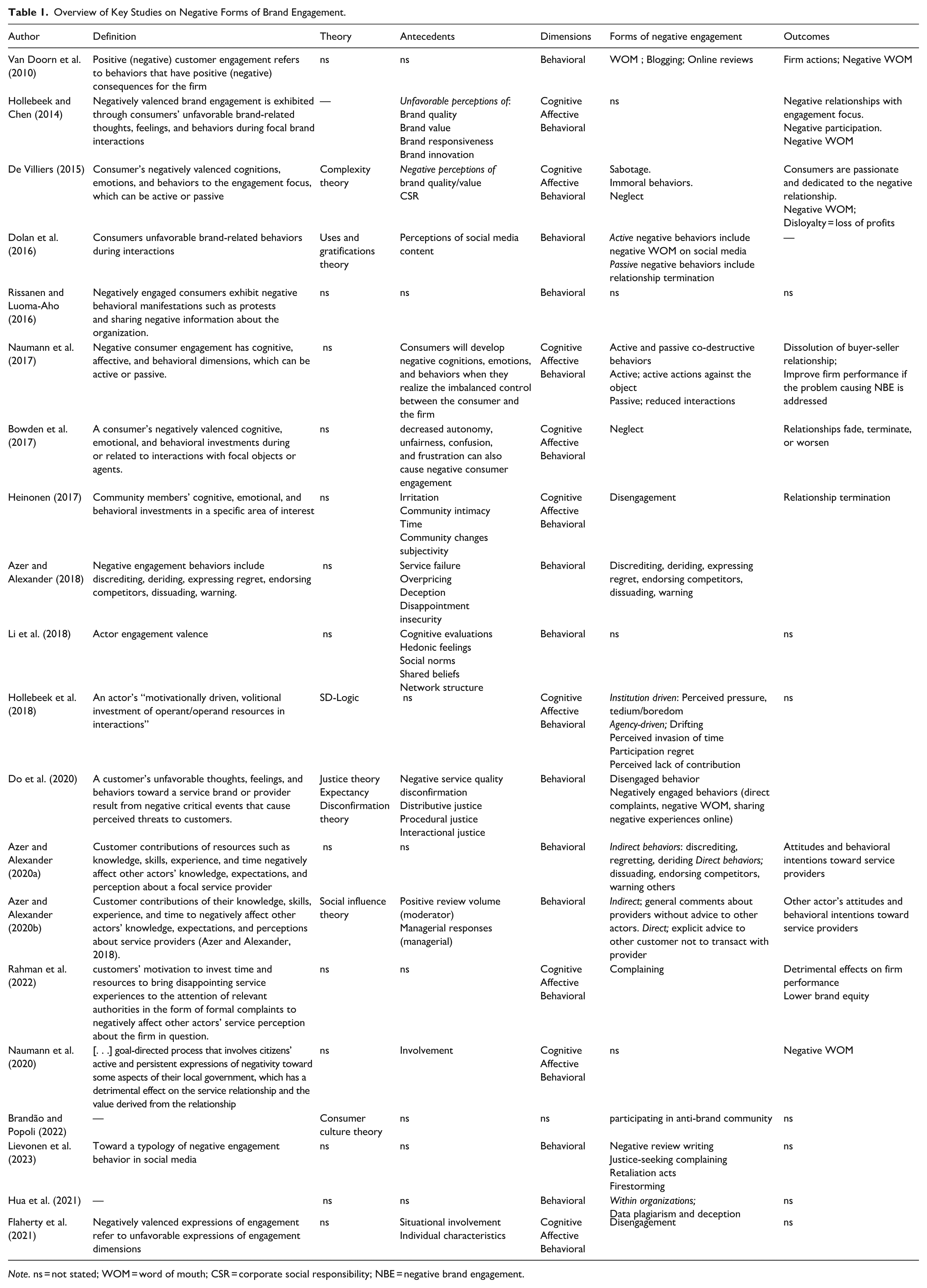
Note. ns = not stated; WOM = word of mouth; CSR = corporate social responsibility; NBE = negative brand engagement.
We develop a conceptual framework that draws upon recent examples of influencer scandals to establish the effectiveness of this commonly adopted pathway in practice. Second, prior research concerning NBE has demonstrated a lack of theoretical underpinning (Table 1, Column 3), for example, Hollebeek and Chen (2014) and Bowden et al. (2017). Table 1 shows that just six of the prior studies on NBE utilize an underpinning theory within their research. Further, these studies focus largely on customer-focused theories. Our review of the literature also reveals a lack of theoretical underpinnings focused on the role of the partner-brand. Given that the focal object of NBE in this study is the partner-brand, we adopt signaling theory as a brand-focused theory supporting our conceptualization.
The third gap evident from our review of prior studies is the dominant focus on antecedents that increase the occurrence of NBE. Lacking is a consideration of how partner-brands might mitigate NBE. Utilizing signaling theory, our study seeks to fill this gap by establishing the critical role of forgiveness in reducing NBE, along with the importance of perceived brand authenticity and immediacy of response as ways to increase forgiveness and ultimately reduce NBE. This knowledge is important, as it offers clear evidence for partner-brands to consider when determining their strategies following a partner-influencers scandal, should they wish to mitigate negative consequences for their brand, such as NBE. Table 1 presents a summary of key studies related to NBE.
Conceptual framework
The literature review identified a need to investigate the pathway of mitigating NBE. In addressing this, we propose the conceptual model in Figure 1 based on the specified pathway observed in practice; it starts with the forgiveness of the influencer, followed by the partner-brand forgiveness, which, if effective, should mitigate NBE. By following this pathway, the conceptual model tells two important stories. First, we highlight the central role that brand forgiveness has in mitigating NBE; through the direct relationship with NBE (H1) and indirectly by mediating the relationship between increasing influencer forgiveness and NBE (H2). Second, we consider the important role of two factors within the partner-brand’s control: brand authenticity perceptions and the immediacy of the response. We propose that perceived brand authenticity increases customers’ willingness to forgive the partner-brand (H3) and reduces NBE, again via brand forgiveness (H4). Finally, we propose that the immediacy of a partner-brand’s response strengthens the relationship between brand authenticity and brand forgiveness (H5).
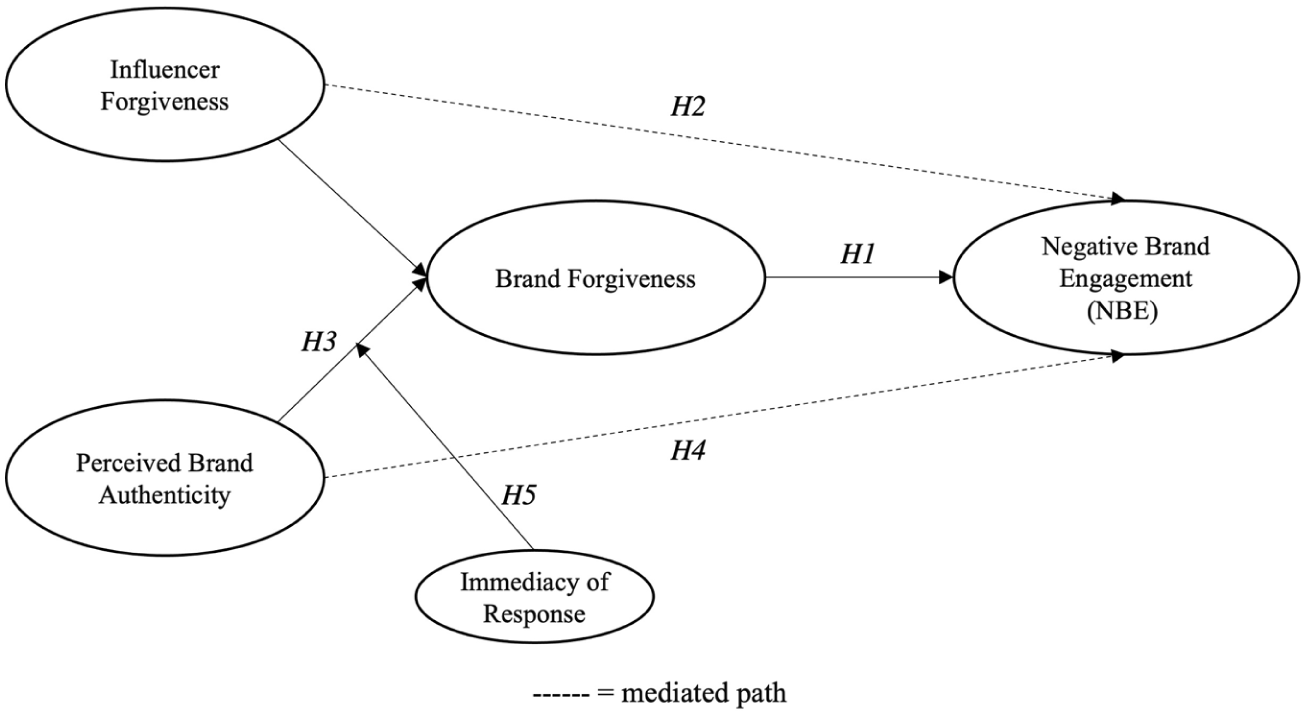
Conceptual model.
Theoretical underpinning
Expectancy disconfirmation theory as a domain theory
Negative brand engagement is a multifaceted phenomenon, as evident in Table 1. While many studies lack a theoretical underpinning, those that employ theory use various approaches, reflecting the complexity of the phenomenon and its context. Many of the theories used in these studies have a limitation in that they exhibit a positive or benefit-focused bias. Theories such as Uses and Gratification Theory (Dolan et al., 2016), Service-Dominant Logic (Hollebeek et al., 2018), and Social Influence Theory (Azer & Alexander, 2020b) inherently assume positive, collaborative, or benefit-driven outcomes. The only study to adopt a negatively oriented theory is Do et al. (2020), which uses Expectancy Disconfirmation Theory (EDT) to provide a foundational understanding of how negative brand engagement arises. When consumers experience a gap between their expectations and the actual performance of a product or behavior of a brand, this mismatch, known as negative disconfirmation, fuels feelings of disappointment or frustration, which can escalate to negative brand engagement (Oliver, 1980). In the context of an influencer scandal, followers form expectations based on the influencer’s persona, values, and lifestyle. When these expectations are shattered due to a scandal, followers experience disconfirmation, leading to feelings of outrage and subsequent negative engagement directed toward the partner-brand. Given this, EDT will underpin our proposed framework.
Signaling theory as a method theory
While EDT explains consumers’ reactions to unmet expectations, it lacks guidance on how brands can mitigate negative outcomes following an influencer transgression. The same limitation applies to the other theories highlighted in Table 1. Therefore, we adopt Signaling Theory as our method theory to provide a framework for understanding and analyzing the brand’s role in overcoming such transgressions. A method theory offers concepts and analytical tools that guide the research process and interpretation of findings (Gregor, 2006; Whetten, 1989). Signaling Theory shifts focus from the influencer’s attributes to the brand’s strategic role in managing consumer perceptions. It describes how brands convey information—signals—about themselves to influence others’ perceptions and behaviors (Connelly et al., 2011). By integrating EDT with Signaling Theory, we create a comprehensive framework that not only explains negative brand engagement after influencer transgressions but also offers strategic insights for brand response. This combined approach shifts the focus from an influencer-centric view to emphasizing the brand’s role in managing consumer perceptions and responses.
The premise of Signaling Theory is that customers have limited information about a brand’s unobservable quality, behavior, or intent but desire more to aid decision-making (Connelly et al., 2011). This information asymmetry creates uncertainty and perceived risk, which brands seek to reduce by sending signals. Critical to Signaling Theory are two characteristics: first, signals must distinguish high-quality from low-quality actors (known as the separating equilibrium); second, for customers to trust these signals, they must be perceived as sufficiently costly to the sender (Bergh et al., 2014; Connelly et al., 2011). In influencer marketing, brands collaborate with credible influencers who can send effective signals that reduce information asymmetry. A brand endorsement is a costly signal; influencers risk their reputation if they endorse a low-quality brand. Conversely, low-quality brands may find it difficult or costly to collaborate with credible influencers (Bergh et al., 2014; Connelly et al., 2011).
Signaling Theory has been applied in influencer marketing to understand how positive signals from influencers impact judgments (Wilkie et al., 2022). However, the significance of Signaling Theory becomes even more pronounced in the context of influencer scandals. An influencer scandal results in the customer challenging or questioning their beliefs about the partner-brand’s quality, behavior, or intent, which creates uncertainty for the customer. To overcome this uncertainty, the influencer and the partner-brand need to send signals to re-establish their integrity and ultimately reassure customers of their intentions and behavior, reducing uncertainty and mitigating NBE. This study focuses on three factors positioned as credible signals: how the customer views the influencer’s and partner-brand’s response to the scandal, the partner-brand’s perceived authenticity, and its response speed.
The importance of forgiveness
Recently, the notion of forgiveness has been discussed as an important consideration for brands, with studies indicating that positive brand perceptions decrease when customers cannot forgive brands following scandals (Costa & Azevedo, 2023; Kennedy & Guzmán, 2020). As discussed earlier, Joireman et al. (2013, p. 319) define forgiveness as “an intrapersonal act of letting go of negative emotions.” This act can be directed in three ways: the forgiveness of self, forgiveness of others, and forgiveness of situations (Fetscherin & Sampedro, 2019). In line with prior research in the marketing domain, this study focuses on the forgiveness of others, that is, the brand and the influencer. Prior studies have explored brand-forgiveness after a service recovery strategy (e.g. Casidy & Shin, 2015; Yagil & Luria, 2016). In this area, scholars have found that the severity of the brand scandal and its response influence forgiveness rates (Tsarenko & Tojib, 2015).
While these studies provide valuable contributions to understanding forgiveness, we have yet to understand the impact of forgiveness on focal objects: the brand and the influencer. Moreover, while scholars have explored the consequences of customer-brand forgiveness on negative word of mouth (e.g. Casidy & Shin, 2015; Costa & Azevedo, 2023), repurchase intentions (e.g. Costa & Azevedo, 2023; Tsarenko & Tojib, 2015), to the best of our knowledge, the relationship between forgiveness and NBE is yet to be explored. Instead, prior studies concerning the antecedents of NBE, as summarized in Table 1, highlight negative customer feelings such as negative emotion (Rodrigues & Borges, 2021), feelings of unpleasantness and pain (Higgins & Scholer, 2009), and fearful emotions (Ferguson & Johnston, 2011). While these studies focus on factors which enhance NBE, we focus on how NBE can be reduced.
We argue that customers’ willingness to forgive a partner-brand will directly reduce their likelihood of adopting NBE. We draw upon signaling theory to support this notion. Apologizing and acknowledging the wrongdoing is seen as a credible signal because it provides information aimed at reassuring customers of what the partner-brand sees as acceptable behavior, and given the potential reputation damage and the monetary cost, perceived as an action a high-quality brand is more likely to do (Demsar et al., 2023). Therefore, brand forgiveness represents a way to reduce the information asymmetry, ultimately meaning customers are reassured and less likely to adopt NBE.
H1: Brand forgiveness reduces negative brand engagement.
Customers must also determine whether they will forgive the influencer for their actions. For researchers, we need to identify whether influencer forgiveness can result in the forgiveness of the partner-brand. Despite this need, extant literature tends to examine the role of forgiveness of a human brand (e.g. a celebrity; Finsterwalder et al., 2017) and brand forgiveness (Fetscherin & Sampedro, 2019) separately, rather than looking at the relationship between the two. Consideration of the relationship between the forgiveness of the influencer, and the forgiveness of the brand, and how this ultimately influences negative brand engagement, is particularly relevant in this context. This is because in influencer marketing collaborations, influencers and brands often work as close partners (S. Chung & Cho, 2017; Enke & Borchers, 2019), and often establish long-term relationships (Jin et al., 2019).
Existing research has demonstrated that brands and influencers are interconnected in the context of forgiveness and brand perception (e.g. Singh et al., 2020). These studies often examine how an influencer can help encourage forgiveness following a brand scandal. In our model, we leverage this interconnection to propose that customers’ willingness to forgive an influencer will affect their willingness to forgive the partner-brand. Adopting an integrated perspective, we argue that customers’ willingness to forgive an influencer will affect their willingness to forgive the partner-brand.
Like previous research explaining explain service recovery (e.g. Byun & Jang, 2019; Kharouf et al., 2020) and customer forgiveness (Ali et al., 2023), we also use signaling theory to suggest that the influencer’s response, such as apologizing and acknowledging the wrongdoing, sends a signal to customers because it provides information that distances the partner-brand from the influencer’s scandal, reassuring customers of the partner-brand’s behavior and intentions.
We expect that the potential reputation and monetary damage from such an admission mean that customers will see this as an action a high-quality influencer is more likely to do. Hence, the signal is credible. Accordingly, we propose that when consumers feel a level of forgiveness toward an influencer, it will influence their perceptions of the partner-brand’s behavior and intentions, reducing uncertainty and information asymmetry, thus causing a reduction in NBE.
H2: Influencer forgiveness reduces negative brand engagement through increasing brand forgiveness.
Brand authenticity and its effect on forgiveness and NBE
While prior research often focuses on customer responses to scandals, this study investigates the brand-related factors that can affect forgiveness and mitigate NBE. Prior research has considered some brand-related factors in relation to forgiveness. For example, Sinha and Lu (2016) found that customers are more forgiving when the partner-brand has no control over the scandal, and when customers have strong relationships with the partner-brand. Saldanha et al. (2023), in their conceptual work around cancel culture, propose that a lack of warmth and confidence in a brand among consumers is likely to increase the risk of cancellation. Specifically, the underlying mechanism is likely to be that warmth and competence in the brand will likely increase the likelihood of a consumer forgiving a transgression (Saldanha et al., 2023). However, we argue that brand authenticity, consisting of relational authenticity (the perceived sincerity of the brand in its relationship with consumers) and behavioral authenticity (actions consistent with stated brand values; Ilicic & Webster, 2014), represents a more appropriate underlying mechanism influencing forgiveness following a scandal, because these dimensions directly address consumer concerns about whether a brand’s response after a scandal genuinely reflects its true character, intentions, and values.
Drawing upon signaling theory, we propose that customer perceptions about the partner-brand (i.e. perceived brand authenticity) can increase partner-brand forgiveness, and ultimately, reduce NBE. Authentic partner-brands that pursue openness and sincerity (i.e. relational authenticity) with customers, and act in accordance with their values (i.e. behavioral authenticity), will build trust (Ilicic & Webster, 2014; Kernis & Goldman, 2006). This trust leads consumers to perceive the brand’s apology or actions following a scandal more positively because it is a credible signal; it reduces perceived risks and uncertainty toward the partner-brand (Schallehn et al., 2014). It is an association that differentiates high- from low-quality brands, and is costly (i.e. a low-quality brand is unlikely to send out signals of authenticity due to the potential repercussions to the brand’s performance from false signals). Consequently, customers will be more likely to forgive the partner-brand because authenticity enhances perceptions that the response is genuine.
H3: An increase in perceived brand authenticity will increase brand forgiveness.
Next, we propose that authenticity perceptions reduce NBE via brand forgiveness. In the context of brand-scandals, prior research has found that higher brand authenticity perceptions can lower perceptions of partner-brand responsibility for a scandal (Guèvremont & Grohmann, 2018). This moral decoupling, disassociating the partner-brand from the influencer scandal (Sharma et al., 2020), decreases the likelihood of NBE by reducing negative associations. However, this decoupling is not immediate; it is likely that the perceived authenticity of the brand will first increase customers’ willingness to forgive the partner-brand, creating a chain of effects. We therefore hypothesize a mediating effect where brand forgiveness plays a critical role in the relationship between perceived brand authenticity and reduced NBE. Building on previous research that links authenticity with consumer perceptions of brand behavior, we argue that when customers view a brand as authentic, they are more likely to believe that the brand is acting in accordance with its values and intentions, even in the face of scandal. Brand forgiveness, as an intermediary, allows customers to soften their negative feelings toward the brand, thereby mitigating NBE. Authenticity acts as a signal of the brand’s sincerity and credibility, which fosters forgiveness and ultimately reduces the likelihood of negative engagement with the brand. Therefore, the mediating role of brand forgiveness is key to understanding how perceptions of authenticity influence customer responses to scandals.
H4: Perceived brand authenticity reduces negative brand engagement through increasing brand forgiveness.
The role of immediacy of response
At the onset of a scandal, information asymmetry, uncertainty, and media scrutiny are all at their highest levels (Bundy & Pfarrer, 2015). With the increasing popularity and disruptiveness of social media, the speed of information broadcasting has grown rapidly, ensuring that news of an influencer’s scandal can become a worldwide event in a matter of hours, way beyond the parameters in which scandals used to be restrained (Kintu & Ben-Slimane, 2020). Extant research shows that an immediate response increases the probability of the partner-brand being perceived as credible, as opposed to partner-brands that react slowly, and face criticism and negative feedback from customers as it signals a lack of awareness for the customer (Kintu & Ben-Slimane, 2020). Further, partner-brands that react slowly damage their reputation and risk increasing negative engagement (Kintu & Ben-Slimane, 2020; Roschk & Kaiser, 2013; Vredenburg & Giroux, 2018; Zhou & Whitla, 2013). Hence, an immediate partner-brand response in the wake of an influencer scandal is necessary.
How the immediacy of response from the partner-brand affects the pathway of mitigating NBE can be hypothesized by again drawing upon signaling theory. A quick partner-brand response sends a credible signal to customers about its unobservable qualities (e.g. concern for the customer) and perceived credibility, which parallel perceptions of brand authenticity (i.e. consistent and appropriate behavior and genuineness in its relationships with customers). A low-quality brand might delay a response, hoping that the scandal will subside quickly with only minor reputation or monetary damage. In contrast, a high-quality brand would seek immediate forgiveness after an influencer scandal because of that awareness and concern for the customer, despite the risk of escalating its exposure (Demsar et al., 2023; Finsterwalder et al., 2017). Therefore, because the timing of response parallel perceptions of brand authenticity and can assist in partner-brand forgiveness, we posited:
H5: The immediacy of the partner-brand’s response will positively moderate the effect of authenticity perceptions on brand forgiveness.
Method
Questionnaire design
The questionnaire design contained several elements aimed at reducing potential bias. First, a theoretical and cognitive separation between the specified drivers and outcomes helped minimize the potential for self-generated validity issues (Feldman & Lynch, 1988). Next, questions and items were randomly presented, reducing the potential bias due to the survey structure (Dwivedi et al., 2016). To reduce social desirability bias, voluntary and anonymous participation was emphasized to respondents. There were also several data validation checks in the survey. First, respondents could only attempt the survey once. Second, respondents were eliminated if they provided unintelligible or meaningless responses to any open-ended questions or selected the same point rating consecutively on a prespecified set of statements (n = 13). To further ensure the data, respondents were also excluded if they failed an attention check (“This is a quality check. Please leave this statement blank.”; n = 133; Paas & Morren 2018). Finally, respondents who were too quick (i.e. less than one-third of the median time; n = 189) or too slow (i.e. more than two-thirds of the median time; n = 42) to complete the survey were also excluded. Note that the high number of failed respondents for each check was driven by the average eliminated respondent failing an average of 2.75 criteria.
Sample description, data collection, and screening criteria
A representative sample of the U.S. population was obtained through a third-party online panel provider called Prolific. An online panel was chosen due to its ability to reach the target audience, keep their identities anonymous, and the commercial arrangement of replacing any respondents who fail the validation checks. The data were collected with an online survey. The survey started with two screening questions; whether they have cancelled an influencer (i.e. unfollowed on social media) and purchased from a brand that was endorsed by this influencer before or after canceling. As part of these screening questions, respondents were also asked to name the influencer, provide their social media handles, and name the brand endorsed by the influencer. This information was essential for the subsequent triangulation process to ensure the accuracy and reliability of the data. Respondents provided the names of the influencers they had unfollowed, their social media handles, and the brands these influencers endorsed. We verified the influencer-brand connections and the influencers’ involvement in scandals through a systematic cross-referencing process. First, we checked the provided information against multiple independent sources, such as media reports, social media posts, and official brand statements. A brand endorsement and involvement in a scandal was confirmed if it each was mentioned in at least two independent sources. All respondents could name an influencer that was involved in a scandal and the partner-brand they had purchased from previously.
We also reviewed some statistics to establish whether respondents held negative views toward the influencer and the brand after the scandal. To provide reassurance that respondents canceled the influencer specifically due to a scandal, we analyzed their reported actions following the scandal, which indicated substantial engagement in cancel culture behaviors. Our data showed that 49% of respondents boycotted brands endorsed by the influencer, 39% boycotted media featuring the influencer, 38% liked or shared negative social media posts about the influencer, and 20% made negative social media posts about the influencer. These actions strongly suggest that the cancellation was a deliberate response to the influencer’s scandal, rather than simply unfollowing for other reasons. Additionally, we examined their purchase intentions of the brand moving forward, revealing an interesting U-shaped curve. Nearly 45% of respondents were less likely to purchase the brand after the scandal, with 80% of these responses in the bottom box of “definitely not,” indicating severe repercussions for the brands associated with the scandal. Conversely, 40% of respondents expressed positive intentions to continue purchasing the brand, with 43% in the top box of “definitely,” demonstrating that a certain segment of brand users is willing to decouple the brand from the scandal.
The final sample consisted of 254 customers who were at least 18 years old and fluent in English. The average age was 38 years old, with 59.7% of respondents being female. They were predominantly White (69.6%), followed by African American (13.4%), and then Asian (7.5%) American. Most respondents worked full-time (55.3%), followed by 14.6% being unemployed and job-seeking, while 14.2% were part-time workers. The top 3 brand categories that respondents had purchased an endorsed product from were beauty (30.4%), fashion (17.4%), and entertainment (15.4%).
Common method variance
Given the cross-sectional nature of surveys, there is the potential for the study to be affected by common method variance. The potential for such bias was investigated in several ways. First, we performed Harman’s one-factor test, which indicated that a single factor explained less than 50% (35.95%) of the variance (Podsakoff et al., 2003). Next, in line with Lindell and Whitney’s (2001) procedure, a marker variable test is conducted with the theoretically unrelated variable of a respondent’s love of nature. The results showed the correlation with the latent variables is less than .30. Finally, the VIF values for the latent constructs and items were less than 3.3 (Hair et al., 2016). The results from the three statistical tests strongly suggest that common method variance is not a concern.
Measures
Measures of the constructs draw on validated scales within extant literature. Respondents answered questions against a seven-point Likert scale, ranging from (1 = “strongly disagree, to “7 = “strongly agree.” The measures start with feelings of forgiveness toward the influencer and the partner-brand. Both were measured using four items adapted from Fetscherin and Sampedro (2019). Next, perceived brand authenticity is measured with seven items from Ilicic and Webster’s (2014) scale; five items relate to relational authenticity, while two encapsulate behavioral authenticity. Because they correlate strongly, they are operationalized as a higher-order, reflective-reflective construct. The importance of timing was captured by a single-item measure from Roschk and Kaiser (2013); “If the partner-brand apologizes immediately after news of its partner-influencer’s scandal emerges, I am more likely to continue to support the partner-brand.” Similarly, brand loyalty, using Back and Parks’s (2003) nine-item measure, was operationalized as a higher-order, reflective-reflective construct consisting of conative brand loyalty, cognitive brand loyalty, and affective brand loyalty. Given its well-established influence on brand-related outcomes (Back & Parks, 2003), brand loyalty was included as a control variable to account for pre-existing customer perceptions that may influence levels of forgiveness and negative brand engagement. The dependent variable is NBE, which consists of three constructs; negative cognitive, affective, and behavioral brand engagement, measured with twelve items by Naumann et al. (2020). These items are combined to form a higher-order reflective-formative construct we call NBE, which is explained next.
Negative brand engagement as a higher-order construct
The construct of NBE is put forward as a higher-order reflective-formative construct because they contain three conceptually congruent dimensions, but they are not interchangeable. For example, a change in one dimension (e.g. cognitive engagement) does not necessarily cause a change in the other (e.g. brand engagement). Further, removing either construct would likely alter the conceptual domain. Researchers might model these as stand-alone constructs; however, this increases the number of relationships and moderators, consequently increasing the model’s complexity, which increases and creates the potential for overparameterization. For this reason, modeling researchers advocate using higher-order constructs (Hair et al., 2016; Jarvis et al., 2003). Thus, we operationalize NBE as a higher-order reflective-formative construct consisting of negative cognitive, affective, and behavioral brand engagement.
Analysis and results
Partial least squares-structural equation modeling (PLS-SEM) with SmartPLS (Ringle et al., 2015) was used to estimate the hypothesized relationships because it offers several advantages. First, given the emerging nature of influencer marketing and NBE, our research explores a potentially new theoretical framework rather than confirming established theories (Lou & Yuan, 2019). PLS-SEM is suited for models with mediating and moderating relationships because the relationships are predictive rather than confirmatory (Leppäniemi et al., 2017). Next, PLS-SEM is more appropriate when the model contains formative constructs, unlike covariance-based SEM approaches, where formative constructs can lead to unidentified models (Peng & Lai, 2012). Finally, PLS-SEM provides robust model estimations when the data distribution is non-normal (Reinartz et al., 2009), which is the case in this study as skewness ranged from −1.18 to 1.28, and kurtosis values ranged from −1.24 to 0.67.
Measurement model
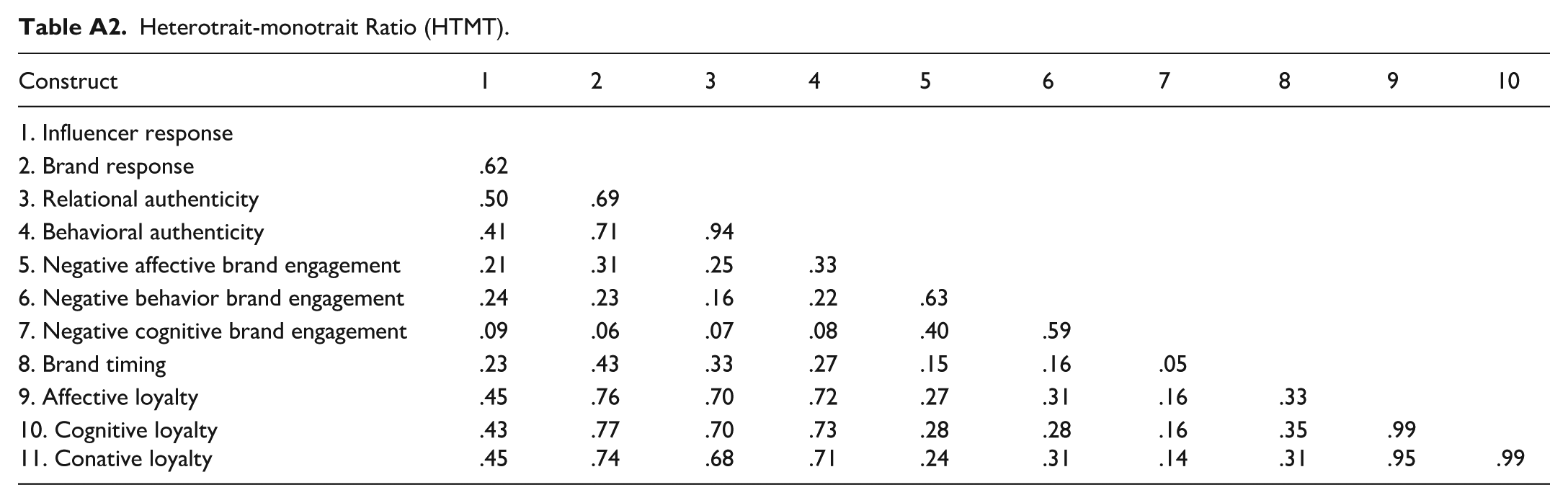
The measurement model assesses the reflective and formative measures. For the reflective constructs, the reliability of individual items was confirmed as the factor loadings ranged from .75 to .92 (see Table A1 in the Appendix A; Hair et al., 2016). The composite reliability values ranged from .75 to .92, exceeding .70 (Chin, 2010). In support of convergent and discriminant validity, average variance extracted (AVE) values ranged from .66 to .84, surpassing the minimally acceptable criterion of .50 (Fornell & Larcker, 1981). The heterotrait-monotrait ratio of correlations confirmed the discriminant validity of constructs as the values were all lower than .70 (see Table A2 in the Appendix A; Henseler et al., 2015), except between relational and behavioral authenticity (.94), and between conative brand loyalty, cognitive brand loyalty, and affective brand loyalty, which supports modeling these as a higher-order, reflective-reflective constructs. Overall, there is robust evidence of the validity and reliability of the measured constructs.
Confirming the formative constructs’ validity requires examining the variance inflation factors (VIF) to check for multicollinearity and test the outer weights for significance and relevance. Multicollinearity is not an issue as the VIF levels are below 2.3 (Hair et al., 2016). The outer weights for negative cognitive brand engagement (β = .55, p < .01), negative affective brand engagement (β = .63, p < .01), and negative behavioral brand engagement (β = .57, p < .01) support their retention as a higher-order, reflective-formative construct.
Structural model
The structural model is assessed by reviewing the significance of the path estimates and the level of variance explained in the dependent variables from a 5,000 resample bootstrap. Each dependent variables’ R-square and Q-square values, respectively, are as follows: brand forgiveness (.67 and .52), influencer forgiveness (.67 and .16), brand authenticity (.53 and .53), and brand timing (.11 and .10), and NBE (.18 and .13). Next, the root mean square error (RMSE) values are lower for the specified model than for a linear regression model, indicating high predictive power. Finally, we assessed the model fit by the standardized root mean square residual (SRMR), which was .05 and meets the criteria of being below 0.08 (Henseler et al., 2016). Thus, the model fits the data well.
Results
First, the results support H1 in that brand forgiveness reduces NBE (β = −.31, p < .01). This result suggests brand forgiveness is a mediator in the relationship between influencer forgiveness and NBE, as other hypotheses rely on its indirect influence on NBE. This starts with the proposed mediating effect of brand forgiveness on the relationship between influencer forgiveness and NBE (H2). That is, influencer forgiveness does not have a direct negative relationship with NBE, but indirectly through brand forgiveness. The results in Table 2 confirmed this mediating relationship as the direct relationship is insignificant (β = .05, p = .56), but the indirect effect is negative and significant (β = −.09, p = .01).
Assessment of the Structural Model for Direct and Indirect Pathways.
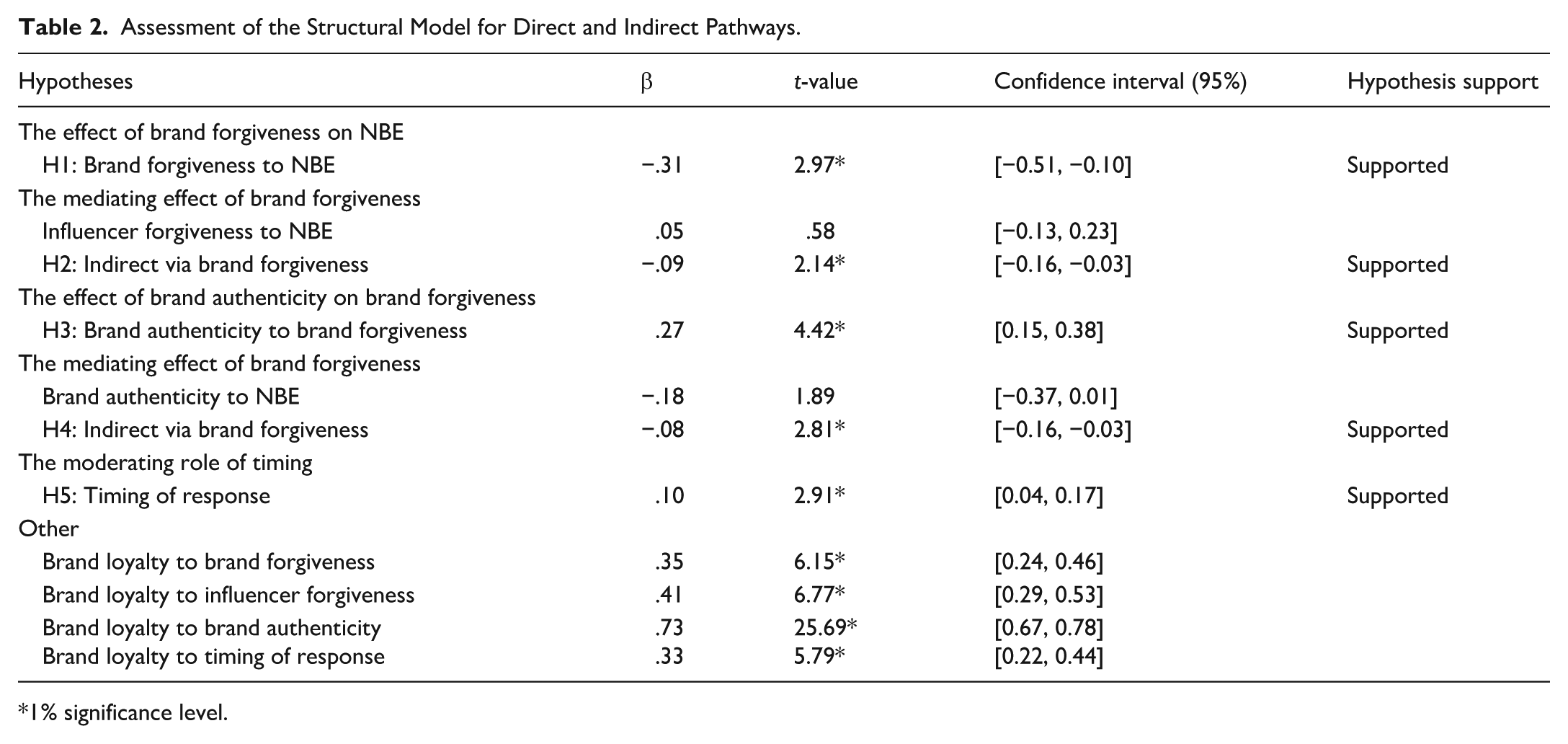
*1% significance level.
The results also support H3 in a positive relationship between perceived brand authenticity and brand forgiveness (β = .26, p < .01). A second mediating relationship involving brand forgiveness was H4; perceived brand authenticity reduces NBE through brand forgiveness, meaning that brand authenticity has a significant relationship with NBE through forgiveness toward the brand. The results in Table 2 again confirm the mediating effect of brand forgiveness (β = −.18, p = .06; indirect effect = −.08, p = .02). Finally, in support of H5, the timing of the partner-brands’ response positively moderates the relationship between authenticity perceptions on brand forgiveness (β = .10, p < .01).
Some supplementary findings reveal several notable indirect effects within the model. Findings from the control variable, brand loyalty, further support key relationships in the conceptual framework. In line with H4, brand loyalty has a significant indirect effect on NBE (β = −.34, p < .01) through brand authenticity and then willingness to forgive after a brand response, suggesting that loyal customers perceive authentic brands as more trustworthy and deserving of forgiveness, which in turn lowers NBE. In line with H2, brand loyalty indirectly promotes forgiveness through a multi-step pathway involving both the influencer and brand (Brand Loyalty → Willingness to Forgive after Influencer Response → Willingness to Forgive after Brand Response → NBE, β = −.04, p = .02), highlighting that loyal customers are more inclined to forgive both the influencer and the brand, potentially reducing NBE. Next, and in line with H5, the timing of the brand’s response has a significant indirect effect on NBE (β = −.06, p = .02), emphasizing the importance of a quick response. The interaction between brand timing and authenticity also has a significant relationship with NBE indirectly (β = −.03, p = .03), suggesting that authenticity is most impactful when paired with prompt action. These findings underscore that brand-related factors—especially loyalty, authenticity, and response timing—are potentially more critical in mitigating negative consumer reactions than influencer-related factors, such as willingness to forgive the influencer.
General discussion
As collaborations between brands and influencers grow, the often “live,” and highly interactive nature of social media means that partner-brands might be increasingly at risk of being associated with an influencer scandal. Yet little is known about the effects such scandals can have on partner-brands. This study focused on negative brand engagement (NBE) as the key consequence faced by partner-brands in this situation, and with this, sought to identify and explore factors that might mitigate NBE. Thus, providing theoretical and practical insights that contribute to understanding the negative side of influencer marketing, which are detailed next.
Theoretical implications
The first contribution of this research relates to the overall nature and process of NBE following influencer scandals. While research is beginning to address the drivers, forms, and consequences of NBE, evident is a lack of investigation into how partner-brands might mitigate NBE. This paper proposes a conceptual pathway commonly reflecting the events observed in practice; the influencer, followed by the partner-brand, apologizes to their customers, seeking forgiveness for their actions. The partner-brand then endeavors to distance itself from the partner-influencer. By following this pathway, we identify two key factors: forgiveness and brand authenticity perceptions. Specifically, we contribute to the growing recognition of the critical role of forgiveness by identifying its central relationship with NBE; through the forgiveness of the influencer and the partner-brand. Further, and in line with partner-brands endeavoring to distance themselves from the partner-influencer, our findings suggest perceived brand authenticity and response immediacy to a scandal for partner-brands can help increase forgiveness and potentially mitigate NBE.
Prior research concerning NBE has adopted fragmented approaches (e.g. behavioral vs. multidimensional views) and demonstrated a lack of theoretical underpinnings. Table 1 highlighted that of the studies reviewed, only six have drawn upon a named theory with their conceptualization. Common across these papers is that the named theory is consumer-focused with a positive or benefit-driven bias (e.g. social influence theory; Azer & Alexander, 2020b). This study overcomes that theoretical imbalance by first adopting the Expectancy Disconfirmation Theory as a domain theory to explain the negative emotional responses that arise from influencer transgressions. Second, we drew upon signaling theory to support our conceptual model, providing a theoretical lens for understanding how brands might mitigate NBE. Signaling theory posits that credible signals are needed in situations where information asymmetry exists to bridge the gap between what the brand knows and what the customer perceives. This is especially relevant when an influencer scandal occurs, leading to customers questioning their beliefs about the partner-brand’s quality, behavior, or intent, creating customer uncertainty and widening the information asymmetry. Our conceptual model incorporates this by suggesting that scandals trigger customer doubts. It also distinguishes between the influencer’s and the partner-brand’s responses, aligning with signaling theory’s assertion that signals must be costly or challenging to imitate to be deemed credible. Apologies and acknowledgements of wrongdoing from the influencer and the partner-brand may act as credible signals that can reduce information asymmetry, reassuring customers of the brand’s intentions and behavior, consequently helping reduce NBE. Finally, signaling theory highlights the importance of authenticity and timeliness in signals. Our conceptual model illustrates why customer perceptions about the partner-brand’s authenticity and the response timing work are critical. An authentic partner-brand, aware of and concerned for its customers, would prioritize sending credible signals immediately following an influencer scandal. This proactive approach demonstrates the brand’s commitment to maintaining trust, enhancing the credibility of the signal and increasing the likelihood of customer forgiveness, thereby mitigating NBE.
Signaling theory was further leveraged to justify forgiveness and brand perceptions as critical antecedents to NBE. Prior research into the antecedents of NBE has focussed largely on factors that enhance the likelihood or severity of NBE. Whilst these studies provide a rich insight into consumer-based (e.g. motivations; Dolan et al., 2016), context-based (e.g. service failure; Azer & Alexander, 2018), or organizational factors (e.g. unfavorable perceptions of brand quality; Hollebeek & Chen, 2014) that can enhance NBE, there is a lack of consideration regarding the brand-controlled factors that can mitigate these. Hence, Fetscherin (2019) called for further research to investigate the effects of the partner-brand response strategy on such scandals. This study sought to address this by considering antecedents that the partner-brand can seek to leverage when facing NBE. Thus, the findings that emerge from this different perspective provide insights to the fields of influencer marketing and brand engagement research.
Practical implications
This study highlights the significance and seriousness of NBE as a potential consequence of an influencer scandal within a brand-influencer partnership. Given the ongoing prominence of influencer marketing, it is likely that influencer scandals are a problem that will not go away, no matter the brand’s mitigation efforts. Based on our findings, we can make clear recommendations for marketing managers to follow when a scandal hits, to avoid significant NBE.
First, it is essential that consumers forgive both the influencer and the brand in order to mitigate NBE. Whether such forgiveness is awarded is not in the influencer’s or brand’s control, but marketing managers may still be able to facilitate a process of forgiveness. A first step would be to transparently work with the influencer to, where possible, come to a mutually-agreed resolution. Obviously, this may be more or less difficult depending on the nature of the scandal, but it seems clear that many consumers who follow influencers have built parasocial relationships to an extent where they may be likely to empathize with their situation. In these circumstances, we recommend that marketing managers do not create the perception of treating influencers like marketing tools to be used and then discarded. Working transparently to genuinely apologize means using social media in the way it is intended; to openly communicate with both the influencer and followers. If forgiveness of both the influencer and brand is at all possible, such an approach will be at its foundation.
Second, it is essential that brands are perceived as authentic entities in order to mitigate NBE, through increasing the likelihood of brand forgiveness among consumers. A brand’s authenticity is developed over many years across many areas but, focusing on the influencer marketing context, there are several approaches a marketing manager could take to improve perceptions of authenticity. The Australian Consumer and Competition Commission (ACCC) 2023 states that influencers must clearly disclose promotional posts, avoid making misleading claims in those posts, and not use manipulative promotional practices. They state that brands must ensure that ensure that influencers are aware of their Australian Consumer Law obligations and avoid prescribing misrepresenting content. Such fundamentals underpin authenticity, but also clearly and continually communicating with followers about the nature and ethics of the brand-influencer partnership is also likely to engender perceptions of brand authenticity.
Third, it is essential that brands respond to influencer scandals in a timely manner in order to mitigate NBE, through increasing the likelihood of brand forgiveness among consumers. Social media communities are fast-paced and dynamic and expect a level of immediacy of engagement that many brands are not structured to manage. Where scandals occur, brands should balance the need for careful consideration of their options, legally and ethically, with the need to respond to both the influencer and consumers within a number of hours. One way in which marketing managers can facilitate speedy responses in times of crisis is by developing their crisis response and reputation management plans for these specific circumstances over the long-term, rather than operating to processes created in the moment. According to Adweek (2023), “if you’re putting together a crisis response after the reporter reached out to ask for your statement, you’re already too late.” Such plans need to be co-developed between brand and influencer ahead of time, so that crisis response is proactive and not reactive to public response.
Overall, we find an important underpinning role of brand loyalty in facilitating levels of forgiveness and reducing NBE. In this way, it seems clear that those brands who work to build mutually beneficial relationships, rather than transactional interactions, with their customers over the longer-term will be more likely to successfully navigate influencer marketing scandals.
Limitations and future research directions
This is the first study aimed at understanding the nature, and drivers of NBE in the context of influencer marketing. We acknowledge several limitations which could be addressed in further studies. Limitations include the use of survey data, the generalizability of the results, and the conceptual scope of the study. Accordingly, we present several avenues for further research, designed to advance knowledge in this important field.
The study is limited to the use of survey data, and thus the hypotheses are tested using a cross-sectional design. Our results only show relationships between variables rather than confirming causality. To extend this study, future scholars may wish to conduct follow-up studies using longitudinal data. This could include surveying customers across multiple time points following an influencer scandal, examining how and when their forgiveness and NBE occur, and what role brand authenticity plays along this pathway.
In this study, we focus on perceived brand authenticity and response timing as two important factors influencing brand forgiveness. While these factors are relevant to practitioners, as partner-brands can have direct control over their response timing and improve authenticity perceptions, future scholars should consider other variables which could increase brand forgiveness. Given that we establish the central role of brand forgiveness in reducing NBE, any further insight into how brand forgiveness is enhanced would be relevant to scholars and practitioners.
Footnotes
Appendix A
Heterotrait-monotrait Ratio (HTMT).
| Construct | 1 | 2 | 3 | 4 | 5 | 6 | 7 | 8 | 9 | 10 |
|---|---|---|---|---|---|---|---|---|---|---|
| 1. Influencer response | ||||||||||
| 2. Brand response | .62 | |||||||||
| 3. Relational authenticity | .50 | .69 | ||||||||
| 4. Behavioral authenticity | .41 | .71 | .94 | |||||||
| 5. Negative affective brand engagement | .21 | .31 | .25 | .33 | ||||||
| 6. Negative behavior brand engagement | .24 | .23 | .16 | .22 | .63 | |||||
| 7. Negative cognitive brand engagement | .09 | .06 | .07 | .08 | .40 | .59 | ||||
| 8. Brand timing | .23 | .43 | .33 | .27 | .15 | .16 | .05 | |||
| 9. Affective loyalty | .45 | .76 | .70 | .72 | .27 | .31 | .16 | .33 | ||
| 10. Cognitive loyalty | .43 | .77 | .70 | .73 | .28 | .28 | .16 | .35 | .99 | |
| 11. Conative loyalty | .45 | .74 | .68 | .71 | .24 | .31 | .14 | .31 | .95 | .99 |
Declaration of conflicting interests
The authors declared no potential conflicts of interest with respect to the research, authorship, and/or publication of this article.
Funding
The authors received no financial support for the research, authorship, and/or publication of this article.
