




Abstract
This study examines how different stakeholders perceive influencer authenticity, revealing the misalignments that arise when each group prioritizes different aspects of authenticity. In doing so, the authors generate new theory on influencer marketing and provide managerial insights for brands and agencies to collaborate effectively with influencers to resolve these misalignments and ultimately build and sustain influencer authenticity. Using exploratory, in-depth interviews with consumers, influencers, brand managers, and influencer marketing agencies, the study triangulates stakeholder perspectives on influencer authenticity. Specifically, it examines the misalignment among these groups through the lens of assemblage theory and explores how these misalignments may be resolved to produce successful and lasting influencer assemblages. Finally, it explores how influencer marketing agencies can help manage authenticity misalignments.
Keywords
Unfortunately, many brands today think they can shortcut trust. They pay personalities to promote products they don’t actually use or believe in. The result is influencer marketing that feels fake and inauthentic, breeding distrust (and anger) among consumers.
The opening quote points to an emerging and troublesome phenomenon: brands and influencers are increasingly cooperating to produce content that consumers ultimately see as inauthentic. Industry observers are lamenting an “authenticity crisis” in influencer marketing; while consumers place increasingly more importance on authenticity in their interactions with influencers (Econsultancy 2022), their expectations are not met. Evidence suggests that while 88% of consumers want authenticity from influencers, nearly 50% of influencers are perceived to be inauthentic (HypeAuditor 2023; Morning Consult 2019), and 35% of consumers think influencers are dishonest and lack transparency when it comes to both their branded content and their own image (Lynch 2018). As a result, marketing agencies like Ogilvy have opted to avoid collaborations with influencers they consider inauthentic, particularly those who alter or retouch their bodies in their posts (Greenwood 2022).
This “authenticity crisis” in influencer marketing has given rise to important academic and managerial discussions (Audrezet, De Kerviler, and Moulard 2020; Chen, Yan, and Smith 2023) around what determines an influencer's authenticity. Prior work has tended to examine influencer authenticity mainly from one perspective, such as that of the influencers themselves or their followers (e.g., Audrezet, De Kerviler, and Moulard 2020; Lee and Eastin 2021). While these perspectives are undoubtedly useful, looking at authenticity through the lens of a single stakeholder neglects a holistic overview of the vested, and at times conflicting, interests of all key stakeholders, which may further exacerbate the authenticity crisis. Thus, this study addresses two critical questions: What misalignments exist between stakeholders regarding elements of authenticity that they deem important, and how do stakeholders navigate these misalignments to achieve influencer authenticity?
To address our research questions, we adopt the perspective that influencers are “assemblages” (DeLanda 2006) made up of measurable characteristics (properties), namely expertise (the extent to which the influencer is perceived to be an authority in a given field), connectedness (the extent to which followers feel familiar with and are engaged by the influencer), originality (the extent to which the influencer uses storytelling and shares personal experiences), transparency (the extent to which the influencer communicates in a balanced and open fashion), and integrity (the extent to which the influencer is perceived as intrinsically motivated), the interplay of which results in influencer authenticity.
In a social assemblage, influencers are not just individuals with a following on different social media platforms; they are part of a larger assemblage that includes various components: followers, brand managers, representatives of influencer marketing agencies, as well as branded content and endorsed products. These components of the assemblage interact with the influencer through their unique capacities, either stabilizing or destabilizing the influencer assemblage—and thus, its authenticity (DeLanda 2006). Because each component interacts with the influencer through their unique capacity, they will prioritize different properties of the influencer assemblage, creating various misalignments in the assemblage. To explore how these misalignments are resolved and how lasting influencer assemblages are formed—resulting in influencer authenticity—we adopt a discovery-oriented, theories-in-use approach (Zeithaml et al. 2020). We complement managerial insights from qualitative interviews with perspectives from consumers, influencers, and influencer marketing agencies to generate novel theory on influencer authenticity. This leads to two main contributions.
First, the current study reconceptualizes influencer authenticity through the lens of the major stakeholders involved. Notably, whereas prior research defined how consumers or influencers perceive authenticity (Audrezet, De Kerviler, and Moulard 2020; Lee and Eastin 2021), we found that when examined holistically, influencer authenticity is not a stable, inherent trait of the influencer, but is contextual and situational. Thus, through the lens of assemblage theory, we first define an influencer's authenticity as a holistic assessment by influencers, consumers, brand managers and influencer marketing agencies, based on five properties—namely expertise, connectedness, integrity, originality, and transparency—whereby the role and importance of each of these properties varies according to the stakeholder's own vested interest. Understanding the contextual nature of influencer authenticity through this holistic assessment shows that authenticity is not an inherent quality, but rather an alignment between the brand, the influencer, and the consumer. We explore how the five properties of the assemblage can be leveraged to create this alignment between the influencer, the brand, and consumers, thereby enriching our understanding of the construct of authenticity.
Second, ignoring the potential misalignments inherent in the assemblage limits our understanding of the key drivers of influencer authenticity. Thus, through the adoption of a holistic, multistakeholder perspective, this study explores how different stakeholders navigate the misalignments inherent in the influencer assemblage. We are hence able to map the misalignments between stakeholders and provide actionable recommendations to brand managers, influencers, and influencer marketing agencies for creating lasting influencer assemblages. This allows us to generate new knowledge (Table WA1 in the Web Appendix) on what constitutes influencer authenticity and address the authenticity crisis by guiding stakeholders toward building and maintaining influencer authenticity.
Influencer Authenticity
Authenticity in the marketing domain is defined as something that is “genuine, real, and/or true” (Beverland and Farrelly 2010, p. 839). Nunes, Ordanini, and Giambastiani (2021, p. 2) see authenticity as a “holistic consumer assessment determined by six component judgments (accuracy, connectedness, integrity, legitimacy, originality and proficiency) whereby the role of each component can change according to the consumption context.” Prior work examined influencer authenticity by looking at it mainly from one perspective: that of the influencers or their followers (Audrezet, De Kerviler, and Moulard 2020; Lee and Eastin 2021).
Audrezet, De Kerviler, and Moulard (2020) explored authenticity from the influencers’ perspective, and distinguished between two types of authenticity: passionate authenticity (e.g., when influencers are driven by an inner passion, more than by a commercial objective) and transparent authenticity (e.g., when influencers disclose information about the contractual terms of a collaboration). Lee and Eastin (2021) explored authenticity from the perspective of followers and argued that consumers assess influencer authenticity using the key constructs of sincerity, truthful endorsements, visibility, expertise, and uniqueness. In addition, Lindmoser, Weitzl, and Zniva (2022, p. 143) conceptualized influencer authenticity as the “extent to which consumers perceive a social media influencer as behaving in accordance with his/her true self.” While these perspectives are helpful, we aim to explore authenticity through the lens of all key stakeholders. To analyze potential conflicting interests and understand how stakeholders may navigate these successfully with the objective of creating and maintaining influencer authenticity, we adopt the perspective that influencers are “assemblages” (DeLanda 2006).
Assemblage Theory
DeLanda (2006) conceptualized assemblages as “agentic systems of different components that interact with one another in ways that can either stabilize or destabilize an assemblage” (Parmentier and Fischer 2015, p. 1229). Assemblage theory has been successfully applied in marketing to understand various phenomena, such as how consumers experience the Internet of Things (Hoffman and Novak 2018), how technology fuels consumers’ passion for consumption (Kozinets, Patterson, and Ashman 2017) and drives continued product usage (Franco et al. 2024), and how social media may destabilize brands (Rokka and Canniford 2016) or lead to audience dissipation (Parmentier and Fischer 2015).
The assemblage is defined by its emergent properties and capacities that arise from interaction among its component parts, as well as the expressive and material roles played by components during interaction (DeLanda 2006, 2016). In this view, the influencer assemblage is made up of various elements, or properties, which are measurable characteristics that specify what the assemblage is (Parmentier and Fischer 2015). We posit that the influencer assemblage comprises the properties of expertise, connectedness, originality, transparency, and integrity; in other words, traits and qualities that formulate these properties. In a social assemblage such as that of influencers, the components of the assemblage include both people and things (DeLanda 2006; Parmentier and Fischer 2015). More specifically, influencers are not just individuals with a following on different social media platforms, but rather part of a larger assemblage that includes various components: followers, brand managers, representatives of influencer marketing agencies, as well as the branded content and endorsed object.
We argue that all components within the assemblage interact with each other, contributing to either the stabilization or destabilization of the assemblage and, ultimately, to the formation of influencer authenticity (DeLanda 2006). In the context of assemblage theory, stabilizing the influencer assemblage involves strengthening its properties, thereby building influencer authenticity. Conversely, misalignments in these properties can destabilize the assemblage and tarnish influencer authenticity. In sum, the definition of influencer authenticity depends not only on the perceptions of influencers and consumers but also on the other components involved in the assemblage.
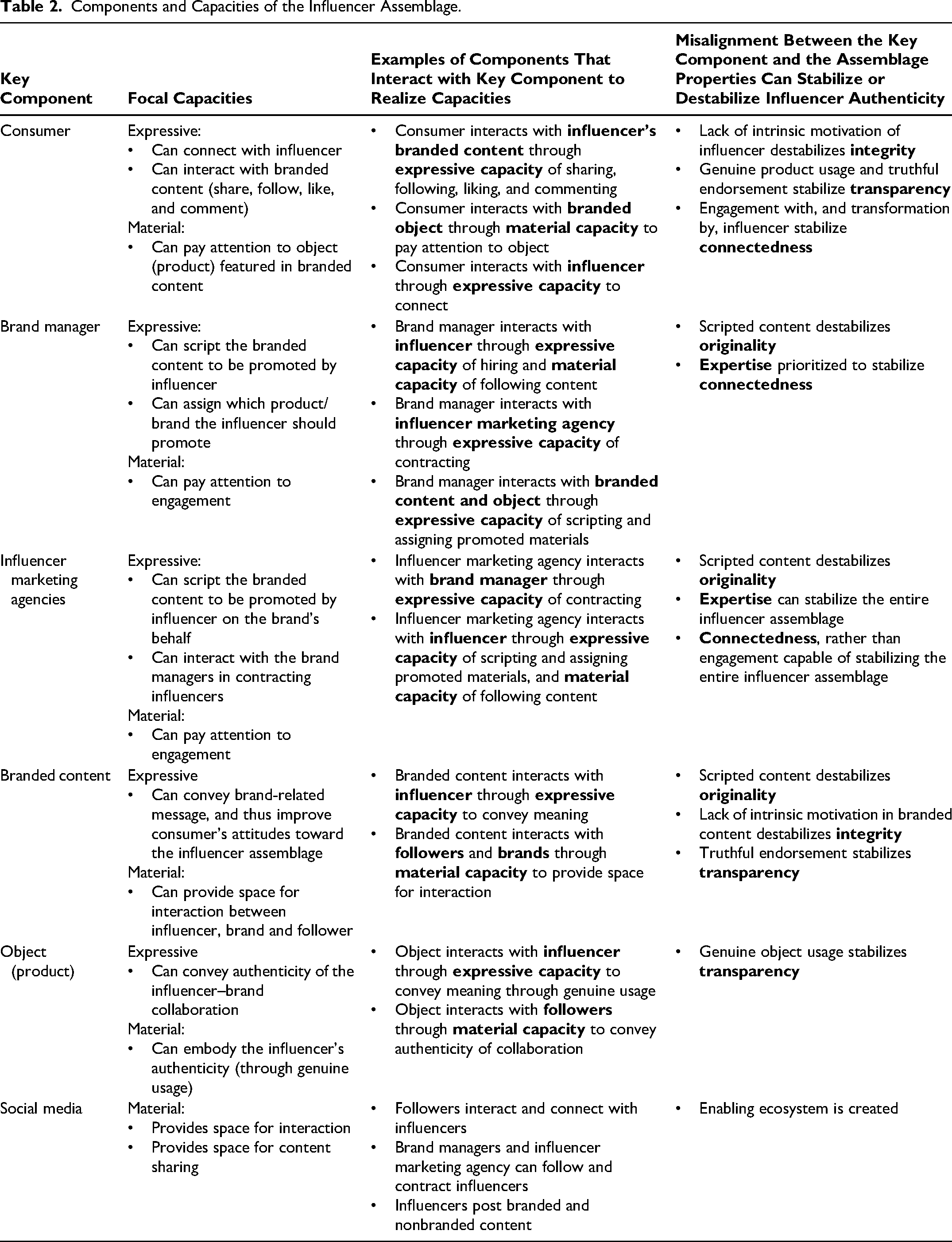
The components of the assemblage interact with other components and properties through their capacities, which define what the entity does or what can be done to it. DeLanda (2006) distinguishes between material and expressive capacities. While material capacities interact with the capacities of both sentient and nonsentient elements within the assemblage, expressive capacities only interact with sentient elements (i.e., people). For example, branded content has a material capacity to facilitate interaction between the influencer, the brand, and the consumer (e.g., through commenting, sharing, and liking the content), and an expressive capacity to convey an advertising message, improving consumers’ attitudes toward the brand and the influencer. Table 1 explains these concepts used in our theorizing, while Table 2 outlines the components, their focal expressive and material capacities, and how misalignments among components can stabilize or destabilize the assemblage.
Assemblage Theory Concepts Foreshadowing Some of Our Findings.
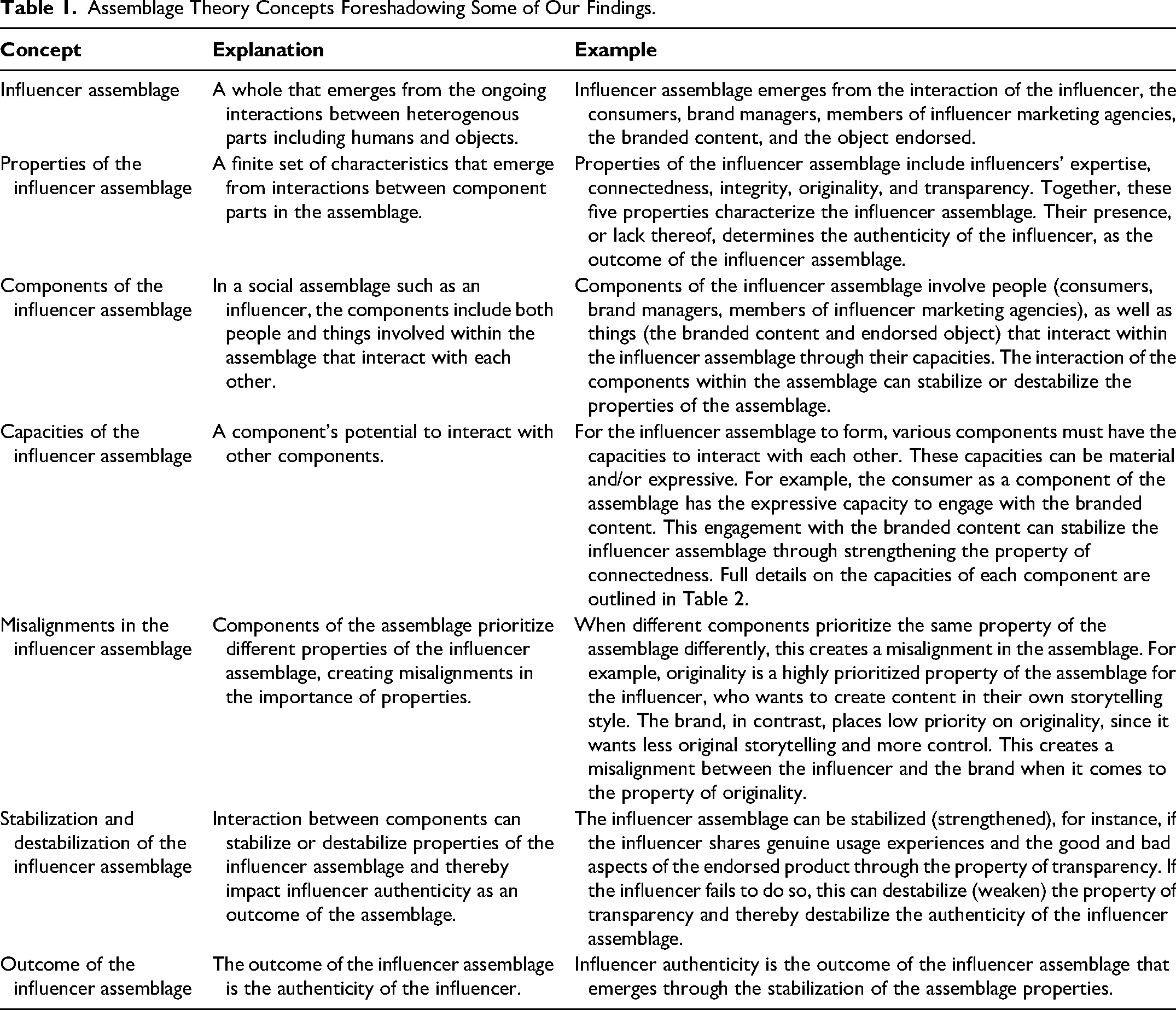
Components and Capacities of the Influencer Assemblage.
An Assemblage-Theoretic Characterization of Influencers
Before discussing our theoretical premises in detail, we first elaborate on how the influencer assemblage is brought together.
The wider context in which influencers come into existence, through their ability to interact with other components, is enabled by social media. Digital platforms such as Instagram, Snapchat, TikTok, and YouTube enable interaction between consumers and influencers (Fisher 2020). Similar to how celebrity watchers are embedded in ecosystems of intersecting social, cultural, and technological networks (e.g., Carrington and Ozanne 2022, p. 861; Puar 2012), influencers and their assemblage function within the enabling technological infrastructure, where social and cultural influences interact with technological interfaces. Drawing on Carrington and Ozanne (2022), who conceptualized celebrity watching as part of the social media ecosystem, we posit that the influencer assemblage exists within this dynamic ecosystem. This sociotechnological infrastructure connects material elements (e.g., phones, laptops, influencers, objects) to digital elements like social media platforms and content. The term “influencer assemblage” captures how influencers are part of this dynamic social media ecosystem. Next, we highlight key components of the influencer assemblage that contribute to its stabilization or destabilization, and ultimately, to the formation of influencer authenticity.
Brand managers play a critical role in the influencer assemblage through their expressive capacity to assign endorsed objects to the influencer and provide instructions on the branded content created by influencers. Brand managers also have a material capacity to follow the influencer and observe how engaged the consumers are with the influencers’ content. Their material capacity to do so is key in selecting influencers for partnerships. As one of our study respondents (BM11
1
) explained, their material capacity involves “[looking at] aspects like the engagement rate, past collaborations, customer feedback on their work, and their communication” to choose influencers to work with. Based on our interview findings, the most important metrics focus on an influencer's popularity (such as content quality, number of followers, and video views) and the quality of their followers: If an influencer has 300,000 followers, whose videos are viewed 15,000 times a day, vis-à-vis an influencer with 2,000,000 followers and whose videos are watched 30,000 times a day, then Influencer 1 is seen as a “higher-quality” influencer and more authentic. (BM42)
In some cases, brand managers exercise their expressive capacity to contract influencers, while in other cases, they collaborate with influencer marketing agencies. Influencer marketing agencies constitute another key component that has an expressive capacity to select and contract influencers. Influencer marketing agencies, like brand managers, have the expressive capacity to instruct on the branded content endorsed by the influencer, as well as the material capacity to follow the influencers’ work and assess engagement rates. The extent to which these two components exercise their expressive capacity in scripting content can either stabilize or destabilize the influencer assemblage.
The branded content and the endorsed object also possess material and expressive capacities that shape the influencer assemblage. Branded content has the material capacity to provide a space for interaction between the influencer, the brand, and consumers. When shared within the influencer assemblage, branded content may improve consumers’ attitude toward both the brand and the object being promoted, therefore stabilizing the assemblage. For instance, branded content that is consistent with an influencer's expertise and features truthful reviews and original storytelling has the expressive capacity to stabilize the assemblage by reinforcing key properties, such as expertise, transparency, and originality. Similarly, the endorsed object (e.g., a branded product) possesses an expressive capacity to stabilize the assemblage. When endorsing a branded product that the influencer genuinely uses, the object has the expressive capacity to stabilize the assemblage through the property of transparency.
To illustrate this point, consider influencer Victoria Magrath (Figure 1), who, even when endorsing a separate brand (such as Redken), simultaneously manifests authentic usage of the Dyson Airwrap, an object she had previously endorsed.
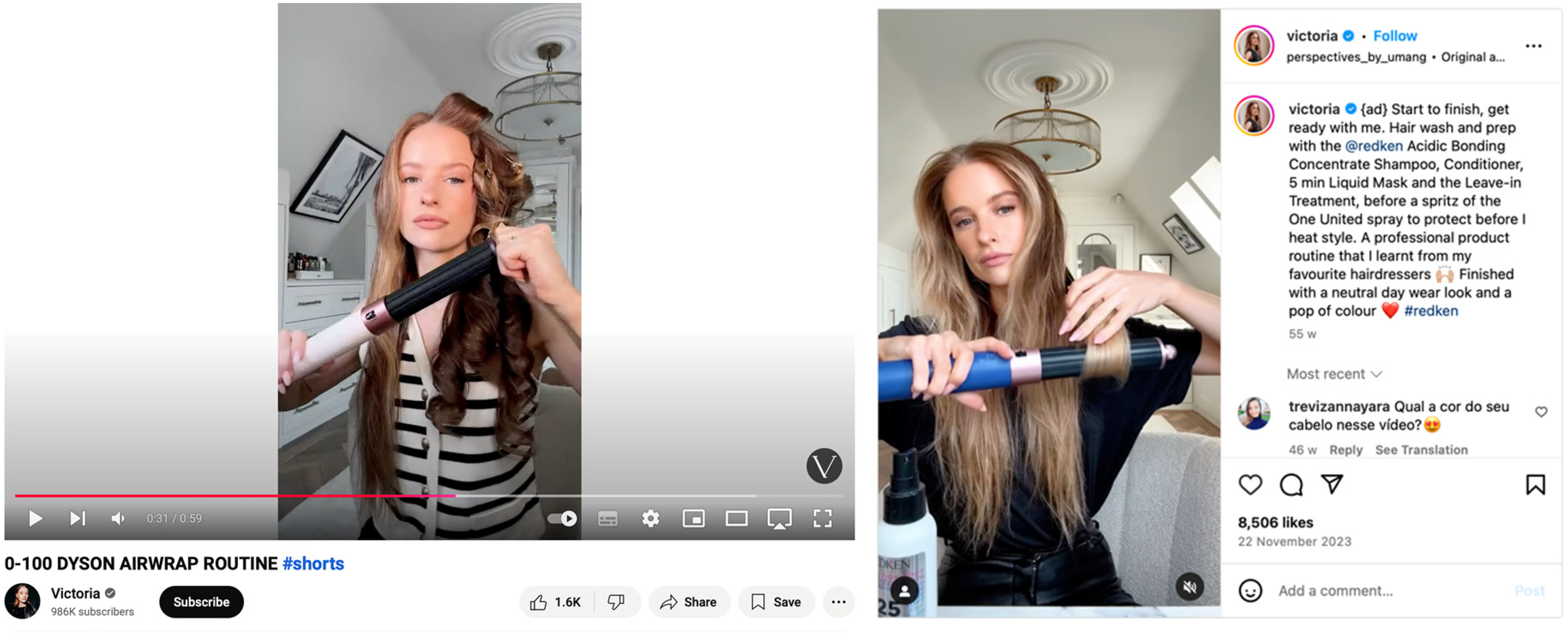
Victoria Magrath Genuinely Using a Previously Endorsed Object.
Consumers are another critical component of the influencer assemblage. Drawing from Parmentier and Fischer (2015) and McQuail (1997), we define consumers as those who pay attention to the influencer's content, whether by following them on social media, watching their content, or participating in discussions. An influencer's audience tends to be heterogeneous, including some deeply engaged fans who feel a sense of attachment (Thomson 2006), those who feel a sense of community with other followers (Muniz and O’Guinn 2001), and occasional viewers.
A key material capacity of consumers is their focal attention (DeLanda 2006), and since they devote attention to influencers’ content, they are integral to the influencer assemblage. Consumers’ expressive capacities to interpret and interact with an influencer's branded and nonbranded content allows them the opportunity to stabilize or destabilize the influencer assemblage. For instance, when consumers respond to influencers’ posts or engage in Q&A sessions, they contribute to stabilizing the assemblage by enhancing connectedness, which in turn bolsters influencer authenticity.
A good example is how consumers interact with influencer Jeffree Star's makeup tutorials (Figure 2), emphasizing how honest these videos are. Rather than promoting brands directly, these tutorials offer truthful reviews, thus stabilizing the influencer assemblage. Conversely, consumers’ material capacity to pay attention to the products endorsed by influencers can destabilize the assemblage if influencers endorse products they do not genuinely use, undermining transparency.
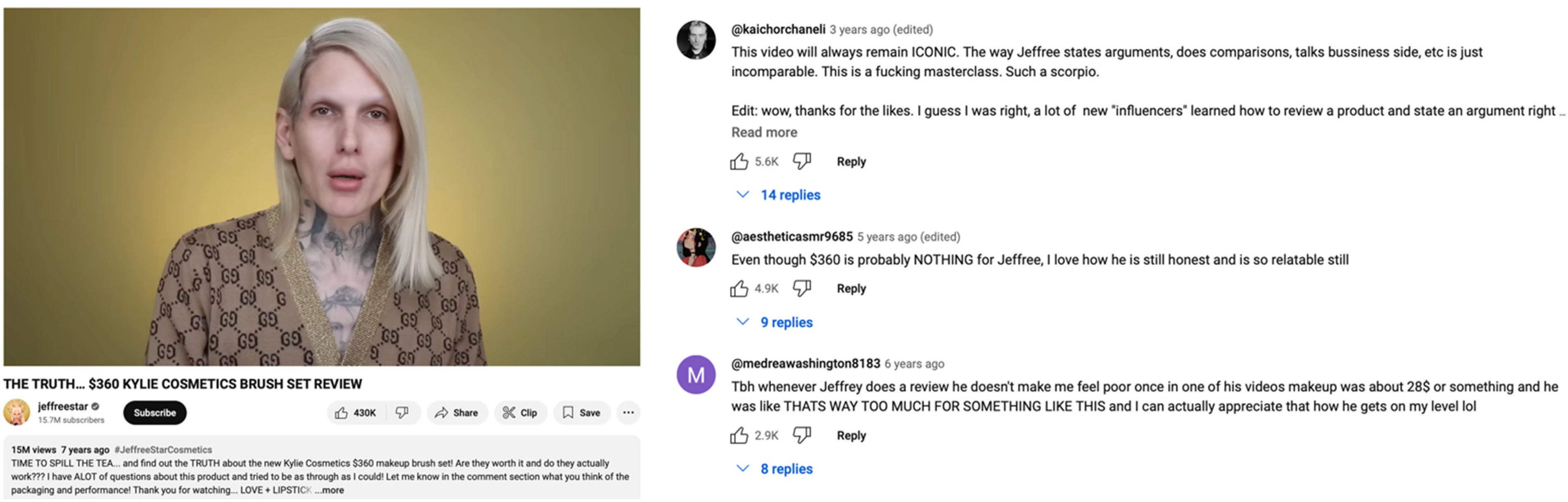
Jeffree Star's Truthful Endorsement Creates Interaction Among His Community.
Method and Data
We use this assemblage perspective to explore the dynamics of the influencer assemblage and observe how various stakeholders can work together to create lasting influencer assemblages. Specifically, we explore how different stakeholders define influencer authenticity and navigate the misalignments inherent in authenticity, using a discovery-oriented, theories-in-use approach (Zeithaml et al. 2020). Our research involved conducting 185 in-depth interviews across four groups of informants (see Table WB1 and WB3 in the Web Appendix) using purposive sampling to obtain a knowledgeable sample and derive rich insights (Patton 1990). Interviews were carried out with 42 consumers, 48 influencers, 56 brand managers, and 39 representatives of influencer marketing agencies. All 185 interviews were conducted in a one-on-one and face-to-face setting, or virtually using Zoom or Webex, and lasted between 43 and 96 minutes. All respondents were assured of confidentiality. In addition, 270 Amazon Mechanical Turk (MTurk) survey participants, who were prescreened to be consumers, were recruited to answer our questions about influencers.
Interview Protocol
Following Zeithaml et al. (2020), we developed a conversational guide with broad questions for participants, along with related probes and follow-up questions (Table WB2 in the Web Appendix). Each conversation was recorded, notes were taken, and a memo to oneself was written immediately following the conversation as to how it adds to prior ideas and points to future lines of inquiry. Data was collected in three rounds. The first round, conducted over 12 weeks in spring 2022, was aimed at “construct hunting” and involved 39 interviews with brand managers, consumers, and influencers from the alumni network and a series of executive education programs of a university. In addition, consumers were approached in a large shopping mall and invited to participate in the study. We also reached out to influencers on social media. The objective was to identify and develop the construct of influencer authenticity (Zeithaml et al. 2020). In this first round of data collection, we asked questions on what influencer authenticity and branded content authenticity mean to the respondents (see Part I in Table WB2 of the Web Appendix).
In the second round, 85 additional interviews were conducted in summer/fall 2022, to develop a tentative definition of influencer authenticity and establish a feedback loop for continual conceptual refinement (see Part II in Table WB2, Web Appendix). The in-depth interviews were designed to understand (1) what influencer authenticity means to different stakeholders, (2) how brand managers work with influencers, and the challenges inherent in such relationship, (3) what consumers perceive as authentic and inauthentic content, and their opinions on influencer authenticity, and (4) what the role of influencer marketing agencies is in managing the misalignments between influencers and brands. Consumers, brand managers, and influencers were approached through a series of university programs as well as social media. Purposive sampling was followed to recruit 16 participants from influencer marketing agencies. Moreover, 270 MTurk survey participants—prescreened to be consumers—were recruited to answer our questions on influencer and brand authenticity. A detailed description of the sample characteristics is offered in Table WB1 and WB3 (Web Appendix).
The third round, conducted between spring 2023 and summer 2024, involved 61 interviews. This round of data collection served the purpose of “construct trapping” and firming up the construct meaning and boundaries (Part III in Table WB2, Web Appendix). This enabled the researchers to refine the conceptual structure of influencer authenticity following multiple rounds of feedback loops, as recommended by Zeithaml et al. (2020).
Data Analysis
We employed systematized qualitative analysis involving open, axial, and selective coding (Strauss and Corbin 1990). Three members of the research team independently coded the transcripts using an open coding process (Corbin and Strauss 2008). The initial codes were identified and consequently grouped into first-order categories. The second step involved axial coding, where we identified how the first-order categories are related to each other through both inductive and deductive analysis (Strauss and Corbin 1990). Through this approach, the first-order categories we identified were collated into second-order themes that helped conceptualize the patterns in the data with respect to influencers’ authenticity. These second-order themes formulate the subcomponents of the properties of authenticity.
We followed an iterative process, moving among the interview data, revisiting the relevant literature, and identifying the emerging patterns to develop conceptual categories (Eisenhardt 1989). The literature on influencer authenticity and assemblage theory helped us identify the emerging theoretical propositions. We then grouped the second-order themes into theoretical dimensions that we refer to as properties of authenticity. We examined the relationship between the first- and second-order categories and refined them into simpler categories, through which the key dimensions were achieved. Table WB4 (Web Appendix) provides further details on each step in the data analysis procedure.
Findings
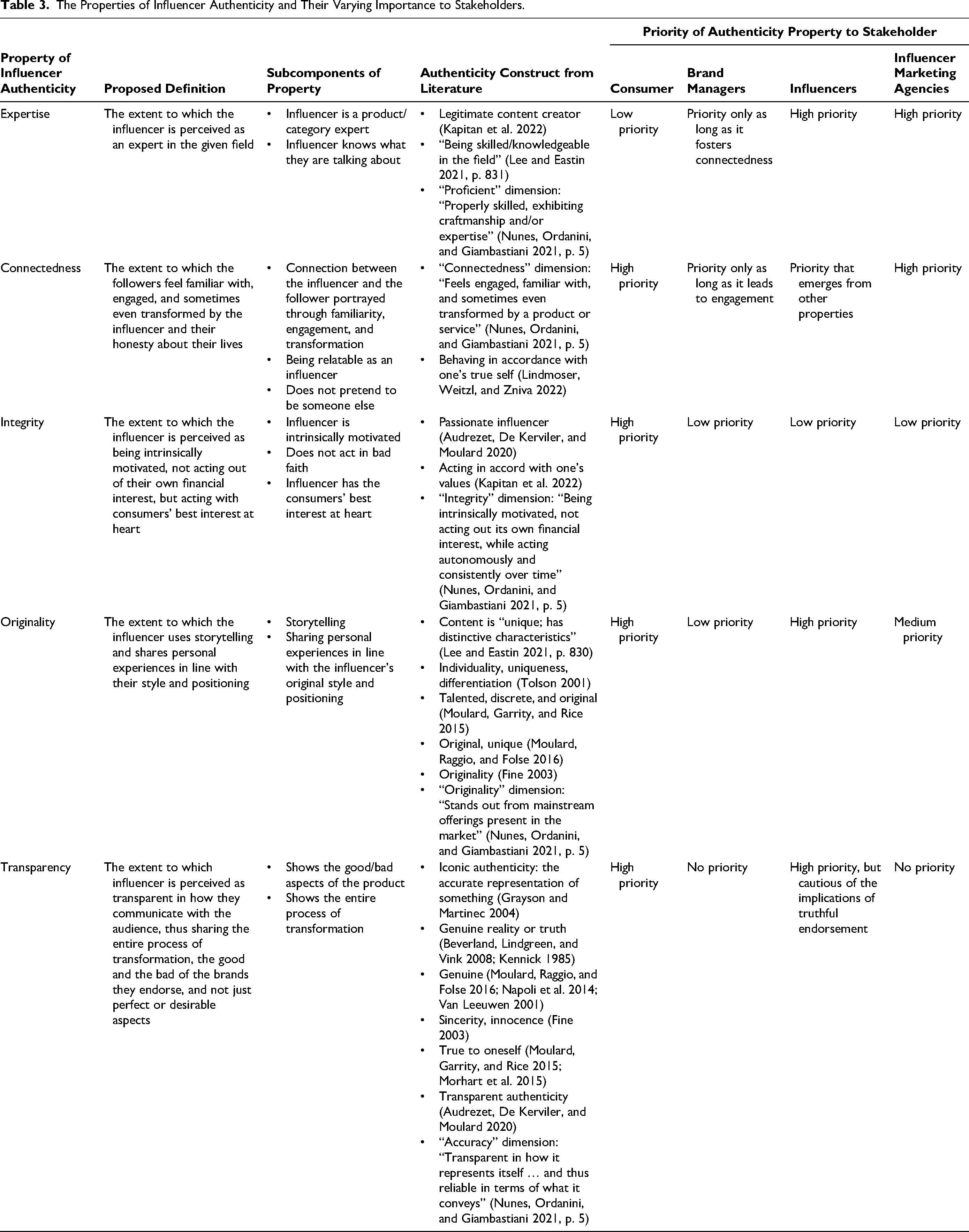
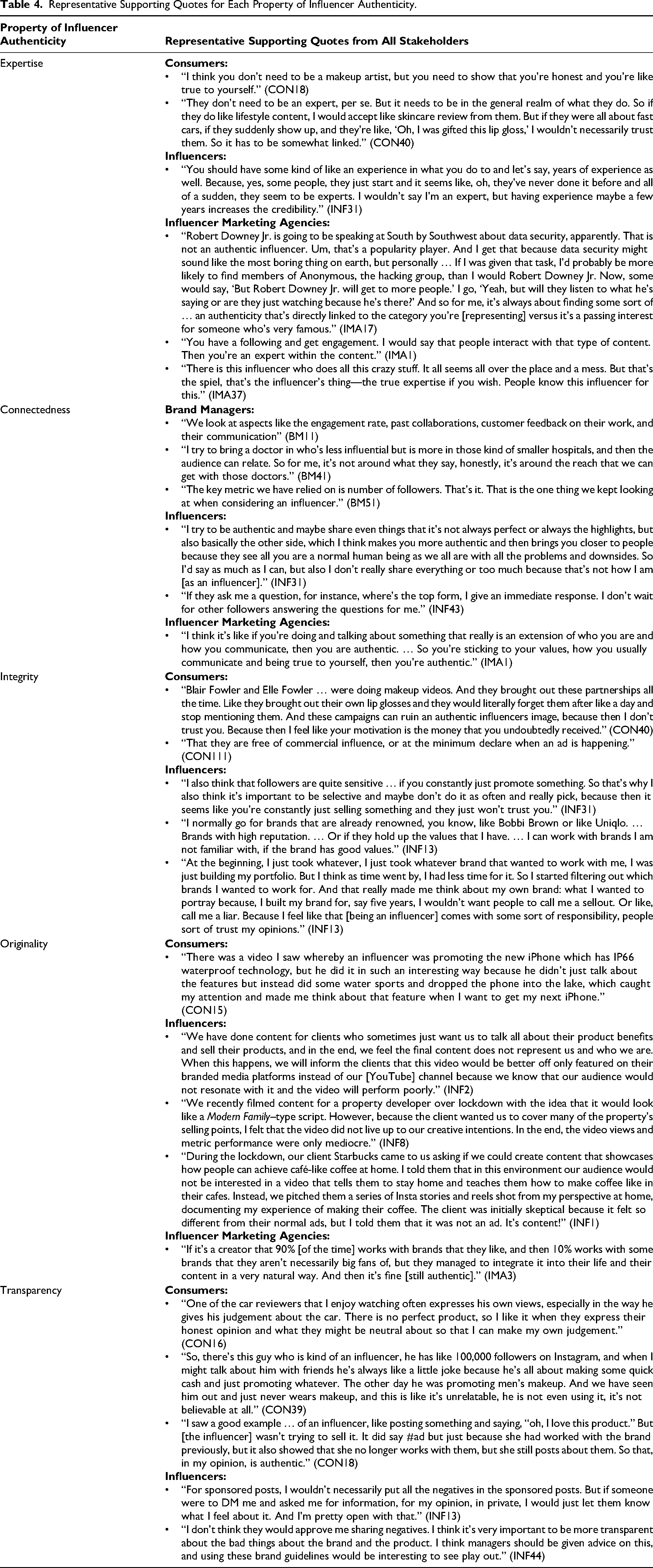
Influencer authenticity is not fixed but rather results from the interactions between the different components of the assemblage. The way these different components interact with each other can lead to misalignments, which can either stabilize or destabilize the influencer assemblage (DeLanda 2006; Parmentier and Fischer 2015). In the following sections, we explore these misalignments in further depth. Figure 3 provides a visual representation of the influencer assemblage, highlighting the misalignments between its various components. Specifically, Table 3 introduces the different properties of authenticity, highlighting how our definitions map onto prior constructs, while Table 4 presents the relevant data excerpts.
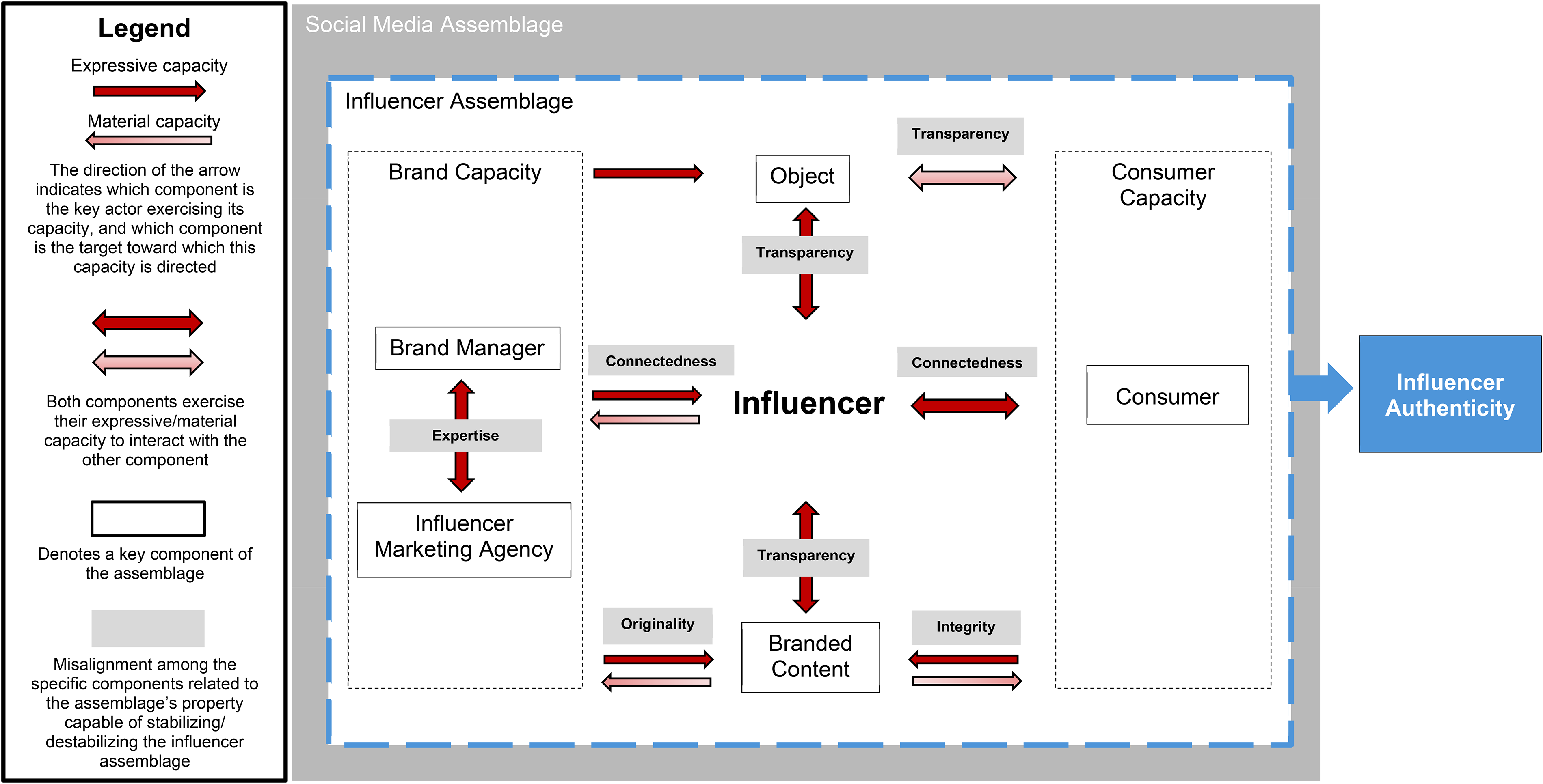
The Influencer Assemblage Within the Enabling Infrastructure of Social Media Assemblage.
The Properties of Influencer Authenticity and Their Varying Importance to Stakeholders.
Representative Supporting Quotes for Each Property of Influencer Authenticity.
Misalignments Linked to Expertise
The first misalignment between stakeholders in the influencer assemblage relates to the influencer's expertise, which we define as “the extent to which the influencer is perceived as an expert in a given field.” Our findings suggest that influencers place high priority on their expertise in a given domain. However, they do not describe expertise in the traditional sense of the word. For example, they do not think they need formal education or professional training in their specific area. Instead, they emphasize the need for a strong understanding of their field and rely on their expressive capacity to convey this knowledge to their followers through the content they produce. For instance, INF31, a food influencer, shared that while she is not a trained cook, she has successfully used her expressive capacity to connect with her followers by sharing homemade delicacies for over five years: You should have years of experience in what you do. Because some influencers have never done [something] before and all of a sudden, they seem to be experts. Having years of experience increases the credibility. (INF31)
A surprising and provocative finding is that while influencers prioritize their capacity to connect with consumers based on their expertise, it is a less pivotal property for the other components in the assemblage. Consumers, for instance, place a low priority on expertise. Instead, through their material capacity to follow the influencer's content, they focus more on whether the influencer seems knowledgeable and relatable, rather than on the influencer’s ability to impart professional or expert advice: Authenticity does not mean expertise, in the very strict sense of the word. Someone could be authentic and be like “Hey, I’m gonna come here and show you how I do my makeup and you know, I’m just learning myself, let's learn together.” That's very authentic. (CON39)
If an influencer is known as someone who likes to try out new trends, from a consumer's perspective, that may be labeled as expertise. Thus, consumers often find influencers who share content consistently on a given topic, along with being vocal about their struggles (e.g., their first steps of a personal journey), more believable than their “expert advice.” [The influencer] did a video just counting how many tiles he broke. And he was supposed to be an expert. If that was me trying this, I would break it a thousand times. So instead of having to watch a content where someone is faking that he just could get it done in the first try, he is showing you, look, I’m being authentic, I fail as well. (CON39)
A key insight from our research is that consistency in content creation often involves defining a specific niche. For instance, rather than following general fitness influencers, consumers tend to seek out those who consistently produce content within a certain niche. As CON38 noted: I started to turn away from following these experts, like sportsmen, to instead those that are amateurs in a specific sport. I was running a 10k, and I started to follow amateur runners preparing for a 10k. Their experience resonated with me more, and they gave me real advice. (CON38)
DeLanda (2006) argues that components of assemblages can exit and be replaced without destabilizing the assemblage, provided the capacities of the other components are sufficient. That is, as long as the influencer produces consistent content, formal expertise can be replaced by consistency. In contrast, influencers who move between different categories may fail in their expressive capacity to connect with followers, thus destabilizing the assemblage. For instance, CON1 described an influencer who usually featured high-end beauty products, and who, in CON1's view, lost authenticity by recommending a new shampoo with SPF protection. CON1 was skeptical about the product's claims and benefits, and she wondered why the influencer failed to address this important question and blindly promoted a cheap retail shampoo instead of her usual high-end brands. Consequently, CON1 claimed she had rejected both the brand and the influencer.
This highlights a critical repercussion of content consistency: stepping outside of a consistent content theme can not only destabilize the assemblage by diminishing perceived expertise but also negatively impact algorithm rankings. As INF43 noted: I wanted to talk about different things, so I created a new account to talk about productivity, procrastination, because I knew that it would mess up my algorithm. Whenever I post something that is not related to travel, it doesn’t get a lot of reach. For me, it's a bit more pragmatic. It's less about how I’m being perceived by others. It's more about how I’m being ranked with the algorithm. (INF43)
Brand managers, through their material capacity to follow influencers, believe that the property of expertise can foster connectedness, though being an expert as such is not a pivotal property of the assemblage. More specifically, brand managers view influencers’ expertise as enhancing their credibility and leading to favorable returns on investment. BM11, owner of a sustainable lifestyle brand, explained that she turns to workout class instructors to advertise her brand. As people “love” the classes provided by these teachers, they will trust them and the brands they recommend: “They get to tap into this community of people that trust them, and [can] transmit their advice … it's like word of mouth” (BM11).
Similarly, BM41, a brand manager in the pharma industry, mentioned that she partners with doctors to share knowledge about new pharmaceutical products. However, a challenge in the industry's regulated nature is that influencers cannot always be directed on what to say. To avoid paying influencers who do not fully endorse their product, BM41 now carefully selects influencers who can drive audience engagement: Being totally transparent, I may not use certain speakers over other speakers for sure. I had a doctor one time who loved getting involved with lots of people [companies]. But I have had a situation where I was asking him to talk about my product, but there was another product that was launching and he used the time to speak about the other product. That's fine, but it's not what my objective was. So I may not use him again. (BM41)
Brand managers believe that influencers, in crafting branded content, exert their expressive capacity to create credible brand messaging owing to their domain expertise. Influencer marketing agencies place high priority on expertise, viewing it as a stabilizing property that builds trust and credibility. As one respondent put it, “It is their expertise that makes you trust them” (IMA3), and it is their “credibility in the given field they represent that makes them authentic” (IMA17). However, a key misalignment in the assemblage stems from the level of priority placed on expertise by brands and influencer marketing agencies (see Figure 3). While brand managers see expertise as stabilizing the credibility of branded content, agencies view expertise as stabilizing the entire influencer assemblage, extending beyond the confines of the branded content alone. As IMA1 explained: What is perceived as an ad is very much dependent on the format the influencer uses. Sometimes they don’t actually use the brand before the collaboration, but if they are able to present the brand in a way that is consistent with what they have been doing, it will feel less of an ad and make it more believable. … It also needs to be something that you are creating content about. Because if I, for example, start doing makeup now but I’m doing tech reviews, you’re like, “Why would you do that?” (IMA1)
Misalignments Linked to Connectedness
The second critical property leading to misalignment in the influencer assemblage is connectedness, which refers to the extent to which consumers feel connected to and engaged with the influencer. For consumers, connectedness is a very important property of the assemblage. It stems from the closeness they feel to the influencer's content, and in some cases, it even transforms them due to the influencer's relatability and honesty. Consumers frequently mentioned feelings of “relatability” and a “sense of community” as factors that stabilize the assemblage. This connectedness is embodied in interactions such as responding to influencer questions, sharing comments, and sending direct messages. As CON19 expressed, being authentic means “being relatable” and not pretending to be something you are not. This may involve posting content that is unscripted and not overly polished, or unedited pictures (CON22). For example, “pictures of acne, being real, not ‘Instagrammy’” (CON19) and staying true to the image you are trying to create: “If you’re a fitness influencer, it means staying fit and in shape” (CON94).
Influencers also recognize the importance of their ability to connect with followers as a key property of the assemblage. However, they assert that for connectedness to stabilize the assemblage, other properties of the assemblage must first be established. For instance, INF3, an influencer specializing in trading cards, shared that while consumers visit his TikTok channel to learn about trading cards, he maintains his authenticity through his personality and by fostering interactions with his audience: There's an education component. I’ve had a lot of people say that it makes them happy when they wake up in the morning and they see a new video from me, because I’m just a very positive guy. I think that [the content] is educational, but I think also it's just my personality. (INF32)
Influencers emphasize that connectedness is nurtured through the material capacity of their content, which provides a platform for fostering discussions, forming community, and ultimately stabilizing the assemblage. However, influencers sometimes underestimate the role of consumers’ expressive capacity in stabilizing the assemblage. INF47, for example, admitted, “I always thought that putting myself out there was the most important part. Interactions with my followers was something that I did not care about as much.” Influencers who wish to maintain authenticity should engage with and transform their audience: It's important to build some kind of relationship with your audience, so they know you as a person. And I think if you build that relationship, they’re more likely to trust you. If you recommend something, [then they will know] it is really good rather than if they don’t know you that well, [they won’t trust your recommendations]. (INF31)
Influencer marketing agencies share the viewpoint of consumers and see connectedness as a very important property of the assemblage. As IMA1 put it, “You actually have impact. You have a following and get engagement, people interact with that type of content. Then you’re an expert within the content.” IMA17 shared the same belief, arguing that the influencer should be respected in their field, which ultimately translates to economic benefits: Authenticity is born from you and how you live without an eye on popularity, without an eye on financial benefit. It is a quest that you believe in. It's not about how many people like you. It's about how respected you are with the people that matter. (IMA17)
While influencers and agencies understand how different actions can stabilize the assemblage through connectedness, brand managers still tend to focus on the outcome of connectedness: how many people click on, interact with, and watch the influencer's content and buy the product promoted. A recurring theme from our interviews is that brand managers value engagement as an outcome of authenticity but lack a deeper understanding on how connectedness stabilizes the influencer assemblage. This creates a misalignment between the brand and the influencer (Figure 3). As BM41 noted, when choosing influencers, engagement metrics serve as a proxy for authenticity, rather than delving deeper into what creates authenticity: I look at how engaged the followers are, how many saves she has on Instagram, how many people share her content, are people engaged in asking questions, they want to know what you are doing, what you are wearing, what do you think about a matter? (BM41)
A manifestation of this misalignment can be seen in the interaction between influencers and brands when it comes to tracking the outcome of connectedness. Many influencers reported that they are often expected to adopt a tracking system that enables brand managers to track the click-through rate, downloads, and other engagement metrics. Interestingly, we found that Asian influencers (particularly Korean influencers) are resistant to using these tracking systems, as they feel it compromises their control over content and interactions with their followers (e.g., INF36, INF39, INF40). For instance, INF40 noted that tracking systems increase the brand manager's bargaining power, diminishing the influencer's position within the assemblage. This was also confirmed by brand managers in China, such as BM45, who noted that some influencers resist the use of tracking systems because they do not want to grant brands access to such a transparent method of evaluating their performance.
This misalignment around the importance of connectedness as a property of the assemblage affects how the assemblage is formed. When recommending influencers for brand partnerships, agencies prioritize influencers based on relatability and follower engagement, as well as influencers’ expertise. In contrast, brand managers are primarily focused on favorable return on investment. By failing to appreciate the role of connectedness in shaping authenticity, assemblage components risk destabilizing the influencer assemblage. Specifically, when influencers prioritize metrics over genuine engagement, they may sacrifice other properties like original storytelling or expert advice for financial gains. Likewise, brand managers who rely solely on engagement metrics and do not appreciate the role of connectedness in stabilizing the assemblage may select influencers who do not align with the brand's values or resonate with the intended audience.
Misalignments Linked to Integrity
The third critical misalignment in the influencer assemblage concerns integrity, which we define as the extent to which an influencer is perceived to be intrinsically motivated, does not act in bad faith, and has consumers’ best interest at heart. We group these subcomponents under the property of integrity because their interplay denotes the financial disincentive of the influencer assemblage. More specifically, a dominant view among the agencies and brand managers we studied is that influencers work with brands merely for their “next payroll” (BM11) and do it “purely for the money, not for their own brand image” (IMA3). Integrity can stabilize the assemblage when influencers act with intrinsic motivation and prioritize the interests of their audience over financial incentives.
The role of branded content is central to the misalignment around integrity. If influencers are not intrinsically motivated, the branded content they produce can destabilize the assemblage through its expressive capacity to convey meaning (see Figure 3). This is because consumers expect branded content to reflect genuine appreciation for the product. As CON116 put it, “We trust influencers who are authentic in their content, meaning the influencers’ opinions are honest and reflect their real beliefs and values.”
Consumers place very high priority on integrity and are increasingly suspicious of influencers who appear to be biased or “bought.” As CON11 stated, “When you are paid to say something, there is an incentive to promote the product versus when you are not being paid. Then your only incentive is to get people to use a product without acting in your own self-interest.” Consumers believe influencers who work with every brand that approaches them risk destabilizing their assemblage due to a lack of integrity. While consumers do not expect influencers to work for free, they value those who are selective about partnerships: There are influencers who don’t make it as obvious that they’re getting paid for [posting] something. They might be getting sent clothes or makeup, and they might not go out there and say [which brand it is]. But they’ll just post something on it and then just say that it's that brand when they’re asked about it, which I think makes it a bit more authentic. (CON18)
Even if influencers are not free of financial interest, at least they should declare it, according to CON111. Nevertheless, an overabundance of ads, according to CON19, “feels very fake, everything is like #ad so I just skip it.” Influencers, while wary of being perceived as financially driven, often face a dilemma: in the end, they need to promote brands to earn a living. Thus, they place low priority on integrity as a property of the assemblage: We all have bills to pay. When do I still feel myself working with a brand? They [brands] may have their own desires. When often I would like to try something else. There is a danger of it all feeling like prostitution. (INF17)
Most influencers recognize that collaborating with too many brands can destabilize the integrity property of the assemblage in the eyes of their followers: Followers are quite sensitive if you constantly just promote something. That's why I also think it's important to be selective and don’t do it as often and really pick, because then it seems like you’re constantly just selling something, and they just won’t trust you. (INF31)
How influencers can stabilize their assemblage through integrity, while benefiting from brand collaborations, remains an open question. As INF43 noted: It makes sense from a brand's perspective, because you don’t want this to be just like a service. You also want the influencer to be very genuine about promoting this product. But as an influencer, why does it matter to me to show integrity? Especially bigger accounts have monetary motivations to their account, so why would it matter for them to consider their followers best interest, or even the brands’ best interest? I find this very interesting. (INF43)
The lack of integrity can destabilize the assemblage not only for consumers but also for brand managers and agencies. While these stakeholders recognize influencers’ financial motivations, and thus place low priority on integrity as a property of the assemblage, they are aware of the potential harm to their brands. As IMA3 explained: We don’t want to work with people who post a … ton of different brands of hair gummies. Because it's very clear that they are just getting money for it. It's not that they’re working with a brand that's true to who they are. (IMA3)
Brand managers and agencies want to leverage consumers’ positive associations with influencers. But if influencers are seen as “working with every brand,” it can damage both the influencer's and the brand's reputation. As IMA1 put it, “The goal of the brand is to kind of piggyback on the influencers’ brand.” To overcome this challenge, brands and influencers look for an alignment in values: Because if you’re if you’re putting your brand in [a campaign with] someone, you want them [influencers] to be in alignment with your brand. If an influencer is wearing [this brand], and they don’t have those values [that the brand has] we can see that [the influencer] is just wearing it to promote something. People turn away from these products, because they can buy a similar product from another brand too. How can I trust that this is actually good, if this [influencer] is promoting other similar brands too? (BM11)
Thus, the misalignment around integrity manifests through the expressive capacity of both branded and nonbranded content (see Figure 3). Consumers, through their expressive capacity, will interact with the branded content that can stabilize the assemblage. This is evident in the case of influencer Kertu Tenso, a Ph.D. candidate and influencer who openly discusses her mental health struggles and only collaborates with brands that align with her intrinsic motivation to help others (Figure 4).
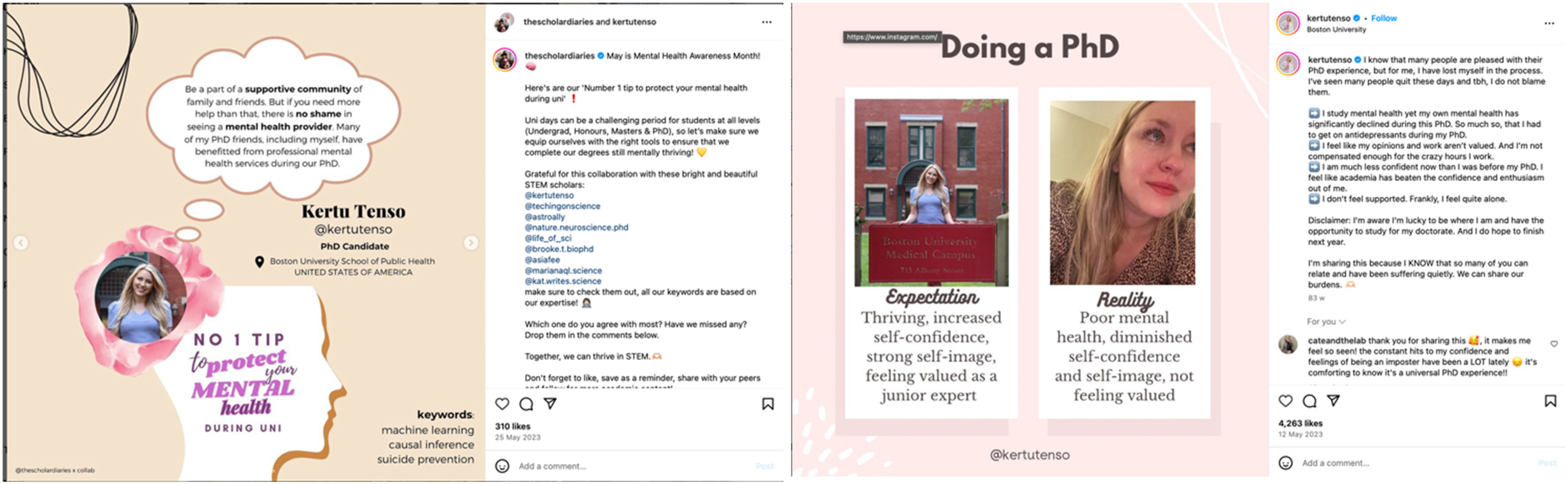
Influencer Kertu Tenso Showcases Intrinsic Motivation and Consumers’ Best Interest.
Misalignments Linked to Originality
The fourth critical property causing misalignment in the influencer assemblage is originality, which we define as the extent to which influencers use storytelling and share personal experiences in line with their own original style and positioning. An authentic influencer shares their own experiences with their followers. As CON21 explained, “[The influencer needs to be] very open, give advice through her experiences, you feel like you know this person a bit.” However, originality creates a misalignment among the components of the assemblage. Influencers want to exercise their capacity to create original content, while brands often wish to control the narrative through scripted content (see Figure 3). Meanwhile, consumers prioritize originality, expecting influencers not to merely repeat brand messages. This means influencers face a challenge, trying to maintain their unique storytelling style and originality in the eyes of consumers in an attempt to differentiate their personal brand from other influencers. As INF1 remarked: Your face has a shelf life. You start as a personality, and the challenge is to make your personality interesting whatever phase of life you grow into because the minute people are no longer interested in you, the synergy [between the influencer and brands] disappears, and you can be replaced. So, the best work on our platform has been when we are free to write, free to make stories, and free to express our signature storytelling style. (INF1)
Consumers value an influencer's unique storytelling style. However, with the rise of generative artificial intelligence (AI), influencers originality may be affected. Increasingly, influencers use generative AI to script, edit, and further develop their content. While this might destabilize the assemblage by diluting influencers’ originality, we find that in fact, transparency about AI usage can actually stabilize the assemblage and build authenticity. As INF45, a podcaster, noted: I’ve created some custom GPTs where I’ve asked the GPT to have a certain style. For example, I’ve gathered PDFs on great journalistic practices, and I’ve given that to ChatGPT. The way I see it, it's only made me a better podcaster and it has accelerated my learning curve profoundly. I’ve also created custom GPTs for LinkedIn strategy, where I give away custom GPTs for free that I’ve created and that has gone really well. I think about this as part of my brand, because my audience also uses [ChatGPT], I encourage people to use artificial intelligence. (INF45)
Brand managers’ expressive capacity to position the endorsed object at the center of content often conflicts with influencers’ capacity to exercise their creative freedom and connect with followers. Influencers are often reluctant to accept partnerships that limit their originality. As INF13 noted, “I have gotten proposals where they want me to say certain things in the caption, I normally reject those.” Similarly, INF31 echoed this sentiment: “I think as creators we should have a certain freedom of how we want to put things together.” Our influencer respondents indicated that they would decline such brand partnerships, as they would not perform well and would not resonate with their follower base, because the content lacks the influencers’ own unique storytelling style: We have done content for clients who sometimes just want us to talk all about their product benefits and sell their products, and in the end, we feel the final content does not represent us and who we are. When this happens, we will inform the clients that this video would be better off featured on their branded media platforms instead of our [YouTube] channel because we know that our audience would not resonate with it and the video will perform poorly. (INF2)
Brand managers, in contrast, often prioritize their expressive capacity to script branded content over originality, which can destabilize the assemblage. DeLanda (2006) argues that processes that increase the internal heterogeneity of an assemblage can help destabilize it. Our analysis indicates that brand managers can contribute to this process by introducing material artifacts (such as the scripted branded content) that have this assemblage-level effect. Branded content that is too scripted can destabilize the assemblage because it increases its perceived heterogeneity. Influencer marketing agencies may help manage the misalignment linked to originality. As IMA13 explained: We understand influencers’ desire to create their own content. It is important to build bridges with brands for both the influencer and the brand to succeed in this. (IMA13)
We find that for both consumers and influencers, originality is a highly prioritized property in the influencer assemblage. Consumers expect influencers to use their content to connect with followers through personal stories and a unique style (DeLanda 2006; Parmentier and Fischer 2015), while influencers strive to bring their unique perspectives to life through their expressive capacity. For instance, TikTok star and comedian Sabrina Brier, known for her sarcastic tone, integrates brands into her humorous videos, maintaining her originality and style (Figure 5).
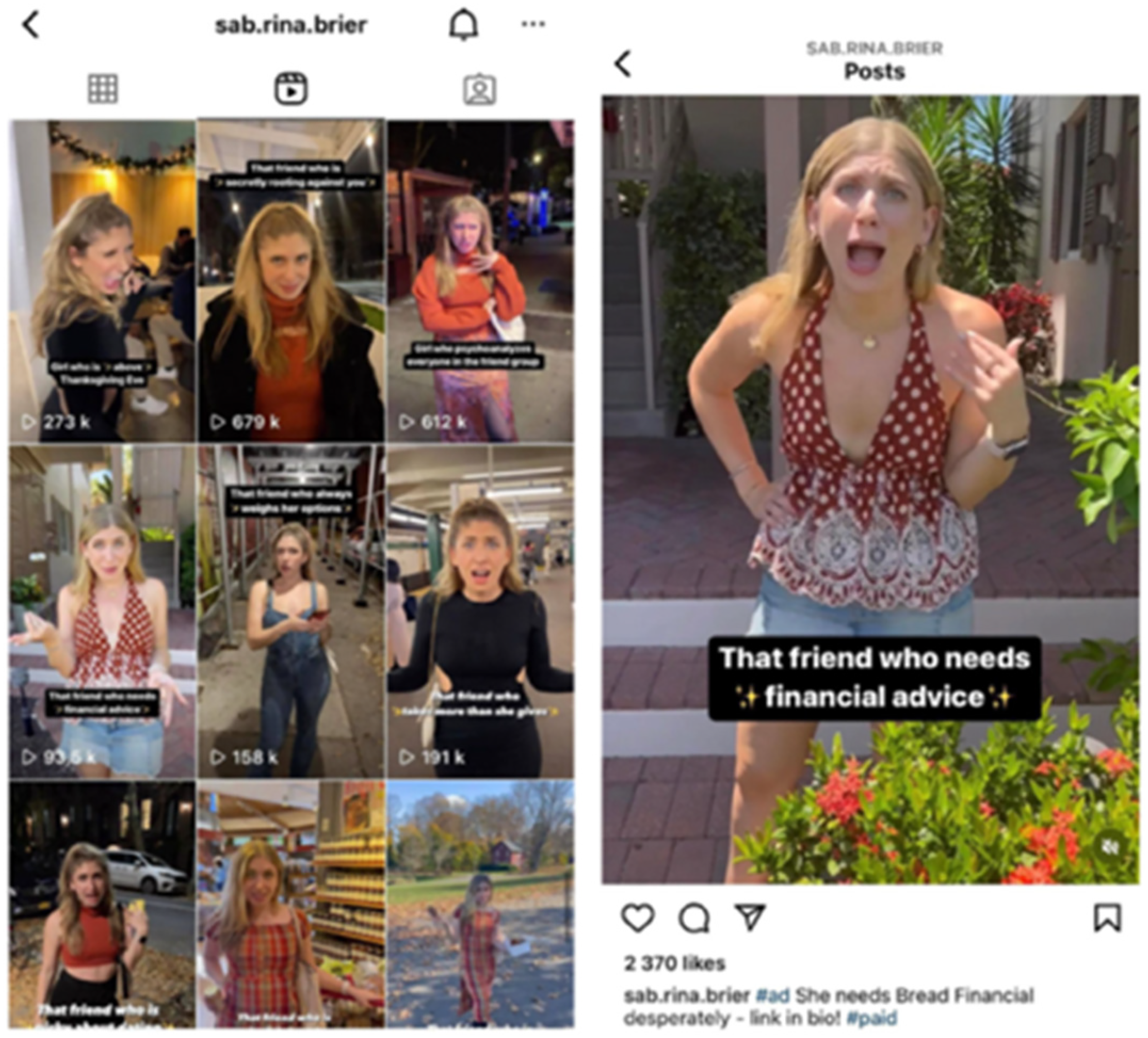
Comedian Sabrina Brier Integrates Colgate into Her Sarcastic Videos.
Brands, however, tend to place low priority on originality. They believe it is in their capacity to push for less personal storytelling and more scripted branded content (Figure 3). This is because they fear losing control over the branded content and becoming secondary participants in the partnership. Brands prefer scripted content to ensure they remain the focal point. In contrast, influencers expect brand managers to trust their understanding of their audience and recognize that content quality does not always equate to a hard sell.
Influencer marketing agencies recognize this misalignment, both appreciating brand managers’ capacity to script branded content and valuing the importance of originality and how it can stabilize the assemblage by maintaining a personal storytelling style. BM40 shared an example that illustrates this point. BM40 gifted a makeup micro-influencer with great engagement levels a pair of jeans from the brand's fashion ecommerce website. The influencer integrated the jeans (and thus the brand) into their everyday life, which yielded unprecedented returns for the brand: She just posted a picture in our jeans. After a couple of the days, she was showing something else [on her stories], and she was in the same jeans. And the same day she went to an event, and she wore the same jeans again, but with a fancy blouse. … She texted me saying that no one was asking about the blouse, everyone was asking her about the jeans because they saw how she combines them [for different events]. She posted on Instagram stories her picture with this [pair of] jeans … saying, “You guys ask a lot about these jeans, so I decided to publish where I got it from” and then it boomed. … All jeans were sold within three days. (BM40)
Misalignments Linked to Transparency
The fifth property of the assemblage leading to misalignment between the different components is transparency, defined as the extent to which influencers openly share both the positives and negatives of a brand they endorse, rather than just the desirable aspects (Liu et al. 2015). Transparency is a highly prioritized property for consumers, who expect an influencer to be honest and balanced. This could involve sharing an entire personal transformation process, showing how the brand impacts their life: Usually, if an influencer has tried the product over say three months and can show me a before and after to demonstrate the effect, then I am certainly more inclined to buy it since I can see the comparison and the person has tried it. (CON8)
Interestingly, our research reveals that brand managers and influencer marketing agencies do not identify transparency as an important property of the assemblage. We found that brands tend to be wary of transparency, preferring influencers not to mention a product's shortcomings. They fear diluting the unique selling points of their products, while influencers are hesitant to deceive their audience. Thus, an unbiased and truthful endorsement can create a misalignment between influencers and brands (see Figure 3). For this reason, although influencers prioritize truthful endorsements, they are also cautious about brand reactions. As INF31 shared, when she did not enjoy a meal at a sponsored restaurant, she left the negative details out of her review. INF11 believed that a crucial requirement in product reviews is to be diplomatic: I used to punish products that I do not like and give them terrible reviews, but eventually I realized that sometimes people do have different tastes, and even if I do not like it, my viewers might not agree! Therefore, I learned to be more diplomatic in my dissent. Instead of saying that a mascara is useless because it is not dark enough, I will say it gives a very light cover which is not right for my style, but people who like a lighter look might prefer this. (INF11)
Brands would naturally prefer influencers not to harm their image with negative reviews, and influencers often feel indebted to the brand. INF13 explained that she “wouldn’t necessarily put all the negatives in the sponsored posts.” Nevertheless, we found that many influencers struggle with sharing truthful reviews due to the fear of losing brand partnerships: A few years ago, I had a partnership with an athletic brand. And they’re really bad quality. But I was nervous to say that, I felt like I couldn’t really be transparent about it. I would tell my friends, if they ask[ed] me how happy I was with that brand. I would say … don’t bother. It's too expensive for what they have. But on my platform, I wouldn’t say it. As a smaller account, I’m more concerned about what the brand thinks about me than what the followers think about me. (INF43)
Although brands generally favor polished content, consumers find that minor imperfections and honest opinions can enhance transparency. Glowing reviews without critique are less believable. Thus, we find evidence of the benefits of performance transparency (Liu et al. 2015) and the blemishing effect (Ein-Gar, Shiv, and Tormala 2012); branded content is labeled as more reliable if the influencer also shares some minor negative information about the endorsed product: One of the car reviewers that I enjoy watching often expresses his own views, especially in the way he gives his judgment about the car. There is no perfect product, so I like it when they express their honest opinion so that I can make my own judgment. (CON16)
DeLanda (2006) suggests that people's focused attention has material capacity that can be deployed by components within the assemblages. When consumers direct their attention to new elements that are entering the assemblage, such as a new product that the influencer endorses, this may produce associate links between the new and old elements that can either stabilize or destabilize the assemblage. Consumers’ focused attention has the capacity to identify and even increase the contrasts between the existing and new elements of the assemblage. If influencers promote products they do not genuinely use, it destabilizes the assemblage. As CON215 put it, “I see people who say they use something, but don’t, as inauthentic. They just want to get the money from a sponsor but don’t use or like the product.” CON18 confirmed that if the influencer does not use the product being promoted, the perceived authenticity of both the influencer and the content decreases: She [influencer] is super famous on TikTok, and she did this mascara review, and at the end she was wearing full [false] lashes. That's just killing your authenticity because you’re saying this mascara is great, but you can clearly see the difference. (CON18)
In fact, authenticity can be strengthened when influencers use the endorsed product even before entering a brand partnership. Consumers indicated that branded content seems authentic when influencer use (or have already used) the brand outside of any paid collaboration. As CON18 noted: I saw a good example … of an influencer, posting something and saying, “Oh, I love this product.” But [the influencer] wasn’t trying to sell it. It did say #ad but just because she had worked with the brand previously, but it also showed that she no longer works with them, but she still posts about them. So that, in my opinion, is authentic. Because even though they have stopped working together, she's still buying the product and using it. Same goes when the influencer has worked with the brand [in the past], but purchased again or when they post something, but they make it clear that they are not being paid for it. (CON18)
Influencers themselves agree that genuinely using a brand is a key property of their authenticity. This allows them to confidently speak to the product's quality and effectiveness. As INF13 explained, “I only work with brands that I use because I know the quality of their products.” Brands, in contrast, seek to exercise their expressive capacity not only to script the branded content but to also contract influencers to promote specific objects (Figure 3). Once the endorsed object enters the influencer assemblage, it carries its own expressive capacity, shaping the meaning and associations tied to the influencer. If the influencer is not a genuine user of the object or holds unfavorable associations with it, the object can destabilize the assemblage. Conversely, if the object performs well, or the influencer is a genuine user of the object, the endorsed object can stabilize the assemblage. For instance, influencer Emma Chamberlain started her career using a Canon camera. Even as her fame grew, she continued to use Canon products, including when interviewing on the red carpet (Figure 6). Because she was a genuine user of the object, the object itself exerted its expressive capacity, helping to stabilize her assemblage and enhancing her perceived authenticity.

Emma Chamberlain Endorses Canon, a Brand She Has Used Throughout Her Career.
Managerial Implications
Having identified the key misalignments in the influencer assemblage, we next turn to examining how various stakeholders can work together to stabilize the assemblage and, in doing so, build and maintain influencer authenticity. This will help us ascertain how to create effective and lasting assemblages, rather than poor, ephemeral ones.
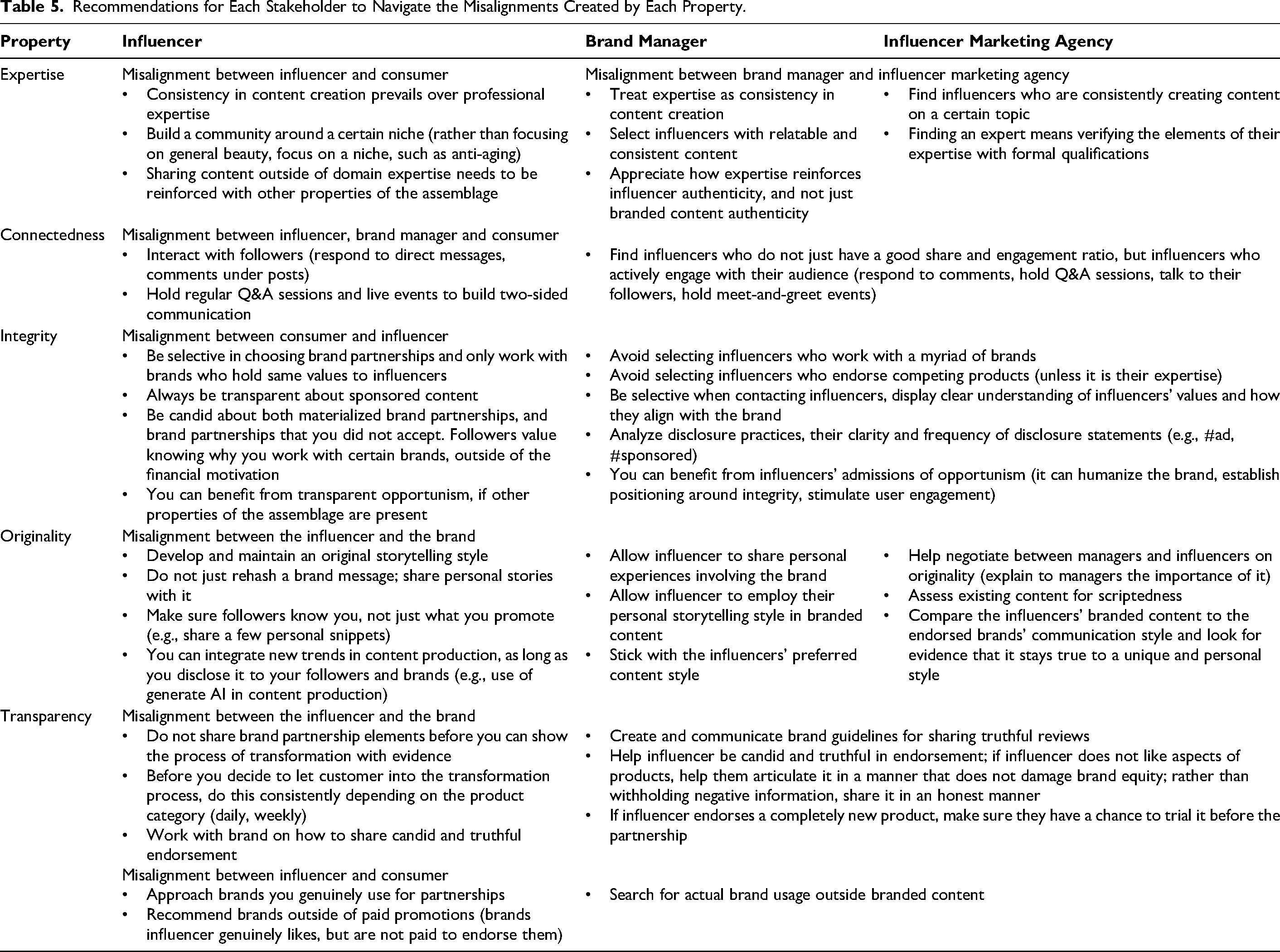
By examining these conflicting interests, we reveal a pivotal finding: influencer authenticity is not an inherent quality of an influencer, but rather a contextual outcome, emerging from the alignment between the influencer, the brand, and their audience. Accordingly, we outline a set of recommendations on how stakeholders can work together to form lasting assemblages in Table 5. Table WC1 in the Web Appendix provides relevant, representative data excerpts.
Recommendations for Each Stakeholder to Navigate the Misalignments Created by Each Property.
Since authentic outcomes are contextual, it is crucial to identify the stages in the influencer–brand partnership where misalignments occur and to understand how these can be managed to build and maintain influencer authenticity. Figure 7 highlights the key stages of the influencer–brand partnership—namely influencer selection, influencer–brand relationship, and content creation—demonstrating that a lack of a certain property capable of destabilizing the assemblage can be offset by stabilizing the other properties. To this end, we offer actionable suggestions for influencers on managing their brand partnerships. Figure 7 also provides guidance for managers on the importance of different properties at each stage of the partnership. First, managers should recognize how connectedness, expertise, and transparency guide influencer selection and help stabilize the assemblage. Second, they must understand the role of integrity in shaping the brands’ relationship with influencers. Finally, managers should appreciate how transparency, integrity, and originality stabilize the assemblage through authentic branded content.
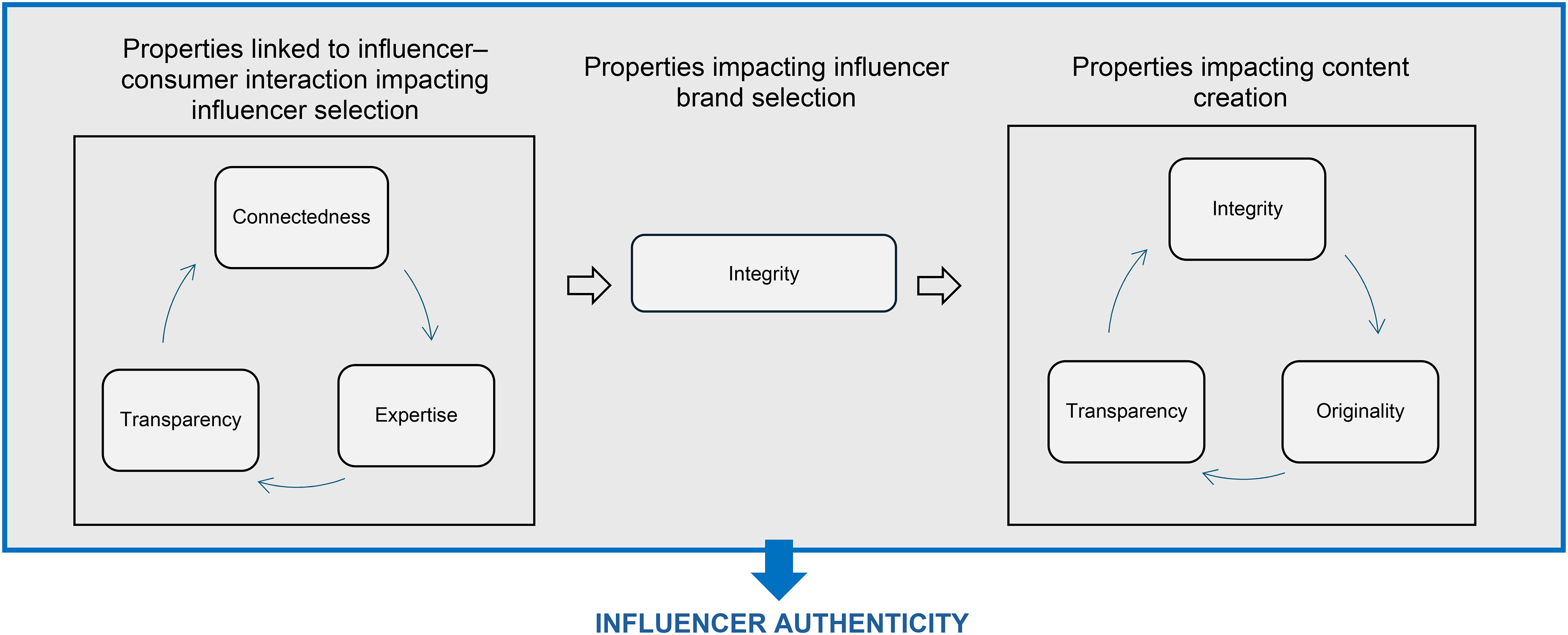
Influencer Authenticity Diagram, Depicting How the Various Properties and Subsequent Misalignments Impact Influencer Selection, Brand Selection, and Content Creation.
Managing Expertise
A key insight from our research is that authenticity is not stable, but a contextual outcome, shaped by various properties of the influencer assemblage. The misalignments linked to various properties of the assemblage, rather than limiting the influencer, can enable the influencer to build and maintain their authenticity. This means that influencers can build and maintain their authenticity even when stepping outside their content domain, provided they leverage other stabilizing properties of the assemblage. As INF46 stated: I always thought I could only ever talk about gaming because that's something I know. Then I made this video about how lazy I felt about cooking and online food delivery. And this blew up. People said they could really relate. This was an “aha” moment for me. I can explore other content too for my audience to enjoy. (INF46)
A novel and provocative implication of our study is that expertise may give influencers and brands greater latitude and freedom to explore content generation and ways of connecting with one's audience (Figure 7). Expertise does not need to confine influencers to a narrow niche, but can instead serve as a foundation that allows greater creative freedom to explore new areas. Managers and influencers alike should recognize that transparency and connectedness can compensate for a lack of expertise in unfamiliar domains. For instance, gaming influencer PewDiePie, despite being known for gaming, can still connect with his audience by sharing stories about his experiences driving across Japan with an endorsed Toyota (Figure 8). The transparency of his genuine usage of the product reinforces his authenticity, despite the lack of automotive expertise.
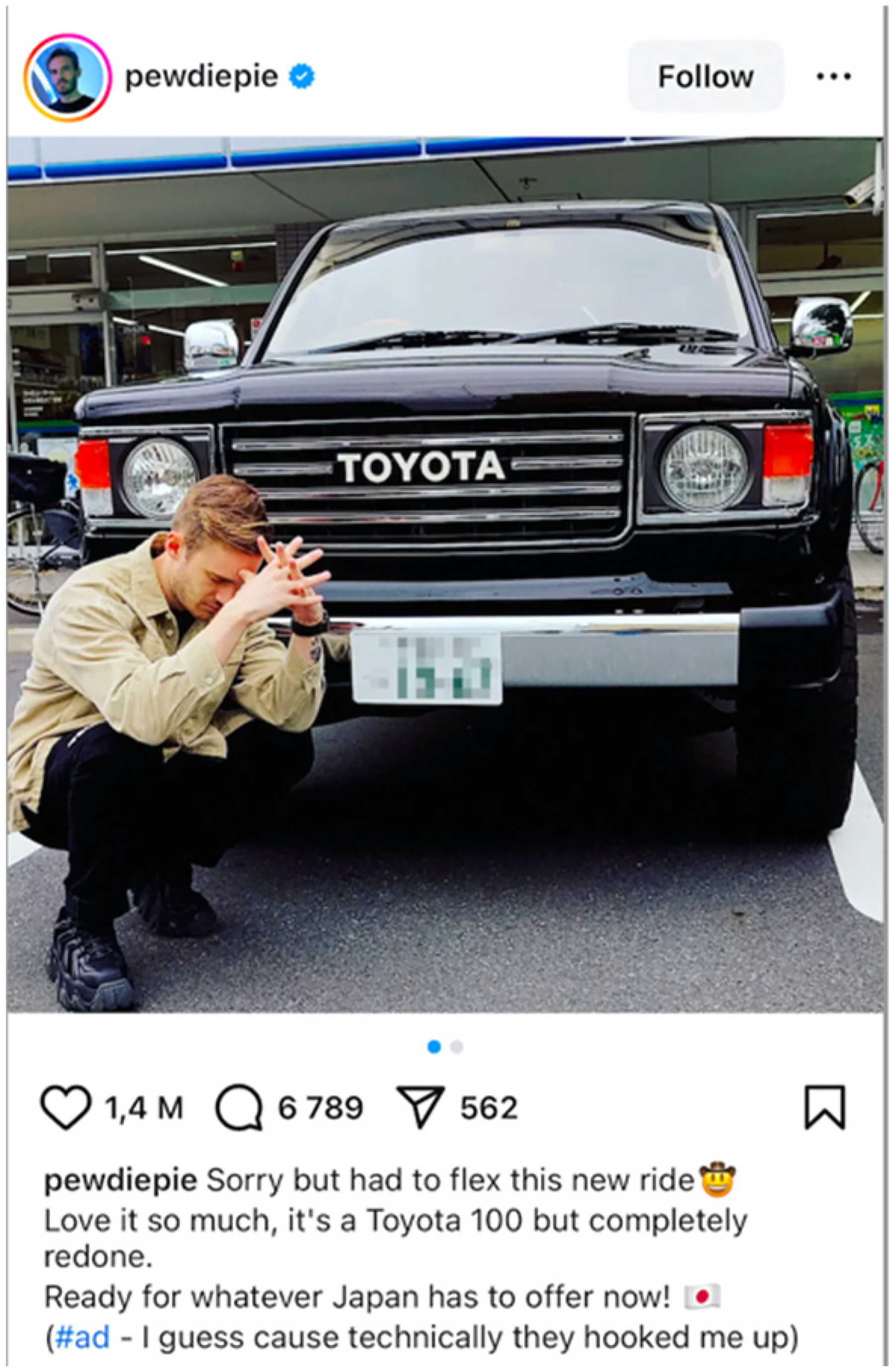
Gaming Influencer PewDiePie Endorses a Toyota Vehicle.
Thus, when selecting influencers for partnerships, managers should prioritize those with consistent content creation in a specific niche but remain open to influencers venturing into new domains. By allowing influencers to explore beyond their core expertise, brands can tap into more organic, relatable, and authentic content that resonates with wider audiences. Similarly, influencers should understand how stepping outside their content domain can reinforce their authenticity, by enhancing their connectedness and transparency (Figure 7). A gradual content diversification strategy may be useful, allowing influencers to venture beyond their core expertise while maintaining authenticity. This could begin with testing new content categories that align with the influencer's storytelling style and audience preferences, using engagement metrics and feedback to gauge reactions. If successful, this content could be scaled over time, while maintaining transparency about the influencer's motivations for exploring new areas.
Managing Connectedness
Another pivotal finding of our work is that brand managers and agencies characterize the consumer–influencer relationship as a form of parasocial relationship: consumers form socioemotional connections with influencers, rooted in the nonreciprocal nature of said relationship (e.g., Tukachinsky and Stever 2019). In contrast to this, however, our findings reveal that in the eyes of influencers, their authenticity stems from the extent to which they can transform their audience, rooted in their ability to interact with their followers, nurture connections, facilitate discussions, and form a community. This often involves the influencer responding directly to followers’ messages and comments and is even embodied in the Q&A sections influencers create with their audience.
Hence, while parasocial relationships are nonreciprocal, we assert that it is the reciprocal nature of the influencer–consumer relationship that stabilizes the assemblage in the eyes of both consumers and influencers. While we found that several metrics have emerged among brand managers and influencer agencies to assess connectedness—such as likes-to-follower ratio (ideally between 1% and 5%), comments-to-follower ratio (between 1% and 2%), and views-to-follower ratio for video content (aiming for 10% to 30%)—a critical implication of our work is the need to look beyond these surface-level engagement metrics. Instead, we encourage managers to assess the quality of interactions, focusing on the depth and thoughtfulness of comments between influencers and consumers. When influencers ignore comments, fail to respond to direct messages, or avoid live interactions with followers, it signals weak connectedness. This is highlighted in IMA35's quote: Too many brand managers and influencers see authenticity as this static thing. Influencers pose as these heroic figures or statues. But there is a real danger and reason why statues end up in museums. There needs to be far greater interaction for the relationship to be seen as authentic. (IMA35)
Consequently, managers should look beyond conventional engagement metrics and prioritize influencers who demonstrate high-quality interactions with their followers (Figure 7). Authenticity is better gauged through the depth of conversation, the responsiveness of the influencer, and how well they nurture meaningful connections. Meaningful connections also tend to feature qualitative feedback loops with followers (e.g., an influencer posts a makeup tutorial, receives questions from followers about alternative product recommendations for sensitive skin, and then creates a follow-up video addressing those concerns). These interactions demonstrate the influencer's ability to inspire and motivate followers to form a community around both the brand, and the influencer.
Brands can encourage influencers to build community-like atmospheres, where the interaction feels less transactional and more relational. To do so, influencers may want to set engagement expectations that prioritize conversations over surface-level metrics. This can be achieved by defining goals that emphasize two-way communication and suggesting interactive content formats (e.g., Q&A sessions, live streams). Influencers might be incentivized with bonuses for creating follow-up content that addresses follower feedback or for actively engaging in meaningful, detailed conversations with their audience. In addition, brands should consider creating guidelines that promote a friendly, conversational tone in influencer content, ensuring that interactions feel personal and relatable, similar to how friends communicate on social media.
Managing Integrity
A crucial challenge influencers face is maintaining authenticity while benefiting from branded partnerships. Integrity, as our findings suggest, hinges on aligning the values of the influencer and the brand. Without such alignment, even a seemingly authentic partnership can appear inauthentic. As CON19 stated, “You can have a very authentic influencer and brand, but if their messages don’t work together, their values [do] not match. So then through that it becomes inauthentic.” Thus, when selecting influencers, managers should strive for a match between the influencer–brand values to establish integrity (Figure 7).
Interestingly, our research uncovers a counterintuitive insight: transparent admissions of opportunism can sometimes enhance authenticity. Influencers who openly acknowledge their financial motivations, especially in a humorous or self-aware way, can paradoxically build trust with their audience. This can lead to a stronger, more relatable form of authenticity. A prime example is Tyler the Creator's campaign in which he publicly stated that he wore a brand's shoes simply because they paid him. This candid admission resonated with audiences, generating more engagement and sales. As IMA38 recalls, “While the execs were furious, people loved it. They saw him as winning twice as he got free sneakers and was paid a lot of money for it. Which ironically, made people buy the shoes.”
This quote points to a shift in audience perception, where transparent admissions of opportunism can actually enhance an influencer's authenticity. Thus, a critical implication of our work relates back to the contextual nature of influencer authenticity; while acting with integrity and having consumers best interest at heart is a key property of influencer authenticity in the eyes of consumers, we explore how visibly highlighting their opportunism in their branded content can in fact build authenticity through other properties of the assemblage, such as transparency and originality. This transparency, when done creatively, builds trust and makes the brand appear more aligned with consumer preferences: Content that is humorous, self-deprecating, or self-aware can generate higher engagement rates and is great for word of mouth. Brands that allow influencers to be honest about the transactional nature of their relationships can be seen as savvier, more in tune with modern marketing trends. It can make the brand feel more contemporary, resonating especially well with younger, media-savvy consumers. (BM53)
To manage integrity in influencer partnerships, brands should prioritize value alignment by conducting precollaboration audits of influencers’ content to ensure shared values and hosting collaborative messaging workshops to unify campaign messaging. Influencers can humorously acknowledge the transactional nature of partnerships in campaigns, making the collaboration feel more relatable. However, we suggest that brands should also monitor audience reactions using social listening tools and adjust strategies based on feedback, ensuring that integrity continues to build authenticity.
Managing Originality
Influencers and brand managers frequently find themselves in misalignments linked to influencers’ original storytelling style in branded content (Figure 7). For example, an influencer wishes to create content they care and are passionate about, as opposed to the “hard sell” content a brand may want (Dutton 2003). A manifestation of misalignments linked to originality arises when the creative voice of the influencer takes priority over the brand's claims. Instead of describing the brand or listing its selling points, the influencer employs their capacity to feature the brand in a creative manner through storytelling. The influencer may just make a passing reference to the brand, or not at all, by simply keeping it in the frame. Consumers recognize the entertainment value of such content and recall the brand benefits even though they are not explicitly described. This alignment between the influencers’ storytelling style and followers’ preferences reinforces influencer authenticity, and therefore, brand managers should understand how they can leverage this fit, without encroaching on the influencers’ content (Figure 7).
We find that the integration of generative AI into content creation does not inherently destabilize the originality of the assemblage, as long as the influencer maintains other properties of their assemblage. To stabilize originality, influencers should develop a personal storytelling style, share personal experiences that resonate with followers, and strike a balance between brand integration and storytelling. Influencers can use generative AI in their posts, provided they do so transparently. Our findings further emphasize the contextual nature of influencer authenticity and suggest that any perceived lack of originality can be mitigated through transparency. As INF45 put it: I don’t have a problem with saying that I’m using AI for certain tasks. It's a no-brainer for me. If they [the brand] tell me it's a problem, then I’m just going to raise my prices. They’re just asking me to do extra work, then they need to pay for it. … So you want me to do this task without AI, then that's ten hours of work. I could do it with AI, that's two hours’ work. But if the brands work with me, they work with me because of my brand and my product and they know what my product is. So, using AI, it's not going to be a problem. (INF45)
To balance influencers’ creative freedom with brand control, brands should provide clear briefs that focus on key outcomes rather than rigid scripts, allowing influencers to integrate the brand naturally into their content. Cocreation sessions between influencers and brand teams might ensure alignment while maintaining authenticity. Influencers should use storytelling techniques that subtly incorporate the brand without overt promotion, focusing on relatable and entertaining content that resonates with their audience. For those using generative AI, influencers should transparently disclose its use, framing it as a tool that enhances creativity.
Managing Transparency
A further misalignment that can destabilize the influencer assemblage through branded content is linked to transparency (Figure 7). While transparency is a critical property of authenticity, it is often underprioritized by brands. Consumers expect influencers to provide balanced, candid reviews, even highlighting the shortcomings of a product. However, influencers are often hesitant to do so, fearing it may jeopardize future brand partnerships. Brands, meanwhile, may discourage transparency to avoid diluting their unique selling points. Our findings suggest that when influencers provide balanced feedback, including negative aspects of a product, consumers perceive them as more trustworthy and authentic.
Authenticity is not an inherent trait of the influencer but is developed through an alignment between the influencer, followers, and the brand. Influencers, however, often struggle to balance their truthful experiences with the scripted content brands expect. When selecting influencers, brand managers should prioritize those with a track record of publishing candid, objective content about the brands they endorse. We have shown that even influencers who appear opportunistic can still maintain authenticity through transparency. Our research, however, also reveals that finding influencers willing to share truthful experiences can be difficult, as many are wary of how brands will react.
To manage the misalignment around transparency, brands should understand these challenges and actively encourage influencers to provide honest feedback when creating branded content. As INF43 put it, “If the brand said, ‘Be honest about what you think about the quality,’ I think if they did say that, I would be honest. I would want the brand to be more forward.” To maintain authenticity, brands and influencer marketing agencies should collaborate to create guidelines that promote truthful reviews. This approach not only strengthens influencer authenticity but also enhances brand authenticity. As IMA39 explained: It can suggest a longer-term outlook or strategy. Over time, building a reputation for allowing authentic and transparent content can position the brand as trustworthy and open. This long-term strategy can foster a more engaged and loyal customer base. Provided the collaboration is managed thoughtfully and strategically, a brand can benefit from [the influencer content] by leveraging the authenticity and engagement it generates in the long run. (IMA39)
This recommendation is welcomed by influencers, who understand the value of transparency but often struggle to uphold it in brand collaborations: I don’t think they would approve me sharing negatives. I think it's very important to be more transparent about the bad things about the brand and the product. I think managers should be given advice on this, and using these brand guidelines would be interesting to see play out. (INF44)
To manage transparency effectively, brands should consider cocreating guidelines with influencers that encourage balanced, honest reviews, including both strengths and weaknesses of products. Offering long-term partnerships might reduce influencers’ fear of losing future deals due to transparency, allowing for candid feedback.
Theoretical Contributions
Our study contributes to several important streams of marketing literature, particularly on authenticity and influencer marketing.
Research on Authenticity
First, the current study contributes to the literature on authenticity. Notably, whereas prior research defined how consumers or influencers perceive authenticity (Audrezet, De Kerviler, and Moulard 2020; Lee and Eastin 2021; Lindmoser, Weitzl, and Zniva 2022), we found that when examined holistically, perceived influencer authenticity is a broader concept that embodies the importance of various properties of authenticity to different stakeholders. More specifically, looking at authenticity through the lens of a single stakeholder fails to provide a comprehensive view of the various, often conflicting interests of all stakeholders. By examining these conflicting interests, we find that influencer authenticity is not an inherent quality of an influencer, but authentic outcomes are situated and contextual. This means that authenticity is not a stable trait of the influencer but is an embodiment of an alignment between the influencer, the brand, and their audience. Consequently, authenticity can be built—and also diminished—through an interaction between the influencer, their followers, and brands.
To understand and reinforce this alignment, stakeholders should look at the various properties of the assemblage. We argue that consistency in content creation stabilizes the influencer assemblage through expertise, yet the influencer can step outside their domain if other properties of their assemblage are present. Similarly, we find that the use of generative AI does not diminish originality, as long as the influencer communicates transparently about its use to their audience. We highlight the importance of a value match between the brand and the influencer to reinforce integrity, yet we also explore the so-far underresearched areas of transparent opportunism. More importantly, as influencer authenticity is contextual, we find that the lack of some properties can be offset by strengthening other properties of the assemblage.
In sum, by considering how these five properties can be leveraged to create an alignment between the influencer, the brand, and the consumers, we enrich our understanding of the construct of authenticity in general. A key theoretical contribution of our work lies in moving away from the definition of authenticity as a stable construct (e.g., Nunes, Ordanini, and Giambastiani 2021) to instead emphasizing its contextual and situational nature.
Misalignments Inherent in the Influencer Assemblage
Because influencers’ authenticity impacts the effectiveness of the influencer–brand collaboration (Audrezet, De Kerviler, and Moulard 2020; HypeAuditor 2023), ignoring the misalignments around authenticity limits our understanding of the key drivers of successful influencer assemblages. Whereas some work in marketing has considered how influencers navigate the misalignments created by brands’ encroachment on their content (Audrezet, De Kerviler, and Moulard 2020; Gerdeman 2019), our focus is on how different stakeholders perceive and manage the misalignments linked to authenticity, and how they can work together to stabilize the influencer assemblage and maintain influencer authenticity. We argue that different stakeholders view the relative importance of each property of authenticity differently, and more importantly, this holistic perspective on authenticity gives rise to various misalignments within the assemblage. Thus, a key theoretical contribution of our work lies in how these misalignments are created through the varying perceptions on authenticity, and how they can be managed by each stakeholder to maintain influencer authenticity.
First, a provocative finding of our study is that while brand managers treat expertise as a property that stabilizes the authenticity of their own branded content, without looking at the entirety of the influencer assemblage, consumers value consistent content creation more than formal expertise. We thus shed light on the multifaceted perspective of expertise as a driver of authenticity mostly in the eyes of influencers and agencies and contradict the importance assigned to being a “proficient” (Nunes, Ordanini, and Giambastiani 2021) and “knowledgeable” (Lee and Eastin 2021) entity in the eyes of all stakeholders.
Second, a critical finding of our work is that brand managers and members of influencer marketing agencies so far define connectedness as forms of nonreciprocal, parasocial relationships. However, our findings point to the importance of a reciprocal, two-sided relationship between the influencer and the consumer. We build on the existing discussion around the importance of engagement metrics by shifting the focus to the quality of two-way communication between influencers and consumers. In doing so, we extend the definition of “connectedness” by Nunes, Ordanini, and Giambastiani (2021) and expand the work of Beichert et al. (2024), Leung et al. (2022), Gu, Zhang, and Kannan (2024), Hughes, Swaminathan, and Brooks (2019), and Wies, Bleier, and Edeling (2022) on engagement; the work by Cascio Rizzo et al. (2024) on influencer impact; and Goldenberg et al.’s (2024) research on building a follower base.
Third, a pivotal finding of our work is that the lack of intrinsic motivation destabilizes the influencer assemblage in the eyes of not only consumers (who may perceive influencers as being mainly financially motivated) but also brand managers and influencer marketing agencies. However, we also find counterintuitive evidence that apparent lack of integrity through transparent opportunism (e.g., an influencer admitting to entering a brand collaboration merely for personal gain) can still be associated with a stable assemblage through the benefits of transparency. Therefore, while we do find evidence for the need for passionate influencers advanced by Audrezet, De Kerviler, and Moulard (2020), we also highlight instances when lack of intrinsic motivation does not necessarily destabilize the influencer assemblage. We also highlight the importance of “integrity” as a driver of authenticity, extending the work of Nunes, Ordanini, and Giambastiani (2021).
Fourth, we emphasize a novel misalignment linked to influencers’ originality that stems from the expressive capacity of material artifacts of a collaboration (the endorsed product and the scripted branded content). We shed light on the crucial role of influencer marketing agencies, who, through their capacity to mediate between the brands and influencers, can stabilize the assemblage's originality. We further contribute to the emerging discussion on the role of generative AI in original content creation by showing that originality can be preserved, as long as transparency is maintained. We thus extend the definition of “originality” as a dimension of authenticity identified by Nunes, Ordanini, and Giambastiani (2021).
Lastly, we offer critical guidance to brand managers and influencer marketing agencies on how they can help maintain influencer authenticity through brand transparency guidelines. We thus advocate for the importance of truthful endorsement in building authenticity and contribute to the ongoing discussion on “accuracy” as defined by Nunes, Ordanini, and Giambastiani (2021) and the blemishing effect (e.g., Ein-Gar, Shiv, and Tormala 2012).
Limitations and Future Research
This study is not without its limitations that offer promising avenues for future research. First, our methodology employed a deductive and confirmatory approach, leading with the term “authenticity” in the interviews. While this approach was necessary for the purpose of “construct hunting” (Zeithaml et al. 2020), typical theories-in-use methodologies are often more open-ended. Future research might explore influencer authenticity with a more inductive approach to capture additional insights.
This study focused exclusively on the authenticity of human influencers. However, with the rise of AI and the metaverse, extending this research to the domain of virtual influencers and avatars could prove promising and fruitful (e.g., Zhou, Yan, and Jiang 2024). For example, luxury brands such as Dior, Prada, and Calvin Klein have already started working with “Lil Miquela,” a virtual influencer with millions of followers. Barbie, Lu do Magalu, or Guggimon are just a few other prominent virtual influencers out of the 150 actively posting on social media today (Hiort 2023). Future studies could examine whether the same properties of authenticity apply to virtual influencers as they do to human ones.
Our novel finding that transparent opportunism can benefit both influencers and brands in the long term also warrants further investigation. Future studies could focus on the mechanisms behind the phenomenon. Similarly, future research may look at influencer authenticity across new social media platforms and content formats and study whether influencers’ authenticity is contingent on how they present themselves across different social media channels. For example, do influencers appear more authentic on YouTube, where longer video formats are favored, or on TikTok and Instagram, where shorter reels dominate? Examining how branded content across platforms (e.g., sponsored posts, vlogs, reels, TikTok videos) impacts perceptions of authenticity could be fruitful.
Lastly, the role of generative AI in content creation deserves further exploration. While we highlighted the importance of transparency in creating authentic branded content, future studies could investigate how the rise of deepfakes and the broader use of AI in influencer–follower communication may affect authenticity in influencer marketing (e.g., del Principe 2024).
Supplemental Material
sj-pdf-1-jmx-10.1177_00222429251319786 - Supplemental material for Authenticity in Influencer Marketing: How Can Influencers and Brands Work Together to Build and Maintain Influencer Authenticity?
Supplemental material, sj-pdf-1-jmx-10.1177_00222429251319786 for Authenticity in Influencer Marketing: How Can Influencers and Brands Work Together to Build and Maintain Influencer Authenticity? by Barbara Duffek, Andreas B. Eisingerich, Omar Merlo and Guan Lee in Journal of Marketing
Footnotes
Acknowledgments
The authors are grateful to the JM review team for their insightful comments and valuable feedback, which greatly enhanced the quality of this work throughout the review process.
Authors Contributions
Part of this research was based on the dissertation completed by the first author at Imperial College London under the guidance of the second and third authors.
Coeditor
Vanitha Swaminathan
Associate Editor
Ashlee Humphreys
Declaration of Conflicting Interests
The author(s) declared no potential conflicts of interest with respect to the research, authorship, and/or publication of this article.
Funding
The author(s) received no financial support for the research, authorship, and/or publication of this article.

Notes
References
Supplementary Material
Please find the following supplemental material available below.
For Open Access articles published under a Creative Commons License, all supplemental material carries the same license as the article it is associated with.
For non-Open Access articles published, all supplemental material carries a non-exclusive license, and permission requests for re-use of supplemental material or any part of supplemental material shall be sent directly to the copyright owner as specified in the copyright notice associated with the article.
