



Abstract
Brand acquisitions are a popular growth strategy. However, both anecdotal evidence and initial empirical evidence suggest that acquisitions can harm the acquired brand. This article proposes and tests a theoretical framework that aims to explain when and why consumers react negatively to acquired brands. Across ten studies using different methods, research designs, product categories, and brands, the authors demonstrate that these negative brand reactions can be explained by the perceived loss of a brand's unique values. Building on this values authenticity account, they document that the negative effect of acquisitions depends on the acquired brand's values, brand age, leadership continuity, and the alignment between acquiring and acquired brands. The findings offer important theoretical and managerial implications, helping managers predict and mitigate the negative effects of acquisitions for brands.
Keywords
Acquiring firms is one of the most common ways to pursue growth; the global value of acquisitions amounted to $2.3 trillion in 2019 (J.P. Morgan 2020). Acquisitions are often motivated by the target firm's brand equity, as well as the market position it has created and nurtured (Bahadir, Bharadwaj, and Srivastava 2008; Kumar and Blomqvist 2004). Despite the importance of brand equity in motivating acquisitions, anecdotal evidence suggests that acquisitions can actually dilute the target firm's brand value. For example, when Unilever acquired the Italian ice cream maker GROM, 83% of polled consumers described the acquisition as “bad news” (Bottero 2015). Four years later, reduced consumer interest led to the closure of several GROM retail outlets, including the ice cream maker's first store. Similarly, consumer ratings for cosmetics brand The Body Shop plummeted after L’Oréal acquired it (BBC 2006). These examples show that there can be substantial consumer backlash after an acquisition, even when the acquired company is itself a large corporation; The Body Shop, for instance, was already a global brand with over 2,000 stores at the time of its acquisition. Consumers can learn about brand acquisitions through news reports, exposure to brand communications, or word of mouth. Given that digital media and social networks now facilitate the rapid dissemination of information, consumers are often aware that a brand has been acquired. For example, many consumers quickly learned of Amazon's acquisition of Whole Foods, Unilever's acquisition of the tea brand Pukka, or Microsoft's acquisition of Activision Blizzard.
Despite the topic's importance, empirical research on consumer reactions to acquired brands is scarce. The potential for brand acquisitions to generate negative reactions among consumers is supported by a considerable amount of anecdotal evidence and has also been documented in extant research (Frake 2017). However, little is known about when and why brand acquisitions (in which one company takes over another) might trigger negative reactions among consumers; our article aims to fill this research gap.
Our work makes several contributions. This study contributes to marketing theory and practice by shedding light on when and how acquisitions can harm consumers’ willingness to buy products from acquired brands. Drawing on a signaling theory perspective, we introduce a framework based on values authenticity loss that can explain why consumers react negatively to acquired brands. Ten studies (using different product categories, types of brands, and measures of consumer reactions) document that values authenticity loss can explain this negative effect above and beyond alternative explanations. Moreover, we advance previous research on authenticity by demonstrating that a brand's perceived values authenticity loss materializes independent of the size of the acquiring company, and we show that values authenticity is a more effective process variable than alternative process variables, including perceived product quality and underdog status. Building on our values authenticity framework, we identify and empirically document several managerially relevant moderators, including the number of times a brand has already been acquired, the continuity of the brand's leadership, the brand’s age (i.e., length of time on the market before being acquired), the brand’s strategic positioning, and the acquirer's values alignment. Interestingly, our effects also reveal that acquisitions might harm not only the acquired brand (in terms of purchase intentions) but also the acquirer. Our findings lead to a series of actionable recommendations for managing and maintaining brand equity, both before and after acquisitions. More broadly, our findings suggest that managers should consider potential consumer reactions to the acquired firm's brand in their due diligence processes before acquisitions. Neglecting the demand-side impact of acquisitions might be one overlooked reason why so many acquisitions fall short of expectations (e.g., Christensen et al. 2011; Datta, Pinches, and Narayanan 1992; Dyer, Kale, and Singh 2003; King et al. 2004).
Acquisitions and Consumers
Acquisitions are transactions in which ownership of a firm and its brand is transferred to another firm. Since acquisitions are complex operations involving all areas of both the acquiring and the acquired firm's activities, the drivers of their success (or failure) have been investigated extensively in finance (e.g., Moeller, Schlingemann, and Stulz 2005), economics (e.g., Jensen 1986; Kroll et al. 1997; Ravenscraft and Scherer 1987), organizational behavior (e.g., Larsson and Finkelstein 1999), and strategy research (e.g., Datta, Pinches, and Narayanan 1992). In marketing, research on acquisitions has mainly focused on strategic marketing aspects by adopting an internal, corporate view on acquisitions. For example, previous research has examined whether a strategic match between the two firms creates shareholder value (Newmeyer, Swaminathan, and Hulland 2016; Swaminathan, Murshed, and Hulland 2008); how brands, sales force, and expertise are redeployed after the acquisition (Capron and Hulland 1999); the role of marketing integration in postacquisition financial performance (Homburg and Bucerius 2005); and sales force reactions to mergers and acquisitions (Bommaraju et al. 2018).
Existing research on how consumers react to acquired brands is scarce and has mainly explored how consumers evaluate (deliberate) postacquisition brand changes. For example, Jaju, Joiner, and Reddy (2006) studied consumer reactions to alternative brand name redeployment strategies after an acquisition. Thorbjørnsen and Dahlén (2011) examined consumer reactions to the deletion of the acquired brand and found evidence of consumer reactance: consumers develop more negative attitudes toward the acquirer brand and more positive attitudes toward the eliminated brand. This finding is consistent with research pointing to consumer reactance when brands undergo other types of change (e.g., Walsh, Winterich, and Mittal 2010). Gaustad et al. (2018, 2019) provide a relevant line of research, examining how consumers react to brands that strategically changed their image following an acquisition or repositioning. Building on self-identity and self–brand connection research, they developed and tested theory about how consumers’ reactions depend on individual differences in self–brand connection. The central finding is that especially consumers with high levels of self–brand connection react negatively when they are informed about changes to important brand associations (e.g., that an acquisition would either dampen or augment the brand image). Although investigating how consumers react to specific planned brand changes is relevant for acquisitions, it does not answer our main research questions or shed light on the signaling value of acquisitions on consumers. Specifically, it is unclear what psychological reactions are elicited by learning that a brand has been acquired. Moreover, it is unclear whether acquisitions will have a negative impact on consumers’ intended and actual behavior—and, if so, what acquisition-related factors will mitigate this effect.
In a different line of research, Umashankar, Bahadir, and Bharadwaj (2021) found that acquisitions can lead to decreased customer satisfaction, most likely because corporate executives shift their attention away from customers to financial issues. In a related study, Frake (2017) analyzed consumer ratings of craft beers before and after they were acquired by large brewing corporations. He compared user ratings of two different platforms—one that disclosed that a craft beer brand was owned by a large corporation and one that did not. Users on the disclosing platform (who might have been more likely to be aware of the acquisition) provided lower overall product ratings but not lower product attribute ratings (e.g., aroma, appearance). Yet, it is unclear what exactly underlies this discrepancy in consumer ratings—it is possible that this effect is due to uncontrolled for factors (e.g., user characteristics), a general support for smaller companies documented in the previous literature (Paharia, Avery, and Keinan 2014; Vandello, Goldschmied, and Richards 2007), some authenticity-related process (as speculated by Frake), or some other reason.
Our research aims to advance this stream of research. Specifically, we focus on how acquisitions can act as a signal that consumers interpret as jeopardizing the authenticity of the brand values and, in turn, have a negative effect on consumers’ purchases. We also investigate company-related factors (e.g., brand age, leadership continuity, alignment of the brand values of acquirer and acquired) impact consumers’ negative reactions to acquisitions. For brevity, we use the broad label “consumer reactions to brand acquisitions” for a variety of marketing-relevant consumer responses, such as purchase intention and choice.
Signaling Perspective and Values Authenticity
Drawing on a signal theory perspective (Connelly et al. 2011), we posit that stakeholders interpret acquisitions as signals. Following a brand acquisition, investors or consumers are usually faced with incomplete information and with uncertainty regarding the future actions of the brand. This uncertainty triggers stakeholders to seek out signals—“observable actions that provide information about unobservable attributes and likely outcomes” (Bergh et al. 2014, p. 2). We argue that in the absence of “better” information, stakeholders use the mere knowledge that a brand has been acquired as a signal to form brand inferences, which can be positive or negative. For example, investors may view acquisitions as positive signals: an indication that the brand is valuable and desirable. Conversely, as the acquisition process entails transferring control to another company, consumers may perceive acquisitions as negative signals because they infer that acquisitions dilute the core values of the brand, or the brand's values authenticity.
Authenticity is a broad concept that entails numerous facets (e.g., Beverland, Lindgreen, and Vink 2008; Carroll and Wheaton 2015; Lehman et al. 2019; Morhart et al. 2015; Newman 2019; Thompson and Kumar 2022) as well as multiple psychological processes, depending on the domain studied (Nunes, Ordanini, and Giambastiani 2021). We posit that potentially negative consumer reactions to acquisitions are best explained by one particular facet of authenticity: values authenticity. Values authenticity refers to the extent to which an entity's stated values—abstract representations of desired end states that serve as guiding principles (Schwartz 1992; Torelli et al. 2012)—are consistent with their actual beliefs and desires as well as their actions (Carroll and Wheaton 2015; Kernis and Goldman 2006; Lehman et al. 2019; Newman 2019; Newman and Smith 2016).
Scholars have used different conceptualizations to describe this construct, but their core content is consistent. For example, Beverland, Lindgreen, and Vink (2008) define “moral authenticity” as the extent to which a producer is motivated by a genuine commitment to their craft. Dutton (2003, p. 259) defines “expressive authenticity” as the “true expression of an individual's or a society's values and beliefs.” Napoli et al. (2014) call this notion of authenticity “sincerity,” defined as the ability to remain true to espoused values. Morhart et al. (2015, p. 202) label this construct “integrity,” defined as “a virtue reflected in the brand's intentions and in the values it communicates.” Finally, Nunes, Ordanini, and Giambastiani (2021) also refer to this concept as “integrity,” directly building on the notion of “assessment of values” used by Newman (2019, p. 10) to define values authenticity. Consistent with previous definitions of values authenticity and integrity, Nunes, Ordanini, and Giambastiani (p. 10) define brands having integrity as those “perceived intrinsically motivated and not acting out of one's own financial interest, while behaving autonomously and consistently over time.” The notion of consistency between values and actions is the common denominator across these different definitions, while other components (e.g., morality, intrinsic motivation, craftmanship) tend to vary from definition to definition. Thus, we adopt the term “values authenticity” (Newman and Smith 2016), which has been used in marketing but also in organizational behavior, management, and psychology research to indicate the consistency between an entity's values and actions (e.g., Lehman et al. 2019; Newman 2019).
Predictions
We propose that consumers may view an acquisition as a signal that the authenticity of a brand's values is being disrupted. Specifically, we propose that when brands are acquired, consumers perceive that these brands lose part of their original core values—that is, what guides their actions and makes them unique in the eyes of consumers. Borrowing the notion of core values from the literature on corporate values (Ashforth, Rogers, and Corley 2011; Collins and Porras 1996; Collins, Porras, and Porras 2005; Lee, Hwang, and Chen 2017), we focus on brand values as those key principles guiding all business activities (Collins, Porras, and Porras 2005). When a brand is founded, it is usually imbued with a specific set of values by its founders, owners, or management team (Carroll and Wheaton 2009; Lehman et al. 2019)—what the brand's core priorities and beliefs are and should be (Greyser and Urde 2019). Thus, founders typically establish brands with a set of beliefs and ideas that are internally determined (Newman and Smith 2016), forming the “soul” or DNA of the brand (Ashforth, Rogers, and Corley 2011; Lee, Hwang, and Chen 2017; Randazzo 1993). These brand values are often openly stated by brands through their communications channels and are embodied by their marketplace decisions (Keller 2021). For example, Patagonia's core values focus on environmental stewardship, and Audi's, on technological leadership (Greyser and Urde 2019; for additional examples, see Collins and Porras [1996]). Brand values guide a company's actions and serve as a guideline for the marketing program (Keller 1999). Notably, brand values are different from strategies; strategies tend to adapt to the circumstances of the business environment, whereas values tend to be more stable over time and represent a brand's essential tenets (Collins and Porras 1996; Collins, Porras, and Porras 2005).
Against this background, we argue that consumers perceive acquisitions as the impetus for an abrupt shift in a brand's value system. An acquisition implies a change in ownership, which in turn raises questions about the continuity of, and control over, the values of the acquired brand. Since the change comes from an external entity (i.e., the acquirer), consumers may develop beliefs regarding the motivations and values of the acquirer, which might be considered at odds with the acquired brand's original motivations and values. Consumers might assume that the acquirer will exert external pressure to change the values of the acquired brand, to align them with its own. In some cases, consumers might suspect the acquirer of introducing new values and ideas to the brand that are inconsistent with its original values and ideas. Thus, irrespective of whether this is really the case, an acquisition may lead consumers to surmise that the acquired brand will lose part of its values authenticity. We find preliminary support for this conjecture in a preregistered study (N = 201; 50.2% female, Mage = 42.27 years, Amazon Mechanical Turk [MTurk]; https://aspredicted.org/9T9_CB7) using real brands in a between-participants experiment (not acquired vs. acquired). After reading the description of a brand (Study 1S, Web Appendix A), participants assessed their perception of brand authenticity by rating the definition of the different dimensions of authenticity by Nunes, Ordanini, and Giambastiani (2021), our definition of values authenticity, and five items evaluating product quality (adapted by Johar and Simmons [2000]). The results show a significant drop in the ratings of values authenticity (Mnot acq. = 5.27, SD = 1.06, Macq. = 4.74, SD = 1.34; t(199) = 3.09, p = .002), but no significant differences for the other dimensions of authenticity or for product quality ratings.
In summary, we propose that consumers’ negative reactions to brand acquisitions (in terms of brand attitudes, purchase intention, and product preference) can be explained by a perceived loss of values authenticity.
We next derive moderator variables that might mitigate the negative effect of acquisitions. These moderators are both managerially relevant and conceptually related to our proposed values authenticity account. Specifically, we predict that values authenticity is eroded by acquisitions unless (1) the continuity of leadership is explicitly maintained or has been previously severed, (2) the perceived alignment of the acquiring and target brand's values is high (i.e., the acquirer and acquired brand share the same values), or (3) consumer expectations of values consistency are high (i.e., values are more malleable due to the young age of the brand or the acquisition is consistent with the core values of the brand). Importantly, these moderator variables represent brand-related information (such as the role of the brand's founder, the brand values used, or the age of the brand) that is widely accessible to consumers and frequently used in brand marketing communications. As a result, consumers may use this information when forming impressions about brands.
Losing Versus Maintaining Core Values: Subsequent Acquisitions and Leadership Continuity
According to our main prediction, an acquisition serves as a signal that the authenticity of the values on which the brand has been established is being disrupted. We argue that this disruption affects consumers’ perception of the focal brand's core values system. In reality, brands are frequently acquired multiple times throughout their lives. Natura Cosméticos, for example, recently acquired The Body Shop, which had previously been acquired by L’Oréal. As a result, consumers may encounter situations in which a brand's value system has undergone multiple shifts because of a change of ownership. While previous research on acquisitions appears to have neglected the role of first versus subsequent acquisitions, we posit that this distinction may play an important role in signaling values authenticity loss. Consumers may interpret the first acquisition as a signal of values authenticity loss. In subsequent acquisitions, however, the set of original values would be considered as already lost, and the acquisition should not serve as a strong signal. Thus, we predict that in the case of subsequent acquisitions, consumers’ negative reactions would be less severe. This prediction is consistent with previous research showing that people tend to be especially influenced by first (vs. subsequent) impressions, especially when it comes to negative attitudes and experiences (e.g., Tversky and Kahneman 1992). Accordingly, they adjust their subsequent evaluation around the initial impression. Thus, consumers may interpret first acquisitions, but not subsequent acquisitions, as strong signals of values authenticity loss.
At the same time, consumers may evaluate an acquisition less negatively when the acquired brand is perceived to protect its core values. We argue that this is possible when the brand does not replace the original management team by a new one, as it is often the case with acquisitions (Boeker and Wiltbank 2005; Hellmann and Puri 2002). Consumers see founders and the original team in a brand as embodying the values of the company (Randazzo 1993). Founders shape and establish brands according to the values they envisioned for the company. Thus, their presence signals that a brand is committed to its core values, whereas their departure signals the opposite. Specifically, the founders’ or management team's continued presence may constitute a signal of their way of doing business and of the direction the brand is taking. Drawing on our values authenticity loss account, we thus suggest that retaining the founder(s) of the brand or its management team after an acquisition will mitigate the perceived loss of original brand values and attenuate negative reactions to acquisitions.
Values Alignment Between Acquirer and Acquired Brand
Furthermore, we expect that alignment between the values of the acquirer and acquired brands will reduce the negative effect of the acquisition. Existing research maintains that brands can benefit (e.g., in terms of increased network efficiency) when they collaborate with other brands that share similar values and priorities (Bundy, Vogel, and Zachary 2018). This alignment of values fosters trust, can lead to more meaningful relationships, and reduce potential conflicts. We posit that consumers might evaluate the acquired brand less negatively when the acquirer and acquired brand share similar values, as consumers may evaluate this as a signal that the acquired brand's values will be preserved after an acquisition. This proposition is consistent with previous research showing that consumers are generally appreciative when brands preserve their core values (Spiggle, Nguyen, and Caravella 2012). However, extant research has not examined the effect of an alignment of values between the acquirer and the acquired brand. We argue that consumers will perceive an acquisition more positively when the acquirer's values are on par with those of the acquired brand. For example, consumers may not react negatively when a brand founded on the values of sustainability and environmentalism is acquired by another brand with the same values.
Consumer Expectations About Values Consistency
Many brands are established to facilitate growth (McKelvie and Wiklund 2010; Nason and Wiklund 2018), which is considered a core value of many businesses (Frederick 1995); their main ambition is to expand their operations and reach as many customers as possible. For example, Microsoft founder Bill Gates often mentioned his vision to have a “PC on every desk in every home” (Bae 2015). Similarly, IKEA's brand value promise is to “create a better everyday life for the many people.”
1
Sometimes founders invoke growth values as the reason for selling the company. For example, the founder of Dot's Pretzels explained the acquisition by Hershey in November 2021 by saying that she had “built the business with the idea of sharing them with everyone.”
2
Some start-up brands are even founded with the explicit goal to be “taken over” after reaching a certain level of success (Uy, Foo, and Ilies 2015) and often actively communicate such growth ambitions to the public (Gao, Ritter, and Zhu 2013). We expect that a brand's growth priorities might affect how consumers react to acquisitions. In line with our values authenticity account, we propose that consumers will react less negatively to an acquired brand when its core values include the pursuit of growth. Specifically, we expect that when a brand's values—as reflected in its focus on growth—are consistent with its behavior and decisions (i.e., the brand's decision to be acquired), such alignment between an entity's inner beliefs and outer behavior constitutes a signal of authenticity (Newman and Smith 2016). Thus, when a brand has an explicit focus on growth, consumers may not consider an acquisition to be inconsistent with the brand's authentic values, and we expect the negative effect of an acquisition to be reduced.
Regardless of the specific values they are founded on, brands can maintain leadership continuity and values consistency over a long period of time, even generations. For example, Australian beer manufacturer Cooper's, established in 1862, proudly states in its communications that the Cooper family is still involved in company management after all these years. Even more starkly, Antinori, one of the preeminent Italian winemakers, states on its website that “the Antinori family has been committed to the art of winemaking for over six centuries.”
3
If loss of values authenticity underlies the proposed negative effect of acquisitions, we further expect that brand age moderates consumer reactions to acquired brands. Research on historical authenticity suggests that an older age or longer history can positively shape the prestige and monetary value of brands; for example, it is suggested that consumers attribute higher quality to brands with a strong heritage (Beverland 2005; Boyle 2003;). Previous research also shows how being older can imbue a brand not only with a reputation for craftmanship but also with values expressed by the company founder (Carroll and Wheaton 2009; Hatch and Schultz 2017). For example, Antinori states that “All throughout its history, twenty-six generations long, the Antinori family has managed the business directly making innovative and sometimes bold decisions while upholding the utmost respect for traditions.”
4
Yet, having a long history and heritage does not necessarily mean that a brand has more integrity (Newman 2019). For example, the founders of many start-ups have strong personalities and vision, and consumer assessment of values authenticity may not be contingent on whether the brand was established recently versus long ago. Nevertheless, in the event of an acquisition, consumers might develop expectations regarding a brand's values. Younger brands might be perceived as “not yet settled” and still in the process of establishing their value system. Thus, value changes early in a brand's lifetime may be perceived as more appropriate, similar to when greater allowances are made for young people whose personalities and value systems are more malleable and inconstant (Neel and Lassetter 2015). By contrast, older brands have underlying values that have guided their actions for many years; therefore, if an older brand is acquired, consumers may view the acquisition as a stronger signal of a deviation from these values and evaluate it more severely. In summary, we predict that consumers will react less negatively to acquired (vs. not acquired) brands when said brands are newer.
Overview of Studies
We organize the empirical portion of the article into two main parts. In the first, we test the predicted negative effect of acquisitions on consumer reactions in terms of brand choice (Study 1) and purchase intentions (Study 2) and provide initial process evidence. We also examine the robustness and generalizability of the effect in light of different sizes of the acquirer (Studies 3a and 3b) and of partial acquisitions (Study 4). These studies also provide evidence for our values authenticity loss account and address alternative explanations.
The second part tests managerially relevant moderating variables and boundary conditions based on our theoretical account and is organized in three sections. Studies 5 and 6 examine the moderating effect of repeated acquisitions and leadership continuity. Study 7 focuses on the role of values alignment. Studies 8 and 9 investigate consumer expectations about values consistency by testing the effect of growth values and of brand age.
In all our studies, we determined sample sizes a priori based on pilot studies and report all conditions and participant exclusions (if any). All the stimuli are available in the Web Appendix. Data are archived at https://osf.io/kxtdc/.
The Negative Effect of Acquisitions: Mediation, Robustness, Generalizability (Studies 1–4)
As previously stated, many anecdotes and some empirical evidence point to a negative effect of acquisitions on brand preferences. Nevertheless, a systematic and internally valid test of this hypothesis is missing in the literature. We therefore begin our empirical investigation with a series of demonstrations pertaining to the impact of acquisition cues on consumer response to brands (Studies 1 and 2). In addition, these studies provide initial evidence for our values authenticity loss account (H1). In Studies 3a and 3b, we examine the potential role of consumers’ general dislike for large corporations. In Study 4, we examine the robustness of the negative effect of an acquisition on the acquired brand if the brand is only partially acquired. Finally, in an add-on study, we also show that also the acquirer is affected by the negative effect of acquisitions, but to a smaller extent.
Study 1: Incentive-Compatible Choice
Study 1 is an incentive-compatible choice experiment examining whether an acquisition can shift consumers’ preference from an acquired brand in favor of a comparable product from another brand.
Method
We recruited 404 U.S. participants (44.8% female, Mage = 45.75 years, MTurk) who were randomly assigned to one of two conditions in a preregistered experiment (https://aspredicted.org/G87_S37) using an incentive-compatible choice design (for similar designs, see Acar et al. [2021] and Meyvis and Van Osselaer [2018]). We introduced participants to the logos and background descriptions of two chocolate brands, Ghirardelli and Russell Stover (Web Appendix B for full stimuli). Both are real U.S. brands that have been acquired by the Swiss chocolate manufacturer Lindt-Sprungli but kept their original brand names. We presented both brands side by side and informed participants that they could win a box of chocolates in a lottery. Specifically, we told participants that we would raffle off boxes of chocolate, and they could choose which brand they would like to receive. We manipulated between participants whether Ghirardelli or Russell Stover was mentioned as having been acquired. Thus, participants in the first condition were informed that Ghirardelli was acquired (and Russell Stover was not), whereas those in the second condition were told that Ghirardelli was not acquired (and Russell Stover was). We randomized the presentation order (whether Ghirardelli [Russell Stover] was displayed before or after) and the acquisition cue (whether Ghirardelli [Russell Stover] was acquired or not). In addition to product choice (our dependent variable), we measured both brands’ values authenticity (our mediator variable) with three items presented in random order: “The brand remains true to its espoused values,” “The brand refuses to compromise the values upon which it was founded,” and “The brand has stuck to its principles” (1 = “strongly disagree,” and 7 = “strongly agree”; α = .95). Upon study completion, we conducted a lottery in which three winners were randomly determined to receive their chosen box of chocolates.
Main findings
First, we examined whether acquisition information affected product choice. When Russell Stover was presented as acquired, 80.7% of participants chose the Ghirardelli chocolate (19.3% chose Russell Stover). When Ghirardelli was presented as acquired, only 62.2% of the participants chose the Ghirardelli chocolate (37.8% chose Russell Stover). Thus, providing brand acquisition information resulted in a significant 18.5% change in choice share (χ2(1) = 16.92, p < .001).
Second, we examined the ratings of values authenticity. Consistent with our expectations, the acquisition cue significantly reduced consumers’ perceptions of values authenticity for both brands (Ghirardelli: Mnot acq. = 5.67, SD = .95 vs. Macq. = 4.48, SD = 1.39; t(402) = 10.06, p < .001, d = 1.00; Russell Stover: Mnot acq. = 5.52, SD = 1.01 vs. Macq. = 4.40, SD = 1.41; t(402) = 9.15, p < .001, d = .91). We estimated a mediation model to test whether the observed loss in values authenticity mediates the negative effect of the brand acquisition on choice (H1). Results are in line with the hypothesis (ab = .15, SE = .06, 95% confidence interval [CI] = [.04, .27]; PROCESS Model 4 [Hayes 2017], 10,000 bootstrap resamples as in the subsequent studies). Study 1 provides initial evidence for the negative effect of acquisitions on consumer brand preference in an incentive-compatible experiment with real brands. The findings suggest that acquisitions can reduce the acquired brands’ choice shares in favor of competitors. This study also documents the mediating role of values authenticity.
Study 2: Field Survey
Study 2 employs a correlational design with recently acquired real brands to test the proposed negative effect of acquisitions on purchase intentions in the field and to test whether values authenticity underlies this effect. Specifically, we tested whether consumers’ negative reactions to acquired brands materialize when consumers do not receive explicit information about the acquisition. For this purpose, we surveyed consumers regarding their willingness to buy or use recently acquired brands and the brand's perceived values authenticity. As a proxy measure for consumer acquisition knowledge, we measured the extent to which consumers know that other companies control the brand. 5 We predict that higher consumer acquisition knowledge is associated with reduced purchase intentions.
Method
Participants were 359 U.S. consumers (56.5% female, Mage = 33.74 years, Prolific) who were randomly assigned to one of six versions of a survey. In each of the six versions, we exposed participants to one of the following major brands acquired in 2017: Whole Foods, Casamigos Tequila, Dr Pepper, LinkedIn, Panera Bread, or Jimmy Choo. Participants read a brief description of the brand and product category. In this study, we deliberately refrained from mentioning the recent acquisition of the brand. Instead, as our independent variable, we asked participants to what extent they thought another company controlled the brand (“To the best of my knowledge the brand is …”; 1 = “completely independent,” and 7 = “completely controlled by another company”), which served as a proxy variable of brand acquisition knowledge. As our dependent variable, we measured purchase or usage intention with three items: “If I were going to buy [use] this product [service], the probability of buying [using] [brand name] is …,” “The probability that I would consider buying [using] products from this brand is …,” and “The likelihood that I would purchase [use] products from this brand is …” (1 = “very low,” and 7 = “very high”; α = .96). We also measured perceived values authenticity (our proposed mediator variable) with the same items used in Study 1 (α = .85). A factor analysis revealed that the measures load on three factors (see Web Appendix C; the two-factor solution for purchase intention and values authenticity is robust in all subsequent studies). Finally, we asked respondents to fill out a series of demographic variables.
Main findings
We conducted a regression analysis using bootstrapping procedures (PROCESS Model 4) with acquisition knowledge as the independent variable, purchase intention as the dependent variable, and values authenticity as the mediating variable. The analysis revealed a significant main effect of acquisition knowledge on purchase intention (b = −.12, SE = .06, p = .028) and on values authenticity (b = −.22, SE = .03, p < .001). This negative and significant relationship supports our prediction that higher perceived external control (i.e., thinking that the brand is controlled by another company) reduces consumers’ purchase intentions and values authenticity ratings. Notably, values authenticity mediated the effect of perceived control on purchase intention (ab: −.05, SE = .02; 95% CI = [−.09, −.02]), providing converging support for H1.
Study 3a and 3b: Robustness to Size of the Acquirer and Product Category
The aim of Studies 3a and 3b is to test whether the negative effect of acquisitions materializes only when a large company acquires a smaller brand, as suggested in previous research (Frake 2017). In this case, it is possible that the observed adverse reactions are driven by a general negative attitude toward large corporations (Paharia, Avery, and Keinan 2014). In Studies 3a and 3b, we manipulate the acquirer's size and test the robustness of the main and mediator effects examined in Studies 1 and 2. If our theoretical account centering on values authenticity loss is correct, we expect the negative acquisition effect to hold irrespective of acquirer size.
Method
For Study 3a [3b] we recruited 424 [400] U.S. participants (47.6% female, Mage = 38.78 years [45.8% female, Mage = 41.45 years], MTurk) and randomly assigned them to one of four conditions (not acquired, acquired by a bigger company, acquired by a smaller company, or acquired by a company of the same size) in a between-participants design. Participants were first introduced to Rusty Root [Workman], a fictional brewing company [a real book publishing company] and read a brief description about the company and its foundation. In the not-acquired condition, participants received no further information. In the bigger, smaller, and same-size acquired conditions, participants read that the brand was acquired by Fitch Fish [Hachette], a brewery [book publisher] that is bigger, smaller, or the same size, depending on the condition (see Web Appendix D for full stimuli). A separate test (N = 140) confirmed that our manipulation of company size was effective (χ2(6) = 200.26, p < .001). Next, we measured purchase intention (α = .96) and values authenticity (α = .94) as before.
Main findings
We first compared participants’ purchase intention ratings in the not-acquired condition with participants’ combined (average) ratings in the acquisition conditions. Compared with participants in the not-acquired brand condition, participants in the acquired conditions rated the brand lower on purchase intention (Mnot acq. = 4.79, SD = 1.48, Macq. = 4.16, SD = 1.49; F(1, 423) = 14.94, p < .001, d = .38) [Mnot acq. = 5.16, SD = 1.34, Macq. = 4.74, SD = 1.28; F(1, 399) = 7.82, p = .005, d = .28]. A one-way analysis of variance (ANOVA) revealed that participants' purchase intention ratings were not significantly different across the three conditions (Macq. bigger = 4.14, SD = 1.61 vs. Macq. same size = 4.07, SD = 1.42 vs. Macq. smaller = 4.26, SD = 1.42; F(2, 314) = .42, p = .659, d = .002), [Macq. bigger = 4.65, SD = 1.41 vs. Macq. same size = 4.80, SD = 1.28 vs. Macq. smaller = 4.78, SD = 1.13; F(2, 302) = .41, p = .661, d = .11]. Importantly, the results were not affected by the size of the acquiring company (individual contrasts: ps > .60, Figure 1). We also obtain consistent results if we repeat these analyses with values authenticity instead of purchase intention as the dependent variable (for the results and contrasts on values authenticity of this study, see Web Appendix D; for the results on values authenticity of the remaining studies, see Web Appendix E).
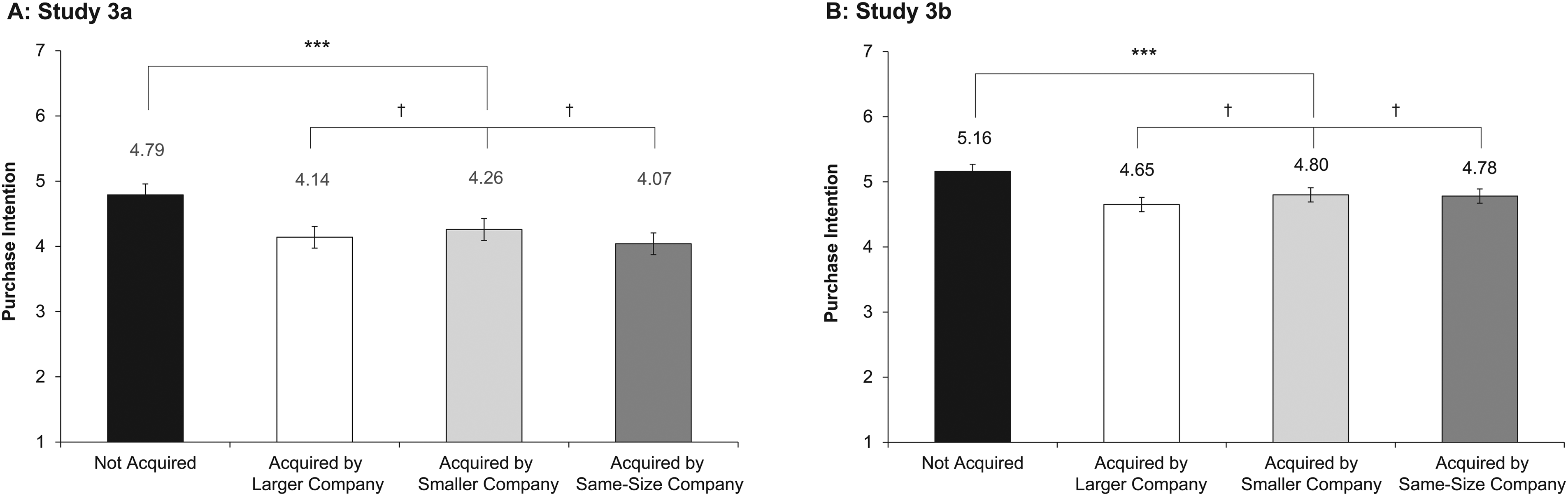
Studies 3a and 3b: Effects of Acquirer Size on Purchase Intention.
A multicategorical mediation analysis confirmed that the main effect is mediated by perceived values authenticity loss (indirect effect: ab = −.20, SE = .04; 95% CI = [−.27, −.13]) [ab = −.18, SE = .03; 95% CI = (−.23, −.11)]. As predicted, being acquired undermines the values authenticity of the acquired brand, with a subsequent negative effect on purchase intentions. If the negative effect of acquisitions were caused by a generally negative disposition toward larger companies buying up smaller brands (e.g., Paharia, Avery, and Keinan 2014), participants would have evaluated acquisitions by a smaller or same-size company less negatively.
Our findings advance existing research, which has hitherto considered acquisitions inauthentic only when large companies bought smaller ones (Frake 2017). Drawing on our values authenticity account, we instead argue that acquisitions can reduce authenticity even when the acquiring company is smaller than the acquired company. Apart from providing process insights, this study is managerially relevant. It is not uncommon for companies to try to acquire larger ones (e.g., Porsche attempting to acquire Volkswagen, an automotive giant with far greater revenues [Semuels 2006], Heinz-Kraft attempting to acquire Unilever, a company over twice the size [Reuters 2017]).
Study 4: Robustness to Full Versus Partial Acquisition
The aim of Study 4 is to test whether the negative acquisition effect only materializes when the entire brand is acquired, or if it still exists when smaller shares of the brand are acquired. Acquiring companies have two options: they can acquire either the entire brand or just a share of it. From a managerial and legal perspective, it is particularly critical whether more than 50% of the shares are controlled by another company (Akhigbe, Madura, and Spencer 2004). We expect consumers to view a complete acquisition as a clear signal that a brand's value system will change. However, consumers may view even a partial acquisition of a brand as a harbinger of change to the brand's value system (because of increased external pressure). Therefore, it is conceivable that selling only a small share of the brand is sufficient to dilute a brand's purchase intentions and values authenticity.
Method
We recruited 424 U.S. participants (46.9% female, Mage = 39.31 years, Prolific) who were randomly assigned to one of seven conditions of a between-participants design. We introduced participants to the same fictitious brand used in Study 3a (Rusty Root Brewery). In the not-acquired condition, participants received no information about the acquisition. In the six acquired conditions, we manipulated the portion of Rusty Root acquired by the Fitch Fish company (15%, 30%, 45%, 60%, 75%, or 100%; Web Appendix F). We then measured purchase intention (α = .95) and values authenticity (α = .94) as before.
Main findings
First, we compared participants’ purchase intention and values authenticity ratings for the not-acquired condition with the aggregated ratings of the acquired conditions. Planned contrasts revealed that, compared with participants in the not-acquired condition, participants in the acquired conditions indicated significantly lower purchase intention (Mnot acq. = 4.96, SD = 1.31, Macq. = 4.43, SD = 1.35; F(1, 423) = 7.99, p < .01, d = .25). Second, we aggregated the acquired conditions into two groups: less than 50% of shares acquired and more than 50% of shares acquired. Compared with participants in the not-acquired condition, these participants indicated reduced purchase intention when the acquirer bought less than the majority or more than the majority of the shares (Mnot acq. = 4.96, SD = 1.31; Macq.<50% = 4.53, SD = 1.41; Macq.>50% = 4.33, SD = 1.27; F(2, 421) = 5.04, p = .007, d = .39). The latter groups did not differ in terms of purchase intentions. We obtained similar results for values authenticity, with the main difference that the manipulation of acquired shares had a stronger effect on values authenticity. For example, participants already rated the focal brand lower on values authenticity, even when only 15% of the brand was acquired (Mnot acq. = 5.72, SD = .92; Macq.15% = 5.05, SD = 1.14; t(119) = 3.53, p < .001, d = .32). This was not the case for purchase intention; here, the negative purchase intention effect only started to become significant when more than 30% of the brand was acquired. These findings suggest that the share size of an acquisition has a more sensitive effect on values authenticity than on purchase intention. A multicategorical mediation analysis on purchase intention demonstrated a significant indirect effect through values authenticity on purchase intention (ab = −.10, SE = .02; 95% CI = [−.14, = −.07]). These findings suggest that the indirect effect through values authenticity remains robust across acquisition increments.
In summary, the results of Studies 1–4 provide converging evidence in support of H1 and document the robustness and generalizability of the negative effect of acquisitions on consumers reactions to acquired brands. Yet, since acquisitions involve not only the acquired brand but also the acquiring company, it might be that negative reactions to the acquired brand spill over to the acquiring company. To test this possibility that acquisitions also harm the acquirer, we conducted an add-on study (see Web Appendix G) in which we used the same basic experimental manipulation as in the previous studies (acquired vs. nonacquired) but asked participants to indicate purchase intentions for both the acquired brand and the acquirer. As an empirical context, we introduced participants to two real food producers, Hershey and Pretzels Inc. Consistent with the results in the previous studies, when participants were informed that Hershey purchased Pretzels Inc. (vs. not), they indicated significantly lower purchase intentions for Pretzels Inc. (Mnot acq. = 5.51, SD = 1.04 vs. Macq. = 5.06, SD = 1.54; t(209) = 2.47, p = .014, d = .34). Interestingly, participants in the acquired condition also indicated significant lower purchase intentions for Hershey, the acquirer (Mnot acq, = 5.88, SD = .96 vs. Macq. = 5.58, SD = 1.15; t(209) = 2.03, p = .044, d = .28). Taken together, these results suggest that acquisitions harm not only the acquired brand but also, to a lesser extent, the acquirer.
The Moderating Effect of Repeated Acquisitions and Leadership Continuity (Studies 5 and 6)
The primary aim of Studies 5 and 6 is to examine of the first set of managerially relevant conditions under which the observed negative main and mediation effect of acquisitions is attenuated. Study 5 examines whether consumers’ negative reactions to an acquisition are attenuated when this was not the first time the brand had been acquired (H2). Study 6 examines the moderating effect of continuity of leadership (H3).
Study 5: First Versus Subsequent Acquisition
Based on our values authenticity account, we expect that the negative acquisition effect is attenuated after the first acquisition of a brand (H2). To test this prediction, we compare two situations: one in which a brand is acquired for the first time, and one in which the brand undergoes a subsequent acquisition after the first. Moreover, this study addresses perceived product quality as another potential alternative account. Although the mediation results from the previous studies are difficult to explain using this account, it is possible that consumers expect acquisitions to negatively affect product quality, which thereby lowers purchase intentions.
Method
We recruited 363 participants (43.0% female, Mage = 40.38 years, MTurk) and randomly assigned them to one of three conditions (not acquired, acquired for the first time, or acquired multiple times) in a between-participants design. Participants read information about Pinbag, a (fictitious) company producing backpacks. Participants in the first-time-acquired condition read that the company had been recently acquired by another textile company. Participants in the subsequent-acquisition condition read that Pinbag had been acquired by a textile company, and then recently acquired again by another textile company. Participants in the not-acquired condition did not receive any acquisition-related information (see Web Appendix H for stimuli). A chi-square test (χ2(4) = 339.07, p < .001) confirmed that participants correctly identified the brand as having been not acquired, acquired once, and acquired multiple times in the respective conditions. We measured purchase intention and values authenticity as in the previous studies. Furthermore, to examine whether any effect of the acquisition on purchase intention might be affected by product quality perceptions, we asked participants to evaluate product quality using a series of seven-point items adapted from Johar and Simmons (2000): engineering and design, reliability, materials, manufacturing process, and performance (α = .93).
Main findings
An ANOVA on purchase intention produced a significant effect (F(2, 362) = 5.97, p = .003). We next conducted a series of planned contrasts. Compared with participants in the not-acquired condition, participants in both the first-time and subsequent-acquisition conditions indicated lower purchase intention (Mnot acq. = 5.24, SD = 1.22 vs. Mfirst acq. = 4.89, SD = 1.51; p = .041, d = .26 vs. Msubseq. acq. = 4.63, SD = 1.60; p = .003, d = .39). Moreover, consistent with H2, we find no difference between the two acquired conditions (F(1, 240) = 1.67, p = .198), indicating that the negative acquisition effect is attenuated after the first acquisition.
The pattern of results for values authenticity are consistent (F(2, 362) = 29.89, p < .001; see Web Appendix I for detailed analyses). We also obtain similar patterns for product quality, although the effect is weaker and only marginally significant (F(2, 362) = 2.84, p = .06; see Web Appendix I). We ran a multicategorical parallel mediation analysis (Model 4) with values authenticity and product quality as mediators. The analysis reveals two significant indirect effects; importantly, the effect of values authenticity is significantly stronger (b = −.21, SE = .05) than that of perceived product quality (b = −.07, SE = .03; contrast: b = −.1352, SE = .0534, 95% CI = [−.24, −.03]). Next, we ran a mediation model with perceived values authenticity as the mediator controlling for product quality. The model reveals an indirect effect of values authenticity and a nonsignificant indirect effect of product quality (95% bootstraps CI). These results confirm that values authenticity plays an important role in determining consumers’ negative reactions to an acquisition, above and beyond product quality perceptions.
Study 6: Leadership Continuity
Study 6 has two aims. The first is to examine a relevant boundary condition for the negative effect of acquisitions, namely the continuity of founder leadership (H3). The second is to provide further process evidence by measuring the mediating effect of values authenticity and two potential alternative explanations, namely perceived product quality and “underdog” status.
Method
We recruited 360 U.S. participants (43.9% female, Mage = 41.44 years, MTurk) who were randomly assigned to one of three conditions (not acquired, acquired/leadership continuity, or acquired/leadership change) in a preregistered experiment (https://aspredicted.org/V8Q_96N) using a between-participants design. As in the previous study, participants read information about the backpack brand Pinbag. After reading about the brand and its founders, participants in the not-acquired condition received no further information, whereas participants in both acquired conditions read that the firm had been acquired by Alphatex, a fictitious textile and apparel firm. Participants in the acquired/leadership continuity condition read that the two founders maintained their role in the company. Participants in the acquired/leadership change condition read that the two founders left after the acquisition (see Web Appendix J for stimuli). After reading this information, participants indicated their purchase intention (α = .95), perceived values authenticity (α = .95), and product quality (α = .95) using the same scales as before. In addition, we asked participants to indicate the brand's underdog status (“I think Pinbag is an underdog,” “Pinbag had to overcome obstacles to succeed,” and “Pinbag is a brand that has passion for its products”; α = .74; Acar et al. 2021).
Main findings
An ANOVA on purchase intention revealed a significant main effect (F(2, 359) = 17.64, p < .001). Follow-up contrasts revealed lower purchase intentions when the founders were no longer with the acquired brand (Mnot acq. = 4.76 vs. Macq./leader. change = 3.87; t(357) = 4.77, p < .001, d = .50). When the founders remained with the acquired brand, there was no significant difference in purchase intention between the two conditions (Mnot acq. = 4.76 vs. Macq./leader. cont. = 4.89; t(357) = −.70, p = .484, d = .07; see Figure 2).

Study 6: Effects of Leadership Continuity on Purchase Intention.
We repeated these analyses with the three potential mediator variables, one at a time. The patterns were consistent for values authenticity, less pronounced for perceived product quality, and not consistent for underdog status (see Web Appendix K for details and contrast analyses).
Next, we conducted a multicategorical parallel mediation analysis (with the acquired vs. the acquired-leadership change conditions) and compared the indirect effects of values authenticity with that of perceived product quality and underdog status, two potential alternative explanations. First, we found a strong significant indirect effect through values authenticity (b = −.71, SE = .17, 95% CI = [−1.05, −.39]). Consistent with the findings of Study 5, we also found a significant but substantially smaller indirect effect through perceived product quality (b = −.35, SE = .09, 95% CI = [−.66, −.19]). Consistent with the findings of Studies 3a and 3b, the indirect effect through underdog status was not significant (b = −.02, SE = .07, 95% CI = [−.13, .15]; see Web Appendix K). We next tested the relative explanatory power of the three potential process variables. We estimated three mediation models, one for each process variable, and entered the two remaining variables as covariates. The first model shows that the indirect effect of values authenticity remains robust, even when controlling for perceived product quality and underdog status (ab = −.48, SE = .12, 95% CI = [−.73, −.26]). This, however, is not the case for the other two potential alternative explanations. The indirect effect through perceived product quality is not significant when controlling for values authenticity and underdog status (ab = .14, SE = .08, 95% CI = [−.01, .32]). Similarly, the indirect effect through underdog status is not significant when controlling for values authenticity and perceived product quality (ab = −.001, SE = .02, 95% CI = [−.05, .05]). These findings further support our theorizing on the key role values authenticity plays in determining consumers’ negative reactions to an acquisition when the leadership of a brand changes.
The Moderating Role of Values Alignment (Study 7)
The aim of Study 7 is to test a further boundary condition, namely whether consumers perceive the values of the acquirer to be aligned with those of the acquired brand. We predict that consumers will react less negatively to an acquisition when there is stronger alignment between the values of the two brands (H4).
Method
We recruited 361 U.S. participants (73.1% female, Mage = 31.01 years, Prolific) who were randomly assigned to one of three conditions in a between-participants design (not acquired, acquired/high values alignment, or acquired/low values alignment). For this study, we used Pela, an actual producer of environmentally friendly phone cases and accessories, as the target brand. The brand's core values focus on environmentalism. Participants read a short description of the brand (see Web Appendix L for full stimuli). In the not-acquired condition, participants did not receive any further information, whereas participants in the two acquisition conditions received acquisition information. In the high-values-alignment condition, participants were told that Patagonia, a clothing company known for its environmental values, had acquired the target brand Pela; in the low-values-alignment condition, we told participants that Supreme, a clothing company not known for environmental values, had acquired Pela. We selected these two U.S. brands based on the website goodonyou.eco, which rates the sustainability of clothing producers. Furthermore, we conducted a pretest with a separate sample of 100 participants wherein participants rated brands in terms of brand attitudes, brand familiarity, perceived quality, and environmentalism as a core corporate value. Patagonia and Supreme only differed in terms of environmentalism (p = .017; for the other variables, ps > .30). We used the same scales as in previous studies to measure purchase intention (α = .94) and values authenticity (α = .86). As a manipulation check of values alignment, we included the following item: “As far as you know, how much do the values of the brand Patagonia align with those of the brand Pela?” (1 = “not at all,” and 7 = “very much”).
Manipulation Check: Values Alignment
As expected, participants rated the values of the target brand (Pela) as more aligned with the values of Patagonia than of Supreme (Macq. align. hi = 5.08, SD = 1.29 vs. Macq. align. lo = 3.68, SD = 1.42; F(1, 238) = 63.56, p < .001).
Main Findings
An ANOVA on purchase intention revealed a significant effect (F(2, 358) = 6.43, p = .002) consistent with H4. When the acquired brand had low values alignment (Supreme), participants indicated significantly lower purchase intention when the brand was acquired by Pela (Mnot acq. = 4.71, SD = 1.30, Macq. align. lo = 4.08, SD = 1.67; t(358) = 3.44, p < .001, d = .36). When the acquired brand had a high values alignment (Patagonia), the difference in purchase intention between the acquired and nonacquired condition was not significant (Mnot acq. = 4.71, SD = 1.30, Macq. align. hi = 4.56, SD = 1.33 t(358) = −.84, p = .404, d = −.08; Figure 3).

Study 7: Effects of Values Alignment on Purchase Intention.
A multicategorical mediation analysis (Model 4) again provides support for the mediating effect of values authenticity. The indirect effect through values authenticity is significant for the contrast between the not-acquired condition and acquirer-with-low-values-alignment condition (b = −.29, SE = .09, 95% CI = [−.48, −.13]). However, the indirect effect is not significant for the contrast between the acquired and the high-values-aligned-acquirer conditions (b = −.04, SE = .07, 95% CI = [−.17, .09]).
The Moderating Effect of Values Consistency (Studies 8 and 9)
In this section, we test how values consistency can moderate the effect of acquisition on values authenticity. First, we show how acquisitions harm values authenticity less in the case of a brand established with a growth value orientation, as the acquisition is consistent with the brand's founding values (Study 8). Second, we show how acquisitions may hurt old brands more, as they disrupts values that are set in time (Study 9).
Study 8: Growth Orientation of the Acquired Brand
Study 8 tests the moderating role of growth orientation—that is, whether the acquired brand has an overarching growth objective. A brand's growth orientation reflects values that are not inconsistent with the decision to seek an acquisition. Specifically, we test our prediction that the negative effect of acquisition is attenuated when the brand puts a strategic priority on growth (i.e., an intention to reach as many consumers as possible; H6).
Method
We recruited 504 U.S. participants (44.5% female, Mage = 38.11 years, MTurk), and randomly assigned them to one condition of a 2 (brand: not acquired vs. acquired) × 2 (orientation: control vs. growth) between-participants design. Participants read a paragraph about an actual outdoor equipment brand, Tatonka. In the acquisition conditions, participants read that Tatonka was recently acquired by another company, Outdoor Tech; in the not-acquired condition, participants did not receive this information. In the high-growth conditions, participants read the following fictitious value statement from the company founder: “It is a matter of how many people use my products. At the end of the day, we want lots of people to use and appreciate them. I started the company keeping this value in my mind and I am trying my best to pursue it.” Conversely, in the control conditions, participants read, “It is not a matter of how many people use my products. It is a matter that the passionate people use and appreciate them. I started the company keeping this value in my mind and I am trying my best to pursue it.” (See Web Appendix M for complete stimuli.) Participants completed the same purchase intention (α = .95) and values authenticity (α = .92) scales as in the previous studies.
Main findings
A 2 × 2 ANOVA produced a significant main effect of the brand acquisition factor on purchase intention (Mnot acq. = 4.80, SD = 1.47; Macq. = 4.36, SD = 1.46; F(1, 503) = 11.57 p < .001, η2 = .02), which was qualified by a significant interaction effect (F(1, 503) = 4.85 p = .028, η2 = .01) consistent with H5.
In the control condition, participants indicated significantly lower purchase intention when the brand was (vs. was not) acquired (Mnot acq. = 5.02, SD = 1.34, Macq. = 4.30, SD = 1.61; F(1, 503) = 11.56, p < .001; Figure 4). This, however, was not the case in the growth condition (Mnot acq. = 4.58, SD = 1.54; Macq. = 4.42, SD = 1.29; F(1, 503) = .756, p = .385). Moreover, the main effect of growth orientation was not significant (Mgrowth = 4.50, SD = 1.42; Mcontrol = 4.66, SD = 1.52; F(1, 503) = 1.57, p = .210, η2 = .00), indicating that participants were neither more nor less likely to purchase the brand when it pursued a growth strategy.

Study 8: Effects of Growth Orientation on Purchase Intention.
We found the same pattern of results for values authenticity (main effects: Facq.(1, 503) = 79.76, p < .001; Fgrowth(1, 503) = .168, p = .682; interaction: F(1, 503) = 10.36 p < .001; see Web Appendix E for detailed analyses). A moderated mediation analysis (Model 7) confirms the mediating role of values authenticity (index: b = .21, SE = .07; 95% CI = [.08, .35]). The indirect effect through values authenticity is significantly stronger in the control condition (b = −.39, SE = .06; 95% CI = [−.52, −.29]) than in the growth condition (b = −.18, SE = .04; 95% CI = [−.28, −.10]; the two CIs do not overlap). The results thus support our theorizing.
Study 9: Brand Age
Study 9 examines the moderating impact of brand age. We test whether the negative effect of acquisitions is stronger for an acquired brand that has been in the market longer, compared with a more recently established brand (H6).
Method
We recruited 633 U.S. participants on MTurk (47.4% female, Mage = 38.66 years), who participated in a 2 (brand type: not acquired vs. acquired) × 2 (brand age: old vs. new) between-participants experiment. They were introduced to Pinbag, the fictitious backpack company used in Study 6. Participants in the acquired conditions read that the brand was acquired by a textile and apparel firm, whereas participants in the not-acquired condition received no further information. In the old-brand condition, participants read that Tom Eagles, the firm's founder, established his business in Pittsburgh, Pennsylvania, in 1869. In the new-brand conditions, participants read the same text but that he established his business in 2010 (see Web Appendix N). Participants then completed the measures for purchase intention (α = .95) and values authenticity (α = .96) as before.
Main findings
A 2 × 2 ANOVA on purchase intention produced a significant main effect of acquisition (Mnot acq. = 5.06, SD = 1.31; Macq. = 3.94, SD = 1.47; F(1, 632) = 101.48, p < .001, η2 = .14) and a nonsignificant main effect of brand age (F(1, 632) = .019, p = .889, η2 = .00). In support of H6, the two-way interaction proved significant (F(1, 632) = 4.27, p = .039, η2 = .01). The negative effect of acquisition on purchase intention was stronger when the brand was old (Mnot acq. old = 5.16, SD = 1.23 vs. Macq. old = 3.82, SD = 1.50; t(629) = 8.53, p < .001) versus young (Mnot acq. young = 4.95, SD = 1.38 vs. Macq. young = 4.07, SD = 1.43; t(629) = 5.70, p < .001). The same ANOVA on values authenticity displays the same pattern (main effect of acquisition: F(1, 632) = 560.58, p < .001, η2 = .47, interaction: F(1, 632) = 8.52, p < .01, η2 = .01). The main effect of brand age proves not significant (F(1, 632) = .926, p = .336, η2 = .00).
The results of a moderated mediation analysis (PROCESS Model 7) reveal a significant index of moderated mediation (b = −.14, SE = .05; 95% CI = [−.24, −.05]). The indirect effect through values authenticity is significantly stronger in the old brand condition (b = −.63, SE = .07; 95% CI = [−.76, −.50]) than in the young brand condition (b = −.49, SE = .06; 95% CI = [−.61, −.38]), further supporting our values authenticity loss account. Furthermore, we conducted a posttest using the same stimuli and design as the main study (N = 207) to explore whether product quality could account for our findings. A 2 × 2 ANOVA on perceived product quality revealed a nonsignificant main effect of brand age (F(1, 206) = .212, p = .645) and a significant main effect of the acquisition factor (F(1, 206) = 16.88, p < .001). However, and in contrast to the previously observed significant interaction effect on values authenticity, the analysis revealed no significant interaction effect on perceived product quality (F(1, 206) = .937, p = .334). It is therefore unlikely, that perceived product quality offers an alternative explanation for the observed moderation effect in this study.
General Discussion
While extant research in accounting, finance, strategy, and organizational behavior has explored in detail how acquisitions impact organizations, little attention has been paid to how acquisitions impact consumers. Through a survey about real brand acquisitions, and nine experiments using both incentive-compatible and attitudinal measures, we shed light on this managerially important yet neglected topic. Building on a signal theory perspective, we propose an account based on loss of values authenticity to contextualize negative consumer reactions to acquired brands. Drawing on this account, we further predict managerially relevant boundary conditions that will attenuate the negative effect of acquisitions. Specifically, negative consumer responses to acquisitions are reduced when (1) brands have been acquired before (Study 5), (2) the original leadership remains involved in the company (Study 6), (3) the acquirer has values that align with the values of the acquired brand (Study 7), (4) acquired brands position themselves as having an orientation toward growth (Study 8), and (5) brands are younger (Study 9). In summary, our studies provide converging support for a values authenticity loss account regarding the negative effect of acquisitions on consumer response to brands. The very asset that often motivates them—the brand—can be endangered by acquisitions by undermining the authenticity of the brand's values. Thus, more speculatively, our findings suggest a possible reason why so many acquisitions fail to meet commercial objectives (e.g., Christensen et al. 2011).
Theoretical Implications
Our research advances the current body of academic work on acquisitions by documenting when and why consumers react negatively to acquisition news. Specifically, we demonstrate the importance of values authenticity (relative to other accounts including perceived product quality and underdog status) in explaining negative reactions. Further, we show that perceived loss of values authenticity is more relevant for certain brands (i.e., older brands that have been on the market longer, brands professing niche-oriented values) than for others (i.e., newer brands that have only been on the market for a short time, brands professing values related to growth).
More broadly, our results reveal that consumers react not only to marketing tactics but also to firms’ high-level strategic actions, such as acquisitions. Such actions constitute a signal that consumer can interpret and rely on in judgments and decision making. We demonstrate that a study of consumer behavior can be informative for corporate strategy decisions and illustrate how marketing strategy and consumer behavior intersect as streams of research. Thus, our work bridges consumer behavior with marketing strategy and corporate management research.
By examining brand acquisitions through the theoretical framework of values authenticity, our moderating effects also contribute to the literature on values authenticity. As Newman (2019) points out while calling for further research in this area, values authenticity contains nuances that deserve more attention; our work unravels some of these nuances. First, we find that individuals’ assessment of values authenticity is sensitive to even partial changes in ownership. In Study 4, consumer perception of authenticity dropped significantly after the acquisition, even when the acquirer bought only a small share of the company. In an add-on study, we document that negative consumer reactions can also spill over to the acquirer, reducing consumers’ purchase intention. Second, we demonstrate that brand age per se does not influence consumers’ view of the genuineness of company values (Study 9). Yet, when an external agent or event seemingly interferes with those values, brand age becomes a factor in shaping consumer perception in this regard. Third, our study contributes to the literature by examining how the alignment between the acquirer's values and those of the acquired brand reduces potential negative consumer reaction (Study 7) because signaling alignment of core values helps brands preserve their authenticity.
Moreover, we enrich the theory on values authenticity by demonstrating how a growth orientation can be considered authentic if the actions taken are consistently guided by such values (Study 8). This finding also indicates that overtly conveying disinterest in the wider commercial market, as many “indie” or “hipster” brands do, might backfire if the founders decide to sell their company. By showing when growth-oriented values can be perceived as authentic, our research also helps shift the focus of studies on values authenticity, which have heretofore mainly been centered on small companies and craft market categories (Silver, Newman, and Small 2020). Finally, our studies rule out several alternative accounts. One such candidate process relates to a natural characteristic of acquisitions: that is, most acquisitions involve a large acquirer and a smaller acquired firm. Company size could therefore be seen as a potential confounding factor and provides an account grounded in greater sympathy overall for small (vs. large) firms. Research in social psychology and consumer behavior (e.g., Paharia, Avery, and Keinan 2014) finds that when people witness competition, they tend to support the disadvantaged party. In Studies 3a and 3b, we rule out such an account by demonstrating that consumers consider an acquired company less authentic, regardless of the size of the acquirer (bigger, same size, or smaller). Our study also shows that the values authenticity loss is independent of the acquirer's size (which therefore revises previous suggestions in the literature; Frake 2017). In addition, in Study 6 we empirically rule out the possibility that our findings are determined by an underdog effect, showing how values authenticity accounts for the mediating effect over and above other factors. We also address the possibility that acquisitions lead to a perceived loss of quality in the acquired brands. While our studies show that acquisitions may have a (slight) negative effect on product quality perceptions, values authenticity accounts for the effect on purchase intention beyond product quality, as shown in Studies 5 and 6. It is important to acknowledge, however, that alternative explanations such as product quality perceptions and underdog status may be useful in explaining consumer reactions to acquisitions in particular contexts (e.g., specific industries or consumer segments).
Implications for Managerial Practice
Despite their increasing popularity in the corporate world, between 60% and 80% of all acquisitions have reportedly failed to create value (Christensen et al. 2011; Dyer, Kale, and Singh 2003). Although explaining the reasons behind such high failure rates is beyond the scope of this research, our findings suggest that consumer discontent following an acquisition might play a role. Therefore, our research encourages managers to consider possible negative consumer reactions when evaluating the appeal of a new acquisition. Our findings are illuminating for brand managers because they reveal contexts where acquisitions are more (vs. less) likely to damage the brand. In particular, our results offer a word of caution with respect to acquiring firms operating in domains where authenticity is a key asset to brands (e.g., in sectors where symbolic value of products is important such as for “craft” or “artisanal” products).
In addition to pointing out consumers’ negative feelings after acquisitions, our results offer valuable insights as to why acquisitions are often viewed unfavorably. The mechanism of values authenticity loss presented in this article highlights the delicate nature of brand identity. While acquirers might think they have secured a stable and valuable asset by acquiring the target brand, our findings show that brand authenticity is easily tarnished by an acquisition. What can managers do to avoid this outcome? Our findings suggest that a series of considerations can be made both before and after the acquisition process takes place.
Before the acquisition
Managers can examine the target brand's communications and identify whether the vision statement, advertising, social media accounts, and other forms of branding contain any references to growth or reaching a broader range of customers. Such cues may make the acquisition process more favorable in the eyes of consumers (Study 8). Moreover, an alignment of values between the acquirer and acquired brands reduces potentially negative reactions (Study 7). Targeting brands aligned with the acquiring company's core values and making this alignment salient can benefit the acquisition process. Similarly, the acquiring company could consider brand age a key factor. Consumers view the acquisition of a newer brand as less harmful (Study 9). Scouting for young, promising brands could prove beneficial, potentially giving the acquirer an aura of patronage and a reputation for investing in nascent businesses. Our findings in Study 5 reveal that negative consumer reactions are reduced in cases where brands have a history of being taken over. Accordingly, brands that have undergone previous acquisitions should be an attractive acquisition target.
After the acquisition
Our findings suggest that managers should carefully plan how to effectively frame announcements communicating acquisitions. For example, Study 6 shows that when consumers are made aware of management continuity, the negative effect of the acquisition is attenuated. This type of communication could be especially effective in the case of older brands. If the founders/original owners will not be involved with the company after its acquisition, managers may want to consider retaining long-term employees and highlighting this action in their communications. Similarly, maintaining a connection with the founders/original owners could prove beneficial to brands that are more oriented toward niche values (e.g., passion, craftsmanship); the presence of founders/original owners could act as an authenticity proxy for these values, mitigating the negative impressions consumers may develop. In the case of companies with growth-oriented values or a newer brand, continuity of leadership could be positioned as an investment by the acquirer toward the brand, to nurture its potential and develop its capabilities. Similarly, when the acquirer has values that align with those of the acquired brand, highlighting this can boost perceptions of the acquisition and nurture the brand. In summary, while forming expectations regarding the outcome of an acquisition, managers should carefully evaluate the characteristics of the brand they want to acquire and the values that drive the brand's actions in the marketplace. Figure 5 provides a checklist based on our findings for managers involved in the acquisition process.

Checklist for Managers.
Directions for Future Research
We focused on the negative effects of acquisitions because these are especially crucial from a practical point of view. However, more research is needed to investigate the potential positive effects of acquisitions. For example, it is conceivable that information about acquisitions could also strengthen perceptions of firms. Acquisitions might signal that a firm is in demand, and consumers might accordingly infer that the target firm (and its products) is somehow “good,” because it would not have been acquired otherwise (Kardes, Posavac, and Cronley 2004). While we identified a series of factors mitigating the negative effect of acquisitions, there are might also factors that could boost consumers’ reactions to acquisitions. For example, it is possible that acquired brands might also benefit from acquisitions in the eyes of consumers when the acquired brands fall short of having the (marketing) capabilities necessary to succeed in a competitive environment (e.g., research and development facilities, a strong distribution network, marketing intelligence for the analysis of competitors, advertising resources). Similarly, when considering the continuity of management, consumers may actually be relieved and view acquirers in a more positive light when they take over a brand with poor or controversial management.
Another area that deserves further research is the dynamic acquisition process itself. In our experiments, as in most real-life situations, consumer cognizance of a brand acquisition occupies one moment in time, when in fact the acquisition may be a very long process. Examining the longitudinal effect of the acquisition process on consumer reaction could shed light on how consumers form thoughts on the buyout process over time. In addition, it could speak to aspects of our suggestions for managerial practice that we could not address. Future research could also test the long-term effects of acquisitions and examine if the negative effect we identify changes over time. Future studies could unravel how acquisitions impact revenues by considering additional factors that could cause a potential drop in sales (e.g., looking at the acquired brand's previous performance or level of technological innovation). Overall, our findings should help decision makers better manage the acquisition of firms and avoid negative consumer reactions.
Supplemental Material
sj-pdf-1-jmx-10.1177_00222429221137817 - Supplemental material for When and Why Consumers React Negatively to Brand Acquisitions: A Values Authenticity Account
Supplemental material, sj-pdf-1-jmx-10.1177_00222429221137817 for When and Why Consumers React Negatively to Brand Acquisitions: A Values Authenticity Account by Alessandro Biraglia, Christoph Fuchs, Elisa Maira and Stefano Puntoni in Journal of Marketing
Footnotes
Associate Editor
Vanitha Swaminathan
Declaration of Conflicting Interests
The author(s) declared no potential conflicts of interest with respect to the research, authorship, and/or publication of this article.
Funding
The author(s) received no financial support for the research, authorship, and/or publication of this article.

Notes
References
Supplementary Material
Please find the following supplemental material available below.
For Open Access articles published under a Creative Commons License, all supplemental material carries the same license as the article it is associated with.
For non-Open Access articles published, all supplemental material carries a non-exclusive license, and permission requests for re-use of supplemental material or any part of supplemental material shall be sent directly to the copyright owner as specified in the copyright notice associated with the article.
