




Abstract
Employing Lemon & Verhoef’s customer journey framework to capture sequential user interactions with digital products, we develop a strategic framework for promoting standalone apps (those without existing brand backing) spanning pre-adoption, adoption and post-adoption stages. Four critical insights emerge: (1) Standalone apps require culturally adaptive trust mechanisms employing social proof and transparency strategies to compensate for brand anonymity, (2) Resource-constraint adaptation fundamentally shapes promotional strategy selection, with successful apps developing resource-efficient approaches across multiple touchpoints, (3) Technical-commercial balance through hybrid monetisation models shows higher retention than single-revenue approaches and (4) Cross-stage promotional integration reveals that strategies must dynamically interconnect across customer journey stages, with post-adoption success relying on above-average engagement and ethical data use. Our review reveals gaps in long-term strategy effectiveness, cultural adaptation mechanisms and cross-stage optimisation, leading to a research agenda investigating dynamic trust-building frameworks, resource-efficient promotion strategies and temporal promotional optimisation. This study advances digital marketing theory by extending the customer journey framework to standalone digital products and developing a model explaining how brand absence and resource constraints jointly shape promotional effectiveness. These contributions offer practical implications for resource-constrained app developers in competitive marketplaces.
Keywords
Introduction
Understanding how customers navigate from initial mobile app awareness to final download represents one of the most critical challenges in today’s mobile app economy. Mobile apps are now essential for promoting and distributing products (Stocchi et al., 2022), with 4.83 million apps available and 137.8 billion downloads in 2024 (Lauran, 2024). Yet despite this substantial scale, successfully guiding potential users through each stage of the customer journey – from awareness to interest, evaluation, and ultimately conversion – remains poorly understood. Apps improve user engagement and create value (Bellman et al., 2011; E. Kim et al., 2013; Natarajan et al., 2017), help brands reach marketing goals, build company value through design (Boyd et al., 2019), influence customer journeys (Lemon & Verhoef, 2016), and provide competitive customer experiences (Kopalle et al., 2020). With global spending on app download advertisements expected to reach $94.9 billion by 2025, growing 20% from 2023 (Rosenfelder, 2023), understanding how to optimise each touchpoint in the customer journey has become vital for maximising these investments (Chiong et al., 2020). Beyond paid advertising, platform visibility, promotions, and developer updates directly affect how apps are discovered, downloaded, and used throughout the customer journey (Lee & Raghu, 2014; McKelvey & Hunt, 2019).
However, comprehensive understanding of app launch strategies (C. Z. Liu et al., 2014; Reeck et al., 2023) and user acquisition approaches (Munzert et al., 2021) that effectively address each customer journey stage remains limited. This knowledge gap is particularly critical for standalone apps – those not affiliated with existing brands (Stocchi et al., 2019, 2022) – which must navigate the entire customer journey without pre-existing brand awareness, requiring innovative strategies to build awareness and attract users from scratch (Zhao & Balagué, 2015). This study has two research objectives: (1) to systematically review and synthesise existing knowledge on promoting standalone apps across all customer journey stages, and (2) to offer a comprehensive future research agenda addressing gaps in current understanding. Standalone apps have proven successful, from WhatsApp achieving a $19 billion valuation before its Facebook acquisition (Appel et al., 2020) to Bluesky reaching 1 million users in 2023 despite entering the highly competitive social networking market (Oladipo, 2023).
Research on app downloads employs the conversion funnel framework (Park, 2023), encompassing three stages: attracting potential customers through awareness and interest strategies (Hassan et al., 2015); encouraging engagement and evaluation; and conversion, where customers download the app. These stages correspond to the pre-adoption and adoption stages of the customer journey (Lemon & Verhoef, 2016). In the pre-adoption stage, app managers should prioritise enhancing user experience to encourage word-of-mouth promotion and positive reviews (Romano et al., 2021; Stocchi et al., 2018), as demonstrated by COVID-19 contact tracing apps that boosted downloads through social proof, norms and incentives (Munzert et al., 2021; Sharif et al., 2021).
However, limited academic literature addresses strategies for increasing conversion funnel success across pre-adoption behaviours (need recognition, search, evaluation) and adoption (download). This gap is problematic since many developers focus monetisation strategies on app downloads. Existing studies often examine strategies isolated to single customer journey stages – app influencers (pre-adoption, cf. Hu et al., 2019), App Store Optimisation (adoption stage, cf. Mahmood, 2020) or app architecture techniques (adoption and post-adoption, cf. Reeck et al., 2023). We therefore offer a holistic perspective integrating app promotion strategies across all customer journey stages to facilitate app download and installation.
Standalone apps face significant challenges in competitive digital markets (Furner et al., 2014). Lacking brand awareness and mental availability, these apps struggle with recognition and recall, easily getting lost in crowded app stores (Stocchi et al., 2022). Without established brand backing, they face dual challenges: building marketing presence from scratch while competing in markets with low entry barriers and prevalent copycat technologies. This creates promotional burdens, trust-building problems and resource limitations (Zhao & Balagué, 2015), requiring constant innovation where alternatives are just one tap away (Stocchi et al., 2022). Most existing research focuses on branded apps as extensions of well-known brands (e.g. Zara, IKEA) rather than standalone digital products (Bellman et al., 2011).
Our study examines strategies that increase standalone app downloads and installations using the funnel model. While acknowledging other important outcomes (usage, purchases, purchase intentions), we focus specifically on downloads and installations to address the unique challenges standalone apps face in securing early user adoption without established brand recognition. Our systematic literature review differs from existing studies (Kumar & Mittal, 2020; Lee & Raghu, 2014; Reeck et al., 2023; Stocchi et al., 2022) by providing a holistic view of standalone app promotion strategies across customer journey stages. This conceptual approach synthesises academic literature from marketing, consumer psychology and information systems to identify key promotional factors, critical literature gaps, and develop a future research agenda. For practitioners, the findings provide insights into effective standalone app marketing strategies across all journey stages, aiding development of robust and adaptive promotional campaigns.
Research background
Customer journey and App promotion
Lemon and Verhoef’s (2016) Customer Journey framework builds on earlier research (Gentile et al., 2007; Maechler et al., 2014, 2016) to understand customer experiences across multiple touchpoints as an episodic process before, during and after purchase (Følstad & Kvale, 2018). In the app domain, this framework encompasses stages such as awareness, consideration, downloading, first use, continued use and in-app purchases or upgrades (Rita et al., 2023). Each stage represents a crucial touchpoint where app marketers can influence user behaviour and attitudes (H. Liu & Sese, 2022; Reeck et al., 2023). For example, a standalone fitness-tracking app’s customer journey might begin with social media awareness, proceed to App Store browsing and review reading (pre-adoption), then downloading and setup (adoption), followed by regular activity tracking and premium upgrades (post-adoption). Similarly, a language-learning app may start with word-of-mouth recommendations (pre-adoption), proceed to installation and first lesson completion (adoption), and continue with daily practice and progress sharing (post-adoption). While the Customer Journey framework applies across an app’s entire lifecycle, this study examines promotional strategies at the critical launch stage, where the journey from pre-adoption through initial post-adoption represents the most significant challenge for apps without brand equity.
Academic literature offers various app promotion strategies across customer journey stages, yet existing systematic reviews (Kumar & Mittal, 2020; Lee & Raghu, 2014; Stocchi et al., 2022) have examined mobile app marketing broadly without differentiating standalone apps or systematically mapping promotion strategies to specific customer journey stages. Standalone apps form a distinct category, independent digital products building market presence from scratch rather than extending existing brands. Unlike branded apps leveraging established relationships and resources, standalone apps must simultaneously establish product functionality, brand identity and market positioning. Our synthesis provides stage-specific insights. Pre-adoption strategies must build brand equity and achieve market fit in saturated ecosystems through extended market research, strategic resource allocation and efficiency-centred business models (Guo et al., 2017; Khan et al., 2023). Cultural adaptation mechanisms are critical, with apps showing stronger download performance when accounting for investor-consumer cultural proximity (Soh & Grover, 2023). Iterative design processes balancing innovation with platform conventions are essential (Barlow et al., 2019). Adoption-stage strategies emphasise strategic categorisation through optimisation and behavioural nudges (Qiu et al., 2017; Thaler & Sunstein, 2008). While cross-platform development accelerates launch timelines, native implementations yield higher satisfaction despite longer development cycles (Ahti et al., 2016). Post-adoption success hinges on creating self-sustaining feedback loops (Jung et al., 2021) and data-driven optimisation frameworks.
Review methodology
This systematic review examines promotional strategies for standalone apps using established scholarly methods. We operationalised standalone apps as mobile applications developed without affiliation to pre-existing brands, requiring independent market presence without leveraging established brand equity. Our methodology prioritises transparency while maintaining focus on standalone apps’ unique marketing challenges, distinguishing them from brand-affiliated counterparts. By applying consistent inclusion criteria focused on promotion-specific interventions and excluding general app marketing studies, we ensure the findings remain contextually grounded in standalone app developers’ operational realities.
Literature search strategy
This literature review employs a PRISMA approach to critically examine marketing strategies for standalone apps throughout the customer journey (Moher et al., 2009). Searches were carried out using the following terms within topics: ‘Startup’ OR ‘Standalone’ OR ‘Independent’ AND ‘App’ OR ‘Application’ AND ‘Marketing’ OR ‘Promotion’ OR ‘Advertising’ across the Web of Science database (Page et al., 2021). Subsequently, we manually identified studies focused on marketing strategies for app promotion. The search was restricted to literature published between 2015 and 2024, reflecting the rapid evolution of the mobile app ecosystem during this period and its relevance to current marketing practices (Moher et al., 2009). In total, 155 records were initially identified through database searches, with an additional 4 records obtained through manual searches of journal websites and industry sources.
Screening
Initial screening reviewed titles and abstracts for relevance using specific inclusion and exclusion criteria. Studies were included if they discussed paid or organic strategies, methods, or techniques aimed at increasing standalone app visibility and downloads/installations. Peer-reviewed journal articles, conference proceedings, book chapters, industry reports and white papers published in English were prioritised for methodological rigour and relevance. Studies were excluded if they focused on branded apps from established companies, discussed general mobile app marketing without standalone app specificity or lacked actionable insights or empirical evidence. This approach ensures thorough literature review while maintaining focus on standalone apps (Chandler et al., 2019). The screening process excluded 112 records, leaving 43 records for full-text assessment.
Eligibility
The eligibility assessment involved a detailed review of the full texts of the remaining 43 records to evaluate their alignment with the study’s objectives. Each article was examined to ensure that it focused specifically on standalone app promotion strategies and their relevance to the customer journey framework. Articles that lacked specificity to standalone apps, provided only peripheral or implicit references to promotional strategies, or focused primarily on app development or monetisation without discussing promotional aspects were excluded at this stage. For example, studies that addressed general app-related topics, such as user interface design or payment systems, were excluded if they did not provide insights into app promotion strategies. Following this assessment, 21 records were excluded, resulting in a final set of 23 studies for inclusion in the review.
Inclusion
The final set of 23 studies was included in the review and systematically categorised based on their focus on the customer journey stages (Lemon & Verhoef, 2016). The selected studies provided insights into promotional strategies tailored to the unique challenges faced by standalone apps, such as limited brand awareness, constrained marketing budgets and competitive app store environments. The review process is summarised in Figure 1, which visually represents the identification, screening, eligibility and inclusion stages.
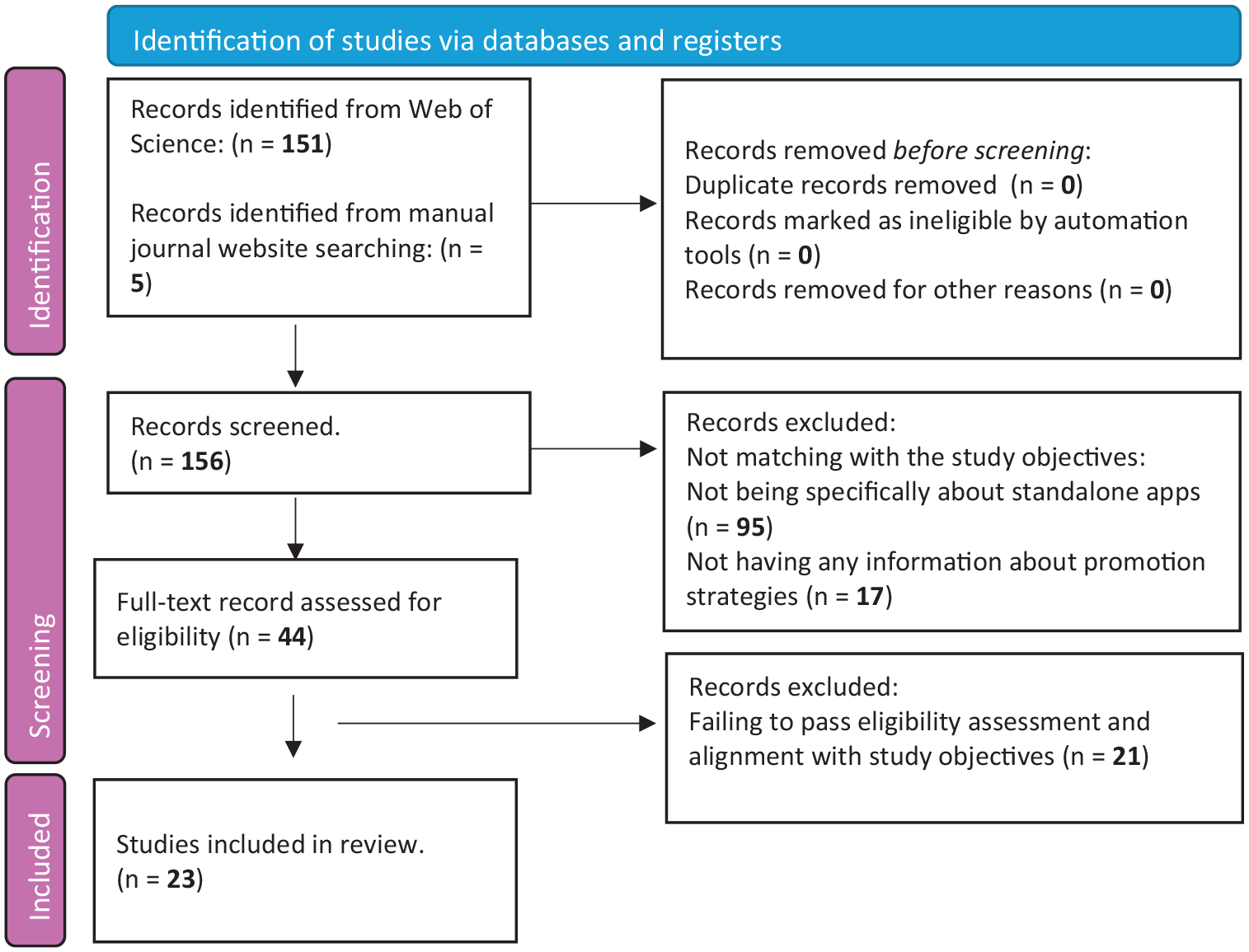
PRISMA flowchart for the review process.
Data categorisation and analysis
The selected studies were organised into thematic categories based on customer journey stages. Customer journey provides a comprehensive theoretical lens capturing the full spectrum of consumer-app interactions from awareness through post-adoption, making it particularly suitable for understanding standalone app promotion challenges. This approach aligns with established marketing literature emphasising stage-specific strategies, as different promotional tactics are required at awareness, consideration and adoption phases (Gentile et al., 2007; Lemon & Verhoef, 2016). Key strategies and insights were extracted and synthesised to identify patterns, gaps and opportunities, with particular emphasis on addressing standalone apps’ unique challenges in achieving visibility, building trust and driving downloads.
Findings
Our findings focus on promotional strategies for standalone apps at launch stage, addressing their unique challenges when entering competitive marketplaces without pre-existing brand equity. Table 1 summarises key strategies across customer journey stages. Through systematic analysis of the 23 included papers, we employed rigorous theme identification where two researchers independently coded the papers, identifying 15 promotional strategies later consolidated into broader strategic themes (requiring support from at least two papers). We categorised these themes by their primary impact on the customer journey, resolving disagreements through discussion. The analysis identified seven distinct strategic approaches across three customer journey stages: pre-adoption (market analysis and cultural positioning, design and user experience, cultural and market fit), adoption (conversion strategy and tactical marketing, revenue and technical considerations) and post-adoption (user engagement and retention, data-driven optimisation).
Summary of Relevant Literature.
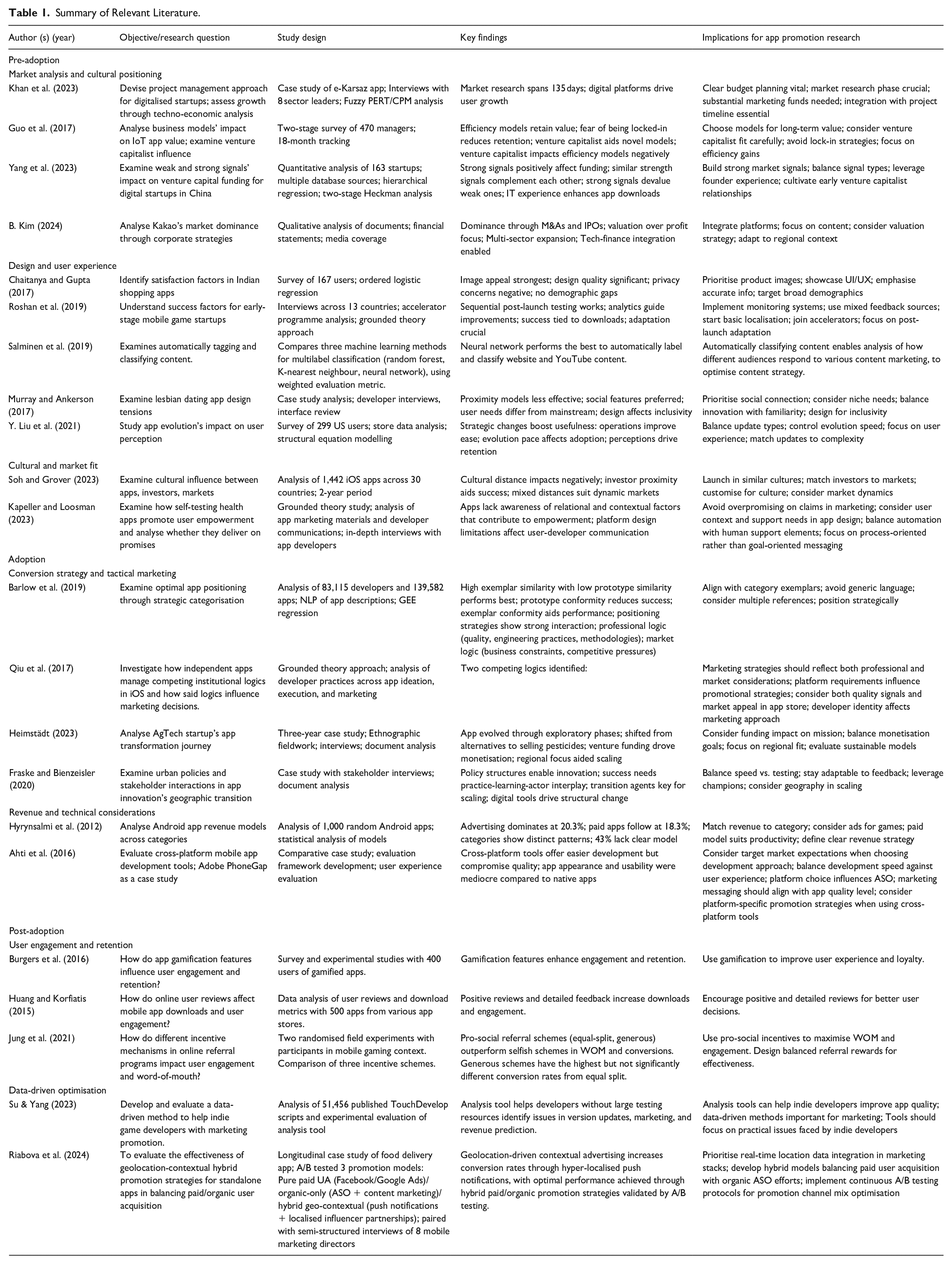
Our analysis reveals key success factors across customer journey stages. In the pre-adoption stage, thorough market research and strategic planning directly affect growth patterns (Khan et al., 2023), with efficiency-focused business models (freemium with targeted premium features) outperforming lock-in strategies (Tyrväinen & Karjaluoto, 2024). Strong market signals (pre-launch waitlists, beta-testing engagement) and founder experience significantly influence capital attraction and downloads (Appel et al., 2020). Cultural alignment and user-centric design are crucial for success (Soh & Grover, 2023). During the adoption stage, strategic positioning balancing similarity with exemplar apps while offering unique features achieves better performance (Barlow et al., 2019; Qiu et al., 2017). Hybrid monetisation strategies combining subscriptions with microtransactions show higher retention than single-revenue approaches (Tyrväinen & Karjaluoto, 2024). Dynamic pricing based on engagement patterns increases conversion rates (Runge et al., 2022), though cross-platform development offers efficiency at the cost of user experience quality (Ahti et al., 2016; Appel et al., 2020). Post-adoption success leverages gamification features boosting installs (Burgers et al., 2016), positive user reviews driving downloads and retention (Huang & Korfiatis, 2015), and pro-social referral mechanisms improving word-of-mouth conversions (Jung et al., 2021). Data-driven tools for engagement optimisation, churn prediction and personalisation algorithms especially benefit resource-constrained developers (Su & Yang, 2023).
The following sections will discuss (a) how these strategies are relevant and important for standalone apps and (b) the specific implications they have for standalone apps when it comes to facilitating user behaviours and boosting app downloads.
Pre-adoption stage
Market analysis and cultural positioning
Market research and positioning are vital for standalone app success. Starting with zero visibility, these apps require thorough research to identify entry points and cultural adaptation to bridge marketer-consumer gaps for better adoption (Khan et al., 2023; Soh & Grover, 2023; Tiongson, 2015). Cultural adaptation builds awareness by connecting with target users lacking prior brand associations. Market research reduces uncertainty by aligning with market expectations while finding unique value propositions, as research indicates apps balancing familiarity with innovation achieve higher conversion rates (Barlow et al., 2019; Kübler et al., 2018). Understanding app store elements is essential for effective positioning (Böhm & Schreiber, 2014). Without brand equity, standalone apps need trust mechanisms from positioning onwards, where market analysis must identify trust signals valued by target audiences to replace missing brand recognition. Apps targeting emerging markets must adapt to local regulations and social norms to compensate for lacking brand credibility (Kanthawala et al., 2019). Studies suggest favouring efficiency-centred models over lock-in strategies (Guo et al., 2017) affects user behaviour by reducing decision fatigue, with research showing simpler onboarding processes boost first-week retention (Su & Yang, 2023).
Standalone apps need market analysis to find category-specific trust proxies for positioning strategy, lacking transferred trust from established brands. Effective positioning should highlight real user growth, as apps with strong adoption metrics rank higher in app stores (Yang et al., 2023). This creates cycles where visibility drives downloads, improving rankings. For apps with zero initial awareness, this cycle is essential, requiring strategies building momentum through targeted micro-communities where word-of-mouth offsets lacking brand recognition. Though expansion across industries might appeal (B. Kim, 2024), standalone apps perform better focusing on specific niches. Clear specialisation helps users grasp app purpose quickly, improving search rankings and conversion rates (Stocchi et al., 2022). This niche focus is vital for standalone apps, allowing concentrated awareness-building and reputation development in defined communities rather than spreading limited resources thinly. Automated market research tools help developers adjust strategies based on real-time data, allowing apps to refine positioning while maintaining comprehensive market insights (Su & Yang, 2023). For standalone apps, these tools quickly identify awareness gaps addressable through niche positioning, helping build visibility in underserved segments where lacking brand recognition is less disadvantageous. This approach optimises resources and creates behavioural nudges through consistent, research-informed patterns, driving downloads.
Design and user experience
Design and user experience are vital for standalone apps, requiring user-centred designs to overcome market entry barriers. For these apps, the lack of brand equity creates a major hurdle as users have no existing trust or quality expectations, making first impressions much more important in adoption decisions than for branded apps. Studies show user recognition and preferences for app icon design significantly impact initial attraction (C. C. Chen, 2015; Y. Liu et al., 2021; Wang & Li, 2017). This visual first impression is crucial for standalone apps, as their icon must convey purpose, quality and trustworthiness without the brand recognition established competitors have. Effective interfaces need to balance visual appeal with usability (Chaitanya & Gupta, 2017) – especially important for apps requiring quick trust-building without an established brand (Zhao & Balagué, 2015). Ongoing refinement during development, including adapting to local preferences (Roshan et al., 2019; Soh & Grover, 2023), helps drive early adoption. Standalone apps need to build trust mechanisms into their design elements, using visual cues signalling security, transparency and quality to replace the automatic trust branded apps receive. Colours and layouts serve as trust-building tools (Murray & Ankerson, 2017), while simple, intuitive interfaces streamline onboarding (Bargas-Avila & Hornbæk, 2011). For standalone apps, design must work harder to establish credibility, as using familiar industry design patterns creates trust signals (Micheli & Gemser, 2016) helping users validate new apps despite having no brand recognition.
Feature updates should focus on guiding user behaviour rather than adding complexity, as streamlined functionality promotes organic sharing by reducing overwhelm (Roshan et al., 2019). Fashion retail apps, for example, benefit from design elements combining aesthetics with functionality (Magrath & McCormick, 2013), while landing pages and post-click experiences should follow platform conventions (Salminen et al., 2019). Standalone apps must build awareness without established distribution channels, making their design elements essential for organic sharing and word-of-mouth – requiring deliberate inclusion of shareable moments and visual distinctiveness branded apps might not need. Following platform design conventions serves not as a limitation but as a shortcut to user familiarity, helping people learn the app more quickly (Aqib et al., 2023). Finding the right balance between innovation and familiarity is essential, using design cues combining new features with recognisable patterns (Magrath & McCormick, 2013). For standalone apps, this balance is especially tricky – they need enough familiar design patterns to build immediate trust while also standing out visually in crowded markets. Building accessibility from the start, rather than adding it later, widens audience reach and demonstrates ethical commitment (Siyal et al., 2024). Standalone apps can use inclusive design not just as an ethical practice but as a strategic trust-building tool, as accessible design signals professionalism and attention to detail helping bridge the credibility gap from lacking brand recognition. When executed effectively, these strategies create momentum: better app store visibility attracts new users, while intuitive design maintains engagement, making user experience both a growth driver and retention tool.
Cultural and market fit
Cultural and market alignment are crucial for standalone app success, requiring different strategies than branded solutions. Standalone apps struggle with cultural credibility, as users don’t have the reassurance of an established brand’s cultural understanding and market commitment, leading to greater scrutiny of cultural authenticity than branded alternatives face. Effective cultural fit involves more than translation – it requires adapting to local regulations and social norms, helping apps build trust more quickly (M. Chen et al., 2023). Cultural adaptation acts as a vital trust mechanism that can replace brand recognition by showing deep local understanding that demonstrates market commitment despite having no previous presence. Health apps, for example, need to address region-specific credibility concerns, as Kanthawala et al. (2019) found users often make informal judgments about app quality based on cultural alignment. Standalone apps must reflect local values in their design to make up for their lack of corporate credibility (Stocchi et al., 2022). Standalone apps face a trust gap they must fill through highly localised cultural signals – studies show that cultural adaptation works not just as a usability improvement but as a main trust-building tool (Alteren & Tudoran, 2019).
Successful apps use continuous user feedback systems (Guzman & Maalej, 2014) to handle both technical and cultural challenges, with adaptable design structures for unstable markets and deeper integration in stable ones (M. Chen et al., 2023). Standalone apps must leverage cultural fit to build awareness by identifying culturally specific problems that larger branded competitors have missed, creating community connection driving word-of-mouth in targeted cultural segments. The alignment between development teams and target users is essential because cultural mismatches cause misunderstandings reducing app appeal (Soh & Grover, 2023). Even small cultural misalignments can completely prevent adoption, as users have no existing brand goodwill to offset these issues, requiring thorough cultural validation. Modern approaches view cultural adaptation as ongoing collaboration, especially for apps using AI requiring regular cultural testing (Su & Yang, 2023). Standalone apps can turn their lack of brand history into an advantage through cultural flexibility, as they can quickly implement culturally specific features without dealing with brand consistency requirements. This approach not only makes market entry easier but also improves app store visibility, as platforms favour culturally relevant solutions. Cultural relevance addresses the trust gap through cultural authenticity while enhancing algorithmic discovery through culturally aligned keywords and engagement patterns. When fully embraced, cultural adaptation becomes a growth tool – reducing user uncertainty while improving discovery through culturally aware engagement patterns working well for both users and algorithms.
Adoption stage
Conversion strategy and tactical marketing
Strategic marketing must address market challenges while building credibility. Standalone apps face conversion friction that requires effective positioning – fitting into familiar patterns while offering unique features to stand out (Fraske & Bienzeisler, 2020; Stocchi et al., 2022). This positioning challenge requires both category education and differentiation – a dual task branded apps avoid. App store elements like metadata and screenshots significantly affect visibility (Böhm & Schreiber, 2014), while personalised marketing boosts conversion rates (Tong et al., 2020). Standalone apps must use these app store elements as main trust signals rather than just extra information: studies show that conversion rates improve significantly when screenshots show deep functionality (Feiz et al., 2022). Good marketing combines community-building with revenue goals (Qiu et al., 2017), as standalone apps need both user support and growth potential that appeals to investors (Heimstädt, 2023). For these apps building community acts as a vital trust mechanism, creating social proof that replaces brand equity while also addressing low awareness through word-of-mouth that branded competitors don’t rely on as much.
Many apps evolve from free models to paid features due to industry pressures, adopting business practices while maintaining community-friendly messaging to retain early users (M. Chen et al., 2023). Standalone apps face unique monetisation timing challenges: adding paid features too early can halt crucial awareness growth, while waiting too long risks creating a permanently free perception, requiring sophisticated freemium strategies. Global expansion needs local customisation and global features, using structured feedback systems to adapt insights without losing cultural authenticity (Guo et al., 2017). Standalone apps need greater localisation investment to overcome trust gaps in new markets and may achieve higher growth by addressing culturally specific needs that globally standardised branded apps miss. Food delivery apps, for example, benefit from interface designs focusing on familiarity, as Choi (2020) connected user satisfaction with reduced decision fatigue in frequently used apps. Standalone apps need to use this familiarity principle more strategically than branded alternatives. Marketing must remain adaptable to platform rule changes, maintaining core values while exploiting temporary visibility opportunities (Yang et al., 2023). Standalone apps can potentially achieve quick awareness growth by rapidly adapting to new algorithmic preferences. Modern solutions use built-in analytics for real-time strategy adjustments – apps with AI-driven sentiment tracking adapt better to market changes without losing identity (Su & Yang, 2023). Standalone apps can leverage this analytics advantage more effectively, as their lack of brand history allows quicker changes based on user data, creating an agility advantage. This transforms marketing into ongoing value adjustments pleasing both app store algorithms (favouring steady engagement) and users (expecting genuine improvements). When executed well, strategic positioning works as both growth starter and retention tool, using algorithm-friendly visibility tactics while staying relevant through continuous improvement (Fraske & Bienzeisler, 2020).
Revenue and technical considerations
Balancing income generation and technical design in standalone apps means resolving competing priorities: immediate profits versus long-term system health. Standalone apps need to carefully time monetisation to avoid hampering crucial early growth, creating financial pressures that branded apps with existing revenue don’t face. The conflict between star ratings and income (Hyrynsalmi et al., 2015) affects unknown apps more severely, requiring flexible pricing systems aligning features with what users will pay (Tyrväinen & Karjaluoto, 2024). This balance is especially delicate, as aggressive monetisation can lead to negative reviews causing disproportionate harm to adoption. Technical solutions need to balance safety and speed using adaptable structures, combining thorough security checks with multi-device compatibility (Ahti et al., 2016). Apps without brand equity face greater technical scrutiny, as users hold unknown entities to higher performance standards, requiring stronger technical implementations to achieve perceived reliability. Hybrid monetisation models combining subscriptions and microtransactions work better than single-revenue approaches, especially in price-sensitive markets (Kübler et al., 2018). For standalone apps, these models are important trust-building mechanisms, offering free entry points that help overcome initial brand scepticism while providing premium options generating revenue only after trust is built through usage.
Technical implementation needs to address security concerns, as Rakesh et al. (2023) identified perceived risk as a major barrier to mobile banking adoption during crises like COVID-19. Standalone apps face heightened security perception challenges, since without brand equity to signal trustworthiness, they need to implement and clearly communicate security measures beyond industry standards. Cross-platform tools often reduce user experience quality, making native implementations necessary for critical features (Patel et al., 2020). Security planning involves more than basic protection, treating breaches as threats to income that require built-in recovery systems (Appel et al., 2020). Standalone apps face uneven security reputation risks compared to branded alternatives, since a single security incident can permanently ruin adoption potential for an unknown app. Technical decisions affect income: smooth performance improves app store visibility through user engagement, while security failures cause ranking drops (Su & Yang, 2023). Exceptional performance can generate word-of-mouth recommendations, while also creating algorithmic visibility through engagement metrics that directly address the awareness gap. When managed well, technical infrastructure becomes a competitive advantage – turning app architecture from a basic requirement into a standout feature in crowded app stores.
Post-adoption stage
User engagement and retention
User retention requires multi-layered strategies addressing cognitive processes and network effects (Tarute et al., 2017). Without brand loyalty protection, standalone apps need sophisticated retention approaches, including culturally familiar yet user-friendly designs that facilitate mental processing (Lin & Chen, 2019; Wang & Li, 2017). Familiar interfaces build trust by creating comfort that compensates for lack of brand recognition while reducing mental friction that causes abandonment. Modern loyalty systems extend beyond reviews by granting community status through contributions, incentivising participation (Fang, 2019). Standalone apps benefit much more from these contribution systems, as they turn passive users into active advocates who create organic visibility, tackling both the retention challenge and the awareness gap. Referral programs mix social rewards with clever sharing features to drive viral growth (Jung et al., 2021). For standalone apps, these referral systems work as trust-building mechanisms by using existing relationships to overcome brand scepticism.
Unknown apps benefit from gradual commitment systems – small initial engagements that grow over time – making up for lack of brand trust (Thaler & Sunstein, 2008). This engagement approach directly addresses the trust gap faced by standalone apps. Apps now integrate sophisticated gamification features that significantly boost user engagement and referral conversions (Burgers et al., 2016). These gamification elements, including achievement systems, progress tracking, and social challenges, act as engagement accelerators, creating compelling user experiences that compensate for lack of brand familiarity through intrinsic motivation and social proof mechanisms. New studies show active users improve app store visibility through platform algorithms, creating success cycles for retention-focused designs (Yang et al., 2023). This is vital for standalone apps, since retention directly drives discovery through engagement-based visibility algorithms, addressing awareness challenges through existing user behaviour. This requires intelligent personalisation systems learning individual user patterns while following ethical guidelines (Siyal et al., 2024). Additionally, gamification features strongly drive referral conversions and improve long-term engagement (Hofacker et al., 2016). Apps also need ongoing cultural adaptation after adoption to stay relevant (Magano & Cunha, 2019). Standalone apps can pivot more completely to match cultural shifts, turning brand flexibility into an advantage offsetting their initial awareness disadvantage. Together, these approaches transform retention efforts into predictive systems pleasing both platform algorithms (which want constant use) and users (who expect personalised rewards), turning basic engagement tactics into self-sustaining ecosystems.
Data-driven optimisation
Balancing data use in standalone apps means constantly juggling advanced analysis with limited resources. Developers face a data challenge: lots of data but few clear insights, needing automated tools that identify cause-effect patterns (Su & Yang, 2023). Standalone apps face a major data disadvantage early on: they begin with minimal behavioural data requiring early-stage optimisation approaches focused on maximising insights from limited samples. Free analytics tools have improved to predict how updates affect user metrics – acquisition, retention, and payments – through ‘what-if’ simulators with explainable AI dashboards (Mustač et al., 2022). These tools help developers forecast how changes will affect user behaviour and revenue streams, support data-driven decisions while enabling standalone apps to achieve higher prediction accuracy about feature impacts. Additionally, geolocation-based ads increase conversions by sending targeted push notifications based on location, particularly when combining paid and organic promotional strategies (Riabova et al., 2024). For standalone apps, these location-based systems address awareness challenges through highly targeted visibility maximising limited marketing resources. Sentiment analysis of user reviews provides useful insights for feature prioritisation (Guzman & Maalej, 2014). Standalone apps face greater consequences from negative sentiment, requiring agile approaches to spot emerging issues before they cause damaging feedback loops.
Detailed feedback on specific features guides iterative design improvements (Guzman & Maalej, 2014). Quickly responding to specific user concerns shows responsiveness that builds relationship value for standalone aps. Overall, customisation tools, when combined with ethical data practices, improve user retention (Siyal et al., 2024). Standalone apps’ lack of established brand expectations allows greater personalisation flexibility, creating tailored experiences that drive both retention and referrals. Apps need to adapt to constantly changing store algorithms through self-adjusting optimisation strategies (Yang et al., 2023). This creates success cycles where good privacy practices increase user trust, which improves app store visibility (Siyal et al., 2024). Transparent data practices build trust that substitutes for brand familiarity, while also generating positive signals for store algorithms. Ultimately, data skills become core strengths, helping apps balance current wins with future opportunities through smart prediction systems.
The stage-specific analysis above reveals that standalone apps face distinct challenges at each journey stage – from establishing credibility during pre-adoption to building trust through design and maintaining engagement post-adoption. However, examining these strategies in isolation overlooks a critical reality: standalone apps operate with severely constrained resources and must create synergies across all stages simultaneously. Unlike branded apps that can afford stage-specific optimisation, standalone apps require integrated approaches where pre-adoption positioning directly influences post-adoption retention, and user experience design must simultaneously address conversion and long-term engagement. The following section examines these cross-stage dynamics and strategic interdependencies that are uniquely critical for standalone app success.
Cross-stage strategic integration framework
The integrated analysis reveals that standalone apps cannot succeed through traditional stage-specific optimisation. Instead, they require strategic integration where each marketing decision simultaneously addresses multiple funnel stages while building long-term sustainability. This represents a fundamental departure from conventional app marketing, where branded apps can afford sequential optimisation across distinct stages.
We present an integrated framework (Figure 2) mapping promotional strategies across the app customer journey, specifically designed for standalone apps operating without brand equity. Leveraging Lemon and Verhoef’s (2016) customer journey model, our framework organises promotional strategies into three interconnected stages, linked by dynamic feedback pathways enabling continuous cross-stage optimisation. These pathways demonstrate how behavioural analytics from post-adoption inform cultural positioning in pre-adoption, community metrics from adoption optimise accessibility design and engagement patterns convert into user experience benchmarks. This cross-stage integration framework addresses a gap in existing literature, which predominantly examines app marketing through traditional funnel stages developed for branded products. Our analysis reveals that standalone apps operate under fundamentally different constraints requiring integrated approaches not adequately addressed in current marketing frameworks. The framework serves multiple strategic purposes: isolating stage-specific actions (cultural adaptation frameworks in pre-adoption, gamification-driven engagement in post-adoption) while creating bidirectional feedback loops where user behaviour data actively updates earlier strategies. Unlike traditional journey models (Gentile et al., 2007), our framework demonstrates how future and previous app experiences create continuous learning cycles that shape current positioning strategies, transforming post-adoption insights into pre-adoption optimisation tools.
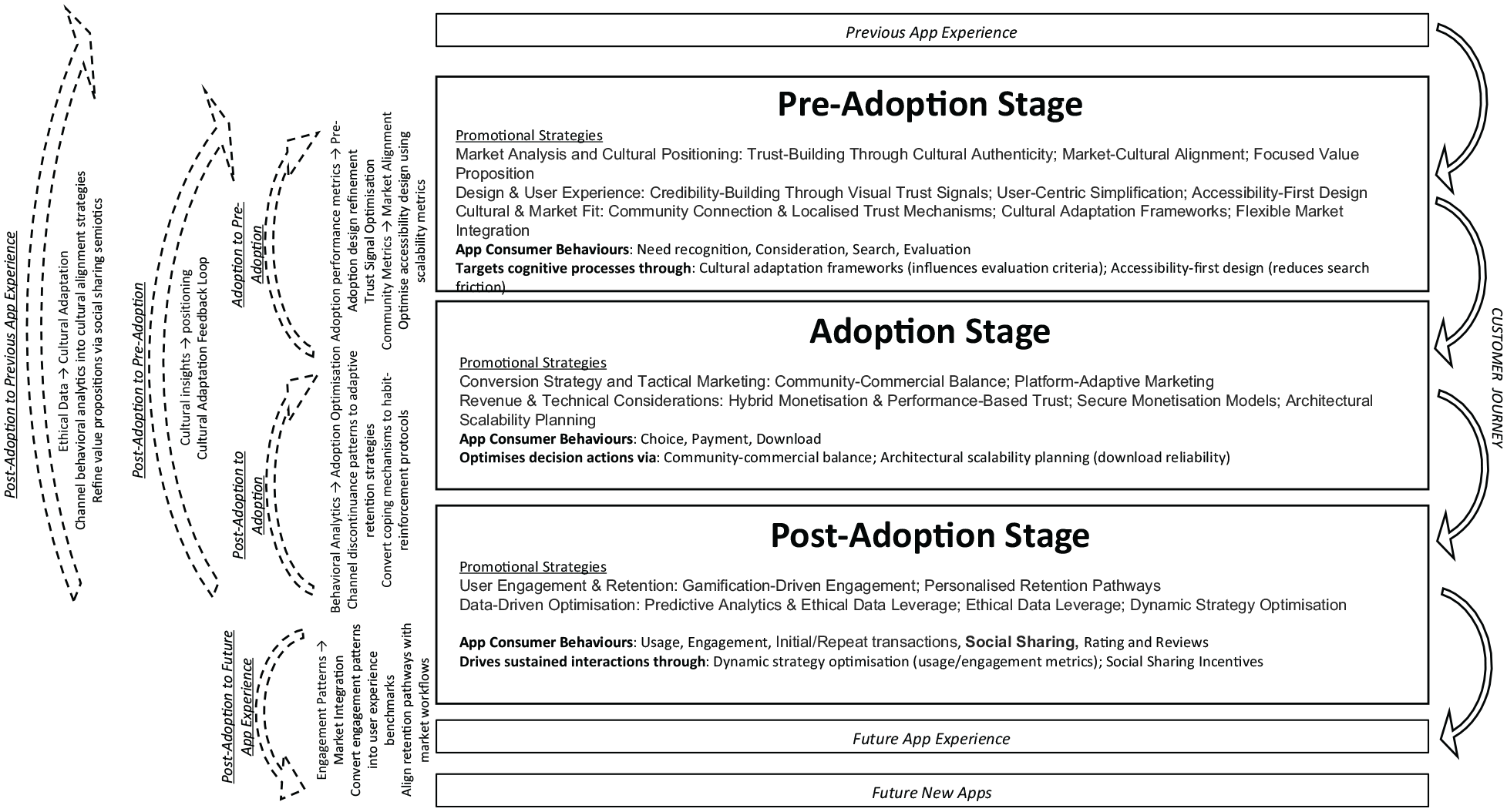
Integrated conceptual framework for promoting standalone apps across the customer journey.
The framework’s innovation lies in recognising that standalone apps must leverage their lack of brand constraints as a strategic advantage: using post-adoption discontinuance patterns to refine adoption strategies, channelling engagement patterns into market integration benchmarks and converting social sharing behaviours into cultural alignment strategies. This creates a self-reinforcing ecosystem where each stage amplifies the others, generating momentum necessary for standalone apps to compete against established branded alternatives through integrated rather than sequential approaches.
Discussion and future research agenda
Synthesis of literature findings
Effective standalone app promotion requires stage-specific strategies addressing awareness, trust and adoption challenges. Pre-adoption success hinges on cultural-market alignment through designs balancing conformity with differentiation (Barlow et al., 2019; Soh & Grover, 2023), adapting to cultural contexts while maintaining innovation (Kübler et al., 2018). Adoption success emerges from technical-commercial balance, with apps combining native development with hybrid monetisation achieving higher retention (Ahti et al., 2016; Hyrynsalmi et al., 2015). Dynamic pricing and multi-platform compatibility drive engagement while addressing resource constraints. Post-adoption growth is propelled by self-reinforcing architectures where gamification features drive a significant portion of referral conversions (Burgers et al., 2016), while AI-powered analytics enable real-time strategy iteration for resource-constrained developers (Su & Yang, 2023). Additionally, geolocation-based targeting and contextual advertising have emerged as crucial tools for optimising user acquisition, particularly when balanced with organic growth strategies (Riabova et al., 2024). Crucially, standalone apps must convert abandonment signals into acquisition fuel through closed-loop systems – discontinuance patterns informing cultural adaptation frameworks, while payment behaviours recalibrate ASO parameters. This demands continuous metric translation across journey stages, with top performers allocating majority of marketing resources to feedback-loop activation rather than isolated stage interventions (Yang et al., 2023).
Theoretical contributions
This study advances mobile app marketing theory through three theoretical developments. First, using Lemon and Verhoef’s (2016) customer journey framework, we develop a cross-stage strategic framework, which positions integration as a distinct approach where standalone apps gain competitive advantage through bidirectional stage optimisation rather than sequential progression. This challenges linear customer journey assumptions in digital marketing theory. Second, we extend choice architecture theory (Thaler et al., 2012) by theorising trust signal substitution mechanisms, how standalone apps systematically replace missing brand credibility through algorithmic interface design and behavioural data conversion. This theoretical extension establishes how technological affordances become trust-building mechanisms, moving beyond traditional nudging concepts to address the unique challenges of building user confidence without established brand equity. These contributions transform app marketing theory from static, stage-based models to dynamic, integrated frameworks that recognise the unique constraints and opportunities of standalone digital products competing against established branded alternatives.
Managerial implications
Our findings offer actionable implications for standalone app developers. Success requires an integrated approach across all journey stages while maintaining resource efficiency. Developers should prioritise cultural adaptation through balanced market research, leveraging automated tools while emphasising cultural nuances affecting adoption (Soh & Grover, 2023). Technical implementation decisions significantly influence promotional success – developers should carefully weigh trade-offs between rapid cross-platform development and superior native user experiences (Ahti et al., 2016), as technical quality directly impacts store visibility and user trust. Revenue model selection must align with user expectations and app store algorithms; hybrid monetisation strategies combining subscriptions with microtransactions show superior retention compared to single-revenue approaches (Tyrväinen & Karjaluoto, 2024). Post-adoption optimisation requires implementing closed-loop feedback systems where user behaviour data continuously refines promotional strategies – apps using AI-powered analytics achieve faster iteration cycles while maintaining ethical practices (Su & Yang, 2023). For highly competitive markets, post-adoption strategies must focus on adaptive retention mechanisms that respond dynamically to user behaviour, ensuring long-term engagement. Finally, successful standalone apps must convert abandonment signals into acquisition fuel through systematic metric translation across journey stages, with top performers allocating significant resources to feedback-loop activation rather than isolated stage interventions (Yang et al., 2023). This integrated approach helps resource-constrained developers maximise impact while building sustainable growth mechanisms.
Limitations and boundaries of the review
Despite valuable insights, several limitations exist. First, the rapid evolution of app markets may limit temporal validity as policies, preferences, and technologies evolve. Second, our focus on standalone apps potentially limits generalisability to brand-affiliated applications. Third, examining primarily English-language publications may miss insights from emerging economies with different adoption patterns. Fourth, the heterogeneity of app categories and business models makes it challenging to develop universally applicable promotional strategies – what works for gaming apps may not translate to productivity tools. Fifth, the review’s emphasis on academic literature means cutting-edge industry practices may be underrepresented, as practitioners often implement novel approaches before, they appear in scholarly work. Finally, limited experimental and longitudinal studies in the dataset restrict our understanding of how promotional strategies’ effectiveness evolves over extended periods. Future research should address these limitations through more diverse data sources, longer-term studies, and broader geographic coverage while maintaining focus on the unique challenges faced by standalone apps.
Future research agenda
We propose a research agenda building upon insights gained from studying standalone apps in isolation from brand influences. This perspective enables future research in two critical directions. First, researchers should investigate how brand-affiliated apps can leverage their existing brand assets more effectively, potentially adapting successful standalone app strategies to complement traditional brand equity. This comparative analysis could reveal whether established brands might be underutilising their marketing assets in the app space. Second, our findings create opportunities for examining how the identified promotional strategies perform across longer-term outcomes throughout the customer journey.
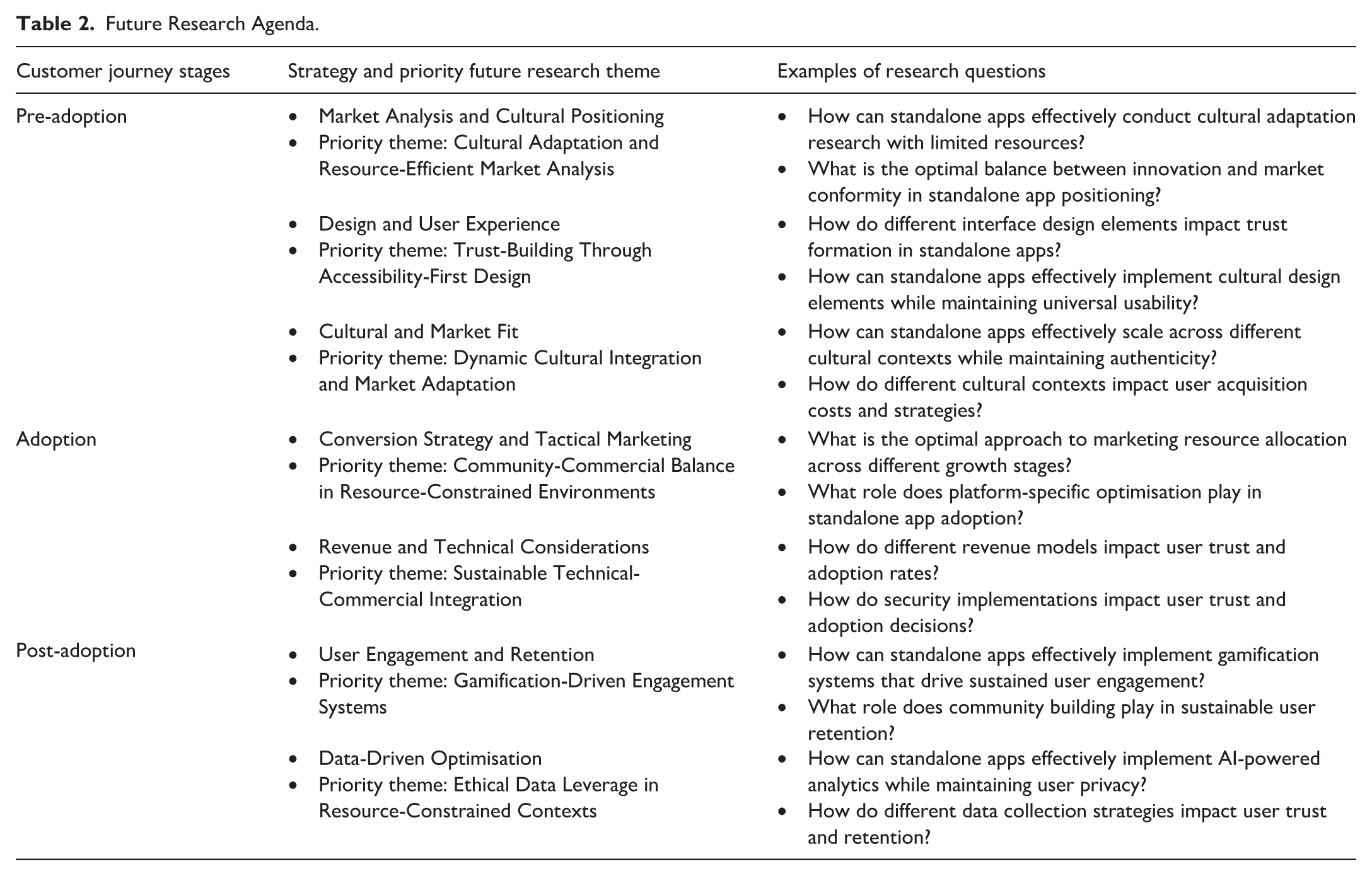
Our agenda represents a shift from traditional marketing paradigms through three transitions: brand-centric to trust-centric frameworks, resource-abundant to resource-constrained contexts and standardised to adaptive approaches. These require methodological innovations capturing the interplay between technology, psychology, and market dynamics. The agenda particularly calls for cross-disciplinary research combining behavioural economics, digital psychology, and marketing analytics to build more robust theoretical models of app success in competitive markets. This opens critical debates around digital trust evolution, automated tools for independent developers, and app store ecosystem sustainability. Furthermore, longitudinal research examining metrics beyond downloads – such as user engagement, retention and lifetime value – could explain how promotional efforts influence long-term performance across different app categories and user segments. This comprehensive approach would help develop new theoretical frameworks explaining success factors for apps operating with limited traditional marketing resources while informing how established brands can optimise their app marketing strategies without relying solely on existing brand equity (Table 2).
Future Research Agenda.
Conclusion
This review advances understanding of standalone app promotion by integrating diverse strategies across the customer journey. Our analysis reveals three key insights: standalone apps face unique challenges requiring tailored approaches; successful promotion requires balanced strategy integration with resource efficiency; and promotional effectiveness varies by cultural context and market dynamics. These findings provide both theoretical contributions to digital marketing literature and practical implications for standalone app developers navigating increasingly competitive app marketplaces. The proposed future research agenda outlines critical paths for advancing our understanding of standalone app promotion in an evolving digital landscape.
Footnotes
Declaration of conflicting interests
The author(s) declared no potential conflicts of interest with respect to the research, authorship, and/or publication of this article.
Funding
The author(s) received no financial support for the research, authorship, and/or publication of this article.
