




Abstract
Recent years have seen increased calls for marketers to embrace diversity and emphasise inclusivity, allowing brands to communicate with audiences more authentically. Such calls have spanned brand communications, advertising, social media and the like. Simultaneously, there has been a rise in virtual environments (i.e. virtual reality and the metaverse) and some consumers are increasingly demanding greater diversity in these virtual spaces. Despite this, little is known about how consumers perceive brands that take a diversity stand in these virtual, or artificial, environments. Do consumers perceive these brand strategies as grounded in integrity? Or do they perceive diversity representation in virtual environments as a form of exploitation? With this paper, we investigate the effect of diversity representation in virtual environments across two empirical studies. We provide evidence that while diversity representation can have positive effects in virtual environments, brand motives are an important mediator that influence consumers perceptions of diversity representation in virtual environments. Taken together, this research raises important considerations for brand managers, and the marketing discipline generally, as brands increasingly look for opportunities to engage with consumers in virtual environments.
Introduction
It has become important for marketers to embrace diversity and place more emphasis on inclusivity and equity – both in practice (Kipnis et al., 2021; Upadhyah & Tuli, 2024) and academia (Lewis et al., 2024). The significance of diversity in marketing has heightened in response to an ever-evolving society and increasingly diverse global population. In many countries – including the United States, Australia and United Kingdom, to name a few – there are diverse marketplaces of consumers to engage, and some consumers increasingly expect brands to authentically reflect society’s diverse backgrounds, attitudes and behaviours (Brodzic et al., 2021). While age, gender, race and ethnicity are differences that brands commonly draw on to represent diversity, characteristics including religion, sexual orientation, ability and neurodiversity are becoming more prominent. Ultimately, diversity representation involves providing diversified content for diversified audiences in a way that aligns with modern society. Embracing diversity (alongside equity and inclusion) not only allows brands to develop relatable narratives for consumers from an array of backgrounds and experiences (Ferraro et al., 2022), but enables deeper and more meaningful brand-consumer interactions and relationships.
Representations of diversity have also become increasingly common in virtual environments (Ferraro et al., 2024), showcasing a range of cultural, racial and ethnic groups, as well as genders and physiques (Sands et al., 2022). This evolution has been driven by recent technological developments, such as generative AI and deep fakes, that are changing the ways consumers and brands interact in virtual environments (Campbell et al., 2022; Van Esch et al., 2024). In social media settings, virtual influencers such as Shudu and Kami represent women of colour and people with Down Syndrome. In virtual environments (i.e. Roblox and Fortnite) consumers can create and present diverse forms of identity (McDowell, 2021). And in the context of advertising, brands can utilize generative AI platforms like midjourney to turn text-based prompts into images (Vanian, 2023) – for instance showing diverse models representing a brand. Further, in the context of virtual environments, consumers have been shown to have a desire to see greater diversity in terms of body type, gender identity, abilities and types of clothing for different body shapes and sizes (Calandra, 2022).
Despite the immense opportunity for brands to represent diversity and engage consumers in virtual environments, very little is known about how consumers respond to these efforts. Key questions to explore include: How do consumers view a brand’s diversity representation in virtual environments? Are perceptions grounded in integrity or exploitation? With this research, we seek to advance knowledge about diversity in marketing through understanding the effect of diversity representation on consumers in virtual environments. The aim of our research is twofold. First, to examine how consumers respond to diversity representation in virtual environments; and second, to investigate the mediating effect of brand motives on these effects. This knowledge is pertinent given that consumers are increasingly spending time engaging with brands in virtual environments (Romano et al., 2022). Our research contributes to the diversity in marketing literature by investigating diversity attributes in newly emerging contexts (i.e. virtual settings). In doing so, we address calls to extend prior studies from traditional media to online contexts (i.e. Eisend et al., 2023). In addition, we extend prior research that has shown virtual entities can be imbued with human characteristics (Siegel et al., 2009) resulting in a positive halo effect of diversity representation which carries over to virtual environments. Importantly, we caution marketers that in some instances, consumers can perceive brand motives as being self-serving, with negative consequences.
The remainder of this paper is structured as follows. First, we present a review of key literature pertaining to diversity representation in marketing, diversity in virtual environments and consider how consumers might respond to brands that imbue virtual entities with diversity traits. Next, we describe and present two empirical studies, which are followed by a general discussion of the findings and implications for theory and practice. The paper concludes with limitations and suggestions for future research.
Theoretical background and hypothesis development
The role of diversity in marketing
Marketing plays an important role in producing, reproducing, shaping and transforming societal and cultural values (Campbell et al., 2023; Tuncay Zayer & Coleman, 2015). Historically, marketing has been responsible for both perpetuating and dispelling stereotypes of specific consumer groups (Yeh et al., 2017). Prior studies have highlighted that marketers are guilty of under-representing marginalised groups, failing to recognise these groups as profitable consumer segments and not paying attention to the strong positive signals that diversity representation may create for brands (Park et al., 2022). Under-representation, though disappointing, is perhaps not surprising as traditionally the effects of diversity representation amongst general consumer populations have been polarising (Eisend, 2019; Eisend & Hermann, 2019). Today, however, consumers hold more favourable attitudes toward diversity than in the past, indicating that diversity representation in marketing could lead to positive brand outcomes amongst consumers (Eisend et al., 2023; Middleton & Turnbull, 2021).
Recent social movements focusing on equality in gender, race and sexuality have intensified the pressure on brands to embrace diversity, equity and inclusion (DEI) by transforming their business and marketing practices (Chandy et al., 2021; Ferraro et al., 2022; Harrison et al., 2017). Diversity can be defined as physical or socio-cultural differences attributed to people and the representation of these differences in markets; equity as fairness in the treatment of people in providing opportunity and outcome; and inclusion as creating a culture that fosters belonging (Arsel et al., 2022). At a practical level, diversity representation in marketing involves understanding and appreciating consumer differences by creating inclusive, mindful and respectful campaigns (Dimitrievska et al., 2019). Many brands are embracing diversity representation, using diverse models and brand representatives across their traditional and online marketing and customer service channels, from advertising, to events and customer service agents, among others (McKinsey, 2021). Nevertheless, while diversity is becoming a strategic priority and has clear implications for brands, empirical research on diversity representation in marketing has only begun to emerge, with little to no attention in virtual settings.
Representing diversity in virtual environments: Integrity or exploitation?
Consumers and brands are increasingly gravitating toward interacting with each other in virtual environments, which can include a range of online platforms based on virtual reality (VR), augmented reality (AR), gaming or even within the metaverse (Barrera & Shah, 2023). Diversity has been identified as an important consideration and opportunity for brands in virtual environments (Zallio & Clarkson, 2022). Specifically, brands have an opportunity to incorporate diversity representation into their marketing through diverse virtual brand representatives which could serve to both promote diversity more broadly and lead to competitive advantage. While it is known that in ‘real-world’ environments, diversity representation can help improve consumer’s attitudinal judgements of brand personality, little is known about the effect of brands representing diversity in virtual environments.
Theoretically, consumers might respond to diversity representation in virtual environments in one of two ways – either perceiving such representation as a form of integrity or as a form or exploitation. Consumers are frequently exposed to brands supporting socio-political causes, such as diversity representation. When brands engage is such forms of virtue signalling (Demsar et al., 2021), consumer cynicism can be dispelled and positive brand identities built and associated with integrity (Batra & Keller, 2016; Cambier & Poncin, 2020; Venable et al., 2005). While the process of affect transfer means that brands can be evaluated more favourably (De Houwer et al., 2001; Rosengren et al., 2020), we argue that diversity representation in virtual environments might be viewed as synthetic, or false in nature and hence may have the opposite effect.
While virtual environments make it easier for brands to imbue virtual entities with (artificial) diversity characteristics to resonate with consumer segments who care deeply about this cause (Pitt et al., 2022), it is possible that consumers will perceive diverse virtual entities as ‘fake’. In this way, it is possible that consumers may perceive a brand is inauthentically aligning itself with a social cause (i.e. diversity representation). In order to generate profit by selling more products and services, they are likely to view this as a form of exploitation and respond less favourably to the brand’s attempts to signal virtue (Mirzaei et al., 2022; Södergren, 2021; Spiggle Nguyen & Caravella, 2012). This was the case, for example, when Levi’s announced it would be using virtual models to represent diverse consumer groups (Demopoulos, 2023). Because consumers are sceptical of brands who appear to exploit social causes, we expect that the synthetic nature of virtual diversity representation will lead to negative attitudinal responses. Specifically, we predict:
Downstream impact on brand response
We expect a similar pattern of effects in terms of consumer brand responses. For instance, drawing on literature from diversity representation in real world contexts, there are positive impacts on consumer brand responses. These effects have been shown in the contexts of marketplace diversity (Arsel et al., 2022; Mason & Pavia, 2006; Scaraboto & Fischer, 2013), workforce diversity (McKay et al., 2011) and advertising diversity (Perkins et al., 2000; K. M. Thomas & Wise, 1999). In a virtual environment, assigning diversity characteristics to non-human brand representatives could lead to negative behavioural intentions toward a brand. Consumer experiences in virtual environments are characterised by falsity because they are synthetic, artificial or untrue (Scharp, 2010). If not managed carefully, the falsity associated with synthetic customer experiences can lead to scepticism from consumers, resulting in consumers discounting these experiences and in turn, less favourable outcomes for the brand (Golf-Papez et al., 2022). This effect has been shown in the context of virtual influencers – entities which are autonomously controlled by artificial intelligence and visually presented as an interactive, real-time rendered being on social media (V. L. Thomas & Fowler, 2021). Virtual influencers can lack authenticity due to their fictionalised personality characteristics, which translates to less trust, less persuasive ability and therefore lower purchase intentions (Lou et al., 2022; Sands et al., 2022). We therefore predict:
The mediating effect of brand motives
As brands increasingly take public stances on socio-political issues, attempting to match cause-related messaging, purpose and values through prosocial marketing and corporate practice (Moorman, 2020; Sarkar & Kotler, 2018), consumers are increasingly scrutinising the brand’s underlying motives (Holt, 2002). Indeed, it is well-documented that attribution of brand motives can act to mediate the relationship between a brand’s alignment with social-causes and subsequent attitudinal and behavioural outcomes (e.g. Du et al., 2010; Peloza & Shang, 2011; Pfajfar et al., 2022; Skarmeas & Leonidou, 2013). In essence, attribution theory posits that an individuals’ attitudes toward a brand varies depending on their inferred motives about an organisation’s behaviour (Webb & Mohr, 1998).
It has been proposed that consumers can infer different types of brand motives (Ellen et al., 2006), including values-, strategic-, egoistic- and stakeholder-driven. Values-driven motives represent a belief that the firm cares about the cause and has a genuine concern (Cheng et al., 2019). Such perceptions infer that the company is engaging in diversity representation for moral and ethical reasons and as such, its actions are seen as positive and public serving. Prior research has shown that perceptions of values-driven motives often lead to more positive responses (Skarmeas & Leonidou, 2013). As such, we predict:
Strategic-driven motives reflect beliefs that the company can achieve business imperatives while supporting a given cause (Ellen et al., 2006, Vlachos et al., 2009). These motives tend to be seen as positive, but firm-serving in nature. In essence, they balance a company’s need to increase profits through the support of pro-social initiatives (Vlachos et al., 2009). Ultimately, strategic-driven motives can lead to favourable outcomes (Groza et al., 2011). Hence, we predict:
Egoistic-driven motives refer to the belief that the company may be exploiting a given cause, rather than advocating for the cause (Kim et al., 2020). When individuals believe a firm might be exploiting a cause or acting in a manipulative manner, they are less likely to respond positively (Foreh & Grier, 2003). In essence, egoistic-driven motives are firm-serving motives, which emphasise the benefits to the company, as such we expect they will enhance perceived exploitation and result in negative brand response. Hence, we predict:
Finally, stakeholder-driven motives are seen as public-serving and focus on the need to react to pressure from stakeholders to satisfy their expectations. In general, when consumers perceive a company’s actions are driven by a response to stakeholder pressure, the result is typically negative consumer response (Leonidou & Skarmeas, 2017). Hence, we predict:
Overview of studies
Across two studies we explore the effect of diversity representation in virtual environments to address our hypotheses. We investigate these effects across two distinct contexts whereby customers either act as passive recipients of brand-related cues (Study 1) or engage in proactive brand interaction via a service encounter (Study 2). We contrast passive and proactive brand interactions as this can provide insight into the effect of diversity representation in virtual environments on potential (mere exposure) and current customers (brand interaction; De Vries & Carlson, 2014).
Study 1
With Study 1 we assess the effect of virtual diversity representation on perceptions of integrity and exploitation (H1). We also assess the mediating effects of each of the four brand motives on the relationship between virtual diversity representation and perceptions of integrity and exploitation (H3a-b, H4a-b, H5a-b, H6a-b).
Study overview
In study 1 we manipulate diversity representation in a virtual environment using a written description and visual stimulus (see Appendix 1). The scenario describes a context where respondents act as passive recipients of brand-related cues, reading a newspaper article about a brand that has utilised virtual entities described as representing diverse communities (or not). We use a fictitious brand to avoid the potential for any known brand associations as confounding effects (Bergkvist & Rossiter, 2008).
Sample, design and procedure
Given we implement a parallel mediation model to assess the indirect effects of multiple mediators; we aimed to obtain a sample size of at least 300 to ensure at least an 80% likelihood of detecting an indirect effect (Schoemann et al., 2017). A sample of 318 US respondents (52.8% female, Mage = 36.3 years, SD = 9.7) were obtained via the Prolific online panel. Respondents were randomly allocated to read one of the scenarios and were then presented a series of multi-item scale questions (Appendix 2 provides full scale items and reliabilities) drawn from existing literature to assess the dependent variables and then the mediators (Geuens & De Pelsmacker, 2017). In Study 1, we assess perceptions of integrity, exploitation and word-of-mouth (WOM) as our dependent variables. The mediators we measure are attribution about brand motives, which is a scale comprising values-driven motives, strategic-driven motives, egoistic-driven motives and stakeholder-driven motives (Ellen et al., 2006).
Analysis and results
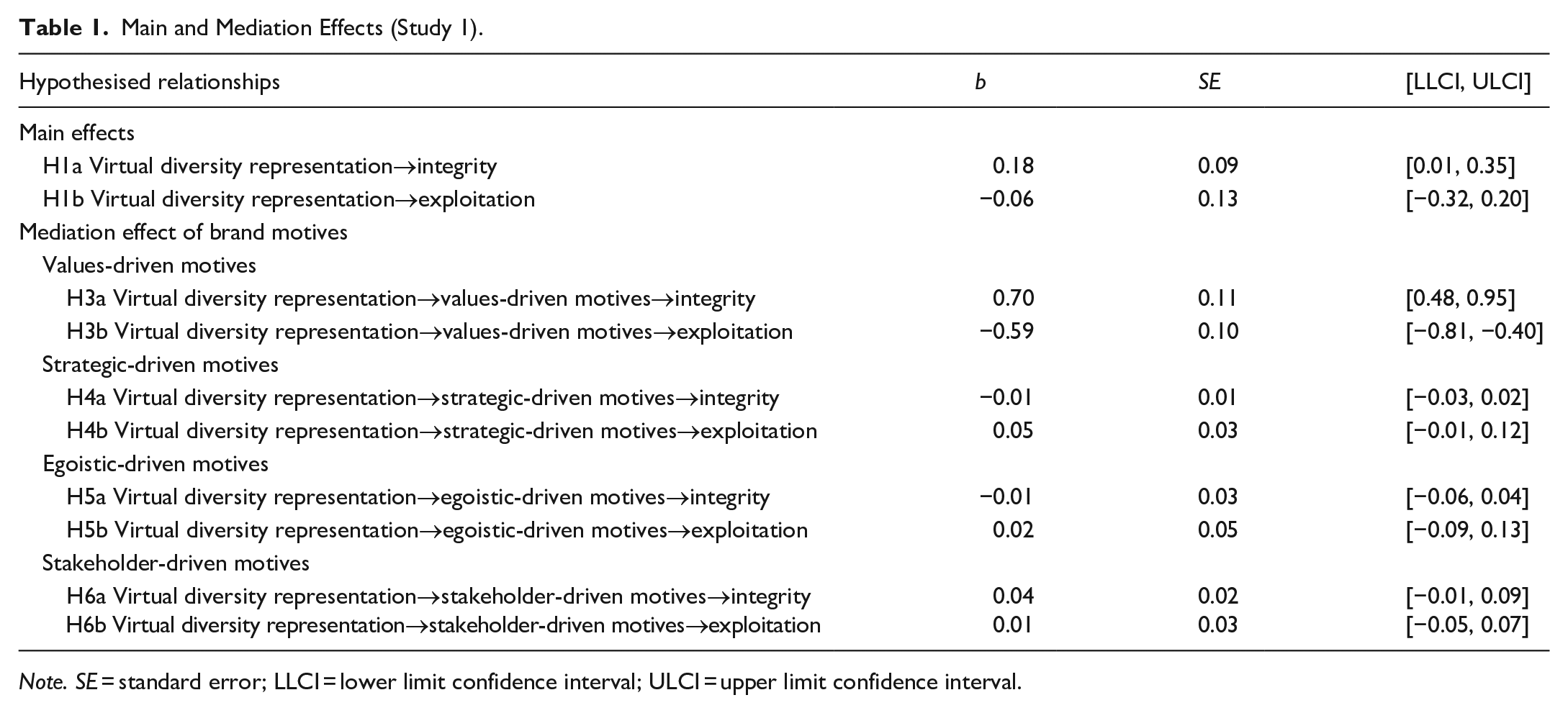
We first check our manipulation of diversity representation and find that respondents interpreted our manipulation as expected (F1, 316 = 159.82, p < .001). Specifically, respondents in the diverse model condition rated the models as more diverse (M = 6.03, SD = 0.92) when compared to those in the non-diverse condition (M = 3.32, SD = 1.89). We use Hayes (2013) PROCESS macro to test our hypotheses and run multiple mediation analysis separately for each dependent variable as suggested by Hayes (2013). We report bias-corrected coefficients and boot-strapped 95% Confidence Intervals computed with 10,000 resamples. We report results for direct and indirect effects in Table 1.
Main and Mediation Effects (Study 1).
Note. SE = standard error; LLCI = lower limit confidence interval; ULCI = upper limit confidence interval.
In terms of main effects, results reveal a significant effect for virtual diversity representation on integrity (H1a: b = 0.18, SE = 0.09, 95% CI [0.01, 0.35]). No main effects are found for exploitation (H1b: b = −0.06, SE = 0.13, 95% CI [−0.32, 0.20]). In terms of indirect effects, we find that values-driven motives mediate the effect between virtual diversity representation and all three outcome variables. Specifically, with a positive indirect effect of values-driven motives on integrity (H3a: b = 0.70, SE = 0.11, 95% CI [0.48, 0.95]) and a negative indirect effect of values-driven motives on exploitation (H3b: b = −0.59, SE = 0.10, 95% CI [−0.81, −0.40]). We find no significant indirect effects.
Discussion
We find that virtual diversity representation has a positive effect on perceptions of brand integrity. While our results find a direct effect between virtual diversity representation and integrity (supporting H1a), we find that this relationship is mediated by values-driven motives (supporting H3a). Further, while we find no direct effects between virtual diversity representation and exploitation, we find that this relationship is fully mediated by values-driven motives (supporting H3b). This means that when consumers perceive a brand’s motives for using diverse virtual models as values-driven, they are more likely to see the brand as having integrity, less likely to see the brand as being exploitative. We find this is a context where respondents act as passive recipients of brand-related cues (i.e. are exposed to information about the brand). This is important as it indicates that non-customers can be positively influenced by a brand’s utilisation of diversity in virtual environments, such as virtual influencers of virtual models. Next, we test these effects in a context where respondents make proactive contributions to brand interactions, specifically a customer service interaction.
Study 2
With Study 2 we again assess the effect of virtual diversity representation on perceptions of integrity and exploitation (H1) and extend to investigate the effect on brand outcomes of satisfaction and purchase intention (H2). We also assess the mediating effects of each of the four brand motives on the relationship between virtual diversity representation and perceptions of integrity, exploitation, satisfaction and purchase intention (H3a-d, H4a-d, H5a-d and H6a-d).
Study overview
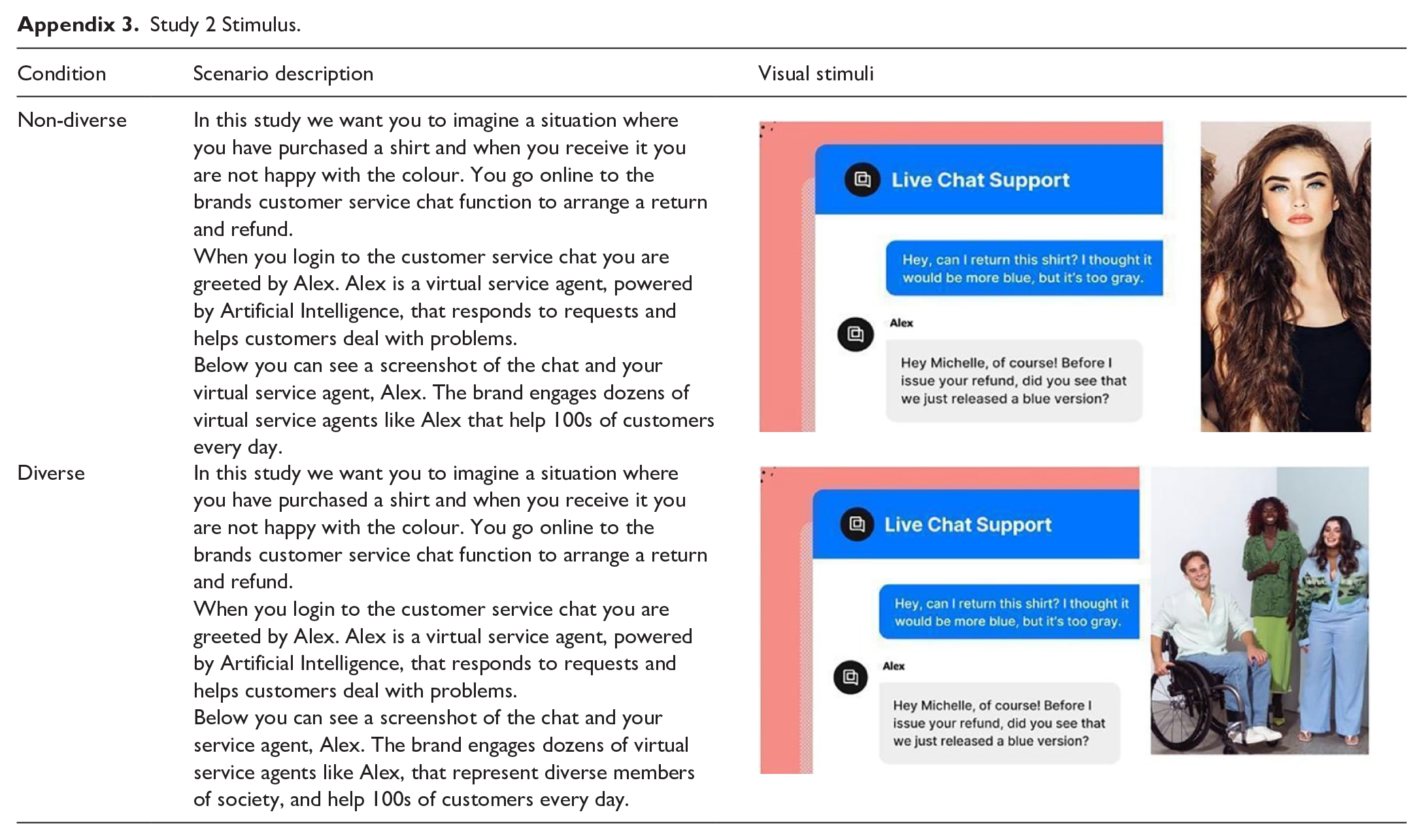
In study 2 we manipulate an alternative form of virtual diversity representation in a customer service setting (see Appendix 3). The scenario describes a context where respondents contact a customer service agent to proactively seek service assistance. When they reach the agent, they realise the agent is a virtual service agent, described as representing a diverse community (or not). Again, a fictitious brand is used to avoid the potential for any known brand associations.
Sample, design and procedure
A sample of 346 US respondents (45.4% female, Mage = 36.6 years, SD = 10.5) were obtained via the Prolific online panel. Respondents were randomly allocated to read one of the scenarios and were then presented a series of multi-item scale questions (see Appendix 2). Given the scenario presents a service interaction with a brand, we measure satisfaction and purchase intention in addition to the dependent measures assessed in Study 1 (integrity and exploitation). The same mediators about brand motives are also measured.
Analysis and results
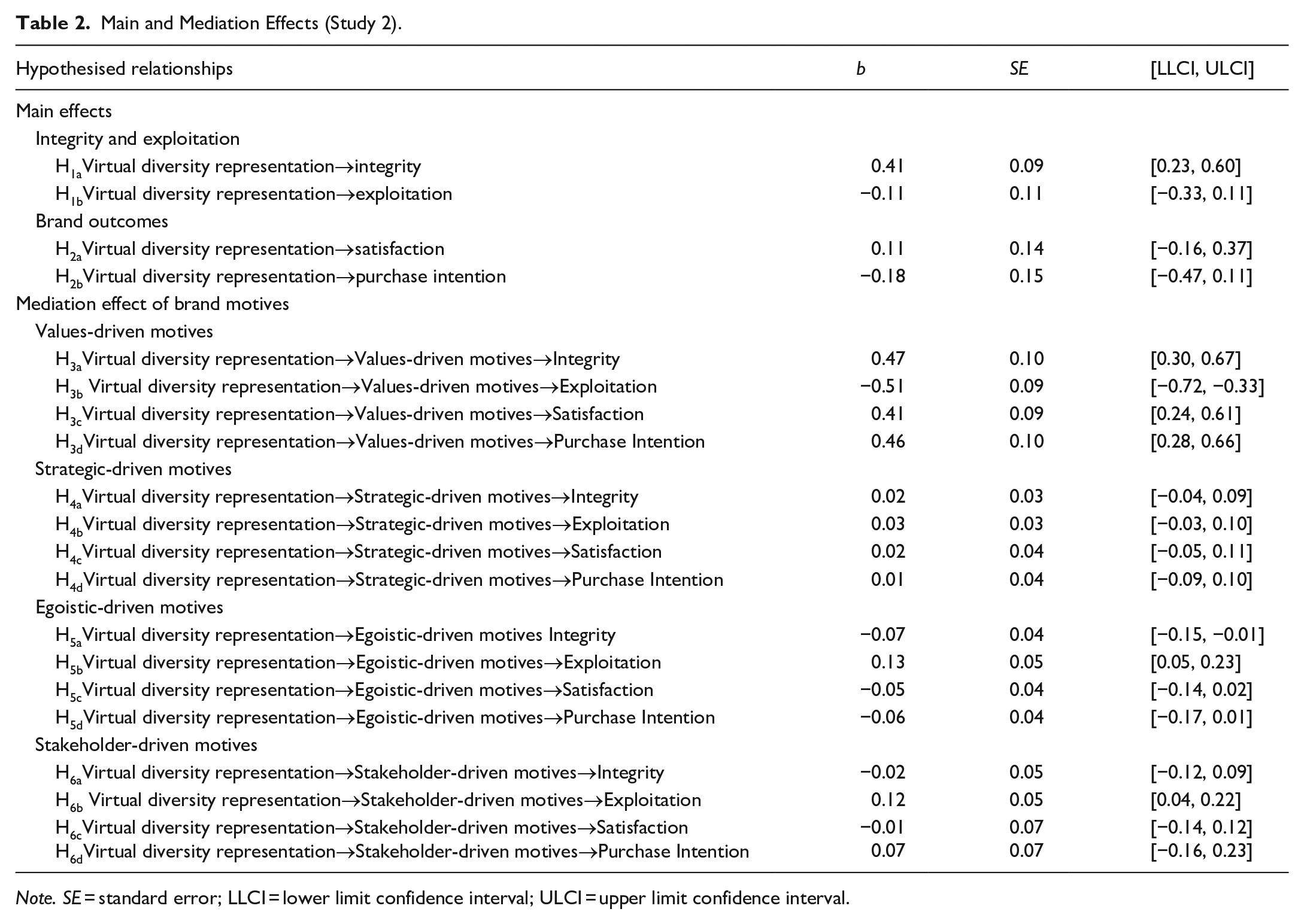
We find support for the manipulation of diversity representation (F1, 344 = 83.79, p < .001). Respondents in diverse service agent conditions rated the service agent as more diverse (M = 4.84, SD = 1.74) when compared to the non-diverse service agent condition (M = 3.06, SD = 1.67). We again use Hayes (2013) PROCESS macros to test our hypotheses as in Study 1, with results presented in Table 2.
Main and Mediation Effects (Study 2).
Note. SE = standard error; LLCI = lower limit confidence interval; ULCI = upper limit confidence interval.
Our results reveal a main effect of virtual diversity representation on integrity (H1a: b = 0.41, SE = 0.09, 95% CI [0.23, 0.60]). No main effects are found for exploitation (H1b: b = −0.11, SE = 0.11, 95% CI [−0.33, 0.11]). In terms of behavioural intention, we find no main effect for satisfaction (H2a: b = 0.11, SE = 0.14, 95% CI [−0.16, 0.37]) or purchase intention (H2b: b = −0.18, SE = 0.15, 95% CI [−0.47, 0.11]). In terms of indirect effects, we find that values-driven motives mediate the effect between virtual diversity representation for all our outcome variables. Specifically, with a positive indirect effect of values-driven motives on integrity (H3a: b = 0.47, SE = 0.10, 95% CI [0.30, 0.67]), a negative indirect effect of values-driven motives on exploitation (H3b: b = −0.51, SE = 0.09, 95% CI [−0.72, −0.33]). We also find positive indirect effects of values-driven motives brand outcomes satisfaction (H3c: b = 0.41, SE = 0.09, 95% CI [0.2, 0.61]) and purchase intention (H3d: b = 0.46, SE = 0.10, 95% CI [0.28, 0.66]). For egoistic-driven motives, we find a negative indirect effects of egoistic-driven motives on integrity (H5a: b = −0.07, SE = 0.04, 95% CI [−0.12, −0.01]) and a positive indirect effect on exploitation (H5b: b = 0.13, SE = 0.05, 95% CI [0.05, 0.23]). Finally, we find an indirect effect of stakeholder-driven motives on exploitation (H6b: b = 0.12, SE = 0.05, 95% CI [0.04, 0.22]). We find no other significant indirect effects.
Discussion
With Study 2, we again find that diversity representation in virtual environments positively influences perceptions of brand integrity (supporting H1a). However, we find no direct effects on exploitation or brand outcomes of satisfaction or purchase intention. We do, however, find that brand motives act to mediate several effects. First, we again find values-driven motives acts to mediate the relationship between diversity representation in virtual environments and our dependent variables (H1a: integrity, H1b: exploitation, H1c: satisfaction and H1d: purchase intention). When consumers view a brand’s motives for representing diversity in vitrail environments as values-driven, perceptions of exploitation decreases while perceptions of integrity increase along with satisfaction and purchase intention. We also find egoistic-driven motives act to moderate the relationship between diversity representation in virtual environments and both integrity and exploitation (supporting H5a and. H5b). Specifically, and as predicted, we find egoistic-driven motives positively mediates the relationship between virtual diversity representation and integrity, and negatively mediates the effect on exploitation. In sum, when individuals believe a firm might be exploiting a cause or acting in a manipulative manner, they are less likely to view the firm’s motives as driven by integrity and more likely driven by exploitation. Finally, and as predicted, we find that stakeholder-driven motives mediate the relationship between virtual diversity representation and exploitation (supporting H6b).
General discussion
We show that in diversity representation in virtual environments can have positive effects on consumers perceptions of a brand. Specifically, our findings show that a brand that employs diversity representation in virtual environments tends to be seen as motivated by integrity. Importantly, we show these effects across consumers who have indirect (i.e. exposure to advertising) and direct (i.e. exposure to service experience) contact with a brand. However, we show that perceptions of exploitation can be activated when consumers perceive the brand as being driven by self-centred attributions (Ellen et al., 2006). Specifically, when consumers view firm motives as egoistic or stakeholder driven. In contrast, when a consumer perceives values-driven motives as the reason for a firm engaging in virtual diversity representation, there are a broad range of positive effects on brand perceptions and behaviour. Taken together, these findings are important given that technology such as generative AI and deep fakes are rapidly changing the way in which marketers operate, providing new opportunities and challenges (Campbell et al., 2020).
Theoretical implications
With this research, we make four key contributions. First, we add to the growing and emerging body of research considering diversity in marketing, addressing calls to extend understanding from traditional to online contexts (Eisend et al., 2023; Södergren, 2021) While prior research has shown that ads featuring diverse models tend to be more salient for consumers in the diverse group (K. M. Thomas & Wise, 1999), we show positive effects of diversity representation are generalisable to a broad-based sample. Importantly, this builds on emerging work suggesting that general consumer populations are increasingly responding more positively to diversity representations than they ever have in the past (Eisend et al., 2023; Middleton & Turnbull, 2021; Pounders, 2018). We show that consumers react positively to brands that represent diversity virtual settings, but also caution that brand motives are an important factor mediating consumer response.
Second, this research extends the focus of diversity from real world settings to virtual environments, further highlighting the importance of diversity as a central pillar in immersive environments, such as VR or the metaverse (Zallio & Clarkson, 2022). Research has only recently begun to investigate marketing effects in online advertising and influencer marketing (Feng et al., 2019; Li, 2022; Yang et al., 2021), and to our knowledge there is no research that considers the effect of diversity representation in virtual environments. As such, this study is significant, as it extends the growing literature in this area by affirming that consumers respond favourably to diversity presentation, not only in advertising, but in other virtual world marketing efforts, including virtual events, and customer service delivery. Given the centrality of diversity to virtual environments, this indicates that brands who look to engage with consumers in virtual world settings will need to integrate diversity representation into the core of their marketing strategies, including general brand interactions, communications and service interactions.
Third, we show that when brands imbue virtual entities with diversity cues that consumers can attribute strategic and egoistic motives, or self-centred perceptions that a corporation is taking advantage of diversity causes for profit. This further extends existing work that suggests these efforts at representing diversity, could lead to accusations of moral grandstanding (Demsar et al., 2022; Tosi & Warmke, 2016) if the brand’s efforts are perceived to be inauthentic (Sands et al., 2024).
Fourth, our findings extend prior research that has shown virtual entities can be imbued with human characteristics (Siegel et al., 2009). We provide further support that consumers anthropomorphize machines, applying social heuristics and attributing social traits (Feine et al., 2019), some of which might be diversity related. Prior research shows that this can decrease uncertainty and increase social presence, thereby resulting in consumer reactions that are similar cognitively, effectively, socially and behaviourally, to interactions with human agents (Edwards et al., 2019). Like these previous studies, we also show that in virtual contexts (virtual models, virtual service agents) human characteristics (i.e.diversity representation) can positively impact consumer response to brand interactions. In essence, there is a positive halo effect of diversity representation which carries over to virtual environments. For marketers, this means that consumers are willing to perceive virtual entities as representing diverse communities. Such knowledge is valuable for brands that seek to enter virtual environments.
Managerial implications
Our findings have implications for marketers, brands and advertisers. First, we show that diversity representation is an important consideration for consumers and that the positive effects can spill-over from direct and indirect brand interactions. In essence, our findings suggest diversity representation is an effective way to connect with consumers in virtual environments. In addition, our research provides caution for brand managers considering the use of virtual entities, be it in virtual environments or in virtual service interactions. Importantly, consumer perceptions of brand motives are important and can influence consumers to see brand efforts as underpinned by integrity or exploitation.
Our findings also have broad implications for brands considering the use of generative AI or deepfakes in media and communications (Campbell et al., 2022). Our findings would indicate that while consumers might attribute positive perceptions to virtual entities, consumers can also perceive the brand in a negative light when virtual entities are imbued with diversity elements. Brand managers should be cautious about blanket appropriations of diversity representation in virtual environments and be sure to communicate (directly or indirectly) values-driven motives. As in the real world, it will be important for brands to apply a lens of cultural sensitivity and audience understanding to any activities where diversity representations are to occur within virtual environments.
Limitations and future research directions
Being one of the first empirical studies focusing on diversity representation in virtual environments, we hope this paper opens up novel opportunities to conduct further research in this emerging area of marketing. This study operationalized diversity through manipulating race, disability and body type characteristics. However, there are numerous other diversity characteristics that remain unexplored, including, for example, gender identity, sexuality, age (particularly older consumers), religion or neurodiversity, to name only a few. In isolation, each of these diversity characteristics may have different effects on consumer responses and brand outcomes. Future studies could look to isolate each of these for testing or examine the interaction effects between them in eliciting consumer responses and brand outcomes. In addition to our study, more work is required to understand the specific factors and cues that may lead consumers to believe diversity representation in virtual environments is inauthentic, insincere or a form of moral grandstanding. Future research could examine how factors such as company history relating to diversity, recent diversity transgressions, execution of diversity representation and contextual cues within virtual environments, among other things, play a role in how consumers infer motives when it comes to the genuineness of diversity representation. As an extension of this, scholars could also focus on understanding how companies can engage in diversity representation in authentic ways while maintaining cultural sensitivity. One example of this could be to create virtual service agents based on human diverse employees.
Our study also focuses on consumer responses to virtual diversity representation in Western markets (Prolific panel participants are predominantly USA and UK based). Broadly speaking, Western markets have become more accepting of diversity representation through large scale macro-social movements. As such, this provides a limited view, particularly for brands and brand managers who operate and manage virtual assets globally. Future research could explore how cross-cultural consumers respond to diversity representation in virtual environments, as well as which diversity characteristics have positive impacts in non-Western contexts. Moreover, this study was limited to diversity representation in two specific types of consumer-brand interactions: fashion show models and virtual service agents. Future research could build on this study by looking at other agents, entities and interactions involved in virtual consumer-brand engagements, including chatbots, brand representatives or virtual world advertising, among others. Finally, we conducted experiments using hypothetical scenarios focused on the fashion industry. Researchers could look to replicate this study or extend it into real virtual world scenarios (e.g. Fortnite, Roblox and the metaverse) and other categories (e.g. gaming, automotive or various services). This could help both scholars and practitioners to understand how to best engage in specific diversity characteristic representation within each specific product or service category.
Footnotes
Appendices
Study 2 Stimulus.
| Condition | Scenario description | Visual stimuli |
|---|---|---|
| Non-diverse | In this study we want you to imagine a situation where you have purchased a shirt and when you receive it you are not happy with the colour. You go online to the brands customer service chat function to arrange a return and refund. When you login to the customer service chat you are greeted by Alex. Alex is a virtual service agent, powered by Artificial Intelligence, that responds to requests and helps customers deal with problems. Below you can see a screenshot of the chat and your virtual service agent, Alex. The brand engages dozens of virtual service agents like Alex that help 100s of customers every day. |
|
| Diverse | In this study we want you to imagine a situation where you have purchased a shirt and when you receive it you are not happy with the colour. You go online to the brands customer service chat function to arrange a return and refund. When you login to the customer service chat you are greeted by Alex. Alex is a virtual service agent, powered by Artificial Intelligence, that responds to requests and helps customers deal with problems. Below you can see a screenshot of the chat and your service agent, Alex. The brand engages dozens of virtual service agents like Alex, that represent diverse members of society, and help 100s of customers every day. |
Declaration of conflicting interests
The author(s) declared no potential conflicts of interest with respect to the research, authorship, and/or publication of this article.
Funding
The author(s) received no financial support for the research, authorship, and/or publication of this article.
