



Abstract
Employees should be treated as internal customers to motivate and engage in online knowledge sharing, which is the backbone of organisational competitiveness. Online knowledge sharing helps organisations survive fierce competition for the capability of facilitating the transfer of individual knowledge to organisational capital and decreasing redundant learning time. However, the majority of online participants, known as lurkers, just read the knowledge shared without contributing themselves. Based on Social Exchange Theory, this study focused on the determinants of lurkers and posters, especially in the organisational context. This study collected 792 responses from employees in Vietnamese organisations. Results show that knowledge self-efficacy and perceived ease of use are two strong determinants of knowledge sharing reciprocity and job performance. Additionally, knowledge sharing reciprocity is the critical determinant of posters’ and lurkers’ job performance. Knowledge sharing reciprocity mediates the impact of knowledge self-efficacy, perceived ease of use and organisational rewards on job performance for both poster and lurker groups.
Introduction
Internal marketing is a critical element of any organisation for its ability to increase internal brand culture and motivate employees towards a shared brand vision (Van Nguyen et al., 2019; Zhang et al., 2022). Viewing employees as internal customers enables consideration of employees as generators of internal intelligence (Nguyen, 2022; Park & Tran, 2018), who, with their intellectual capability, skills, motivations, and abilities, contribute to achieving institutional goals. Fundamental to an effective internal marketing strategy is the extent to which organisations embrace a knowledge sharing culture. Motivating employees to actively exchange and share their tactics and implicit knowledge, skills, and experiences ensure that organisational knowledge is available to employees when required, thus influencing employee learning in organisations (Ngo et al., 2020; Zhang et al., 2022). Importantly, embracing knowledge sharing has been shown to contribute positively to employee productivity, retain intellectual assets and improve innovative capabilities, which in turn enhances competitive advantage and reduces organisational uncertainty (Hoang, 2022; Kwahk & Park, 2016).
With technological advances, managing online knowledge sharing has become a critical business activity as online platforms, such as Microsoft 365, play an integral role in the day-to-day internal communications and reporting within organisations (Navimipour & Charband, 2016; M. Nguyen, 2022). Although numerous internal marketing solutions have been proposed, such as rewards and bonuses, fostering online knowledge sharing behaviour is a challenging task (H. F. Lin, 2007). The challenge resides in the large majority of participants, known as lurkers, who primarily view information shared in online communities but do not actively contribute themselves (Amichai-Hamburger et al., 2016; Preece et al., 2004). Although lurkers are traditionally considered a non-valuable resource due to their free-loading behaviour that benefits primarily from observing the fresh content of others, they represent a significant participatory group, albeit at a lower level of participation (Kollock & Smith, 1996; van Mierlo, 2014). Lurkers are estimated to represent between 50% and 90% of online knowledge sharing participants and thus have an immense capacity for impacting posting rates, as well as the quality of posted content (Cranefield et al., 2015).
Contributing to the inclusion as participatory members, Edelmann (2013) more recently advocated the term ‘lurker’ should not be viewed as an absolute measure of behaviour, but rather holistically as a passive participatory behaviour. Although lurkers may not post frequently, they indeed do post within online communities. Additionally, lurkers may need significant time to read information shared by others (Sun et al., 2014) or may require time to learn how to use the online platform (Amichai-Hamburger et al., 2016). Moreover, lurker predilection for in-depth reading of all shared content prior to raising a question not previously asked helps to reduce unnecessary repetitious queries (Ridings et al., 2006). As many lurkers consider themselves community members, viewing lurking as a normal, active, and valuable form of online behaviour leverages learning as occurring more from reading other’s comments than from writing their own (M. Nguyen et al., 2021). This suggests that while participants join online communities because they want to improve their understanding of a topic, individual expectations lead to varying levels of participatory behaviour and engagement actions (Preece et al., 2004). Moreover, T.-M. Nguyen (2021) posits that lurking is a way to better understand the community.
To date, despite posters and lurkers coexisting on online platforms including organisational online knowledge sharing platforms, they are rarely examined together in a single study; thus, we know very little about how the driving factors differ between lurkers and posters, especially in the organisational context and non-western countries (T.-M. Nguyen, 2020). The extant knowledge sharing literature has focussed predominantly on posters as they are the main player in generating knowledge content within online communities (Jeon et al., 2011; Kankanhalli et al., 2005; Yang et al., 2017). Consequently, the consideration of lurkers as valued constituents in the knowledge sharing process is under-examined. In addition, there are few studies conducted in developing countries such as Vietnam (T.-M. Nguyen, 2020). The driving forces of online knowledge sharing behaviour in a developing country may be different from those in western counterparts. The handful of studies on posters and lurkers in non-western countries have mainly focused on online communities rather than organisational online knowledge sharing (see Web Appendix). In online communities, anyone often can join the online community and share knowledge while in the organisational context, online participants often belong to the same organisation, have a certain trust of each other and work together to contribute to the development of the organisation (T.-M. Nguyen, 2020). Therefore, motivation to share knowledge sharing online in organisations may be different. Furthermore, few studies have examined the organisational outcomes of the knowledge sharing process, including job performance (see Web Appendix). Improving employee job performance is often one of the goals of employers when encouraging employees to participate in online knowledge sharing and facilitating the online knowledge sharing process (Kwahk & Park, 2016). From the organisation perspective, given the number of challenges surrounding organisations, human resources have become very important resources and improving employee job performance should be placed at the top of every organisation’s agenda because it helps the organisation survive and succeed in the ever-changing business environment (Masa’deh et al., 2016). Kwahk and Park (2016) argues that employee job performance is a determinant of the prosperity and survival of organisations and organisations should focus more on knowledge sharng to enhance employee job performance which helps increase organisational competitive advantage.
This study will make several theoretical and practical contributions. First, this study will deepen the understanding of the predictors of lurkers and posters in knowledge sharing in organisations. Second, the majority of online knowledge sharing studies focus on posters (e.g. Hung et al., 2015) or combine posters and lurkers into one group (e.g. C. M. Chang et al., 2015). Few studies examine posters and lurkers as separate groups (e.g. Amichai-Hamburger et al., 2016). Third, this study extends beyond the primarily explored domain of knowledge sharing in e-learning communities (Yilmaz, 2016), virtual communities (Liao & Chou, 2012; Yang et al., 2017), and medical practitioners (Stewart & Abidi, 2012) to enhance understanding of online knowledge sharing in business contexts, specifically telecommunications, banking, and insurance. Fourth, the current study extends the understanding of online knowledge sharing to the developing country of Vietnam. Finally, by understanding the drivers of online knowledge sharing and potential outcomes of online knowledge sharing behaviour, organisations are able to increase knowledge sharing within the organisation. The following section provides the relevant literature review and hypotheses development, followed by detailing the research method, results, discussion, and implications.
Theoretical background
Social Exchange Theory and rganisational online knowledge sharing framework
Social Exchange Theory assumes that individuals participate in the exchange process based on their comparison between costs and benefits (Blau, 1964). According to Social Exchange Theory, individuals participate in online knowledge sharing platforms to exchange knowledge. Online knowledge sharing enables employees to collaborate beyond the limitation of time and space and makes the knowledge shared available to all other employees (Zhang et al., 2022). The employees who have experience solving an issue can help others by sharing their information, experiences, and skills to help others with similar situations or problems to improve job performance (Kwahk & Park, 2016; Zhang et al., 2022). On the other hand, in the workplace, employees often need to address a number of work issues and difficulties; thus, employees often need a solution or advice shared by experienced colleagues (Hung et al., 2015). Online knowledge sharing in organisations plays a role as a bridge to connect those who want to share knowledge, and those who need it (M. Nguyen et al., 2021). Through the knowledge exchange process, employees can support each other to address work issues to improve job performance (Kwahk & Park, 2016).
Social Exchange Theory also explains that as knowledge is the core value in the knowledge exchange process, individuals need to have knowledge self-efficacy, which refers to the ability to offer valuable knowledge to others (C. L. Hsu & Lin, 2008). In addition, because the knowledge is exchanged via online platforms, thus, individuals need to know how to use online platforms to enable their participation (C. L. Hsu & Lin, 2008). Moreover, online knowledge sharing in organisations is voluntary; therefore, employee motivation is critical for the exchange process of knowledge sharing (Kwahk & Park, 2016). The existing literature illustrates that an organisational reward mechanism plays a crucial role in encouraging employees to share knowledge online (H. F. Lin, 2007). Organisational rewards refer to extrinsic incentives such as increased salary, bonuses, promotions, job security, paid promotions, and career development that employees can obtain if they actively share knowledge (Choi et al., 2008). However, in the literature, these three key reasons have not been identified as the antecedents of online knowledge sharing in organisations of posters or lurkers in organisations for posters and lurkers. These three factors were also listed as the most important factors (see the literature reviews by Amichai-Hamburger et al., 2016; Sun et al., 2014) that prevent individuals from exchanging knowledge.
Furthermore, the knowledge sharing literature has predominantly focussed on examining the predictors of online knowledge sharing behaviour, while few studies have examined the organisational outcomes of the knowledge sharing exchange process. Two key organisational outcomes critical to the knowledge sharing exchange process are knowledge sharing reciprocity and job performance (Kwahk & Park, 2016). According to previous studies, the premise of investing in an online knowledge sharing system is to facilitate the backward and forward process of knowledge exchange among employees and to encourage the problem-solving innovation process, which relies on knowledge sharing reciprocity (Chai et al., 2011). In turn, the increase in employee knowledge sharing reciprocity often results in an improvement in organisational productivity and maintains organisational competitive advantage, which in turn improves employee job performance (Kwahk & Park, 2016).
In this study, knowledge self-efficacy, perceived ease of use, and organisational rewards are examined as determinants of knowledge sharing reciprocity and job performance, as illustrated in Figure 1.
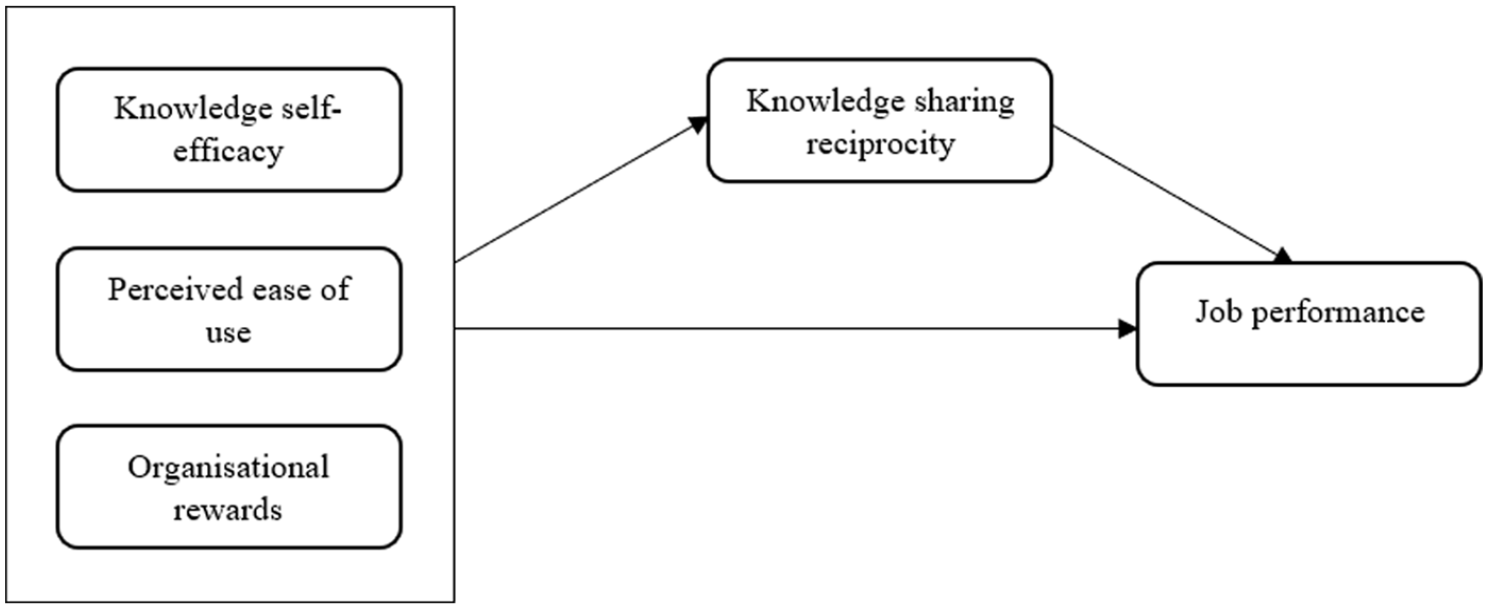
Organisational online knowledge sharing (OOKS) framework.
Knowledge self-efficacy and online knowledge sharing
Employees with high knowledge self-efficacy are more inclined to have high knowledge sharing reciprocity and expect improvement in their job performance outcomes (Jeon et al., 2011). In the study by Ridings et al. (2006), when posters and lurkers have a high level of knowledge self-efficacy, they are more likely to expect knowledge sharing reciprocity as they expect others to reciprocate their sharing. Posters and lurkers with a high level of knowledge self-efficacy spend time sharing knowledge, they also want to learn from others through knowledge sharing reciprocity (Sun et al., 2014).
In this study, the impact of knowledge self-efficacy on job performance is also proposed for both posters and lurkers in online knowledge sharing. For posters, posting is a way to present their knowledge, gain a better understanding of a topic and find a better solution to address work issues (Kwahk & Park, 2016). Posters are likely to actively share and discuss their difficulties in their jobs, as well as proactively address their work problems (Jeon et al., 2011). According to Preece et al. (2004), lurkers participate in online knowledge sharing because they want to improve their understanding of a topic; thus, even if lurkers have high knowledge self-efficacy, they tend to engage in deep discussion to improve job performance (Nonnecke & Preece, 2001). Accordingly, the following hypotheses are proposed:
Perceived ease of use and online knowledge sharing
Both posters and lurkers participate in online knowledge sharing with a certain demand for knowledge (Hung et al., 2011) and tend to use online knowledge sharing platforms if they are easy to use (Papadopoulos et al., 2013). Posters and lurkers often spend time learning necessary functions, which in turn influences their expectations of knowledge sharing reciprocity (Chai et al., 2011). In contrast, posters and lurkers make more effort to create and codify their knowledge in these systems for others’ use, reply to posted questions, as well as enhance mutual relationships with others via sharing knowledge (T.-M. Nguyen, 2021). With such invested effort, posters and lurkers expect that others will actively engage in the knowledge sharing process and actively reciprocate (Kwahk & Park, 2016).
According to M. Nguyen et al. (2021) and Preece et al. (2004), the extent to which an online platform is perceived to be easy to facilitate knowledge sharing for both posters and lurkers. It is expected that for posters, easy to use online platforms will actively facilitate online sharing as posters often participate in online knowledge sharing because they actively want to increase their job performance outcomes (Kwahk & Park, 2016). Perceived ease of use of online platforms is likely to engage lurkers and may increase their posting behaviour (Amichai-Hamburger et al., 2016; T.-M. Nguyen, 2020). For lurkers, reading often meets their expected needs, and they may find an appropriate solution from existing discussions to improve job performance (Sun et al., 2014). Thus, the following hypotheses are proposed:
Organisational rewards and online knowledge sharing
Organisational rewards are proven to affect all types of participants, including posters and lurkers (Nguyen & Malik, 2020). Under the motivation of organisational rewards, both posters and lurkers may engage in online knowledge sharing, evidencing their contribution to the organisation and proving worthiness for organisational rewards (H. F. Lin, 2007; Phang et al., 2015). When posters are motivated by organisational rewards, they are more likely to engage in higher knowledge sharing reciprocity because they openly share their knowledge, and the sharing of their expertise has attracted attention from numerous followers (Sun et al., 2014). Therefore, posters are more inclined to expect that they could demonstrate their contribution to the organisation by showing their active participation through regular posting (T.-M. Nguyen, 2020; Sun et al., 2014). Similarly, being motivated by organisational rewards, lurkers often spend more time reading information shared in online communities and may start sharing knowledge; thus, they tend not to expect others to reciprocate (Amichai-Hamburger et al., 2016).
Furthermore, the impact of organisational rewards on job performance may be seen from both posters and lurkers. Posters often make an effort and spend time to develop in-depth discussions to solve their work issues and increase work effectiveness, quality, and productivity (M. Nguyen et al., 2021). While lurkers are motivated by organisational rewards, they may be more engaged in reading information shared by others to find a suitable solution to improve job performance (Amichai-Hamburger et al., 2016). Thus, we propose the following hypothesises:
Knowledge sharing reciprocity
Knowledge sharing reciprocity refers to the perception that current knowledge sharing behaviour will lead to future requests for knowledge being met (Kwahk & Park, 2016). The effect of knowledge sharing reciprocity on job performance may be weaker for lurkers than posters. Previous research has shown that knowledge sharing reciprocity significantly affects the quantity and quality of knowledge shared by posters and lurkers and posters. Posters often share knowledge to help others (Amichai-Hamburger et al., 2016). Those who receive the knowledge shared by posters also tend to reciprocate (Kwahk & Park, 2016). Therefore, posters are able to build a mutual understanding among employees and improve their knowledge through in-depth discussion with others (Lai & Chen, 2014; Wasko & Faraj, 2005). As a result, posters’ job performance could be enhanced due to their high level of knowledge sharing reciprocity, which often improves knowledge or mutual support among employees (Kwahk & Park, 2016).
Lurkers often do not engage in communication and do not interact with other members because they may feel that they have no control over who responds to their questions or their quality and no assurance that those they are sharing knowledge with will help them in return (Nonnecke et al., 2004). However, the posts shared may somehow help lurkers solve their work problems or help them improve their performance in tasks (Amichai-Hamburger et al., 2016). The concerns of lurkers may have been raised and answered by others, which benefits lurkers in their job performance (Amichai-Hamburger et al., 2016). Thus:
The mediating role of knowledge sharing reciprocity on job performance
Both posters and lurkers often expect to increase knowledge acquisition when they participate in online knowledge sharing (C. L. Hsu & Lin, 2008). It is quite evident that posters and lurkers are likely to have more positive attitudes towards knowledge acquisition when the knowledge shared is closely related to their work, which often results in job performance improvement (Kwahk & Park, 2016). With respect to knowledge acquisition, C. L. Hsu and Lin (2008) emphasise that high-quality relationships only survive when there is a reciprocal exchange of knowledge. Through the enhancement of posters’ and lurkers’ knowledge acquisition, posters and lurkers tend to expect higher job performance (Chai et al., 2011; Kwahk & Park, 2016). These interdependent knowledge transactions enable posters and lurkers to maintain their reciprocal relationships (Akhavan & Mahdi Hosseini, 2016). Thus, those who want to increase knowledge acquisition often have a positive attitude towards reciprocal relationships (M.-J. J. Lin et al., 2009). While lurkers may not necessarily share knowledge when they participate in online knowledge sharing, they want to improve their knowledge self-efficacy in their professional domain by having access to the knowledge shared, which leads to an increase in knowledge acquisition (M. H. Hsu et al., 2007). Such motivation may be higher when the knowledge shared involves the lurkers’ domain of expertise to improve their performance. The more the knowledge shared is relevant to their work and helps them improve their job performance, the more knowledge they expect other members to share (Sun et al., 2014).
Knowledge sharing reciprocity could also mediate the impact of posters’ and lurkers’ perceived ease of use on job performance. In the organisational setting, perceived ease of use plays a significant role due to the necessity to learn how to use online platforms to participate in online knowledge sharing (H. F. Lin, 2007). Both posters and lurkers need to spend time learning how to function on online platforms (costs) (Papadopoulos et al., 2013). Posters participate in online knowledge sharing because they anticipate that they can learn something by building relationships with others or acquiring valuable knowledge to improve job performance (benefits) to compensate for the costs (Papadopoulos et al., 2013). The benefits will be greater if the knowledge exchange process is boosted through high knowledge reciprocity (C. L. Hsu & Lin, 2008). Lurkers, even though they do not share knowledge, still need to learn how to access the knowledge shared on online platforms (Papadopoulos et al., 2013). Thus, lurkers also expect that with their effort (costs), they could benefit from the knowledge shared (benefits) (Papadopoulos et al., 2013).
Knowledge sharing reciprocity may have a mediating effect on the association of antecedents of knowledge sharing, including organisational rewards and job performance for all members, including posters and lurkers. This argument is supported by Jeon et al. (2011), who posit that knowledge sharing reciprocity creates a ‘social give and take’ relationship. When posters share knowledge they often anticipate receiving reciprocal knowledge from other members and are inclined to expect that when they share their valuable knowledge, other members should share knowledge in return to enhance social capital. As Jeon et al. (2011) suggest, the more posters contribute to organisational capital and help others improve job performance, the more they show that they deserve organisational rewards. Interestingly, Hung et al. (2011) found knowledge sharing reciprocity affected lurkers’ satisfaction with knowledge sharing, suggesting that while lurkers possess lower online knowledge sharing participatory behaviour, organisational rewards positively influence their knowledge sharing reciprocity capabilities that lead to enriching social capital. Thereby, lurkers benefit from assessing social capital to improve job performance. Thus, the following hypothesis proposes:
Method
Survey context and sample
Data were collected in Vietnam. Vietnam is an emerging and transitional economy. Online knowledge sharing in Vietnam has been facilitated along with Internet penetration and the development of information technology (Nguyen et al., 2013; Nham & Nguyen, 2012) that has led to the presence of many online platforms to share knowledge in organisations (Dong et al., 2010). However, Vietnamese employees have not actively participated in organisational online knowledge sharing, which was evidenced by the very low ranking of Vietnam in the knowledge economy indices (KEI) (104 out of 145 countries in 2016) to measure employee knowledge confidence to share with colleagues (Knoema, 2016). Furthermore, Vietnamese employees are often characterised with both collectivism and individualism (Kokubun, 2017). With the characteristics of collectivism due to the heavy impact of the Communist regime and the Marxist-Leninist educational system in the past, Vietnamese employees often participate in organisational online knowledge sharing as a member of the organisation (Le & Lei, 2019). However, Vietnamese employees are also characterised by individualism (Dong et al., 2010); thus, although being a member of online platforms, they often hoard or hide knowledge as a way to maintain power (Dong et al., 2010). They hesitate to teach their skills or share knowledge with others due to the belief that their skills and knowledge are the sources of their job security (Kokubun, 2017). Therefore, the infrastructure of Vietnamese companies is ready for online knowledge sharing, but Vietnamese employees seem not (Le & Lei, 2019); Vietnam is an interesting context to examine the driving force of organisational online knowledge sharing in this study. Based on the suggestion of Akhavan and Mahdi Hosseini (2016), three industries, namely, telecommunication, banking, and insurance, were chosen as knowledge management practices are important in these industries in Vietnam.
The sample collection process consisted of two steps: pilot testing (Step 1) and the main survey (Step 2). In Step 1, a back-translation technique was employed in line with Sok et al. (2013) to translate the questionnaire from English into Vietnamese. A pilot test was performed with 30 participants to check the reliability and validity of the questionnaire. The feedback and results of the pilot test were used to verify measurement items and improve validity and readability.
In Step 2, an online questionnaire was distributed via SurveyMonkey, with participants receiving a study overview email with the online survey link. The survey commenced with four funnelling questions to ensure the eligibility of participants: they were above 18 years old, worked in the three target industries in the past 12 months, were a member of the online knowledge sharing platforms in their organisations and shared knowledge with colleagues in these platforms. Employees were then asked: ‘Thinking about the online platform you use in your organisation, to what extent do you agree or disagree with the following statements’. Subjects responded to questions about their knowledge sharing behaviour followed by knowledge self-efficacy, perceived ease of use, organisational rewards, knowledge sharing reciprocity, and job performance.
In total, 792 usable responses were collected. Males and females were equally represented, with 389 males (49%) and 403 females (51%). The majority of respondents were aged below 40 years and were highly educated, possessing a higher degree (Masters or higher, n = 123; Tertiary degree, n = 587; Technical/Vocational college, n = 76; and high school, n = 6).
Measures
All measures were adapted from previous studies using seven-point Likert scales. The scale of knowledge self-efficacy was adopted from the study by Bock et al. (2005) to measure the confidence of participants in their ability to share knowledge that is valuable to others. The Measures for perceived ease of use were adopted from Hsu and Lin’s (2008) study assessing employees’ belief that using online platforms to share knowledge is free of effort. The organisational rewards measures were adapted from H. F. Lin’s (2007) examination of organisational extrinsic incentives influencing employee sharing knowledge capabilities within organisations. The knowledge sharing reciprocity measures were drawn from Kwahk and Park’s (2016) study assessing reciprocal benefits within virtual environments. Finally, the job performance measures, adapted from Kwahk and Park (2016), assessed the employee job performance outcomes as a result of online knowledge sharing. Table 1 details construct items.
Component Loadings for the Outer Model.
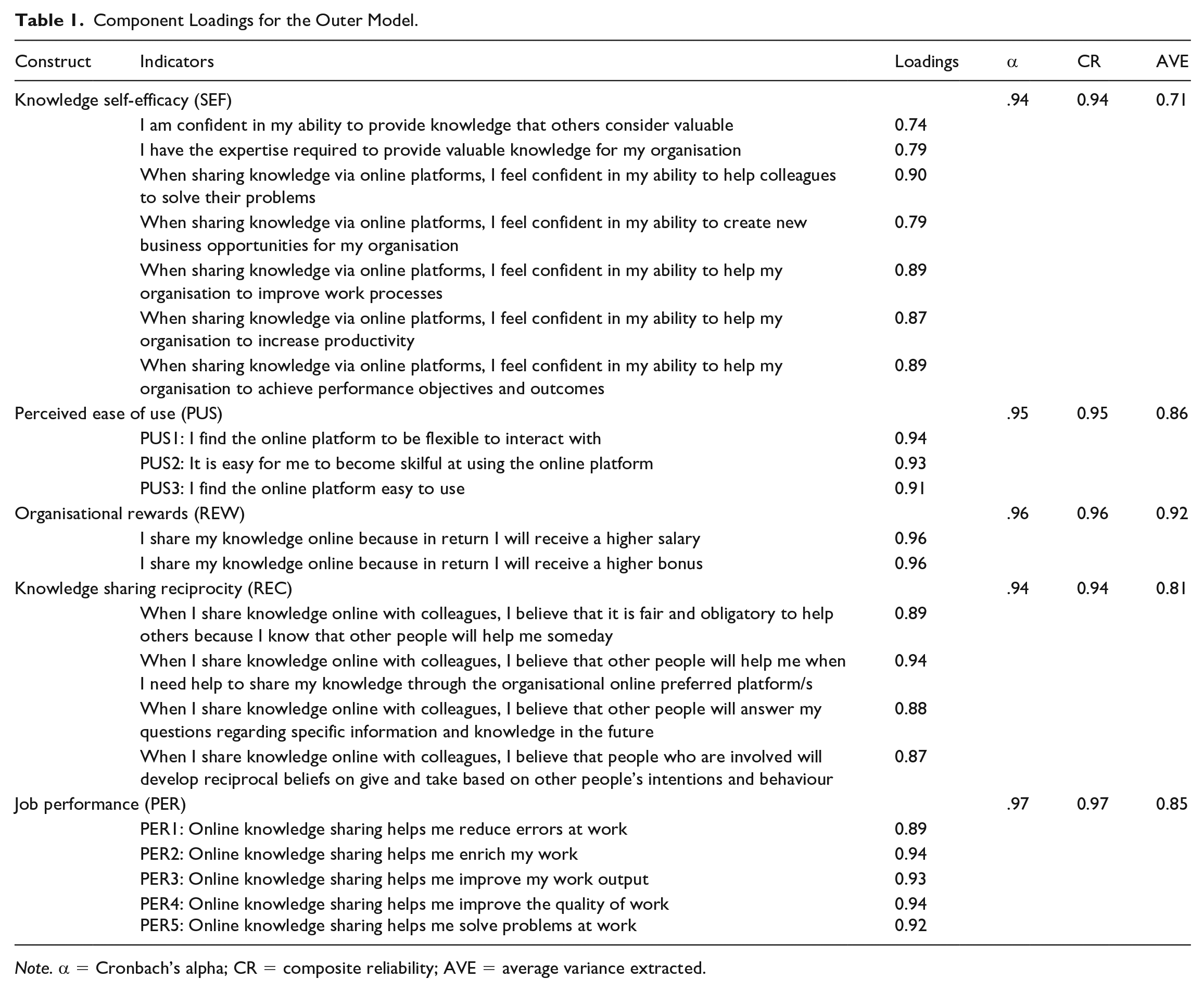
Note. α = Cronbach’s alpha; CR = composite reliability; AVE = average variance extracted.
Common method bias
To address common method bias, Harman’s single factor test using exploratory factor analysis (EFA) was assessed (Podsakoff et al., 2003). Without being constrained, EFA generated five distinct variables (knowledge self-efficacy, perceived ease of use, organisational rewards, knowledge sharing reciprocity, and job performance). When being constrained all measurements into one factor, the results of EFA revealed 35.39% of the variance. In addition, the marker-variable technique was conducted (Lindell & Whitney, 2001) using the firm operation period as a marker variable. The mean change in correlations of all constructs when partialling out the effect was less than 0.001. In addition, following the recommendation of Kock (2019), common method bias was checked using PLS algorithm analysis in which factor-level variance inflation factor (VIF) resulting from a full collinearity test was examined. VIF would help measure how much the variance of an estimated regression coefficient is increased due to collinearity. If all VIF values are equal or less than 3.3, this would indicate that the model has no common method bias (Kock, 2015). In this study, five constructs were examined: knowledge self-efficacy, perceived ease of use, organisational rewards, knowledge sharing reciprocity, and job performance; therefore, five PLS algorithm analyses were conducted in which one of these constructs, in turn, was considered a dependent variable while the others were considered predictors as follows:
(1) knowledge self-efficacy, perceived ease of use, organisational rewards, and knowledge sharing reciprocity as predictors of job performance;
(2) perceived ease of use, organisational rewards, knowledge sharing reciprocity, and job performance as predictors of knowledge self-efficacy;
(3) organisational rewards, knowledge sharing reciprocity, job performance, and knowledge self-efficacy as predictors of perceived ease of use;
(4) knowledge sharing reciprocity, job performance, knowledge self-efficacy, and perceived ease of use as predictors of organisational rewards;
(5) job performance, knowledge self-efficacy, perceived ease of use, and organisational rewards as predictors of knowledge sharing reciprocity.
All VIF values were well below the cut-off value of 3.3. Thus, common method bias was not an issue in this study.
Results
The study employed partial least squares (PLS) approach via SmartPLS 3 to assess the measurement and structural model. Cronchbach’s alpha and composite reliability were assessed to examine the internal consistency reliability of the constructs. PLS-SEM was chosen as the tool for statistical analysis due to its distinct advantages over CB-SEM. When applying PLS-SEM using SmartPLS 3, this study is guided by the systematic procedure of Hair et al. (2014). Table 1 shows that the Cronbach’s alpha values of all constructs and composite reliability were higher than 0.70 (Nunnally, 1994), indicating acceptable reliability. Convergent validity was assessed using bootstrapping analysis. The average variance extracted (AVE) values exceeded the threshold value of 0.5 (Fornell & Larcker, 1981). In addition, the results supported the discriminant validation of constructs where the comparison between the square roots of the AVEs and all corresponding correlations were evaluated (Fornell & Larcker, 1981) See Table 2.
Correlations Among Construct Scores.
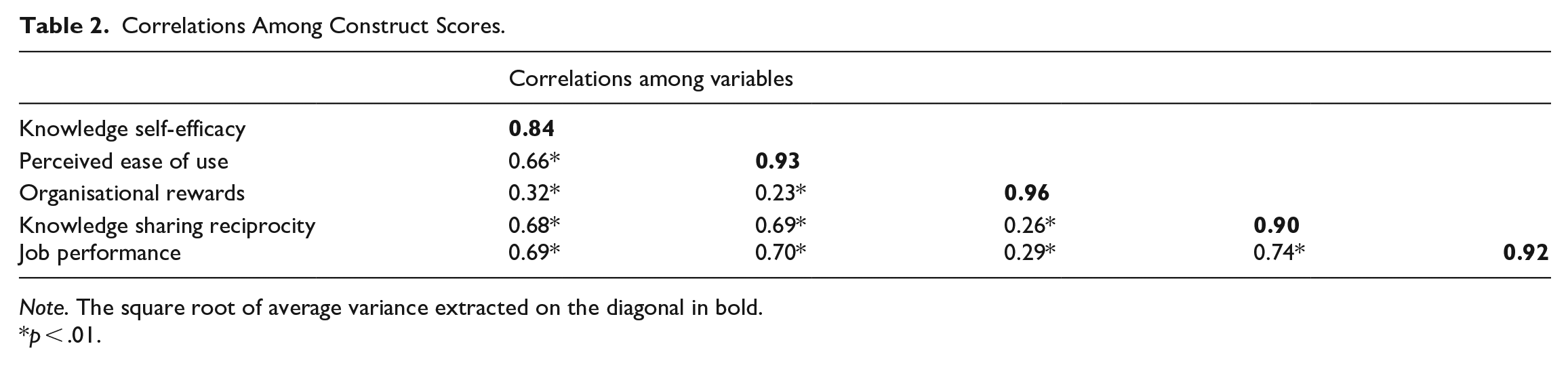
Note. The square root of average variance extracted on the diagonal in bold.
p < .01.
The sample was divided into two groups according to Preece et al.’s (2004) definition of lurkers and posters. Lurkers were classified as those who had not posted or had only requested knowledge in the last 3 months, with posters classified as those who posted or shared knowledge (Preece et al., 2004). A question was raised to ask if participants posted in the past 3 months. According to their responses, of 792 respondents, there were 477 posters and 315 lurkers.
Next, a multi-group analysis was conducted to examine the differences in the PLS-SEM inner model between lurkers and posters. Results in Table 3 and Figure 2 indicate that knowledge self-efficacy significantly affected knowledge sharing reciprocity and job performance in the lurker group (lurkers: βknowledge sharing reciprocity = 0.44, p < .001 and βjob performance = 0.23, p < .001) and in the poster group (posters: βknowledge sharing reciprocity = 0.34, p < .001and βjob performance = 0.23, p < .001). Therefore,
Multi-Group Results for Posters Versus Lurkers.
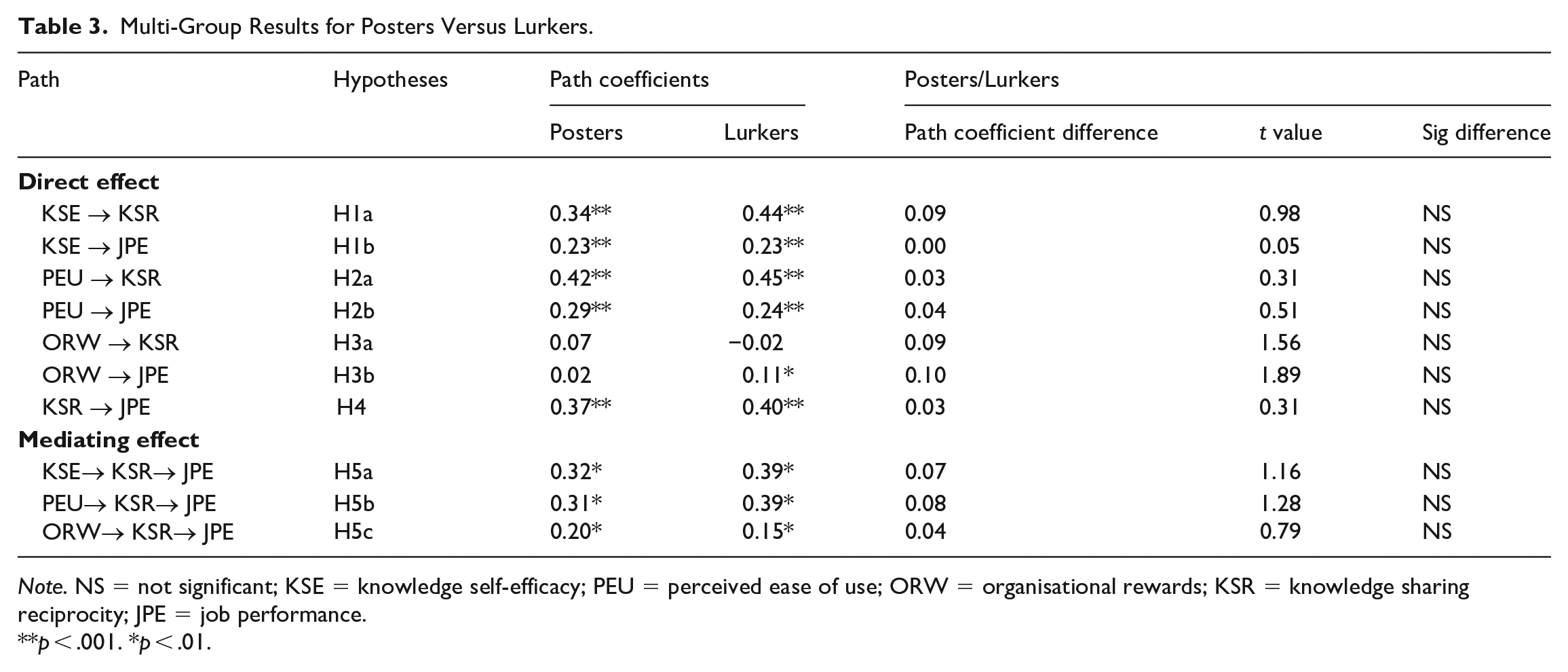
Note. NS = not significant; KSE = knowledge self-efficacy; PEU = perceived ease of use; ORW = organisational rewards; KSR = knowledge sharing reciprocity; JPE = job performance.
p < .001. *p < .01.
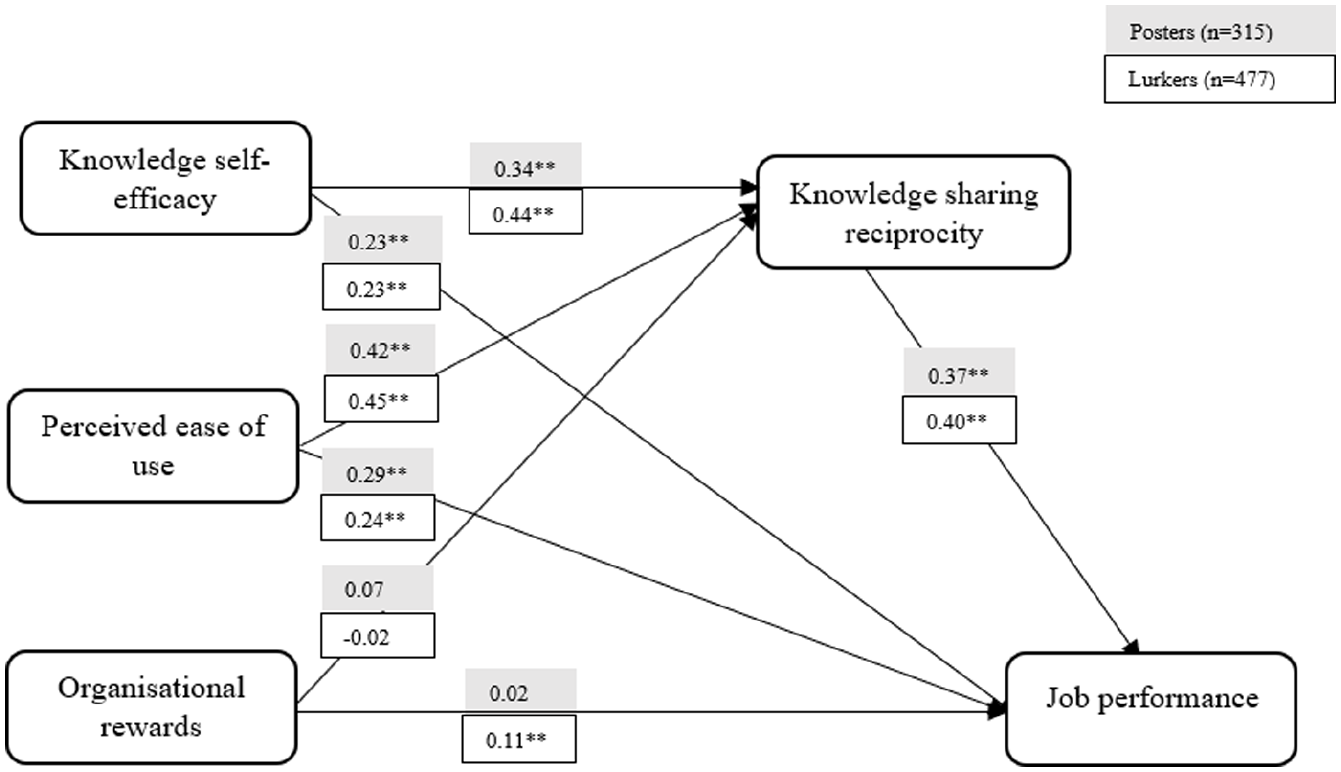
Structural model results.
The results also indicate that perceived ease of use significantly influenced knowledge sharing reciprocity and job performance in the lurker group (lurkers: βknowlede sharing reciprocity = 0.45, p < .001 and βjob performance = 0.24, p < .001) and in the poster group (posters: βknowledge sharing reciprocity = 0.42, p < .001and βjob performance = 0.29, p < .001). Thus,
In addition, organisational rewards were shown to have a significantly positive effect on job performance in the lurker group (lurkers: β = .11, p < .01) but did not affect job performance in the poster group (posters: β = .02, p > .05). Nor did affect knowledge sharing reciprocity in either group (posters: β = .07, p > .05; and lurkers: β = −.02, p > .05). Thus,
As shown in Table 3, knowledge sharing reciprocity had a significantly positive impact on job performance in both groups of lurkers (lurkers: β = .40, p < .001) and posters (posters: β = .37, p < .001). Thus, H4 was supported.
For robustness check, the mediation role of knowledge sharing reciprocity was checked using the SPSS macros PROCESS (Hayes et al., 2017). The results confirmed that for both posters and lurkers, knowledge sharing reciprocity mediated the impact of knowledge self-efficacy (posters: β = .31, 95% CI [0.25, 0.39]; lurkers: β = .43, 95% CI [0.33, 0.54]), perceived ease of use (posters: β = .29, 95% CI [0.22, 0.38]; lurkers: β = .38, 95% CI [0.28, 0.48]), and organisational rewards (posters: β = .13, 95% CI [0.08, 0.18]; lurkers: β = .12, 95% CI [0.05, 0.20]) on job performance. In addition, competing models with knowledge sharing reciprocity as a moderator were conducted using the SPSS macros PROCESS (Hayes et al., 2017). Analyses revealed that in both groups, knowledge sharing reciprocity did not moderate the impact of knowledge self-efficacy (posters: β = –.05, 95% CI [–0.09, 0.02]; lurkers: β = –.08, 95% CI [–0.12, 0.04]), perceived ease of use (posters: β = –.05, 95% CI [–0.08, 0.02]; lurkers: β = –.03, 95% CI [–0.07, 0.02]) and organsational rewards (posters: β = –.04, 95% CI [–0.07, 0.01]; lurkers: β = –.05, 95% CI [–0.08, 0.01]) on job performance.
Discussion
This study examined the motivation of lurkers and posters in online knowledge sharing via computer-mediated platforms in organisations. The mediating role of knowledge sharing reciprocity is also investigated in this study. Overall, key factors driving posters and lurkers to share knowledge online do not differ. However, the impact of knowledge self-efficacy, perceived ease of use, and organisational rewards on knowledge sharing reciprocity and job performance is stronger for lurkers than posters. Furthermore, knowledge sharing reciprocity is indicated to have a mediating effect on the impact of knowledge self-efficacy, perceived ease of use, and organisational rewards on job performance.
This study shows that high knowledge self-efficacy will lead to high posters’ and lurkers’ knowledge sharing reciprocity and job performance. If posters and lurkers have a high level of confidence about their ability to share valuable knowledge with others, they tend to actively share knowledge online and also expect others to reciprocate. Posters and lurkers often participate in online platforms for knowledge needs. Their expectation for the knowledge shared in return is not different because they make an effort to share knowledge and contribute to the organisation; thus, they both expect to receive help in the future. For both lurkers and posters, sharing knowledge is the way to create a bond with others, and knowledge sharing reciprocity maintains the knowledge sharing process. In addition, employees with high self-efficacy, regardless of whether they are lurkers or posters, tend to acquire knowledge more quickly and then apply it to their job, leading to improvement in job performance. These results are aligned with the findings of previous studies, such as Arnold and Paulus (2010) and Nonnecke et al. (2004). Arnold and Paulus (2010) emphasised the role of passive learning in increasing performance.
In this study, perceived ease of use was found to affect knowledge sharing reciprocity and job performance in both poster and lurker groups. These results indicate that both posters and lurkers participate in online platforms with a certain knowledge demand; therefore, when they learn how to use online platforms, they expect to benefit from the mutual give and take of knowledge sharing among members. They also hope that when they put time and effort into becoming familiar with the online platform, they can learn from others to improve their job performance. Additionally, they expect that the mutual give and take of knowledge sharing among members helps to create a favourable environment for knowledge exchange, leading to improvement in job performance. These expectations do not differ between posters and lurkers. These results extend the findings of Hung et al. (2015), who examined the impact of knowledge sharing reciprocity on perceived ease of use and found that when reciprocal benefits are expected to be strong, employees tend to be willing to make more effort on understanding online platforms; therefore, they see the system being more accessible.
Organisational rewards were found to affect poster’ and lurkers’ job performance differently. Organisational rewards affect lurkers’ job performance, both directly and indirectly, via knowledge sharing reciprocity. However, organisational rewards do not influence posters’ job performance directly; instead, they influence indirectly via the mediating effect of knowledge sharing reciprocity. These results indicate that for lurkers, organisational rewards motivate them to participate in online knowledge sharing to acquire knowledge to improve job performance. Organisational rewards also motivate lurkers to join the discussion in online knowledge sharing to help each other, which often leads to improvement in job performance. However, to achieve organisational rewards, posters may want to share useful knowledge and encourage others to join the discussion to contribute to organisational capital, which benefits all participants and leads to improvement in employee job performance. These findings of this study assist in explaining the discrepancy in the results of previous studies where the impact of organisational rewards on knowledge sharing behaviour was found in some studies but was not supported by others. In this study, knowledge sharing reciprocity does not mediate the relationship between organisational rewards and job performance when examining overall participants. However, when examining the lurker and poster groups, knowledge sharing reciprocity fully mediates the influence of organisational rewards on posters’ job performance and partially mediates the effect of organisational rewards on lurkers’ job performance. These findings indicate that with knowledge sharing reciprocity as a mediator, organisational rewards impact both lurkers’ and posters’ job performance. These findings help to provide a possible explanation for the mixed results in previous studies where some of them included knowledge sharing reciprocity in their model and examined both lurkers and posters while others did not, leading to mixed results.
Knowledge sharing reciprocity significantly affected job performance in the lurker and poster groups, but no difference was found between the two groups. Both posters and lurkers participated in online platforms mainly for knowledge needs; therefore, they tended to think that if they contributed to the organisation through knowledge exchange, they would experience improvement in job performance. Employee job performance could be improved regardless of the knowledge sharing behaviour of posters or the reading and browsing behaviour of lurkers. Posters could learn from sharing their knowledge and improve their performance by discussing their work issues with others, while lurkers could enhance their performance by acquiring knowledge shared by others. Both active and passive learning behaviour could lead to improvement in job performance.
Implications
Implication for theory
This study provides an understanding of how key contributing factors of online knowledge sharing behaviour help enhance employee knowledge sharing reciprocity and job performance. Previous studies have examined the predictors of online knowledge sharing behaviour but have rarely examined the organisational outcomes of online knowledge sharing behaviour, such as knowledge sharing reciprocity and job performance. The main goals of organisations when facilitating online knowledge sharing are to increase employees’ acquisition, create a favourable environment for employees to help each other in their work, which refers to an increase in knowledge sharing reciprocity (Chai et al., 2011), and then improve employees’ job performance (Kwahk & Park, 2016). Consequently, the organisation is able to create organisational competitive advantage (Bock et al., 2005). Therefore, the investigation of outcomes of knowledge sharing reciprocity and job performance should be taken into account in future research on organisational online knowledge sharing.
This study extends Social Exchange Theory when examining the mediating role of knowledge sharing reciprocity. In the knowledge sharing literature, knowledge sharing reciprocity has been mainly investigated as a determinant of knowledge sharing behaviour (Lai & Chen, 2014). In this study, knowledge sharing reciprocity is examined both as a predictor of job performance and a mediator that links knowledge self-efficacy, perceived ease of use, and organisational rewards with job performance. This research provides additional insights into the importance of knowledge sharing reciprocity to create a mutual give and take of knowledge sharing that helps to maintain knowledge sharing behaviour, leading to improvement in job performance. When employees share knowledge due to their expectations of reciprocal knowledge sharing, they will continue to share knowledge. Those who receive knowledge shared in online platforms often develop a sense of knowledge owing or knowledge debt and are likely to reciprocate by sharing their knowledge. As a result, an active exchange of knowledge is created and helps employees learn via the mutual give and take of knowledge sharing, which improves job performance. Thus, the mediating role of knowledge sharing reciprocity needs to be considered in online knowledge sharing.
The study shows that the predictors of lurkers and posters in organisational online knowledge sharing differ. These results emphasise that in online knowledge sharing, differentiating two kinds of online participants is crucial as their behavioural patterns are dissimilar. Previous studies tended to examine determinants of posters and implied that the factors that motivate posters also work with lurkers and vice versa (Kwahk & Park, 2016). However, the results of this study show that lurkers and posters are motivated by different factors. These findings help to explain the discrepancy in the results of previous studies. Thus, the examination of these two different types of participants is necessary. This study is one of the first to examine online knowledge sharing in organisations in an emerging and transitional economy. Organisational online knowledge sharing has been investigated in western countries, but few studies have been conducted in an emerging and transitional economy such as Vietnam’s (M. Nguyen et al., 2021). The results of this study consolidate the findings of previous studies and extend the literature by providing some different findings in a developing country context.
Implications for practice
The empirical findings of the study have practical implications, as explained following. First, this study suggests that knowledge self-efficacy plays a crucial role in influencing knowledge sharing reciprocity and job performance. Management should emphasise that knowledge sharing among employees significantly contributes to the success of the organisation. Moreover, the improvement of knowledge self-efficacy is crucial to organisations in a competitive and changing business environment. Clear feedback is one of the helpful ways to improve knowledge self-efficacy perception. Furthermore, online platform developers should offer a user-friendly interface. This could make employees perceive online platforms as easier to use in the early stages and consequently encourage them to use online platforms more often to share knowledge. Guidance, tutorial videos, and frequently asked questions (FAQs) are recommended. The provision of interfaces with animated assistant icons that are fun and tie into social functioning is also helpful because such design features are very useful when engagement with online platforms becomes routinised, less challenging, and less discovery-oriented (Papadopoulos et al., 2013). In addition, a stable online platform system with fast connectivity can help to increase the ease of use. Thus, organisations should maintain the stability of online platform systems to increase employees’ perceived ease of use. Further, management can provide training courses in the early stage of the use of online platforms to enhance employees’ familiarity. If employees experience success during training and during the early stages of use, they are more inclined to continue to use online platforms for knowledge sharing. In addition, as organisational rewards can motivate lurkers and posters to share knowledge, some organisational rewards should be offered for those who are active in online knowledge sharing, who help each other and who improve their job performance. For posters, management needs to create a favourable knowledge sharing environment to facilitate the transfer of knowledge and motivate interpersonal interactions among employees. When employees share their valuable information, skills or experience, individual knowledge can be transferred to organisational capital and enhance employee job performance. Therefore, online platform managers should endeavour to improve content management for easy understanding and searching, so the effort of sharing knowledge is seen and appreciated by others, possibly resulting in a higher level of knowledge sharing reciprocity. Online platforms can also be utilised as a formal channel to spillover information in an organisation to encourage employees to share knowledge and reciprocate others’ knowledge sharing.
Limitation and future research
This study has several limitations. The first limitation is that the use of a self-reported questionnaire to collect data is prone to sampling bias. Future research should adopt other collecting data methods such as in-depth interviews or experimental research design that could be useful to gain more insights into employees’ online knowledge sharing in Vietnamese organisations. Secondly, the study focuses mainly on extrinsic motivation. Organisational rewards focus on extrinsic rewards such as bonuses and increased salary or promotion rather than intrinsic rewards such as praise and public recognition. Investigating other intrinsic factors such as identification and trust may be helpful further in understanding the driving forces of online knowledge sharing. Finally, the research did not ask about the type of online knowledge sharing platforms, the voluntariness of system usage, the moderation/management type, and the anonymity of users. Future studies may want to add these factors as control variables to capture their impact on posters and lurkers.
Supplemental Material
sj-docx-1-anz-10.1177_14413582231167035 – Supplemental material for Share or Not Share Knowledge: Posters Versus Lurkers in Organisational Online Knowledge Sharing and Internal Marketing
Supplemental material, sj-docx-1-anz-10.1177_14413582231167035 for Share or Not Share Knowledge: Posters Versus Lurkers in Organisational Online Knowledge Sharing and Internal Marketing by Mai Nguyen, Marie-Louise Fry and Denni Arli in Australasian Marketing Journal
Footnotes
Authors’ Note
Mai Nguyen is also affiliated to Thuongmai University, Vietnam.
Declaration of conflicting interests
The author(s) declared no potential conflicts of interest with respect to the research, authorship, and/or publication of this article.
Funding
The author(s) received no financial support for the research, authorship, and/or publication of this article.

Supplemental material
Supplemental material for this article is available online.
References
Supplementary Material
Please find the following supplemental material available below.
For Open Access articles published under a Creative Commons License, all supplemental material carries the same license as the article it is associated with.
For non-Open Access articles published, all supplemental material carries a non-exclusive license, and permission requests for re-use of supplemental material or any part of supplemental material shall be sent directly to the copyright owner as specified in the copyright notice associated with the article.
