



Abstract
The world’s current ‘linear economy’ business model diminishes finite resources and disregards ongoing detrimental effects being created on our planet. Society needs to do something different, and move to a circular economy for sustainability. Changing existing consumer behaviour to extend the life of currently unwanted household goods can play a beneficial role to increase circularity. Underpinned by the COM-B model of behaviour and associated Behaviour Change Wheel (BCW), this study explores householders’ existing behaviour and views regarding unwanted goods, and perspectives of local government employees/contractors involved in collection of unwanted household goods, to develop recommended interventions to increase circularity. The study offers theoretical contributions as one of the first studies to apply the COM-B model and BCW within the circular economy context and identifies prioritisation/co-ordination as key issues needed in the model. Additionally, practical contributions are provided including recommendations for increased education, incentivisation and enablement (including improved infrastructure); with cost, safety, technology and politics key barriers to increasing circularity of unwanted goods by households. A crucial finding is a need for responsibilisation whereby all stakeholders must accept the specific role each needs to play in a co-ordinated effort to address the challenge of sustainability. The study provides social contribution addressing SDG Goal 12 (responsible consumption) and identifies how various stakeholders can do something different to assist increasing household participation in a circular economy – for the future of humankind and the planet.
Keywords
Introduction
The typical global ‘linear economy’ business model began in the 17th-century industrial revolution but ignores the environmental and long-term damage it is causing to society and depletes the resources of the planet (Prieto-Sandoval et al., 2018). This ‘linear economy’ basically converts ‘natural resources into waste, via production’ (Murray et al., 2017, p. 371). As a society, we currently consume resources at a ‘50% faster rate than can be replaced’ (Esposito et al., 2018, p. 5). A similar perspective states that ‘[g]lobally, we are consuming as if we had the resources of 1.8 planets’ (Schibsted, 2019, p. 1). Additionally, the population of the world is increasing and most countries aim to improve their way of life by becoming a developed country, resulting in a growing middle-class which further drives demand (Esposito et al., 2018). Alarmingly, only 17% of the world is currently classified as ‘developed’ and this figure is predicted to increase to 50% by 2050 (B. Wang, 2018) and ‘[t]o live in the developed world is to live in a consumerist society’ (Gilovich et al., 2015, p. 152). Problematically, ‘humanity is not taking the urgent steps needed to safeguard our imperilled biosphere’ and there is thus a need to ‘re-examine and change our individual behaviors’ including ‘drastically diminishing’ resource consumption (Ripple et al., 2017, p. 1026). Put simply, our current way of living is unsustainable and as a society, we need to do something different!
Whilst our natural environment operates as a circular closed-loop ecosystem, humans have typically imposed a ‘linear economy’ business model which is demonstrably unsustainable. Indeed, ‘the world’s current economic model is deeply flawed’ (Business and Sustainable Development Commission, 2017, p. 19). Hence, it is considered that society needs to move to a circular economy for sustainability, with a change in consumer behaviour ‘becoming an important part of the system’ (Wastling et al., 2018, p.1). A circular economy can be defined ‘as an economic system designed with the intention that maximum use is extracted from resources and minimum waste is generated for disposal’ (Deutz, 2020, p. 193). Pleasingly, governments are increasingly recognising a need to shift from the current ‘take, make, use and dispose’ model to a ‘maintain resource value’ model via a circular economy, but the issue is, HOW to do this? The behaviour of consumers in a circular economy ‘has not yet been clearly described’ (Wastling et al., 2018, p. 2) and more broadly, little knowledge currently exists regarding how to introduce a circular economy (Camacho-Otero et al., 2018; Hamilton et al., 2019; Kirchherr et al., 2017).
A household typically engages with a product during three stages – product acquisition, usage, and then end-of-use (Wastling et al., 2018). Hence, a consumer’s ‘behaviour and decision-making’ during these stages ‘can enable or hinder’ the circular economy (Georgantzis Garcia et al., 2021, p. 2). Consequently, ‘the role of consumption in the circular economy is of interest to’ numerous stakeholders (Georgantzis Garcia et al., 2021, p. 2). In a circular economy, ‘the aim is to circulate products at their highest level of value’ (Wastling et al., 2018, p. 1). Thus, unwanted, household goods can play a beneficial role in a circular economy. Instead of being condemned to landfill, the life of currently unwanted goods can be extended in one form or another – reducing the need to purchase new items. Whilst various research examines aspects of sustainable product acquisition (e.g. Whelan & Kronthal-Sacco, 2019), this specific research paper focuses on the end-of-use stage. This paper is part of a broad ongoing circular economy study and is underpinned by Michie et al.’s (2011) COM-B model of behaviour (which suggests Behaviour is the result of interaction between Capability, Opportunity and Motivation) and the associated Behaviour Change Wheel (BCW). The aim of this specific study is thus: to explore householders’ views and behaviour regarding unwanted household goods (i.e. end-of-use/post-purchase behaviour), and capture the views of local government employees/contractors involved in the collection of unwanted household goods, to ultimately identify potential interventions to increase the level of circularity. The guiding research question addressed in line with this aim is:
RQ1: What
This project contributes by responding to calls that work needs to be done regarding ‘how to trigger change . . . and transition towards a circular economy’ (Camacho-Otero et al., 2018, p. 18) and similar calls from Wastling et al. (2018), Hamilton et al. (2019) and Davies et al. (2020). The research also addresses recent higher-level calls from Chandy et al. (2021) for research that contributes to a better world, and from Haenlein et al. (2022) for research that aims to assist in improving societal wellbeing and the planet. Additionally, the research addresses the recent calls in the Australasian Marketing Journal by Bolton (2022) for research targeting The United Nations’ Sustainable Development Goals (SDGs) and Responsible Research in Business and Management (RRBM), and Rosenbloom (2022, p. 1) who considers that sustainable development is ‘the most pressing grand challenge currently’ facing the world.
The following sections provide background to the research by presenting detail regarding a circular economy, consumption, plus the theoretical underpinnings used for the research. Subsequent sections then describe the research approach used in the research, followed by detail of the results and discussion. The paper finishes with practical implications, contributions, and suggestions for future research.
What is a circular economy?
Various definitions of the circular economy have been suggested. For example, Kirchherr et al. (2017, p. 229) consider a circular economy as ‘an economic system that replaces the ‘end-of-life’ concept with reducing, alternatively reusing, recycling, and recovering materials in production/distribution and consumption processes’. Similarly, ‘[c]ircular business models use already existing materials and products as inputs and therefore their environmental footprint tends to be consistently smaller than that of traditional business models’ (OECD, 2018, p. 3). The circular economy is centred on three principles – elimination of waste and pollution, circulation of products and materials at their highest value, and regenerating nature (Ellen Macarthur Foundation, n.d.). Linked to a circular economy, with reference to Belz and Peattie (2009), Jackson and Michaelis (2003), and also Lim (2017), Bolton (2022, p. 3) suggests ‘sustainable consumption’ can be regarded as ‘consumption that supports the ability of current and future generations to meet their needs without causing irreversible damage to the environment or the functioning of ecological and social systems while improving stakeholding well-being and efficiency’.
The concept of a circular economy challenges the current (linear business model) ‘economic logic because it replaces production with sufficiency: reuse what you can, recycle what cannot be reused, repair what is broken, remanufacture what cannot be repaired’ (Stahel, 2016, p. 435). It ‘decouples economic activity from the consumption of finite resources’ (Ellen Macarthur Foundation, n.d.). Unfortunately, currently, unsustainable consumption is worldwide (Bhattacharyya et al., 2021), and ‘[w]idespread practice of consuming sustainably has clearly not materialized’ (Lim, 2022, p. 1). Indeed, at present, the world is only 8.6% circular (Circularity-gap.world, 2021). Thankfully, given the urgent and imperative need to increase circularity, the concept of a circular economy has recently ‘found much favour in national and local governments all over Europe’ (Savini, 2019, p. 676), whilst policies have been developed in Australia at both national and state levels (e.g. Commonwealth of Australia, 2018; NSW Government, 2019; Victoria State Government, 2020).
Consumption – From linear to circular
In line with ‘linear economy’ business models, traditional marketing has typically convinced consumers to think that ‘new’ is better than ‘second-hand’, which is often reinforced by peers of the individual consumer (Hopkinson et al., 2018). This results in most industrialised societies living in a linear economy of mass production and mass consumption of new products (Esposito et al., 2018).
Sustainable consumer behaviour can be defined as ‘actions that result in decreases in adverse environmental impacts as well as decreased utilization of natural resources across the lifecycle of the product, behavior, or service’ (White et al., 2019, p. 24). From a product usage perspective, the ‘final component of consumer behaviour’ in a circular economy is determining whether an item is to be ‘re-used, recycled or simply discarded or destroyed’ (Birtwistle & Moore, 2007, p. 212). If practicing a circular economy, consumers can be regarded as redistributors as opposed to end-users in the channel (Jacoby et al., 1977) as the circular economy ‘aims to overcome the take-make-dispose linear pattern of production and consumption, proposing a circular system in which the value of products, materials, and resources is maintained in the economy as long as possible’ (Merli et al., 2018, p. 703).
A ‘waste hierarchy’ is often discussed in relation to the circular economy. The top of the hierarchy (MOST preferable) is to avoid waste, followed by reduce waste, reuse waste, recycle waste, recover (including energy), treat (including hazardous waste), and then dispose of waste (LEAST preferable) (Commonwealth of Australia, 2018). Many goods (both new and used) sit unused in households ‘rather than entering the secondary goods market where they can resume their useful life’ (Winterich et al., 2017, p. 104), ideally as high as possible in the waste hierarchy. For items to enter the second-hand market, current owners need to make a behavioural decision to release the items. Hence, releasing unwanted household goods into a circular economy model at as high a level as possible can play a vital role in assisting sustainable consumption and progress towards a circular economy.
Theoretical underpinnings – COM-B model of behaviour and the Behaviour Change Wheel (BCW)
Behavioural change interventions can be defined as ‘coordinated sets of activities designed to change specified behaviour patterns’ and can be used to address ‘pressing issues facing society’ (Michie et al., 2011, p. 1) – of which the need for sustainability and a circular economy is a vital issue. The often-used ‘theory of planned behaviour’ is claimed by West (2006) to not consider issues of impulsivity, habit, self-control, emotional processing or associative learning. Following consultation with behaviour change experts and a review of 19 different frameworks of behaviour, Michie et al. (2011) developed the COM-B model of behaviour and the Behaviour Change Wheel (BCW) which is a framework that ‘provides a basis for designing interventions aimed at behaviour change’ (p. 4). The model is based on a ‘causal analysis of behaviour’ (Michie et al., 2011, p. 9). A strength is that it identifies which component/s of behaviour need changing for a successful intervention (West & Mitchie, 2020). Whilst typically utilised within the health field (e.g. West et al., 2020 examining Covid), the model has potential for use in broader settings and is utilised in this current research.
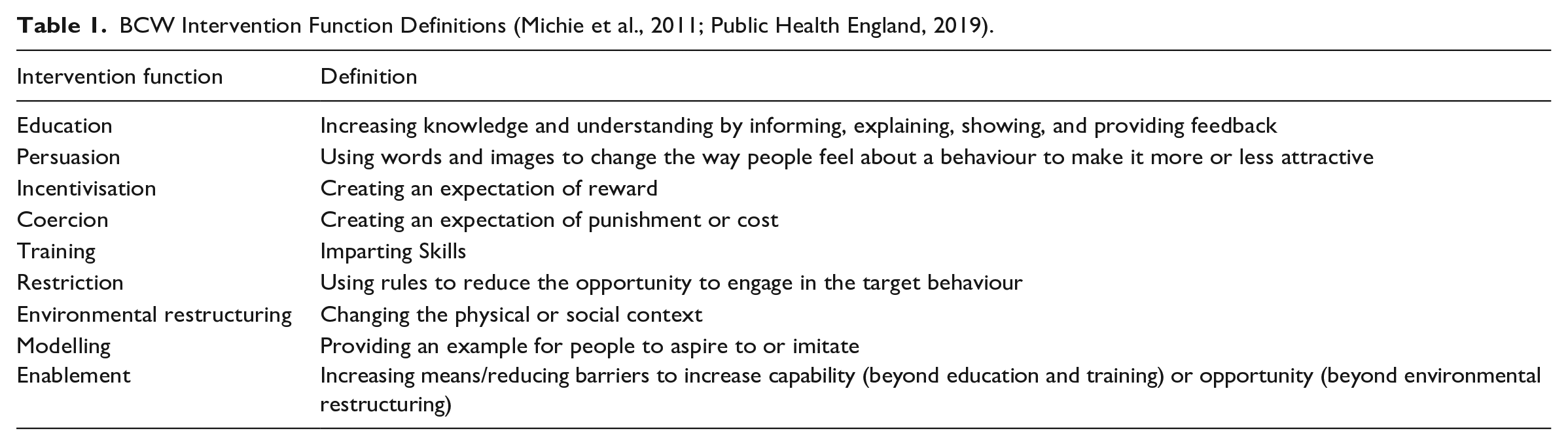
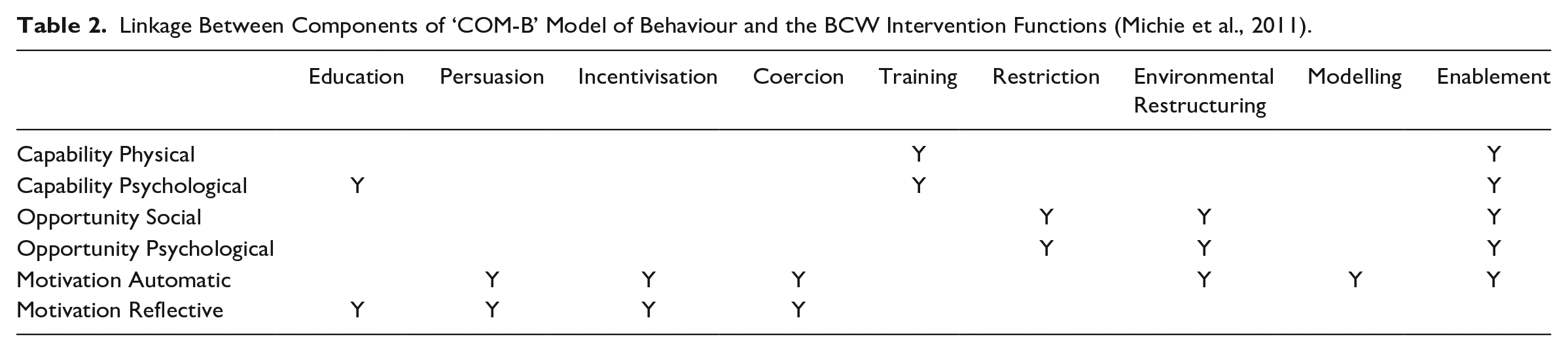
The COM-B model of behaviour is positioned at the centre of the BCW. The model contends that, for a specific behaviour to occur, a person must be both physically and psychologically able (Capability), they must also possess the physical and social opportunity to perform the behaviour (Opportunity) and to do the behaviour they must want to perform that specific behaviour more so than any other competing behaviours (Motivation). Here, motivation is defined as ‘those brain processes that energize and direct behaviour’ (Michie et al., 2011, p. 4). These components interact, hence any interventions need to target one or more components to enable effective behavioural change. The COM-B model is shown in Figure 1. If the desired behaviour is not occurring, analysis of the situation can assist to identify what needs to shift to enable the desired behaviour to occur. Accordingly, the COM-B model is at the centre of a larger system of behaviour and is surrounded by nine intervention functions and seven policy categories – the BCW (Figure 2) which can assist stakeholders to conduct behavioural analysis and identify possible subsequent interventions (e.g. aiming to increase circularity in the case of this current research). Whilst the policies are more nationally focussed, they can also be utilised at a local level and have the ability to create or support one or more of the intervention functions. Definitions of the intervention functions and provided in Table 1, with the linkage between COM-B and the BCW intervention functions shown in Table 2. Table 3 provides definitions of the policy categories.
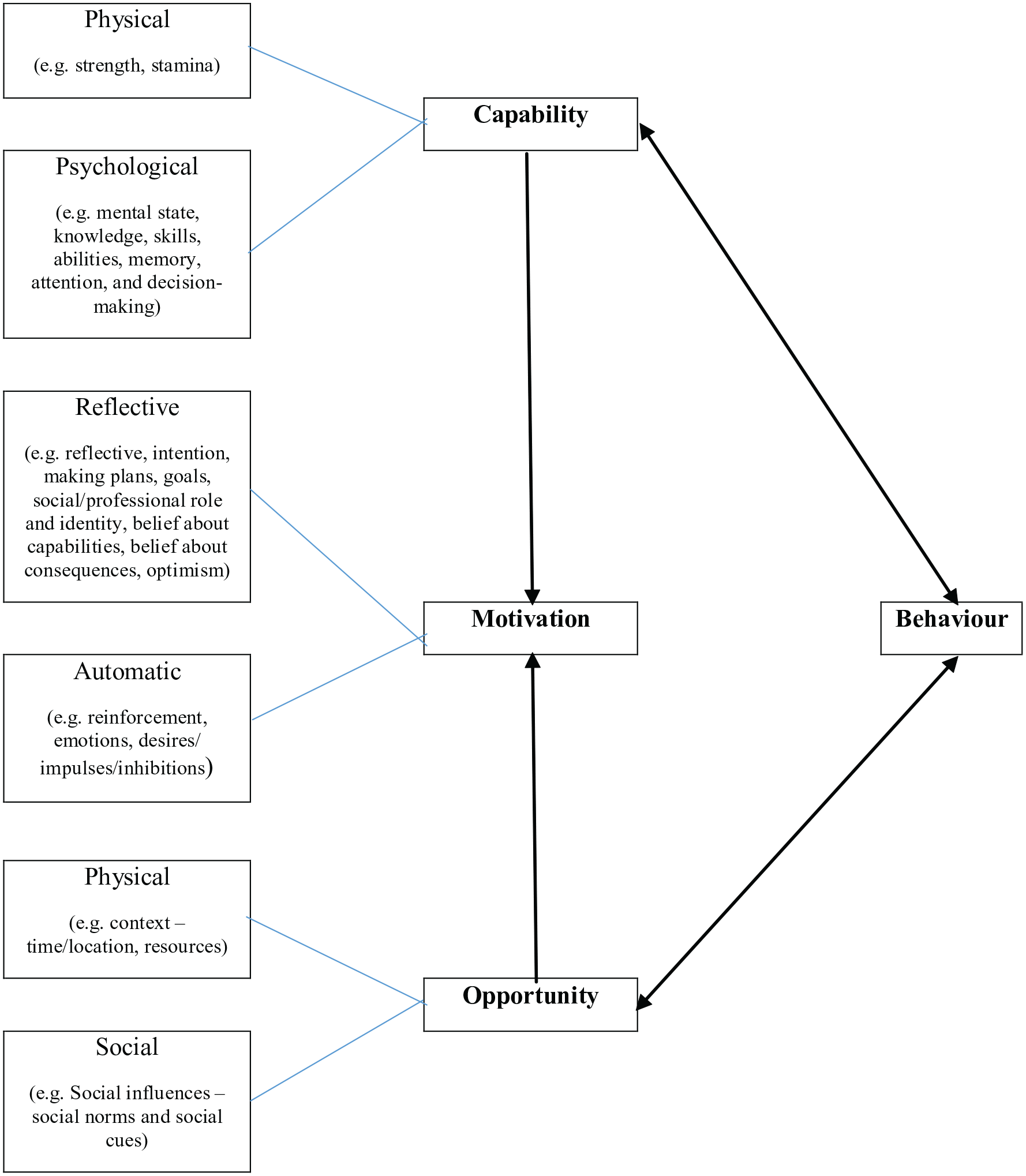
COM-B Model for analysing consumer behaviour (Michie et al., 2011).
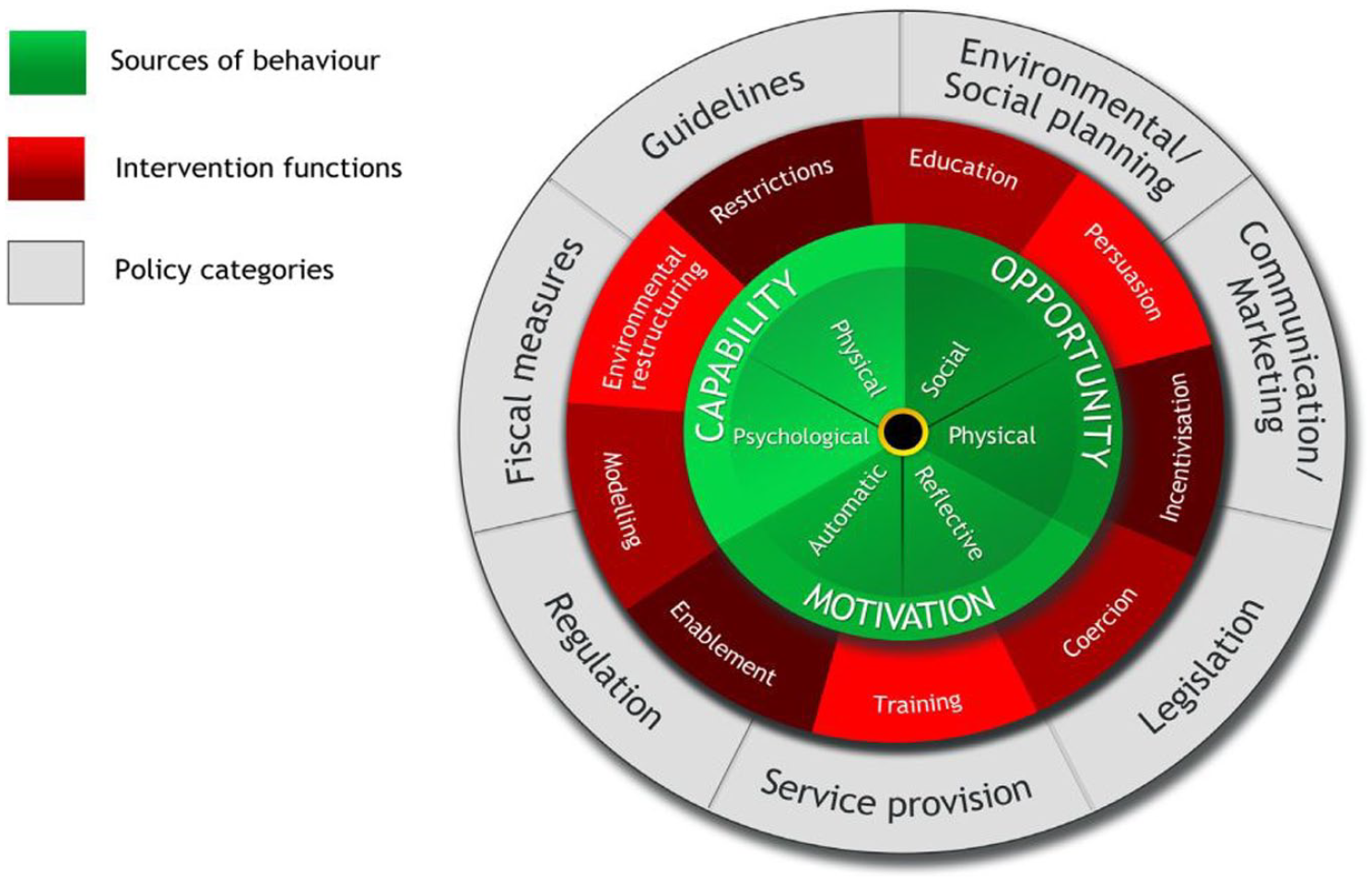
Behaviour Change Wheel (Michie et al., 2011, p. 7).
BCW Intervention Function Definitions (Michie et al., 2011; Public Health England, 2019).
Linkage Between Components of ‘COM-B’ Model of Behaviour and the BCW Intervention Functions (Michie et al., 2011).
BCW Policy Definitions (Michie et al., 2011, p. 7).
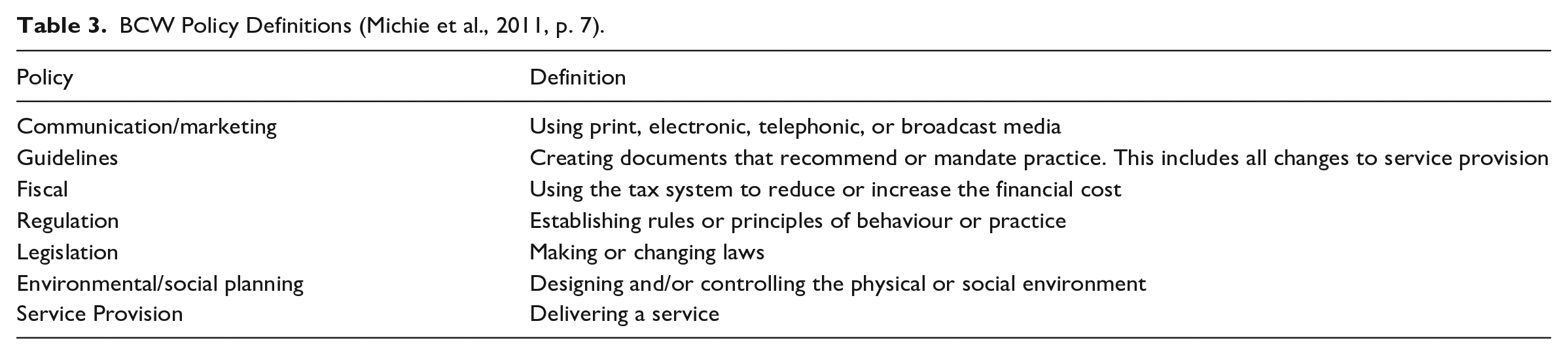
In summary, the COM-B model and specifically the BCW enable the identification and contextualisation of current practices and ‘what’ needs to be altered to facilitate behavioural change (both individual-level change and the underlying requirements). The BCW via identified interventions subsequently enables understanding of ‘how’ to make change (Social Change UK, 2019).
As indicated above, the guiding research question for the current research is – ‘What
Research approach
Ethics approval was obtained from the University Ethics Committee. A mixed-methods process was utilised, underpinned by the COM-B model and particularly the BCW. The research was conducted across four adjoining local government areas (LGAs) on the east coast of regional New South Wales in Australia. Informed consent was obtained from all participants.
The data included an online survey of households plus semi-structured interviews with relevant LGA council employees and contractors. Lincoln and Guba’s (1985) guidelines for ‘purposeful sampling’ were utilised to select council employees and contractors directly involved in household waste collection. The council employees and contractors were interviewed to capture their knowledge of unwanted item collection and processing issues, as well as determine what services/facilities were offered to residents for the disposal of unwanted goods (as opposed to regular weekly waste collection services). A total of 13 employees across the 4 councils were interviewed (each council was interviewed separately for confidentiality). Employee titles included Manager Waste & Resource Recovery, Waste Contract Manager, Waste Site Operations Manager, Collection Bookings Administrator, and Truck Driver – these reflected the range of employees involved in collections, from senior management to ‘on the ground’ employees. Three employees from the main waste contractor were also interviewed (including Operations Supervisor and Council Liaison Officer). The interviews were digitally recorded then professionally transcribed and subsequently checked for accuracy by the researchers via simultaneously listening to the audio and reading the transcripts.
The online survey containing both closed-ended and open-ended questions was made available to households. The draft survey was piloted with a sample of residents. Feedback from the pilot aided in fine-tuning the final survey (mainly ordering and wording of questions). To identify existing household behaviour, the survey aimed to firstly identify what, why, and how households dispose of unwanted goods (closed-ended questions). The survey additionally sought householders’ views regarding existing council clean-up services/facilities and suggestions (requiring interventions) for how increased utilisation of unwanted goods can occur (open-ended questions). The survey remained open until 300 valid responses were received.
The transcripts from the interviews with council employees and contractors as well as the responses to the open-ended questions in the household survey were thematically analysed manually, guided by Gioia et al. (2013) and particularly Braun and Clarke’s (2006) phases of thematic analysis (p. 87). The Braun and Clarke approach has ‘become the most widely cited’ version of thematic analysis (Clarke & Braun, 2017, p. 298). Thematic analysis is considered a powerful method to enable generation of understanding experiences, thoughts and behaviours across a qualitative data set (Braun & Clarke, 2012). The transcripts from council employees and contractors plus the open-ended responses from households were read on multiple occasions and analysed thematically with ‘typical’ quotes from the transcripts provided as evidence for each theme. A predominately deductive approach was utilised to identify relevant themes of interest as it enables identification of specific findings within the context of the theoretical underpinnings of the research (Braun & Clarke, 2012) – namely the BCW. However, mindful of potential limitations with a purely deductive approach, an inductive approach was also utilised enabling additional themes to be identified in the data as appropriate. Thematic analysis is a progressive and iterative process. Themes capture ‘something important about the data in relation to the research question, and represents some level of patterned response or meaning within the data set’ (Braun & Clarke, 2006, p. 82). Subsequently, to address the research question, data and themes were mapped into the BCW as deemed appropriate. Diagnostic/interpretative analysis of the results followed the approach suggested by Braun and Clarke (2006, p. 94) to explore issues such as ‘What does this theme mean?’, ‘What are the implications of this theme?’ and ‘What conditions are likely to have given rise to it?’
Additionally, to ensure validity and quality, the ‘primary strategies’ developed by Creswell (2003) for qualitative research, plus the ‘checklist of criteria for good thematic analysis’ developed by Braun and Clarke (2006, p. 96) were utilised.
Results and discussion
To assist in addressing the specific research question, it was considered appropriate to initially gain an understanding of households’ current behaviour. This data was generated from the quantitative component of the online household survey and involved three specific survey questions. Firstly, in regards to ‘
Types of Items Disposed of by Households in the Past 12 months.
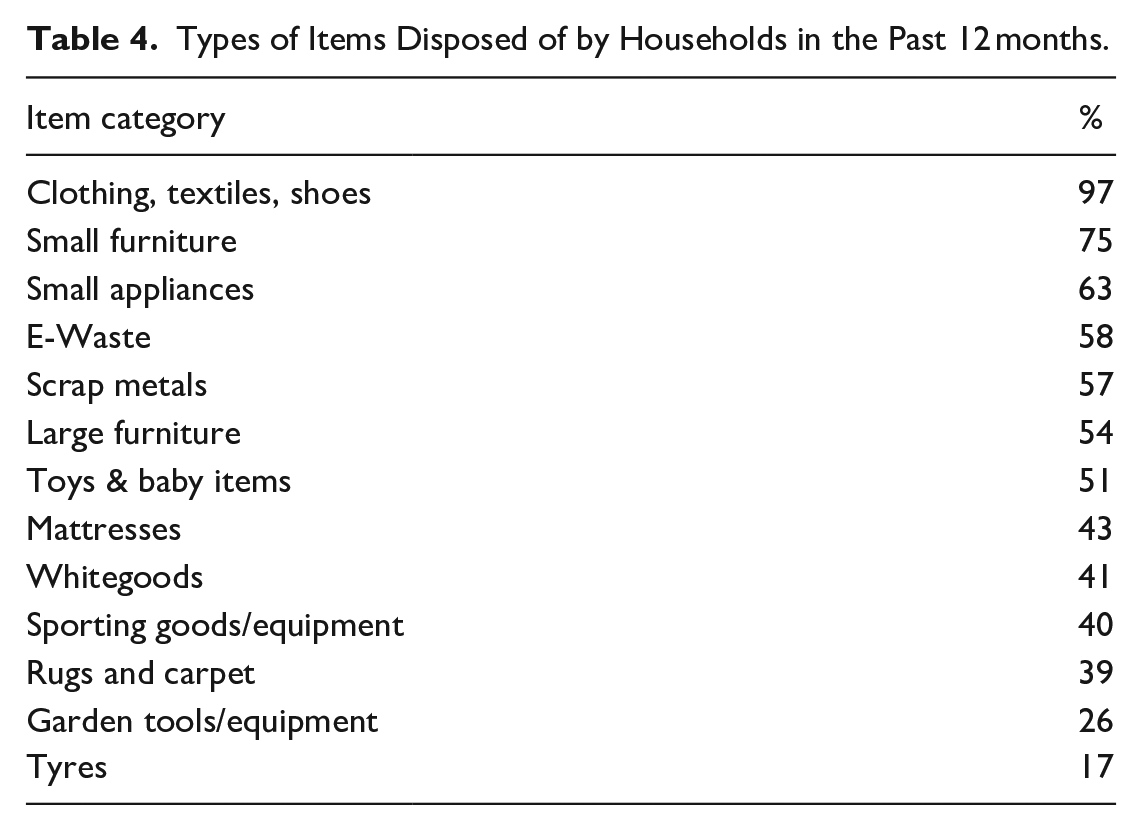
The results indicated that households were involved in the disposal of a broad range of items. The most disposed of items were ‘clothing, textiles, shoes’. The results are perhaps not surprising considering the volume of these common items within a typical household, the relatively low initial purchase price of such items, and the typical lifespan of such items. Clothing and shoes are utilised every day and subject to wear and tear and crucially, the vagaries of fashion. Small furniture and small appliances are used regularly and are generally relatively low price, and of typically low/average quality, whereas items such as mattresses and whitegoods tend to be more expensive and have a longer life span hence are discarded less frequently. From a circular economy perspective, whilst all items should have appropriate re-use/recycle/repair infrastructure, items disposed of regularly in high proportions should be given the highest priority by stakeholders and the most focus in terms of the development of appropriate circular disposal infrastructure (training intervention in BCW). Also, these item categories need to be a key focus by new product developers to develop new items that either won’t need replacing so often or are more easily repairable (policy guidelines/regulations/legislation in BCW). The European Union recently legally requiring all smartphones ‘to use a USB-C port for charging’ from Autumn 2024 (Otte, 2022) is an example of a policy legislation intervention.
Secondly, in regards to ‘
Reasons for Item Disposal in the Past 12 months.
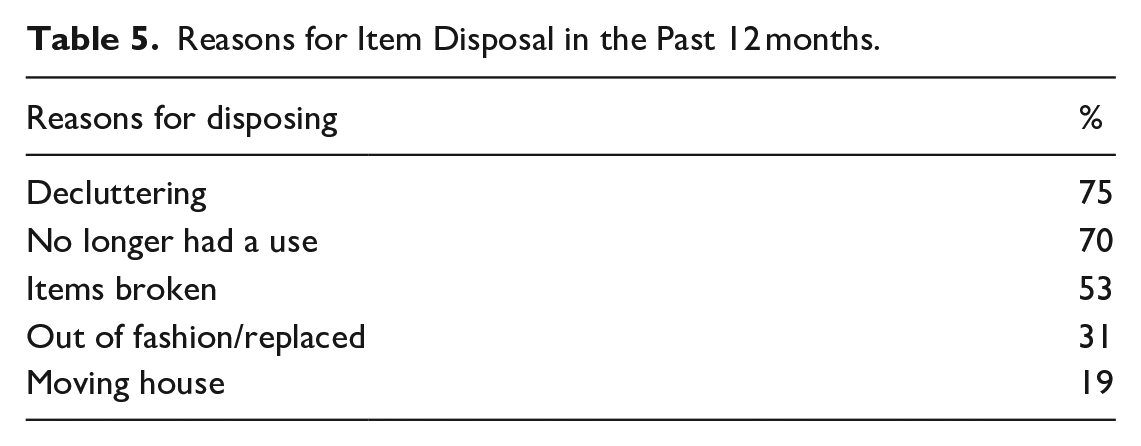
These goods should be able to find a home in some form – there needs to be appropriate education/persuasion/incentivisation/modelling interventions and increased infrastructure available for households to dispose of the items as productively as possible without the item going to landfill. Households need to receive more educational intervention regarding available disposal options and councils and local community groups need to consider providing more infrastructure. ‘Decluttering’ tends to suggest the items are still usable, but the consumer simply has too many items – suggesting overconsumption.
Why do consumers get to the point where they need to declutter? For numerous reasons, consumers may buy more than they need. Marketers need to accept some blame for this! Marketers will argue that the process of shopping can satisfy various hedonic needs, including social – plus the production and selling of new items creates jobs and is good for the (currently linear) economy. But there is minimal or no consideration of the planet in this rationale. Given the current unsustainable state of the planet, surely the time has come when we need to look at our consumption and reduce it. The development of ‘wiser consumption’ as suggested by Ozanne et al. (2021) will assist households to make wise decisions concerning unwanted goods. This is an area where social marketers can introduce various behavioural interventions (via education and persuasion in BCW) to encourage consumers to consume fewer ‘non-essential’ items and find alternative means of satisfaction – and also consider the sustainability of any purchases. Additionally, companies need to provide more focus on ‘planet’ in the triple-bottom-line of ‘people, profit and planet’ (Miller, 2020). The research identified that ‘clothing, textiles, shoes’ were the most disposed of product category. Various companies are producing more environmentally friendly clothing, and whilst this is commendable, a key issue is the relatively high price of these items. We need more of these environmentally and higher quality items, but consumers need to be convinced to buy less, but buy quality that will last longer – with less emphasis on fashionability – a major consumer behaviour challenge.
In terms of ‘no longer had a use’, these items too are likely to be re-usable. Consumerism is potentially a reason why the consumer initially purchased these items, but other factors such as a change in family circumstances are a possible cause for the current situation. The research showed that ‘deceased estate’, ‘children grown out of toys and clothes’, ‘clothing no longer fitted’ were reasons for the items being no longer required. Households need to have the capability (in the COM-B Model) via education about responsible disposal (education intervention in BCW) of these items. The third main reason for disposal was due to items being ‘broken’. Some of these goods could be reused, recycled, repaired, or repurposed although this can be a cost/benefit situation and also requires appropriate training and infrastructure. As noted by Ozanne et al. (2021, p. 237), ‘[i]t can be expensive or impossible for consumers to fix or refurbish the products they own’. This is an issue that manufacturers need to address, by re-designing products to make them easier and less costly to repair. Apple is well-known for making items difficult to repair (Chugh, 2021) and France is the first country where the national government has introduced a ‘repairability’ score for products (Andrews, 2021). The Australian Government Productivity Commission (Productivity Commission, 2021, p. 2) recently conducted a ‘right to repair’ inquiry and released a report that found ‘that there are significant and unnecessary barriers to repair for some products’. This could lead to upcoming policy changes. Pleasingly, various tertiary education marketing textbooks for ‘New Product Development’ subjects now promote the use of ‘Design for Environment’ principles (e.g. Ulrich et al., 2020) which encourage the design of products that are easier to repair and/or are made from recycled/recyclable materials. This needs to be pushed amongst product designers. However, a current problem needing resolution is that ‘many firms have not established means to collect, recycle, or remanufacture their products, which impedes consumers’ ability to dispose of products purposefully and safely’ (Ozanne et al., 2021, p. 239). Challengingly, for many manufacturers, the costs involved in moving from existing to sustainable practices are likely to be high (Ekins & Zenghelis, 2021) and these costs will likely need to be transferred to consumers. Governments (via BCW legislation policy interventions where needed), can play a key role in forcing companies to produce sustainable and repairable products. The next highest reason for disposal was ‘out of fashion/replace’. Such goods may be able to find a home – particularly with the renaissance of vintage/retro but this also indicates the pressure on some consumers to wear the latest fashion hence social marketers can aim to address this consumer behaviour issue via a ‘persuasion’ intervention.
Thirdly, in regards to ‘
Disposal Method per Item Category.
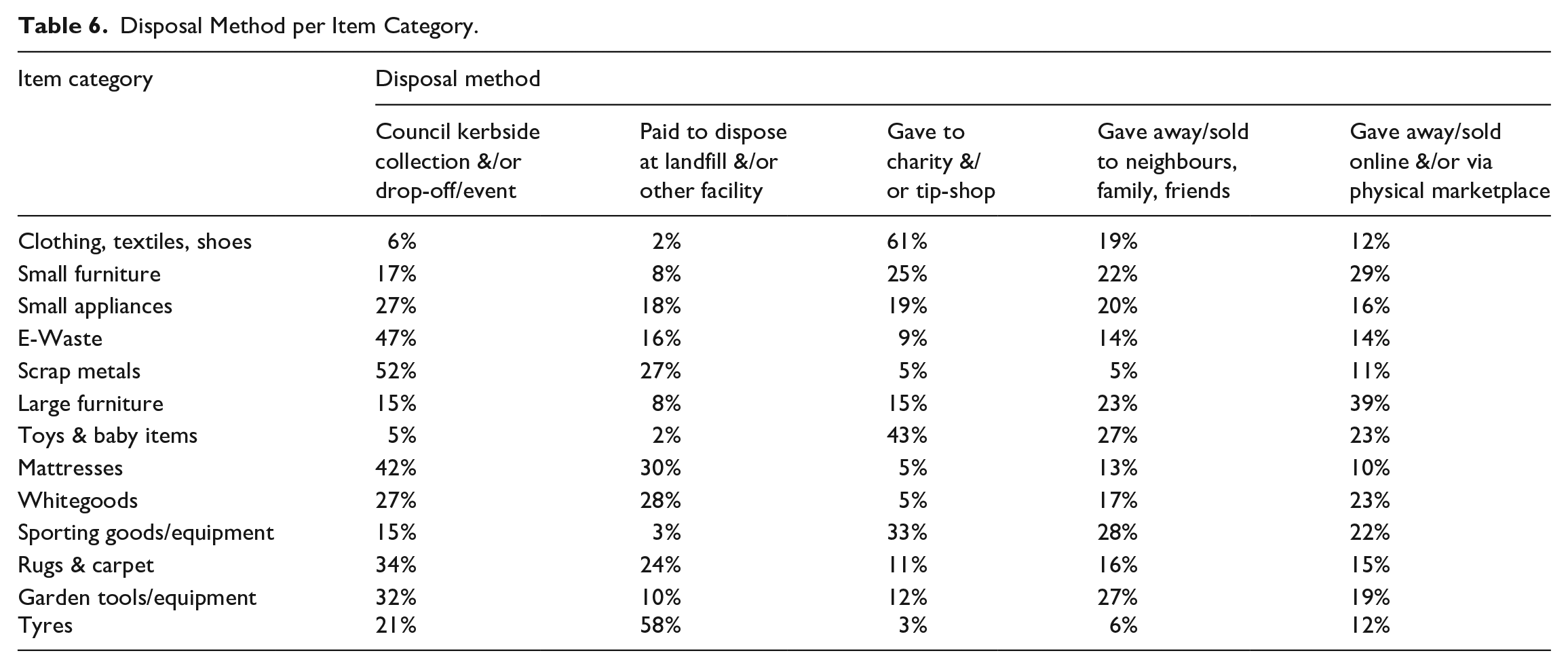
Charity and op shops are the key disposal method for ‘clothing, textiles, and shoes’, as well as ‘toys and baby items’. Unless these items are high quality/brand items in demand from potential buyers (enabling selling), if the owner has the capability and motivation (COM-B model) and because the items are small and lightweight, they are easy to transport and donate to charity/op shops (also a capability and motivation issue given time is involved). Online and physical marketplaces are the main disposal method for both large and small furniture. The physical size and volume of these items can prevent households from having the capability to transport the items to charity/op shops. Also, many charities, due to the increasing reliance on elderly volunteers are no longer accepting weighty items such as furniture (a capability issue within the charity stakeholder). Hence the items are often advertised online (sometimes for free) and collected by people who have appropriate modes of transport to pick up such goods (capability). Overall, the actual disposal method for each item category tends to reflect the ease of disposal (capability) and potential opportunity to make some money.
There is increasing interest in sustainable consumption ‘including the purchase of used products instead of new ones’ (Ahn & Kwon, 2022, p. 408) which provides an opportunity (if capability and motivation exist) for households to sell/giveaway unwanted items rather than simply discard them into the waste stream. Problematic items such as e-waste, mattresses, and tyres typically required council disposal. Overall, if items are of good quality, households aim to give the items to family and friends (due to relatively low capability, opportunity and motivation hurdles if family and friends live close-by and appropriate labour and transport are available), donate them to charity, or sell them, otherwise, the items end in the council waste collection. As noted by a council employee – ‘post it on Facebook and hopefully somebody comes and gets it from you . . . anything that ends up here, I think, has already tried to do the reclaim’ and ‘if it ends up in our tip shop, you’re probably the bottom of the rung of quality’ [C2A]. Councils should educate consumers and promote the disposal of items via various pre-existing outlets, with council collection becoming a last resort – this will increase the life of the goods as well as reduce council disposal costs.
As just discussed, diagnostic analysis of what, how and why unwanted goods are disposed of (quantitative component of the household survey) has sought to address why households undertake their current, specific behaviour.
BCW intervention functions
We now turn our attention to diagnostic analysis of the council/contractor interviews and household survey open-ended freehand comments to address the research question – ‘What
Per the COM-B model, if all the components of behaviour, namely capability, opportunity and motivation exist, then appropriate sustainable behaviour assisting a circular economy can occur. Otherwise, various interventions via the BCW (which link to COM-B as indicated previously in Table 2) need to be generated to add the relevant required capability, opportunity and motivation. As noted in Appendix A1, the need for all nine BCW Interventions was identified in the research, however, three specific interventions were identified as key and require priority (namely education, incentivisation, and enablement) hence are discussed in detail in the following paragraphs. The remaining six interventions can be considered as ‘support’ to assist delivery of the three identified key interventions.
In regards to the
(1a) education emphasising the high-level imperative for practising circular behaviour - to address household comments exemplified by ‘People don’t understand about the mess we are in with waste’ [H261].
(1b) Whilst this education intervention needs to address the general community, a separate sub-programme (focussing on the high-level imperative for practising circular behaviour) should be developed specifically targeting school children as behaviour developed during childhood typically transfers into adulthood. Pleasingly, in Australia, a few schools are beginning to incorporate the teaching of the circular economy topic in their classrooms (Australian Circular Economy Hub, 2023).
(2) education regarding waste hierarchy options - ‘encourage people to buy used items . . . [e]ncourage people to get items repaired rather than purchase new’ [H19] and ‘you’ve got mentality of people that I don’t care where you take it, I wanted it off my lawn’. [C5A].
(3) dissemination of information regarding the existing unwanted item handling options within the respondents’ local government area – ‘I'm new here so don't know a lot of what's around or services available’ [H28].
Overall, educational interventions need to be efficiently designed to effectively address the diverse range of residents within each local government area. The ‘persuasion’ intervention and ’modelling’ intervention can play useful roles in supporting the ‘education’ key intervention which may also lead to residents undertaking a ‘training’ intervention (e.g. to subsequently repair items rather than discarding the items into the waste stream).
In regards to an
Overall, the education intervention (and other interventions) also have a challenge involving the issue of responsibilisation, which can be defined as ‘the process by which subjects are rendered individually responsible for a task which previously would have been the duty of another . . . or would not have been recognized as a responsibility at all’ (Wakefield & Fleming, 2013). In past years, most stakeholders turned a blind eye to sustainability, with governments arguably more focused on generating industry and jobs, and consumers typically focussed on the cost of items when making purchase decisions. Now, however, there is general recognition of the need for sustainability and a circular economy. A key challenge for society is thus for all stakeholders to take responsibility for the situation and play their part. Therefore, the education intervention needs to convince the community and industry of the need for all stakeholders to play a role and become responsible for their own behaviour, by challenging existing behaviour and ideally making a behavioural change. This requires highly effective educational strategies. Input from social marketers in designing education can play a valuable role.
Linked to households wanting an incentive, there is also the implicit assumption by some households that moving to a more circular economy should not cost households financially – ‘I think the big perception is recycling is free. If you put a price on it, people will whinge and complain. It takes how many generations, whatever it is, to make that shift to change people’s mindset’ [C2B]. Whilst, understandably, households don’t want to pay extra for sustainability and a circular economy, it is naïve of these households to expect such changes to be cost-neutral, otherwise, the changes would have likely been made many years ago. Anything offered ‘free’ to households ultimately needs to be costed into other revenue sources such as taxes.
Thus, households not only expect an incentive/reward to change their behaviour towards increased sustainability but at a minimum, expect sustainability-related services to be free. These expectations are a crucial challenge for various stakeholders and it is imperative during any education interventions to focus/sell to society the holistic incentive/reward of having a more sustainable planet for our future. Given that fundamental human behavioural change takes time, such interventions need to be taken as soon as possible. ‘Coercion’ and ‘restriction’ interventions are basically the opposite of incentivisation interventions and there was relatively little comment from respondents regarding possible coercive actions or restrictive activity. This suggests households typically do not want to be forced into a circular behaviour via the threat of penalties or restrictions and that incentives are preferable to coercion or restriction concerning introducing behavioural change.
Technology – the available technology to improve recycling and waste processing is developing, but a council employee/contractor comment – ‘I’ve been in waste . . . going on six years . . . we’ve heard advanced waste treatment is coming . . . That’s been going for five years now and nothing’s been done. Nothing’s built’ [C2B] – suggests technical development barriers exist within the industry. Thus, relevant stakeholders need to be incentivised to speed up the development of improved recycling and waste processing methods. Such research can be conducted with collaborative input from both university institutions and industry.
Cost – A key issue for both households and councils is cost. As the entity tasked with household waste collection, Local Government Councils have a responsibility to assist households with the disposal of unwanted items – either directly by offering various infrastructure, or by encouraging households to practice alternate disposal methods before using council facilities. Thus, what infrastructure a council chooses to provide will be highly influenced by the cost of provision. Many councils are relatively small and have little opportunity to increase revenue from their constituents – either household residents or businesses operating in the LGA. Councils can aim for economies of scale by joining with adjoining LGAs however a challenge is that many LGAs are somewhat unique and may find it difficult to merge resources. An example would be a predominately rural area compared with a more densely populated region. Within the current research, it became apparent that each of the four adjoining LGAs had subtly different resident populations requiring different infrastructure. From a household perspective in regards to cost to the household - ‘The last time I used it, it was free and now they want to charge so I won’t be using it’ [H183]. This comment is somewhat curious as no council-provided facilities are ultimately ‘free’. This is a perception issue, as visually ‘free’ services are ultimately included in council rates. Thus, when offering council services to households, councils need to package the service in such a way that households consider the service as ‘free’. A typical council employee/contractor comment is ‘the cost of [us] diverting is three times the cost of putting it in the landfill’ [C2A]. This links with a previously identified intervention to educate households, and assist with opportunity, to dispose of unwanted items as high up the waste hierarchy as possible before resorting to disposal via council waste facilities.
Safety – A third barrier was identified as safety and is a key issue for council-operated infrastructure – ‘there’s the safety aspects of sorting through mixed waste’ [C2A]. In a highly litigious society, all organisations, including Councils need to be higher vigilant with their operations, hence safety becomes paramount when considering what infrastructure may be offered. This does, however, offer the opportunity for the design of safer unwanted goods handling services.
Politics – A fourth barrier was politics which may play a role in council decision-making – there can be conflict and tension between councillors, employees, and residents - ‘Councillors make their decisions, which might be politically motivated’ [C2C] and based on competing priorities. These barriers to enablement of increased circularity amongst households need to be openly and honestly recognised by all stakeholders with pro-active actions taken to minimise or ideally remove the barriers.
BCW policy issues
Linked to the BCW intervention functions are the over-riding BCW policies. These will influence what interventions stakeholders ultimately decide to introduce. This can also become an iterative process. If identified interventions are considered valuable but not within current policy, this can put pressure on relevant authorities to change their policies. For example, whilst the ‘coercion’ intervention identified ‘[h]igher taxation of cheap . . . products that have a short life’ [H15], whether this could be implemented would need to be dictated by government policy.
Practical implications, contributions, and future research
Practical implications
Underpinned by the COM-B model of behaviour and linked to the BCW intervention functions, based upon interviews with council employees and contractors, plus a household survey, the research aimed to provide increased understanding regarding the current consumer behaviour of households (post-purchase behaviour) in regards to their disposal of unwanted goods and specifically identify interventions to increase household involvement in a circular economy. Some interventions can be conducted by local government (i.e. councils), whilst other interventions require State and Federal government involvement, or non-government organisations, industry and community groups. The research identified what types of goods are disposed of by households, and why and how households dispose of unwanted goods. Key findings from the subsequently developed interventions were the identification of the need for increased, and more effective education of households (consumers) regarding awareness of a greater need for circular behaviour, disposing of unwanted items at as high a level as possible on the waste hierarchy, and existing circular disposal options. Identification of the need to encourage more sustainable consumption behaviour overall was suggested and supports comments that many consumers are unaware of our current unsustainable consumption (Boström, 2020) and that various consumers are currently not concerned about sustainability (Shreedhar & Galizzi, 2021). ‘[T]here are many challenges bringing the consumer on board with the circular economy’ (Hobson et al., 2021, p. 3). This was recognised in the research that the mindset of some households is that they simply want their unwanted items gone – ‘I don’t care where it goes I just want it gone’. Hence the critical need to increase broad education to households regarding the imperative for more sustainable consumption, leading to responsibilisation. Such an educational campaign to promote sustainable consumer behaviour can however meet resistance (Scheurenbrand et al., 2018) thus there is a need to understand what creates resistance and hence avoid such issues.
Gonzalez-Arcos et al. (2021) suggest that increased sustainability behaviour can be achieved via interventions that shift ‘focus from individual behaviour to social practice change’ (p. 54). It is suggested that the Social (e.g. cultural norms and social cues) subset of Opportunity in the COM-B model (and associated interventions generated via the BCW) can address this issue raised by Gonzalez-Arcos et al. (2021). Another key finding was that there was a lack of appropriate training options and infrastructure to assist households to extend the life of goods (e.g. repair, repurpose). Linked to this, when designing new products - product designers need to improve sustainability and increase the ease of repairability of new products. As identified via the BCW, governments may need to introduce legislation requiring manufacturers to offer new products that are more sustainable and easier to repair. The provision of appropriate infrastructure in convenient locations by councils was also a key intervention identified. Crucially, it was noted that the availability of appropriate technology, cost, safety and local government politics (competing priorities) were key barriers to intervention enablement. Relevant stakeholders need to recognise these barriers to enablement of the identified interventions, and proactively take steps to address these barriers. Opportunities for councils to reduce costs, potentially by working with adjoining councils to create improved economies of scale can be examined. Linked to the BCW interventions, are Policy Issues – these tend to be ‘higher level’ and generally the responsibility of different levels of government – these can ideally ‘assist’ various stakeholders on the journey to a circular economy, but if necessary, may require changes to existing fiscal measures, legislation and regulation if necessary.
Theoretical contribution
Usage of the COM-B model of behaviour and specifically the associated BCW intervention functions as an underpinning framework was shown to be useful in analysing the existing behaviour of households in regards to their current disposal of unwanted household items and subsequently generate potential interventions to increase circularity. COM-B and BCW have previously traditionally been utilised within the health setting. Thus, within the circular economy arena, apart from Wastling et al. (2018) using the COM-B and BCW to examine the design of products to encourage circular behaviour, to the best of the author’s knowledge the current research is the first known research to utilise COM-B and BCW to examine the behaviour of households in relation to unwanted household goods. The paper thus expands understanding and use of these frameworks within the circular economy perspective and is considered a key contribution. Hobson et al. (2021) consider that various circular economy research places the consumer as central ‘around which resources flow and new practices emerge’ (Hobson et al., 2021, p. 2) however a problem with such research is that it regards the consumer as passive with unproblematic engagement (Hobson, 2021). The COM-B model of behaviour and BCW used in this current research places consumers at the centre of the framework and has shown that consumers are not passive, and that engagement is not unproblematic – consumers are indeed responsive and need capability, opportunity, and motivation to behave sustainably.
When mapping data into the BCW, two potential improvements to the existing model were identified. Firstly, ‘allocation of responsibility’ was identified as a specific issue within the thematic analysis. This is not currently identified in the existing BCW. There is a need to identify/develop appropriate interventions, but there is also a need to identify and indicate who is responsible for implementing each specific intervention. Crucially, in relation to utilising the COM-B Model and BCW in the context of households and the circular economy, there are numerous stakeholders, including all tiers of government. Hence it is vital to identify who is responsible for each intervention. Secondly, following the generation of potential interventions, the issue of ‘prioritisation/co-ordination’ was identified. The possible interventions need to be considered holistically regarding which need to be prioritised. Various interventions are mutually dependent. Following a BCW analysis, communication between all relevant stakeholders would be required to determine an appropriately co-ordinated timeline to deliver each intervention. for example, if an educational intervention is required to influence household behaviour, the appropriate infrastructure to enable households to conduct a new behaviour needs to already be in place before the education commences.
Practical contributions
There is currently little knowledge as to how to introduce a circular economy, particularly in regards to consumer behaviour (Hamilton et al., 2019; Kirchherr et al., 2017; Wastling et al., 2018) and ‘[u]nderstanding the dynamics of consumer behaviour in transitioning towards a circular economy is . . . necessary’ (Cramer, 2020a, p. 2867). Likewise, Camacho-Otero et al. (2018), p. 1) determined that ‘more work could be done regarding . . . the adoption and diffusion of the circular economy’. Citing Camacho-Otero et al., 2018; Mostaghel & Chirumalla, 2021; Wastling et al., 2018, p. 42) consider that whilst organisations are aiming to progress towards a circular economy, ‘the critical role of customers or consumers in this transition process has been underestimated’. Also, Davies et al. (2020, p.2928) suggest ‘insight to consumption has not yet been thoroughly interrogated in the circular context, exposing a contribution gap’. Likewise, Lim (2022, p. 1) suggests introducing a circular economy and promoting sustainable consumption is extremely complex, and ‘new research in the area is still required’. The research aims to assist in closing these gaps on a crucial issue addressing our future and provides contribution to consumer behaviour research within the circular economy in the context of unwanted household goods.
Hobson et al. (2021, p. 5) presented a circular economy ‘Research Agenda’ including the need to determine ‘what forms of supporting infrastructure are required to foster yet more engagement’ in the circular economy and similarly, Kumar and Dholakia (2022, p. 299) suggest that research regarding ‘broad and specific enablers of consumers’ behavior toward responsible consumption . . . is limited’. Within the context of unwanted household goods, the paper provides a contribution to address these comments by using the BCW to identify what additional supporting infrastructure can be provided by local councils and other groups to assist households increase circularity concerning unwanted items.
Social contributions
The paper also provides a social contribution. Bolton (2022, p. 5) considers that ‘all work in marketing should be considered in light of the SDGs’. The current linear economy ‘is becoming increasingly unsustainable’ (PwC Australia, 2021, p.6) and needs to be transformed into a circular economy that ‘holds particular promise for achieving multiple SDGs’ (United Nations, 2018). The circular economy can reduce environmental pressures (European Parliament, 2021), particularly ‘the excessive use of resources’ (Cramer, 2020b, p. 16). Transitioning to a circular economy is ‘one of the major challenges our society is facing today’ (Cramer, 2020c, p. 1). Consumers can play a key role in increasing circularity, not only with their purchase habits but with their disposal behaviour which can ‘impact the environment, businesses, society and consumer well-being’ (Y. Wang et al., 2020, p. 570). SDG12 (responsible production and consumption) is generally regarded as the crux to sustainable development (Pantzar et al., 2018) and is the primary SDG focus of this paper hence a strong social contribution.
Bolton (2022) suggests impactful marketing research should follow ‘the principles of Responsible Research in Business and Management’ (p. 1) which emphasise ‘Service to society . . . Stakeholder involvement . . . [and] Impact on stakeholders’ (p. 4). This research addresses the issue of sustainability and hence is of service to society. The research utilised stakeholder involvement, specifically households, council employees and contractors involved in the disposal of household items. This also addresses the comment from Hankammer et al. (2019) that the introduction of a circular economy requires input from a range of stakeholders. The impact on these stakeholders was examined and also identified how other stakeholders such as product designers, manufacturers, government and marketers (predominately social marketers) can become involved in addressing the sustainability issue. As such, additionally, the research also addresses the call from Haenlein et al. (2022) for market research that considers a range of stakeholders including society and the planet. Similarly, in keeping with the comment from Chandy et al. (2021) who ‘believe that we still know too little about marketing’s role in improving—or harming—our world (p. 1)’, the research responds to their call for ‘a greater emphasis on the spillovers—both positive and negative—of marketing’ (p. 5). In this research, the negative is the abundance of unwanted goods (consumerism) and products unable to be repaired cost-effectively, but the positive is the hope that increased interventions can influence consumer behaviour, and also encourage other relevant stakeholders to improve infrastructure to enable better re-use of unwanted household items.
Future research
The research only analysed households that do dispose of unwanted items. Future research could analyse those households which do not dispose of unwanted items – reasons for not disposing of unwanted items may include already practising sustainability hence having nothing needing disposal, or limited income resulting in only being able to purchase essential items, or perhaps households have unwanted items but have simply not taken steps to dispose of (potentially due to lack of capability, opportunity or motivation). The research was conducted within a selected region of Australia – a developed country with specific cultural norms. The level of development within a country affects the level of existing consumerism, as do income levels, cultural perspectives, and government’s political perspectives. Given the diverse nature of countries and societies and the variability of consumerism across the planet, conducting similar research in other geographical regions is worthwhile. It has been shown in the current research that the COM-B model and the associated BCW are a useful framework to analyse behavioural aspects of the circular economy. White et al. (2019) have suggested their SHIFT framework can also be utilised to assist practitioners and researchers encourage more sustainable consumer behaviour. Future research could compare both of these frameworks.
This paper is part of an AMJ special issue based on the theme ‘The Implications of Something Different: Bright Side, Dark Sides and the Unexpected’. Given our linear business model is creating an unsustainable planet, with marketers arguably being part of the problem for creating a consumer society, we need to do something different! The bright side is that with appropriate involvement and coordination of all stakeholders, including marketers (particularly social marketers), we can switch to a circular economy to create sustainability. The dark side is that introducing a circular economy is difficult, and will involve challenges, with the need for stakeholders to accept change, with consumers likely to have to change their consumer behaviour. The unexpected is that once we recognise the need for a circular economy for a sustainable future, the beneficial changes to the planet including less pollution might just be worth it!
Achieving sustainability is vital for the survival of humankind and our planet. We need to do something different! Put bluntly, if we are unable to address sustainability, ‘we will run the risk of becoming the only species on the planet that is sufficiently intelligent to recognise our own imminent demise but too foolish to prevent it’ (Ergene et al., 2021, p. 1331).
Footnotes
Appendix
Populated BCW Intervention Functions.
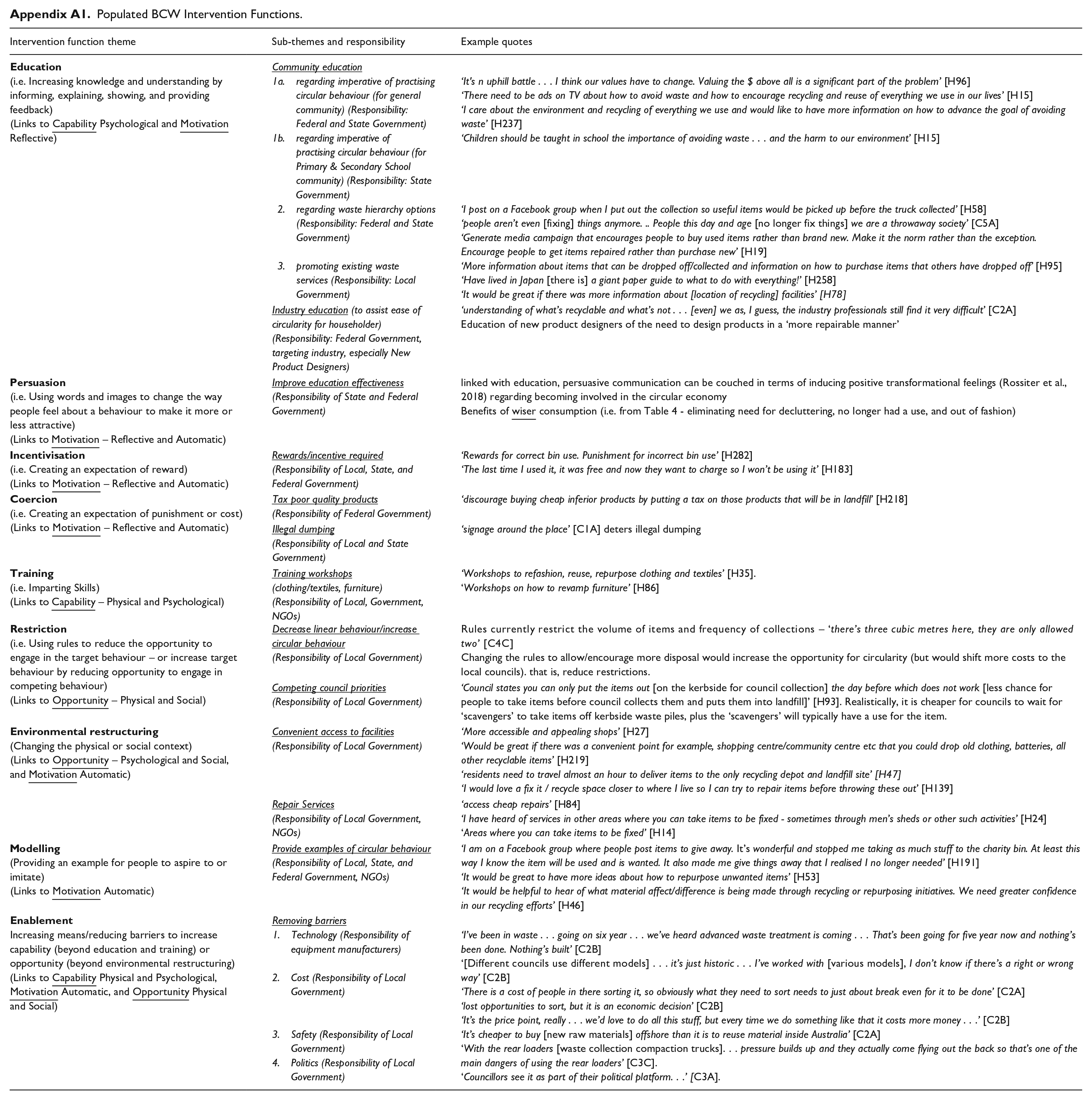
| Intervention function theme | Sub-themes and responsibility | Example quotes |
|---|---|---|
(i.e. Increasing knowledge and understanding by informing, explaining, showing, and providing feedback) (Links to |
Community education
1a. regarding imperative of practising circular behaviour (for general community) (Responsibility: Federal and State Government) 1b. regarding imperative of practising circular behaviour (for Primary & Secondary School community) (Responsibility: State Government) 2. regarding waste hierarchy options (Responsibility: Federal and State Government) 3. promoting existing waste services (Responsibility: Local Government) |
‘It's n uphill battle . . . I think our values have to change. Valuing the $ above all is a significant part of the problem’ [H96] ‘There need to be ads on TV about how to avoid waste and how to encourage recycling and reuse of everything we use in our lives’ [H15] ‘I care about the environment and recycling of everything we use and would like to have more information on how to advance the goal of avoiding waste’ [H237] ‘Children should be taught in school the importance of avoiding waste . . . and the harm to our environment’ [H15] ‘I post on a Facebook group when I put out the collection so useful items would be picked up before the truck collected’ [H58] ‘people aren’t even [fixing] things anymore. .. People this day and age [no longer fix things] we are a throwaway society’ [C5A] ‘Generate media campaign that encourages people to buy used items rather than brand new. Make it the norm rather than the exception. Encourage people to get items repaired rather than purchase new’ [H19] ‘More information about items that can be dropped off/collected and information on how to purchase items that others have dropped off’ [H95] ‘Have lived in Japan [there is] a giant paper guide to what to do with everything!’ [H258] ‘It would be great if there was more information about [location of recycling] facilities’ [H78] |
|
|
‘understanding of what’s recyclable and what’s not . . . [even] we as, I guess, the industry professionals still find it very difficult’ [C2A] |
|
|
|
linked with education, persuasive communication can be couched in terms of inducing positive transformational feelings (Rossiter et al., 2018) regarding becoming involved in the circular economy |
|
|
|
‘Rewards for correct bin use. Punishment for incorrect bin use’ [H282] |
|
|
|
‘discourage buying cheap inferior products by putting a tax on those products that will be in landfill’ [H218] | |
|
|
‘signage around the place’ [C1A] deters illegal dumping | |
|
|
‘Workshops to refashion, reuse, repurpose clothing and textiles’ [H35]. |
|
|
|
Rules currently restrict the volume of items and frequency of collections – ‘there’s three cubic metres here, they are only allowed two’ [C4C] |
|
|
|
‘Council states you can only put the items out [on the kerbside for council collection] the day before which does not work [less chance for people to take items before council collects them and puts them into landfill]’ [H93]. Realistically, it is cheaper for councils to wait for ‘scavengers’ to take items off kerbside waste piles, plus the ‘scavengers’ will typically have a use for the item. | |
|
|
‘More accessible and appealing shops’ [H27] |
|
|
|
‘access cheap repairs’ [H84] |
|
|
|
‘I am on a Facebook group where people post items to give away. It’s wonderful and stopped me taking as much stuff to the charity bin. At least this way I know the item will be used and is wanted. It also made me give things away that I realised I no longer needed’ [H191] |
|
|
|
‘I’ve been in waste . . . going on six year . . . we’ve heard advanced waste treatment is coming . . . That’s been going for five year now and nothing’s been done. Nothing’s built’ [C2B] |
Acknowledgements
The input from Dr Elyse Stanes (University of Wollongong) during primary data collection is acknowledged. The insightful comments from the anonymous reviewers is gratefully acknowledged, as is guidance from Professor Liliana Bove as a Guest Editor for the Special Issue.
Declaration of conflicting interests
The author declared no potential conflicts of interest with respect to the research, authorship, and/or publication of this article.
Funding
The author disclosed receipt of the following financial support for the research, authorship, and/or publication of this article: The research was supported via University of Wollongong – Global Challenges Seed Funding.
