



Abstract
Eco-anxiety and associated emotions are on the rise. International estimates range from 25–68% prevalence. Australians now regard climate change as their top concern for the future, with some young people reconsidering their intentions to become parents. The emotional sequela from climate change is becoming clearer. How it is conceptualised, responded to, and reinforced within public discourse requires further consideration. This paper presents a multi-method qualitative text and discourse analysis of Australian online news articles published in 2022 reporting on emotions and our ecological future. Drawing on sociological theories of emotions and Foucauldian conceptualisations of discourse, we present insights into the potency of emotions and discourses within online news media. We identify four differing conceptualisations of emotions, interpret what these discourses can do, and conclude with ways in which the public can reclaim agency in resisting discourses that engender passivity in the context of future ecological threats.
Introduction
Australians now regard climate change as their top concern for the future (Patrick et al., 2021), despite lagging on climate policy and support for such policies continuing to follow party lines (Colvin & Jotzo, 2021). Eco- or climate anxiety – and associated emotions of anger and helplessness – are growing. International studies estimate the prevalence to range from 25–68% (Pihkala, 2020), with recent data suggesting Australia is verging on a mental health crisis related to pre- and post-traumatic stress disorders associated with eco-anxiety (Patrick et al., 2023).
Affective entanglements with climate change are fundamental markers of our present situation and future trajectory. Emotions orient us towards past, present and future (Banham, in press; McKenzie, 2023), and are experienced viscerally and internally, while situating us within our social and environmental surroundings (Denzin, 1984). Through culturally informed understandings and labels of embodied sensations, emotions affect us, connecting us to each other and to culture. They are central to decision-making (Wettergren, 2019), with eco-anxiety implicated in growing trends of young Australians citing climate change in decisions not to reproduce (O'Shanassy, 2021). We use emotion and affect interchangeably in this paper to conceptualise emotion as a form of affect which has acquired a widely recognized, culturally informed label, and recognisable social dynamics (Ahmed, 2004, 2015).
Importantly, emotions can push us towards either social action or inaction (Jasper, 2018). In his book The Emotions of Protest, Jasper (2018) explicates the role of short-term emotions, moods, urges and longer-term moral emotions in propelling, sustaining and disrupting social movements in recent history. In the context of climate change, anxiety is positioned as particularly important because it has the potential to be both immobilising in the form of paralyzing panic and mobilizing in smaller, more manageable measures (Jasper, 2018, p. 40). Jasper goes as far as to position non-debilitating anxiety as central to sociopolitical action: ‘Without it, few would vote, protest, or engage in other political activities’ (Jasper, 2018, p. 40). He notes, too, how the media plays a role in amplifying or dampening anxieties, fostering embodied dis/engagement and climate activism as forms of political movement (Jasper, 2018, p. 41).
How we conceptualise the emotions connected with climate change in the public realm also matters. Beyond distinctions between emotions and affect, discursive conceptualisations of emotion mediate our decisions to act and the actions we take (Ajjawi et al., 2022). For example, media discourses that follow outdated mind–body dualist understandings in casting emotions as disruptive to reasoning might encourage readers to respond with distrust to eco-anxiety. Going further, if climate-related emotions are cast as harmful pathologies, this can prompt circumvention (Montgomery, 2008), with adults limiting their own and their children's exposure to media content that could evoke feelings of eco-anxiety.
Drawing on the work of Jasper (2018), McNaughton (2013) and others (e.g., Ahmed, 2004, 2015), this paper offers insights from a multi-method qualitative text and discourse analysis (MMQTDA) of Australian news articles published in 2022 reporting on emotions related to our ecological present and future. More specifically, it responds to the research question: What do differing media discourses of emotions and affect do in the context of climate anxiety reporting in Australia?
Background
To situate our analysis of news reporting of climate anxiety and related emotions, we elaborate on the work of Jasper (2018) and others who connect emotions to sociopolitical action, especially action related to climate change (see also Hurtado Hurtado, in press). We go on to theorise on the centrality of emotions and discourses on emotions to positioning and mediating their effects/affects.
Emotions and political action
Emotions imbue everyday life (Zembylas, 2003). Symbolic interactionists have long suggested that it is through emotions reflecting collective identities – so-called social or moral emotions – that we learn who and how to be (Mead, 2000). Emotions like pride and shame alert us to what is important in our social lives (Scheff, 1990, 2010), inform our ‘basic collective identities’, and ‘move us to action’ (Jasper, 2018, pp. 5, 14).
Political action is especially saturated with affect about past, present, and future. Importantly, affective entanglements with social movements are said to range in temporality and intensity from quick and in-the-moment ‘reflex emotions’ to more enduring ‘affective commitments’ and ‘moral emotions’, with the latter holding greater potential for enduring collective action (Jasper, 2018). Here we introduce key emotions implicated in the eruption, contour and successes or failures of social movements. Following Jasper (2018, p. 33), we present these emotions as interacting ‘assemblages of underlying feel-thinking processes’ inflecting sociopolitical action: collective anger, shame, anxiety and fear, pride and joy, hope and love (Collins, 2004, 2008; Jasper, 2018).
Anger
Anger, a complex, sometimes pleasurable, activating and outwardly focused emotion (Drummond, 2018), is positioned as primary to social movements (Holmes, 2004), heightening support for interventions and change (Jasper, 2018). It is said to be especially potent in the context of injustice and when it leads to a more enduring moral commitment: indignation (Jasper, 2018). In Jasper's words, ‘anger is a crucial motivation for protest. Without outrage over an injustice, without a villain to blame, there simply is no cause’ (Jasper, 2018, p. 46).
Shame
Shame, in contrast, can be demotivating to collective action, if it is directed inappropriately at others (i.e., externalised blame), rather than towards recognising the wrongness of our actions and attempting to change the action (more akin to guilt, see Tangney et al., 1996). Shame – a fundamental embodied tool of social control – involves feelings of unworthiness based in shared moral values. When converted to pride, however, through anger and indignation at another for their shameful actions, it can motivate social action (Jasper, 2018). Scheff (1990) draws attention to the interrelatedness of shame and anger. For example, when one experiences resentment, there is alternation between shame and anger, with anger being directed outwards. In contrast, within shame–anger sequences in the context of guilt, anger is directed inwards at the self.
Anxiety and fear
Anxiety, an ambient or background emotion (Barbalet, 2011), is capable of emotional impacts on individuals beyond their full consciousness. Fear, in contrast, is often theorised as a more basic, reflex emotion that is central to fight, flight and freeze responses (Turner, 2007). These two emotions are said to work together to inflect social movements. According to Jasper (2018), anxiety can form an enduring backdrop to higher intensity reflex emotions, such as paralysing and inwardly focused fear, which can promote a higher sense of risk and inaction. Or, at lower levels of intensity, it can prompt information-seeking and political action (Jasper, 2018).
Pride and joy
Pride is implicated in social movements through collective identities. When we engage in political action based on collective moral commitments, this leaves us feeling proud. Where participants also feel joy as a member of a collective, this spurs adoption of and action towards group goals (Collins, 2004; Jasper, 2018). As Collins (2004) explains, joy and happiness reinforce positive emotional energy, which can sustain engagement with a collective.
Hope and love
In contrast to hopelessness, despair and resignation, feeling confident and hopeful that action can lead to positive change is motivating. Paired with anger at another group, hope is particularly motivating (Jasper, 2018). Such emotions can become paired through ‘us and them’ dynamics, when love for one's group and place, underpinned by collective identification, is paired with hate for another group that transgresses that identification. This can intensify the potential for morally fuelled collective action: what Jasper refers to as a ‘powerful moral batter[y]’ (Jasper, 2018, p. 106).
Emotions and climate change
Unlike other social movements, the sociopolitical dynamics of climate-related emotions are not so clearly linked to an external enemy. Instead, in thinking about ourselves as part of a holistic world threatened by climate change, we ourselves are part of the problem, which leads to an emotional sequela that is said to be depleting and guilt-invoking. Jasper asserts: Acknowledging global warming… would entail unpleasant emotions that most people try to avoid: a feeling of helplessness; guilt over their own role in global warming; fear that their physical surroundings are no longer safe and dependable; and an unsettling threat to their own individual and collective identities. (Jasper, 2018, p. 95)
In these circumstances where there is no clearly defined external, primary enemy to direct anger towards, the lack of political action can leave us feeling resigned and devoid of hope. Jasper describes climate change's sociopolitical landscape as demotivating (Jasper, 2018, p. 95). Through shared weather events and climate anxiety, however, this affective landscape offers some potential for collective action.
Eco-anxiety is often defined as a distinct psychological experience that includes affective and behavioural symptoms, rumination and concern for the planet and one's impact on planetary health (Hogg et al., 2021). Along with anger, sadness, helplessness and guilt, children and adults worldwide are said to be experiencing heightened levels of climate-related anxiety (Hickman et al., 2021; Verlie, 2022), and strong feelings of powerlessness and dissatisfaction with government efforts to address climate change. Such anxiety, as noted above, can be mobilising at lower levels if it prompts further consideration, information seeking, and collective political identification and action.
The possibility for collective eco-anxiety in Australia, as in other parts of the world, is strong given the recent upsurge in weather-related disasters (e.g., bushfires and floods) (Maybery et al., 2020). Theories of collective emotions (Denzin, 1984; Von Scheve & Salmella, 2014) describe how emotions can take on socially collective properties via ‘the synchronous convergence in affective responding across individuals towards a specific event or object’ (Von Scheve & Ismer, 2013, p. 406). The collective nature of these weather-related experiences warrants further critical attention. Such events could prompt a collective form of anxiety with the potential to promote shared identities and ignite social action.
Emotional discourses
The potential for rallying collective emotional experience and action is, however, mediated by the discursive framings employed in the mass media. These framings shape ‘how we react to feeling-thinking processes’ with the news media constructing and amplifying emotions (Jasper, 2018, p. 5). Not only do emotions do things – attach to some bodies more easily than others, position, allow, constrain (Ahmed, 2004, 2015) – discourses of emotion generated by groups also do things. They shape expectations and scopes, reinforce hierarchies, and constrain or support relationality (Ajjawi et al., 2022; McNaughton, 2013; Olson et al., 2020).
In her Foucauldian discourse analysis of medical education textbooks, McNaughton (2013) found emotions to be framed within distinct discourses, with implications for who should practice medicine and how (Hekman, 1990). Others have built on these to postulate five relevant discourses for analysing emotions in texts:
Textbooks treating emotion as physiology predominated, drawing on outdated mind–body dualist conceptualisations of emotions as internal, universal and physical threats to objective clinical reasoning – something medical students need to get used to (McNaughton, 2013). Textbooks casting emotions as a skill – something to be managed and mastered in interactions with patients and staff (Hochschild, 1983) – were less prevalent (McNaughton, 2013). Within an emotion as socio-cultural mediator discourse, emotions are implicated in interactions and politics, reaching beyond individuals to reflect and permeate (organisational) cultures and moods. This discourse was least evident in medical texts (McNaughton, 2013). Recent applications of McNaughton's (2013) work have added a fourth discourse: emotion as pathology. It has many parallels to emotion as physiology, but draws from psychology in casting emotions as possible symptoms of disorders or ailments that can impede functioning (rather than reasoning) (Davies, 2015; Olson et al., 2020, 2022). Other applications have added a fifth discourse: emotion as reflexive practice. It draws from theorisation of emotion as central to reflexivity (Ajjawi et al., 2022). Emotional reflexivity scholars suggest that emotions are essential for reflecting on one's reflections about who and how to be (Brownlie, 2014; Holmes, 2010). This understanding of emotions has parallels to how emotions were understood in ancient Greece, as pathos: embodied sensations implicated relationally in persuasion and thus central to reasoning (Konstan, 2006).
In this paper, we draw on the aforementioned scholarship on emotional discourses (e.g., Ajjawi et al., 2022; McNaughton, 2013) to consider how the potentiality of emotions related to climate change are discursively moderated within Australian mass/print media. After presenting our methodology, in the section that follows, we provide our analysis of what differing discourses and implicit conceptualisations of emotions do in the context of our looming environmental crisis, with implications for how to foreground affect as we work towards climate justice.
Methods
To understand the breadth and detail of representations of ‘climate anxiety’ and related concepts and emotions, we searched Australian media – namely, online newspaper articles – using the Factiva database. We structured searches to remove identical duplicates from results and focus on reporting on climate change as a broad subject area. Given the environmental and political importance of 2022 in Australia – with catastrophic floods in March followed by a federal election in May – we restricted our search to publications in the Australian–New Zealand region between 1 January 2022 and 31 December 2022.
Searches were performed until no further unique results were returned (reflected in diminishing overall search result numbers after removal of duplicates from prior searches). In total, 381 initial results were returned from searches using terms including: ‘anxiety’ (153 results), ‘worry’ (147 results), ‘grief’ (42 results) and ‘climate anxiety’ (39 results).
Of the initial 381 results, preliminary screening was performed with a focus on overall relevance. During this preliminary screening phase, articles that comprised content duplicated via ‘syndication’ to smaller media outlets/papers were also removed. Following this preliminary screening, 55 articles remained, and preliminary coding of these 55 was then undertaken with a focus on emotions (including but not limited to grief, eco-grief, anxiety, eco-anxiety, distress, anger, generalised emotions, worry, concern, sadness, disillusionment/disappointment, frustration), or use of specific emotion-driven language around climate change. Subsequently, 22 articles were selected, representing the range of perspectives present (un/supportive of climate action, optimistic and pessimistic), media sources (metro/capital city vs non-metro/regional) and networks: from the famously conservative Murdoch-owned News Pty Ltd to the centre-left Fairfax Media (Muller, 2017). These articles were not just authored by journalists, but editors, members of the public, politicians and academics, often reflecting political interests and divisions on climate policy. A PRISMA-style methodology was utilised for the above, and the process and its results are captured in Figure 1 (Moher et al., 2009).
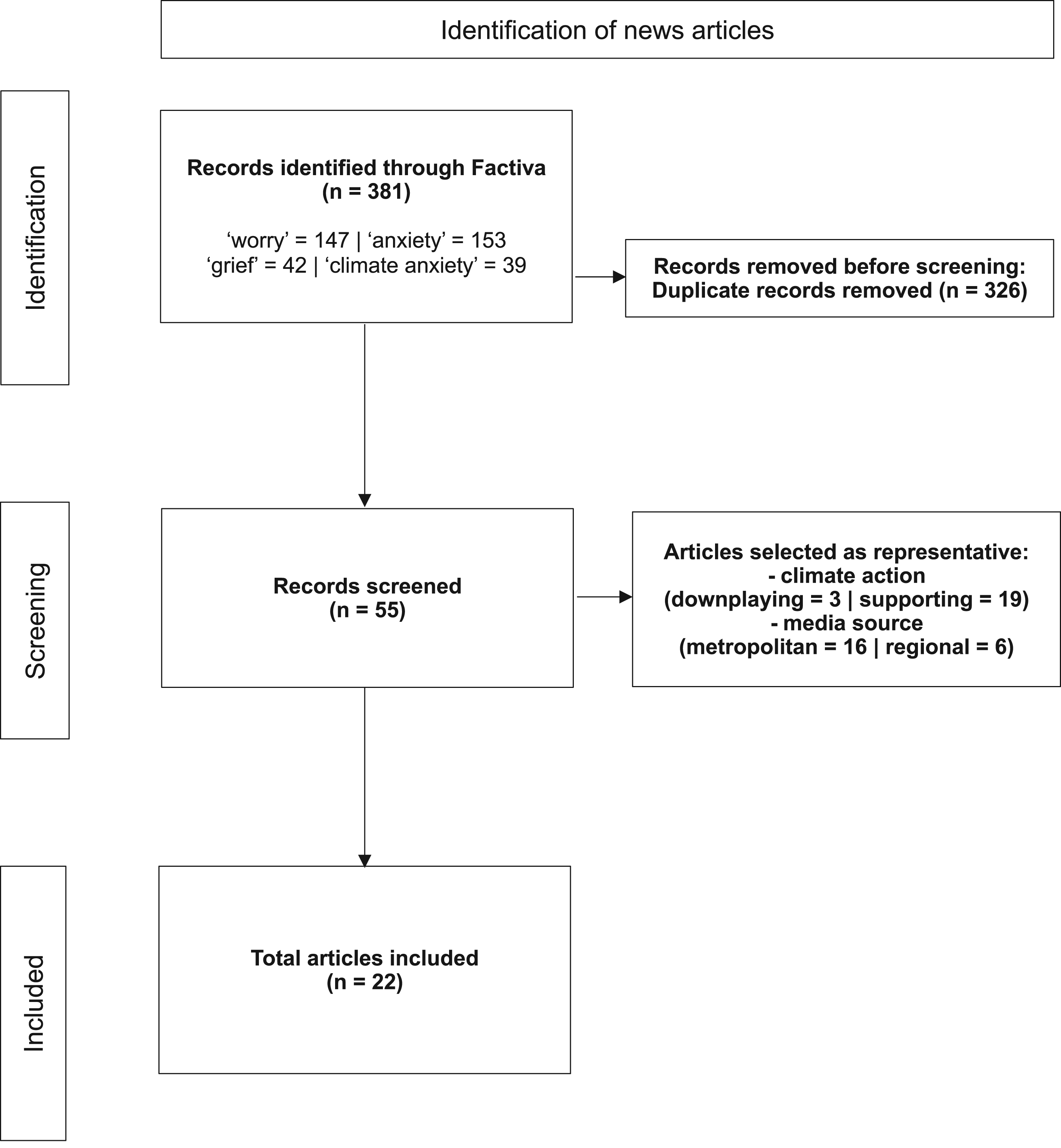
PRISMA flow chart (Moher et al., 2009).
Aligned with a post-paradigmatic approach to studying social emotions (Olson et al., 2020), and growing support for the use of analytic techniques from different qualitative traditions to produce a fuller understanding, we employed an MMQTDA, including content analysis, thematic analysis and Foucauldian discourse analysis (Alejandro & Zhao, 2023). Content analysis was performed first to foreground the emotions referenced within the articles, followed by a thematic analysis of inferred narratives (Pinnegar & Daynes, 2007), supported by NVivo (QSR International, 2023). Analysis then culminated in a Foucauldian discourse analysis. Following McNaughton (2013), we conceptualised emotions as historically and textually situated practices that work to form objects and identity positions. Our aim was problematisation: identifying naturalised, implicit emotion discourses, with the goal of disrupting taken-for-granted assumptions (Alejandro & Zhao, 2023). Specifically, we asked how the problem of climate change was framed, what discourses on emotions were employed, what these emotional discourses dis/allowed and the implications for how the future is governed. Through this process we extrapolated four emotional discourses, and drew on Jasper (2018) to analyse their potential effects. These insights are presented below, drawing on quotes from the news articles included in our study (page numbers are not included when quoting, as they are from online sources without pagination).
Findings
Content analysis
Most of the articles were from metropolitan (n = 12) and regional (n = 3) New South Wales – a significant majority of primary articles were published in New South Wales – with fewer from other states: Victoria (n = 3), Queensland (n = 2), South Australia (n = 1) and Tasmania (n = 1). In addition to worry, anxiety and grief – which were emotion terms within our search strategy – alarm, distress, anger, shame, betrayal and mania were co-located within the articles. Interestingly, hope was mentioned as much as grief and loss within included articles (see Figure 2).
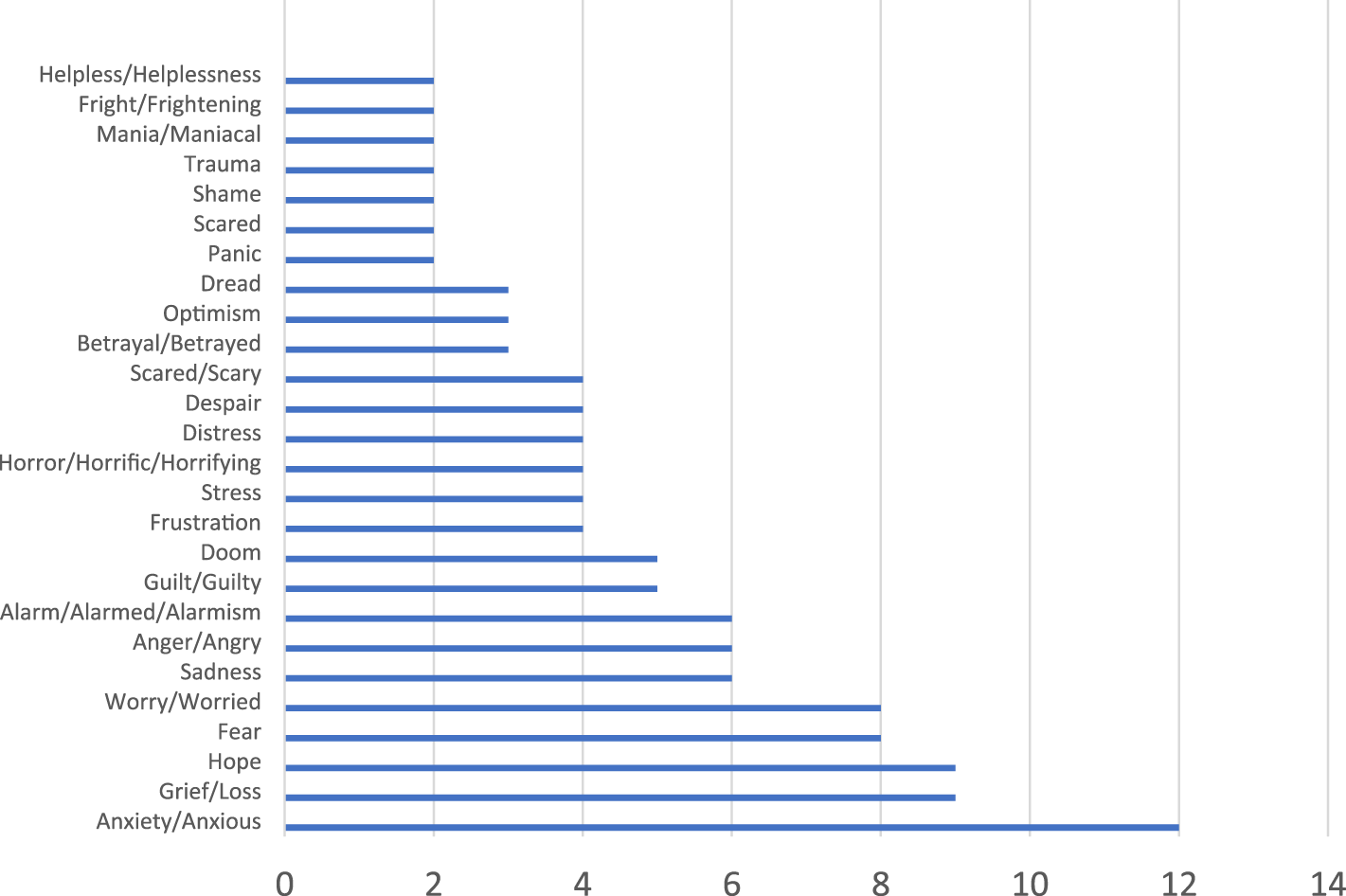
Emotions described at least two times across all included articles.
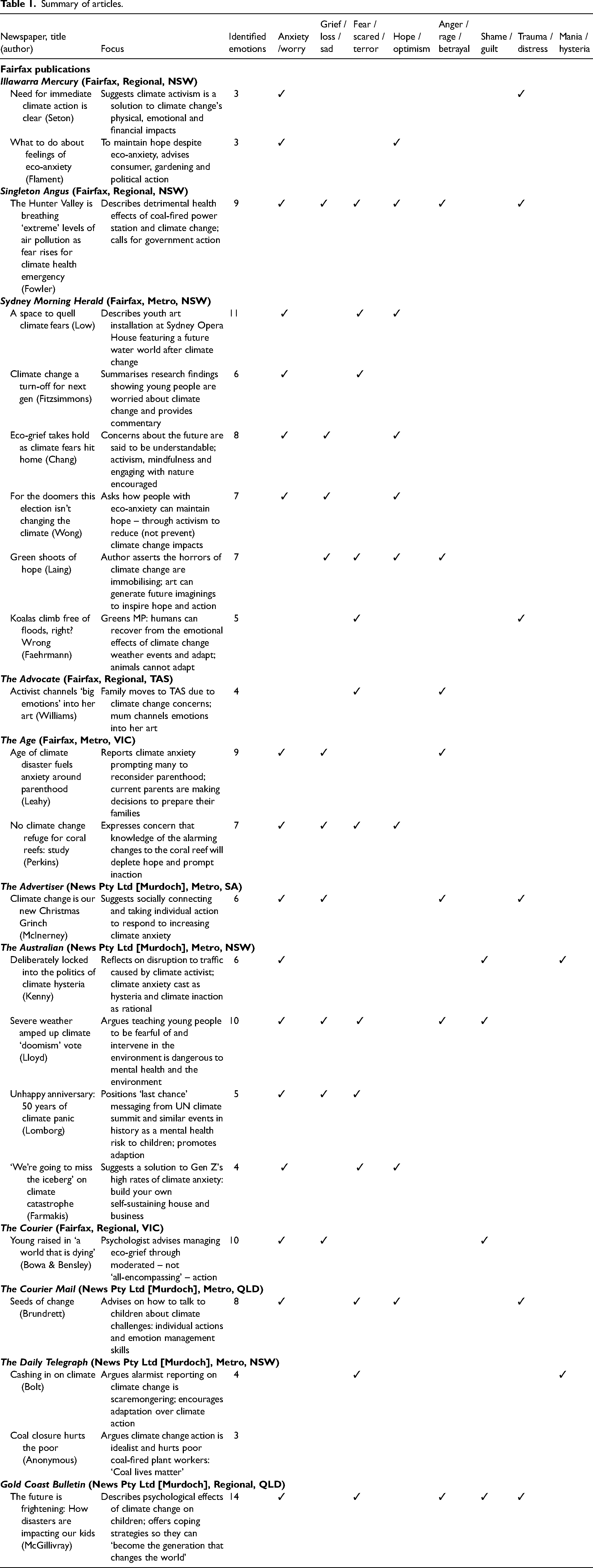
The included articles focused on a range of topics, from young people's concerns about the future (Brundrett, 2022; Farmakis, 2022; Fitzsimmons, 2022; Lloyd, 2022; Low, 2022; McGillivray, 2022; Seton, 2022) and reconsideration of parenthood (Leahy, 2022), to art as a useful emotional space for exploring and assuaging climate anxiety (Laing, 2022; Low, 2022; Williams, 2022), to disparaging assessments of climate activists (Kenny, 2022; Lloyd, 2022) and redirection towards climate adaption (Bolt, 2022; Lomborg, 2022). Many attended to what people can do to deal with overwhelming emotions related to climate anxiety, with advice ranging from stopping ‘dangerous’ (Kenny, 2022) ‘global warming hysterics’ (Bolt, 2022) to encouraging activism (Seton, 2022; Wong, 2022) and advising on (largely individually oriented) emotion management strategies (Bowa & Bensley, 2022; Brundrett, 2022; Chang & Ward, 2022; Farmakis, 2022; Flament, 2022; McGillivray, 2022; McInerney, 2022). Some positioned this emotional regulation as necessary to children's future climate activism: ‘we can guide our children to a place of hope and self-agency that will help them become the generation that changes the world’ (McGillivray, 2022). One noteworthy outlier included an article on how coal-fired plant workers will suffer due to climate change action to close plants, ending with a bold and problematic reappropriation that ‘Coal Lives Matter’ (Anonymous, 2022).
When we organised articles by media ownership (see Table 1) – Fairfax Media and News Pty Ltd – we saw a stronger presence of shame and hysteria in the Murdoch-owned News Pty Ltd, emotions that are fundamental to (patriarchal) social control (Guenther, 2023; Scheff, 1990).
Summary of articles.
Thematic analysis of narratives
Through our thematic analysis of the included news articles, we articulate three implicit narratives:
Emotions as an understandable response to climate change; Emotions as an extreme or politicised response to climate change; Emotions related to climate change as either problematic or helpful in their effects.
Within the latter, there was variation, with narratives ranging from climate anxiety as a pathology that we need to protect children from or find coping strategies for, to a prioritisation of emotions as necessary fuel for climate activism.
Articles positioning climate change-related emotions as understandable were found in both Fairfax (Bowa & Bensley, 2022; Chang & Ward, 2022; Fitzsimmons, 2022; Flament, 2022; Leahy, 2022; Seton, 2022; Williams, 2022) and News Pty Ltd (McGillivray, 2022; McInerney, 2022) publications. In these articles, climate anxiety and eco-grief are positioned as ‘natural’ given the ‘extreme weather’: For many, the devastating extreme weather of 2022 has left behind chronic uncertainty and an abundance of emotions. Images of locals desperately paddling through floodwaters appearing next to those of communities sheltering from extreme heat have become ubiquitous, but no less alarming… Climate anxiety is a growing concern among Aussies, which can lead to feelings of worry, upset, anger, sadness, and distress. (McInerney, 2022) Climate grief…. it was a natural response to an uncertain future but could present in different ways, including concern that Australia is becoming ‘far less’ habitable. ‘I think … the bushfires, the floods, and some of the disasters that have happened lately have brought it up to the forefront.’ (Bowa & Bensley, 2022)
Some adopting this narrative focused on wildlife and natural environments rather than people: One photo circulated on social media was of a saturated and terrified koala holding on for dear life to a wooden fence as floodwaters in the Lismore area raged around him. It's one of many distressing photos and videos to emerge of wildlife and livestock trapped, and most likely killed. It is beyond heartbreaking. (Faehrmann, 2022) It was scary and disturbing… I grew up with these dreams of wanting to make my contribution to science and conservation… and to see this happening before my eyes in my lifetime has been really, really upsetting. (Perkins, 2022)
Articles explicitly positioning climate change-related emotions as extreme or politicised were found almost exclusively within News Pty Ltd publications (Bolt, 2022; Kenny, 2022), but subtle references to the climate concerns and those concerned about the climate as ‘doomism’ (Lloyd, 2022) or ‘doomers’ (Wong, 2022) were found in Fairfax and News Pty Ltd publications. Overt denouncement of climate concerns disparaged climate anxiety and climate action as forms of ‘hysteria’ or ‘mania’: …it's time more people woke up, especially after millions of Australians just went gaga at this election for global warming hysterics demanding we ‘do something’ about global warming, and never mind the cost. (Bolt, 2022) When even our major party politicians talk about a ‘climate crisis’ and the fringe parties are ever more maniacal, we might expect radical action from young activists. You cannot deliberately spread hysteria and be surprised at hysterical responses. (Kenny, 2022)
Articles attending to the effects of climate-related emotions were more varied. Most articles employing this narrative cast climate anxiety as a mental health pathology or ‘threat’ for which we need coping strategies (Bowa & Bensley, 2022; Chang & Ward, 2022; McInerney, 2022), to protect children from (Lloyd, 2022; Lomborg, 2022) or to help children manage (Brundrett, 2022; Low, 2022; McGillivray, 2022). Young people should give themselves space to worry but also get on with life. Self care – nutrition, exercise, socialising, fostering support networks. (Bowa & Bensley, 2022) [C]limate combatants must consider the psychological damage being done by using the weather to undermine confidence and engender fear in the natural world. (Lloyd, 2022) [‘]When children go to school… they can hear about climate change… and that can be frightening and distressing,’ Burke says ‘…help your child process their thoughts and feelings and manage the strong feelings they might have.’ (Brundrett, 2022)
Others cast climate anxiety as a threat to (Laing, 2022; Williams, 2022) and/or fuel for climate activism (Fitzsimmons, 2022; Fowler, 2022; Perkins, 2022; Seton, 2022; Wong, 2022). …confused about the necessary responses…. Fear about the threats ahead…. Grief and despair at the enormous losses of mass extinction…. The combination is so emotionally and intellectually overwhelming that it causes a kind of shutdown or short-circuit…. despair is impeding us from acting. (Laing, 2022) The ‘doomers’… say they're struggling to live their lives knowing no one in power appears to care enough to fix the crisis. ‘The climate is really affecting me at the moment. I can't commit to anything, I can't figure out the correct way of doing things, I try to focus on other areas of my life but I can't’. (Wong, 2022) ‘I find my activism is fuelled by big emotions and it is difficult to find a place for those,’ she said. ‘It is important to honour the feelings of frustration and terror and use them as teachers and release them so when you move into action you can use them in a powerful way’. (Williams, 2022) You feel so much more hopeful when you are making change and you can see people making change around you. (Fitzsimmons, 2022)
Foucauldian discourse analysis
Finally, we plotted inferred emotional discourses against those discussed in our literature review from McNaughton and her contemporaries (Ajjawi et al., 2022; McNaughton, 2013; Olson et al., 2020, 2022), identifying four prominent discourses (see Table 2). It is important to note that many articles employed more than one emotional discourse.
Summary of findings on emotional discourses in online news reports.
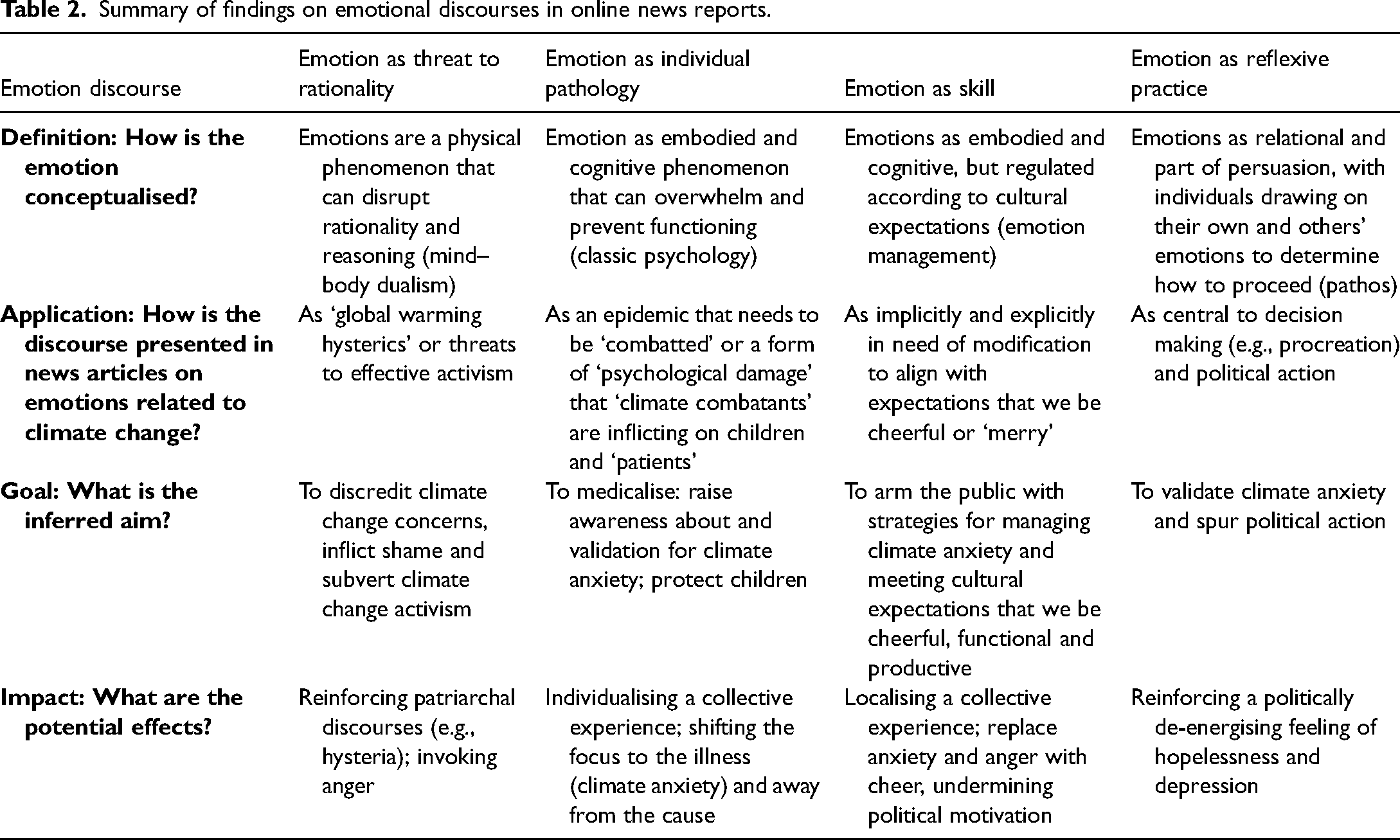
The first, emotion as threat to rationality, reflects early and reductionist mind–body dualist conceptualisations of emotion as a universal and physiological phenomenon that can undermine reasoning (McNaughton, 2013; Wettergren, 2019). This emotional discourse – which has been widely critiqued – was identified in only a few articles, and was found predominantly in articles from the Murdoch press positioning climate change emotions as a form of hysteria, mania or fear mongering (Bolt, 2022; Kenny, 2022; Lomborg, 2022) and a threat to reasonable (in)action and climate adaption. But it was also identified in one Fairfax article positioning ‘big’ emotions as problematic to activism: ‘You can’t be angry when you talk to a politician, are leading a protest march or when talking to others in the community’ (Williams, 2022).
The clear aim of articles invoking this discourse within the Murdoch media (c.f. Williams, 2022) was to position emotions related to climate change as unreasonable and climate action as shameful ‘idiocy and extremism’ (Kenny, 2022), casting the climate-concerned as incompetent and emotional, and the conservative elite as rational (Jasper, 2018). This reflects feminist scholarship that points to mind–body dualism's legacy in positioning the feminine as soft, embodied, irrational and untrustworthy (Guenther, 2023; Hekman, 1990). Yet, Jasper's (2018) work into emotions of protest suggests such positioning could also prompt anger and indignation in climate activists – emotions that are powerful in their capacity for outwardly oriented disruption.
The second discourse, emotion as individual pathology, reflects classic stimulus-response conceptualisations of emotions as cognitive and internal to the individual (Olson et al., 2020, 2022). Such conceptualisations are reflected in mid- to late-twentieth century treatment of emotions as symptoms of mental health disorders and threats to functioning (Davies, 2015). In employing this second emotional discourse, dominant in half of our sample, articles cast emotions related to climate change as a threat to ‘daily life and functioning’ (Lloyd, 2022). Readers with climate anxiety were instructed to ‘combat fears’ (Brundrett, 2022) and positioned as ‘patients’ (Bowa & Bensley, 2022). This was the only discourse employed by regional News Pty Ltd publications.
The inferred aim of articles employing this discourse was to medicalise climate anxiety and related emotions: ‘eco-grief’ and ‘climate distress’ (Fowler, 2022). These articles recast arguably everyday emotional experiences as mental illnesses in need of awareness-raising, validation and intervention (Conrad, 2007; Davies, 2015). The effects of such medicalisation, however, could undermine collective action by individualising a shared experience (Furedi, 2008), side-stepping the potential for collective identity and emotion-building (e.g., love) (Jasper, 2018) and shifting the focus towards the mental health concern and away from the cause: climate change and inaction.
The third discourse, emotion as skill, reflects understandings of emotion as embodied and cognitive, but modified in line with cultural expectations or feeling rules (McNaughton, 2013). Aligned with Hochschild's (1983) conceptualisation of emotion management, and less politically infused and relational (McKenzie et al., 2019) conceptualisations of emotion regulation (Gross, 1998), this discourse was implicitly invoked in almost a quarter of included articles through implicature regarding the benefits of ‘empowering optimism’ (Low, 2022) and suggestions on what individuals should do to be cheerful and ‘merry’ at Christmas (McInerney, 2022). A range of techniques were suggested, from ‘acceptance and mindfulness’ (Chang & Ward, 2022) to self-care, talk and gratitude (McGillivray, 2022).
The expressed aim of news articles using this discourse was to help adults and children cope, function in everyday life and meet cultural expectations of productivity and positivity. Yet, such an approach risks – as with the second discourse – individualising a collective phenomenon, circumventing the opportunities for collective identity and joy highlighted by Collins (2004). Furthermore, through promoting the management of climate-related emotions like anxiety and anger, it risks draining them of their political power. As Jasper (2018) asserts, low-to-moderate anxiety is necessary to social action. And anger, especially in its longer-term form, is positioned as one of the primary emotions of political action (Holmes, 2004).
The fourth discourse, emotion as reflexive practice, reflects contemporary modernist understandings of emotions as relational and interpersonal (Brownlie, 2014; Holmes, 2010), and ancient Greek conceptualisations of emotions as central to persuasion and decision-making (Konstan, 2006). This discourse was inferred in nearly half of the included articles, where climate anxiety and related emotions were described as something to be expected amongst ‘engaged and passionate’ young people (Fitzsimmons, 2022) and important drivers in decisions to take political action (Faehrmann, 2022; Seton, 2022) or personal action, such as decisions to not procreate (Leahy, 2022).
The clear aim of articles invoking this discourse was both to validate feelings of climate anxiety and draw on its affective momentum to spur political action. But, as Jasper (2018) and some of those interviewed in articles suggest, if the anxiety is too intense it can lead to paralysis, rather than political action. Dr Wachenfeld, a leading Great Barrier Marine Park Scientist, is quoted expressing this concern: The thing that worries me when there is severe impact to the Great Barrier Reef [is that] I always worry that people lose hope…. What the reef needs right now is the strongest possible action globally. (Perkins, 2022).
Discussion
Insights from our MMQTDA of online news reporting in Australia on climate change and related emotions about the future reveal important emotional dynamics at work. In addition to various topical concerns – future and parenthood apprehensions, industrial change, different activism stances, art and other emotion management strategies for anxiety – it suggests three key narratives are at play, from empathetic to critical (of activists). The first was of emotions presented as an understandable response to climate change, depicting anxiety as an expected response to extreme weather and climate disasters. The second was around the politicisation of emotional responses – especially within News Pty Ltd publications – whereby climate anxiety and associated activism was depicted as extreme, unwelcome and even hysterical. The third was around the effects of climate anxiety, with depictions ranging from a problematic pathology and threat to adult and child mental health, to a beneficial resource or ‘fuel’ for climate action.
Analysing the emotional discourses within Australia's mainstream online news reporting on climate change and emotions garnered further insight – of use to those wishing to foreground and reposition this discursive landscape. These discourses ranged from a dismissal of climate protesters as hysterical to a recognition of climate-anxiety as understandable and in need of action: coping strategies, emotion management, art and activism. Furthermore, we found the data fitted pre-existing emotional discourses (Ajjawi et al., 2022; McNaughton, 2013).
Some News Pty Ltd publications embraced mind–body dualism in casting emotions as a ‘maniacal’ (Kenny, 2022), extremist threat to reasonable, conservative consideration – reflecting patriarchal emotions discourses that position some as more rational than others (Ahmed, 2015; Hekman, 1990). This insight suggests a certain hypocritical irony in the way News Ltd press cast the debates as overly emotional and ‘hysterical’ by use of evocative, emotive language and titles. What's more, they suggest that ‘hysterical’ emotions must be regulated by ‘rational’ thinking, but rationality in this context is a mere euphemism for inaction whereby ‘Delay is the new denial’ (Shue, 2022, p. 2). Ultimately, this discourse can be seen to be employing deflationary tactics aimed at derailing collective experiences of pride and elation from doing ‘good’ in the context of climate activism, but has the potential to backfire if it instead ignites collective anger (Jasper, 2018).
It was not only those news articles embracing mind–body dualism that positioned climate anxiety and related emotions as individual problems. Three of the four identified discourses reinforce an individualistic conceptualisation of emotions related to climate change, with pathologisation the discourse most invoked. Most publications tended to pathologise climate anxiety, shifting focus away from collective action towards its treatment as an individualised psychological condition. In a similar vein, several papers focused on the emotional ‘skills’ and techniques required to manage climate anxiety and stay positive, but with the possible side effect of eroding the collective emotional energy necessary for social action (Collins, 2004, 2008). The final discourse followed the reflexive turn, a discursive outlier in recognising the relational importance of emotions to engagement and shared action (Holmes, 2004, 2010). This last discourse has the most potential to activate political action, but care must be taken to reinforce mobilising and not paralysing collective climate anxiety (Jasper, 2018).
Such insights raise avenues for future research, suggesting it would be useful to examine whether the emotional narrative perpetrated by each press is a by-product of the conservative/progressive ethos of the paper, or whether they are being deliberately instigated by editors and media owners driving a particular agenda through widespread manipulation of collective emotions. Future endeavours could also focus on the role of social rather than mass media in shaping affective and emotional responses to climate change, and whether social media generally ‘megaphones’ mass media emotional messaging or aids in reflexively interpreting it.
Conclusion
Overall, our analysis shows that Australians are experiencing feelings of despair and inaction as they face an anxious present about an uncertain future. Although the role of these online news articles in shaping the broader climate discourse can be contested based on the waning impact of mainstream media, the messaging in this media format can be said to interact with Australia's emotional climate. Jasper (2018, p. 80) notes that ‘Moods are about energy, and nothing is more central to voluntary action than energy levels’. In a period of frequent protests such as the ‘School Strike 4 Climate’ and Extinction Rebellion disruptions, the presentation of climate emotions in the media has the potential to shift the emotional energy needle from activating hope to deflated despair.
Needed now are strategic and collective emotional responses, through our news media and key community organisations, that promote shared skills of both anger and hope; ‘combinations like anger and hope…motivate action’ (Jasper, 2018, p. 99) and tap into the ‘powerful moral batteries’ of fear paired with (in)security (Jasper, 2018, p. 106). This challenge demands more than medicalisation of such emotions, more than individualistic and localised strategies for managing climate anxiety and complying with narrow expectations of cheer (Setchell et al., 2019). The causes and consequences of climate change are complex and far reaching; our affective engagement with these changes needs to match this level of nuance. Individualised climate narratives are unlikely to spur protest, group identity or responsible action (Jasper, 2018). Rather, they default to feelings of isolation, despair, anxiety and hopelessness. As publics, parents and politicians work to reclaim agency in the context of present and future ecological threats, collective forms of emotional agency are essential to effective climate action.
Footnotes
Declaration of conflicting interests
The author(s) declared no potential conflicts of interest with respect to the research, authorship, and/or publication of this article.
Funding
The authors received no financial support for the research, authorship, and/or publication of this article.
