



Abstract
We examined the latest decade of Australian sociology PhD completions for differences in the number and quality of research outputs students published during doctoral enrolment. There was no evidence of a statistically significant difference between Go8 PhD students and their non-Go8 PhD counterparts in terms of either the quantity of research publications achieved, or the quality of these publications as measured by high-impact journals. There was also insufficient evidence statistically to conclude that Go8 men and Go8 women differed from one another, or that non-Go8 men and non-Go8 women differed from one another in overall quantity of outputs and publishing in high-impact journals. However, publishing success of men and women, when combined, regardless of whether they were at elite Go8 or non-Go8 institutions, showed gender had a marginally significant effect on publication productivity, men outperforming women, in both publication counts and in publishing in high-impact journals.
Keywords
Introduction
Are the often-claimed differences between Australia's elite Group of Eight (Go8) universities and other non-Go8 institutions evident at the doctoral level? More specifically, is student production of refereed outputs during enrolment in a PhD, greater in number or of better quality at Go8 universities than the non-Go8s? The Go8 institutions are generally larger, more famous, higher ranked, better resourced financially, and lead in research intensity, excellence and funding from industry (Norton, 2016). Their longer institutional histories accumulate bequests and scholarships. They attract highly capable staff and students at all levels from within Australia and internationally (Go8, 2022).
University systems in many countries reflect, or affirm, a hierarchical order of prestige and purported excellence ranging from elite universities to less well-known institutions (Gallagher, 2011). In the United Kingdom, Oxford and Cambridge, and Russell Group universities, occupy this position relative to most other universities. In the United States the group of Ivy League and R1 research-intensive universities occupy the elite end of the spectrum. China's C9 university cluster comprises the lead institutions there, along with 33 ‘Double First-Class’ universities positioned for world ranking (Allen, 2017; Marginson, 2007).
In this article we have extended our data collection to a larger set than previously studied. We have also shifted our focus of inquiry from our earlier investigation of men and women's publishing practices during their PhDs based on a five-year time period 2013–17 (Rajčan & Burns, 2021). That article focused on production of refereed research outputs by sociology PhD candidates at elite Australian Go8 universities. The present investigation has doubled the length of time under investigation to the full decade 2010–19. At the same time, the universities included now go beyond the sub-sample of elite Go8 universities to include all Australian universities producing sociology PhDs. As in the previous article the focus is on completed sociology PhDs in sociology departments or iterations of these in interdisciplinary schools of social sciences. We have widened our focus to publishing in high-impact journals in addition to counting the number of refereed outputs students achieved during their PhD enrolment.
This PhD dataset offers a current view of the emerging sociology academic, policy, and research workforces in Australia today. The study also has implications for PhD-awarding institutions. In career terms, processes that are actively in play in this doctoral cohort include cumulative advantage (Merton, 1988), and early research productivity as a predictor of later and overall research productivity (Horta & Santos, 2015; Pinheiro et al., 2012).
With the additional data that has been collected, the present article focuses on the claim, sometimes implied but often explicit, that is made by or on behalf of the cluster of public elite Go8 universities located in the State metropolitan centres around Australia. This claim is that these institutions are superior to other universities on most if not all measures, as well as in an overall sense of academic excellence compared to the non-Go8 Australian universities located in a mix of metropolitan and non-metropolitan cities and regions (Carroll et al., 2019). In this study we forgo the complexity of weighting differing measures of productivity and excellence across disciplines and academic levels – always a difficult and inexact science even before rhetoric enters the conversation. Instead, we concentrate on the emerging cohort of new academics and researchers in a single discipline, sociology.
Australian Go8 and non-Go8: difference in status and rankings
Within the neoliberal context of market competition for funding to supplement the decreasing government funding of universities, prior market position has influenced their future market position (Brown, 2010). The oldest and most established Australian universities have been able to mobilise their prestige and other resources in competition with other newer and less established universities. Their higher status, resources and research capacities gave them a head start in competition with the rest of the sector. Or in Marginson's phrase (2019, p. 281), ‘In higher education the race is mostly won by those who start at the front row of the grid.’
Eight of the ten oldest Australian universities came to constitute the elite Group of Eight (Go8). These are the University of Sydney, the University of Melbourne, the University of Adelaide, the University of Queensland, the University of Western Australia, the Australian National University, the University of New South Wales, and Monash University (Gallagher, 2011). These institutions were in an advantaged position when the Australian higher education sector changed gear to a more competitive model as the result of the Dawkins reforms (Harman, 2005). Two of the ten oldest universities, the University of Tasmania and the University of New England, were situated in peripheral locations and did not have the advantage of metropolitan populations to expand their size and research intensity like the other oldest universities (Ingram, 2023; Marginson & Considine, 2000). Approximately a decade after the Dawkins reforms in the late 1990s these highest performing eight universities organised themselves into the so-called ‘Group of Eight’ universities (https://go8.edu.au/about/the-go8).
The Go8 institutions are focused on attracting the brightest and most capable students and ‘world-leading’ academic staff and researchers. Marginson (2019, p. 281) stated that in 2014, in the middle of the decade that we are reporting on here, ‘these eight universities had a quarter of university student load but received 71.3 percent of research funds distributed by merit and published most of the high citation papers’ for Australia. In addition, at the doctoral level the Go8 ‘awards almost half of all research doctorates in Australia’ (Go8, 2022). Marginson (2009, p. 237) also observed that ‘on most indicators of resources and performance, especially research-related areas, there is a significant gap between the Go8 [and other Australian universities]’.
In 2019, ‘The Academic Ranking of World Universities (ARWU) results – which focuses on research performance – has seven of the Group of Eight (Go8) members in the world's top 100’. Vicki Thomson, Go8 Chief Executive, says: ‘The ARWU are considered the world's most prestigious rankings…. While the Go8 rankings are strong, they belie the real strength of the universities as the engine room of research productivity with its world-leading researchers judged by the impact of their work, and publication rate’ (Go8, 2019).
Discursively the Go8 universities position themselves as the preferred university destinations for both domestic and international students. In its document called ‘Facts of Distinction’, the Go8 explicitly advances its collective elite status claims as ‘Australia's world-leading research-intensive universities, a premier group which prides itself on being elite, but not elitist’ (Go8, 2022, p. 3). In a country with a strong egalitarian ethos this claim can be read as saying several things in negotiating Go8 elite claims relative to other universities in the higher education sector. Not only is this statement speaking to fee-paying international students and Australia's middle-upper class, it addresses the government's desire for human capital development and Australia's competitiveness in the global knowledge economy through research and innovation (de Wit & Adams, 2013).
In the decade for which data is presented in this article, the Go8 universities have been consistently the highest ranked in Australia in the three most commonly used global university rankings, ARWU, Times Higher Education (THE), and Quacquarelli Symonds (QS) World University Rankings (Go8, 2022). All eight institutions of the Go8 are ranked in all these global rankings in the top 150 universities worldwide and seven are placed in the top 100. In 2019, 33 Australian universities were ranked in ARWU and the 25 non-Go8 universities were stratified in the rankings from 201–300 and then spread through successive tiers to just above 1000 (ARWU, 2019). As a different measure of status and research intensity, the Australian national research Excellence in Research in Australia (ERA) measures the quality of research outputs by discipline produced at Australian universities against ‘world standard’ on a low-to-high scale from 1 to 5. In the latest ERA round in 2018, Go8 universities, out of all Australian universities, had the largest proportion of research fields ranked at the highest levels: 4 ‘above world standard’ and 5 ‘well above world standard’ (Go8, 2022).
The elite status of the Go8 can be seen in the QS rankings by discipline to also reflect the premier ranking of sociology in these institutions. Measured across this decade, the QS World University Rankings for sociology show that five of the Go8 institutions (Australian National University, the University of Sydney, Monash University, Melbourne University and the University of Queensland) ranked consistently within the global top 50. Across all Australia another half dozen non-Go8 universities were placed within the top 100 for sociology for one or more years during 2010–19, though not consistently for a longer period. Only one non-Go8 institution, La Trobe University, was placed in the top 50, but only for 2013 (QS Top Universities, 2019). The Australian ERA rankings for sociology also show the advantage of the Go8 institutions; that is, at the start of the 2010s Go8 universities’ sociology output was ranked on average at 3 ‘World Standard’ in contrast to non-Go8 sociology universities being ranked at 2 ‘Below World Standard’. A decade later, by the end of the 2010s the Go8 sociology was ranked on average at 4 ‘Above World Standard’ whereas non-Go8 sociology was ranked at 3 ‘World Standard’ (Burns & Rajčan, 2021, p. 8).
University type and publishing
The present study looks at publishing in Australian sociology by university type, examining publishing by PhD students during their candidacy. The most common distinction of university status in Australia is that between the Go8 and other universities (non-Go8) as described above. When looking at the discipline of sociology in the United States, sociologists from elite sociology departments publish more refereed articles on average than academics from other non-elite sociology departments (Wilder & Walters, 2020). Further, the gap in publishing between sociologists from elite departments and non-elite departments is most significant in terms of publishing in high-impact journal outlets such as sociology flagship journals.
Various studies such as Perrucci et al. (2019) or Keith et al. (2002) conclude that the likelihood of achieving publications in United States sociology flagship journals is directly associated with universities’ sociology departmental rankings; that is, whether one is a member of an elite department or not. Weeber (2006) established that sociologists from the elite departments accounted for more than half of all outputs published in the three highest ranked United States sociology journals. Headworth and Freese (2016) showed that the difference in terms of high-impact publishing between the elite sociology departments and other departments was also mirrored at the PhD level; that is, PhDs from the elite departments published a disproportionately higher number of outputs in the key sociology journals and other high-impact outlets compared to PhD students from other non-elite sociology departments.
None of the studies in the Australian setting investigated the differences in research productivity between Go8 and non-Go8 sociology staff or PhD students. A recent study focused on Australian psychology researchers found that Go8 psychology academics outperformed non-Go8 psychology staff both in terms of the overall number of outputs and in publishing in highly ranked journals (Craig et al., 2021). A number of explanations have been put forward in accounting for these differences in research productivity, as well as research productivity in high-impact outlets between elite and non-elite institutions, including the following: disparities in research environment, which may manifest in differences in financial support for research; higher emphasis on research and publishing (especially in high ranked outlets); ability to attract staff and PhD students of high calibre; networking with government and commercial sectors; and social class habitus and related family social capital (Arnado, 2023; Wilder & Walters, 2020).
Gender and publishing
A key variable of interest in this study, in addition to university type, is what effect the gender of candidates has on their research productivity during PhD enrolment (Blackmore, 2014; Morley, 2005). Numerous studies have reported a research productivity gap between men and women academics. Is that true today, for Australian sociology PhD students? In various fields of research men academics tend to achieve on average a greater number of refereed research outputs than women, including in the high-impact journals category (Bentley, 2012; Breuning & Sanders, 2007; Mayer & Rathmann, 2018; Sugimoto et al., 2013). For instance, in the United States, men sociologists achieved on average around 50% more articles and book chapters than women sociologists. Further, men also outproduced women in the high-impact publishing category by achieving at least 35% more outputs in United States sociology flagship journals (Keith et al. 2002; Stack, 2002).
Wilder and Walters’ (2020) study of publishing practices of sociology academics found that men outperformed women in United States elite sociology departments, but that women outperformed men at most other institution types, except R1 research-intensive universities, where they published at the same rate as men. They also noted under-representation of women sociologists compared to men at elite sociology departments compared to non-elite departments. In terms of PhD students publishing, a study by the American Sociological Association found that women PhDs reported receiving lower levels of support in publishing during their PhD enrolment (ASA, 2004). In Australia, Dever et al. (2008) found similarly that women PhD students reported receiving significantly less support in activities relevant to the academic career progression such as publishing, presenting at conferences and applying for research funding. Some recent studies on PhD student publishing documented women achieving less outputs than men (e.g. Lindahl et al., 2021), while others reported no gender differentials in publishing (Rajčan & Burns, 2021; Shen & Jiang, 2021).
Australian universities have shared an international push for a fairer gender distribution among the academic workforce (Lafferty & Fleming, 2000, p. 262). Between 2008 to 2017 universities were hiring on average 1.4 women academics for every man, which has led to an overall increase in the proportion of women academics over the ten-year period, from 42.3% to 45.5% (Larkins, 2018). Despite these efforts to re-gender the academic workforce, the gap between men and women academics still remains large at more senior levels (Bönisch-Brednich & White, 2021; Larkins, 2018). In contrast to this general higher education pattern, for many decades Australian sociology has had a higher proportion of women PhDs, as well as women academics, in its workforce. Here too, however, it is only more recently that more women have been appointed in greater numbers to senior levels. A number of reasons have been put forward to explain the gap between men's and women's research productivity. These include: women spending more time on administration and teaching duties; in some instances, women being clustered in less intensive research universities; how women are positioned in the academic division of labour, in research specialities, in working part-time, or having career gaps; less involvement in academic networks and sometimes hostile, chilly, or less supportive working environments (Aiston & Jung, 2015; Dever et al., 2008; Fahmy & Young, 2017).
Method
The results reported here are based on a full-decade cohort of sociology PhDs completed across Australian universities, 2010–19, within the primary sociology homes in each university. As part of constant restructuring in the Australian university sector the tendency over the last two decades has been for sociology, along with other disciplines, to be subsumed into larger interdisciplinary schools, rather than remaining as stand-alone sociology departments, becoming sociology ‘disciplines’ or ‘programmes’ within these larger units. For the most part these were staffed by academics who were officially labelled as sociologists and provided the main teaching workforce for sociology at these institutions. Most PhDs categorised as sociology could be expected to be completed within these sociology units.
To analyse differences in publishing practices of Australian sociology PhDs by university type (Go8 versus non-Go8) and gender, the data collection of research outputs during doctoral enrolment went through three stages: first, identifying completed sociology PhDs; second, finding refereed outputs that students achieved during enrolment; third, matching journal articles with information about journal rankings.
Stage 1: Establishing completed sociology PhDs 2010–19
This involved re-checking our dataset for 2013–17 for Australian Go8 sociology PhDs (n = 173) reported in this journal (Rajčan & Burns, 2021), then expanding the dataset in two directions: to cover the full-decade period, 2010–19 and to include sociology PhDs from both Go8 and non-Go8 universities (n = 623). In the re-checking process of our previous study it was gratifying to see that very little amendment was needed in the updated information on those already completed PhDs.
When looking at completed PhDs for a particular university against Field of Research codes (FoR), we identified theses coded as Sociology Field of Research (FoR) 1608 in each university's primary sociology teaching unit (ABS, 2008). There were, however, many additional theses partially coded as FoR 1608 completed in schools and departments across the university, such as education, business, health, and environment (Rajčan & Burns, 2021). Focusing only on theses from the primary sociology units allowed the research to avoid over-including theses with undoubted sociological substance but potentially different disciplinary focus. Further, we found that inconsistent FoR coding by the individual universities of completed theses by discipline between universities was compounded by technological changes, making it a difficult task to find completed theses and their disciplinary classification or coding, even with valuable research librarian assistance (Rajčan & Burns, 2023).
To locate sociology PhDs that were completed in sociology organisational units we used publicly available data from several sources. Ethics approval was granted by the university to conduct this study. First, university library catalogues and institutional repositories were searched to create a list of sociology PhD completions. Second, current and historical versions of sociology organisational unit web pages were searched to identify sociology PhD completions. TROVE (https://trove.nla.gov.au), an archival database, provided historical versions of Australian university websites that in some cases included data on completed PhDs. Third, university administrators, librarians and academics were consulted for their institutional knowledge.
Stage 2: Establishing the number of refereed outputs that sociology PhDs achieved during enrolment
Once we had gathered data on completed sociology PhDs for the whole decade, 2010–19, we then moved to the second stage of our data collection process, which consisted of gathering data on outputs that this set of PhDs achieved during their candidature. We followed the practice used by other researchers of including refereed journal articles and book chapters, but excluding a variety of other research outputs achieved by students, such as editorials, book reviews, and conference papers (Laurance et al., 2013; Lindahl et al., 2021). The rationale for inclusion was that within the contemporary imperative to publish, journal articles in particular are regarded as the ‘gold standard’ for institutional metrics and individual careers (Roksa et al., 2022). We also followed other researchers’ conventions in classifying refereed articles and book chapters as being produced during candidacy if they were published within one year after thesis submission to recognise the delay between submission and publication (Horta & Santos, 2015; Pinheiro et al., 2012).
Information on students’ research outputs during their PhD enrolment was gathered from a wide range of sources. After inspecting students' completed theses for possible information about their refereed outputs, other sources included using various research databases such as Scopus, Web of Science and GoogleScholar; academic social media profiles such as ResearchGate; and other databases such as ORCID. This breadth of information sources overcame the limitations of using a single database such as Scopus. We were able to compile a comprehensive list of research outputs for each student in our dataset. Personal pronouns, names, and other biographical information used in theses and other sources, such as biographical notes in publications, were used to categorise the gender of PhD completers. A caveat is that only one student identified as gender diverse, a likely under-representation.
Stage 3: Matching journal articles with information about journal rankings
After collecting data on refereed outputs that PhD students achieved during their enrolment, we located information on journal rankings for journals in which students published their work, to enable us to classify articles published in high-impact journals. To assess whether there is a difference in terms of publishing in high-impact journals between PhD students from Go8 and non-Go8 universities, and between genders, we adopted the international SCImago journal quartile ranking (https://www.scimagojr.com/).
SCImago rankings divide journals into four quartiles, Q1 being the highest ranking and Q4 being the lowest ranking based on Scimago Journal Rank indicator (SJR). This indicator ‘takes into account both the number of citations received by a journal and the importance or prestige of the journals where such citations come from’ (Mauleón et al., 2013, p. 93). We treated outputs published in SCImago Q1 journals as an indicator of high-quality publishing.
Our investigation of PhD students’ publishing considered, first, all outputs (meaning all refereed journal articles and book chapters combined) and, second, outputs in high-impact refereed journals, operationalised as articles in Q1 journals. By applying the Q1 quality measure to the data on completed sociology PhDs’ outputs from primary sociology homes at Australian universities (2010–19), we were able to ask the following questions:
Question 1: Have students from elite Australian Go8 universities outperformed students from non-elite Australian universities in terms of the number and quality of refereed outputs achieved during PhD enrolment? Question 2: Have men outperformed women in terms of the number and quality of refereed outputs achieved during PhD enrolment? Question 3: Have Go8 men outperformed Go8 women in terms of the number and quality of refereed outputs achieved during PhD enrolment? Question 4: Have non-Go8 men outperformed non-Go8 women in terms of the number and quality of refereed outputs achieved during PhD enrolment?
Results
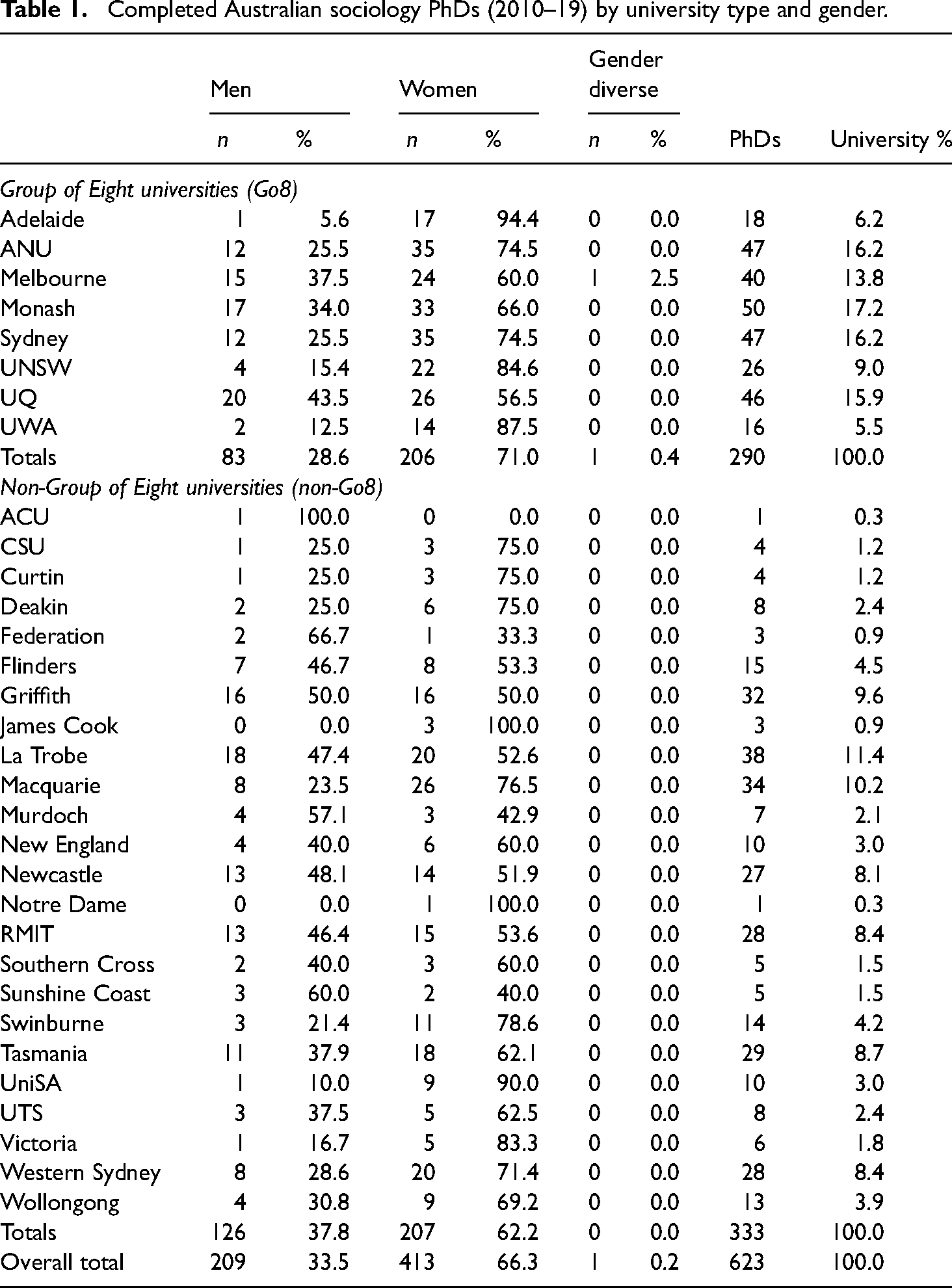
A full cohort of 623 sociology PhDs were completed in the main sociology organisational units at Australian universities during the latest decade (2010–19), an average 62.3 PhD completions per year (Table 1). There has been a trend upwards over the 2010–19 decade in terms of the number of sociology PhD completions. In the 2010–14 time period there were 251 sociology PhD completions, and from 2015–19 there were 372 sociology PhD completions, an increase of 48.2%. Overall, thesis completions were spread between elite Go8 universities (n = 290, 46.6%) and slightly more than half at non-Go8 universities (n = 333, 53.4%). The highest number of PhD completions at Go8 institutions were at Monash University, the University of Sydney, Australian National University, and the University of Queensland. At non-Go8 institutions the largest number of PhD completions were at La Trobe University, Macquarie University, Griffith University, and the University of Tasmania. The sociology PhD cohort was highly feminised, composed of two-thirds women (66.3%) and one-third men (33.5%). This pattern was broadly similar at both Go8 and non-Go8 universities, with Go8 universities having a slightly higher proportion of women (71.4%), compared to non-Go8 universities (62.2%). We identified one gender diverse student in the study.
Completed Australian sociology PhDs (2010–19) by university type and gender.
University type and gender publishing patterns
PhD students’ production of refereed articles and book chapters ranged between 0 and 21 outputs during enrolment per student (Figure 1). A high proportion of students (n = 373, 59.9%) published at least one refereed article or a book chapter. In contrast 250 (40.1%) did not achieve any outputs. This finding is similar to the New Zealand situation, where more than half (55.8%) of sociology PhD students published at least one refereed output during candidacy (Rajčan & Burns, 2022). In total, students produced 1,078 refereed outputs. This represented a mean of 1.73 outputs across all students, including those who published and those who did not (mean = 2.9 outputs for students who did publish). The research outputs consisted of 820 (76.0%) journal articles and 258 (24.0%) book chapters.
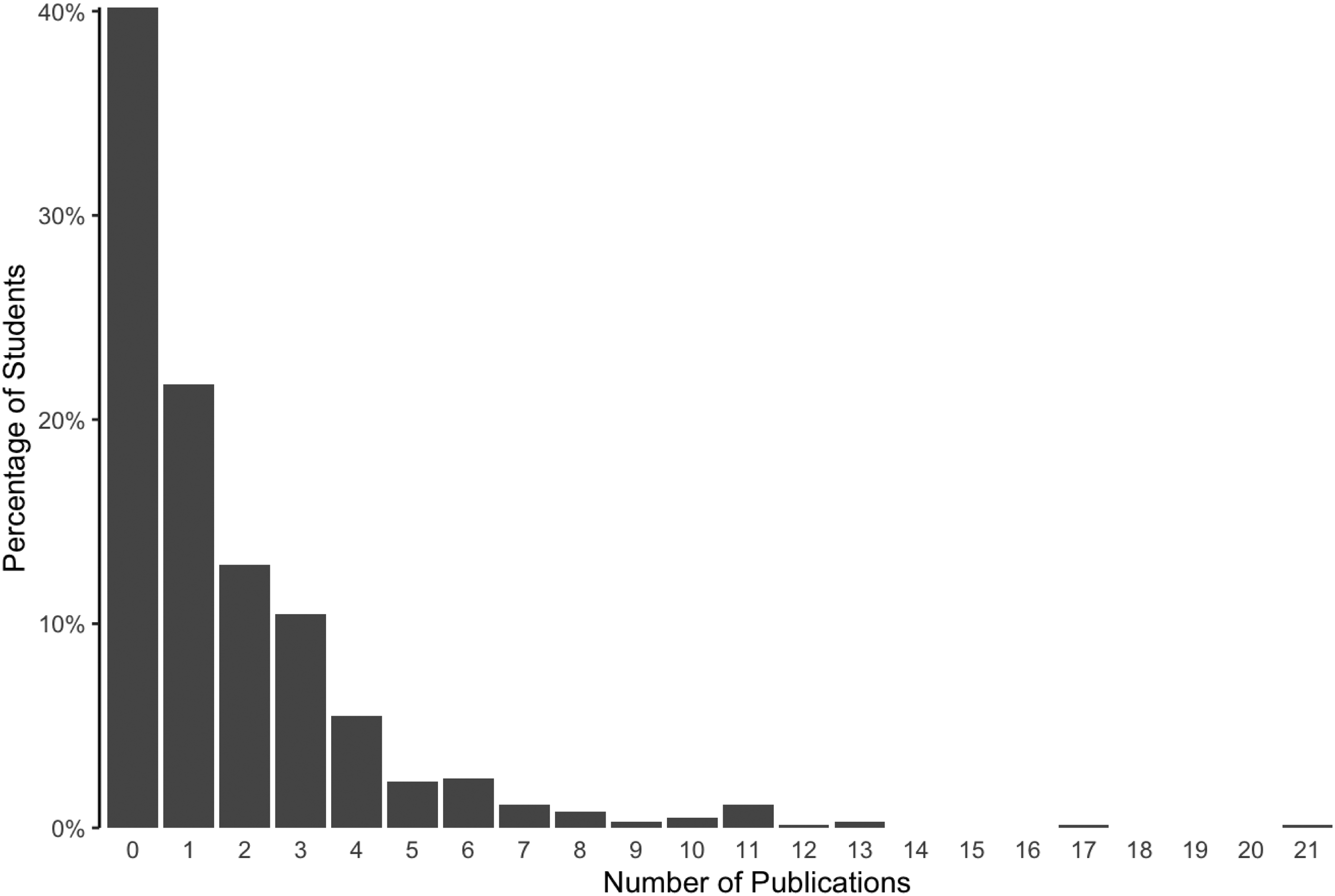
Distribution of students by number of outputs (articles and book chapters)
In more detailed analyses we looked at students publishing in high-impact journals operationalised as SCImago Q1 journals. In Q1 journals individual students published between 0 and 8 articles (Figure 2). Of 623 students, 159 (25.5%) achieved at least one article in a Q1 journal and, collectively, they produced 270 articles (mean = 0.43 including all students).
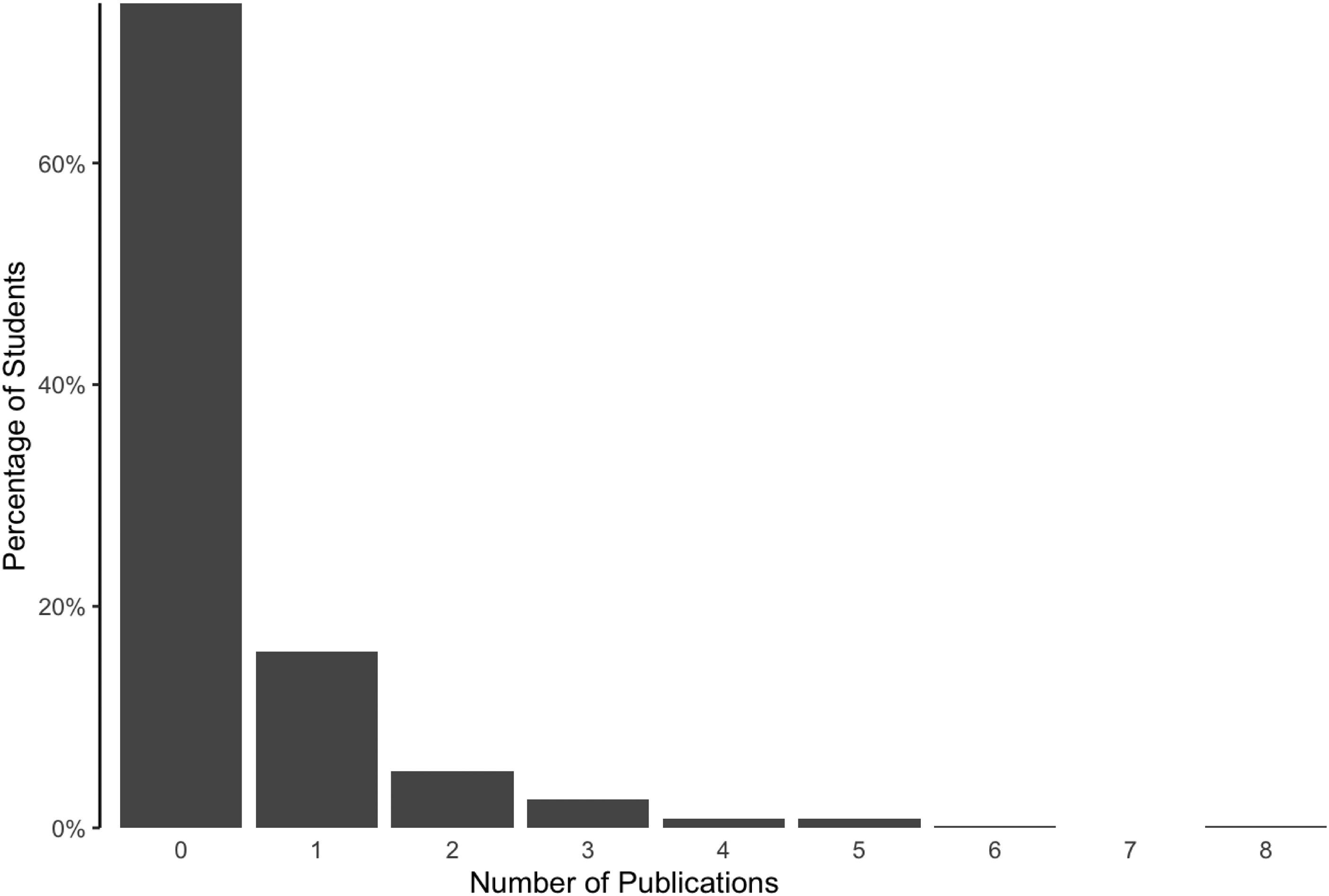
Distribution of students by number of outputs in high-impact journals (Q1)
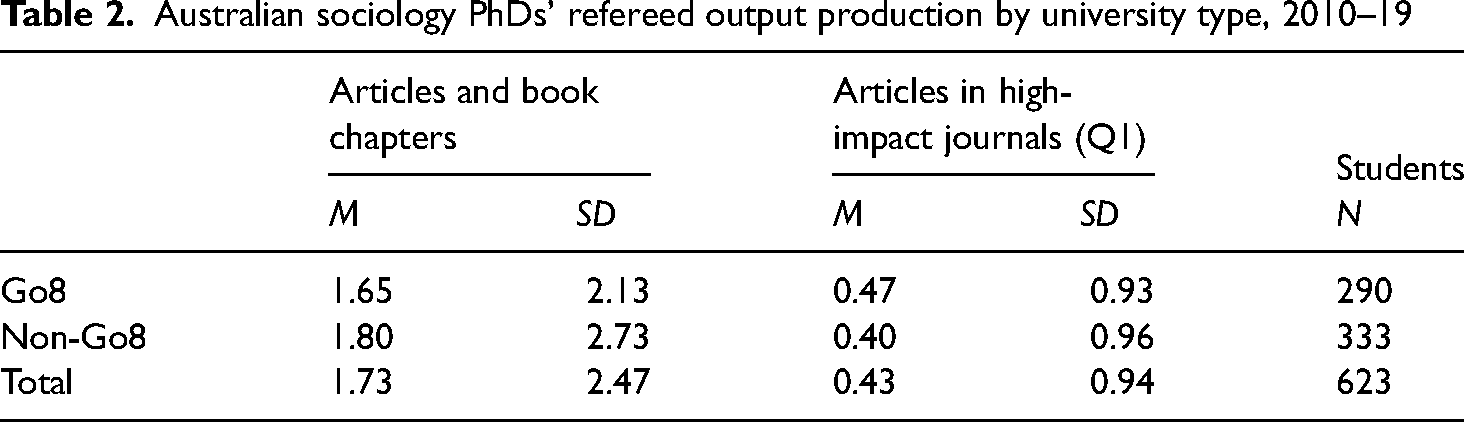
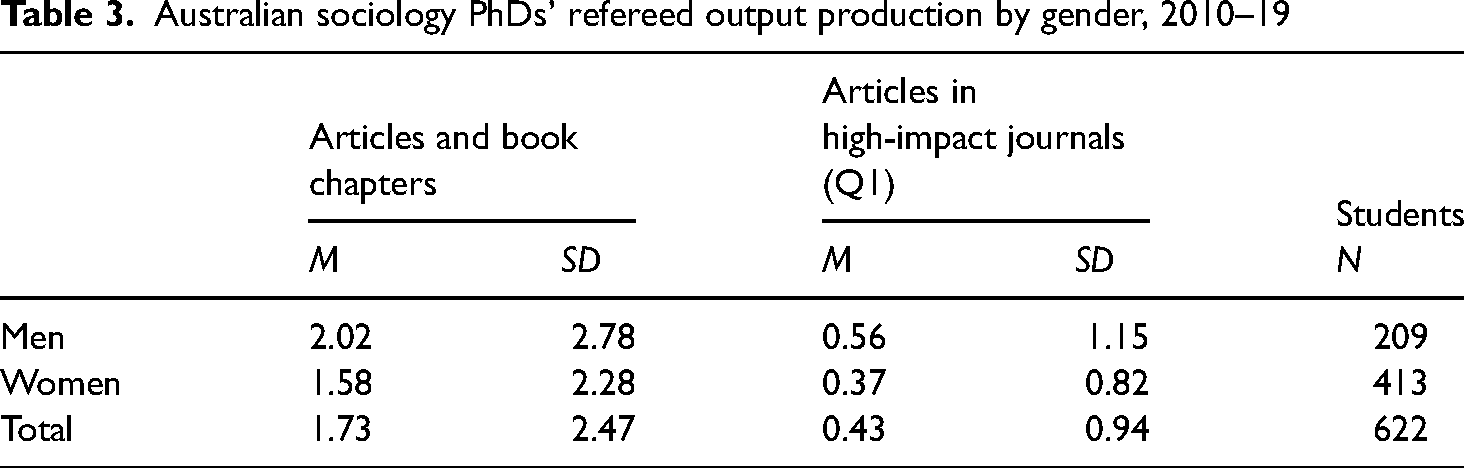
Tables 2–4 report means of students’ publications for all articles and book chapters combined, and for articles in high-impact journals (Q1). This information is presented first by university type in Table 2, second, by gender in Table 3, and, third, by gender and university type in Table 4.
Australian sociology PhDs’ refereed output production by university type, 2010–19
Australian sociology PhDs’ refereed output production by gender, 2010–19
Australian sociology PhDs’ refereed outputs by university type and gender, 2010–19
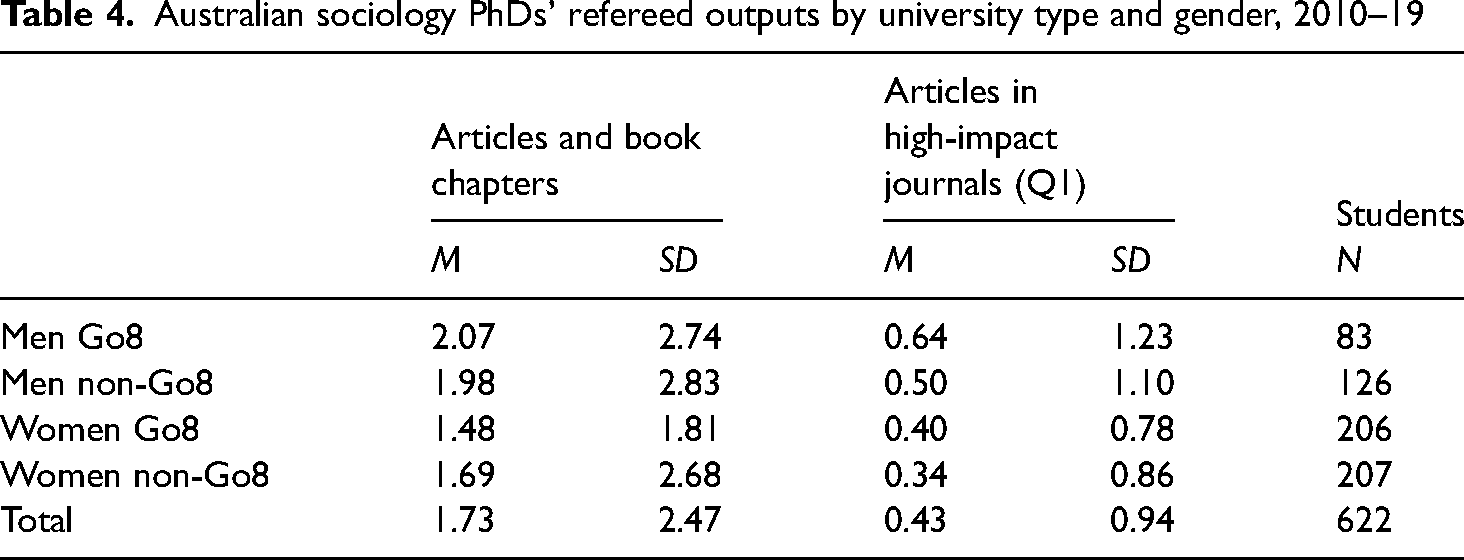
Table 2 shows that there was a very little difference between Go8 and non-Go8 PhD students in terms of overall publishing (articles and book chapters) and the same can be observed in terms of publishing in high-impact journals (Q1).
Table 3 shifts the focus to gender, showing that men overall were somewhat more productive than women when looking at articles and book chapters and also in terms of articles in high-impact journals Q1.
Table 4 shows means for our output categories by university type and gender. Men from Go8 and non-Go8 had the highest output averages, whereas Go8 and non-Go8 women were somewhat lower. In the next section we extend the analysis of PhD students’ publishing practices further using regression models.
Analysing the data further
To deepen the analysis of PhD students’ publishing practices, a negative binomial generalised linear model was selected to examine the data. This was because the dependent variable ‘number of publications’ was a count variable and its distribution was highly skewed: when focusing on all publications, articles and book chapters (Model 1), the mean was 1.73 and variance 6.11; when analysing outputs in high-impact journals Q1 (Model 2) the mean was 0.43 and variance 0.9. Predictor variables in both models were university type (Go8; non-Go8), gender (men; women) and the interaction of these variables. Both models showed overall a good fit (Model 1: deviance 642 on 617 df, log likelihood −1109, AIC 2228; Model 2: deviance 413 on 617 df, log likelihood −532, AIC 1075) and satisfied modelling requirements although there was an indication that they were not very strong in terms of prediction (omnibus test: Model 1: p = 0.14; Model 2: p = 0.10).
Model 1: Articles and book chapters
The first model focused on all publications (articles and book chapters combined). The results from this model showed that the effect of university type (p = 0.71) on research productivity was insignificant at the 0.05 level. This indicated that there was no evidence of statistically significant difference in research output averages between PhDs from Go8 and non-Go8 universities (Table 2). The results from this model further showed that gender, when looking at all men and women overall, had a marginally significant effect (p = 0.032) on research productivity. Men on average produced a higher number of journal articles and book chapters than women and this difference was marginally statistically significant (Table 3). The interaction term between gender and university type was not statistically significant (p = 0.46), showing that the publishing patterns between genders were essentially the same at the elite and non-elite Australian universities (Table 4). In terms of specific subgroups that we were interested in: Go8 men compared to Go8 women and non-Go8 men compared to non-Go8 women there was insufficient evidence statistically to conclude that Go8 men compared to Go8 women (SE = 0.33, t = 1.75) and non-Go8 men compared to non-Go8 women (SE = 0.28, t = 1.03) were different in their research output averages because of the larger standard errors caused by the smaller numbers of PhD students in each subgroup.
Model 2: Articles in high-impact journals Q1
The second model focused on articles in high-impact journals Q1. It concluded similarly that the effect of university type (p = 0.26) on research productivity was insignificant at the 0.05 level. This indicated that there was no evidence of statistically significant difference in research output averages between PhDs from Go8 and non-Go8 universities (Table 2) when looking at high-impact publishing. The results from this model further showed that gender, when looking at all men and women overall, had a marginally significant effect (p = 0.021) on research productivity. Men on average produced a higher number of journal articles in high-impact journals than women and this difference was marginally statistically significant (Table 3). The interaction term between gender and university type was not statistically significant (p = 0.91), showing that the publishing patterns between genders were essentially the same at the elite and non-elite Australian universities in high-impact journals (Table 4). In terms of specific subgroups that we were interested in: Go8 men compared to Go8 women and non-Go8 men compared to non-Go8 women there was again insufficient evidence statistically to conclude that Go8 men compared to Go8 women (SE = 0.47, t = 1.19), and non-Go8 men compared to non-Go8 women (SE = 0.35, t = 1.07) were different in their research output averages because of the larger standard errors caused by the smaller numbers of PhD students in each subgroup.
A further possibility in our analysis was to follow a suggestion that we should also incorporate other variables such as first or later authorship, and investigate whether these correlate with elite or non-elite university status or gender. The difference between doctoral students at elite and non-elite universities, and also between genders, may be reflected, for instance, in being first or subsequent author. We decided to test differences in author order: sole/first or second/later, initially looking at articles and book chapters and then examining author order in terms of articles in high-impact journals (Q1) using a negative binomial generalised linear model. To protect against type-I error in these post hoc analyses we adopted a significance level p < 0.01. The results showed that there was no evidence of a statistically significant difference between PhDs from elite and non-elite institutions or between genders in these authorship order patterns.
Discussion and conclusion
The two main variables reported on in the results above, university type and gender, raise contrasting points of discussion. In the case of university type, responding to our research question 1 involves discussing why we did not find significant differences when a common-sense understanding would suggest that differences would be evident between Go8 and non-Go8 institutions. In the case of gender differences, responding to our research question 2, the contrasting discussion involves accounting for the differences in publishing between men and women even though these were not large.
University type non-difference
Several explanations might be tentatively advanced to at least partially account for why there was a broad similarity between sociology PhDs from elite and non-elite Australian universities in overall publication counts and in publishing in high-impact journals. First, it might be that the shift towards a greater emphasis on publishing during PhD enrolment has flattened differences between elite and less well-resourced universities. This idea might be extended by considering whether future differences could emerge. Second, it is possible that the greater social and financial resources of the Go8, reflected in their global rankings for sociology as well as in the ERA disciplinary rankings, function more at the staff and research project level than at the doctoral level.
Third, this study did not compare sociology with other disciplines. It might be that the practice of publishing during a sociology PhD study is less embedded in Australia and has yet to translate into a Go8 advantage. This broad similarity may not apply in science disciplines where doctoral publishing is more common (Lee & Kamler, 2008). Fourth, preoccupation with timely completions applies equally to Australian Go8 and non-Go8 universities (Green & Bowden, 2012); late PhD completions negatively impact budgets. This priority may have affected the potential publishing difference between PhD students from elite and non-elite universities.
Fifth, students from higher socioeconomic backgrounds, that are more likely to be enrolled at elite universities, have additional forms of social capital that may not be evident during PhD candidacy, but which are likely to confer cumulative advantages post-PhD in future careers (Watkins, 2021). Sixth, equivalence in refereed output production during enrolment between PhDs from elite and non-elite universities is only one form of symbolic capital. It may be that PhD completion at an elite university relative to refereed outputs becomes evident in differences in success in the post-PhD research labour market. Or it may be there are some discipline-specific factors at work that are not replicated in other fields.
The evidence presented here at the doctoral level appears to counter Go8 claims of superior performance for the discipline of sociology, but as the tentative explanations above indicate, there appear to be deeper and more profound reasons operating. Future research could test whether this similarity between Go8 and non-Go8 PhDs in publishing persists into the five-year early career post-PhD period. The similarity in research productivity between Australian sociology PhDs from elite and non-elite universities contrasts with United States findings that sociology PhD enrolment at an elite institution is linked with better publishing outcomes (Headworth & Freese, 2016).
Gender difference
The evidence from our data is that men on average produced a higher number of journal articles and book chapters than women, and that they also produced a higher number of articles in high-impact journals, and these differences were statistically significant. Gender and research productivity form an important nexus in the debates around equity and opportunity in higher education. In interpreting these current results, it is important not to over-account for what was, in fact, a fairly small difference, men producing approximately half an output (0.44) more articles or book chapters, and one-fifth of an article more (0.20) when considering publishing in high-impact journals (Q1). The largest of these differences – of around half of a research output – was small on Cohen's (1988) effect size scale (d = 0.17).
Questions 3 and 4 proposed the value of investigating gender differences within elite and non-elite institutions. We found that on average men at both the elite and non-elite institutions produced somewhat more outputs in both quantity and quality than women, but there was no evidence of a statistically significant difference between any of the pairs. The largest of the differences for these pairs, of around half of an output between Go8 men compared to Go8 women, when looking at article and book chapter publishing, represented only a small effect on Cohen's scale (d = 0.22).
The observed productivity gap here, may have several partial interpretations. First, an argument might be made that the differences between men and women are a residual component of an ongoing cultural change over several generations (Blackmore, 2014). Second, a different explanation refers to lower levels of support for women across the academy in general, including at the PhD level (ASA, 2004; Dever et al., 2008). Third, women may have less involvement in academic networks that support publishing and may be less involved in co-authoring with their supervisors (Lindahl et al., 2021). Fourth, gender-based differences in productivity may reflect different expectations or less recognition of women's research (Boustan & Langan, 2019). Fifth, gender differentials may apply to the value being placed on research productivity and to the fields of research chosen (Stack, 2002).
Although the gender differences in sociology PhDs’ publishing productivity documented here were small, previous studies using the idea of cumulative advantage have chronicled how initial small differences in research productivity tend grow over time (Merton, 1988; Pezzoni et al., 2016). In a similar way to our proposition above about Go8 and non-Go8 differences, future research could investigate whether the relatively minor gender difference in publishing at the PhD level remains the same or increases in the early career five-year post-PhD period. Applying a cumulative advantage lens to this PhD dataset means further interrogating possible interpretations of the elite status and gender differentials identified above. Given the importance of publishing for advancing individual careers and sociology's disciplinary success, debates interpreting these findings and further research evidence will undoubtedly continue.
Footnotes
Funding
The authors disclosed receipt of the following financial support for the research, authorship, and/or publication of this article: This work was supported by Macquarie University (International Macquarie University Research Excellence Scholarship – PhD Scholarship Allocation No. 20224138) and is part of Adam Rajčan's PhD thesis.
Acknowledgements
Appreciation to Peter Petocz for preparation assistance and advice.

Author biographies
Adam Rajčan is a PhD candidate at Macquarie University and Adjunct Research Officer in the Department of Social Inquiry at La Trobe University. He is currently researching publishing patterns of Australian and New Zealand sociology doctoral students along several lines: gender, destination journals, university ranking, and monograph v thesis by publication.
Edgar A Burns is Hawke's Bay Regional Council Chair of Integrated Catchment Management, Waikato University School of Social Sciences, developing social change insights about environment practices in the light of climate change. He publishes on expert knowledge and various aspects of tertiary education, health equity and regenerative agriculture.