




Abstract
This study brings three empirical findings from the Australia–New Zealand region to considering the current state of sociology in this part of the world. Focusing on sites of institutional disciplinary reproduction, we point to the disappearance of sociology-named organisational units, the spread of sociological PhDs across university faculties and the interdisciplinary nature of sociology PhD journal publishing. In the constant restructuring of university education, sociology is one of many disciplines impacted by corporatist decision making. These changes external to sociology are paralleled by internal debates on the discipline’s core and periphery and its boundaries in relation to other social sciences. Long-running contentions among sociologists involve the nature and success of the discipline. We frame our contribution to the conversation through two contrasting conceptual terms, invisibilisation and sociologification, twin processes of sociology being less visible yet finding it widely spread across today’s Australasian academy. Sociology’s sustainability remains an open question.
Introduction
This article brings together new data with ideas about the current state of Australasian sociology. In doing so we find a tension between sociology’s ability to contribute broadly to academic research and its reduced ability to maintain its visibility. Is sociology thriving or fading? In this article we aim to bring contemporary empirical data on its institutional visibility and doctoral research to long-running debates about sociology as a discipline and to contribute to discussions about academic sociology, knowledge production and the neoliberal agenda in higher education.
Changes in today’s higher education sector have been impacting many disciplines and sociology is no exception. Institutionally managed answers to ‘what is sociology’ often appear more powerful in the medium term in defining sociology than are sociologists’ ideas (Connell, 2019; Marginson and Considine, 2000). Discussions among sociologists centre around disciplinary content, borders, purpose(s) and relationships within the academic division of labour (Abbott, 1988; Lund et al., 2024). Our study examined, first, the presence of sociology-named organisational units; second. the dispersal of sociology PhD completions across the university; and third, where sociology PhD candidates from sociology organisational units published their refereed articles during their doctoral studies. This article looks at what can be learned from the data about reproducing sociology in the Australasian setting, allowing for the limitations of our data.
At the departmental level sociology has experienced significant eclipse in being amalgamated into schools of social science. The spread of sociology across university faculties, however, might be seen as a positive effect, but there may be alternative impacts from the emerging generation of sociologists publishing in journals outside sociology. We bring an interpretive frame to the data that follows, drawing on longer-term sectoral changes alongside these current datasets, and university changes external to the discipline. Scholars are invited to consider alternative readings and bring other data to the disciplinary evidence presented here.
Background
The interaction of contemporary sociology scholarship with the reconstitution of universities organisationally may not be fully separable. Nevertheless, identifying external and internal factors shaping sociology’s current situation, function and purpose, helps interpret findings presented here. This background section first considers the structural conditions of the contemporary university sector that are not of sociology’s making. This is followed by sketching debates among sociologists about the nature of the discipline and what constitutes its disciplinary core and boundaries.
Sociology and Structural Change
Several major longer-term patterns are characteristic of the Australasian higher education sector. Five are obvious. A first sectoral change is the sustained growth since the 1970s in student population and number of universities (Marginson and Considine, 2000). This secular trend was accompanied by growth in the number of universities and staff, with a maturing of this workforce coming into the present century. Second, decades-long growth in international full fee-paying students has made international education a key source of revenue for higher education in this part of the world (Blackmore, 2020; McCrohon and Nyland, 2018). Third, research assessment systems have been introduced in recent decades by governments to gain compliance and assure the ‘world-class’ status of Australasian universities and their research efforts – Excellence in Research for Australia (ERA) and Performance Based Research Fund (PBRF) in New Zealand. These largely emulate the United Kingdom Research Assessment Exercise (RAE), now the Research Excellence Framework (REF) (Haddow, 2021).
Fourth, doing well in world university rankings with the high emphasis on publications has become important in the Australasian academy strategically in competing for resources and prestige in the globalised higher education sector (Douglass, 2016; Hazelkorn and Gibson, 2017). Fifth, a utilitarian view of university education and research has become dominant, with national policy settings now seeing this as an instrument of economic growth and national development (Connell, 2013; Gasser, 2024; Musiał-Karg et al., 2023). In this environment, Science, Technology, Engineering and Mathematics (STEM) disciplines are being favoured, while ‘governments and communities are losing confidence in the relevance and value of social science education’ (Academy of Social Sciences in Australia, 2021: 25).
As part of the neoliberal project to economise education there has been a transition from a collegial-institutional model of university governance to emulating a corporate commercial model (Gasser, 2024; Slaughter and Rhoades, 2000); the creation of what Marginson and Considine (2000: 5) termed ‘the enterprise university’. This new entity operates with very different priorities: the primary task of [university] managers is not to encourage research and scholarship as ends in themselves. Nor is it particularly to encourage practices based on imagination, criticism, or other scholarly values. The bottom line is the research prestige of the university and its contribution to the financial balance sheet. (Marginson and Considine, 2000: 135)
This corporate-style management reduced the authority of academics to make decisions about their university and restrained disciplinary power and voices in relation to broader university agendas and strategy (Klikauer, 2013, 2023). From a top–down perspective ‘as the executive leader sees it, to secure institutional flexibility and responsiveness he/she must break the power of the disciplines in university governance’ (Marginson, 2002: 128). One of the manifestations of this is a shift from discipline-based departments to larger interdisciplinary organisational units, which are more amenable to control from above (Becher and Kogan, 1992). The changing conditions of academic work included emphasis on securing external research grants and publishing (Connell, 2019). Sociology has been susceptible to these managerial pressures as much as any other discipline.
Internal Debates about Sociology as a Discipline
Debates within sociology about the discipline’s nature as to its core, boundaries and futures existed well before the shift to the enterprise university. Describing the relationship of these debates over some decades as the external structure of the university has evolved is, however, complex. Sociologists’ commentaries vary in the degree to which they explicitly engage with the external changes happening. These internal perspectives of sociology are summarised as follows.
Loosely Integrated Discipline
A first general positioning has been to see the intellectual openness and unbounded character of sociology as its strength. Urry’s (1981: 34) assertion that sociology was ‘a parasite-scavenger’ discipline created a ‘call and response’ for other sociologists’ reflections. He argued that disciplines bordering sociology, such as economics, psychology, history and political science, simultaneously presuppose and reject ‘the social’, meaning the general form of social relations linking individuals and groups. He saw these neighbouring disciplines’ tighter unity as often reductionist, requiring elaboration of new ideas . . . elsewhere, this often happening in sociology (Urry, 1981: 35).
This parasite-scavenger aspect meant that sociologists saw the discipline as functioning as a midwife or nursery of new specialisms/disciplines. Defining sociology as a social science discipline ‘with minimal organisation, structure, or unity, into which many contending developments from other [disciplines] get incorporated’, meant for Urry (1981: 35) that: although [it] is parasitic it enjoys two crucially important features: first to provide a site within which a further elaboration of the original innovation may occur and secondly to provide the context in which a wide variety of contending social theories can be placed in juxtaposition with each other.
From this stance the discipline can be perceived as distinct in its relationship to the broader social science category and interdisciplinary research. As these debates continued, two decades later Urry (2000: 3) further commented that ‘sociology’s discursive formation has often demonstrated a relative lack of hierarchy, a somewhat unpoliced character, and an inability to resist intellectual invasions’. Stanley (2005: 125) concurred with this statement, saying that sociology as ‘a discipline is . . . by nature plastic and subject to continual intellectual change’.
Need for a More Integrated Discipline
A second perspective has seen this intellectual openness and unbounded character of sociology as its weakness. For sociology to flourish there was a need for a clear demarcation of the discipline’s core and a strong departmental presence. Scott’s (2005: 74) combative response to the ideal of disciplinary openness concerned sociology’s fragmentation and its complex relationship with other disciplines, wanting to ensure the integrity and persistence of sociology as a discipline. He saw contradictions in sociology’s parasite-scavenger function allowing it to prosper on the one hand, but also making it harder to sustain ‘the more general conception of sociology’ (Scott, 2005: 5.4).
The relationship between sociology and its others (various ‘studies’) was problematic for Scott. He saw them as growing at disciplinary sociology’s disadvantage and argued that ‘over time successive sociological concerns have crystallised, expanded and differentiated from [sociology]. Educational studies, criminology, health studies, business studies, media studies . . . have all grown at the expense of sociological specialisms and have recruited many of their practitioners from sociologists’ (Scott, 2005: 3.5).
Scott aimed to find a middle ground between two conceptualisations of sociology; that is, between Urry’s parasite-scavenger fostering new specialisms/disciplines, and a Comtean conception of sociology ‘as the foundational science that is able to grasp central characteristics of the social’ (Scott, 2005: 2.1). Ensuring the integrity and continuity of the discipline required strong departmental sociology unified around ‘the study of the social’ and reassertion of a ‘core’ curriculum in social theory and comparative and historical sociology. This sentiment has been echoed by various Australasian sociologists such as Harley and Wickham (2014) and Turner (2012).
Criticism of ‘Closed Off’ Vision of Sociology
These differences in how sociologists saw the boundaries of sociology continued through critiques of a formalised sociology. Collyer and Veazey (2023) in discussing contemporary Australian sociology argue that ‘what is sociology’ means seeing concepts like ‘the core’ or ‘the social’ as simply sociologists doing disciplinary ‘boundary work’ to assert identity. They also stated that whether a given sociologist subscribes to the idea of a disciplinary core of some kind influences their commentary on how well sociology is doing. These authors also expressed concern that such commentary by sociologists about the lack of a disciplinary core had itself negative effects on the discipline and could become a self-fulfilling prophecy (Collyer and Veazey, 2023: 253).
Urry’s (2005: 78) riposte to the idea of a bounded discipline was that: there is . . . little worse than a discipline seeking to erect boundaries around something that cannot be bounded, trying to pull up the drawbridge when there is little ‘essence’ left within the castle . . . There is I would suggest no simple ‘centre’ to sociology.
At the same time Urry (2005: 1.7) acknowledged that: there is something in Scott’s claim that it is increasingly hard to say just what makes a sociology department or indeed a sociologist. But this stems I would argue from ‘success’ not ‘failure’ . . . So rather than this being a disappearing discipline it is increasingly de-differentiated, less a ghetto and more an expanding discipline.
Writing in further responses to these exchanges, Stanley (2005: 131) critiqued Scott’s (2005) middle-ground for sociology, preferring the idea of disciplinary hybridity to reflect the pluralism of sociology. Her perspective, contrary to Scott’s, was that various sociology ‘others’ were not growing at the expense of sociology. These ‘hybridic sociologies’ were part of the discipline, not draining sociology but often benefitting sociology. She further noted that ‘this intellectual openness [of sociology] is and has been a defining characteristic for a lengthy period . . . and has made sociology . . . attractive to successive generations’ (Stanley, 2005: 3.4). From the Nordic setting, Aspers et al. (2014: 311) agreed that ‘Sociology today has become more multifaceted or genuinely pluralistic than ever before’ and ‘if there is a sociological core, for example in terms of theory, it is less clear than it was 65 years ago’ (2014: 316).
Sociology and Neoliberal Audit
From another angle, neoliberalism brings metric power (Feldman and Sandoval, 2018) and the introduction of performance and evaluation cultures (Jarvis, 2022). Holmwood (2010) brings the discussion of sociology as a loosely integrated discipline to contemporary concerns about university managerialism. His commentary focused on the vulnerable position of sociology within the corporate university and governmental research audits (Haddow, 2021). He distinguishes between importer and exporter disciplines to argue that evaluation of research outputs is problematic for exporter disciplines such as sociology ‘as their academic output is at risk of being subsumed by other [importer] disciplines’ (Lyle, 2017: 1170).
For Holmwood (2010: 646) ‘in sociology it is not only individuals and frameworks, concepts and methodologies that migrate, but entire [specialisms] which are then reproduced within the “applied” [discipline]’. He suggests this may result in the weakening of sociology’s disciplinary status and core identity and its ‘ability to reproduce a critical sensibility’ (2010: 639). Its status is also under threat by universities’ new ‘power networks’ that prefer STEM’s quantitative focus and metrics that have the effect of disadvantaging the social sciences and humanities (Jarvis, 2022: 157).
This position was in turn countered by Savage (2010: 661–662) who despite his alarm at the threat to sociology of big data (Savage and Burrows, 2007), argued that Holmwood’s view was too bleak and ‘too reliant on the distinction he draws between “exporter” and “importer” disciplines which might be too crude’. While recognising Holmwood’s statement of sociology’s interdisciplinarity, he suggested this undermined his importer–exporter dichotomy, as sociology’s success has also included importing from other disciplines as others have noted (Aspers et al., 2014; Urry, 1981). More optimistically Savage (2010: 662) thought sociology ‘better placed . . . to deal with the neoliberalisation of higher education . . . since it might be less inclined to defend its core . . . and might be more adaptable to hybrid research opportunities’ compared with other disciplines.
In summary, managerialism’s impact on sociology’s reproduction within universities intrudes into these intra-disciplinary discussions. The present article brings empirical data into the conversation: the presence of sociology in organisational unit names; disciplinary classification of PhD theses using the Australasian Fields of Research (FoR) coding; and destination journals in which PhD students choose to publish (ABS, 2008) – and how we might anticipate managerialism working as it tries to classify, quantify and control (Lund et al., 2024).
These internal disciplinary discussions, however, only partly engage with the changes reshaping sociology, ‘changes that are going on behind our backs’ (Griffith and Smith, 2014: 3). Internal debates between sociologists would seem to be somewhat disconnected from managerialism’s de facto definition imposed on what is sociology in the academy. Structural changes directly affect how sociology functions in any of its ‘midwife’ or ‘exporter–importer’ ways, down to individual working conditions. For today’s generation, discussions about the nature of sociology include how can they ‘do’ sociology in this context. Examples of this are seen in scholarly work on academic precarity (Feldman and Sandoval, 2018; Jarvis, 2022; Shore and Davidson, 2014) and the application of Braverman’s labour processes to academic employment (Ross and Savage, 2021).
Our framing of these issues is to suggest that there are twin processes of sociology being less visible and being spread at the same time. Invisibilisation captures how the presence of sociology is difficult to find across the university organisational landscape; sociologification is the diffuse nature of contemporary sociology across the academy.
Method
Bringing empirical data to contemporary thinking about sociology connects this present-day evidence to the ongoing conversation. We have compiled three sets of findings, each using a distinct method of data collection addressing the reflective tradition described above within sociology, but also speaking to current managerial practices affecting the visibility and spread of sociology’s position within the academy.
Finding 1
We compiled data on the disappearance of named sociology organisational units with sociology in their title, such as ‘Department of Sociology’ or ‘School of Sociology and Social Work’ using several sources of information. First, we inspected historical versions of university websites for the 2000–2023 period accessible through the internet archive (https://archive.org/web/) and the Australian TROVE online database (https://trove.nla.gov.au/). Second, we analysed Nexus – the newsletter of the Australian Sociological Association – for information on university restructures and departmental/school name changes. Third, we also cross-checked information in published material that focused specifically on Australian and New Zealand sociology organisational units (Crothers, 2018; Germov and McGee, 2005; TASA, 2001). Fourth, in some instances we contacted university administrators and academics to gather information on sociology organisational units at their institutions. From this evidence we prepared Figure 1 illustrating the disappearance of named sociology organisational units.
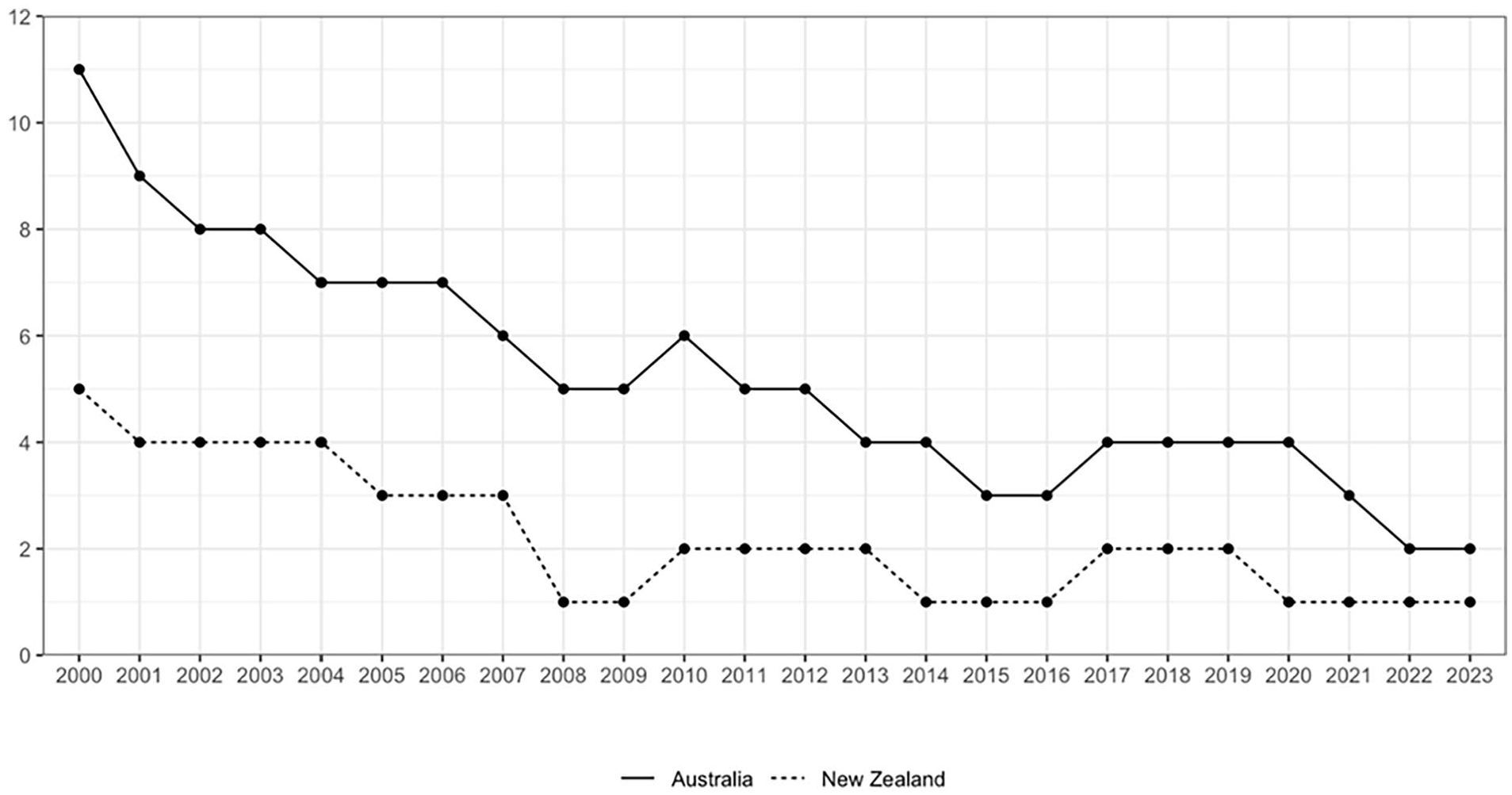
Number of ‘named’ sociology organisational units or combined organisational units with sociology in their title in Australia and New Zealand (2000–2023).
Finding 2
We documented the spread of sociology PhDs across diverse university organisational units, presenting evidence from one major Australian university, the University of Queensland. Universities at the start of the 2010s adopted a practice of requiring PhD students to allocate theses being submitted, in consultation with their supervisors, with up to three Australian and New Zealand Standard Research Classification’s Field of Research (FoR) codes (ABS, 2008) to provide information about their thesis discipline. First, we selected the University of Queensland because its data on completed PhD theses FoR coding was consistently reported and publicly available in their research repository. Not all universities are consistent in using FoR codes to code theses or have theses publicly available along with FoR codes (Rajčan and Burns, 2023: 65–67). Second, we selected all PhD theses from the university research repository data that were allocated at least one FoR ‘1608 sociology’ code and were completed during the last decade (2010–2019). Third, we obtained copies of these theses and identified organisational units with which they were affiliated. Fourth, we prepared Figure 2, which illustrates the spread of these sociological theses across the university.
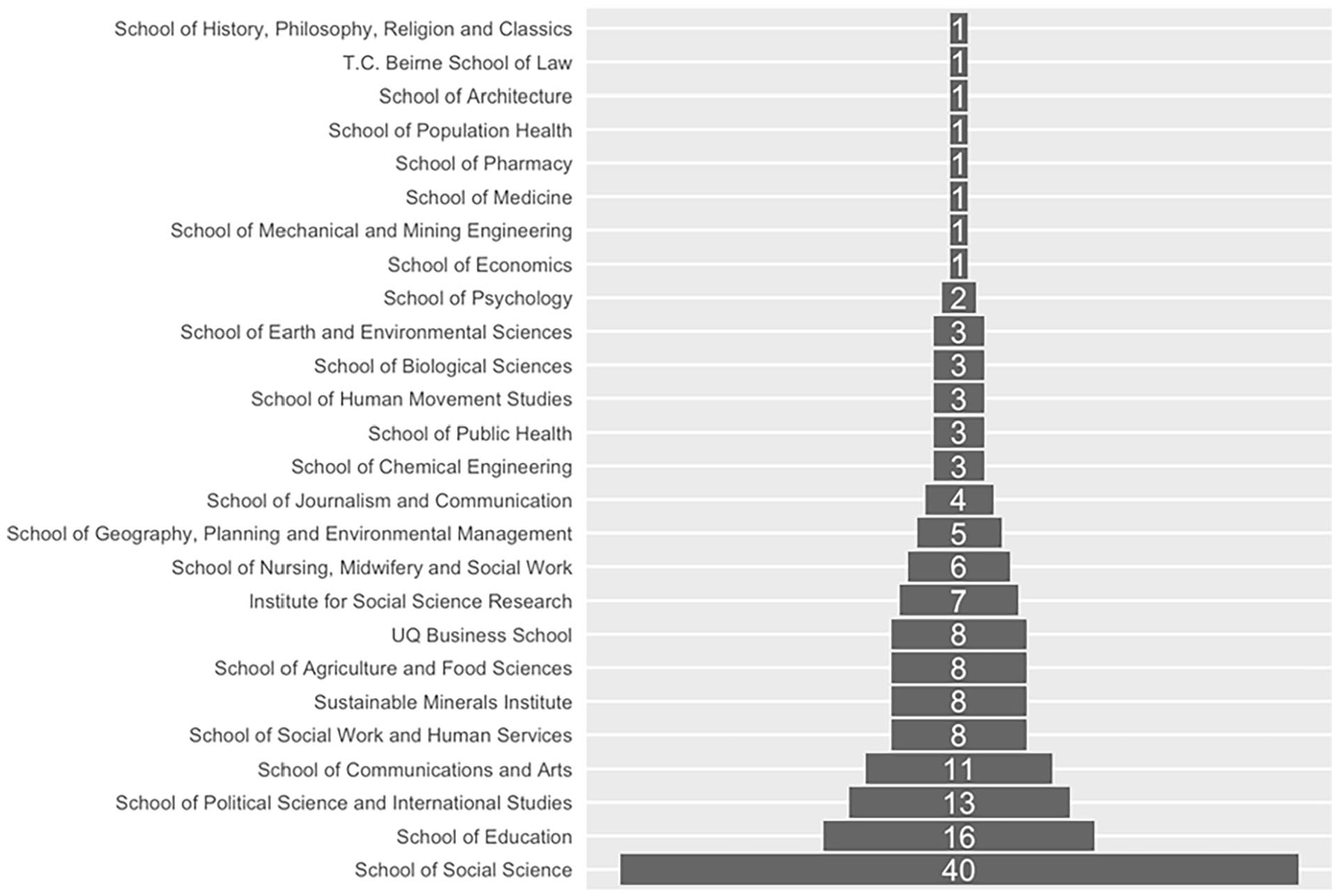
University of Queensland PhD theses with at least one FoR 1608 sociology code by university organisational unit (2010–2019).
Finding 3
Sociology PhD publishing was examined by identifying sociology and non-sociology refereed journals in which they published. First, this required locating research outputs produced during enrolment in Australia and New Zealand (2010–2019) by PhD students located in sociology departments or their iterations (disciplines or programmes) in multi-disciplinary schools. Second, we located journals in which they published using the 2018 Excellence in Research in Australia (ERA) journal list (ARC, 2018). This provided information on journal disciplinary classification by FoR codes.
We considered sociology journals to be those that were assigned on this list ‘FoR 1608 sociology’ code and as non-sociology journals those that were not so labelled. This process of checking journal FoR coding also allowed us to identify journals in which PhDs published that were not included on this list. Third, we noted for each student that achieved at least one article, the number of articles in sociology journals, non-sociology journals and in journals not included on the ERA journal list. Fourth, based on this data we created Figure 3 showing the spread of articles between recognised sociology journals and non-sociology journals.
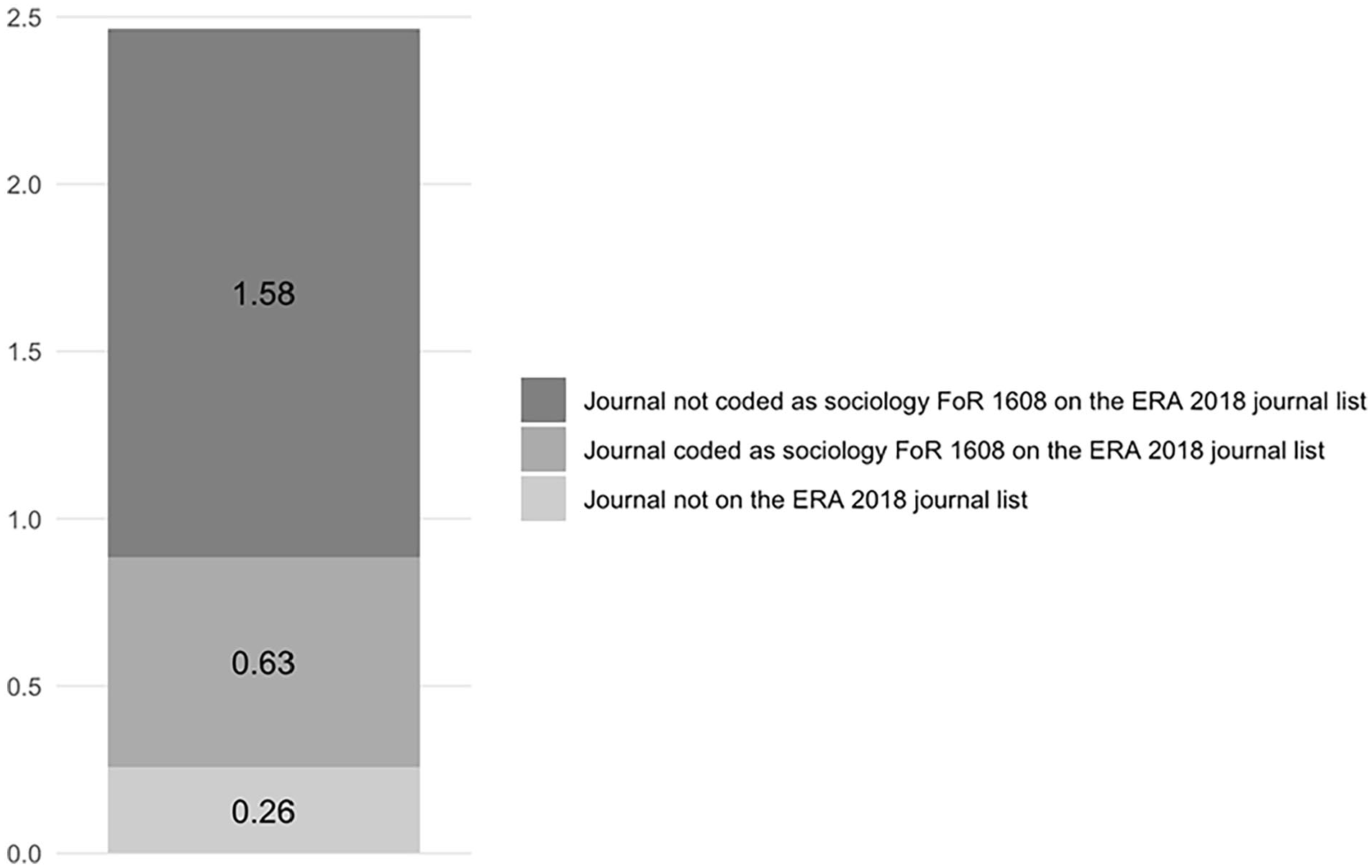
Spread of articles by destination journals within and outside the discipline of sociology, for Australian and New Zealand sociology PhD students (2010–2019).
Findings
The three empirical patterns of evidence documented here speak to our proposed concepts of invisibilisation and sociologification. The first finding sets out the public face of sociology, fading like Lewis Carroll’s Cheshire cat’s steady disappearance until little more than the grin is left. Whether in sociology’s case this is a mischievous grin or a grimace is up for discussion. The second finding presents a case study of a decade’s worth of theses at one Australian university showing the organisational units within the university where PhD theses administratively coded as sociology were completed. The third finding continues the focus on sociology PhD completers but brings additional evidence beyond university institutions to consider the refereed journals in which these doctoral students published their research.
Finding 1: Changing Organisational Structures and the Disappearance of Named Sociology Organisational Units
The main point in this first finding section is that sociology has been steadily changed from having departmental naming previously found on institutional websites, administrative listings and promotional material. Instead, sociology has been shifted to being a subunit of larger organisational units with generic titles (e.g. School of Social Sciences; School of Humanities, Arts, Education and Law). It is absorbed or submerged as ‘a programme’ or ‘a discipline’ rather than being an autonomous organisational unit with ‘sociology’ in its title. This has implications for the visibility of sociology (and sociologists). As Crothers (2018: 4) noted, ‘over the last two decades, the economies of scale of departments have been seen as not cost effective, and instead combination into higher scale units has been sought’.
Figure 1 depicts the decreasing number of ‘named’ sociology organisational units in Australian and New Zealand universities for 2000–2023. Sociology was (sometimes with other disciplines) explicitly named in the organisational unit title. The Figure 1 starting year does not imply that the process of amalgamation into larger schools began at that date. At some institutions prior to this sociology was already a programme/discipline within a larger School rather than an identified department. Crothers (2018: 4) suggests that sociology was at some universities ‘tucked . . . in complex (and possibly problematic ways) into larger multidisciplinary units from its introduction as a discipline’.
In 2000 there were 11 universities in Australia (out of 39) with named sociology organisational units such as: Department of Sociology and Anthropology (Newcastle University), School of Psychology and Sociology (Central Queensland University), School of Sociology, Politics and Anthropology (La Trobe University), School of Sociology and Social Work (University of Tasmania), School of Sociology (University of New South Wales) and so on. At the same time there were another dozen universities where sociology was part of a larger organisational unit like ‘School of Social Sciences’ (University of New England) or ‘School of Social Inquiry’ (Murdoch University) as a subunit (TASA, 2001). At the start of the 2010s the number of universities with named sociology organisational units decreased to six: ‘Department of Sociology’ (Flinders University; Macquarie University); School of Sociology (Australian National University) created in 2010; School of Sociology and Social Work (University of Tasmania); Department of Anthropology, Archaeology and Sociology (James Cook University); and Department of Sociology and Social Policy (University of Sydney).
At the end of the most recent decade in 2019 the number of universities with named sociology organisational units dropped to four: Department of Sociology (Macquarie University); Department of Sociology and Social Policy (University of Sydney); School of Sociology (Australian National University); and Department of Sociology, Criminology and Gender Studies (Adelaide University) created in 2017. In 2023 there were only two universities with named sociology organisational units in Australia: School of Sociology (Australian National University) and Department of Sociology, Criminology and Gender Studies (Adelaide University).
The pattern of repeated restructurings and departmental amalgamations in New Zealand has been broadly similar. In 2000 there were sociology-named organisational units at five out of the eight New Zealand universities: Department of Sociology (Auckland University and University of Canterbury); Department of Sociology and Social Policy (Victoria University Wellington and Waikato University); and School of Sociology and Women’s Studies (Massey University). At the start of the 2010s the number of universities with sociology-named organisational units dropped to one: Department of Sociology (Auckland University). By 2019 there were only two universities with named sociology organisational units: Department of Sociology, Gender and Social Work (established at Otago University in 2011) and Department of Anthropology and Sociology (re-established at the University of Canterbury in 2014).
In 2023 there was only one university with a sociology-named organisational unit: Department of Anthropology and Sociology (University of Canterbury). In both Australia and New Zealand, the repetitions of university restructuring have led to reduced visibility of sociology. The argument put forward in this first finding section is that at the turn of the present century, after decades of growth in higher education, 1990s corporate logics of downsizing and restructuring became management mantras (Cannella and Koro-Ljungberg, 2017; Cooper et al., 2012; Gumport, 2000) that were mainstreamed as university administrative practice (Connell, 2013).
Sociology’s invisibilisation recorded in Figure 1 has taken place within these managerialist changes (Trowler, 2010). A discipline report that mapped sociology (Marshall et al., 2009: 4) for the Australian Learning and Teaching Council provided ‘an overview of the extent and nature of sociology teaching in Australian universities’. In a section headed ‘Invisible Sociologists’ these authors expressed their concern about how this was occurring: Restructuring is one response to reduced funding and in Australian universities it has typically meant creating larger administrative units with the aim of achieving economies of scale. One of the effects of this may be that sociology is rendered invisible. The mapping exercise documented this across Australian universities. (Marshall et al., 2009: 30)
Thus, a combination of government resistance to rising higher education sector costs and the adoption of manager-centric metrics emulated changes occurring in other Anglophone nations also experiencing some version of neoliberalism or new public management (Griffith and Smith, 2014).
From a disciplinary point of view, the involuntary nature of this change – being rendered invisible – is also seen in the decline of sociology’s web presence on university websites. Marshall et al. (2009: 30) cited a sociologist commenting: Sociology here is taught in the Humanities and Arts’ Faculty. And that in itself has been restructured to include Education and others. So, to some extent, Sociology departments are really subsets of broader departments now . . . the institutional structure means that it disappears at a formal level.
University restructures merging disciplines into larger organisational units have been an ongoing feature. We repeatedly encountered comments like the following administrator’s statement: [Sociology] is part of a ‘cluster’ called Global Studies (itself part of a bigger college called College of Arts, Business, Law and Social Sciences). Global Studies contains disciplines like . . . International Aid and Development, Indonesian, Japanese, Sustainable Development, Terrorism and Counter-terrorism Studies, Asian Studies . . . and as I wrote, Sociology.
Social science disciplines being disfavoured has occurred despite bringing in significant student numbers, driven by executive preference for science and technology (Blackmore, 2020; Macintyre, 2009). It is not, however, just sociology that is being impacted by university restructuring processes; other disciplines are also impacted. The size of sociology as a significant social science discipline makes this a particularly acute issue for it. Gibson’s (2007: 101) litany of effects from geography being invisibilised at Australian universities is recognisable by sociologists: Names of units are ‘identity-forming accoutrements’ . . . They are the banners under which the performance of disciplines is assessed; they are the linguistic tools of senior university managers and bureaucrats, and the means by which visibility is maintained. . . . That geography is not in the name of many of its institutional settings . . . means it might often miss out on students ‘grazing’ for degree options, is absent from the by-line . . . or makes it difficult to articulate geography’s unique intellectual contributions when faculty and campus wide restructures are likely.
More recent commentary on Australian geography (Head and Rutherfurd, 2022: 41–42) noted that through constant restructuring and amalgamations: Geography lost its distinctiveness inside hybrid schools with vaguely social and environmental character [and that] Geography programmes lacked visibility . . . Of the 25 academic units that teach a Geography-related major, 14 do not have Geography in their name; instead, the discipline is part of a School . . . in only seven of the 25 academic units are the geographers clearly identified as geographers on the unit’s website. The others are hidden in long lists of staff from unspecified disciplines.
This echoes the situation for sociology. Website visibility has become the lingua franca of organisational presence in the internet era (O’Connor and Yates, 2014). For sociology and other disciplines within universities, being under centralised control and not readily discoverable means a much-diminished disciplinary presence (Marshall et al., 2009).
Though most sociology teaching units are being submerged (Figure 1), this does not mean that some of them are not growing, for instance, adding sociologists to the staff or increasing student numbers.
PhD completions in sociology departments or their iterations as programmes or disciplines, increased across the decade 2010–2019 in Australia by almost 50% and PhD completions in New Zealand stayed constant (Rajčan and Burns, 2022, 2024). A different invisibilising process for sociology occurs as some universities shift from PhDs awarded in specific disciplines to conferring generic PhDs in ‘Social Sciences’ or similar. It should be noted that some universities never offered PhDs in specific disciplines such as sociology (Rajčan and Burns, 2023: 68–69). A technical distinction between loss of ‘sociology’ in organisational unit names and the discipline being invisibilised as separate processes does not sufficiently address the reality of fading disciplinary presence.
The managerialist turn towards disciplinary massification in larger organisational units has contradictory impacts on a discipline like sociology. It becomes harder to defend its porous borders while also becoming easier to extend beyond them as the borders of other disciplines are also eroded. From the perspective of commentators discussed earlier who invoked sociology’s interdisciplinary nature, this may be congruent with their view of the discipline. For other commentators seeing the necessity for a departmental institutional basis with core disciplinary content, this is loss and diminution in the neoliberal university world. The future of sociology turns on the transition pipeline between undergraduates, PhDs and sociology teaching in this increasingly invisibilised position in the academy.
Finding 2: Spread of Sociology PhDs across the Academy
This finding invites a conception of the spread of sociology that is concurrent with its invisibilisation, seen in the completed sociology PhDs. In contrast to the disappearance of the public presence of sociology, this dataset suggests sociology is pervasive throughout universities and adds a fresh dimension to problem analysis and knowledge production in those existing, often applied, fields. What we have come to call our cake diagram shows the extent of this present-day dispersal of sociology across the academy in this case study.
The base layer of the cake diagram is the School of Social Science where the main sociology organisational unit – sociology programme – has been situated at the University of Queensland, Australia. At the bottom layer of the cake, Figure 2 shows there were 40 PhD theses completed in this unit that were allocated at least one FoR ‘1608 Sociology’ code during 2010–2019. Above this base layer there are an additional 26 organisational units where 119 PhD theses were completed that had been assigned at least one FoR ‘1608 Sociology’ code during 2010–2019.
Figure 2 shows the important contribution of sociology outside the primary sociology unit. In principle, the logic of the cake figure could apply to other universities showing a greater or lesser diffusion of theses with sociological content across various university organisational units. In Figure 2 many of these organisational units will have academic staff with a sociology background. Empirically we are showing here sociology’s current spread across a wide variety of university organisational units using the example of sociological PhDs.
It would be an interpretive mistake to assert that Figure 2 by itself evidences a long-term trend of sociology’s spreading. It is a snapshot of the spread of sociology at a given time (the 2010–2019 decade). Our preference for interpreting the data as part of a trend comes from the wider literature discussed earlier. Other scholars may have other interpretations. It might be that the spread is not in tandem with invisibilisation but is a point in a decreasing trend; or that sociology has always been spread across the academy.
Preferring the first reading of Figure 2 we think aligns also with the presence of a sociologist diaspora to other fields and faculties arising from the shifting logics of supply and demand in the academic labour market. Sociology now produces more sociological PhDs than in the past; across the 2010–2019 decade, sociology PhDs doubled (Rajčan and Burns, 2024). The non-growing market for sociologists, however, drives them to find employment elsewhere in the university using their sociological training and expertise (Hordósy et al., 2024). This line of reasoning recognises the movement of sociology personnel, ideas and research practices across the academy.
Additionally, Figure 2 may reflect not just the migration of sociologists, but also of other disciplines’ scholars adopting and adapting sociological lenses, particularly given the current emphasis on interdisciplinarity. Sociology and theorising ‘the social’ thus provide itinerant expression of Urry’s (1981) midwife/nursery function or Stanley’s (2005) ‘hybridic’ areas and sub-specialties across academies. Further, non-sociology specialisms are being created engaging ‘the social’, adopting hyphenated rubrics like socio-technical, socio-ecology, socio-hydrology, socio-medical.
Support for our interpretation also comes from Warren (2019: 185) who notes that the 21 highest ranked United States sociology departments now produce 50% more sociology PhDs compared with the 1990s. They hire, however, at approximately the same rate as in the 1990s. In the United Kingdom Parker (2015: 166) observed that: just as the sociology departments were beginning to shrink, so were other parts of the university beginning to grow rapidly. The labour market for sociologists to teach in their ‘home’ departments was shrinking, and so they became ‘émigrés’, working in medical faculties; social work and policy departments; schools of education, criminology and development studies . . . business schools.
Returning to the ‘cake’, Figure 2 in our view evidences the pervasive nature of sociology and the spread of these various ‘hybridic sociologies’ through the dispersal of sociological PhDs across the university, acknowledging that this is a snapshot of the current state of spread.
Finding 3: Publishing beyond Sociology Journals
The data presented in this finding section speaks to sociology both becoming less visible and its current spread. In terms of sociologification – the spread of sociology – Figure 3 shows the dispersal of research outputs produced by Australian and New Zealand sociology PhDs who completed between 2010 and 2019. These articles appeared in a diverse range of journals, the majority of which were not classified as sociology in the Excellence in Research in Australia 2018 (ERA) journal list (ARC, 2018). The destination journals chosen by these PhD students provide another datapoint about the interdisciplinary character of sociology. In terms of the earlier Finding 1 of sociology as a discipline disappearing from the organisational landscape, an argument might be mounted for seeing invisibilisation also operating in the wide range of journals in which PhD students have published.
We draw from Figure 3 that this large intellectual effort produced in non-sociology journals risks these outputs being attributed to other disciplines and fields. The credit to sociology is rendered invisible, as earlier noted. From the point of view of individual PhD students and academics, the primary driver may well be simply getting published. From a managerial perspective, where such outputs are allocated will have consequences for the perception of sociology as productive or not. Such potentially split attribution in applying managerial logics of institutional performance is very different to the internal intellectual logics that have occupied sociologists in the literature debating the nature of sociology.
We identified 718 sociology PhDs who completed their degrees between 2010 and 2019 in sociology departments or their iterations at Australian and New Zealand universities. Three hundred and seventy-five of these candidates (52.2%) published at least one refereed journal article during their enrolment, producing 924 journal articles (mean 2.46 articles per student) in 579 journals. In terms of the spread of articles between sociology and non-sociology journals, 591 (64.0%) were published in non-sociology journals, 236 (25.5%) were published in sociology journals and 97 (10.5%) in journals not on the ERA 2018 journal list. Figure 3 shows the mean number of publications per PhD student within the three journal categories: (1) non-sociology; (2) sociology; and (3) outlets not on the ERA 2018 journal list.
This data in describing where sociology PhDs published their research can be read in more than one way. On a first level this diversity of publishing outlets speaks to the interdisciplinary nature of sociology and sociological research, ignoring for the moment coercive managerial processes in the contemporary university that we discussed earlier. In terms of the FoR disciplinary codes used in Australian and New Zealand higher education (ABS, 2008), one academic advised us that university managers are agnostic about disciplines, not interested in ‘details’ below the two-digit codes (FoR 16 Studies in Human Society) but only generic field codes above disciplines. The achievement of sociology codes (FoR 1608) across the academy can thus be achieved in any school or faculty but may not be recognised.
Evidence of a simple success–failure binary is illusory. On the one hand, the academic labour market imperatives of ‘publish or perish’ must be enacted by both individuals and institutions (Eliason, 2008; Musiał-Karg et al., 2023; Tran, 2024). On the other hand, there is the internal institutional ‘massaging’ that many larger Australasian universities engage in to enhance disciplinary ‘world ranking’ on the ERA five-point scale (Haddow, 2021). This is done by moving publications between selected disciplines. There is, then, a paradox between a lack of interest in individual disciplines noted above and conscious manipulation of disciplinary outputs. Either way, little institutional regard is given to sustaining longer-term productivity of sociology as a discipline (Welch, 2016).
The spread of journal publications reported here is viewed quite differently from contrasting positions within sociology. As an intellectual space, this spread of sociological thinking is a positive outcome. As a discipline contesting for its position in the academy, it might be more simply interpreted as sociological contributions sitting with or even disappearing into the success of other fields. These competing inferences from Finding 3 can be read in terms of processes of invisibilisation as well as pointing towards sociologification. The justification for either view cannot be derived solely from this data given it represents a single decade, 2010–2019, rather than showing a longitudinal pattern.
Thus, again we would be making an interpretive mistake asserting that the data in Figure 3 shows a long-term trend of sociology’s spreading, although Urry (2005) was optimistic. Alternatively, other scholars may hold a view that publishing outside sociology is decreasing, having been even more pronounced in the past; or may view Figure 3’s pattern as having always been the case. As in the instance of Figure 2, we favour the first interpretation as the most likely. This preference notes two limitations: by itself this does not surmount the leap from the data point we present but relies on wider understanding of the discipline’s history. Further, the point-in-time data here does not capture possible rises or falls over a longer period.
A longer-term pattern of publishing mostly outside sociology journals supporting our reading of the Australian and New Zealand situation is also seen in Warren’s (2019: 188) study of young academics in the United States. His data demonstrated a trend of increased proportion of article publications outside recognised sociology journals in the United States over several decades. Is this sociologification and success or is it dilution of sociology’s presence through work elsewhere? Does it represent a disciplinary fading because other fields get credit for work that sociology supervision, collaboration co-authoring and concepts have brought to those projects?
Conclusion
The datasets presented in this article about the discipline of sociology come from the Australian and New Zealand university context. Four features of our data can be noted: the material is empirical rather than philosophical; except in the first finding it is not longitudinal; it is contemporary data from outside the geo-political centres; and it comes from a region generally acknowledged as having first-world higher education sectors. Within the limits of the evidence, we can say that in the Australian and New Zealand context the data tells us what a new generation of sociologists is doing. Understanding their work using the concepts of invisibilisation and sociologification has brought us back to the reproduction of sociology as an academic discipline.
Our framing of this data within the ongoing managerial reorientation of today’s universities broadened the internal disciplinary conversations about the nature of sociology. In using a larger analytic frame, we have tried to be attentive to dialectics that animate data supportive or challenging of different views. Within-sociology discussions are not realistic without accounting for managerial definitions of disciplinary existence. Our discussion has noted the structural changes being cemented into universities that are constraining sociology’s formal presence.
PhDs are at the cutting edge as they reflect institutional and disciplinary change and also represent possible future directions. Sociology is facing major challenges to its institutional presence and acceptance in this part of the world. We have argued that what might have initially appeared to be contrasting interpretations, invisibilisation and sociologification, are not either–or, but both–and.
Footnotes
Acknowledgements
Appreciation to Ben Spies-Butcher, Jacqueline Mackaway and Shaun Wilson for their encouragement and support.
Funding
The authors disclosed receipt of the following financial support for the research, authorship and/or publication of this article: this work was supported by Macquarie University (International Macquarie University Research Excellence Scholarship–PhD Scholarship Allocation No. 20224138).
