



Abstract
A wealth of research documents disparities in workplace outcomes between cisgender heterosexual employees and LGBTQ+ employees. However, few studies have examined how workplace wellbeing may differ among different subgroups within the LGBTQ+ umbrella – that is, the notion of ‘diversity within diversity’. The current study fills this gap in knowledge by theorising and testing differences in workplace wellbeing across nuanced sexual- and gender-identity groups. To accomplish this, we use unique survey data from the 2020 Australian Workplace Equality Index (AWEI) Employee Survey (n = 5270 respondents and 146 organisations) and random-intercept multilevel regression models. Our results reveal significant differences in workplace wellbeing between different diversity groups. For example, LGBTQ+ employees identifying as gay/lesbian and as cisgender men generally report better outcomes than employees identifying with other minority identities. Overall, our findings call for workplace equity policies that target stigma towards plurisexual, gender non-conforming, and smaller and more invisible diversity groups.
Background
In many countries, hetero-patriarchal social structures mean that LGBTQ+ identification remains a stigmatised social status (Hayfield, 2021; Köllen, 2016), including within contemporary Australian society (Perales & Campbell, 2018, 2019). As a result, gender- and sexual-diversity groups are subjected to higher rates of exclusion, discrimination and harassment across social environments (Borgogna et al., 2019), including the workplace (DeSouza et al., 2017; Waite, 2020). However, while growing rapidly, scholarly evidence on the workplace experiences and outcomes of gender- and sexual-diversity groups remains limited (Lloren & Parini, 2017; Ng & Rumens, 2017).
To date, the literature has been dominated by two types of studies. First, some studies have used qualitative methods to offer ‘thick descriptions’ of the subjective workplace experiences of LGBTQ+ people (Galupo & Resnick, 2016; Kelly et al., 2020; Willis, 2009). This research has explored how gender and sexually diverse people navigate workplace stressors and exclusion, engage with workplace supports, and experience the implementation of organisational diversity and inclusion policies (Galupo & Resnick, 2016; Kelly et al., 2020; Willis, 2009). Second, some studies have leveraged quantitative methods to compare work-related outcomes between heterosexual and LGBTQ+ employees. This research has documented substantial differences in workplace outcomes between cisgender heterosexual employees and employees who belong to a gender- and/or sexual-minority group. This includes differences in (un)employment rates, wages, career prospects, and job satisfaction, with cisgender heterosexual individuals almost invariably occupying a privileged position in the organisational hierarchy (Drydakis, 2019; Köllen, 2016; Kuyper, 2015).
Although these pioneering studies have offered critical insights into the experiences and outcomes of LGBTQ+ employees, there are important gaps in knowledge. Critically, existing studies often conflate gender identity and sexual identity, and fail to investigate groups within these diversity categories (Ng & Rumens, 2017). Relatedly, existing studies tend to compare heterosexual (or cisgender) individuals to ‘catch-all’ categories comprising an amalgamation of different sexual- or gender-minority groups. For instance, studies focusing on sexual identity tend to contrast the experiences of heterosexual people to those of either the larger and more ‘mainstream’ minority groups (e.g. gay, lesbian and, occasionally, bisexual people) or a combination of these. Hence, existing research largely treats gender- and sexual-minority groups as monolithic categories, thereby failing to recognise ‘diversity within diversity’ in their workplace experiences (Beauregard et al., 2018).
The current study seeks to fill this gap in knowledge by theorising and examining differences in workplace wellbeing between nuanced sexual-identity (e.g. bisexual, pansexual, queer, and asexual) and gender-identity (e.g. agender, trans, and non-binary) groups. To accomplish this, we use unique survey data from the 2020 Australian Workplace Equality Index (AWEI) Employee Survey (n = 5,270) and multivariable regression models. Our key results reveal significant differences in workplace wellbeing between different diversity groups. For example, LGBTQ+ employees identifying as gay/lesbian and as cisgender men generally report better outcomes than employees identifying with other minority identities. Overall, our findings call for workplace equity policies that target stigma towards plurisexual, gender non-conforming, and smaller and more invisible diversity groups.
Conceptual framework
Heteronormativity and cisnormativity in the workplace: applying queer theory
Queer theory can help conceptualise the role of gender and sexuality diversity in workplace hierarchies. The workplace functions as a place of community, support, and social identity, contributing to employees’ personal goals, sense of self, and overall life satisfaction (Willis, 2009). Yet it is also an environment filled with social and cultural norms surrounding self-image, relationships, and performance, and which can entrench heteronormative narratives (de Souza et al., 2016). Here, heteronormativity refers to ‘a set of power relations that constitutes and privileges heterosexuality as “normal” in numerous social and cultural contexts’ (Rumens, 2016, p. 390). In addition, the workplace is also a cisnormative social environment, where embedded social norms and expectations dictate that individuals should conform to the gender corresponding to their sex assigned at birth. Cisnormativity in the workplace operates at both the organisational and individual levels, be it through gendered bathrooms, use of gendered language or pronouns, limited gender-identity selection on forms, or identity assumptions made by colleagues (Resnick & Galupo, 2019).
Although these processes may be shifting in some workplaces – especially as inclusion and diversity policies become more widespread – empirical evidence demonstrates that workplaces are still home to discriminatory behaviours and practices against those who do not adhere to heteronormative and cisnormative expectations. Therefore, as maintained by both queer (de Souza et al., 2016; Ng & Rumens, 2017) and gender (Acker, 2006) scholars, the workplace cannot be assumed to be a neutral ‘agender’ or ‘asexual’ space. Consistent with these tenets, recent research documents how certain organisational policies and practices reinforce traditional cis/patriarchal ideologies and undermine queer workers’ identities. These processes can negatively affect the outcomes of LGBTQ+ employees, both inside and outside of the workplace (Goryunova et al., 2021; Jiang et al., 2019; Lloren & Parini, 2017).
Workplace stressors facing LGBTQ+ employees: the minority stress perspective
Workplace (dis)advantage stemming from gender and sexuality diversity can also be understood from the prism of minority stress theory. The minority stress model posits that disparities in health and wellbeing between LGBTQ+ and cisgender heterosexual individuals are the product of factors such as stigmatisation, discrimination, and social exclusion (Meyer, 2003; Testa et al., 2015). This model underlines the relationship between social statuses arranged along sexual or gender hierarchies, discriminatory social environments, and wellbeing outcomes (Meyer, 2003; Velez et al., 2013). Cis/heteronormative social structures enable and encourage the proliferation of stressors that affect the day-to-day experiences of gender- and sexual-minority groups, and these stressors get ‘under the skin’ and diminish their health and wellbeing (Burgwal et al., 2019; Hatzenbuehler, 2009; Meyer, 2003).
The stressors faced by LGBTQ+ people can be proximal or distal. Distal stressors are those external to the individual and include micro-aggressions, bullying and harassment from others (Galupo & Resnick, 2016; Meyer, 2003; Testa et al., 2015). In the workplace, distal minority stressors encompass both formal instances of discrimination resulting from structural processes (e.g. objective disparities in wages, promotion opportunities, and career progression between LGBTQ+ and other employees), as well as informal forms of ‘everyday’ discrimination against LGBTQ+ employees (e.g. exclusion from peer groups, jokes and innuendo, misgendering, and mispronouncing) (Lloren & Parini, 2017; Resnick & Galupo, 2019).
Proximal minority stressors operate within LGBTQ+ employees and represent mental, emotional and psychological impacts of experiencing distal stressors (Meyer, 2003). Proximal stressors include internalised homophobia, identity concealment, or rejection expectation. An important proximal stressor within the workplace is identity concealment; that is, a psychological identity-management strategy that LGBTQ+ individuals adopt to avoid discriminatory treatment. This may involve not disclosing one’s identity to colleagues, avoiding questions on gender, sexuality or relationships, and allowing co-workers to assume a heterosexual identity (Velez et al., 2013). Although identity concealment can reduce exposure to distal stressors, exerting sustained efforts to hide one’s identity within a workplace context can lead to feelings of alienation, burnout and anxiety, and negatively impact wellbeing (Velez et al., 2013).
Workplace experiences of LGBTQ+ people: existing empirical evidence
Often inspired by queer theory or the minority stress model, a wealth of literature has compared the workplace experiences of LGBTQ+ employees to those of cisgender and/or heterosexual employees. However, surprisingly few studies have considered the workplace outcomes of specific groups within the LGBTQ+ umbrella, let alone compared them.
Concerning sexual identity, Kuyper (2015) contrasted the workplace experiences of Dutch lesbian, gay, bisexual, and heterosexual employees, concluding that bisexual people experienced higher burnout, bullying and perceived unequal opportunity in the workplace than heterosexual employees. Notably, there were only small differences between heterosexual and gay/lesbian employees. Consistent with this, a review by See and Hunt (2011) revealed that bisexual employees in the UK were often overlooked and their experiences masked within those of gay/lesbian people. Yet bisexual employees were less likely to be out at work, which negatively impacted their productivity and happiness.
The literature on the workplace outcomes of other sexual-identity groups such as pansexual, queer, and asexual people is scarce. As an exception, some qualitative studies have examined how queer people negotiate the workplace, discussing personal narratives of exclusive and inclusive spaces, the process of forming and defining identities at work, and the relationship between interpersonal and professional identity management (Kelly et al., 2020; Mattheis et al., 2020; Willis 2009).
Concerning gender identity, there has been recent scholarly attention on the workplace experiences of trans, non-binary and gender-diverse people. McFadden and Crowley-Henry (2016) identified four main themes in this literature: pre-career experiences, job search experiences, experiences at work, and transitioning in the workplace. Other studies have focused on identity support and disclosure, or the use of language and gender-affirming behaviours (Huffman et al., 2021; Perales, 2022; Perales, Ablaza, Tomaszewski, et al., 2022). Working environments for trans and gender-diverse individuals can be particularly challenging, especially for people undergoing a transition in the workplace, who may exhibit distress, anxiety, and depression (Brewster et al., 2012). There is also evidence that working in a ‘trans-friendly environment’ has positive effects on workplace outcomes for trans, non-binary and gender-diverse employees (Huffman et al., 2021; Perales, Ablaza, et al., 2022).
Some recent US studies have documented differences in workplace outcomes between (binary) trans and non-binary employees. Davidson (2016) concluded that trans women had more negative employment experiences than non-binary people and trans men. Similar findings emerged from Geijtenbeek and Plug’s (2018) study of the Dutch labour force, who found that trans women earned less than both trans men and cisgender men. In contrast, Dispenza et al.’s (2012) qualitative study identified comparatively high levels of stress, anxiety, and depression in the workplace among trans men. Despite arguments that workplaces are experienced differently by employees who challenge the gender binary (Beauregard et al., 2018) – such as those who identify as non-binary, genderqueer or agender – to our knowledge, no studies have focused on their workplace outcomes.
Altogether, research comparing the workplace experiences of sexual- and gender-minority groups is patchy and incomplete, calling for more and richer empirical evidence. This is the goal of the present study. In the next section, we develop theoretical expectations on differences in workplace wellbeing across specific sexual and gender-identity groups.
Theorising disparities in workplace wellbeing across different minority groups
Both the theoretical and empirical literature point to differences in wellbeing for sexual- and gender-minority groups relative to cisgender and/or heterosexual people. However, as argued before, there is little scholarship on whether certain sexual- or gender-minority groups are more (dis)advantaged in the workplace than others, and if this results in differences in workplace wellbeing.
Undoubtedly, both queer theory and the minority stress model have been immensely influential frameworks for making sense of the life-course experiences and outcomes of LGBTQ+ people, including those pertaining to the realm of work. However, research adopting these frameworks has seldom considered distinctions within the LGBTQ+ umbrella. In this section, we draw on selected tenets of both perspectives and on existing empirical evidence to derive a series of broad theoretical expectations. To accomplish this, we rely on three key principles: the role of plurisexuality, gender non-conformity, and group size.
First, we posit that LGBTQ+ people holding a plurisexual sexual identity (i.e. bisexual or pansexual) should report lower levels of workplace wellbeing than those identifying with a monosexual identity (i.e. gay/lesbian employees). Previous empirical studies have reported that individuals with plurisexual identities exhibit greater disadvantage in markers of health and wellbeing than gay/lesbian individuals (Booker et al., 2017; Chan et al., 2020; Perales, 2019; Perales & Campbell, 2019). Indeed, plurisexual LGBTQ+ people face additional sexual stigma and encounter more minority stressors than monosexual LGBTQ+ people, both within and outside the workplace (Dyar et al., 2015). For bisexual people, for instance, additional stressors stem from biphobia, binegativity and the delegitimisation or erasure of bisexual identity, including exposure to claims of bisexuality being an ‘experimental phase’ and pressures to conform to a monosexual identity such as gay, lesbian or ‘straight’ (Flanders et al., 2017; Hayfield, 2021; McLaren & Castillo, 2020; Prior, 2021). The same processes are likely to operate, perhaps even more strongly, for pansexual individuals. These experiences may cause a reluctance among people with plurisexual identities to accept or openly disclose ‘queerness’ to others within the workplace, or to elicit support from peers who know about their identities. Since both self-acceptance and identity disclosure are known proximal determinants of LGBTQ+ wellbeing (Jiang et al., 2019), these factors may lead to comparatively lower levels of workplace wellbeing among these groups.
Second, we theorise that workplace wellbeing may be lower among people identifying as gender non-conforming (i.e. as non-binary or agender) compared to those identifying within the gender binary (i.e. as cis or trans men and women). This is because gender-non-conforming individuals not only challenge the notion that one’s gender should align with one’s sex, but also confront the idea that gender is indeed a binary construct (Boncori et al., 2019). Relative to cisgender employees and binary trans employees, the gender identities of these employees may be less likely to be fully understood, appreciated and/or supported by their co-workers, particularly those who were raised in traditional environments and who hold more heteronormative attitudes. Indeed, research has documented higher rates of self-reported organisational harassment and discrimination among gender-diverse employees, compared to both cisgender and more ‘visible’ diversity groups (Waite, 2020). For this reason, gender-non-conforming individuals may also be less likely to disclose their gender identity to co-workers, which may in turn result in greater levels of stress and anxiety due to identity concealment (Valentine & Shipherd, 2018). Further, relative to cisgender people, gender-non-conforming people may experience the workplace differently due to cisnormative organisational structures. For instance, they may face group-specific formal and informal barriers to workplace inclusion – such as the inability to enter their correct gender in forms, gendered uniforms or dress codes, exposure to gendered language, and the absence of gender-neutral toilets (Goryunova et al., 2021).
Third, we anticipate poorer wellbeing among people identifying with gender- and sexual-minority groups that are smaller in size. Since public support of minority groups increases with education about the group (Jones & Brewster, 2017) and with intergroup contact (Knepp, 2020), individuals from smaller LGBTQ+ groups may be less likely to be fully integrated in Australian workplaces. Australian data from the 2021 Writing Themselves In survey showed that 33.8% of young LGBTQ+ people identified as bisexual, 28.6% as gay/lesbian, 11.2% as pansexual, 8.4% as queer, 4.6% as asexual, and 13.4% as something else (Hill et al., 2021). Concerning gender identity, 72.9% identified as cisgender, 19.5% as non-binary, and 7.7% as trans (Hill et al., 2021). These group-size differences should have a bearing on the degree of awareness and acceptance of individuals identifying with these groups by peers and co-workers, with those belonging to smaller groups (such as queer, asexual, non-binary, trans, and agender being less understood and welcome than those belonging to larger groups (e.g. the gay/lesbian and bisexual groups), ultimately impacting their wellbeing. This proposition is consistent with the argument that, while gay/lesbian people have seen significant improvements in their social inclusion (including in the domain of work), this progress is yet to spill over to less visible and socially understood minority groups (Köllen, 2016; Ng & Rumens, 2017). Further, individuals in smaller gender or sexuality groups may be less likely to encounter similar others at work or reach sufficient numbers to form (semi-)formal workplace groups to elicit support and defend their collective interests.
Data and methods
The Australian Workplace Equality Index Employee Survey (2020)
To explore the workplace wellbeing outcomes of LGBTQ+ Australians and test our theoretical propositions, we use data from the AWEI Employee Survey. The AWEI Employee Survey is distributed annually by Pride in Diversity, a program of the not-for-profit organisation ACON Health that promotes the workplace inclusion of LGBTQ+ employees. The survey collects information on workplace wellbeing, diversity and inclusion on the basis of gender and sexuality diversity. To participate in the AWEI survey, organisations must be a member of Pride in Diversity, or request to take part in it. The AWEI Employee Survey is distributed by participating organisations to their employees through an online questionnaire, and is completed voluntarily and anonymously.
Our analyses are based on the 2020 AWEI Employee Survey data, which was collected in early 2020 and had an initial sample of 33,572 individuals from approximately 150 workplaces. As our article focuses exclusively on sexual- and gender-minority groups, we analyse data from a subsample of 5,270 respondents from 146 workplaces who identified as LGBTQ+ and had valid information on the variables of interest. This sample restriction is necessary because the items used to construct our outcome variable capturing workplace wellbeing were only asked of respondents who identified as LGBTQ+. Hence, cisgender heterosexual people were not part of the analysis.
The 2020 AWEI Employee Survey is an excellent data source to meet our research aims for three reasons. First, while many datasets lack information to identify sexual and gender minorities (e.g. trans, non-binary, and queer people), the AWEI Employee Survey features a detailed breakdown of these and other groups. This allows us to compare finely defined sexual- and gender-identity categories. Second, the number of LGBTQ+ respondents in the AWEI Employee Survey (n = 5,270) is much greater than that in other general population surveys (e.g. n = 554 in the 2016 wave of the Household, Income and Labour Dynamics in Australia Survey). This enables more precise and robust analyses. Third, being dedicated to issues of diversity and inclusion, the AWEI Employee Survey features much richer information on these topics than many other surveys – including an encompassing measure of workplace wellbeing questions addressed at LGBTQ+ respondents.
Measures
To capture respondents’ workplace wellbeing – our dependent variable – we constructed a composite index out of seven survey items capturing respondents’ self-reported feelings in the workplace (Cronbach Alpha = 0.92). These items were Likert-scale questions asking respondents about their level of agreement with certain statements, with response options ranging from 1 ‘strongly disagree’ to 5 ‘strongly agree’. The statements were: (1) ‘I feel safe and included within my immediate team’, (2) ‘I feel I can be myself at work’, (3) ‘I feel accepted for who I am’, (4) ‘I feel mentally well at work’, (5) ‘I feel productive at work’, (6) ‘I feel engaged with the organisation and my work’, and (7) ‘I feel a sense of belonging here’. To combine these statements into a single index measure, we averaged out scores for all items for each individual. The resulting index has a mean score of 4.2 and a standard deviation of 0.7 (see Table A1 in the Online Appendix).
Our key explanatory variables are measures of sexual and gender identity. Sexual orientation was determined from a survey question asking respondents ‘How would you best describe your sexual orientation?’ Responses comprised the following categories: straight (n = 30; 0.6%); gay/lesbian (n = 3,414; 64.8%); bisexual (n = 1,119; 21.2%); pansexual (n = 306; 5.8%); queer (n = 260; 4.9%); asexual (n = 112; 2.1%); and other (n = 29; 0.5%). Recall that the ‘straight (heterosexual)’ category refers to people who identified as ‘straight’ out of gender-diverse individuals, as cisgender heterosexual people are not part of the analysis. Gender identity was determined based on respondents’ answers to the questions ‘Which of the following would best describe your gender identity?’, ‘Do you have a trans history/experience?’, and ‘What sex were you assigned at birth?’ This information was used to derive a single variable with the following categories: cisgender man (n = 2,595; 49.2%); cisgender woman (n = 2,225; 42.2%); trans man (n = 81; 1.5%); trans woman (n = 108; 2%); non-binary, assigned male at birth (n = 60; 1.1%); non-binary, assigned female at birth (n = 130; 2.4%); agender (n = 26; 0.5%); and ‘other’ gender identity (n = 45; 0.8%).
Modelling strategy
To analyse differences in reported workplace wellbeing among sexual- and gender-minority groups, we apply a series of random-intercept multilevel regression models (Goldstein, 2010). These models account for the hierarchical structure of the AWEI Employee Survey data, where respondents (Level 1) are nested within employers (Level 2). The models take the following general form:

The model results are presented as unstandardised regression coefficients (
Empirical evidence
This section presents the key results of our regression models. Model 1 in Table 1 shows the results of a random-intercept multilevel regression model adjusted for the control variables where the outcome variable is workplace wellbeing and the key explanatory variable is sexual identity. The coefficients indicate that people from all other sexual-identity groups report lower levels of workplace wellbeing than people who identify as gay/lesbian (the reference category). These sexual-identity groups are bisexual (β = −0.21, p < 0.01), pansexual (β = −0.29, p < 0.01), queer (β = −0.32, p < 0.01), straight (but with gender diversity) (β = −0.34, p < 0.05), asexual (β = −0.40, p < 0.01), and those who selected the ‘other’ option (β = −0.54, p < 0.01). Therefore, the results reveal a premium in workplace wellbeing associated with identifying as gay/lesbian, rather than any other identity label.
Unstandardised coefficients from random-intercept multilevel regression models of the workplace wellbeing index
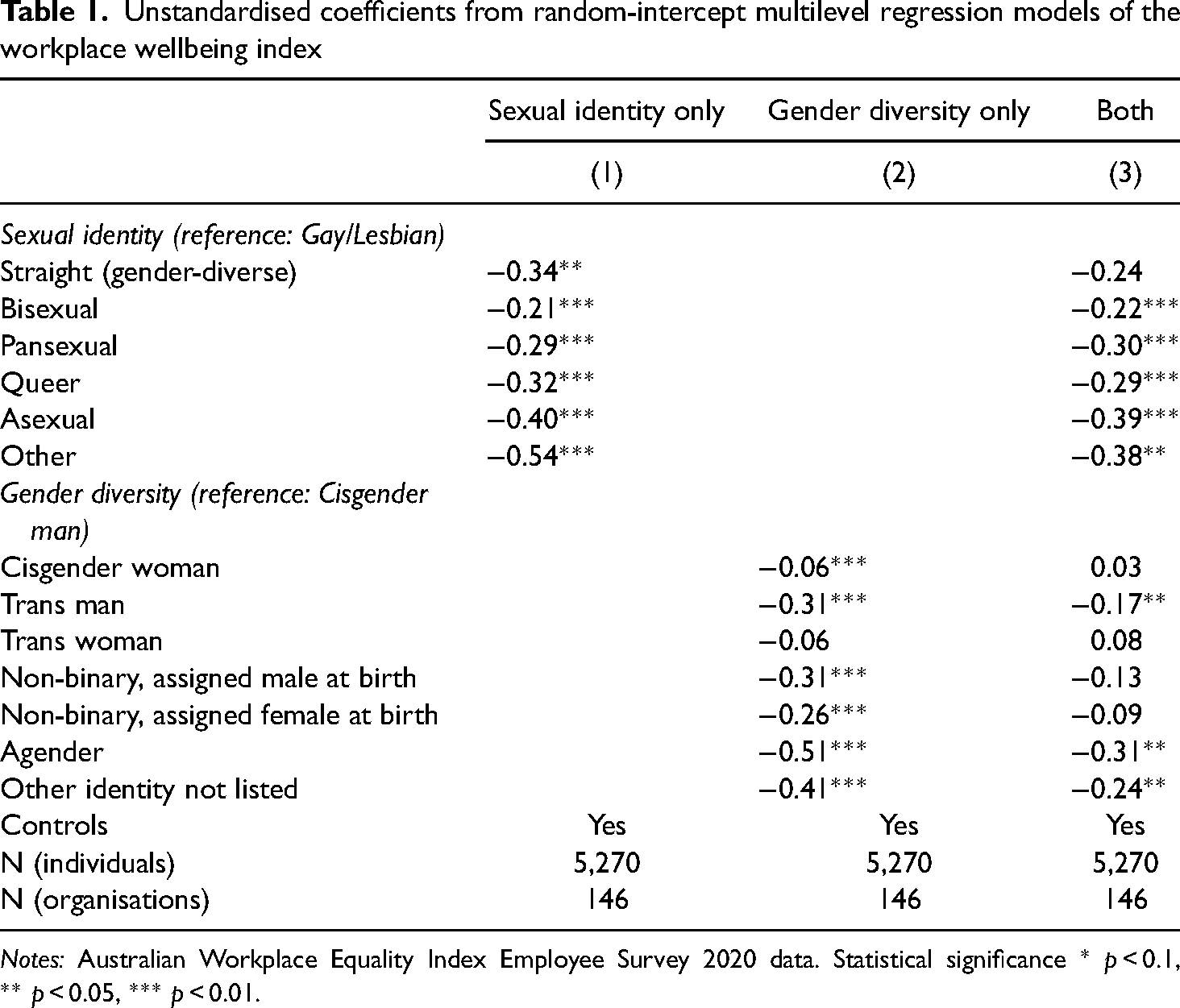
Notes: Australian Workplace Equality Index Employee Survey 2020 data. Statistical significance * p < 0.1, ** p < 0.05, *** p < 0.01.
Model 2 shows the results of an analogous random-intercept multilevel regression model of workplace wellbeing in which the key explanatory variable is a measure of gender diversity (reference = cisgender man). The results indicate that all gender-diversity groups report lower levels of workplace wellbeing than cisgender men. This applies to cisgender women (β = −0.06, p < 0.01), non-binary people assigned male (β = −0.31, p < 0.01) or female (β = −0.26, p < 0.01) at birth, trans men (β = −0.31, p < 0.01), people with ‘other’ gender identities (β = −0.41, p < 0.01), and agender people (β = −0.51, p < 0.01). For trans women, the relationship had the same direction, although it was not statistically significant (β = −0.06, p > 0.1). Overall, therefore, the results reveal a negative and statistically significant relationship between identifying as someone of diverse gender identity and workplace wellbeing.
In Model 3, both sexual and gender identity are used as predictors. The results highlight the overlapping effects on workplace wellbeing of gender and sexuality. Once both factors are introduced into the model, the coefficients on the dummy variables for certain gender-identity categories are no longer statistically significant. The coefficients on the sexual-identity categories demonstrate that all groups still report lower levels of workplace wellbeing than the gay/lesbian reference group, ceteris paribus. This applies to people identifying as bisexual (β = −0.22, p < 0.01), queer (β = −0.29, p < 0.01), pansexual (β = −0.30, p < 0.01), ‘other’ sexual identity (β = −0.38, p < 0.05), and asexual (β = −0.39, p < 0.01). The straight (but gender-diverse) sexual-identity group also exhibits lower levels of wellbeing than gay/lesbian respondents, but the difference is not statistically significant (p > 0.1).
The coefficients on the gender-identity variables in Model 3 also reveal differences in reported workplace wellbeing among some of the groups, net of sexual identity. In particular, trans men (β = −0.17, p < 0.05), people with ‘other’ gender identities (β = −0.24, p < 0.05) and agender people (β = −0.31, p < 0.05) all reported lower levels of workplace wellbeing than cisgender men, ceteris paribus. Non-binary people, trans women and cisgender women exhibited no statistically significant differences in workplace wellbeing compared to cisgender men in this model. Altogether, these results suggest that the lower workplace wellbeing reported by non-binary people, trans women and cisgender women might be a function of their sexual identities, rather than their gender identities. This is consistent with the fact that a large portion of them identify as sexually diverse.
To better convey the magnitude of the effects in this model (Model 3), we also present the results converted to predicted means for selected gender-identity and sexual-identity groups. Specifically, we calculated the predicted means in the outcome variables across people with different gender and sexual identities in our sample, if these people had the same values in all control variables. Figure 1 shows how gay/lesbian people report the highest levels of workplace wellbeing, with their predicted mean on the index equalling 4.2 units (on a scale of 1 to 5). Queer and pansexual people report mean scores just below 4.0 units, while asexual respondents have the lowest predicted means at around 3.8 units. These results align with earlier literature reporting differences in workplace outcomes among LGBTQ+ people, suggesting that those identifying as gay/lesbian reported better wellbeing outcomes (Booker et al., 2017; McInroy et al., 2020). The results are also consistent with previous empirical scholarship indicating that pansexual people experience greater disadvantage in health than bisexual people (Greaves et al., 2019).
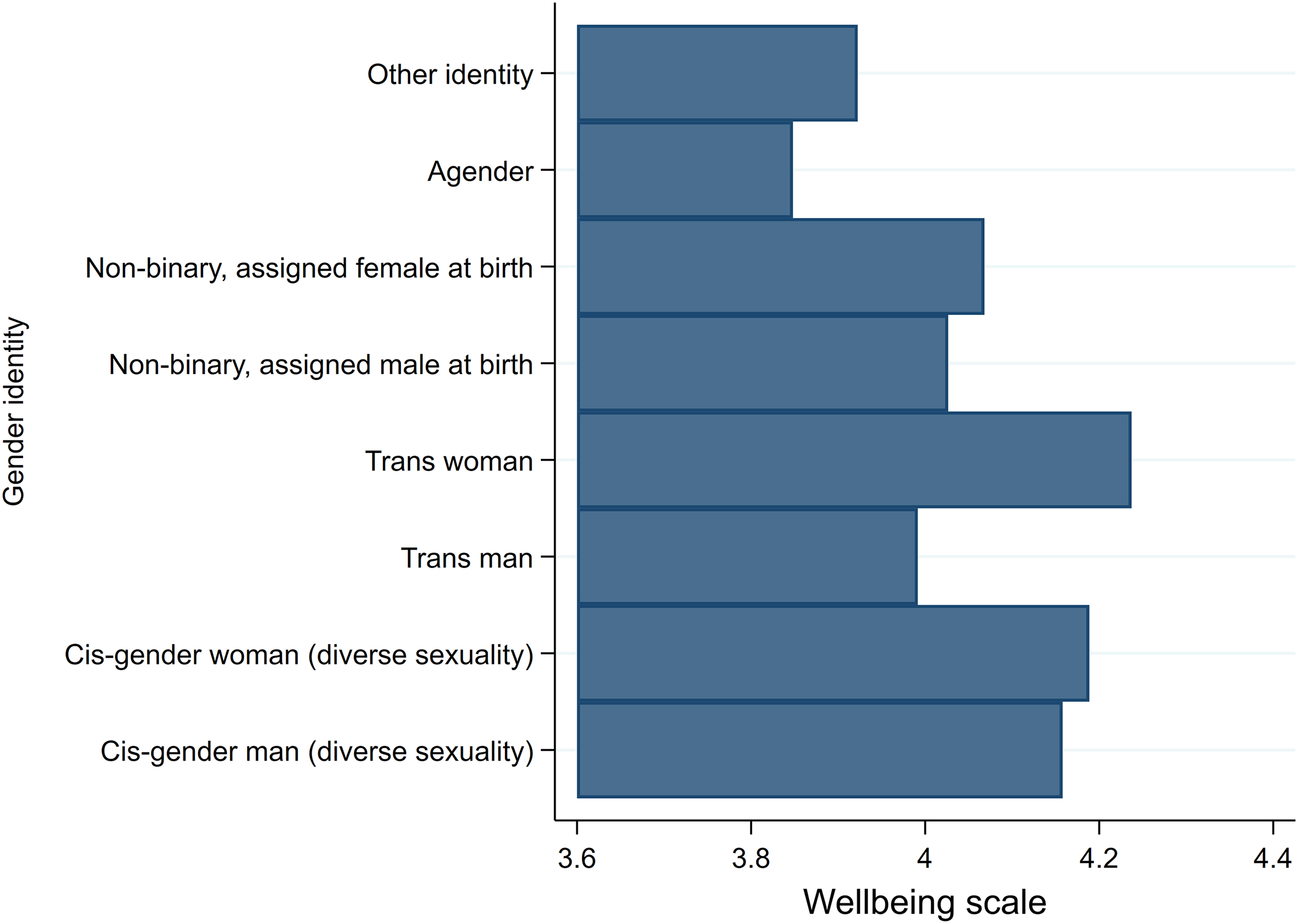
Predicted wellbeing by sexual identity.
Analogous results for the gender-identity variable based on Model 3 are presented in Figure 2. The predicted means of workplace wellbeing are similar for cisgender men and cisgender women with diverse sexualities, with cisgender women reporting slightly higher mean scores on the wellbeing index (4.2 units compared to 4.1 units). There are also significant differences in the predicted means of trans men and trans women, with trans women displaying higher workplace wellbeing than trans men (4.2 units compared to 3.9 units). The results thus reveal within-group differences in wellbeing among people with minority gender identities, especially between cisgender, trans and non-binary people, which is consistent with previous literature (see e.g. Aparicio-Garcia et al., 2018).
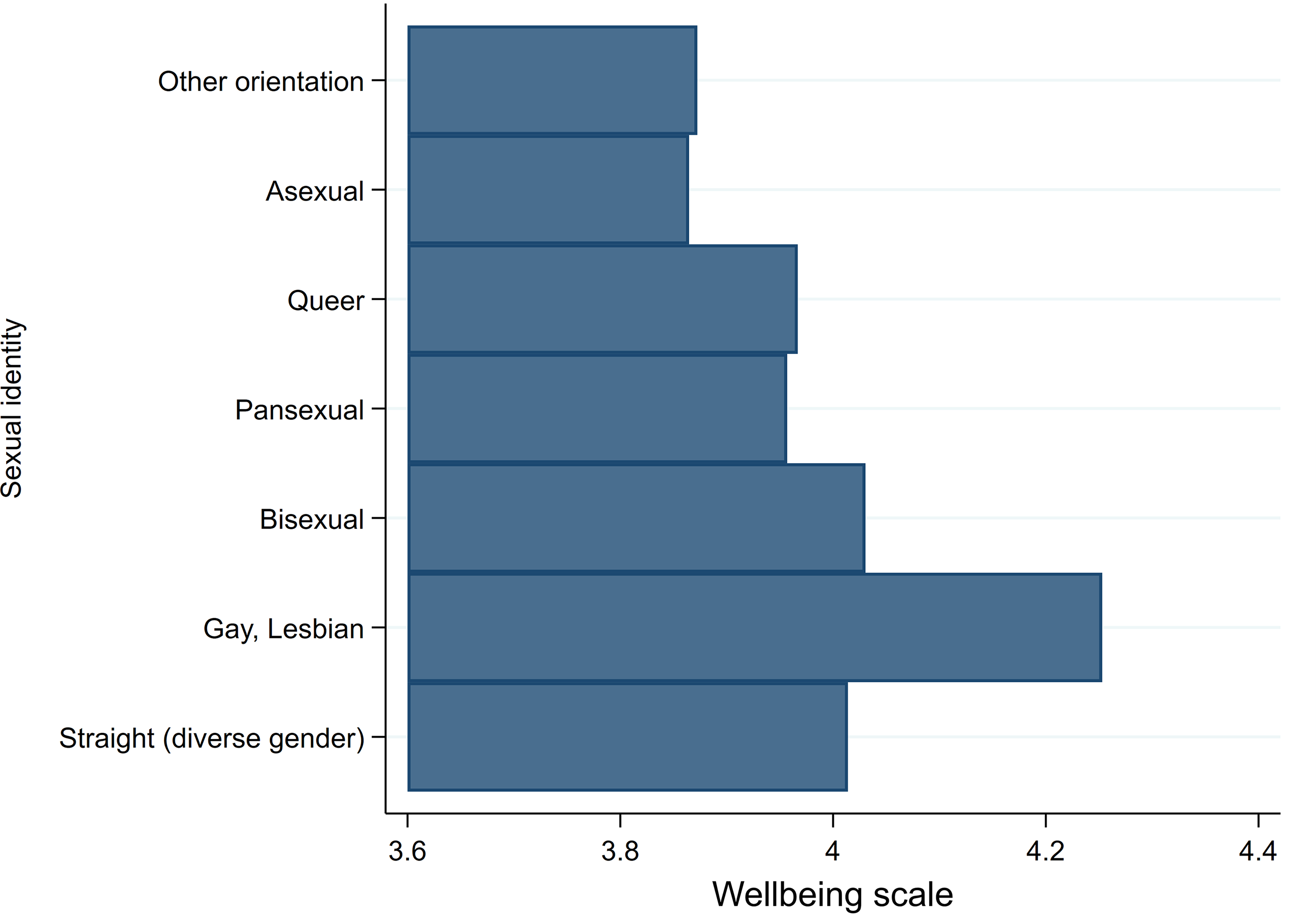
Predicted wellbeing by gender identity.
Discussion and conclusion
This article has used unique Australian survey data to explore differences in workplace wellbeing across nuanced gender- and sexual-identity groups. In doing so, we moved beyond existing scholarship that only captures gender and sexual identity using coarse categorisations.
Our first theoretical expectation was that individuals with plurisexual identities (e.g. bisexual and pansexual) would report lower levels of workplace wellbeing than individuals with monosexual identities (e.g. gay or lesbian). This expectation was based on previous evidence indicating that individuals with plurisexual identities exhibit greater health disadvantage than individuals with monosexual identities (Booker et al., 2017; Chan et al., 2020; Perales, 2019; Perales & Campbell, 2019), and accounts of greater stigma and exclusion against individuals holding plurisexual compared to monosexual identities (Dyar et al., 2015; Flanders et al., 2017; Hayfield, 2021; McLaren & Castillo, 2020). Consistent with this prediction, our analyses revealed that bisexual and pansexual employees reported significantly lower levels of workplace wellbeing than gay/lesbian individuals. Out of all plurisexual identity groups, pansexual people reported the lowest workplace wellbeing. Although plurisexual groups share similar experiences of discrimination, pansexual people may be exposed to more intense levels of stigma, being more likely to be deemed sexually promiscuous, untrustworthy and ‘incapable’ of committing to monogamous relationships (Prior, 2021). These findings also align with research documenting particularly pronounced health disadvantages among pansexual people, compared to bisexual people and other plurisexual groups (Greaves et al., 2019). Overall, we conclude that the marginalisation of plurisexual communities appears to extend to the workplace environment, perhaps because colleagues are less supportive and understanding of their identity.
Our second theoretical expectation was that workplace wellbeing would be lower for individuals who identified as gender non-conforming (i.e. non-binary and agender), compared to cisgender-identifying individuals. This prediction was based on theoretical and empirical scholarship pointing to disadvantage in mental health, social wellbeing, and work outcomes for people identifying outside the gender binary (Burgwal et al., 2019; Goryunova et al., 2021; Waite, 2020). Our results were partially consistent with this theoretical expectation, as agender people reported lower workplace wellbeing than cisgender men. Theories of minority stress and cisnormativity can be useful in understanding why such inequalities in health for agender people may exist. This disadvantage could be the result of social control processes penalising gender non-conformity among agender people. Particularly, agender people challenge social norms of gender itself, where gender is prescribed as a natural and fixed category falling into the man/woman binary. People who identify as gender non-conforming may thus be disadvantaged in the workplace for resisting patriarchal, heteronormative and cisgender boundaries (Boncori et al., 2019). As agender people commonly identify ‘without a gender identity’, multiple genders or beyond-binary ideas of gender, their workplace wellbeing may be influenced by identity misunderstanding and erasure, pressures to conform to a binary gender, and invisibility in representation (Boncori et al., 2019). More scholarly attention is needed to understand how agender people experience their workplaces.
Our third theoretical expectation was that differences in workplace wellbeing across subgroups of the LGBTQ+ community would be related to group size. Individuals belonging to larger and hence more visible minority groups may be less likely to be misunderstood and also more likely to receive the support of similar others. Consistent with this, our analyses revealed significantly lower levels of workplace wellbeing for smaller gender- and sexual-minority groups – trans men (n = 81), agender (n = 26), asexual (n = 112), pansexual (n = 306), queer (n = 260), and ‘other’ gender (n = 45) and ‘other’ sexual-identity groups (n = 29) – compared to larger groups – such as cisgender (n = 4,820) and gay/lesbian (n = 3,305) employees. These findings suggest that the visibility and prevalence of a group in the workplace might influence their wellbeing. One explanation for this could be that colleagues or lay people are not often educated on how to interact with or support individuals from less-mainstream gender and sexual identities. The more mainstream and visible a minority group is, the more likely it is that other people may be aware of their needs. This has been demonstrated in research on intergroup contact, which shows that the forming of relationships, peer groups, and LGBTQ+ networks, increases the likelihood of ally behaviour, knowledge of LGBTQ+ issues, and awareness of diversity (Knepp, 2020).
Although we predicted that non-binary and trans employees would report lower workplace wellbeing than cisgender employees due to group size, trans men, agender people and people with ‘other’ gender identities were the only gender-diverse groups for which we found statistically significant differences. The lower workplace wellbeing of trans men in our study aligns with research by Dispenza et al. (2012), who reported that trans men experienced higher levels of workplace disadvantage, including micro-aggressions and lower social support. Our results also resonate with studies on gender-minority stress highlighting the continued experiences of discrimination and transphobia faced by gender-diverse people – both in and out of the workplace – and the health inequalities stemming from these experiences (Rood et al., 2016; Tan et al., 2021). Trans men’s wellbeing at work, specifically, may be impacted by misgendering, lack of access to support networks, gender policing, and the presence of hegemonic masculine norms (Budge et al., 2010). Other studies have illustrated added pressures for trans men to conform to traditional masculine identities in the workplace, documenting (micro-)aggressions from co-workers if they did not present ‘sufficiently masculine’ (Jeanes & Janes, 2021). Taken together, this body of evidence and our new findings point to unique workplace stressors affecting trans men, resulting in lower workplace wellbeing.
Limitations and avenues for further research
Despite the novelty and strengths of our study, some limitations need to be acknowledged. First, as the AWEI Employee Survey data were derived from a non-probability sampling method, the sample might not be representative of the wider population. As a result, our findings cannot be readily generalised to all LGBTQ+ employees in Australia. This also means that the measures of statistical inference used in our analyses are only indicative and need to be interpreted with caution. Second, as the AWEI Employee Survey is completed on a voluntary basis, there is also a possibility of participant bias. For example, its respondents may have self-selected into the sample and may have views and experiences that are not representative of people who declined to participate. Altogether, these limitations call for further research replicating our findings using representative samples of LGBTQ+ employees – once these data become available.
Our results also showcase the need for future research into LGBTQ+ workplace experiences, pointing to useful avenues for further inquiry. First, our research conceptualises workplace wellbeing outcomes for diversity groups using queer theory and the minority stress model. Consistent with hypotheses derived from these perspectives, we were able to empirically demonstrate the existence of disparities in workplace wellbeing between subgroups of the LGBTQ+ umbrella. However, this study did not identify specific workplace stressors or indicators of cis/heteronormativity that could offer direct answers as to why certain identity groups reported lower wellbeing. In our theoretical set up, we speculated that factors such as co-workers’ degree of support of LGBTQ+ employees, co-workers’ understanding of different groups and their needs, and workplace cultures that permit or endorse micro-aggressions against LGBTQ+ employees may be behind the observed associations. New studies should be conducted to determine whether these or other mechanisms are responsible for workplace wellbeing disparities across LGBTQ+ groups.
Our findings also open additional pathways for future research. For example, the present study has focused on the ‘main’ or ‘direct’ effects of gender and sexuality diversity on workplace wellbeing. It is however important to acknowledge that the level of workplace disadvantage and ensuing level of workplace wellbeing of employees with diverse genders and sexualities may be intersectional in nature (see e.g. Cech & Rothwell, 2020). That is, the workplace wellbeing of different groups within the LGBTQ+ umbrella may differ to varying degrees depending on these individuals’ other socio-demographic traits – including their ethnicity, birth cohort, socio-economic background, or health status. We hope that the present study spurs further research that examines the intersectional nature of workplace wellbeing for different LGBTQ+ groups along these and other axes. The resulting findings would likely provide a more nuanced understanding of the processes that may be at play in producing and reproducing wellbeing hierarchies across employee groups.
Likewise, the characteristics of employees’ workplace environments may be an additional, plausible source of effect heterogeneity (Cech & Rothwell, 2020). The statistical models in this study were adjusted for relevant job-level factors, such as employment type, job level, and workplace location. This rules out confounding bias to our focal findings on the different gender and sexuality diversity groups due to these various factors. However, it was beyond the scope of our analytic approach to test whether and how differences in workplace wellbeing between different gender and sexuality groups may be contingent on these and other workplace characteristics (e.g. occupational group, industry of work, workplace diversity policies, and colleagues’ attitudes and behaviours). Subsequent quantitative and qualitative research that explores the potential moderating role of these workplace factors on the workplace wellbeing of employees from different LGBTQ+ groups is warranted.
Implications for policy and practice
The findings reported in this study have important implications for policy and practice aimed at improving the workplace wellbeing of gender- and sexual-minority groups. Although many respondents in the AWEI Employee Survey reported relatively higher scores on the wellbeing index, scores were consistently lower for certain diversity groups. For example, plurisexual, gender-diverse and smaller identity groups experienced poorer workplace wellbeing than gay, lesbian and cisgender employees. This suggests that these groups would benefit the most from extra efforts and novel approaches to workplace inclusion, and that employers should prioritise workplace supports that cater to their needs and circumstances. LGBTQ+ focused educational programs for employees may be an important tool for employers to foster more inclusive, aware, and accepting environments for those identity groups that may experience less visibility and more isolation in the workplace, including agender and asexual people.
These arguments align with those of scholars who have critiqued workplaces for adopting ‘universal’ LGBTQ+ inclusion models, without assessing the needs of individual identity groups (Ng & Rumens, 2017; Ozturk & Tatli, 2016). As a result, existing LGBTQ+ inclusion initiatives may favour more visible and institutionalised groups (e.g. lesbian/gay employees), and may not go far enough in dismantling cis/heteronormative workplace cultures that oppress smaller and less visible groups (Ng & Rumens, 2017). It follows that tailored workplace policies are imperative to improving the working lives of all, not a select few, gender and sexually diverse employees, and that this requires employers to evaluate the impacts of inclusion policies across subgroups. In simpler words, organisations should steer away from ‘one size fits all’ approaches to LGBTQ+ inclusion and diversity.
Supplemental Material
sj-docx-1-jos-10.1177_14407833221118383 - Supplemental material for Workplace wellbeing among LGBTQ+ Australians: Exploring diversity within diversity
Supplemental material, sj-docx-1-jos-10.1177_14407833221118383 for Workplace wellbeing among LGBTQ+ Australians: Exploring diversity within diversity by Madeline Donaghy and Francisco Perales in Journal of Sociology
Footnotes
Acknowledgements
This research was supported by the Australian Research Council’s Centre of Excellence for Children and Families over the Life Course (CE200100025). The authors would like to thank Pride in Diversity and ACON Health for enabling access to their data, and Lisa McDaid, Christine Ablaza, Alice Campbell, Dawn Hough, Nicki Elkin and Jess Mayers for their support and helpful comments on the research.
Declaration of conflicting interests
The author(s) declared no potential conflicts of interest with respect to the research, authorship, and/or publication of this article.
Funding
The author(s) disclosed receipt of the following financial support for the research, authorship, and/or publication of this article: This work was supported by the Australian Research Council (grant number CE200100025).

Supplemental material
Supplemental material for this article is available online.
Author biographies
Madeline Donaghy is a recent graduate from the School of Social Science at The University of Queensland. Her Honours thesis explored the workplace wellbeing of LGBTQ+ Australians, using quantitative methods, and is the basis of this article.
Francisco (Paco) Perales is Adjunct Associate Professor of Sociology at The University of Queensland. His research uses longitudinal and life-course approaches and quantitative methods to enhance our understanding of social stratification in contemporary societies. His recent work has concentrated on identifying the drivers of socio-economic inequalities by socio-economic background, gender, and sexual orientation within Australian society. His work has recently been published in outlets such as Demography, Social Forces, Journal of Marriage and Family, Population and Development Review and Social Science & Medicine.
References
Supplementary Material
Please find the following supplemental material available below.
For Open Access articles published under a Creative Commons License, all supplemental material carries the same license as the article it is associated with.
For non-Open Access articles published, all supplemental material carries a non-exclusive license, and permission requests for re-use of supplemental material or any part of supplemental material shall be sent directly to the copyright owner as specified in the copyright notice associated with the article.
