




Abstract
Young women's risky drinking cultures are pertinent to the world of amateur Australian Football League, yet they have received limited research attention. Drawing on surveys, focus groups, and semi-structured ‘scroll-back’ interviews, this study provides an in-depth investigation of negotiations of gender and risky drinking in such cultures. A range of intersecting socio-cultural themes were identified, summarised into four overarching elements: drinking as central to initial homosociality; awareness of appropriateness; divergences between women's and men's cultural priorities and alcohol behaviours; and young women's unique cultural prioritisation of collectivity and mutuality. The findings further sociological knowledge on risky drinking and gender.
Keywords
Introduction
Alcohol consumption is deeply embedded in many Australian socio-cultural activities and norms. Though population-level drinking continues to decline, a significant minority still drink at levels that increase risk of harm (AIHW, 2020). Age and gender are compounding factors for such groups, with being young and being a man being stand-out correlates of risky drinking (Livingston et al., 2018). Despite the persistent gender gap in alcohol consumption, a significant minority of women also drink at risky levels (Livingston et al., 2018), leading to a growth of research on women's alcohol cultures (MacLean et al., 2019; Palmer, 2015; Palmer & Toffoletti, 2019). Contributing to this work, we argue that young women who play amateur Australian Football League (AFL) 1 are a key population for researching alcohol cultures. Indeed, the ‘social worlds’ (Room et al., 2022) of AFL are archetypal sites of heavy and often risky drinking, though research attention predominantly falls upon men's alcohol consumption (Roberts et al., 2019; Palmer, 2009). This gives a partial view of ‘the holy trinity of alcohol, sport and gender’ (Palmer, 2011: 173) that is ingrained in Australia. Situated in the context of contemporary femininities and women's social and homosocial (i.e. platonic, same-sex) relationships, women perform, participate in, and perpetuate drinking norms and behaviours in these social worlds, negotiating unique cultural priorities of collectivity and mutuality in distinctly gendered ways.
Our interest in this social world is framed by the Alcohol Cultures Framework (ACF) (VicHealth, 2019b), a planning tool for those with an interest in changing risky drinking cultures to reduce harms from alcohol products. ACF practitioners and participants are called to focus on social worlds where risky drinking is commonplace, and consequently shift elements within that world to ensure drinking can be ‘done’ in less risky ways. Three key elements are outlined as fundamental: settings, skills, and shared meanings. As such, the contribution of this article is to sociologically explore how and why women who play amateur AFL in Victoria drink and describe the dynamics of such drinking. We use Social Practice Theory (SPT) as a lens to attend to these questions, making use of the theory's scope to sociologically unpack social behaviours that are an ‘embodied practice that is grounded in everyday life and part of local (youth) cultures’ (Roberts & Ravn, 2020: 262), in the particular ‘social world’ of young women AFL players.
The article proceeds as follows: we first review existing literature on the relationship between sport, alcohol, and gender, illustrating current gaps in the field; then establish SPT and the ACF as essential research frameworks; and conclude that young women's perspectives and experiences are needed for a fuller picture. The research design is then described, discussing the theoretical and practical justifications for our methodology. The thematic findings are subsequently analysed through an SPT lens under the following headings:
Drinking as central to initial homosociality Awareness of appropriateness Comparisons between women's and men's cultural priorities and alcohol behaviours Young women's uniquely gendered cultural prioritisation of collectivity and mutuality.
Finally, in the conclusion, the dynamic, divergent narratives of young women in the social world of AFL are evaluated, and future directions for research and policy outlined.
Literature review
The literature review is split into two sections. First, we discuss key conceptual terms that frame the study, namely the definition and application of the term ‘drinking culture’ and the concepts of ‘social worlds’, SPT, and the ACF. Second, we consider more empirical literature, first discussing relevant, recent, and comparable work on men's risky drinking, then analogising rugby literature and discussing socio-cultural perceptions of appropriateness to surface specific issues pertaining to women, drinking, and gendered norms.
Concepts, theories, and frameworks
Despite mounting academic discourse relating to ‘drinking culture’ (Savic et al., 2016), in recent decades little explicit definition has emerged. Accordingly, the term is often situated abstractly and ambiguously, left open to interpretation, thus becoming ‘paradoxically … commonsense and unproblematic – something that the reader intuitively understands’ (Savic et al., 2016: 271). Consequently, discussions primarily focus on problems associated with or induced by alcohol patterns and intoxication, disregarding alcohol-affiliated culturally significant meanings and practices. Similarly, public health discourse relating to drinking perceives (particular extents of) alcohol use as fundamentally risky and harmful, regardless of its context and purpose. For example, Australia's National Health and Medical Research Council (AIHW, 2020: 18) defines risky drinking as a lifetime risk for alcohol consumption of more than two standard drinks on any day, and a single occasion risk of more than four standard drinks on a single occasion. Yet such health messaging fails to ‘engage with the realities and pleasures’ (Roberts et al., 2019: 3) of drinking, limiting recognition or respect among those the recommendations are constructed for.
Thus, summarising emerging interpretations, Savic et al. (2016: 280) conclude that: Drinking cultures are generally described in terms of the norms around patterns, practices, use-values, settings and occasions in relation to alcohol problems that operate and are enforced (to varying degrees) in a society (macro-level) or in a subgroup within a society (micro-level).
The multi-dimensional nature of drinking cultures indicates their non-static, non-prescriptive character. Accordingly, we situate drinking culture as a network of meanings, continuously renegotiated and reconstituted, rather than passively transmitted, attending to its non-uniform nature, manifesting in relation to other ‘actors, use-values, practices and settings’ (Savic et al., 2016: 276). The notion of a national drinking culture, or indeed a national Australian culture, is problematic – complete cultural uniformity is rare, and in Australia (typically touted as a hub of multiculturalism), cannot be presumed, meaning ‘subcultures’ or ‘contracultures’ are impractical concepts in the context of drinking and AFL, as no singular culture that these characteristics can be ‘sub’ to exists (Savic et al., 2016).
We therefore employ the sociological concept of ‘social world’ (Cressey, 1932; Room et al., 2022; Shibutani, 1961; Unruh, 1980), indicating a cultural entity that has limited claim on participants’ lives, meaning members can participate in and move between several ‘worlds’. Coined by Chicago school symbolic interactionists, Cressey’s (1932: 31) early exploration of the unique realm of taxi-dance halls offers a useful definition: It is a distinct social world, with its own ways of acting, talking and thinking. It has its own conception of what is significant in life, and – to a certain extent – its own scheme of life.
Social worlds, therefore, encapsulate the ‘imagery, processes, interaction, and relationships’ that unite phenomena, originating in the ‘lexicon of everyday life’ (Unruh, 1980: 272). Each has a characteristic set of activities, and relative behaviour guided by norms, which Room (1975: 364) explains as ‘building blocks of cultural entities, the units of momentum which together compose what has been described as the flywheel of culture’. These units are understood as rules or expectations in social worlds, affecting or enforcing behaviour or non-behaviour. Sport is an example of a social world that periodically draws participants together, where shared interest dictates degree of involvement. As Room et al. (2022) contend, ‘social worlds’ is a useful concept for identifying and investigating collective drinking cultures. Yet it remains under-utilised, despite drinking being primarily a social activity, and a secondary presence in shared sociable occasions in social worlds (Room et al., 2022).
SPT is complementary to studying the alcohol cultures of social worlds. A major sociological framework, SPT maintains an emphasis on ‘understand[ing] the complexities of mundane performativity’ (Halkier, 2017: 395) and ‘foreground[s] the everyday embeddedness of practices and their normative regulation’ (Roberts & Ravn, 2020: 262). SPT is increasingly applied to the study of a number of embodied practices, including consumption (Warde, 2005), eating (Warde, 2016), sexting (Roberts & Ravn, 2020), and drug use (Bengtsson & Ravn, 2018), and has a major influence in sociological studies of alcohol use (see e.g. Hennell et al., 2020; Savic et al., 2016). SPT, in contrast to traditional public health paradigms, emphasises social practices as carried by individuals, rather than isolated processes. Dominant research modes relating to alcohol cultures follow an individualistic (Hunt & Barker, 2001) and/or social determinant (Peele, 1997) perspective, centralising the burden of responsibility on the individual. This disregards the influence and importance of contextual factors within a social world and the practices through which they are operationalised. SPT draws attention to three interconnected elements: meaning (that is, cultural conventions, expectations, and socially shared meanings), material (such as objects, tools, and infrastructures), and competence (namely knowledge and embodied skills) (Shove et al., 2012: 19).
Regarding drinking, ‘material’ can denote the type, setting, and facilitating technologies of alcohol consumption; ‘meaning’ encompasses the various significances of drinking with peers; and ‘competence’ conveys the gendered nature of drinking, care, and autonomy. These elements interact and inform understandings of how drinking practices ‘emerge, persist, and disappear’ (Roberts et al., 2019: 7) in and across different social worlds. SPT is therefore an increasingly useful lens through which drinking and drug use can be understood as patterned activities that emerge, expand, and transform within specific worlds (e.g. MacLean et al., 2019; Meier et al., 2018). Variations that arise across these contexts are thus illuminated.
SPT shifts the intervention focus from traditional top-down models to the social context, and the practices in which members of a social world are entangled (Supski et al., 2017). This mobilises an exposition of the meaning, material, and competence of risky drinking, enabling SPT to catalyse a reconfiguration of these elements, thereby reducing risk in alcohol cultures. New practices or shifts in prominence of previously marginalised norms (such as abstention or drinking moderately) can therefore be deployed.
The ways that a social world is external and measurable is dependent upon schemas such as VicHealth's ACF (2019a), a tool for those interested in changing such alcohol cultures to reduce harm and risk. The ACF is a translation of SPT, focusing on three separate but overlapping, fundamentally influential cultural elements: settings, skills, and shared meanings (VicHealth, 2019b: 1) – all are central to understanding an ‘alcohol culture’, which is: The way a group of people drink, including their shared understanding of formal rules, social norms, practices, values and beliefs around what is and what is not socially acceptable when they get together.
Evident here are overlaps with the definition of drinking culture, however as we proceed using ACF, ‘alcohol culture’ is used throughout the remainder of the article. Crucially, VicHealth's focus on alcohol culture change does not seek to remove members from a social world. Rather, through a harm minimisation lens, the framework aims to influence and transform drinking norms, expectations, and behaviours, based on pragmatic understandings of risk and social worlds, as opposed to an authoritative, top-down approach. According to VicHealth (2019a), when an alcohol culture permeates a social world, drinking can become harmful for those drinking and those around them. Nonetheless, the framework acknowledges that drinking will endure in social worlds, thus focusing on making drinking ‘less risky’ (VicHealth, 2019a: 9). In practice, this would entail not feeling pressure to drink, non-drinking being viewed as unexceptional, reduction in drinking occurrences, alcohol being consumed in a low-risk way, and intoxication being discouraged (VicHealth, 2019b: 1). The ACF is therefore critical, facilitating the uncovering of effective factors in inducing or reducing risky drinking, thus minimising harm.
The nexus of ACF factors and SPT is exemplified and analysed in research by Roberts et al. (2019). Engaging with a cross-section of social worlds relating to sports, clubs, occupations, and place (that is, metropolitan and regional groups), the research provided an in-depth understanding of men's risky drinking in Victoria. Risky drinking was prevalent across the sample. However, men routinely perceived their drinking to be not risky; their ‘understanding of what constitutes risk and risky amounts of alcohol differed considerably from the national guidelines’ (Roberts et al. 2019: 2, original emphasis). Furthermore, participants regarded alcohol as central to social interaction and connection with other men, and key to the building and strengthening of homosocial relationships. Though type, volume and pace varied across social worlds and settings, participants perceived drinking as a default shared activity. Similar to Thurnell-Read (2012: 7), friendship was identified as central to drinking practices, and therefore cannot be overlooked ‘in favour of a focus solely on the individual body of the drinker’. Furthermore, like MacLean et al.’s (2019) study of same-sex attracted women, the ability to spend money drinking in bars (or similar alcohol-centred settings) facilitated the reinforcement of connections with friends.
Through the SPT lens, Roberts et al. (2019: 2, original emphasis) found that drinking was ‘routinised through repeated (re)enactments of drinking practices on social occasions’. By repeating, re-enacting, and re-experiencing socially established norms of drinking (Butler, 1988), gender is concurrently performed and upheld, alongside alcohol cultures. Like alcohol cultures, gender is legitimised through mundane and ritualised performances (Butler, 1988). However, rather than being an individual choice or an imposition upon an individual, both gender and alcohol are interpreted and conducted within a social world's pre-existing confines. Neither gender nor alcohol consumption are passively scripted, nor determined by ‘nature language, the symbolic, or the overwhelming history of patriarchy’ (Butler, 1988: 531), but continuously ‘put on’, simultaneously shaping and being shaped by one's citizenship in a variety of social worlds.
Alcohol cultures, and women; and alcohol cultures in women’s sport
Skeggs (2005: 965) explores how white working-class women are purported to be the constitutive limit to public morality, reshaping class relations via the making of self, and reinscribing heteronormativity in specific public ways. Through alcohol use and performances of drunkenness, women are forced to display their ‘lack’ of moral value according to symbolic values generated by four processes: Increased ambivalence generated by the reworking of moral boundaries; new forms of neo-liberal governance in which the use of culture is seen as a form of personal responsibility by which new race relations are formed; new ways of investing in one's self as a way of generating exchange-value via affects and display; and the shift to compulsory individuality …
Women who binge drink are therefore highlighted as a significant threat, to the state and morality of a nation, but also to themselves. Such perceptions frame women as central to both the upkeep and downfall of rigid gender norms and values. Through this lens, women's participation in sport and drinking can be analysed.
In Australia, AFL and rugby are arguably the dominant sporting cultures, similar in their characterisation as hyper-masculine social worlds that exemplify risky drinking. Literature denotes rugby as a male preserve: a social setting for the expression, often in extreme forms, of masculine norms. Perrot (1987) notes that a domain can be deemed as such if it has:
a social history technical and symbolic characteristics over-ridingly masculine expected qualities a low percentage of women participants.
As both rugby and AFL fulfil these criteria, we will here analogise key norms of the former in order to analyse women's drinking in the latter social world.
Sporting social worlds are historically heteronormative and masculine, reinforcing patriarchal power relations (Gye, 2015: 2192). Women, for example, attempt to counteract the gendered order of rugby by negotiating the social construction of femininity via their bodies. This is typical of other physically aggressive sports, where women enact violence or otherwise contradict hegemonic perceptions of femininity (Fuchs & Le Hénaff, 2014). Additionally, drinking's purpose in the social world of rugby is twofold, serving as a means of ‘testing, expressing, and accentuating masculinity’ (Sheard & Dunning, 1973: 17), and a process through which internalised restraints can be loosened. For example, in France, rugby has been deemed a site of drinking-induced gender deviance, enabling women to consider themselves ‘real’ sportspeople (Fuchs & Le Hénaff, 2014: 370).
Here, drinking is both a norm (drinking to be a ‘rugby woman’) and a threat (drinking to the extent of no longer being a ‘real woman’), resulting in paradoxical, iterative constructions of femininity that flirt ambiguously with masculinity (Fuchs & Le Hénaff, 2014: 368). As Measham (2002: 349) explains: The loss of control is to some extent controlled, no matter what the results look like to observers. It is a ‘controlled loss of control’.
Consequently, women must also negotiate their drinking intensity, in addition to their entry and presence in their social world. A precarious balance ensues, whereby women fight to be regarded as both real athletes and real women. Such negotiations vary according to individual dispositions and the sport's institutional context, meaning every woman's relationship with femininity is uniquely built. Drinking is thus assigned a specific meaning, shaped through collective learning, and facilitating group homogeneity. However, particular kinds of alcohol consumption (e.g. binge drinking) can symbolically express gender, particularly masculinity (Fuchs & Le Hénaff, 2014). Women who engage in binge drinking are therefore perceived as a significant threat to themselves and society, deviating from archaic, pervasive norms (Skeggs, 2005). Although alcohol consumption enables young women to transgress norms (thereby asserting a necessary and specific identity), it remains governed by a deeply imbued concern for maintaining femininity.
Concomitantly, Palmer and Toffoletti’s (2019) critical postfeminist lens elucidates the complexities of women, sport and drinking by interrogating socio-cultural frameworks within which women perform and understand their own subjectivity, agency, and limits. Postfeminism champions ‘women's equality through demonstrations of personal empowerment, which include women “owning” their femininity and exhibiting choice, agency and the capacity to succeed in all spheres of life’ (Palmer & Toffoletti, 2019: 111). Rather than perceiving drinking merely as a necessary form of (threatening) transgression, Palmer and Toffoletti (2019) suggest that drinking-related activities performed by women in sporting social worlds shift norms and meanings, illuminating drinking as an important form of sociality and pleasure, and a site for the negotiation of new norms and formations of femininity.
This shift refocuses the conceptualisation of drinking and sport away from traditional perceptions of hegemonic masculinity to ‘hegemonic drinking’ (Palmer & Toffoletti, 2019: 113, original emphasis), with gendered implications and effects. By broadening the scope of sport-related drinking to include specific forms (such as the unique narratives of women in AFL), in addition to emerging ways that gender is ‘done’ or performed, postfeminism thus reinvigorates and expands dialogue about new forms of consumption, while facilitating a reconstruction of traditional sport and drinking norms.
Methods
The research design optimised the quality of data collected within the practical limitations of an honours thesis and Covid-19 restrictions on movement and gathering. Ultimately, a mixed methodology of focus groups, interviews, and surveys revealed the multi-faceted nature of alcohol cultures.
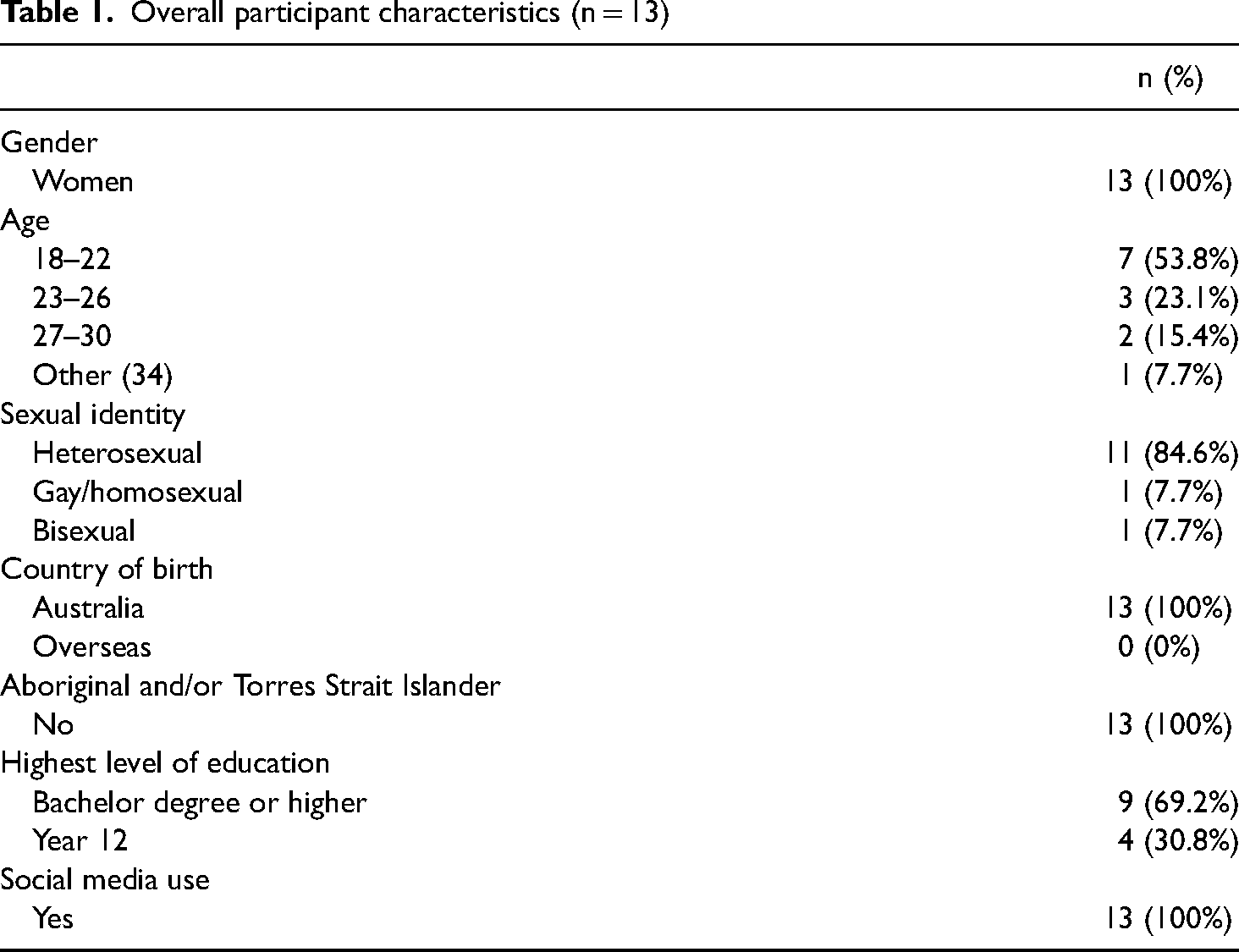
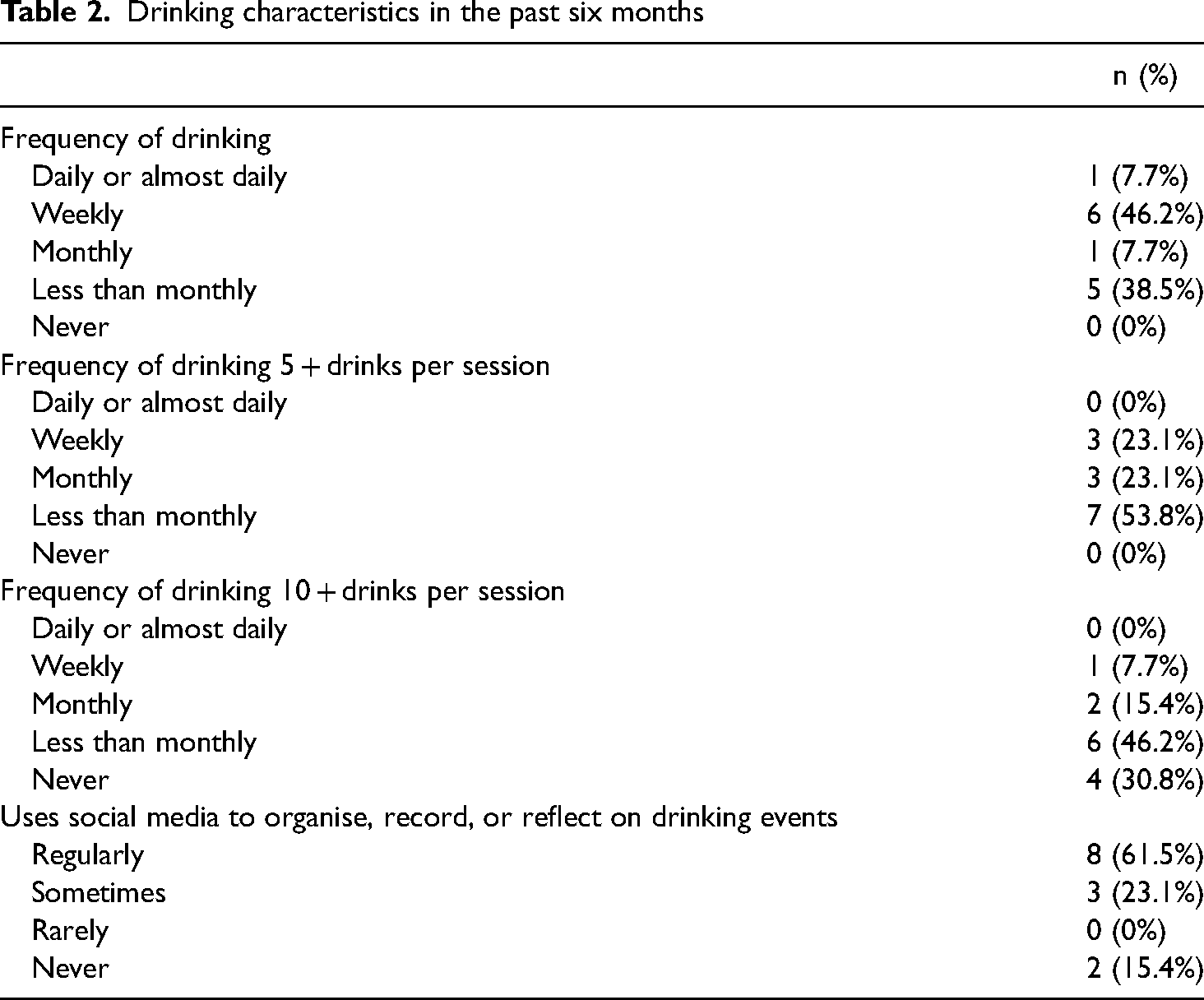
Thirteen participants were recruited via Facebook ads and snowball sampling. Participants first completed a short survey, providing socio-demographic details and basic information about drinking and social media practices. Per Table 1, all participants identified as women and were born in Australia, however none identified as Aboriginal and/or Torres Strait Islander. The median age range of participants was 18–22 years, and the overall range was 18–34 years. Most participants identified as heterosexual and over half held a Bachelor degree or higher. Social media use was ubiquitous. All played in divisions within the Victorian Amateur Football Association (VAFA). While not a representative sample, this research sought depth, rather than generalisability. Per Table 2, drinking was pervasive among the sample.
Overall participant characteristics (n = 13)
Drinking characteristics in the past six months
Drawing on one metropolitan AFL club, two focus groups totalling eight participants were conducted via Zoom, each running for approximately 90 minutes. 2 Stimulated by a list of prompts, discussion was framed with the following themes: drink choice, pace and volume of consumption, perceptions of risky drinking, national guideline definitions, drinking practices, and care approaches. Given that this research is established in a feminist scope, focus groups are considerably less exploitative than researcher–researched power hierarchies in traditional quantitative methods. While no research method can be said to be inherently feminist (Munday, 2006: 94), focus groups disrupt the rigid research dichotomy, empowering participants and allowing a greater degree of control of the research discourse than in surveys or stand-alone interviews (Roberts, 2011: 186). Participants can interpret and answer questions in their own ways, extending or disputing the responses of others to develop deeper discussion (Munday, 2006: 101). Indeed, participants ‘can and do challenge and contradict each other’ (Montell, 1999: 51), thereby producing both personal and collective perspectives that oftentimes could not be elicited in individual interviews. Alcohol cultures do not occur in isolation but emerge fluidly; they are collective and non-static. Focus groups were therefore employed to facilitate a composite understanding of young women's perceptions and performances of drinking and risk, and the extent to which they reject or reinforce norms. The data collection was conducted by Lily Curtis. While not an AFL player, being a young cis-woman of comparable age to participants perhaps led to more elaborate and open discussions of issues that might otherwise have been inaccessible. Nonetheless, we also recognise that rapport is not automatically established through gender matching (Thwaites, 2017).
Additionally, eight participants from six different clubs (including three participants who had been in focus groups) were interviewed one-on-one using the semi-structured social media ‘scroll-back’ (Robards & Lincoln, 2017) method. Using the complementary apparatus that examines specific alcohol-related events or moments, participants were called to attend to the temporal dimensions of sustained use, and examine their ‘data’ as a personal record of lived experience via Instagram, Snapchat, and Facebook. These primarily served as prompts to elicit in-depth reflections on real events. Though alcohol cultures have traditionally been locally bounded, they are increasingly mediated through online spaces (Goodwin et al., 2016: 1), offering diverse ways in which gendered, sporting, and drinking experiences can be communicated. Therefore scroll-back interviews were employed to capture an understanding of young women's narrative construction (Robards & Lincoln, 2017: 720), particularly in critical, transitional, or risky moments.
This research was approved by the Monash University Human Research Ethics Committee (ID: 24578). Prior written informed consent was obtained from participants and verbally maintained throughout data collection. Given the nature of themes discussed, emotional risks were anticipated; topics raised could be embarrassing, emotionally taxing, or result in feeling shamed or disengaged. Consequently, active, empathetic listening was employed to remain alert to potential harms and to avoid exacerbating such feelings.
Findings
A range of intersecting socio-cultural themes was identified in contextualising alcohol cultures. These are summarised into four overarching elements:
Drinking as central to initial homosociality Awareness of appropriateness Comparisons between women's and men's cultural priorities and alcohol behaviours Young women's unique cultural prioritisation of collectivity and mutuality.
Consistent with SPT, elements interact and inform understandings of how drinking practices and norms emerge, persist, and disappear in and across different social worlds. Thus, alcohol does not act ‘on individual bodies alone’ (Savic et al., 2021: 4) but intersects with other factors to produce or facilitate behaviours.
Drinking as central to initial homosociality
Given participants’ initial inexperience with their physical setting and social world, drinking was undertaken to gain confidence and facilitate relationship building during the early stages of playing together. Furthermore, club-organised and -located events primarily centred around drinking during the inaugural stages of women's teams, and beyond their formation. Underscoring the centrality of alcohol to the social world of AFL, S1 referred to a social event organised in the women's first year at an existing men's, school-based club: It was really weird and awkward, ’cause we felt like we were kind of walking in on a men's teams thing, and like, even though it had been pretty much organised by the women's team, I still felt a bit like weird ’cause I didn't know everybody there, but obviously all the men's team knew each other.
The availability of alcohol, men's general disregard, and women's anxieties about unaccustomed competences and settings, meant that participants used alcohol as ‘social lubrication’ (S2, S7) to enact more confident, less inhibited performances of themselves. Similarly, participants used alcohol-focused settings to create initial homosocial bonds during their team's cultural formation:
Drinking was an assumed bonding activity for participants: house parties, clubbing, or having a wine or beer at the clubhouse after playing on a Saturday, for example. Spending time together was therefore equated, consciously or otherwise, to alcohol-convened settings. Training was perceived as an inadequate setting for team-bonding, or developing the rapport necessary for a ‘good, strong team’ (S6). Weekly after-training homosocial team dinners were adopted (per the well-established men's practice), for such purposes. Yet these were primarily attended only by teammates who already knew each other. It was only after ‘a few big nights’ (S2) that participants felt comfortable and confident enough to develop their relationships in non-drinking settings. Given the timing of these events, per the ACF, the team setting became more familiar to participants, and they became more competent in the skills and conventions. Consequently, the focus shifted from alcohol and drunkenness to collective pleasure and friendship, per Palmer and Toffoletti’s (2019) thesis:
Drinking appears central to homosociality for young women, in the same way as for men (Roberts et al., 2019) and older, same-sex attracted women (MacLean et al., 2019). Across focus groups and interviews, when asked if alcohol was a key element of most social occasions, participants immediately said simply ‘yes’. Throughout individual accounts of club alcohol cultures, the use of alcohol as ‘social lubrication’, in initially facilitating the smooth development of relationships with teammates, was a recurring theme:
Accordingly, participants would attend (initially officially club-organised) social events and drink to become ‘a bit more uninhibited’ (F1.1), thereby increasing confidence and sociality. Ease of access and excess facilitated this ‘loss of inhibitions’ (F1.2). This echoes MacLean’s (2016) contention that alcohol use functions as a crucible where young adults can enact and affirm friendships. For young women in the AFL social world, alcohol therefore provides an innate and effective means of constituting friendship. Risky drinking may not be realised here, as participants perceived the need to walk the ‘fine line’ (S5) between drunken and good-mannered behaviour. They did not want to embarrass themselves (thus developing a reputation as a liability or nuisance) but maintained an air of fun and amiability. Subsequent risks to individuals and their relationships required careful management to maintain cultural norms, effectuated by the materials (such as cultural infrastructure) and competence (such as the embodied skills and understandings). These shared meanings are not unique to women's experiences or, speaking more broadly to AFL, and indeed Australian, alcohol cultures.
Five of the teams represented by participants were inaugural in relation to a well-established men's club. Therefore, traditional events and characteristics of the men's club and culture were imparted to the women's team, laying the foundations for a new, emerging culture. Participants explained that, despite differing values between men and women, long-established customs remained. For example, ‘Silly Saturday’, and ‘Mad Monday’ are traditional end-of-season celebrations centred on risky drinking, involving drinking games and dressing up. Many participants fondly recalled the (women's) planning that went into themes and costumes, and shared photos of their efforts. However, costumes were also points of contention across many teams. For example, one participant recalled that, for every Silly Saturday, the coaches (all men), ‘all cross-dressed’ (S2). Any uncomfortable protests were shut down, and women encouraged to laugh it off as ‘ironic’ and ‘funny’. Yet as S2 noted, if the women's team dressed up only as men, it simply ‘wouldn't get the same reaction’ because, as she aptly put it, ‘it's not as funny to be a man, inherently’.
Similarly, at another club's Silly Saturday, controversy ensued when a male player dressed up as a specific female player; the couple were salaciously rumoured to have sexual history. While all other costumes had been meticulously planned and pre-discussed, this male player had insisted on keeping his outfit a surprise. When Silly Saturday arrived, the female player initially did not realise that she was the butt of the male team's joke. Upon comprehending this, she was distraught and engaged in extremely risky drinking. Her female teammates raised the incident with the club leadership immediately, who found the costume ‘too ambiguous’ to recognise, and the team's intimate relationships too personal to interfere with. Those involved were told to ‘have another drink or three’ and forget the episode.
The enactment of masculinity by men in this example, in their treatment of and reaction to women, exposes a distinct performance of gender. Masculinity and alcohol appeared anchored to each other; as opposed to engaging with women's concerns or confronting the perpetrators of the torment, men chose simply to drink and impose this manner of response onto women. This speaks to the intertwinement of risky drinking and masculinity, ‘a dual transgression’ (Fuchs & Le Hénaff, 2014: 368) that minimises women's experiences and perspectives.
Awareness of appropriateness
Goodwin et al. (2016: 295) contend that ‘young people control the frequency and quantity of alcohol consumed during a drinking session and actively engage in positive socialisation’. Indeed, participants explained considerable awareness regarding the appropriateness of drinking, as described in the ACF, from which emerged a hierarchy of priorities. For example, fitness and athletic ability consistently took precedence over drinking before training or matches. Instead, most teams had ‘family dinners’, generally centred around food (‘carb loading’ by eating pasta, typically a diet strategy but primarily for participants’ pleasure) and homosocial bonding to prepare for their match (F1, F2, S2, S5). Participants attributed this to respect: for themselves, teammates, and coaches. Consequently, non-drinking was not stigmatised in this context, as even novice teams ‘took their sport pretty seriously’ (S7). Being hungover is not only ‘not a good look on the field’ (S2) but damaging to one's personal and sporting reputation. There was an unfortunate anecdote of a former teammate who notoriously called in sick before most matches, due to drinking the night before. After many attempts at intervention, she was eventually asked to ‘shape up or ship out’ (S8); she chose the latter and has not played or socialised with the team since. Therefore, a cognitive balance is required by young women, to engage in both drinking and playing.
Furthermore, recognising contextual appropriateness of drinking overlaps the ACF elements of skills and settings. Participants required an understanding of what gendered and drinking performances were pertinent, depending on event type. For example, at a family-oriented fundraising barbeque (S6), with the parents of younger players or the children of older players present, alcohol may be available, but not central (F2.1, S7). This perceptual awareness reflects the fear of reputational risk highlighted by Roberts et al. (2019) whereby clubs were hesitant to participate in research, given concerns that risky drinking discussions could damage their family-friendly reputation.
Comparing women’s and men’s cultural priorities and alcohol behaviours
Though type, volume and rate of drinking vary across settings, and despite the unique space that young women are constructing for themselves within their club, as with men's sports teams (Roberts et al., 2019) or Australian pub culture (Kirkby, 2003), alcohol consumption remains assumed as a default, shared activity for participants and their teammates. The foundations of hegemonic drinking are apparent in AFL, and throughout Australia's intersecting social worlds. Therefore, while risky drinking may not consistently prevail among young women, a culture promoting such norms and behaviours persists. Despite significant variations in the networks of interacting factors that constitute these norms (e.g. gender, age, social class, social networks, and individual experiences [Savic et al., 2016]), the AFL's alcohol cultures endure. The values of this culture, risk-focussed and hegemonically masculine, are woven into the sport's structure, for players and fans alike.
A divergence between culture and agency is apparent here. There is a shared understanding between women that drinking is not forced and can be enjoyed together in moderation. Ostensibly, alcohol consumption among women’s teams is presented as less risky and frequent, and more managed, in comparison to men. However, in the broader social world of AFL, drinking remains central for young women, who collectively associate the sport with alcohol. This norm is perpetuated by habits and routines performed by peers; events like ‘pres’ (pre-drinking) and ‘wine nights’ (S1, S7) are imbued with alcohol. Therefore, while risk-level drinking may not be recurrent for young women, their social world's infrastructure perpetuates the expectation and presence of alcohol. The meanings, materials, and competences of AFL culture are so deeply ingrained with alcohol and masculinity that norms remain stable and well-preserved, despite women's critical lens.
For example, participants indicated sufficient critical cognisance of contextual risks and priorities:
A ‘big’ night may include starting drinking early (e.g. at 4 p.m. if ‘there's nothing better to do’ [S2]), doing many rounds of shots at pres, attending several clubs, bars, or parties in one evening, and getting home very late, or indeed the next morning. Participants noted that there is always someone to encourage you to ‘scull’ (F1.2, F3.3), or match you ‘drink-for-drink’ (F1.2). Risk is therefore not only recognised and prepared for, but ‘footy friends’ (S1) are intrinsically linked to alcohol and its abundant consumption. Though risk may not be pursued at every event, it was widely noted by participants that drinking was more common within AFL when compared to their other social worlds:
This contradiction reiterates the tension between autonomy and culture: participants consistently explained their control over drinking, yet indicated that AFL is inherently imbued with alcohol practices, skills, and norms. An event can be both fun and alcohol-free, but it is not common, and certainly not assumed.
Only with careful reflection could participants ‘compartmentalise different types of fun’ (F2.2). Fun is expected; however, if an event is at night, drinking is a given. Therefore, if alcohol is not consumed in risky quantities and manners (by those who choose to drink), ‘it doesn't meet people's expectations as much’ (F2.2). For example, club-hosted cocktail parties are infamous among participants for having unlimited drinks included in the ticket. Risky drinking was therefore encouraged by the event's material design; participants had the competence that they had to drink ‘at least four drinks’ (F1.3) to get their money's worth, resulting in no barriers to the alcohol access:
This reiterates SPT's conceptualisation that drinking is not an individual choice, but rather that participants carry alcohol norms: inclusion and enjoyment in the social world of AFL are facilitated by risk-promoting structures and materials. Thus, drinking at such events was expected.
Per SPT, the event's meaning was understood by all involved, illuminating individual and group assumptions of risky drinking's association with enjoyment and, by extension, AFL. This affiliation is acknowledged, as is the necessitated autonomy when entering drinking events:
Young women’s uniquely gendered cultural prioritisation of collectivity and mutuality
Young women's very presence and drinking behaviour disrupt the paradigm of AFL, a masculine social world of risky drinking, as does their establishment of a unique team culture, prioritising camaraderie and closeness. Unsurprisingly, as the culture of the women's teams began to develop, it therefore continued to be cultivated not as an exact reflection of men's priorities but as a unique reimagination of AFL norms. Per Palmer and Toffoletti’s (2019) suggestion, women's participation in sport-related drinking is a site for the renegotiation of alcohol and femininity norms. Indeed, participants ubiquitously noted that women's sport is ‘changing dramatically’ (S7) as it begins to become mainstream, exposing gendered cultural differences. As mentioned, though alcohol is initially central to relationship building, women's teams have rapidly progressed beyond drunkenness and risk as a foundation for friendship. Perhaps, given women ‘don't have a problem being in touch with our emotional side’ (S7), finding other common ground is plausible: participants mentioned mountain biking, religion, or motherhood, as examples. Yet this remains complicated by the resilience of alcohol cultures within the AFL social world.
Similarly, AFL remains a barrier to an altered or softer masculinity, enforcing men's emotional distance while still bonding over the sport. Many participants noted that masculine culture is perpetuated by the broader structure of other distinctive and often exclusive social worlds. Schools (predominantly single-sex or private, privileged coeducational) are a conduit for archaic patriarchal priorities, with AFL a ‘key manifestation of masculinity’ (Roberts et al., 2019: 17). Throughout high school particularly, identity development coincides with playing and observing AFL. Thus, given AFL's ‘masculine social construction’ (Fuchs & Le Hénaff, 2014), the social world of schooling becomes insulated by traditional norms. Consequently, the trajectory of schoolboys to footballer men is narrow and common:
This intergenerational learning parallels the embeddedness of compulsory drinking detailed by Roberts et al. (2019): pervasive norms passed around schools and clubs alike, some of which have ‘been around for one hundred years’ (S5). Many participants linked specific male behaviours to unfamiliarity with female interaction, given their single-sex schooling:
As the women's teams are newly established (generally three to five years old), they have lacked opportunities to embed such deep convictions. Thus, they are continuing to develop new traditions and values. Some are inspired by pre-existing features, like the aforementioned weekly team dinners. Though key events for social bonding for men's and women's teams (S2, S4, S5, S7), these did not necessitate risky drinking – again, alcohol may be present, but not central:
Instead, the focus was on participating: ‘the expectation was that you were there’ (S7). Even if one does not drink, or cannot afford to drink, active attendance is mutually valued. ‘Everyone brings something different’ (S1) to the team and, by extension, the team culture. Without interviewing the corresponding men, potential shifts in their alcohol cultures cannot be examined. However, the women suggest inter-team relationships have developed and settled somewhat, since their inauguration. The aforementioned Silly Saturday imitation costumes have not yet been repeated. This may result from individual and group confidence, mutual respect, and afforded close homosociality, in the women's team:
Conclusion
As Palmer and Toffoletti (2019: 112) contend, ‘contradiction and tension are key features of a postfeminist sensibility’. Young women seemingly oppose AFL's masculine drinking norms, while remaining complicit in their perpetuation – despite this being contradictory. They negotiate a complex course of intensity and acceptability; to be considered a binge, non-feminine drinker is to be perceived as ‘significant threat’ (Skeggs, 2005: 967), to themselves, their club, and society. Yet their compliance with norms cannot be attributed to individual behaviour but, as illustrated, to the social entanglement of the meaning, material, and competence that the AFL is established on and sustained by. So integral and inextricable is alcohol to the AFL, it appears inconceivable to imagine the social world without it. Moreover, drinking is not intrinsically unproblematic simply because participants do not cross the government threshold of lifetime risk every time they drink. The extent to which the foundations of the AFL are imbued with alcohol norms does not negate the agency of women (or indeed any participants in the social world), but rather highlights the inviolable nature of alcohol; often criticised but nonetheless revered.
Yet there is an apparent shift (however small) in values, catalysed by women's presence in the AFL social world. True integration of women into this hegemonically masculine realm has not been realised and is contingent on the development of broader Australian norms. Perhaps, as in Australian pub culture, women's visibility is simply ‘not part of the fantasy’ (Kirkby, 2003) of the AFL, as it challenges masculinist conceptions of sport and alcohol, and their deeply convoluted relationship. Men seemingly recognise the necessity of involving women in their clubs and teams, yet maintain patriarchal boundaries and hierarchies. Women acknowledge the AFL as a social world most fundamentally centred on alcohol, and the associated physical and reputational risks. Nonetheless, they are assertive in believing that they can control their individual and shared drinking practices, and resist the masculinity of alcohol culture.
Given the size of our study, we cannot conclusively substantiate this cultural development, nor fully expose individual and collective contradictions. Despite its limited generalisability, in essence this study offers a foundation for further research of a previously obscure social world. Further focus groups and interviews could be conducted to examine alcohol cultures with more diverse samples, an important objective when considering, for example, the ever-increasing presence and recognition of Indigenous peoples in AFL (Hallinan & Judd, 2009), and the fact that Indigenous Australians’ health and social problems related to alcohol use are disproportionately higher than non-Indigenous populations (Wilson et al., 2010). By capturing larger, more diverse samples, further intersectional analysis of social worlds could be conducted, permitting further exploration of gender, sexual identity, disability, and social position.
Finally, efforts to address problematic dimensions of young women's drinking remain constrained if the associated pleasures and sociability go unacknowledged (Harrison et al., 2011). Scholars using schemas like the ACF and SPT must aim to understand, explain, and approach the complexities and entrenchment of alcohol cultures and drinking practices to promote deeper, more nuanced insights, and to determine which factors may be amenable to change, thus informing intervention practices and minimising risk.
Footnotes
Declaration of Conflicting Interests
The author(s) declared no potential conflicts of interest with respect to the research, authorship, and/or publication of this article.
Funding
The author(s) received no financial support for the research, authorship, and/or publication of this article.

Notes
Author biographies
Lily Curtis is a PhD student at the Eastern Health Clinical School in the Faculty of Medicine, Nursing and Health Sciences, Monash University.
Steven Roberts is Professor of Education and Social Justice in the School of Education, Culture & Society, Monash University.