



Abstract
Aims: The aim of this study was to examine the associations between two mental wellbeing (MWB) aspects – subjective wellbeing (SWB) and work–life balance (WLB) – among working women across European countries, further analysing the simultaneous influence of the study participants’ family- and work-related roles and responsibilities as well as macro-level context (country or welfare state categorization) on this association. Methods: A sub-set of data on working women (N = 6265) from the European Working Conditions Telephone Survey 2021 were utilized in multi-level mixed model analyses, where SWB measured with the WHO-5 instrument constituted the dependent variable. Results: WLB showed a statistically significant positive association with SWB. The association between European women’s SWB and WLB was only slightly weakened when considering the influence of the women’s roles and responsibilities in the family context (household structure and age of children) and work context (managerial position and full-time/part-time working arrangement). An effect of the country of residence, but not the five welfare state categories, appeared in relation to SWB in this sample of working women.
Background
The term mental wellbeing (MWB) is often used to refer to a person’s own experience of health, which encompasses emotional and psychological aspects [1]. Two key aspects of the MWB concept – capturing experiences in the individuals’ everyday life – are the focus in this study: subjective wellbeing (SWB) and work–life balance (WLB). Both of these concepts have been focused upon in the knowledge field of public mental health and wellbeing; however, few studies have captured both concepts and any interrelations.
Two traditional directions for outlining SWB are identified from the literature: the hedonic perspective highlights experiences of wellbeing in terms of positive and negative affect [2]; conversely, Diener and colleagues defined SWB as ‘a person’s cognitive and affective evaluations of his or her life’ [3] (p.63) - representing an eudaimonic perspective [4], also emphasizing functioning well as important for SWB.
WLB entails the degree to which those working ‘hold a favourable evaluation regarding their combination of work and non-work roles’ [5] (p.199), constituting a key focal point considering the working individual’s MWB. This multi-contextual concept constitutes a contemporary area of interest given the evolution of the pressures and intensity of working life and also societal developments in, for example, familial structures [6]. An earlier European population-based study by Lunau and colleagues has shown that WLB is associated with health and wellbeing outcomes in the working population, with participants reporting poor WLB also tending to report poorer health and wellbeing [7]. In another population-based study, experiencing good WLB was positively associated with positive mental health and negatively associated with mental ill-health [8]. Notably, WLB can be more challenging for some groups of workers than others, for example, working parents – working women with children tend to report more challenges with WLB compared with men [9,10], and the association between WLB and poor self-reported health among European workers has shown a slightly stronger association among women [11].
The mechanisms of the sociocultural context – encompassing both welfare regime factors such as policy, as well as social attitudes and norms – and how these influence population health and wellbeing is high on the agenda of Nordic and European public health research [12]. This research stems from the theoretical perspectives of social determinants of health and related inequalities [13], furthering the research movement emphasizing the role of the social environment that can both foster and hinder the health and wellbeing of the individual. In light of this, it can be noted that both WLB and its relationship to wellbeing outcomes are affected by the sociocultural setting. For example, Lunau et al. [7] found that the distribution of WLB varied between European welfare states, with the best overall WLB found among study participants within the Nordic welfare state model. Nordenmark and colleagues [14] similarly found a distinction between the Nordic policy context compared with the conservative and liberal family policy contexts, but here affecting the links between MWB and the presence or absence of children living at home. Also, notably, the family policy context was of importance for mental wellbeing only among women in this European study. Further related to the contextual influences, the association between WLB and mental health and wellbeing outcomes was moderated by cultural context in the previously mentioned study by Haar et al. [8]. Here, high WLB was more positively associated with life satisfaction in individualistic cultures compared with collectivistic cultures and also more positively associated with life satisfaction and more negatively associated with anxiety among participants in more gender egalitarian settings. Mirroring this result, countries with a more gender-equal working life and norms supporting women’s employment show less conflict between work and life among both women and men, and women report less conflict between spheres and higher levels of wellbeing [15].
Given these earlier research findings, it is relevant to specifically highlight the situation of working women in relation to the SWB–WLB links, as women have been identified to have more challenges in relation to WLB than men, and various gender-related influences on the SWB–WLB association has been identified. Also, simultaneous consideration of the work and family spheres is less common in international studies in this research area, with the influence of factors often considered separately for key arenas.
Aims
The aim of the current study was to examine the associations between SWB and WLB among working women across European Union (EU) countries – further examining the simultaneous influence of family and work-related roles and responsibilities on this association. While a positive association between SWB and WLB was expected in line with previous research, the study set out to examine whether the association is modified by the women’s socio-cultural context (country or welfare state categorization), or by their family and work roles, and in what way.
Methods
Data from the European Working Conditions Telephone Survey 2021 (EWCTS) was utilized in the present study (more information on methods is found in the survey technical report [16]). EWCTS is a repeated, cross-sectional survey covering 36 European countries, aimed at persons aged 16 years and over who have worked during the week prior to survey participation. Data collection was performed utilizing telephone interviewing methods, with Random Digit Dialling employed. The median interview duration was 22 min [16].
The survey applies a multi-stage stratified random sampling approach. Target sample sizes for each country in the EWCTS study ranged between 1000 and 4200 respondents (final sample size 71,758). Eight counties did not reach their target sample size; the number of missing interviews was, however, low, varying between 1 (Latvia) and 21 (Austria) [16]. Aligning with a study focus on WLB, where caring responsibilities form one central focal point, a data sub-sample was analysed, encompassing participants reporting female gender, aged 25 years and over, who were reportedly residing in households with children (n = 6265).
The following standardized and non-standardized items from the survey questionnaire [16] were subsequently analysed in multi-level mixed models reflecting the study aim:
SWB during the past two-week period was measured utilizing the standard WHO-5 instrument [17 –19], which encompasses five items, enquiring about how often respondents have felt: ‘cheerful and in good spirits’; ‘calm and relaxed’; ‘active and vigorous’; ‘fresh and rested when you woke up’; ‘that your daily life has been filled with things that interest you’. Response options were on a six-point Likert scale (ranging from 0 (All of the time) to 5 (At no time)). WHO-5 is based on hedonistic theory, measuring the frequency of positive emotions [20], overlooking emotion duration or intensity. Scale reliability was good in the current sample (Cronbach’s alpha 0.73). The index coding of the variable calculated according to Topp et al. [18] was used, with scoring calculated from 0 to 100 (points multiplied by four).
Respondents’ perceived WLB was captured with a one-item question: ‘In general, how do your working hours fit in with your family or social commitments outside work?’ Response options were on a four-point Likert scale (1 (Very well) to 4 (Not at all well)). This categorical classification was utilized in analyses.
As childcare responsibilities have been identified as relevant for WLB and wellbeing, a variable combining household size and age of children was used. Respondents were categorized by Eurofound based on these two questionnaire items in nine groups: 1) single, no children; 2) single, children younger than five years; 3) single, children older than five years; 4) two adults, no children; 5) two adults, children younger than five years; 6) two adults, children older than five years; 7) more than two adults, no children; 8) more than two adults, children younger than five years; 9) more than two adults, children older than five years. In the present study, respondents representing groups with children in the household were included in the sample (groups 1, 4 and 7 excluded).
A question pertaining to whether participants were in full-time or part-time work was included (‘In your job, do you work part-time or full-time?’; response options: full time, part time), as well as a dichotomized variable regarding managerial position. The latter was based on the response to the ISCO-08 code book (categories: Managers, Professionals, Technicians and Armed Forces, Clerks, Service and Sales, Skilled Agricultural, Skilled Crafts, Plant and Machine Operators, Elementary Occupations; question: ‘What do you mainly do in your job?’).
Finally, country and welfare state were included as variables in order to capture eventual socio-contextual influences. In this study, the welfare state categorization (based on social expenditure and political tradition) applied by Bambra and Eikemo [21] was applied, with post-communist countries included in the central and Eastern Europe grouping: Central and Eastern Europe (Albania, Bosnia and Herzegovina, Bulgaria, Croatia, Czech Republic, Estonia, Hungary, Kosovo, Latvia, Lithuania, Montenegro, North Macedonia, Romania, Poland, Serbia, Slovakia, Slovenia); conservative (Austria, Belgium, France, Germany, the Netherlands, Luxembourg, Switzerland); liberal (United Kingdom and Ireland); Nordic (Sweden, Denmark, Finland, Norway); Southern Europe (Greece, Spain, Italy, Portugal, Cyprus and Malta).
Statistical analyses
Multi-level mixed model analyses (95% confidence intervals) were performed, where SWB constituted the dependent variable, and its association with WLB was analysed, exploring the simultaneous influence of the study participants’ family and work situation.
The fixed effects of variables of interest were analysed, applying the maximum likelihood method, residual method with regard to degrees of freedom. Initially, a potential clustering effect of welfare state categorization or country was analysed to determine the eventual need for a multi-level analysis. While the welfare state grouping variable did not emerge as a cluster variable when considering the intercept variance estimate (8.03, SE 5.43, Wald Z 1.48, p ⩽ 0.139, intraclass correlation coefficient (ICC) adjusted and conditional 0.019), the country variable was deemed relevant (intercept variance estimate 20.45, SE 5.46, Wald Z 3.75, p ⩽ 0.001, ICC adjusted and conditional 0.049) and was treated as a cluster variable, focusing on random effects.
The frequency of missing values (e.g. respondent refusal or a ‘no opinion’ response) varied between 0.0% (variables country, household composition, managerial position) and 0.8% (n = 51, subjective wellbeing variable) for the variables of interest, deemed not to warrant further analysis.
The EWCTS project follows relevant ethics and data protection principles and the General Data Protection Regulation 2016/679. Ipsos, tasked with commissioning the survey study, also worked closely with the Ethics group at the Social Research Institute at Ipsos, having an ethics review performed for the pilot and the main stage, which was subsequently approved [16].
Results
The characteristics of the study sample (N = 6265) are seen in Table I. The mean subjective wellbeing score was 61.25 (SD = 20.44) and the mean SWB scores for different variable categories are presented in Table I.
Descriptive information about the study sample (women in households with children, N = 6265) and the mean and SD of subjective wellbeing among variable categories.
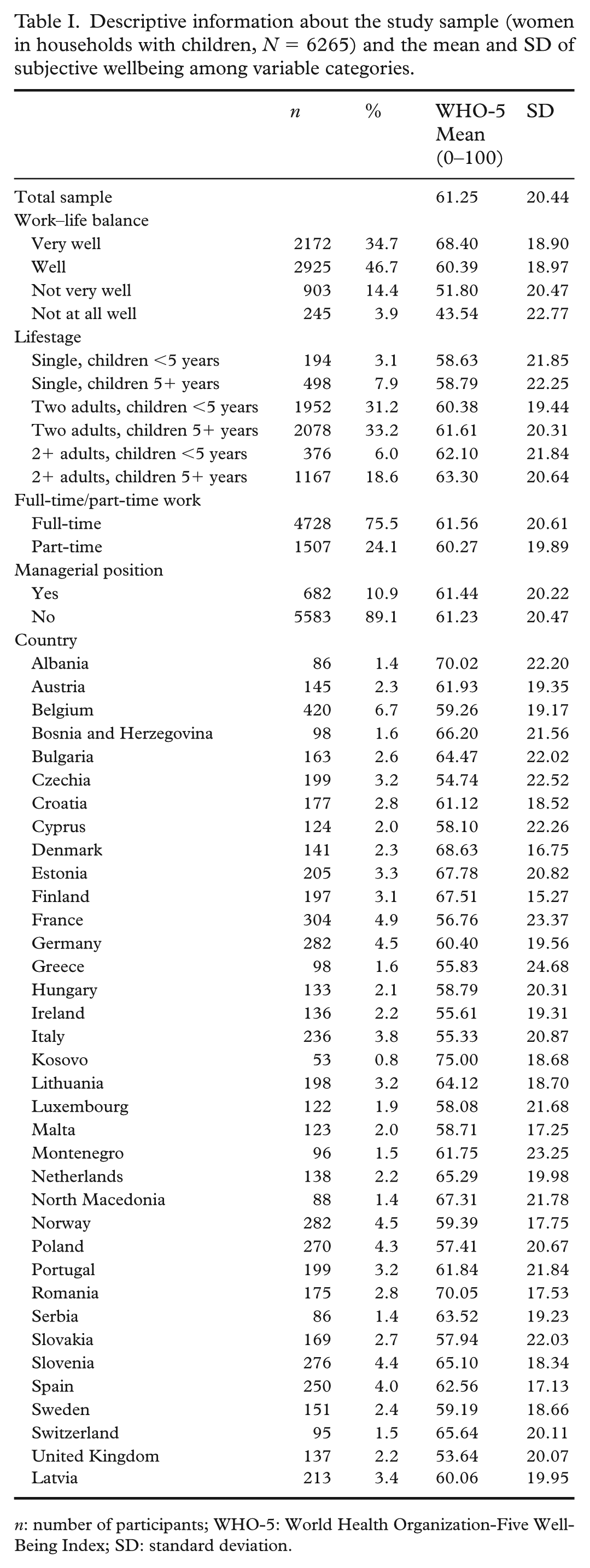
n: number of participants; WHO-5: World Health Organization-Five Well-Being Index; SD: standard deviation.
In Table II, the results of the mixed model analyses are presented.
Multi-level, mixed model analysis with subjective wellbeing as the dependent variable (N = 6265).
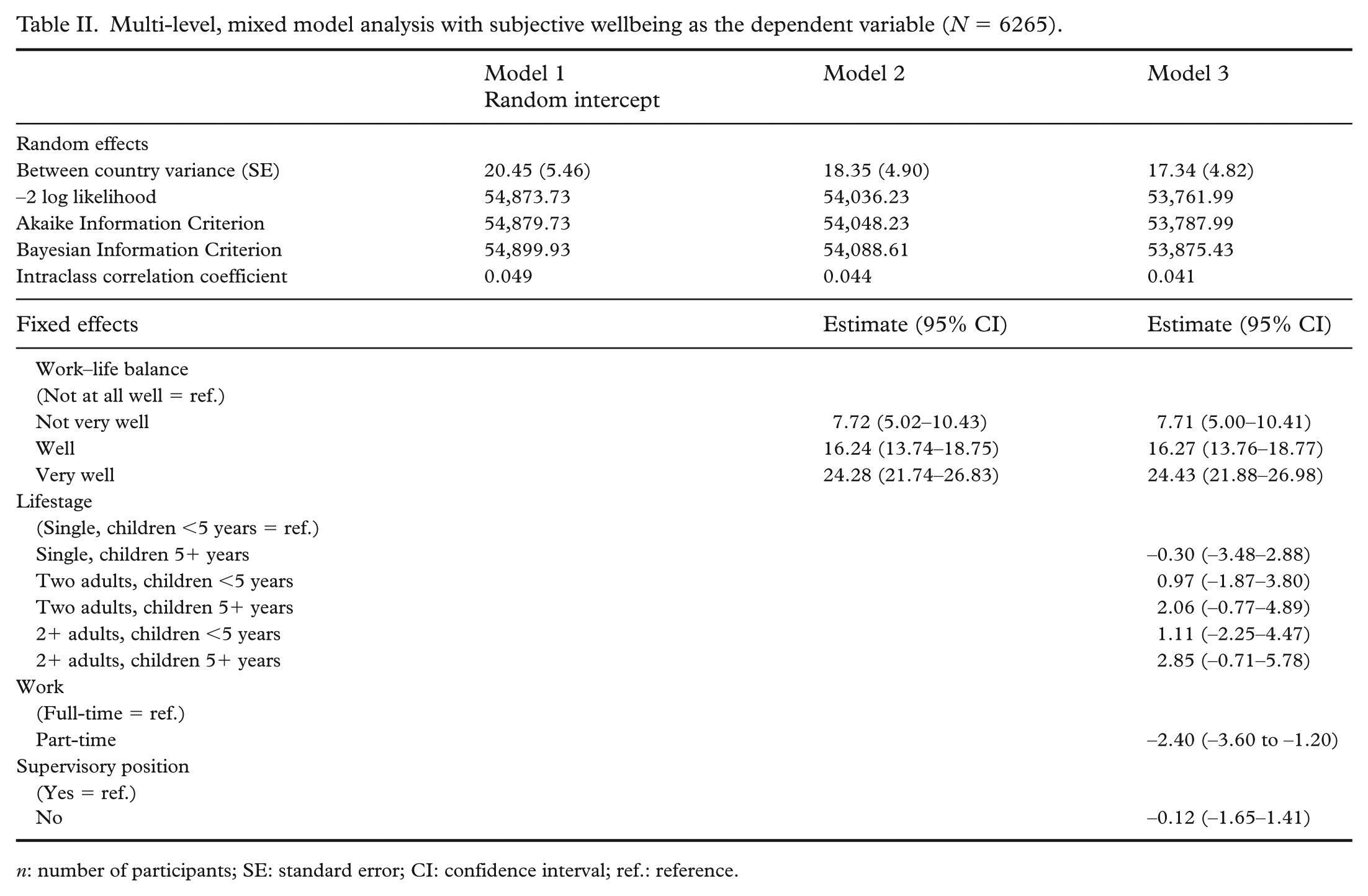
n: number of participants; SE: standard error; CI: confidence interval; ref.: reference.
The between country variance showed a statistically significant random effect in all models, indicating a contextual, country-level effect on SWB among the women in the study. WLB showed a statistically significant positive effect on SWB in all models. Neither life stage nor managerial position showed any statistically significant association with SWB in the analyses, while working part-time was associated with a negative effect on SWB.
Discussion
This study examined the associations between SWB and WLB among working women across EU countries, exploring any influence that the women’s roles and responsibilities in the family and work settings as well as macro-level influences (country or welfare state categorization) might have on this association.
In line with earlier large-scale European studies (e.g. Lunau et al. [7], Haar et al. [8]), a significant positive association between SWB and WLB was found. Considering possible influences on SWB associated with the women’s roles, no effects of life stage as an indicator of caring responsibilities emerged, and potential increased demands related to a managerial position at work was not significantly associated with SWB. A part-time working arrangement was, however, associated with SWB in a negative direction. Increased flexibility provided by a part-time arrangement could be hypothesized to affect wellbeing through practical mechanisms associated with increased flexibility in everyday life; on the other hand the financial effects of part-time arrangements could potentially overshadow these practical perks.
Considering family circumstances in relation to SWB and WLB, Karabchuk [22] found a better SWB among both working and non-working European women with children compared with women without children. As highlighted by Nomaguchi and Milkie [23], the caregiver role can be considered in terms of a demands–rewards perspective, entailing practical challenges but also emotional fulfilment. A systematic review [24] has shown that caring for smaller children poses a risk for WLB among women, while, for example, experienced spousal support functions as a supportive factor. A plausible explanation to life stage not having an influence on the WLB–SWB association could be that, contrary to earlier studies, the applied operationalization for life stage in this study encompasses both the ages of children in the household and the presence of other adults (as a possible source of support). The results could perhaps also be related to the WHO-5 instrument focusing on positive affective states [17,20], as opposed to more evaluative operationalizations. The results may also point to a greater impact of the subjective experience of women’s WLB in relation to SWB, rather than the more structural features related to roles and responsibilities in the home and work spheres.
As EWCTS is a repeated, cross-sectional survey, causal inferences cannot be determined with regard to the SWB–WLB connection. To our knowledge, no large-scale European longitudinal studies have been performed where causal relationships between WLB and SWB can be explored in the general female working population. A few longitudinal studies focusing on WLB and mental health problems (e.g. depressive symptoms), not limited to a specific profession/workplace, have been performed in Nordic countries [25 –27]. These studies identified longitudinal links between WLB and mental health problems in both directions, highlighting complexity in the relationship.
Looking at the broader study context, it can be noted that a lower percentage of European women with children compared with those without children were working in 2021: 72.4% of women aged 25–54 years with children versus 77.0% of women aged 25–54 years without children. The largest gaps in employment rates of women with children compared with those without were found in Czechia, Malta, Romania, Germany and Estonia [28]. Considering macro-level influences, the positive association between SWB and WLB remained statistically intact despite the country-level effect on SWB among study participants. The fact that welfare state grouping was not a significant source of cluster effect on SWB, while the country variable did show an association, might point to a greater relevance posed by sociocultural influences concerning, for example, individualistic versus collectivistic cultures and gender egalitarianism [8] and gender-equal working life and norms supporting women’s employment [15] rather than policy framing. This can be considered in light of the study by Nordenmark [14], where policy context affected the links between MWB and the presence or absence of children living at home, especially among women. The authors identified no difference in MWB between women with or without children in a Nordic policy context, while MWB was poorer among women with children than among women without children in conservative and liberal policy contexts [14]. In our present study, the presence of children in the household was, however, combined with the number of adults in the household, limiting direct comparison with the study by Nordenmark. Karabchuk [22] also pointed to the relevance of policy in relation to SWB among European parents, with the wellbeing of working mothers higher in countries with liberal labour legislation and lower in countries with strict employment protection legislation.
Considering strengths and limitations of this study, a comprehensive European dataset was utilized [16], not limited to, for example, a specific profession of working women as some earlier research has been [29]. Rigorous sampling, data collection and management procedures were applied in the EWCTS project [16]. As described earlier, this study is, however, limited to a sub-set of women from the original EWCTS sample. While the total net sample size exceeded the planned sample size and the respondent gender distribution was successful overall [16], it should be noted that age and education targets were less successful (with respondents under age 25 and over 50 years and those with a lower educational level less represented) [30]. Considering included variables, the frequency of missing data for the variables of interest in this study was low (0–0.8%).
While an internationally validated instrument [18] was employed to capture the dependent outcome, SWB, a single-item question was utilized for the measurement of the central independent variable of interest (WLB). Sirgy and Lee [6] have noted that the research field encompassing WLB would benefit from using not only self-report measures but also behaviour-based measures. On the other hand, subjective experiences as central to MWB are focused upon in this study. Other variables based on non-standardized measures were also utilized in the study, which should be considered in relation to findings. The fact that 55 language versions of the survey were utilized [16] should be kept in mind – despite an elaborate translation process [16], eventual disparities here could potentially affect study results.
Conclusions
A significant association between European women’s SWB and WLB was identified in this specific sample, and the SWB–WLB association was only slightly weakened when considering the influence of women’s roles and responsibilities in the family and work contexts. Influences on SWB at the country-level appeared and, as welfare state categorization influences were not apparent, this might indicate effects of a sociocultural nature, with implications for, for example, public health messaging focusing on norms and attitudes. MWB is a multi-component concept and this study contributes to the growing evidence base on two key aspects of MWB and related interrelations among working women across Europe especially.
Footnotes
Declaration of conflicting interests
The authors have no conflicts of interest to declare.
Funding
The authors disclosed receipt of the following financial support for the research, authorship, and/or publication of this article: This work was supported by Högskolestiftelsen i Österbotten.
