




Abstract
This study undertakes a comparative analysis of the impact of international financial flows—specifically foreign aid, foreign direct investment (FDI) and remittances—on economic growth in South Asia (SA) and 45 other developing countries, using panel data for the period 1980–2016. The study also analyses the indirect influences of financial flows on growth mediated through key transmission channels, including political stability, trade openness and human capital (HC) for both groups. On controlling endogeneity, the results indicate that foreign aid discourages growth both in developing countries and SA. However, FDI and remittances promote growth in the two groups of countries, while their impact is higher in SA. Investigation of transmission channels reveals multiple significant roles of financial flows in impacting economic growth. Exploring the dynamic roles of international financial flows, the findings of the study offer a deeper understanding and insights to policymakers in the developing world.
Introduction
Neoclassical growth models comprehend the crucial role of investment in fostering economic growth. International financial flows, including foreign assistance and remittances, promote capital accumulation and the development of human capital (HC), while foreign direct investment (FDI) significantly increases physical capital. The increase in physical and HC promotes economic growth. During the 1950s, foreign aid started flowing into developing countries, especially into newly independent states. Aid flows aimed at encouraging economic growth and reducing poverty and inequality increased gradually over time. Remittances started growing globally during the 1980s but have increased phenomenally since the start of this century. While FDI flows began to increase sharply from the mid-1980s to the early 1990s, they later surpassed the other international financial flows. Presently, net FDI (inflows) worldwide is 2.6 times greater than remittances received globally and 10.4 times higher than the aggregate volume of aid receipts to all developing countries (source: WDI, 2020).
Globalization has increased trade by reducing barriers and promoting capital mobility, resulting in increased investments and large-scale labour migration. Besides this, the wide-scale spread of financial technology reducing the transfer costs and home countries’ tax incentives has led to increased volumes of remittances globally (see Ratha, 2007; UN-IOM, 2024; World Bank, 2016). In general, aid has been disbursed mainly due to poverty, conflicts, climate change and financial crises, health issues/pandemics and the strategic interests of donors (World Bank, 2024). The ease of capital mobility for large-scale cross-border mergers and acquisitions and greenfield investments, democratization and institutional efficiency, information and communication technologies (ICT), and tax incentives by host countries spurred the growth in FDI flows worldwide (see ECB, 2018; IMF, 2019; UNU-WIDER, 2003).
The increased volume of financial flows worldwide has sparked great interest among researchers in examining their effectiveness. A review of the literature provides mixed findings regarding the impact of financial flows on country growth and development and regional analyses.
Although a large amount of literature exists examining the role of international financial flows (foreign aid, FDI and remittances) in influencing economic growth, less attention is paid to investigating their different transmission channels influencing growth. Further, a few studies analyzed and compared the growth-enhancing effects of all international financial flows with their respective channels. The literature on growth reveals political stability/democracy, trade liberalization and human (intellectual) capital development as the important drivers of economic growth. 1 Our study contributes to the literature by empirically examining the direct effect of international financial flows (i.e., foreign aid, FDI and remittances) and through various transmission channels of—political stability, trade openness and HC—on the economic growth of four South Asian countries (i.e., Bangladesh, India, Pakistan and Sri Lanka), and 45 other developing countries 2 using panel data for the period 1980–2016.
These 45 developing countries hold a 32% share in total aid flows, a 23% share in total FDI (in)flows, and a 47% share in total remittance flows directed to (low- and middle-income) developing countries. Comparing the aid and remittance flows among the country groupings, the more significant divergence between them has been noticeable in South Asia (SA), the only region where remittances have outpaced both aid and FDI combined. However, in all other regions (except Sub-Saharan Africa (SSA)), FDI flows are higher than aid and remittances. Presently, only SSA relies more on aid flows than FDI and remittance flows. Therefore, it is interesting to compare the effect of these international financial flows on economic growth in SA with developing countries from other regions.
This article is organized as follows. Section ‘Literature Survey and Theoretical Framework’ surveys the literature and presents the theoretical framework regarding the role of international financial flows in influencing economic growth through various transmission channels. A preliminary analysis of all international financial flows to SA and other developing countries is presented in Section ‘A Preliminary Data Analysis’. Afterwards, Section ‘Methodology’ discusses the empirical methodology determining the impact of financial flows on economic growth through different transmission channels. In Section ‘Estimation Results’, we present the empirical estimates both for SA and developing countries. Following the empirical results, Section ‘Policy Implications’ suggests important recommendations to policymakers in international financial institutions, donor governments and recipient developing countries. Lastly, Section ‘Conclusion’ concludes the article.
Literature Survey and Theoretical Framework
This section presents the literature on the role of financial flows, such as foreign aid, remittances and FDI, in influencing economic growth directly and through various transmission channels.
Aid and Growth
Although debated, foreign assistance is critical in upgrading living standards by expanding the economic opportunities and income of people in developing countries. This substantially helps developing countries to combat poverty and (income) inequality. The review of the literature on foreign aid’s effectiveness suggests three differing perspectives. One stream of literature views the growth-encouraging role of foreign aid in developing countries (see Asteriou, 2009; Doucouliagos & Paldam, 2008; Maruta et al., 2020; Tahir et al., 2019). The second perspective holds that aid promotes economic growth, but its effectiveness depends on sound macroeconomic policies, strong institutions and good governance (see Baliamoune-Lutz & Mavrotas, 2009; Dalgaard et al., 2004). The third viewpoint challenges the earlier two, arguing that foreign aid may hinder growth in developing countries. This could potentially be due to factors such as (a) inadequate (domestic) resource mobilization, (b) a rising debt burden on low-income economies and (c) an expanded public sector that fosters corruption and poor governance (see Arellano et al., 2009; Rajan & Subramanian, 2008; Young & Sheehan, 2014).
The literature exhibits mixed findings on the role of foreign aid in affecting growth; however, its interaction with democracy encourages growth in developing countries (Svensson, 1999). Foreign assistance can also stimulate growth when developing countries implement prudent monetary, fiscal and trade policies (Burnside & Dollar, 2000). Similarly, Hansen and Tarp (2001) found that aid is more effective following good macroeconomic policies. Conversely, Kosack (2003) documented that foreign aid can negatively impact the quality-of-life index. However, its effect turns significantly positive on interaction with democracy. Rajan and Subramanian (2008) also reported that the impact of aid on growth is either negative or marginally positive. Further, they failed to find aid effective in any geographical region or with a good policy direction. The literature also points out the significance of social capital and institutional quality in enhancing aid effectiveness, as Baliamoune-Lutz and Mavrotas (2009) suggested. They contend that nations with high levels of social capital can utilize aid effectively regardless of policy quality, contrasting with the conclusions of Burnside and Dollar (2000).
The literature also reports that foreign aid increases the volume of government expenditure in aiding social welfare programmes in low-income countries (see Gomanee et al., 2005; Morrissey, 2012). For instance, by reducing mortality rates and increasing school enrolment rates, foreign aid improves HC in developing countries (Birchler & Michaelowa, 2016; Riddell & Niño-Zarazúa, 2016; Wilson, 2011).
Remittances and Growth
Many studies have investigated the effects of remittances on growth and development. A review of the recent literature reveals that remittances play a significant and positive role in influencing growth in developing countries (see Abbas et al., 2021; Abduvaliev & Bustillo, 2020; Combes et al., 2019; Eggoh et al., 2019; Siddique et al., 2012). Nevertheless, a few studies have found remittances to discourage growth (see Le, 2009), while some reported no significant effect at all (see Adams & Klobodu, 2016). The literature also reports that the effects of remittances on economic growth differ with changes in the income levels of developing countries. For example, Benmamoun and Lehnert (2013) found that remittances have a significantly positive effect on economic growth in low-income (poor) countries. However, they reported a negative but statistically insignificant effect on growth in middle-income countries.
The literature highlights the significant role of remittances in enhancing access to education and healthcare, thereby contributing to HC in developing countries by lowering mortality rates and encouraging school enrolments (see Acharya & Leon-Gonzalez, 2014; Azizi, 2018; Salas, 2014). This positive impact of remittances on HC development significantly promotes growth (see Cooray, 2012; Cooray et al., 2016). Remittances are also found to play an active role in promoting growth when countries are politically stable. For instance, Adams and Klobodu (2016) found that the interaction between remittances and political stability has a significantly positive impact on growth in SSA; however, they did not find a strong direct effect of remittances alone.
FDI and Growth
The neoclassical models feature the significant role of investment in economic growth. FDI not only brings physical capital investment but also develops HC by training workers, thus positively contributing to growth. For example, Makki and Somwaru (2004) found a direct, significantly positive impact of FDI on growth and indirectly through trade, domestic investment and HC transmission channels. They reported a significantly positive effect of FDI on growth when it interacts with trade openness and HC. In another study, Alguacil et al. (2011) found that FDI positively influences income levels in developing countries; however, its interaction with economic freedom showed a negative and statistically insignificant effect. Similarly, Mastromarco and Ghosh (2009) noted that the positive impact of FDI on total factor productivity is heavily reliant on the level of accumulated HC. Likewise, Kottaridi and Stengos (2010) also reported a strong positive relationship between FDI and economic growth. They also analyzed the interaction between FDI and HC and found it to be significantly beneficial in high-income and OECD countries, whereas the effect was negative in low-income and non-OECD countries.
Moreover, Völlmecke et al. (2016) identified a positive effect of FDI on European growth in terms of interaction with HC. In another study, Elkomy et al. (2016) examined the interaction effects of FDI with HC and political scores on per capita economic growth in transitional, non-transitional, democratic and authoritarian countries. In their analysis of the full sample (across all countries), they failed to report any significant effects of these interactions. However, in hybrid democracies, they noted a significantly negative impact of FDI on economic growth when interacting with HC, while the effect was insignificant in all other cases. Likewise, the impact of FDI on economic growth when interacting with political scores is found to be significantly negative in authoritarian countries but positive in the case of hybrid democracies. Likewise, Malikane and Chitambara (2017) documented a significant positive effect of FDI on growth in certain Southern African countries. Additionally, they observed a notably positive effect of FDI on economic growth when it interacted with democracy.
Furthermore, the literature also documents that the role of FDI in promoting growth varies when destined to different sectors of the economy. For example, Wang (2009) reported that FDI flows to the manufacturing sector in the Asian economies brought a positive impact on their economic growth; however, no significant role is found for FDI flows to the non-manufacturing sector.
The literature on (endogenous) growth exhibits various models where trade restrictions can either impede or enhance economic growth worldwide (see Matsuyama, 1992). Empirical studies suggest that outward-oriented trade policies are effective in fostering long-term economic growth (see Chang et al., 2009; Dollar & Kraay, 2004). Conversely, Yanikkaya (2003) documented no simple and straightforward relationship between trade liberalization and economic growth, as trade barriers positively affect economic growth in developing countries. Further, Ulaşan (2015) found that reducing trade barriers does not necessarily result in higher economic growth. Balavac and Pugh (2016) noted that the trade liberalization effect is associated with the degree of export diversification. Trade openness positively impacts economic growth when countries specialize in capital goods or high-quality products; however, it may negatively affect growth for countries with low-quality products (Huchet-Bourdon et al., 2018).
The literature also underscores the discouraging effect of population growth on income/economic growth, although there are some marginally positive effects (see Kottaridi & Stengos, 2010; Young & Sheehan, 2014). It emphasizes the significant roles of international financial flows through various channels, including human (intellectual) capital, democracy/political stability and economic freedom (or trade openness). However, only a few studies analyze the various transmission channels of international financial flows. Therefore, this study makes a notable contribution to the literature by empirically examining the growth effects of international financial flows and their interactive transmission channels in SA and other developing countries.
Theoretical Framework
Based on the above literature review and the theory of the neoclassical growth model, we develop a theoretical framework for our study, as shown in Figure 1 below.
Theoretical Framework.
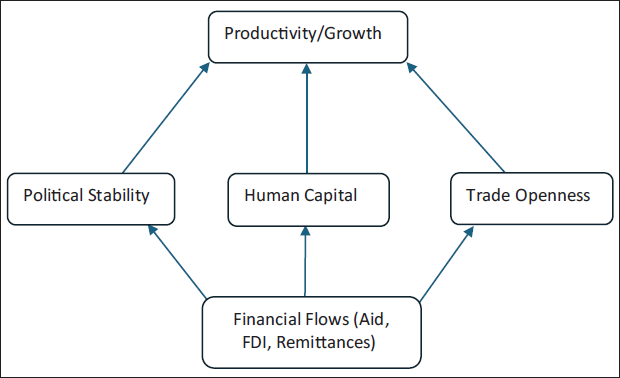
The neoclassical (endogenous) growth models highlight the significance of HC, physical capital and labour in increasing productivity. International financial flows (aid, FDI and remittances) help increase physical capital investment and develop HC, thus enhancing productivity and growth. The literature also establishes the significant role of political stability and trade liberalization in promoting growth. The above theoretical framework also exhibits the prominent role of increasing trade, leading to more production due to increased exports and (capital) imports. Political stability is important in maintaining consistency in policies, expectations, business confidence, investment and consumption decisions.
A Preliminary Data Analysis
A preliminary analysis of the key variables using graphs and descriptive statistics is presented in this section. The data for GDP per capita, foreign aid, FDI, remittances, HC, trade and population growth is accessed from the WDI, the World Bank database. Secondary school enrolment (% gross) 3 data represent HC. Political stability data (represented by ‘polity2’)—ranging between −10 (strong autocracy) and +10 (strong democracy)—is obtained from the PolityIV database, the Centre for Systemic Peace. On the availability of data, the authors analyze four South Asian countries—Bangladesh, India, Pakistan and Sri Lanka—since data (for some variables) are not available for other regional countries, such as Afghanistan, Bhutan, the Maldives and Nepal.
Figure 2 presents the average foreign aid (in billions of $) given to two groups of countries, four South Asian and 45 developing countries, from 1980 to 2016. As seen, average foreign aid started declining from the early to mid-1980s and rising till the early 1990s in SA. In developing countries, however, aid gradually increased from the 1980s to the early 1990s. The average aid flows fell gradually during the 1990s in both groups. Since 2001, foreign aid in both groups began to rise again with fluctuations until 2014, when it started declining. On average, foreign assistance has consistently remained higher in SA than in other developing countries. In SA, India received more aid in absolute dollar terms, followed by Pakistan and Bangladesh. This ranking is overturned when aid is measured as a percentage of GDP. Egypt, Ethiopia, Mozambique, Nigeria, Kenya, Sudan, Morocco, Turkey and Jordan stand out in receiving aid in the developing countries group.
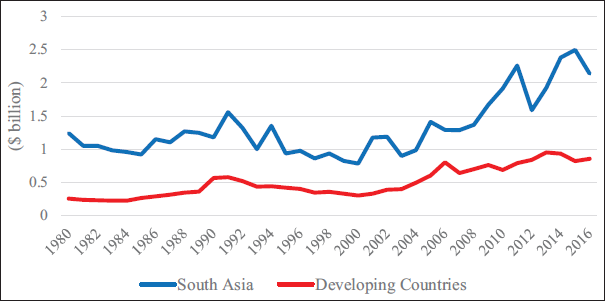
Figure 3 presents the average remittances (in billions of $) for South Asian and developing countries from 1980 to 2016. As seen, remittance flows have always been higher in SA than in other developing countries. Average remittances remained stable in both groups from the 1980s until the mid-1990s. After this, the remittance flows in both groups started increasing gradually, but a greater surge can be seen from the start of this century. Further, on average, remittance flows have increased six-fold in SA and four-fold in developing countries over 2001–2016. India stands as the world’s largest remittance-receiving country. Pakistan received greater remittances within SA (after India), followed by Bangladesh. When expressed in percentage of GDP, Bangladesh received relatively more remittances in SA, followed by Sri Lanka. In the developing countries group, the Philippines, Nigeria, Egypt, Morocco, Turkey, Jordan, Thailand and Colombia received relatively greater remittances.
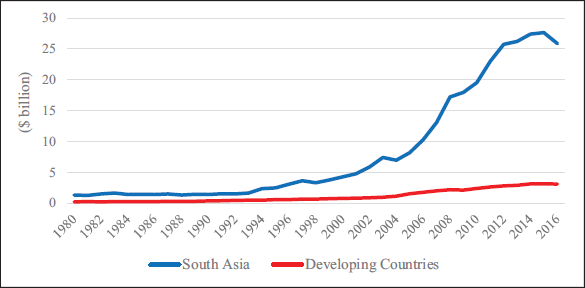
Figure 4 presents the average FDI net inflows (in billions of $) for both groups, SA and developing countries, from 1980 to 2016. The graph shows that average FDI flows remained very low and close in both groups from the 1980s till the mid-1990s. Afterwards, however, in both these groups, FDI began to improve gradually until 2005 and then began to surge. Average FDI increased phenomenally in SA, with some fluctuations, while stabilizing in developing countries. In SA, during the 1980–2016 period (on average), India stands out as the major destination to receive FDI (of more than $ 11 billion per annum), which is 10 and 20 times larger than FDI flows to Pakistan and Bangladesh, respectively. Turkey, Colombia, Thailand, Peru, Egypt, Nigeria and the Philippines received relatively greater FDI flows in the developing countries group.
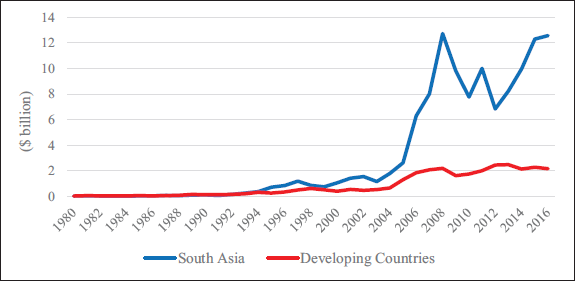
Table 1 presents the mean values of the key variables for SA and 45 developing countries for the sub-periods (1980–2000 and 2001–2016) and the overall period (1980–2016). Columns (1)–(3) present the mean values for SA for the sub-periods and the overall period (1980–2016), while Columns (4)–(6) present the mean values for developing countries for the sub-periods and the overall period, respectively. The last Column (7) presents the t-test statistics to compare the (significant) difference in average values of the variables of interest in two sample groups: SA and developing countries. Comparing Columns (1) and (2) for two different sub-periods in SA reveals that foreign aid (as a percentage of GDP) and population growth have seen a reduction during the 2001–2016 period, while other variables have increased in the more recent sub-period. Notably, on average, FDI flows (in billion $) have increased by more than 20 times; remittances (in billion $) have increased by more than eight times, and per capita income also witnessed more than a three-fold increase during the 2001–2016 period compared to the sub-period, 1980–2000. The comparison between Columns (4) and (5) suggests that, in developing countries, average foreign aid (as a percentage of GDP) and population growth have decreased during the 2001–2016 period compared with 1980–2000. The other variables have increased during the recent sub-period. Notably, average FDI and remittances, income and HC have increased phenomenally in developing countries during the 2001–2016 period.
Mean Values, South Asia Versus Developing Countries, 1980–2016 and Sub-periods.
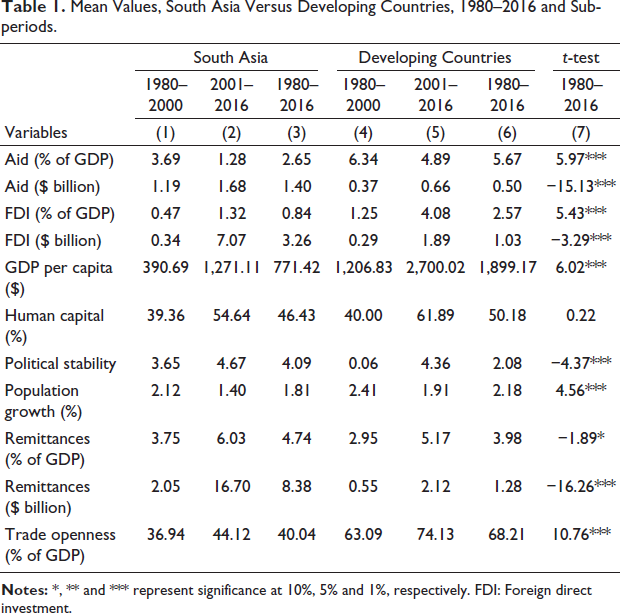
Comparing Columns (3) and (6) for the overall period (1980–2016) indicates that foreign aid, as a percentage of GDP, in SA, has remained less than half of the average aid received by developing countries. However, SA received more aid in absolute (billion $) terms. It also received almost one-third of the average FDI flows (as a percentage of GDP) to developing countries. In contrast, in absolute (billion $) terms, FDI flows were three times higher in SA than in developing countries. Remittances, on average (both as percentages of GDP and in billions of $), have remained higher in SA. In developing countries, the average GDP per capita, HC, population growth and trade openness are higher, whereas average political stability is stronger in SA. T-test results presented in Column (7) indicate that the mean values of the variables of interest significantly differ (at a 5% level) in the two sample groups except for the remittance (% of GDP), which is significant at a 10% level, and HC, which is insignificant.
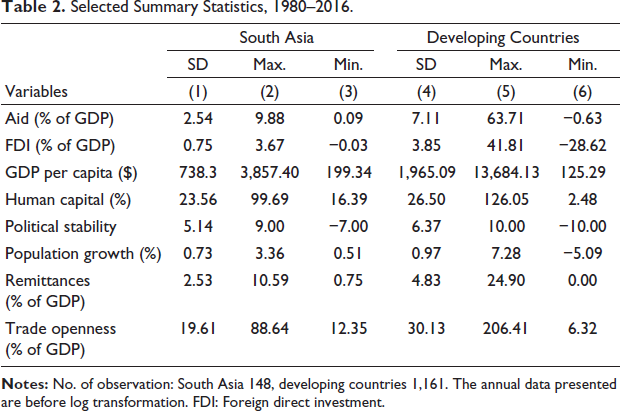
Table 2 presents the selected summary statistics of the variables of interest for SA and developing countries groups. Columns (1) and (4) present the standard deviation, whereas Columns (2), (3), (5) and (6) indicate the range of variables by exhibiting maximum and minimum values in SA and developing countries, respectively. As shown in Table 2, GDP per capita, HC and trade openness have relatively greater dispersion around their mean values. The developing countries group generally has higher standard deviations in all series.
Selected Summary Statistics, 1980–2016.
Methodology
The literature survey reveals the significant roles of international financial flows, trade openness, HC, population growth and political stability on economic growth in developing countries. FDI directly contributes to the accumulation of physical capital. At the same time, the two other international financial flows, foreign aid and remittances, can be transformed into productive physical and HC to influence growth. Based on the above observation, we propose the following models for estimation. The analysis is performed with two data sets, one for SA and one for the other 45 developing countries.
Model 1 (Basic Model)
The proposed basic model determining the effect of international financial flows (of foreign aid, FDI and remittances) on economic growth is as follows:

i = 1, 2, …, N and t = 1, 2, …, T
where i denotes the country, t represents the time; Growth is measured by GDP per capita (in $), while Aid refers to official development assistance and official aid (as a percentage of GDP), Rem represents remittance inflows (as a percentage of GDP), and FDI stands for foreign direct investment inflows (as a percentage of GDP).
Model 2 (Channelized Impact of Foreign Aid)
The literature review also implies that donors favour democratic countries over non-democratic/autocratic countries, that is, democratic countries receive more aid flows. In Model 1, we introduce Aid*Polity to examine the impact of the aid-political stability channel on growth. Additionally, we explore the effect of aid on economic growth through its interaction with trade openness by including Aid*Trade Openness. Education, a key component of foreign aid allocation, plays a crucial role in generating HC; thus, we also analyze the aid-human capital channel by adding an interactive term of Aid*HC. Model 2 includes all three transmission channels of aid.

Model 3 (Channelized Impact of Remittances)
This study also examines the role of remittance-related transmission channels in influencing economic growth by incorporating interaction terms into the econometric model. Specifically, the remittance-political stability channel is analyzed by including an interaction term of Remit*Polity. The impact of the remittance-trade openness channel on growth is assessed through an interaction term of Remit*Trade Openness. Moreover, the role of the remittance- HC channel in influencing economic growth is analyzed by including an interaction term—Remit*HC. The proposed Model 3 below examines these respective transmission channels of remittances on growth.

Model 4 (Channelized Impact of FDI)
The role of FDI in influencing growth is also analyzed through various transmission channels. For this, first, the FDI*Polity interaction term is introduced in the model to examine the role of the FDI-political stability channel. Additionally, the growth effect of the FDI-trade openness channel is analyzed by including the FDI*Trade openness interaction term. Moreover, the FDI-HC channel is evaluated by adding the interaction term—FDI*HC. The proposed Model 4 below incorporates all respective channels of FDI.

All Models 1–4 are estimated both for South Asian and other developing countries. The sample of developing countries is based on aid receipts (of at least 0.1% of GDP during the last 10 years of the study’s time frame, i.e., 2007–2016). South Asian countries also fulfil this criterion. For both groups, the study uses annual data for the period 1980–2016. Theoretically, reverse causality is possible between GDP and remittances (and other financial flows) and between international financial flows. 4 Such theoretical reverse causal endogeneity is possible, that is, when a country’s GDP increases as people of that country can easily find employment locally, the tendency to find employment in a foreign country reduces, thus reducing remittances. Since we found possible endogeneity from empirical testing with both groups of countries, SA (4 countries) and 45 developing countries, the IV-2SLS (instrumental variable-2 stage least square) fixed effect estimation method is applied to estimate the models controlling endogeneity as well as heterogeneity across the panel. In accordance with existing literature, lagged values of financial flows are employed as instrumental variables to account for their corresponding effects, given that such flows typically adhere to pre-established programmes and time-bound implementation schedules (Chowdhury, 2016; Williams, 2018).
For robustness, we apply various diagnostic tests, satisfying the instruments at the first stage and under-identification conditions using the Anderson canon. Corr. LM statistic (with a null hypothesis of ‘equation is under-identified’) and over-identification by the Sargan test (with a null hypothesis of ‘valid instruments’).
Estimation Results
To assess the existence of a long-run cointegrating relationship among the model variables, the study employs the Kao residual-based panel cointegration test, which operates under the null hypothesis of ‘no cointegration’. The cointegration test results for Model 1 are presented in Table 3, separately for SA and the broader sample of developing countries. Given that the p value of the Kao cointegration test is below the .05 significance level for both groups, the null hypothesis of ‘no cointegration’ is rejected. This result indicates the presence of a long-run equilibrium relationship among the model variables in both the South Asian and broader developing country data sets.
Panel Cointegration Test Results.
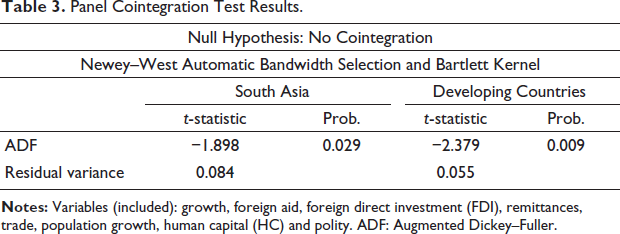
Table 4 presents the IV-2SLS fixed effect estimation results of Models 1–4, determining the effect of international financial flows on growth for SA. The estimation results for Model 1 are presented in Column (1). Columns (2)–(4) present the estimated results for Models 2–4, measuring the impact of transmission channels of financial flows on economic growth, respectively.
IV-2SLS Fixed Effect Estimations, South Asia.
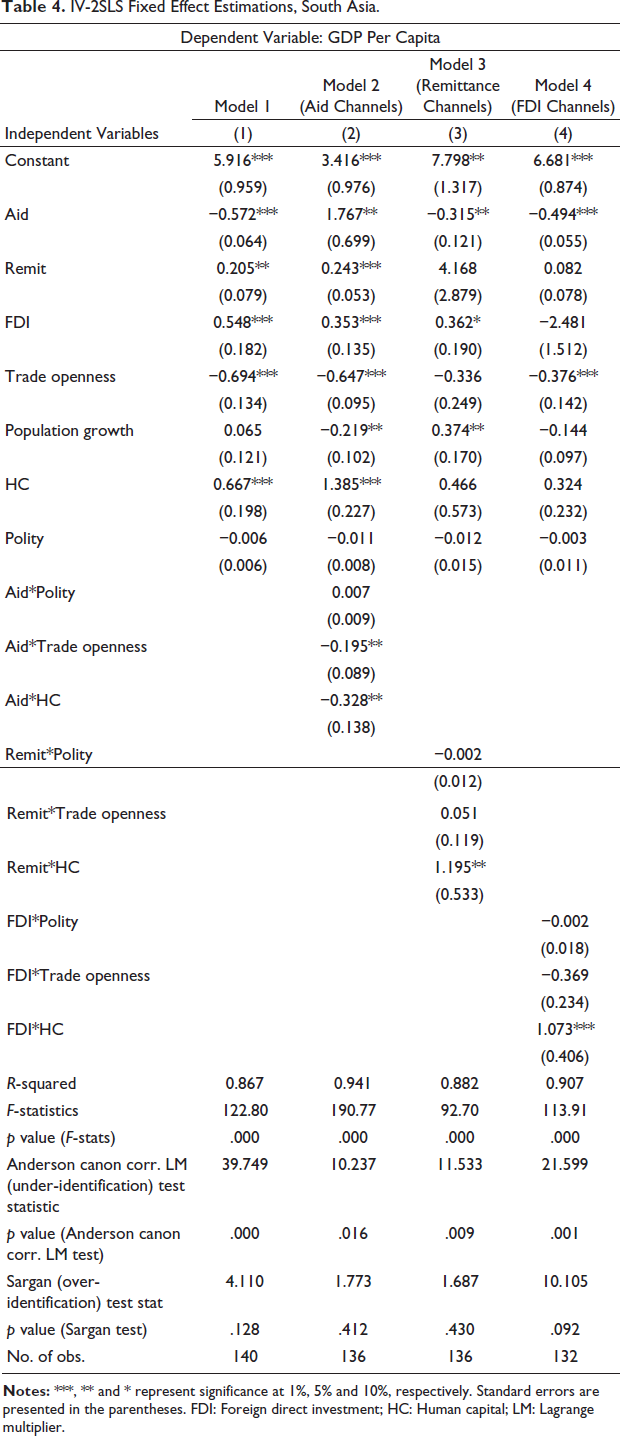
The estimation results for the baseline Model 1, as reported in Column (1), indicate that foreign aid, trade openness and political stability exert a significantly negative influence on economic growth in SA. In contrast, remittances, FDI and HC are found to have a significantly positive effect on economic growth within the region. In particular, the estimates in Column (1) reveal that a 1% increase in aid (% of GDP) significantly reduces per capita income per 0.572% ceteris paribus. Foreign aid significantly reduces GDP growth, potentially due to further increasing debt burdens and the size of government services, often leading to inefficient governance. The results regarding aid follow the literature (see Arellano et al., 2009; Rajan & Subramanian, 2008; Young & Sheehan, 2014).
The above findings reveal that a 1% increase in remittances (% of GDP) increases per capita income by 0.205%, keeping others constant—depicting the positive impact of remittances on growth is as expected, as increased remittances would lead to more investments and, hence, accelerate the economic growth; it is in line with the empirical literature (see Abduvaliev & Bustillo, 2020; Combes et al., 2019; Eggoh et al., 2019; Siddique et al., 2012). Likewise, the estimations show that a 1% increase in FDI (% of GDP) increases per capita income by 0.548% ceteris paribus—suggesting a significantly positive impact of FDI on economic growth. The results are in accordance with the literature (see Alguacil et al., 2011; Makki & Somwaru, 2004; Malikane & Chitambara, 2017). The observed negative impact of trade openness on economic growth is consistent with expectations, as trade liberalization can lead to an increased import burden and hinder growth in countries with limited geographical diversification of exports. This effect is particularly pronounced in nations where the trade balance is dominated by consumer goods rather than capital goods, as noted in the existing literature (see Balavac & Pugh, 2016; Huchet-Bourdon et al., 2018).
Next, we present and analyze the role of transmission channels of international financial flows on growth in SA. The channelized effect of foreign aid presented in Column (2) suggests the positive but statistically insignificant effect of the interaction between foreign aid and political stability. However, the interaction between aid and trade openness significantly negatively impacts growth in South Asian countries. Foreign assistance (due to its tied nature) may have a diminishing effect on economic growth due to weak competitiveness and expensive (capital) imports from the (bilateral) donor countries, which may negatively affect trade and fiscal balances. Foreign aid interaction with HC also negatively affects GDP growth. This could be due to the excessive brain drain of skilled HC from low-income regions to high-income or developed countries.
The estimation results of the channelized effect of remittances are presented in Column (3). The results indicate a negative, though insignificant, impact of interaction between remittances and political stability. The interaction between remittances and trade is also estimated to be insignificant. However, the findings indicate a positive and statistically significant effect of remittances on economic growth when interacting with HC (see Cooray, 2012; Cooray et al., 2016). This suggests that remittances fund families to provide their children with better health and education, skills and training opportunities, thus significantly improving HC and increasing economic growth.
Column (4) presents the impact of different transmission channels of FDI on economic growth in SA. The results show the negative but statistically insignificant coefficient of FDI*Polity. The FDI*Trade openness interaction is negative and statistically significant due to fewer capital controls during globalization. Our findings stand in contrast to those of several other studies (see Makki & Somwaru, 2004), but are consistent with research (see Alguacil et al., 2011) that identifies a negative effect of FDI on economic growth in the context of increased trade liberalization. The findings demonstrate a robust and significantly positive effect of FDI on economic growth when it interacts with HC. This implies that the FDI encourages growth when countries have improved HC (i.e., more educated and skilled workers). Our findings follow the literature (see Kottaridi & Stengos, 2010; Völlmecke et al., 2016).
Summing up, the models dealing with transmission channels of international financial flows suggest the negative effect of the foreign aid and trade openness interaction on economic growth in SA. The HC channel of financial flows significantly influences economic growth. Specifically, the aid and HC interaction discourages growth; however, HC interaction, both with remittances and FDI, encourages growth in SA.
For robustness, the study applies various diagnostic tests related to the under- and over-identification conditions of instruments to validate the findings. Table 4 results indicate that the p values are less than .05 for the F-test and under-identification tests; however, the p value exceeds .05 for an over-identification test. Therefore, the F-statistics, the under-identification (Anderson canon corr. LM) test, and the over-identification (Sargan) test satisfy the conditions for the models’ validity.
Next, we present and analyze the estimates for the developing countries group. Table 5 displays the IV-2SLS fixed-effects estimation results for all models, analyzing the influence of international financial flows on the economic growth of developing countries. Column (1) exhibits the estimated results for basic Model 1. Columns (2)–(4) present the estimated results for Models 2–4, determining the channelized impact of financial flows.
IV-2SLS Fixed Effect Estimations, Developing Countries.
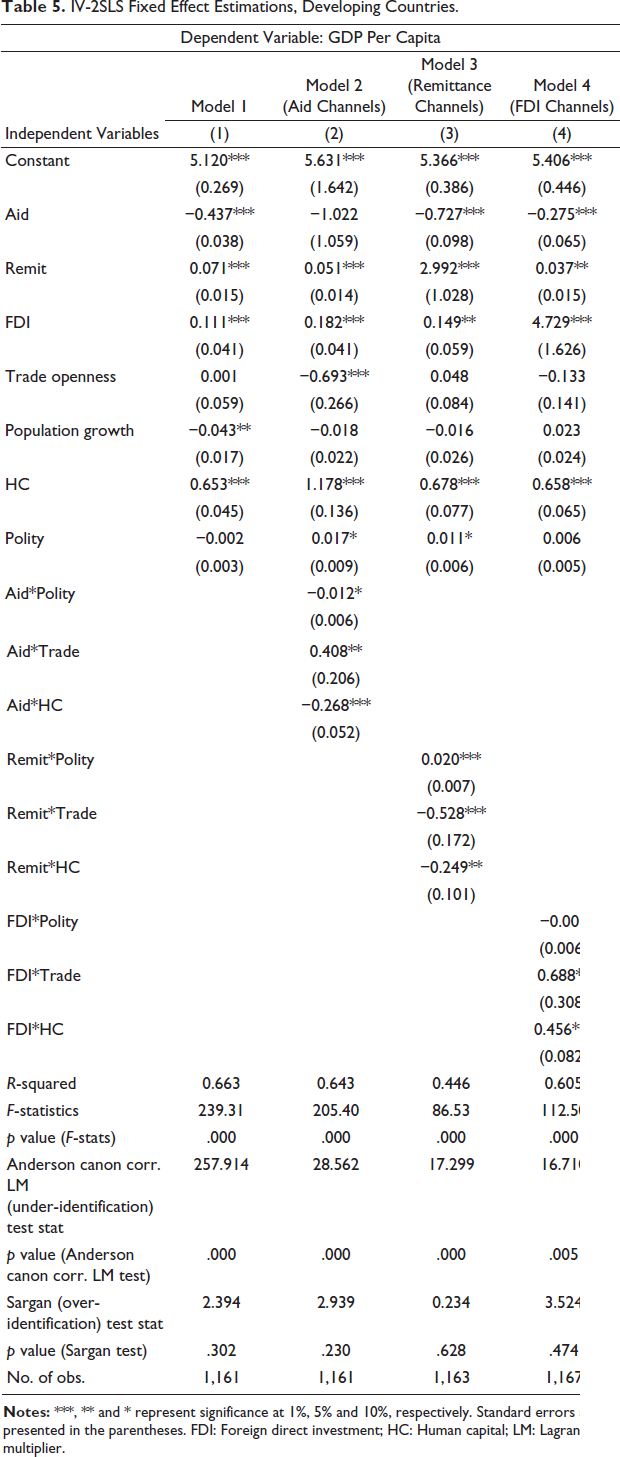
The estimates from Model 1, as presented in Column (1), indicate that foreign aid and population growth negatively affect economic growth. In contrast, remittances, FDI and HC are found to have a significant and positive effect on economic growth in developing countries. The estimates suggest that a 1% increase in aid (% of GDP) reduces per capita income in developing countries by 0.437% ceteris paribus. Like SA, foreign aid negatively influences GDP growth in developing countries. However, other financial flows, particularly remittances and FDI, are shown to enhance economic growth in developing countries, as previously observed in the case of SA. In particular, a one percentage increase in remittances (% of GDP) increases per capita income by 0.071% ceteris paribus. Likewise, the estimations indicate that a 1% increase in FDI (% of GDP) increases per capita income by 0.111% ceteris paribus—suggesting a significant and positive effect of FDI on GDP growth in developing countries.
The channelized estimation results of foreign aid presented in Column (2) indicate that foreign aid interaction with political stability and HC negatively impacts growth in developing countries. The weak democratic political structure in developing countries is ineffective in promoting growth. Further, aid disbursed for the education sector in developing countries is ineffective due to poor governance and/or migration of HC, as witnessed earlier in SA. However, the results reveal that, unlike in SA, the interaction between foreign aid and trade openness significantly encourages economic growth in developing countries, as Burnside and Dollar (2000) indicated.
The channelized effect of remittances in developing countries is presented in Column (3). The results suggest that the interaction between remittances and political stability promotes growth in developing countries. In politically stable regimes, the investment component of remittances is usually stable and high due to high prospects for margins since consumption volatilities are quite low. This finding supports the previous studies (see Adams & Klobodu, 2016). The interaction between remittances and trade openness negatively affects growth. Conversely, the interaction between remittances and HC reduces growth due to the considerable impact of remittances on HC through private consumption, leading to potential migration or brain drain. Unlike SA, the negative impact of the interaction between remittances and HC in developing countries contradicts the relevant studies (see Cooray, 2012; Cooray et al., 2016).
Column (4) presents the results for various transmission channels of FDI and their role in economic growth in developing countries. The results indicate the insignificant effect of FDI-polity interaction on growth. Contrary to SA, the estimations suggest a significantly increasing effect of FDI-trade openness interaction on the GDP growth of developing countries. Our results follow the findings of Makki and Somwaru (2004). The FDI-HC interaction significantly increases GDP growth in developing countries due to skilled HC, as in SA. The literature highlights the growth-encouraging effect of FDI*HC interaction (see Kottaridi & Stengos, 2010; Völlmecke et al., 2016).
Summing up, the models estimating the transmission channels of international financial flows indicate that the remittance flows encourage GDP growth in developing countries when interacting with political stability. At the same time, aid hurts growth in interaction with political stability. The interaction of trade openness with aid and FDI has a significant growth-enhancing impact; however, the interaction between trade openness and remittances discourages growth in developing countries. These findings also suggest that FDI flows through its effects on the capacity building and absorption of HC, significantly encouraging economic growth. However, as HC increases, foreign aid and remittances diminish growth, likely due to the potential for brain drain.
For robustness, the study employs various diagnostic tests to validate the empirical results. Table 5 results indicate that the p values fall below .05 for the F-test and under-identification tests, while they exceed .05 for the over-identification test. The diagnostic tests suggest that the model estimates do not suffer from potential biases, including endogeneity.
Policy Implications
The findings of this study offer significant implications for policymakers in donor financial institutions and governments and recipient developing countries. First, foreign aid may discourage growth in some countries and regions, as seen in SA and the developing countries group, since it is reported as strategically and politically motivated. Second, policymakers should be sensitive about aid as it may not be growth-effective with rapid trade liberalization policies in some developing countries or regions. This may increase expensive imports from donor countries due to tied aid regulations, resulting in current account and other macroeconomic imbalances due to low levels of export diversification, as witnessed in SA. FDI may encourage growth in countries following trade liberalization. Increased liberal policies regarding financial capital and trade may enhance growth due to fewer restrictions on capital controls, digital infrastructure, cost-effective imports and wider export markets–as suggested by the literature.
Third, policymakers should direct foreign aid towards the health sector in countries with relatively stronger educational systems, as foreign aid may hinder economic growth by exacerbating brain drain. Foreign aid can also be allocated to other critical sectors, following the socio-economic priorities of developing countries, to help alleviate poverty. Other essential sectors include infrastructure, energy, trade, communication and digitalization, security, financial development and climate.
Furthermore, developing countries with low levels of human development may allocate funds to the education and health sectors to enhance HC, which is deemed instrumental for attracting FDI and its associated growth-enhancing effects. Remittances, the private financial flows, are an important source of HC development since they may provide means for educational expenditures; however, at increased levels, they may also discourage potential growth due to brain drain. On the other hand, remittances can also help develop HC if motivated by investment purposes; thus, they can effectively influence the supply and demand for HC in the labour market.
Conclusion
The findings of this article indicate that international financial flows significantly affect economic growth. In particular, foreign aid significantly and negatively impacts economic growth in SA and developing countries. On the other hand, remittances and FDI significantly positively impact economic growth in SA and developing countries; however, their impact is relatively large in SA. Trade openness dampens GDP growth in South Asian countries by intensifying competition and diminishing their comparative trade advantage. HC exerts a significantly strong positive effect on GDP growth in both SA and developing countries, whereas population growth harms economic growth in the case of developing countries.
The results further suggest that foreign aid impedes growth in SA under liberal trade policy regulations, as increased liberalization significantly reduces the positive effect of foreign assistance on economic growth. In contrast, foreign aid encourages growth within the broader group of developing countries. Additionally, with improved HC, foreign aid discourages growth in SA and developing countries. This implies that directing aid towards human development may increase the likelihood of ‘brain drain’, which, in turn, hampers economic growth.
The corresponding findings for developing countries indicate that remittances enhance growth when countries are more politically stable or democratic. However, they discourage growth with increased trade liberalization in developing countries. Further, remittance flows diminish growth due to HC flight or brain drain in developing countries. However, remittances promote growth in SA by improving HC through its support for private education and health expenditures in largely populated countries that are relatively poorer than most developing countries.
Finally, following more liberal trade policies, FDI encourages growth in developing countries. Fewer restrictions in trade and financial capital mobility encourage FDI flows, thus effectively promoting growth. FDI’s effect on economic growth is robust and positive due to the development and employability of skilled HC in both groups; however, the impact is larger in SA.
Footnotes
Data Availability Statement
The data that support the findings of this study are available from the corresponding author upon reasonable request.
Declaration of Conflicting Interests
The authors declared no potential conflicts of interest with respect to the research, authorship and/or publication of this article.
Funding
The authors received no financial support for the research, authorship and/or publication of this article.
