



Abstract
This article aims to investigate the persuasive power of immigration on people's attitudes towards a universal basic income (UBI). We use a survey experiment in which respondents, after being asked about their immediate reaction to the idea of introducing an unconditional basic income, are confronted with a counterargument referring to immigration. The experiment was undertaken in November 2021 as part of the Norwegian Citizen Panel, a representative research-purpose internet panel, and replicates a similar survey experiment carried out among Norwegian voters in 2003. In the previous study, a large share of the respondents abandoned their initial position when exposed to counterarguments referring to immigration. The results of the present experiment confirm that immigration has substantial persuasive power as a counterargument among initial supporters of a UBI, also in the contemporary Norwegian context. Contrary to the previous study, we find a strong negative relationship between scepticism about immigration and the propensity to initially support a UBI proposal, but – as in the previous study – we find that having negative attitudes towards immigration is strongly associated with a tendency to abandon an initially supportive stance. Our findings give support to the core of the so-called ‘progressive's dilemma’: that immigration may erode support for ambitious welfare policies, particularly among traditionally pro-welfare state segments of the electorate.
Keywords
Introduction
Milton Friedman famously claimed that ‘you cannot simultaneously have free immigration and a welfare state’ (Griswold, 2012: 159). It is indeed a widely held belief, in political discourse as well as in the academic literature, that high levels of immigration will work to undermine the trust and social solidarity needed to mobilise and maintain popular support for a universal welfare state. This is sometimes referred to as the ‘progressive's dilemma’ 1 (Holtug, 2021), since voters and parties on the political left in affluent democracies tend to defend humane (lax) immigration rules while promoting ambitious redistributive welfare policies.
The assumed negative effect of immigration on social solidarity and welfare state support may be driven by several distinct mechanisms: in-group bias and a lack of identification with strangers/newcomers, competition over jobs and other scarce resources and fears that high levels of immigration will upset the balance between taxpayers and consumers of welfare. A decline in social solidarity because of immigration can be amplified by the sharing of negative stereotypes about immigrants as being less committed to a strong work ethic and therefore more likely to stay on welfare benefits (Van Oorschot, 2006). This belief that immigrants are less willing to work and more likely than the general population to exploit generous welfare benefits, will in the following be referred to as ‘welfare chauvinism’. While immigration through these mechanisms could lead to a weakening of general support for the welfare state, it could also result in a turn towards welfare dualism – the policy idea that social protection should be withheld from immigrants and reserved for indigenous residents or those who belong to the ethnically defined national community (Bay et al., 2013; Careja and Harris, 2022; Kitschelt, 1997). 2
If increased immigration has negative repercussions for welfare state support and can foster welfare chauvinism and acceptance of welfare dualism, it is likely to have negative effects on popular support for the idea of introducing a universal basic income (UBI) available to all residents including newly arrived immigrants. In essence, UBI is an income transfer granted unconditionally to all individuals of a society, without a means test or work requirements (Van Parijs and Vanderborght, 2017). In recent years, suggestions for a UBI have been on the political agenda in many advanced welfare states (for a summary of current international debates, see Chrisp and De Wispelaere, 2022). The idea is, however, still highly controversial. Whereas proponents of UBI promote it as a recipe for social justice, or more modestly as a means to avoid poverty traps in the existing social protection system and to enable individuals to choose an optimal balance between work and commitments outside the labour market, opponents see it as a ‘free lunch’, subsidising non-participation in the labour market (Elster, 1986). Invoking the immigration card is likely to have the potential to reinforce the negative arguments that are typically put forward against a UBI. If a welfare state is incompatible with open borders, as Milton Friedman claimed, the same would certainly be true for a generous universal basic income (Poulsen, 1998).
This raises the question of whether it is possible to reconcile popular support for a UBI with high levels of immigration in affluent societies (Van Parijs and Vanderborght, 2017: 242). In this article, we set forth to investigate the persuasive power of immigration on attitudes towards UBI among the Norwegian electorate. More precisely, we study the impact of using immigration as a counterargument on survey respondents’ initial reactions to a proposal to introduce an unconditional basic income.
Our study replicates a survey experiment undertaken in 2003 among a representative sample of the Norwegian electorate (Bay and Pedersen, 2006). Both experiments use counterarguments inspired by the notion of welfare dualism. After asking about their initial reaction to the idea of introducing a UBI, respondents are challenged to reassess their initial evaluation after being confronted with a counterargument related to the implications of the scheme for immigrants. Respondents who initially reacted positively are faced with a counterargument that highlights how a UBI would also be available to newly settled immigrants, while respondents who initially reacted negatively, receive a counterargument suggesting that a UBI could be designed to exclude newly settled immigrants.
Like the original study, we focus on three research questions: a) Are the respondents’ initial evaluations of the UBI proposal linked to attitudes towards immigration?; b) Do counterarguments referring to immigration have persuasive power concerning the respondents’ evaluation of a proposed UBI?; c) To what extent is the propensity to be persuaded associated with the respondents’ attitudes towards immigration?
In the original study, Bay and Pedersen (2006) identified substantial persuasive power of counterarguments referring to immigration on the respondents’ reactions towards a proposed UBI. A large share of the respondents, especially among the initial supporters, changed their minds when confronted with the counterargument. While the association between the initial position on UBI and immigration attitudes was found to be weak, immigration attitudes were shown to be a strong predictor of the propensity to change opinion. The study concluded that the immigration dimension is a latent attitudinal factor that can be invoked to seriously weaken popular support for a UBI and, by implication, for a universal welfare state.
Motivation for replicating the survey and hypotheses concerning the new results
Two important trends in Norwegian society over the last two decades give reason to expect somewhat different results in the present context. First, the idea of introducing a UBI has been more actively discussed in Norway in recent years. Back in 2003, debates on UBI were primarily confined to academic circles, and most respondents likely saw it as a very abstract idea – perhaps simply as an ambition to reinforce the existing universal welfare state. The recent international surge of interest in UBI – exemplified inter alia by the Swiss referendum in 2016 and the Finnish UBI experiment from 2017 to 2018 – has been reflected in Norwegian public debates, and two minor parties (the Liberal Party and the Green Party) are now calling for some version of UBI in their current party programmes. As in other countries, the Covid-19 pandemic appeared (at least temporarily) to have further stimulated interest in UBI solutions, as it revealed that large groups (e.g. the self-employed, workers in creative industries and students) tend to fall outside the public social insurance system (Jansson et al., 2023). Norway has also seen echoes of the internationally popular argument that a relaxing of the contribution requirement within the social insurance system is an inevitable response to a potential future shortage of jobs due to automation and digitalisation (Standing, 2017). But this heightened interest also comes with exposure to criticism of the UBI idea from mainstream parties and media commentators. We can thus assume that Norwegian voters have been more exposed to arguments both in favour of and against a UBI, compared to the situation in 2003. This could in principle work both ways. However, data from the European Social Survey (ESS) show that Norway currently ranks among the European countries with the lowest popular support for a UBI (Meuleman et al., 2018; Roosma and van Oorschot, 2020). 3 We expect, therefore, that more attention to the dilemmas and practical issues involved in implementing such a scheme in the context of the existing welfare state may have drawn many respondents towards a more sceptical initial reaction.
A second major change that is likely to have influenced the immigration/welfare attitude nexus is Norway's more extended experience with immigration. Since 2003, the share of the population with an immigrant background (first- and second-generation) has increased from about 7% to just below 20%. 4 Immigration policy and policies to integrate immigrants into Norwegian society have, over the last 20 years, been almost continuously high on the political agenda. Two events have particularly had the effect of raising the political salience of immigration: the opening up of the country in 2004 and 2007 to labour migration from Eastern European countries due to EU enlargements, and the 2015 refugee crisis.
Despite the high salience of immigration issues and highly polarised public opinion, there has been no unambiguous tendency for attitudes towards immigration and immigrants to become more restrictive and negative over time in Norway (Brekke and Fladmoe, 2022; Hellevik and Hellevik, 2017). Debates on welfare policy have, however, become increasingly ‘immigrationalised’ in the last decade, emphasising the possible impact these policies might have on migration flows, and the benefit take-up and labour market integration of immigrants (Grødem, 2017; Larsen, 2011). A prominent example is the widely discussed publication in 2011 and 2017 of reports by two government-appointed commissions addressing the assumed challenges posed by immigration to the fiscal sustainability of the Norwegian welfare state (NOU 2011: 7; NOU 2017: 2).
There is good reason to believe that ‘immigrationalisation’ of the Norwegian welfare discourse has contributed to both a stronger correlation between immigration attitudes and the reactions towards the initial UBI question, and a generally more sceptical climate concerning UBI in 2021 compared to 2003. This line of reasoning further leads us to expect that the counterargument given to initial supporters of the UBI idea will be less persuasive in 2021, simply because the respondents are presumably more likely to have considered immigration when answering the initial question. By contrast, we expect that appealing to welfare dualism and an underlying welfare chauvinism among the initial opponents could have a stronger persuasive effect in favour of a UBI in 2021, assuming that anti-immigration sentiments and considerations are an important motivation for their initial scepticism.
Research on the immigration/welfare attitude nexus
Over the close to two decades that have passed since the publication of our original study, international research on the relationship between immigration and welfare attitudes has multiplied. Alesina and Glaeser's book from 2004 has arguably been particularly influential. Drawing on prominent explanations for the underdeveloped nature of the US welfare state (see, for example, Quadagno, 1994, and Gilens, 1999), the authors hypothesised that increased immigration and the resulting ethnic heterogeneity in Europe will tend to undermine social solidarity and reduce support for European welfare states (Alesina and Glaeser, 2004). The ensuing debate has stimulated extended research efforts with highly mixed results. A subset of this research looks at support for a UBI as the main dependent variable. We will not attempt to give a full, representative review of this vast research literature, but in the following will try to show how our study can be placed in a four-fold taxonomy of empirical approaches and research designs that have been used to throw light on the immigration/welfare attitude nexus.
The first main category of research consists of comparative studies that directly look for an association at the macro level (country/region or municipality) between the scale of immigration (influx or population shares) and attitudes to welfare among individuals residing in the relevant macro-unit. A typical example is the recent study by Kevins (2022) using data from ESS 2016 to examine the impact of immigration on support for a UBI in 21 countries. The study finds some evidence for the claim that larger immigrant populations are associated with lower support for a UBI, but only among a sub-group of less educated individuals. In another example of this research design, Finseraas (2008) finds evidence of the opposite effect, confined to conservative welfare states. In these countries, a high level of immigration is associated with a higher demand for social protection and economic redistribution among the host population. The explanation could be that voters who are particularly exposed to economic risks of income loss because of immigration, tend to seek compensation by increasing their preferred level of redistribution as the share of immigrants rises.
When applied to cross-sectional data, this approach suffers from the notorious small-N problem of cross-national comparative research. Adding variation over time in dependent and independent variables (Finseraas et al., 2016), or switching to smaller (and more numerous) macro-units such as municipalities (Bay et al., 2007), could improve the situation, but in the absence of a natural experiment in which variation in immigration across macro-units can convincingly be portrayed as exogenous, endogeneity and the direction of causation are serious concerns.
The second category consists of studies that investigate the association at the individual level between immigration attitudes and welfare attitudes – sometimes with data from only one country and sometimes with data from several countries and applying multilevel modelling. A good example is the study by Senik et al. (2009) using data from ESS 2002/2003. The authors find a negative, but rather modest association between natives’ perceptions of the presence of immigrants and their support for the welfare state, and a strong association between negative attitudes towards immigrants and low support for the welfare state. A similar design is applied by Larsen (2011), who finds that negative perceptions of immigrants are associated with low support for economic redistribution in three European countries (UK, Sweden and Denmark).
The problem with the second approach is that it relies on the untested assumption that the association between the two attitudinal aspects (immigration attitudes and welfare attitudes) is a causal one, running from scepticism towards immigration and immigrants to lower support for universal welfare policies: people first come to be critical of immigrants/immigration, and, in turn, this makes them more reluctant to support redistribution and universal welfare. It is perfectly possible, however, that the observed association at the individual level is mostly spurious, and that increasing (or decreasing) scepticism towards immigrants will not automatically lead to lower (or higher) support for universal welfare policies. It is also entirely possible that the true causal effect of increasing scepticism towards immigrants is even larger than suggested by the observed cross-sectional correlation between the two variables, since individuals with negative views on immigrants might have been particularly supportive of redistributing welfare in the absence of immigration.
A third distinctive category comprises studies that look at the prevalence of welfare chauvinist attitudes and/or support for welfare dualist policies within the electorate of advanced welfare states. An example in this category is the study by Bay et al. (2013), which shows that a large share of the electorate in Denmark and Norway express support for welfare dualist policies with restricted access to welfare benefits for newly arrived immigrants. In a recent scoping review of research on welfare chauvinism, Careja and Harris (2022: 214) find a consistent pattern of correlation between precarious income, low occupational status, perceived economic insecurity – and welfare chauvinist attitudes. The cross-national study by Van Oorschot (2006) on the perception of deservingness of different population subgroups can also be classified as belonging to this third category. Based on the 1999/2000 European Values Study survey, he finds that immigrants are viewed by European voters as a particularly undeserving group.
While the results from these studies on welfare chauvinism and welfare dualism are relevant, the approach offers at best an indication that increased immigration and ethnic heterogeneity could contribute to undermining support for universal welfare policies as well as for a UBI. The study by Parolin and Siöland (2020) attempts to empirically establish a link between welfare chauvinist attitudes and support for a UBI at the individual level. Like Kevins (2022), they use data from ESS 2016, and their study can be seen as a hybrid between the second and third approaches. In a multilevel analysis, they find that welfare chauvinism is negatively related to support for a UBI in a subgroup of high-spending and poverty-reducing welfare states. As Norway belongs to this group, their finding is particularly relevant for our study. The question remains, however, whether the negative association between welfare chauvinism and UBI support at the individual level accurately captures the true causal effect that would result from an exogenous increase in the prevalence of welfare chauvinist attitudes.
Finally, we can identify a fourth category of studies that use survey experiments to investigate the effect of priming/framing or persuasion, by referencing immigrants and immigration, on welfare attitudes. Our original persuasion experiment belongs to this category (Bay and Pedersen, 2006), but so do a range of other studies conducted in recent years. Here we will mention a few of the most relevant contributions. Naumann and Stoetzer (2018) studied whether priming in a survey, referring to immigrants, influences respondents’ attitudes to redistribution in Norway, Germany and the Netherlands. A main finding from their study is that – contrary to what one might expect based on economic competition arguments – only respondents with high incomes and those who face little labour market competition withdraw support for redistribution when exposed to immigration cues. Cappelen and Midtbø (2016) report the results of three survey experiments applied to Norwegian voters. They find evidence of welfare chauvinism among Norwegian voters, and they conclude that intra-EU labour migration is a challenge to the support for the Norwegian welfare state. Similar conclusions are reached by Bay et al. (2016), who investigate the effect of priming, with immigration arguments, on popular support for increasing the universal child allowance in Norway. They find a negative effect of priming referring to EU labour migrants who receive benefits for children residing in the country of origin, but no significant negative effect of priming concerning newly settled asylum seekers. Avdagic and Savage (2021) explore the effect of framing with references to immigration on welfare state support in Germany, Sweden and the UK. They concluded that negative framing had a strong (negative) effect on support for welfare spending in all countries, while the effect of the positive framing was significantly weaker.
Persuasion experiments form a subset of this last category of research, and we will try briefly to sketch the theoretical foundation for this approach.
The rationale behind experiments using counterarguments in welfare opinion research
Persuasion experiments take as their point of departure theories of political communication (Iyengar, 1991; Mutz et al., 1996; Sniderman et al., 1991). Although politicians need to pay attention to the preexisting preferences of voters when developing their political platforms, politics is also about persuading voters. Politicians and political parties may influence voters’ attitudes by framing the reference to a political problem (Feldman and Zaller, 1992; Zaller, 1992). As several, even competing, associations may be invoked in a particular debate, the framing of a problem turns out to be important for how individuals react to political issues and reform proposals (Brewer and Gross, 2005), and framing can be used strategically. An example would be a politician who is against a specific welfare reform and ‘plays the immigration card’ to fight it, focusing on the economic burden of immigration, negative stereotypes of immigrants, or both. Similarly, politicians eager to promote the reform may intentionally underplay the immigration aspects.
To investigate the dynamic between situational information and individuals’ opinions, Sniderman and colleagues (1991) invented the so-called ‘counterargument technique’. The technique is designed to capture how ready people are to leave a policy position when confronted with a counterargument aiming to activate specific individual predispositions (such as attitudes towards immigration and immigrants). It attempts to mimic real-life conversations by creating a situation where the respondent's opinion is challenged by a reaction from the conversation partner. The counterargument technique is relevant to investigating whether specific policy preferences (such as support for the universal welfare state or a UBI) are robust against framing and persuasion that could be activated in real-life political debates.
Of course, the relevance of the results for real-life politics hinges on the assumption that the persuasion experiment successfully mimics real-life political communication and, further, that it is the specific content of the persuasion argument that has triggered a genuine and lasting change of opinion in the respondent, with potential repercussions for political behaviour. We will come back to the last assumption below.
Data, research design and methods
The survey experiment analysed in this article was undertaken in November 2021 as part of wave 22 of the Norwegian Citizen Panel (NCP) (Ivarsflaten et al., 2021). The NCP is a research-purpose internet panel administered by the University of Bergen. It is based on a probability sample of the Norwegian population aged 18 and older and consists of over 10,000 active participants. 5 To compensate for observed biases in net samples, weightings are calculated. In the analyses in this article, we apply a weighting based on age, gender, geography and education.
As already mentioned, the survey experiment is a replication of a study from 2003 (Bay and Pedersen, 2006). The experiment aims to investigate how readily respondents tend to leave an initial policy position (in favour of or against a UBI) when confronted with a welfare dualistic-inspired counterargument. Our initial question is open and does not specify the details of a UBI proposal: ‘What do you think about a system that would automatically guarantee a certain basic income to all permanent residents? A very good idea, a fairly good idea, a fairly bad idea, a very bad idea?’ Respondents who initially reacted positively to the proposal (a very good or fairly good idea) received the following counterargument: ‘Would you still approve if it is applied to newly arrived immigrants?’ Respondents who initially reacted negatively to the proposal received the following counterargument: ‘Would you still be opposed if it could be withheld from newly arrived immigrants?’ In both cases, the alternatives given after the persuasion were ‘Yes’, ‘No’ and ‘Don’t know’.
The technique applied is quasi-experimental (Cook and Campbell, 1979). Unlike in an ideal experiment, there is no random selection into treatment and control groups. Instead, the design is based on comparing the respondents’ reactions before and after the persuasion intervention. With this framework, we cannot know for sure whether it is the content of the persuasion argument that is causally responsible for making people abandon their original position, or if it is simply the exposure to resistance in the form of a counterargument per se. As we shall explain in more detail below, we address this issue by investigating whether and to what extent changing opinion is associated with attitudes to immigration (topic-bound change) and/or with measures of political awareness (topic-free change).
We start our analysis by reporting the reactions to the initial question in 2021, compared with the corresponding distribution in 2003, as reported in Bay and Pedersen (2006), but we do not undertake a detailed comparison of the results of the counterargument experiment. The reason for this is mainly methodological. In 2003 the experiment was part of a telephone survey, while in 2021 the respondents filled in an online questionnaire. It is well documented that the number of ‘don’t knows’ tends to increase when respondents answer anonymously in writing, compared to face-to-face or telephone interviews (Sanchez and Morchio, 1992). This effect is evident in the follow-up to the persuasion intervention: a much larger share of the respondents in 2021 chose the available ’don’t know’ option compared to the 2003 telephone survey. Our aim with replicating the exercise is therefore limited to investigating whether the main results uncovered in 2003, concerning the persuasive power of immigration arguments, still apply in 2021.
After presenting the initial reactions to the question in 2021, compared to 2003, we move on to investigate the association in the 2021 data between attitudes to immigration and the initial reactions to the UBI proposal. We provide a graphical representation of a cross-tabulation of the two variables, supplemented with the computation of the correlation coefficient (Pearson's r). Then we turn to the results of the persuasion experiment. First, we present the distribution of respondents leaving and maintaining their position. Then we explore the association between immigration attitudes and the distribution of supporters and opponents after the counterargument. Again, we use a graphical representation, supplemented with a calculation of correlation coefficients. Finally, we apply a model of persuasibility developed by the inventors of the counterargument technique (Sniderman et al., 1991). The model is designed to deal with one ambiguity of the experiment: an opinion change after the persuasion intervention can either be triggered by the specific content of the counterargument (topic-bound persuasion) or by the simple fact of being met with verbal resistance (topic-free persuasion). In this case, a topic-bound explanation would lead us to expect that the propensity to be persuaded by the counterargument is strongly associated with immigration attitudes, while the topic-free explanation implies that the propensity to change opinion is negatively related to political interest and awareness. This is tested by using OLS regression models in which the variables measuring immigration attitudes and political interest are entered simultaneously as predictor variables. We have chosen to use OLS and the associated linear probability model (LPM). An important advantage of an LPM framework is that the coefficients are easier to interpret than those in logistic regression. Furthermore, the statistical objections to using LPM have been shown to have little practical significance, particularly when the phenomenon under study (in this case changes of opinion) is neither extremely rare nor extremely common (Hellevik, 2009).
Results
Initial reactions to the proposed UBI
We start by reporting the distribution of answers to the initial question in Table 1, where the 2021 replication is compared to the results of the original study. The table shows a substantial decline in the initial support for a UBI between 2003 and 2021. While 66% considered it to be a very good or fairly good idea in 2003, only 39% felt the same in 2021. As we have already indicated, several factors may have contributed to the change. There is reason to believe that some of the support given to a UBI in 2003 was an expression of support for the universal welfare state as such, and not specifically for a UBI (Bay and Pedersen, 2006). In 2021, the respondents may have been influenced by recent public debates highlighting a potential trade-off between introducing a UBI and upholding existing social benefits. There is also the possibility that reactions to a UBI in 2021 have been influenced by the Norwegian debate on immigration and integration over the last decades, with its strong emphasis on worries connected to the scope of immigration in general and immigrants’ lower labour market participation in particular. A UBI may therefore be evaluated in light of this and regarded as a potential incentive to immigrate to Norway, as well as a potential disincentive for immigrants to seek employment.
Initial reactions towards UBI, 2003 and 2021. a
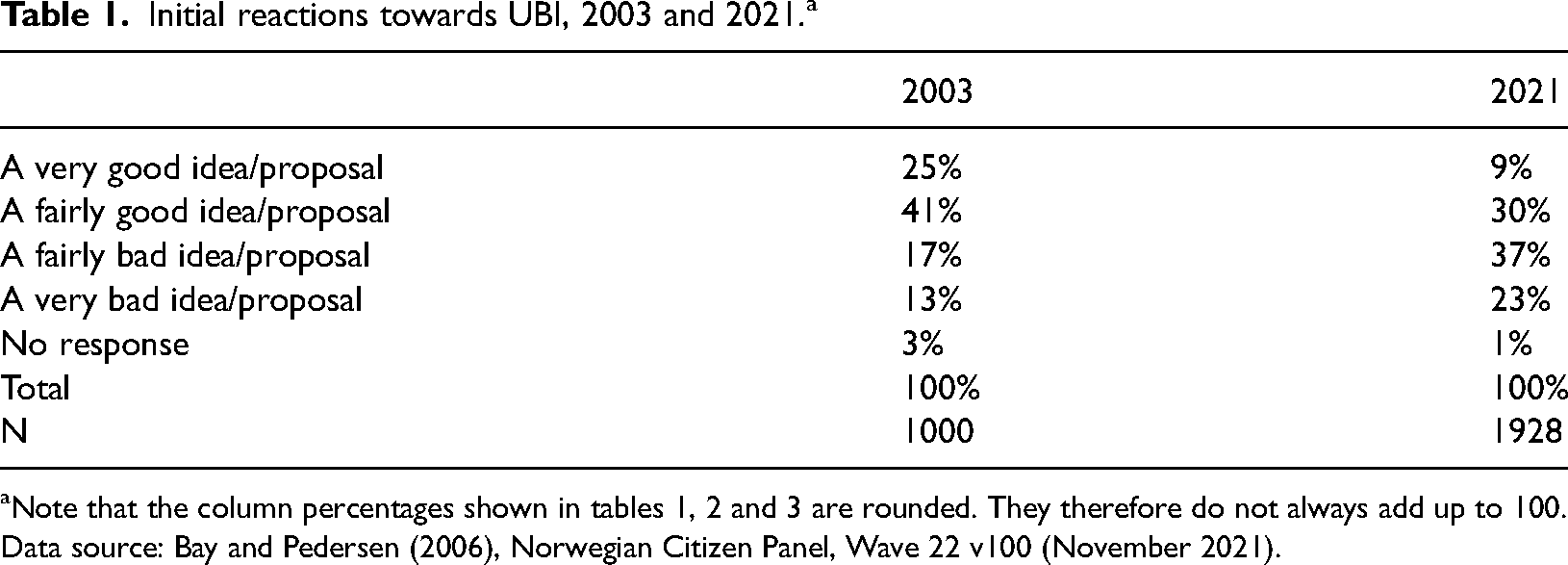
Note that the column percentages shown in tables 1, 2 and 3 are rounded. They therefore do not always add up to 100.
Data source: Bay and Pedersen (2006), Norwegian Citizen Panel, Wave 22 v100 (November 2021).
The level of support in 2021 is about the same as the figure for Norway in ESS 2016, where 31% supported a UBI. Roosma and van Oorschot (2020), in a comparative analysis of the ESS question, find that support for UBI tends to be higher in countries with less ambitious welfare states and higher levels of material deprivation. Their explanation of this result is relevant for Norway: in well-developed welfare states with low poverty rates, inhabitants are eager to maintain their established social insurance system and do not see an urgent need for alternative or supplementary measures.
Are the respondents’ initial reactions ‘immigrationalised’?
As we have suggested, the decline over time in support for a UBI in Norway could also be explained by an increasing tendency for welfare opinions to become immigrationalised in recent years. Figure 1 explores whether there is a relationship between attitudes to immigration and the initial reaction to the UBI idea. 6 Immigration attitudes are measured by a simple additive index of responses to two questions: a) To what extent do you see it as an advantage or a disadvantage that immigrants come to settle in Norway?; b) In your opinion, should it be made easier or more difficult for immigrants to be granted permanent residence in Norway? Higher values mean more positive views on immigration. In the figure, respondents’ scores on the immigration attitude index are grouped into five categories of approximately equal bandwidth. The figure confirms that, in 2021, there is a strong positive relationship between immigration-friendly attitudes and the propensity to initially support the UBI proposal. Pearson's r between the two variables is 0.205 and the association is highly statistically significant. As hypothesised, the association is much stronger in the contemporary Norwegian context than in 2003 (Bay and Pedersen, 2006: 427).
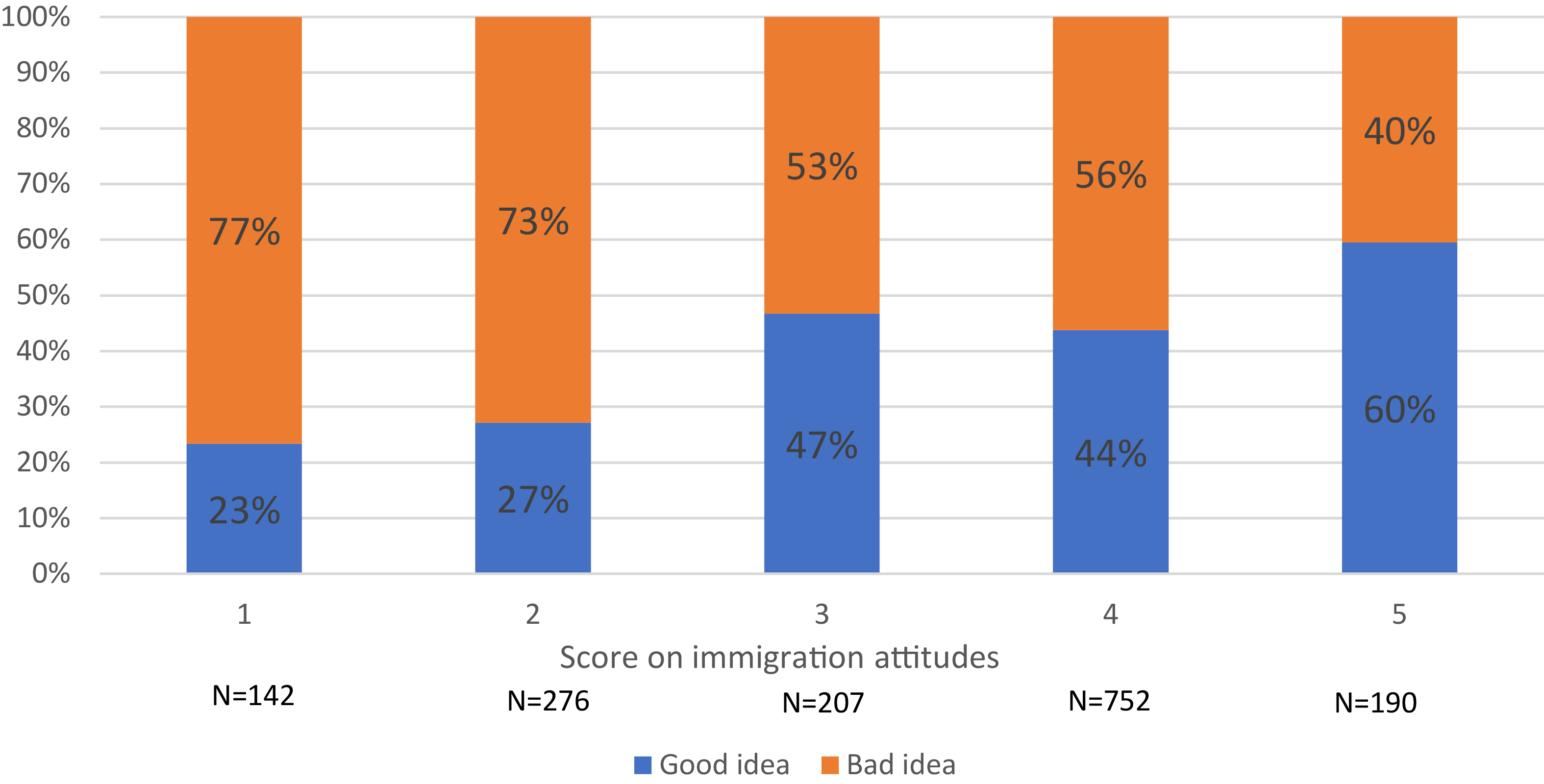
Initial reactions towards UBI by immigration attitudes, 2021.§,a
Among the group with the most positive views on immigration (group 5), 60% support the idea of a UBI while only 23% support the idea within the most immigration-sceptic group (group 1). The significant strengthening of the association between 2003 and 2021 could be due to respondents having become more prone to take immigration into account when reacting to the UBI proposal: i.e. attitudes towards the basic income idea have already become immigrationalised. If this is the case, the information given in the persuasion experiment may be expected to have less of an additional effect. However, the stronger correlation between the two attitudinal dimensions could also be the result of polarisation dynamics and issue bundling, forcing intrinsically unrelated political conflict dimensions to become increasingly aligned over time at the individual level (Wollebæk et al., 2022). In other words, people who are sceptical of immigrants now simply happen to be overrepresented among those who are inclined towards negative evaluations of the UBI idea. In that case, the persuasion may still have the potential to further mobilise negative immigration attitudes against the idea of UBI among the initial supporters.
Responses to the persuasion experiment
The results presented in Table 2 confirm the latter expectation. The table demonstrates that the counterargument referring to immigration still has very strong persuasive power in 2021.
The effect of the persuasion experiment on reactions towards UBI, 2021.
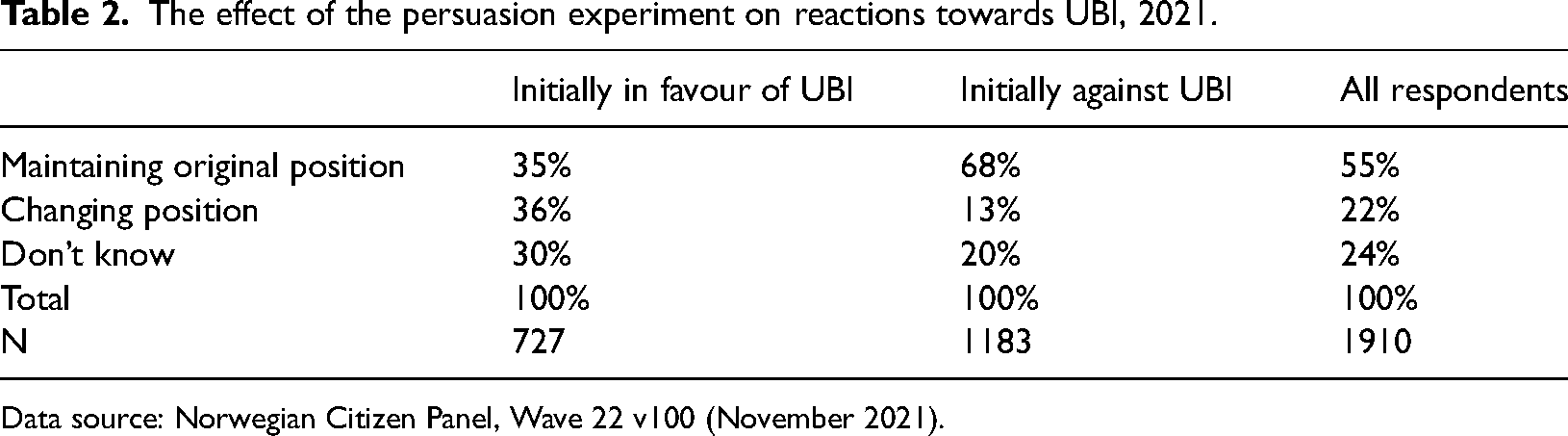
Data source: Norwegian Citizen Panel, Wave 22 v100 (November 2021).
Only 55% of the respondents maintain their initial evaluation of the UBI idea after the counterargument, while 46% abandon their original position. The initial supporters of UBI prove to be the easiest to talk out of their initial reaction. Only 35% maintain an initially favourable evaluation, compared to 68% among the initial opponents. This is in line with the finding of Bay and Pedersen (2006), but the propensity to change opinion is even stronger among the (smaller) group of initial supporters in 2021 than in 2003.
The corresponding counterargument is less effective among the initial opponents. In this group, only 13% are persuaded to endorse a welfare chauvinist version of a UBI, which may suggest that their scepticism towards a UBI is not exclusively or primarily based on welfare chauvinist considerations.
One should note, however, that a substantial share of the respondents – 30% among the supporters and 24% among the opponents – react by changing their initial position to ‘don’t know’. As we have already indicated, the data collection based on an online survey appears to have made it more likely that any doubt or ambiguity will result in a ‘don’t know’ answer. The group answering ‘don’t know’ is interesting in its own right: their hesitation when confronted with an immigration-related counterargument may have decisive political importance when push comes to shove.
Position on UBI after persuasion
We can divide the respondents into four groups, based on their combined answers before and after the persuasion intervention: unwavering supporters of the UBI idea, defecting supporters, defecting opponents and unwavering opponents. The unwavering supporters/opponents are respondents who maintain their original reaction after the persuasion intervention, while the defecting supporters/opponents have either abandoned their original evaluation completely or become uncertain after being confronted with the counterargument. Table 3 shows how the entire sample is distributed between these four categories.
Position on UBI after persuasion, 2021.
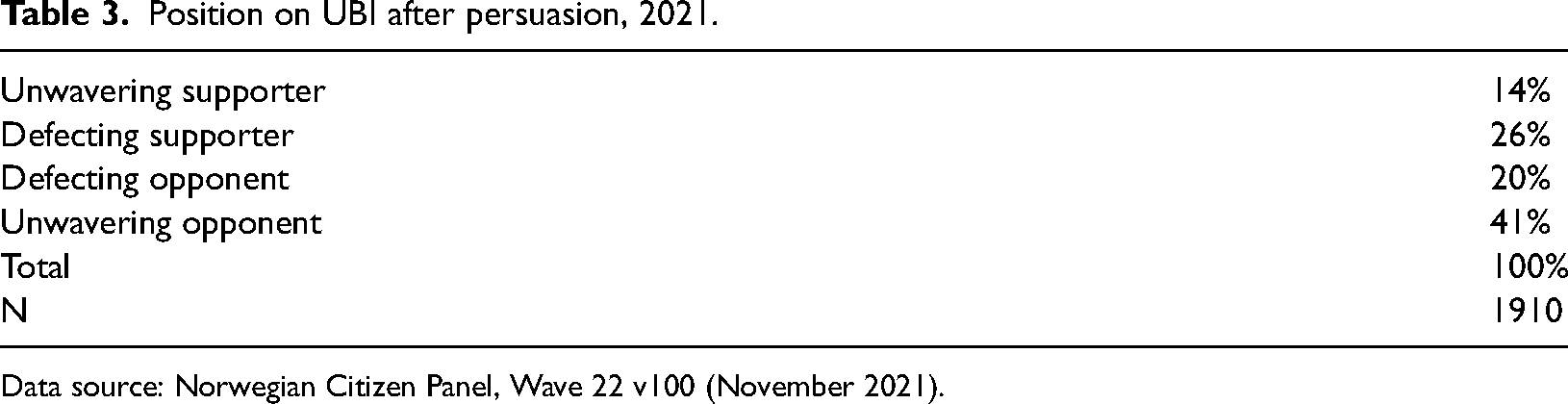
Data source: Norwegian Citizen Panel, Wave 22 v100 (November 2021).
Figure 2 shows how the distribution across these four categories varies with immigration attitudes. It demonstrates that the weakening of support for UBI among the initial supporters as a result of the counterargument is strongly related to immigration attitudes. Among the most immigration-sceptic group, only one percentage point (out of the 24% initial supporters) uphold a positive evaluation of the UBI idea, while 23 percentage points are persuaded to defect. In the most immigration-friendly group, 47 percentage points (out of the 60% of initial supporters) maintain a positive evaluation of the UBI idea, while 13 percentage points are persuaded to abandon their initial positive evaluation. Respondents who are placed in the middle with respect to immigration attitudes (group 3) are also strongly affected by the persuasion experiment. Of the 47% of initial supporters of UBI within this group, only 9 percentage points maintain their initial positive evaluation.
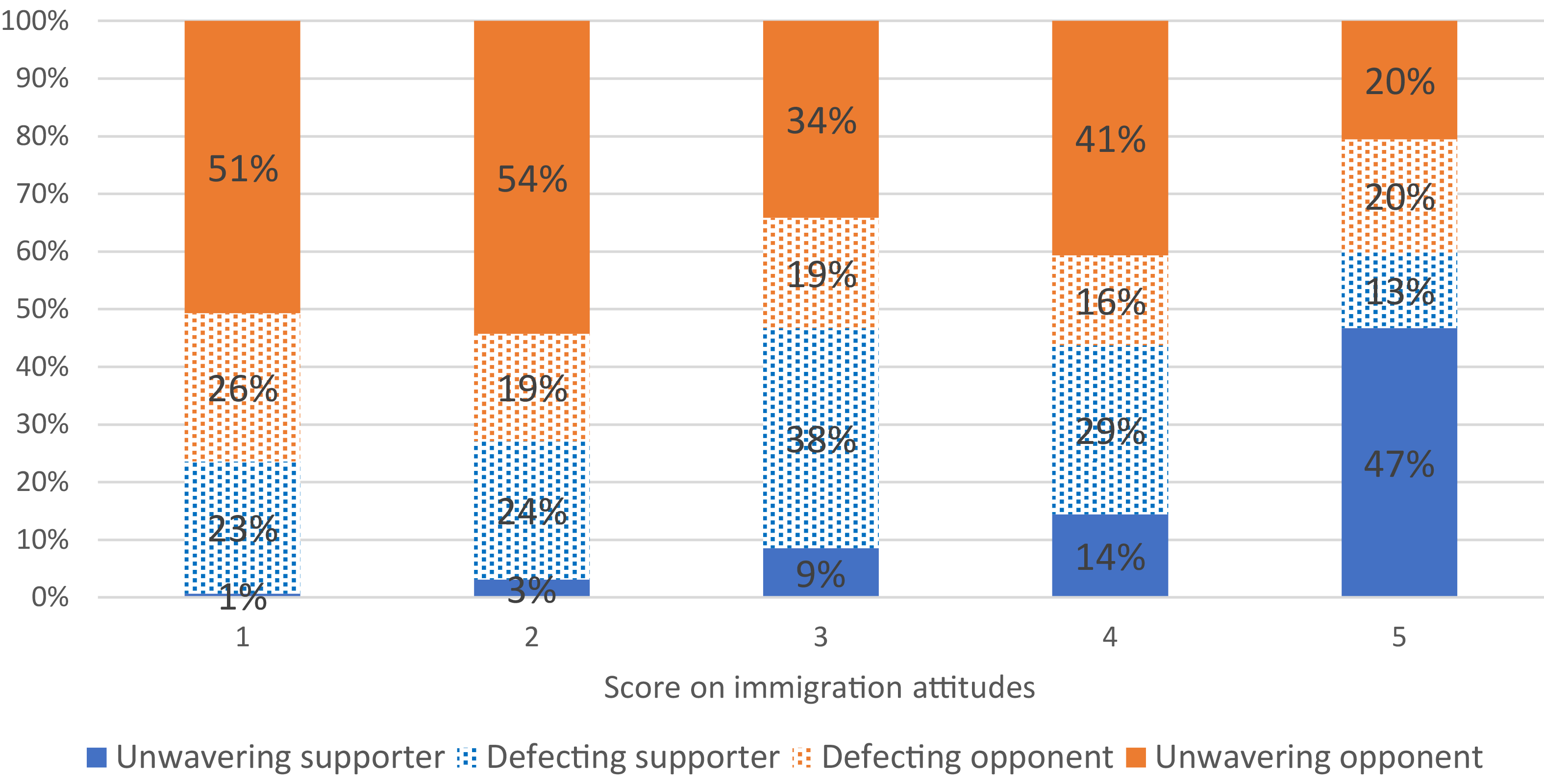
Position on UBI after persuasion by immigration attitudes, 2021.§
We have already seen that the initial opponents of UBI are significantly less affected by the persuasion experiment, and the graph demonstrates that the propensity to accept a welfare dualistic version of UBI among the initial opponents is only weakly related to immigration attitudes. The defecting opponents are much more evenly distributed across the immigration attitude spectrum, compared to the defecting supporters.
Note the very steep gradient of unwavering support for UBI, rising from 1% in the most immigration-sceptic group to 47% in the most immigration-friendly group. Consequently, the correlation (Pearson's r) between (positive) attitudes to immigration and being classified as an unwavering supporter of the UBI idea is quite strong, at 0.313.
Topic-bound or topic-free change of opinion?
We finally turn to a more systematic investigation of whether the respondents’ sensitivity to the counterargument is ‘topic-bound’ or ‘topic-free’. By topic-bound, we mean that it is the content of the counterargument (invoking the immigration implications of a UBI) that convinces the respondents to change their minds, while a topic-free explanation implies that respondents are inclined to change their minds when confronted with any type of verbal resistance. We assume that a topic-bound explanation is supported to the extent that the propensity to change position is strongly related to immigration attitudes. Similarly, we assume that a topic-free explanation is supported if the propensity to change opinion is primarily linked to political awareness – here represented by a variable measuring political interest. In line with Converse (1964) and Feldman and Zaller (1992), we assume that individuals with low political awareness are easier to talk out of a stated political preference than individuals with high political awareness.
We enter the two predictor variables in multiple regression models, with the probability of changing opinion as the dependent variable. The two predictor variables have been standardised (centred around zero and divided by their standard deviation) to make it easier to compare the strength of the associations found. The analysis is done separately for initial supporters and initial opponents, to allow for the fact that both the content and the results of the persuasion experiment are fundamentally different between these two groups.
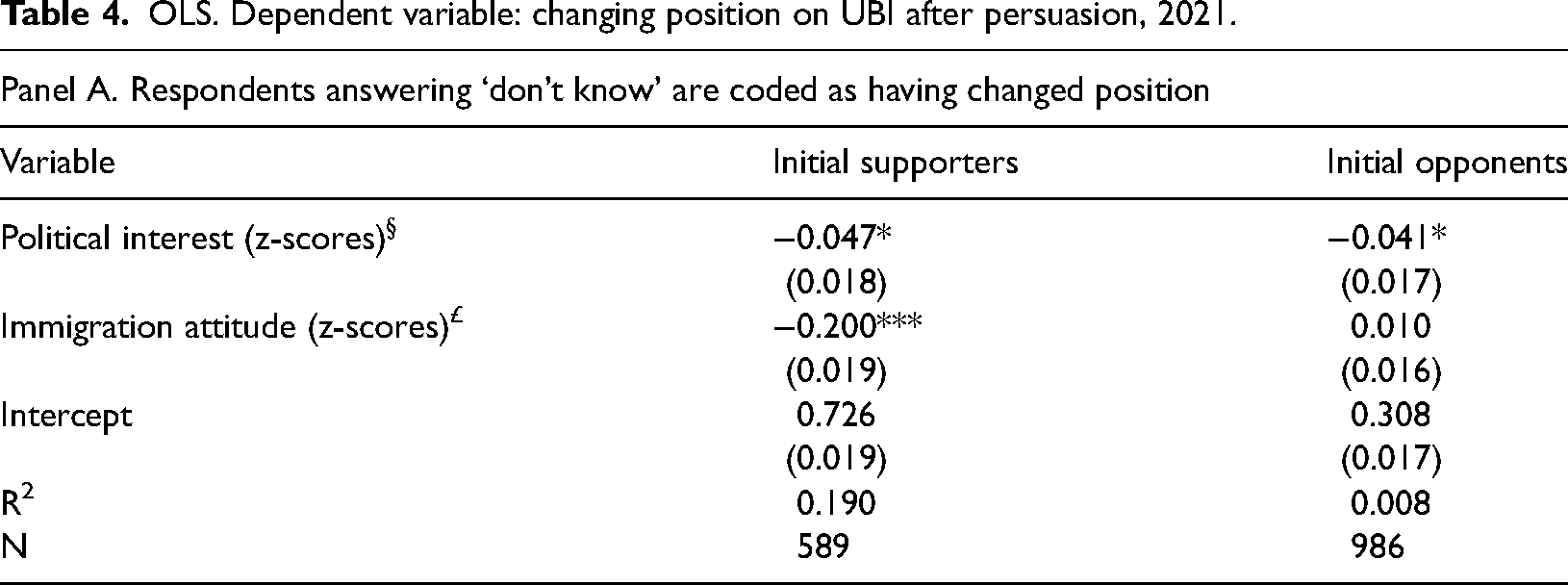
As we have seen, a very significant share of both the initial supporters and the initial opponents react to the persuasion intervention by opting for the ‘don’t know’ alternative. The large share of ‘don’t know’ answers is a challenge for the analysis. On the one hand, these respondents have been swayed to leave their initial position, but on the other, they have not been convinced to take the opposite position. To accommodate this ambiguity, we present two regression analyses. In the first analysis, the respondents saying ‘don’t know’ are coded as having changed their position. In other words, we look at the contrast between maintaining the original position and changing position, either by saying ‘don’t know’ or by abandoning the original evaluation of UBI. From the point of view of exploring the robustness of political support for a UBI, this is arguably the most reasonable alternative. In the second analysis, we excluded respondents who chose ‘don’t know’ and investigated the effects of the two independent variables on the contrast between maintaining or changing the original evaluation of a UBI. 7
The results in Panel A of Table 4 confirm that it is primarily among the initial supporters that we see a change of opinion. As the two independent variables have been centred around their respective means, the intercepts for the two groups give the probabilities of changing position at mean values of the independent variables: 73% in the initial supporter group and 31% in the initial opponent group.
OLS. Dependent variable: changing position on UBI after persuasion, 2021.
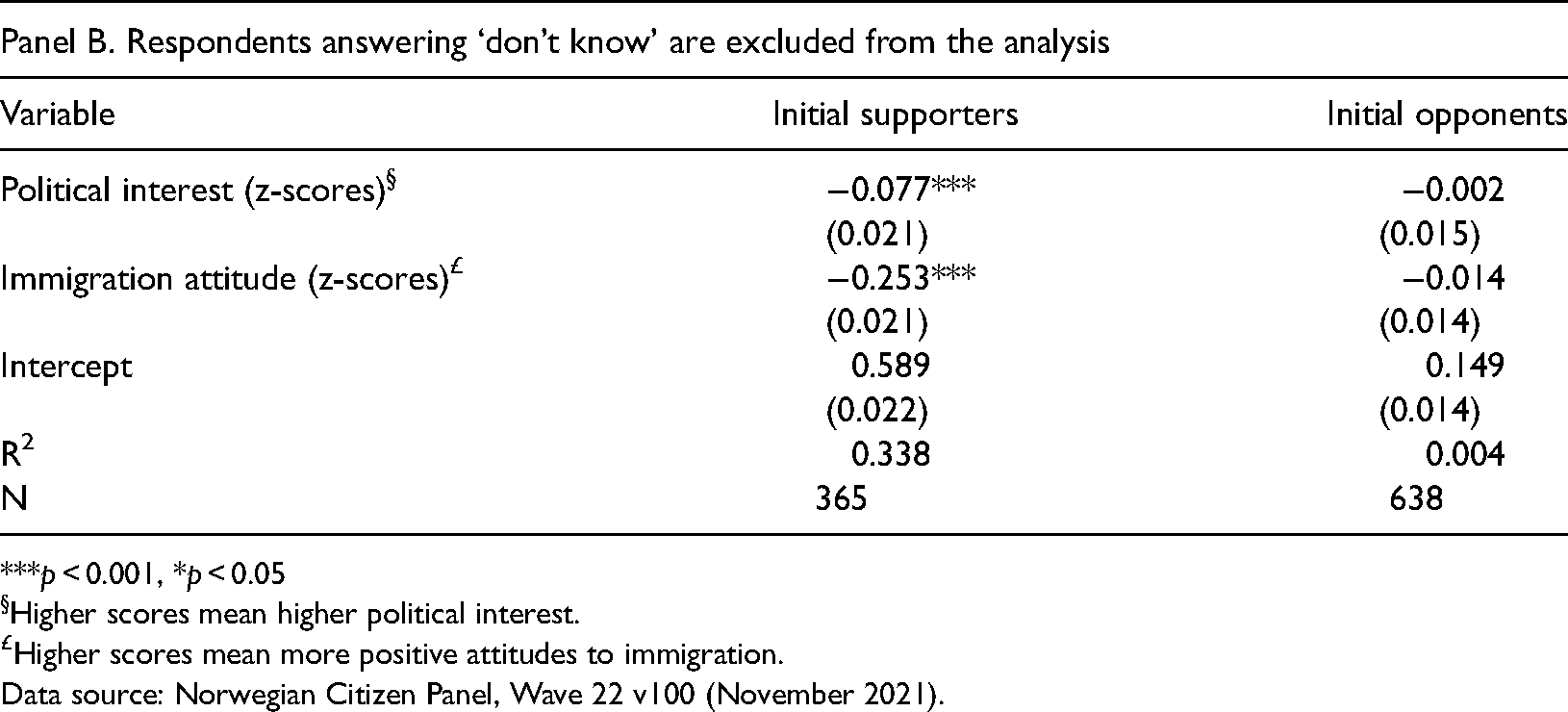
***p < 0.001, *p < 0.05
Higher scores mean higher political interest.
Higher scores mean more positive attitudes to immigration.
Data source: Norwegian Citizen Panel, Wave 22 v100 (November 2021).
It is also almost exclusively among initial supporters that our two independent variables are statistically associated with the propensity to change opinion. By far the strongest association is found with immigration attitudes among the initial supporters. An increase of one standard deviation towards a more positive view of immigrants is associated with a 20 percentage point reduction in the probability of abandoning the initial positive evaluation of the UBI proposal. Among the initial supporters, we also find a negative association with political interest, but the coefficient is much smaller and barely statistically significant. The pattern strongly supports the topic-bound explanation, holding that the content of the counterargument related to immigration is an active mechanism undermining the initial support for the idea of UBI.
Among initial opponents, we find no effect of immigration attitudes on the propensity to change opinion, but a modest negative association with political interest of about the same size as that found among the initial supporters.
When, in Panel B, we exclude the respondents who answer ‘don’t know’ after persuasion, the pattern becomes even clearer. It is now only among the initial supporters that the response to the persuasion is linked to our two independent variables. In this group, the effect of both immigration attitudes and political interest become stronger, while the former continues to dominate, with an increase in the probability of changing position of 25 percentage points per standard deviation. Note also that the two independent variables explain 34% of the variance among the initial supporters. Among the initial opponents, by contrast, neither of the two independent variables shows a clear statistical association with the propensity to change opinion, and the model hardly explains any of the variation in the dependent variable.
Summary and conclusion
In this article, we have explored the persuasive power of references to immigration on people's attitudes towards a UBI. The study replicates a survey experiment undertaken in 2003, showing that a large share of the respondents left their initial position when primed with a reference to immigration.
Compared to the original study, we find substantially lower initial support for a UBI, and unlike the original study, we find a strong association between initial support and immigration attitudes. Nevertheless, the results of the present experiment confirm that counterarguments referring to immigration still have substantial persuasive power in the present Norwegian context. A large share of initial supporters of UBI abandoned their original evaluation when confronted with the argument that a UBI would be available to newly settled immigrants. Furthermore, we find that abandoning initial support is strongly correlated with negative attitudes towards immigrants. Although the initial support for a UBI was relatively low among Norwegian voters in 2021, the effects of the persuasion experiment on the initial supporters are very strong – particularly if we also count those who react by saying ‘don’t know’ after the persuasion intervention.
Our hypothesis that the initial support for the UBI idea has weakened over time, because the issue has already been fully immigrationalised in the minds of Norwegian voters, is not supported. Contrary to our expectations, the persuasion intervention is still highly effective among the initial supporters, and consequently we conclude that the full potential for immigrationalising this issue has not yet been realised.
The impact of the counterargument on the initial supporters of UBI illustrates the core of the progressive's dilemma: immigration may erode support within the traditionally pro-welfare state segments of society. In a comparative study of how Scandinavian social democratic parties handle this dilemma in their party programmes, Grødem (2022) finds that although low employment rates among immigrants are pointed to as a serious challenge, the Norwegian Labour Party sticks to the traditional belief in activation policies, while advocacy for welfare dualistic solutions is absent from the party's agenda. The emphasis placed on activation, as a strategy to cope with immigration, by the Labour Party (as well as by Norwegian centre-right political parties, see Bay and Hellevik, 2022), may explain some of the persuasive power of the immigration issue among the initial supporters. A UBI may be seen as a disincentive for immigrants to participate in the labour market or as an incentive for immigrants to come to Norway, and thereby as a threat to the economic sustainability of the welfare state.
Based on the strong association between attitudes to immigration and initial attitudes towards UBI, we expected that the proposal for a welfare dualistic version of UBI could be tempting for many of the initial sceptics, particularly if they have negative attitudes towards immigrants. This turned out not to be the case. The counterargument was generally much less effective among the initial opponents, and the propensity to go for the welfare dualistic option appeared unrelated to these respondents’ attitudes towards immigration. Several explanations can be suggested to make sense of this result. First, it may reflect the fact that openly welfare dualistic solutions have not been high on the political agenda in Norway. Compared to its neighbouring Scandinavian welfare state Denmark, Norway has to a limited extent implemented welfare policies with a declared intention to discriminate between immigrants and the native population. However, a study from 2009 which compares Norwegians’ and Danes’ attitudes towards discrimination against immigrants in the provision of social assistance revealed that the popular support for this was quite substantial in both countries (Bay et al., 2013). Second, the modest effect of the counterargument among opponents could simply be seen as an indication that scepticism towards the idea of UBI is entrenched among large segments of the Norwegian electorate. The ESS 2016 survey revealed that support for UBI was lowest in Norway compared to all other countries in the survey (Meuleman et al., 2018). Finally, the combination of a strong correlation between attitudes to immigration and attitudes towards UBI and the weak effect of the counterargument among the opponents, may indicate that the two attitudinal dimensions are correlated without being intrinsically related. The idea would be that people who are sceptical towards immigration simply happen to also be sceptical towards a radical expansion of the welfare state through a UBI. They may, for instance, have noticed that political parties (and other opinion leaders) who come closest to advocating something akin to a UBI, also tend to advocate immigration-friendly policies, and vice-versa (Wollebæk et al., 2022).
A large share of the respondents – 30% of the initial UBI supporters and 20% of the opponents – choose the ‘don’t know’ option when confronted with the immigration-related counterargument. A plausible explanation for this would be that the counterargument triggers contradictory attitudinal impulses and hence is a source of cognitive dissonance (Festinger, 1962). Among the initial supporters, the potential source of dissonance is obvious and captured by the phrase ‘the progressive's dilemma’ mentioned in the introduction. Among the initial opponents of the UBI proposal, a welfare dualistic version may be tempting due to its inbuilt chauvinism, but may nevertheless be rejected for its incentive effects and egalitarian implications among the general population. In any case, the large number of ‘don’t know’ answers is an indication that opinions can be moulded by effective political communication.
Our findings add to the existing research on the relationship between attitudes to immigration and to welfare. Despite the differences in methodological approach, our results resonate with the findings in Kevins’ (2022) comparative study of European voters, that support for a UBI is susceptible to immigration-related attitudinal effects. Most directly, our study aligns with Parolin and Siöland (2020), who find evidence of an association between welfare chauvinist attitudes and low support for a UBI in contexts such as Norway, with a comprehensive universal welfare state and comparatively low poverty rates. It remains to be shown that the cross-sectional statistical association reported by Parolin and Siöland (2020) corresponds to a dynamic causal relationship between immigration attitudes and support for a UBI. Our study has attempted to shed light on this dynamic process. Based on a survey experiment among Norwegian voters, our results provide strong evidence that considerations of the implications of the scheme for immigrants can be mobilised to enforce an already strong scepticism towards UBI within the electorate in an affluent and comprehensive welfare state.
Supplemental Material
sj-docx-1-ejs-10.1177_13882627241278111 - Supplemental material for Popular support for a universal basic income – still sensitive to playing the immigration card?
Supplemental material, sj-docx-1-ejs-10.1177_13882627241278111 for Popular support for a universal basic income – still sensitive to playing the immigration card? by Ann-Helén Bay, Tale Hellevik, and Axel West Pedersen in European Journal of Social Security
Supplemental Material
sj-sav-2-ejs-10.1177_13882627241278111 - Supplemental material for Popular support for a universal basic income – still sensitive to playing the immigration card?
Supplemental material, sj-sav-2-ejs-10.1177_13882627241278111 for Popular support for a universal basic income – still sensitive to playing the immigration card? by Ann-Helén Bay, Tale Hellevik, and Axel West Pedersen in European Journal of Social Security
Footnotes
Acknowledgements
We are grateful to researchers at DIGSSCORE (the Digital Social Science Core Facility) at the University of Bergen, participants in the ISF (Institute for Social Research) political seminar and members of the ORGOFF (Organization and Management in the Public Sector) research group at Oslo Metropolitan University, for comments and feedback on earlier drafts of the paper. Special thanks are due to two anonymous referees who provided very helpful suggestions for improving our original manuscript.
Data access
The data were provided by the Digital Social Science Core Facility (DIGSSCORE), at the Department of Government, University of Bergen. The survey experiment was part of the Norwegian Citizen Panel Wave 22 v100 (November 2021). A data file containing the sample and variables used in the analyses will be made available upon request.
Declaration of conflicting interests
The authors declared no potential conflicts of interest with respect to the research, authorship and/or publication of this article.
Funding
The authors received no financial support for the research, authorship and/or publication of this article.

Supplementary material
Supplementary material for this article is available online.
Notes
References
Supplementary Material
Please find the following supplemental material available below.
For Open Access articles published under a Creative Commons License, all supplemental material carries the same license as the article it is associated with.
For non-Open Access articles published, all supplemental material carries a non-exclusive license, and permission requests for re-use of supplemental material or any part of supplemental material shall be sent directly to the copyright owner as specified in the copyright notice associated with the article.
