



Abstract
To avoid catastrophic consequences of impending ecological crises our socio-economic systems need to be transformed in rapid and radical manners. Focusing on working life and Sweden as an example for countries of the Global North with a social-democratic welfare tradition, we ask how social protection systems may be reorganised according to the concept of ‘sustainable welfare’, the satisfaction of basic human needs across space and over time. We combine a literature review with an analysis of qualitative data from deliberative citizen forums following Max-Neef's Human Scale Development methodology. After taking stock of the existing literature that highlights the unsustainable character of current work regimes, we present our application of the methodology used in the citizen forums as well as the data. Our participants generally highlighted the importance of broadening the concept of work beyond ‘employment’ when reflecting on the role of work in addressing and satisfying multiple human needs within planetary limits. The introduction of a universal basic income, a participation income, an expansion of universal basic services, working time reduction and a sabbatical year conditioned on civic participation/education were among the eco-social reform ideas that forum participants highlighted to liberate work from its current unsustainable and capitalist contexts and turn it from a negative into a positive need satisfier.
Keywords
Introduction
To avoid catastrophic consequences of impending ecological crises, our socio-economic systems need to be transformed in a rapid manner so that they can provide a good life for all within planetary boundaries, that is, with significantly reduced energy and material use (Fanning et al., 2020; Rockström et al., 2009). The message from the latest IPCC (2022) report is that radical transformation must immediately be initiated in nearly all fields of society (Koch et al., 2023). However, the extent to which we observe social and political engagement and concrete efforts towards making such a transformation differs across different policy areas. If transportation, buildings, food and energy production and consumption are among the most frequently discussed areas for sustainability transitions, discussions on the ways in which we organise our working life – including industrial relations, wage structure, work-related norms and social protection systems – remain on the margins of corresponding academic and public debate. It seems as if the centrality of wage work as the basis of our current economic system and its importance for individuals and even for interpersonal relations – ‘the cultural dependence’ on work (Hoffmann and Paulsen, 2020) – makes it harder for work to take centre stage in the public imagination and collective endeavours in social-ecological transformation. Work (and employment more specifically) appears rather as a praxis that too often limits measures to reduce the environmental damage caused by our current economic system, as illustrated by the numerous examples of ‘job-killing’ arguments made against climate policies (Vona, 2019).
Social protection systems in developed welfare states are often characterised as ‘a child of industrial capitalism’ (Fitzpatrick, 1998: 22) and reinforce the status of wage work as the most important human activity (Fitzpatrick, 1998). In other words, these systems are underpinned by commodified labour, the pursuit of constantly increasing productivity and economic growth, as well as need satisfaction through private consumption (Büchs and Koch, 2017; Dermine and Dumont, 2022). Despite being one of the most notable societal developments and entrenched institutions in the history of the democratic countries of the Global North (Rehm, 2016), the issue of how social protection systems may be recalibrated and reformed in the context of climate emergency has scarcely been addressed thus far (Bohnenberger, 2023).
This article contributes to the emerging literature that rethinks the role of work and social protection systems in the context of social-ecological transformation towards post-growth and post-productivist economies (Bottazzi, 2019; Corlet Walker et al., 2021; Dermine and Dumont, 2022; Dukelow and Murphy, 2022; Gerold et al., 2022; Gomez-Baggethun, 2022; Hirvilammi and Joutsenvirta, 2020; Koch et al., 2023; Laruffa, 2022; Laruffa et al., 2021). We link the existing scholarly discussion to qualitative empirical data from eleven deliberative citizen forums on sustainable needs satisfaction – or needs satisfaction within planetary limits – which we conducted in Sweden during 2020. The focus is on the ways in which work complicates sustainable needs satisfaction in our current socio-economic system and what reform proposals may be envisioned drawing on this bottom-up perspective.
The article is based on a research project in Sweden, aimed at exploring a new generation of social policy that is ecologically and socially sustainable. Sweden is a critical case for the reorientation of work in social-ecological transition processes for the following reasons. Firstly, Sweden is an archetypical case for social democratic welfare capitalism, where a strong work ethic and the notion of wage work as a prerequisite for access to welfare entitlements strongly prevails and in recent years has become even more salient (Bengtsson and Jacobsson, 2018). Secondly, it is precisely due to this stable work-welfare nexus, which was established and functioned rather successively during the golden period of the Fordist industrial capitalism, that efforts to reconceptualise the role of work in a social-ecological transformation process might encounter resistance and challenges (Lee et al., 2023). Lastly, initial hopes that the social democratic welfare state would somewhat automatically turn into a green state were not realised (Fritz et al., 2021).
The article is structured as follows. After taking stock of the emerging research which articulates the unsustainability of current work regimes, we introduce the methodology used in the citizen forums focusing on the centrality of human needs and its application in previous studies, and describe forum participants and the resulting data in our study. The analysis then focuses on the ways in which people reason about the current role of work in relation to the satisfaction of needs and what changes they would like to see for a more sustainable future in our working life and social protection systems. We conclude the article by highlighting the importance of broadening debates on the role of work in addressing and satisfying multiple human needs. By linking our forum findings to the existing scholarly discussion of eco-social policies, we also argue for the introduction of reforms with a view to repurposing the social protection systems to promote work that serves social and environmental needs.
Rethinking work for a socially and ecologically sustainable society
One of the most salient imperatives within contemporary Western societies is that all capable adult individuals should engage in wage work, unless a range of inevitable conditions such as childbirth, illness, disabilities, or old age hinder them. Reinforced by powerful political rhetoric, the societal consensus is that being ‘economically active’ in terms of wage work or self-employment is the most legitimate way of earning a living, valued over all other forms of human activities. Engaging in wage work and thereby contributing to social protection systems such as pension and unemployment insurance schemes is a fundamental condition that makes adult, able-bodied individuals deserving members of society, in general, and in respect of its social transfers, in particular (Fitzpatrick, 1998). Conventional social protection measures provide monetary compensation for individuals risking loss of income in the above-mentioned situations, but do not challenge productivism (Dukelow and Murphy, 2022). Modern welfare states with entrenched social protection systems, financed largely through taxes on labour income, rely on a strong employment ethic and are embedded in the capitalist growth imperative (Büchs and Koch, 2017; Dermine and Dumont, 2022; Mair et al., 2020). So long as we retain the current economic system where the satisfaction of our basic needs, such as food and housing (in many countries even healthcare and education), is dependent on private consumption in the market economy, the livelihood of people is dependent on continued wage labour – and the institutional structures reinforcing the centrality of work is likely to prevail (Frayne, 2015).
However, the current regime of work and social security has come under scrutiny. The notion that social integration is achieved through participation in wage work is increasingly questioned within and beyond the platform economy (Schor et al., 2020), due to the growing low-wage sector failing to deliver living wages, oppressive mechanisms involving workfare measures, new forms of exploitation in working life characterised by flexibility encroaching the private sphere of life, and so-called ‘bullshit-jobs’ (Graeber, 2018) where the meaning and social function of work is questioned (for comprehensive critiques see Chamberlain, 2018 and Frayne, 2015). Moreover, the environmentally detrimental impact of our working life has been critically reviewed, for instance, in terms of the enormous ecological footprint linked to the material resource use, transportation and infrastructure associated with work, as well as the consumption culture underpinning the work society (Gerold et al., 2022; Hoffmann and Paulsen 2020). In addition, sustainable welfare scholars have proposed new models and systems of work, care and need satisfaction that are reliant on the unconditional provision of basic services (Coote and Percy, 2020; Büchs, 2021; Gough, 2019) and complemented by social protection systems that are repurposed to promote participation in socially and ecologically helpful activities rather than promoting all types of wage work (Dukelow and Murphy, 2022; Laruffa, 2022).
It is important to distinguish between these discussions and more widely and frequently discussed policy agendas such as ‘green employment’ or ‘just transition’. The former focuses on replacing environmentally harmful industry jobs with new jobs in the greener industries, while the latter is linked to labour environmentalism where workers are ascribed the role of active agents in the social-ecological transformation process, pursuing social and environmental justice (Bohnenberger, 2022; Bottazzi, 2019). These agendas do not question growth-oriented job strategies as such, let alone the cultural and social dependence on work as the most important human activity, but assume that the transition towards a more sustainable socio-economic system is possible when the right kind of employment is created and subsidised, and that the job environment dilemma can be addressed by investing in workers’ re-education and upskilling for the green industries. Both agendas are endorsed, for instance, by the International Labour Organization in its green job and just transition policy recommendations (ILO, 2022) and feature centrally in the EU's Just Transition Mechanism (JTM) within the larger framework of European Green Deal and illustrated through the well-known phrase ‘leaving no one behind’ (EC, 2023).
The growing public interest in these agendas signals the central role of transforming the world of work, in that the political feasibility and acceptability of social-ecological transformations critically hinges on convincingly proposing how people's livelihoods can be safeguarded by addressing the distributive consequences of changes in the labour market. The role of social protection systems in compensating for the loss sources of income for workers in fossil fuel industries, for instance, by introducing job guarantee schemes, has been discussed (Culot and Wiese, 2022), and there is an emerging research agenda in the field of social security law where it is argued that social protection provision for human activities that are geared towards care and environmental protection – not merely wage labour through formal employment – should be expanded and encouraged (Dermine and Dumont, 2022).
For the purpose of this article, namely, to illustrate the bottom-up rationales for potential eco-social policies that could transform the role of work and social protection systems in social-ecological transformations, it is useful to briefly introduce some other alternative political visions for transforming the world of work that are not yet endorsed by the current political mainstream discussion or powerful policy organisations and stakeholders. Bottazzi (2019), for instance, places a renewed role of work front and centre when envisioning the paradigmatic change from a capitalist to a ‘contributive’ economy. He argues that the current ways of valuing only monetarily compensated work in the labour market depoliticise and socially alienate individuals, leading to relentless consumerism and ultimately, the degradation of our ecosystems. He proposed that instead, in a contributive economy, the world of work will be centered on intrinsically motivated human activities and collaboratively created social and ecological values and thus ecological resilience. This shift – as radical as ‘idealistic’ in the author's own words – requires that the strongly entrenched market-based rationalities such as private property, unlimited productivity gains and economic growth will be abandoned and replaced with collective ownership, de-commodification and improving human capabilities as the core goal of economic systems. This proposal is in line with the argument that to achieve genuinely transformative changes of society, the capitalist market economy itself will need to be challenged (Feola, 2020; Pirgmaier and Steinberger, 2019; Sorg, 2022).
Another useful approach focusing on renewing the role of work in the context of social-ecological transformations is centred around the concept of ‘community economies’ (Gibson-Graham, 2008; Hirvilammi and Joutsenvirta, 2020). Using concrete cases of community economies, the authors illustrate the ways in which current social protection systems in general, and activation policies in particular, fail to adequately value socially and economically essential work that is not in the form of formal wage labour, hindering diverse work practices, for instance, when doing unpaid part-time voluntary work results in ineligibility for unemployment benefit. Community economies also pay attention to the sense of meaningfulness that people may find when working for what is valued in their community and, hence, beyond the realm of wage work performed only for instrumental reasons and under the employer's control. The emancipatory potential of de-commodifying work is equally stressed in the contributive economy approach introduced above.
The perspectives discussed thus far vary in terms of what alternative versions of the future of work are suggested, how far-reaching the transformations they envision, and what concrete policy tools they discuss (if at all) in relation to organisation, distribution and content of work, and to potential reforms of social protection systems. One recurring element that is important for our study is that they challenge the status of human labour as a commodity and advocate for de-commodification of (at least parts of) work. A recent call by Dukelow and Murphy (2022) to bring de-commodification to the fore in the debate on transitioning towards a post-productivist economy is highly relevant in this context. In the remaining sections of the article, we link these theoretical discussions to our data from deliberative citizen forums in Sweden.
Methodology and data
The empirical analysis of the article builds on qualitative material collected in deliberative citizen forums for sustainable needs satisfaction conducted in 2020 in Sweden. Several scholars have argued for the centrality of human needs in conceptualising sustainable welfare and developing eco-social policies (Büchs and Koch, 2019; Gough, 2017; Koch et al., 2017). Aimed at developing and promoting ways to meet human needs within planetary limits for all people, now and in the future (Koch and Mont, 2016), sustainable welfare as a potential policy paradigm for postgrowth economies is the basis on which the forums were designed.
Human Scale Development (HSD) methodology and its application
More specifically, we used Max-Neef's Human Scale Development (HSD) methodology (Max-Neef, 1991) to guide the discussions on the sustainable satisfaction of nine fundamental needs proposed by Max-Neef: subsistence, protection, affection, understanding, participation, idleness, creation, identity, and freedom. A central notion in applying the HSD method to transformational change processes is that the abovementioned fundamental human needs are considered finite and constant over time and space. Conversely, needs ‘satisfiers’ are the concrete means by which needs are met. They can vary depending on historic, social and cultural contexts and can be more or less socially and ecologically sustainable.
Previously, participatory workshops, group discussions and other similar events using the HSD method have been employed in different national contexts with different goals, and have brought insights that often challenge mainstream narratives of policymakers. For instance, a study by Guillén-Royo et al. (2017) engaged with different groups of residents in a Spanish city and proposed different sets of priorities and a more integrated approach to sustainable development that did not focus solely on the economic dimension. Another study on the use of information and communication technology (ICT) in Norway provided alternative problem descriptions and solutions regarding the sustainable use of ICT, which are qualitatively different from and critical of the mainstream narrative stressing the necessity of ICT (Guillén-Royo, 2020). In Belgium, Jolibert et al. (2014) applied the HSD approach to develop future scenarios of needs satisfaction in a specific region, by involving people with diverse professional backgrounds as representatives of different sectors. Unlike the imperative of regional development, understood in terms of economic growth and expansion, the future scenarios generated through the stakeholder discussions focusing on needs satisfaction emphasised the importance of local production and consumption, more equal access to public services and citizen participation in decision-making processes. The HSD approach was also recently employed in Germany in facilitating the work of citizen-driven renewable energy cooperatives (Centgraf, 2018). The study proposed more focus on the human-centered and relational understanding of civic engagement in studying and facilitating energy cooperatives.
Data collection
Inspired by these previous applications of the HSD method that facilitate a more holistic approach to social-ecological transition processes, the goal of our study in Sweden was to create opportunities for collective reflection and deliberation on the current ways in which we satisfy our needs, and to generate new insights and concrete policy ideas that could facilitate alternative and sustainable ways of satisfying them. In total, 84 people participated in 11 forums, four of which were held in person and the rest held online due to the outbreak of the Covid pandemic. The forums lasted six to seven hours on average, including breaks, and were based on voluntary participation. The recruitment of the participants did not aim to provide a socio-demographically representative pool of Swedish residents. We did, however, achieve certain variation among the participants in terms of their residential areas (urban/rural), occupational backgrounds (see Table 1), and age (from teenagers to the elderly retirees). Seven out of 11 forums were held with people who already knew each other through their engagement with or membership of various types of community organisations, mostly in the areas of social and environmental issues. The other forums served as an opportunity for interested individuals to meet for the first time. Invitations were circulated on research communication platforms and the social network of the research team. Our sampling method hence does not rely on any probability sampling and does not allow us to claim applicability of the outcomes of the forums to the general population in Sweden.
List of citizen forums on sustainable needs satisfaction in Sweden (2020).
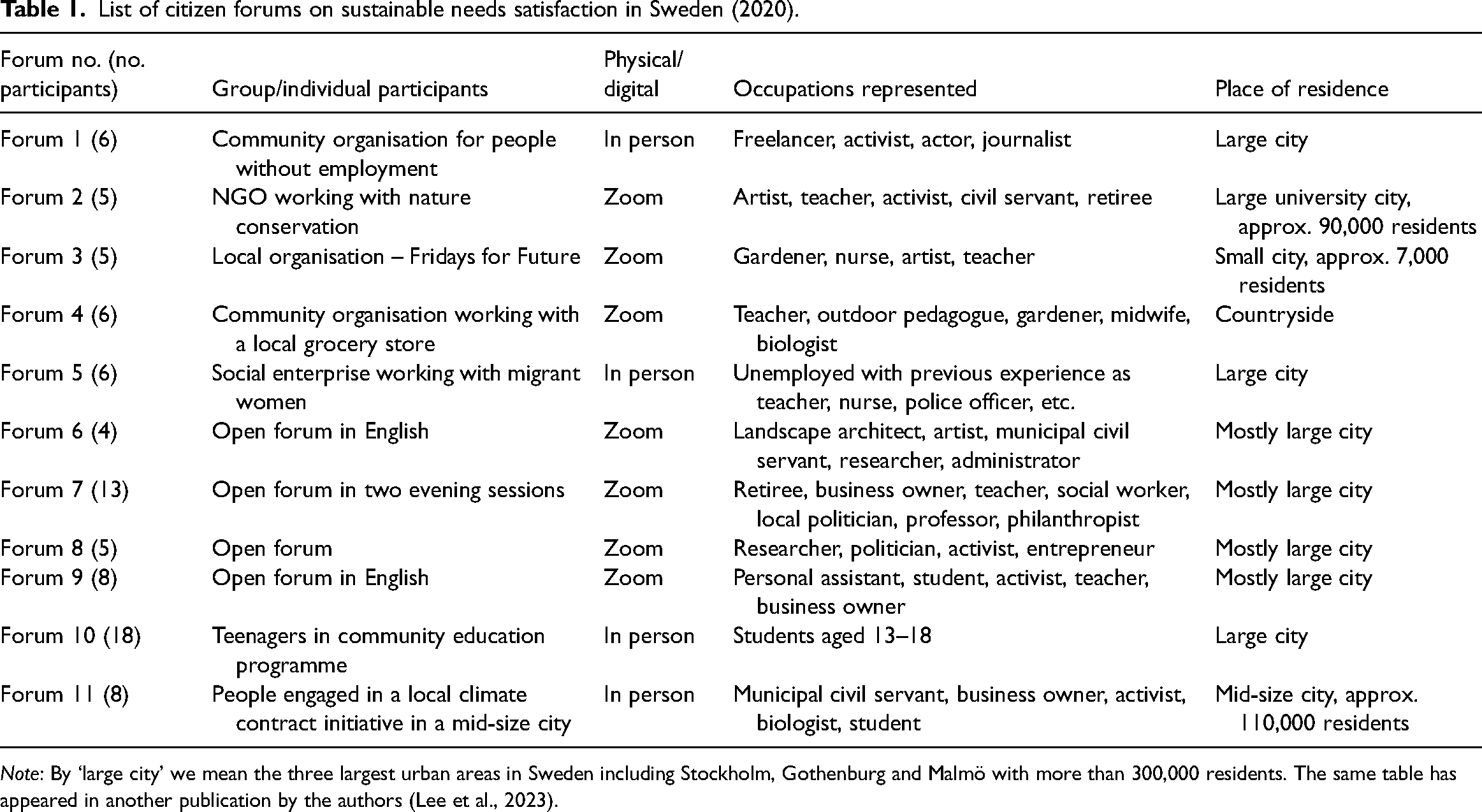
Note: By ‘large city’ we mean the three largest urban areas in Sweden including Stockholm, Gothenburg and Malmö with more than 300,000 residents. The same table has appeared in another publication by the authors (Lee et al., 2023).
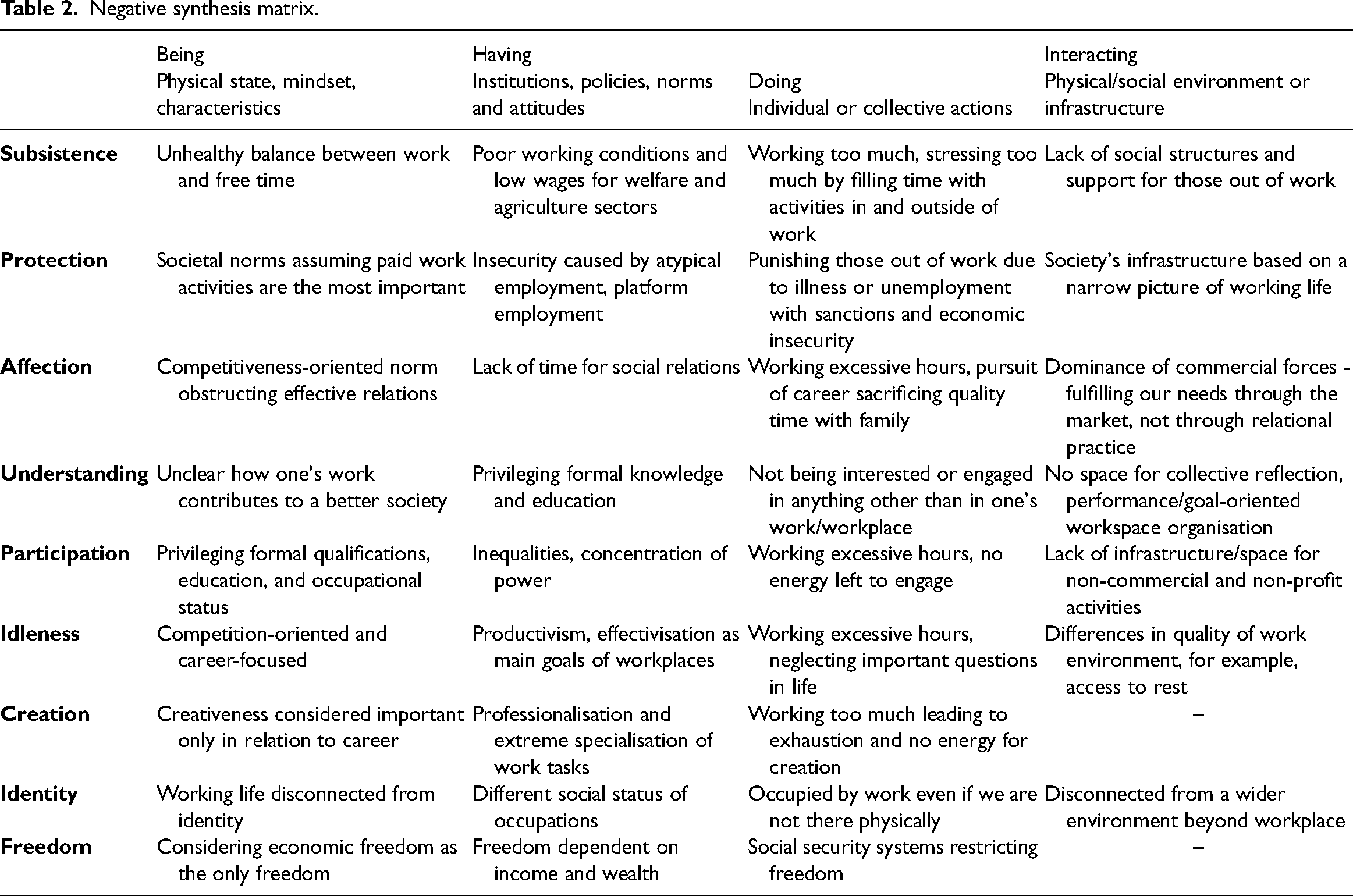
We used the needs-matrix developed by Max-Neef (1991) in structuring the forum discussions (see Tables 2 and 3). The original list of fundamental needs was translated into Swedish, and for reasons of context sensitivity some modifications were made. There was one facilitator for each forum and two assistants took notes and filled in the matrices based on the discussions. The majority of forums were structured in the following way: first, the participants were introduced to the theory of universal needs, where it was postulated that fundamental human needs are universal across time and space but that the ways in which they are satisfied by ‘needs satisfiers’ differ across contexts; second, using the needs-matrix, the participants were instructed to discuss the ways in which they currently satisfy these needs and to critically reflect on their ecological and social impacts, as well as what obstructs the fulfillment of our needs (the term ‘negative satisfier’ was used); third, the participants were instructed to discuss utopian ways of satisfying the same needs, considering the social and ecological sustainability for current and future generations (‘positive/utopian satisfier’); lastly, the participants were encouraged to come up with policy ideas that could bridge the gap between the utopian and current unsustainable ways of needs satisfaction (‘bridging satisfier’) (see Guillén-Royo (2015) for a comprehensive overview of the method). Hence, the same participants discussed current, utopian and bridging need satisfiers. The different types of needs satisfiers were colour-coded by research assistants who filled in the matrices during the forums. Towards the end of each forum the participants had an opportunity to review the completed matrix, before we proceeded to a concluding session, sharing reflections about the forum discussion.
Negative synthesis matrix.
Utopian synthesis matrix.
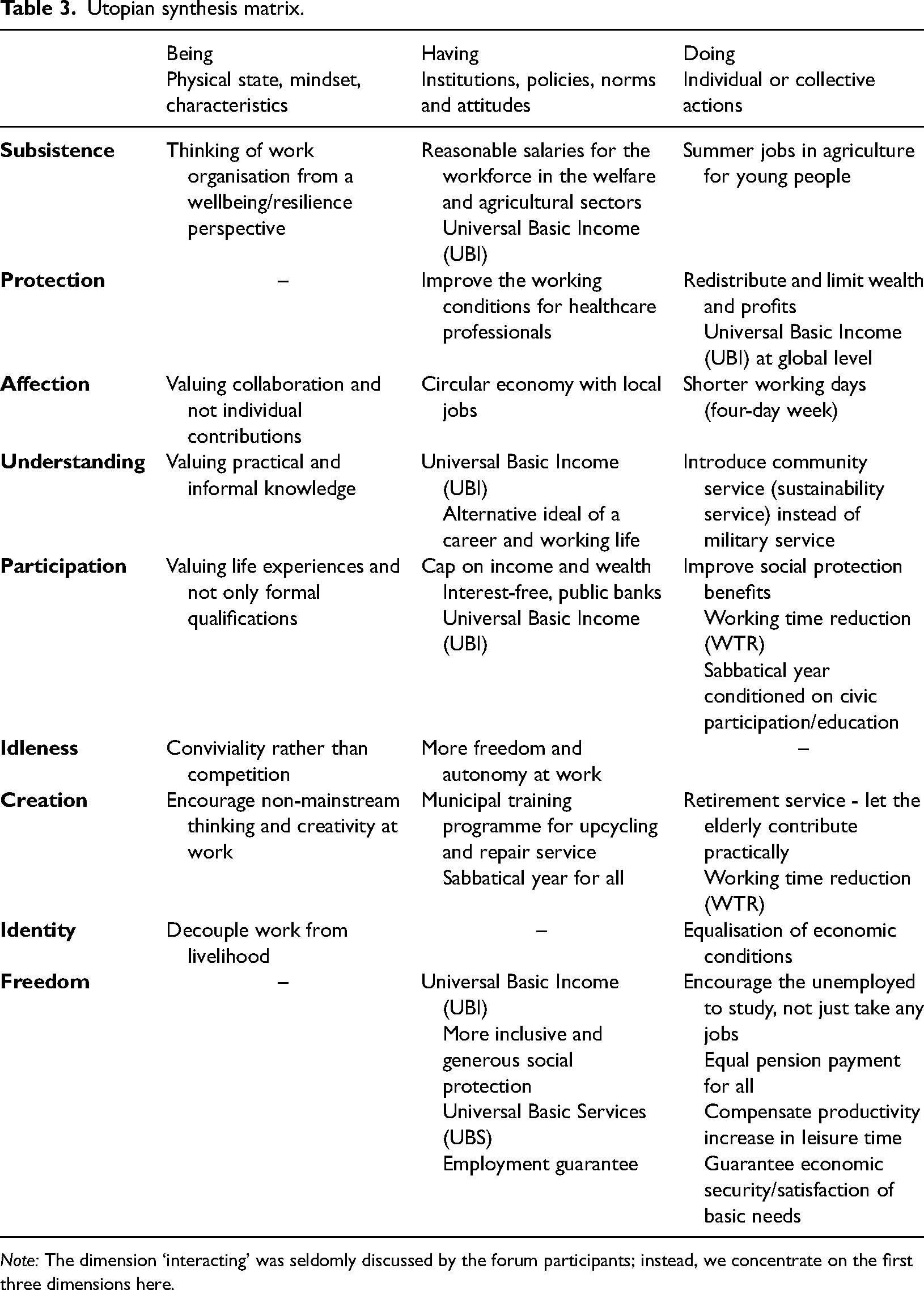
Note: The dimension ‘interacting’ was seldomly discussed by the forum participants; instead, we concentrate on the first three dimensions here.
The various needs matrices were subsequently integrated into one single master matrix using a spreadsheet consisting of approximately 1600 unique entries of ‘needs satisfiers’. As the four columns of the matrix indicates (see Table 2), they can include physical state, mindset or characteristics (under the column ‘Being’), institutions, policies, norms and attitudes (‘Having’), individual and collective actions (‘Doing’) and physical/social environment and infrastructures (‘Interacting’). In the master matrix, it is possible to filter the need satisfiers using different categories of needs as well as secondary themes developed through a thematic coding process (such as ‘Consumption’, ‘Democracy’, ‘Equality’, ‘Work and Income’ ‘Use of Space’, ‘Digitalisation’, etc.). The following analysis is chiefly based on 151 need satisfiers that were coded under the theme ‘Work and Income’. Fifty-seven of these entries were ‘negative satisfiers’, 35 were ‘positive satisfiers’, and 59 were ‘bridging satisfiers’. We make use of a few quotes from the participants in highlighting interesting insights.
Analysis
Following the method proposed by Guillén-Royo (2020), Tables 2 and 3 present consolidated synthesis matrices from the forums. They do not provide an exhaustive picture of all forum discussions but are distilled and condensed versions of the need satisfiers relevant for the purpose of this study. Had we focused on other thematic topics such as housing or transportation, different but possibly overlapping items would be listed in the matrices. Some entries in these matrices are coded under other themes but they were identified during an iterative process of going back and forth between the master matrix and the meeting notes. In the following we present our analysis guided by two questions: In what ways does work obstruct sustainable need satisfaction? What wishes and ideas about transforming our working life were expressed?
Work as a negative need satisfier
The ways in which working life is organised, related norms and their impacts on individuals were frequently discussed throughout the citizen forums and often explicitly linked to several fundamental needs. Below, we show how the forum participants reflected critically on work as a negative need satisfier (Table 2).
First of all, working life was frequently mentioned as a negative satisfier for our need for Subsistence. On the one hand, it was argued that working too much and long hours leads to unhealthy habits and exhaustion. On the other hand, the feeling of insecurity caused by atypical employment conditions - for instance, intermittent employment such as the so-called ‘sms’ jobs or working split shift schedules where one's working hours are divided into two or more parts, with unpaid time off in between - was highlighted in relation to need for Protection. In particular, it was pointed out that insecure employment, poor working conditions and low wages are unequally distributed and concentrated in the sectors that are essential for our society to function, for example, healthcare and agriculture.
Another salient critical view on work as a negative satisfier revolved around the impact of current work patterns on our social relations (in relation Affection and Understanding). People tend to fill even their free time with ‘musts’ and ‘to-dos’ that are focused on enhancing one's long-term employability or career advancement. This in turn impacts our social relations, leading to a lack of quality time for family and intimate relations, and distracts us from existential questions.
Work also functions as a negative satisfier when it comes to fulfilling our need for Participation. Here, the time factor was frequently mentioned as an obstacle to civic participation. ‘Our working life demands a lot. I don’t live up to the ideal of myself as a person who is engaged in society. I want to participate but the threshold is high. Sometimes it is about lack of time, but sometimes it is more about lack of energy. We have energy to complain and whine, but not to do something about it!’ (Forum 4)
It is not only the lack of time due to our over-commitment to wage work that hampers satisfaction of our need to participate in society. At a more existential level, the notion that wage work is the only legitimate way of contributing to one's community was perceived as disempowering people, making them refrain from becoming political subjects. The following quote highlights the ways in which the emphasis on individual advancement, professionalisation and specialisation makes people feel discontent, disempowered, and isolated: ‘Our working life is very much built on specialised work tasks, it is monotonous and it negatively affects our health. It also makes us disconnected from all other things and we lack participation in our wider environment beyond our workplaces.’ (Forum 2)
Inequalities in working life were also discussed in relation to Idleness. While conceptualising idleness in terms of a need was initially perceived as somewhat unusual, the fact that the satisfaction of this need is, to a large extent, determined by material conditions was problematised. In addition, it was argued that involuntary idleness in the forms of unemployment or underemployment (involuntary part-time employment, for instance) could not be seen as a true state of rest, although the workfare discourse portrays people who are out of work in such a way. As a corollary, the current social protection system, exemplified here with the case of unemployment insurance benefits conditioned upon compulsory activation measures, was regarded as a negative satisfier that restrains the freedom of people who, in fact, need societal support.
Arguably less well recognised than the points above was work as a negative satisfier for our need for Creation. The forums not only raised the point that our intensive working life is tiring and exhausting, creating a barrier to creative activities in one's leisure time, but also that, in an extremely specialised division of labour, one needs to have the ‘right’ profession to be able to ‘create’. It was concluded that creativeness is allowed and encouraged only in relation to occupational advancement but not for its intrinsic value. Truly creative jobs were regarded as unevenly distributed.
In relation to our need for Identity, it was problematised that except for some privileged professions where one may perceive work as a calling, working life is often disconnected from our identity. Furthermore, having our self-image subordinated to the ideals of productivism, efficiency and individual-focused career models makes us feel discontent with ourselves: ‘Overall, in our culture, our capitalist society is all about extracting as much labour as possible from the employed. Using the carrot such as career, status and salary, the underlying message is that you are to become, not to be – you are not enough as you are, you need to strive for something. This also affects our self-image and creates dissatisfaction with who we are.’ (Forum 1)
Finally, the wage structure characterised by increasing inequality and controlled by the market mechanism, as well as the status differences between different occupations creating hierarchy within the workforce were discussed as negative satisfiers in relation to our need for Freedom. Participants critically reflected on the ways in which the notion of freedom is being conceived chiefly as economic freedom today and dependent on one's disposable income and wealth.
Work as a positive/utopian need satisfier
The later stages of the forums discussed ‘positive/utopian’ and ‘bridging’ satisfiers, that is, norms, institutions, policies and actions, etc. that could bridge the gap between the current, unsustainable ways of satisfying needs and a utopian future where all needs are met in socially and ecologically sustainable ways. It was mainly during this stage that the participants discussed potential policy measures that could affect wage structures, workplace norms, and social protection systems (Table 3). Compared to the discussion about negative satisfiers related to work, fewer number of satisfiers were suggested and the dimension of ‘interacting’ was seldomly discussed, if at all. The distinction between positive/utopian satisfiers and bridging satisfiers was not so pronounced in the forums, and therefore they are presented in a synthesised manner in the analysis.
In relation to the need for Subsistence, Universal Basic Income (UBI) was suggested as a way of guaranteeing a basic economic security for all - a utopian satisfier that was in fact frequently mentioned in relation to several other needs and across all forums. Mirroring the discussion about negative satisfiers relating to current working life, forum participants called for decent salaries for the workers in the welfare and agricultural sectors, and asserted that there should be more emphasis on wellbeing and resilience (in terms of sustainable working life and health) in the organisation of work. In relation to the need for Protection, similar arguments were made about the working conditions of healthcare professionals, something which resonates with the period in which the forums were held (during the Covid pandemic in 2020). Moreover, forum participants frequently argued for the importance of the redistribution of wealth and profits in the economy and limiting their concentration, as a way of rechannelling resources to meet the basic needs such as food and housing for all.
When it came to the needs of Affection, Understanding and Identity, more locally anchored economic systems were proposed as a positive satisfier for improving the quality of social relations and sense of belonging, for instance, with emphasis on the circular economy based on local jobs and the promotion of community service, which can provide opportunities for people to better understand their local contexts and to be engaged. Changes in our value systems were also called for in this regard, including that we should value collaboration over individual contributions and competition at work: ‘We cannot create meaningful relations with colleagues when we are competing with each other in a constant chase for higher pay and higher positions. A society built on competition discourages proximity to and affection for other human beings.’ (Forum 7)
Once again, echoing the previous discussion about how our working life negatively affects our need for Participation, many bridging satisfiers aimed at freeing up more time for people to participate were suggested (UBI, Working Time Reduction, sabbatical year conditioned on civic participation/education). Other measures proposed were targeted at reducing existing inequalities to create better conditions for broader political participation, for instance, by introducing caps on income and wealth, a public banking system and improving benefits provided by social protection systems.
In relation to our need for Idleness, it was suggested that values such as conviviality and autonomy at work be strengthened, rather than the currently-salient norms stressing expansion, resource effectivisation and competitive attitudes. More freedom and less steered work routines would mean that more people could fulfil their need for idleness. In similar ways, less emphasis on competition and individual career advancement was highlighted as a requirement for people – even the ones who already enjoy a high level of autonomy at work – to consider the need for rest seriously, while the current competition about job and related status determines how people think about the amount of idleness one can ‘afford’.
Generally speaking, the forum participants expressed a wish for work to be less important for livelihoods, and UBI as well as Working Time Reduction (WTR) were frequently mentioned as bridging satisfiers in this regard. Both were discussed as measures satisfying multiple needs simultaneously (‘synergetic’ need satisfiers), a fact that resembles the scholarly discussion on eco-social policies (Büchs, 2021; Gough, 2017) as well as other empirical findings in studies applying the HSD method (Guillén-Royo et al., 2017; Guillén-Royo, 2020). However, some more ‘unconventional’ policy measures were also proposed as positive need satisfiers, such as the provision of municipal training programmes for upcycling and repair services in relation to the Creation need.
Lastly, UBI, Universal Basic Services (UBS), and employment guarantees were proposed as bridging satisfiers for Freedom, as measures guaranteeing economic security and the satisfaction of basic needs for all. Forum participants also proposed that productivity increases be rewarded with more time for leisure rather than greater monetary compensation. In relation to the social protection systems, relevant positive satisfiers that were highlighted included pension benefits which do not reproduce inequalities during working life, and encouraging the unemployed to have more freedom to choose (for instance studying) rather than having to accept virtually any job.
Discussion and conclusion
An increasing number of scholars call for a broadening of the horizon of social policy debates to include ecological sustainability, and the development of eco-social policies that can contribute to keeping our welfare systems within planetary boundaries (Dukelow and Murphy, 2022; Hirvilammi et al., 2023; Koch, 2022). Using Sweden as an example, this article contributes to this agenda by exploring the ways in which the current role of work and social protection systems can be transformed.
When reflecting upon possible policy reactions to the impending ecological and inequality crises, the findings of our deliberative citizen forums support those arguing for a more radical social-ecological reform agenda than the currently hegemonic ‘green’ growth and employment agendas, which specifically (and often exclusively) target the environmental output of work (Bohnenberger, 2022). The fact that work was discussed in relation to all fundamental needs proposed by Max-Neef (1991), as shown in the previous sections, indicates that there is significant societal demand for broadening the scope of debates on the role of work to include multiple human needs, beyond mere subsistence.
Specifically, considering that forum participants critically reflected on the negative role of working life in fulfilling needs such as participation, identity and freedom, a promising direction of reform would be to repurpose the social protection systems so that the requirement to engage in any kind of wage work (not only in terms of eligibility criteria for cash benefits but also as activation demands generally put on benefit claimants) is replaced with a new imperative of work, that is, work that can contribute to meeting social and environmental needs. Although UBI featured in our forums as a highly popular policy measure, its outcomes in relation to ecological footprints are unclear, compared to proposals such as Participation Income (Laruffa et al., 2021; McGann and Murphy, 2023). The latter has a clearer eco-social policy goal by linking the provision of cash benefits directly to individuals’ participation in socially and environmentally valuable activities, including for instance education, care, political participation, and engaging in activities that deliver the societal needs that are not met by the market (Dukelow and Murphy, 2022: 511). Moreover, UBI is comparatively unpopular in Sweden (Khan et al., 2022; Lee et al., 2023), while a Participation Income could be combined much more easily with the social-democratic welfare tradition of UBS.
Although the task of repurposing social protection systems might appear daunting, it is worth taking on considering that the current social protection systems are unlikely to be easily replaced by a single policy instrument such as UBI, despite its salience in public debate. In this regard, Stamm et al. (2020) highlighted the ways in which active market policies targeted at the unemployed could promote activities that can contribute to social and ecological goals, by discussing the upscaling potential of already existing local practices in different European countries in terms of ‘ecosocial innovation’. Unlike the unpopular UBI, this could initiate a new generation of active market policy which, in Sweden, has roots going back to the 1960s – a path dependency that may well turn out to be beneficial for the social-ecological transformation ahead.
The utopian synthesis matrix points us to yet another reform direction that is important, if not novel: the need to address inequalities generated through the day-to-day capitalist practices of our working life and reinforced by the social protection systems. Changes in the wage-setting procedures so that workers performing socially and environmentally desirable work are better paid and have better working conditions (exemplified as workers in care, healthcare and agriculture), and setting limits on incomes from employment and wealth, for instance, could contribute to addressing the ever-increasing inequalities many societies are facing today. The latter measure can at the same time address the disproportionately large ecological footprints of the super-rich as well (Kenner, 2019; Otto et al., 2019).
Lastly, the findings suggest that workplaces might function as a potential site for collective mobilisation and arenas for critical reflection. Freeing people from unnecessary time spent at work is an important condition for empowering political subjectivities and encouraging greater political engagement (Bottazzi, 2019: 8). As it stands, however, working life distracts us from following up on and reflecting on existential questions and ‘real’ needs. For future research and citizen engagement to facilitate a social-ecological transformation, our experience with citizen forums leads us to recommend, within and beyond the sphere of work, the introduction of larger-scale deliberative institutions such as climate assemblies as ‘alternative social spaces’ (Koch, 2020) where people actually have a chance to interact in other ways than in relation to status, competition and individual advancement. This includes the opportunities to rest and contemplate. We could not provide a better ending than by citing one of our forum participants: ‘We live in a capitalist society where needs and wants grow continuously. But it is only in stillness where we can reflect on what our genuine needs are.’ (Forum 8).
Footnotes
Acknowledgements
We would like to thank Mònica Guillén-Royo for training us in facilitating HSD workshops in 2020. We also thank the participants in the panel session on Sustainable Welfare and Eco-social Policy at the International Conference of the European Society for Ecological Economics, which took place in June 2022, for commenting on an early version of this manuscript. Finally, we also thank Viktor Johansson Bytyqi and Rebecka Berggren for their assistance in data collection.
Data access
The data will be archived and become publicly available when all ongoing and planned data analyses and publication projects are finalised. Please contact the corresponding author with related inquiries.
Declaration of conflicting interests
The authors declared no potential conflicts of interest with respect to the research, authorship, and/or publication of this article.
Funding
The authors disclosed receipt of the following financial support for the research, authorship, and/or publication of this article: This work was supported by the Energimyndigheten [Swedish Energy Agency], (grant number 48510-1).
