




Abstract
We call for coupling degrowth with urban studies and planning agendas as an academically salient and politically urgent endeavour. Our aim is threefold: to explore ways for ‘operationalising’ degrowth concepts into urban and regional everyday spatial practices; to sketch pathways for taking degrowth conceptually and methodologically beyond localised experiments and inform larger scale planning practices and international agendas; and to critically assess the multiple ways in which such a radical urban degrowth agenda will have to differ in the Global North and in the Global South. We outline five steps for such a programmatic, yet paradigmatic, urban degrowth agenda. These are: (1) grounding current degrowth debates within their historical–geographical context; (2) engaging (planning) institutions in linking degrowth practices to urbanisation policies; (3) examining how urban insurgent degrowth alliances can be scaled up without co-optation; (4) focusing on the role of experts and professionals in bringing degrowth principles into everyday urban practice; and (5) prefiguring how degrowth agendas can confront the diverse and unequal urban social relations and uneven outcomes in the Global North and South.
Coupling degrowth and spatial sciences: The academic and political importance of an urban/regional degrowth agenda for planning futures
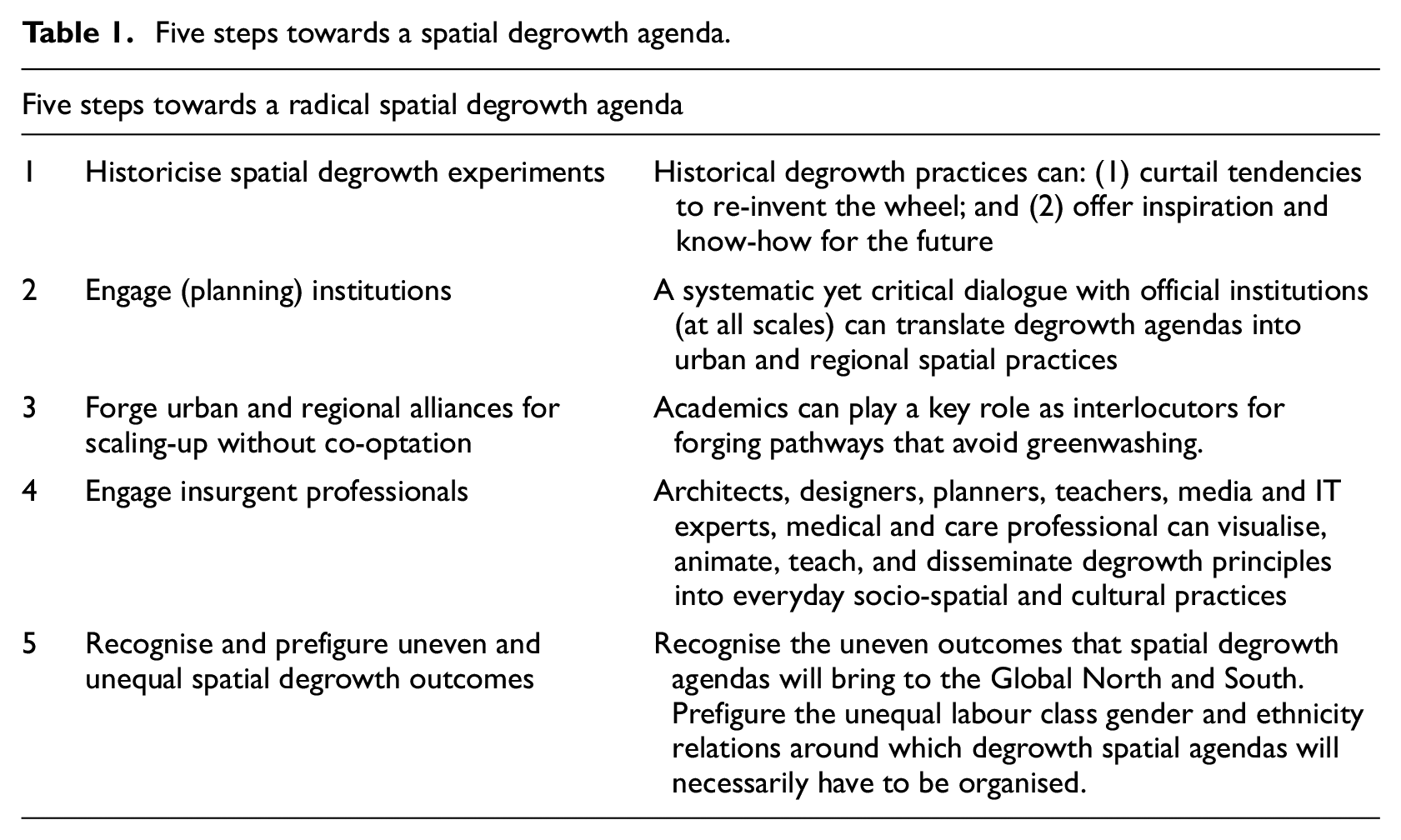
This special issue (SI) opens a dialogue between degrowth scholarship and critical urban studies. Our aim is threefold: first, to explore pathways for ‘operationalising’ degrowth concepts into urban agendas and spatial practices; second, to sketch a framework for a radical urban and regional degrowth agenda that can systematically take degrowth beyond localised experiments, and inform larger scale planning practices and international agendas; and third, to critically assess the multiple ways in which such a radical urban degrowth agenda will have to differ in the Global North and the Global South. In the article, we shall sketch five steps for developing a programmatic, yet pragmatic, spatial degrowth agenda. These are summarised in Table 1.
Five steps towards a spatial degrowth agenda.
In recent years, debates on degrowth as a means to address the climate emergency received attention in fields as diverse as political ecology (Gezon and Paulson, 2017), ecological economics (Barca, 2018; Kallis et al., 2012), geography (Demaria et al. (2019), anthropology (Hornborg, 2021c; Lloveras et al., 2018) and technology studies (Ibrahim and Sarkis, 2020). However, degrowth scholarship has not yet been able to find concrete and satisfactory pathways to operationalise these debates into spatial practices; or to develop tangible methods that can address the urgent urban and regional planning, design, and architecture issues related to housing, energy transitions, water management, or urban mobility needs under a climate emergency (Chertkovskaya et al., 2019; Demaria et al., 2013, 2019; D’Alisa et al., 2014; Nelson and Schneider, 2018).
Critical urban scholarship for its part has thus far engaged with degrowth debates mostly in an arbitrary, non-analytical manner. While some urban scholars quote degrowth as a potential inspiration for imagining alternative urban socio-environmental futures, there is no systematic exploration of what an urban degrowth agenda might look like, with a handful of recent notable exceptions, which we shall explore in the next section (Demaria et al., 2019; Savini, 2021; Savini et al., 2022; Xue and Kębłowski, 2022).
We argue that coupling degrowth and critical urban studies agendas is a politically urgent and long overdue scholarly endeavour that will benefit both fields. For urban studies scholarship, a systematic engagement with degrowth will expand and enrich the field’s analysis of the dynamics of socio-spatial change under a climate emergency. For degrowth scholarship, a more systematic engagement with urban studies’ grounded theories and debates around planning, socio-spatial policies, spatial activism, urban imaginaries, and urban political ecology can foster pathways for ‘spatialising’, ‘operationalising’, ‘scaling-up’ and even ‘institutionalising’ degrowth debates that currently remain focused mainly on macro-economic level policies or on documenting localised small-scale practices.
This special issue brings together scholars from the fields of degrowth, urban planning, architecture, housing, mobility, urban history, geography, and urban political ecology, who all address empirically and theoretically the same key research question: how can we harvest, scale up, and institutionalise the potential of localised degrowth practices in order to transform the future of extensive urbanisation under a climate crisis emergency? The special issue’s geographical coverage spans the Global South and the Global North, with case studies from the Philippines (Metro Manila), India (Chennai), Estonia (Tallinn), China (Chengdu), France (Aubagne), the Netherlands (Amsterdam), Argentina (Buenos Aires), England and Wales.
Degrowth and urban studies/spatial sciences: A missing dialogue
Degrowth is a slogan, a field of research, a practice, but also a political strategy that challenges the hegemony of economic growth and calls for a democratically led redistributive downscaling of production and consumption in industrialised countries as a means to achieve socio-environmental justice and well-being (Demaria et al., 2013; Nelson and Edwards, 2020). Degrowth is usually associated with a focus on the beauty and efficiency of the ‘smaller’, the ‘less’ or the ‘different’ (D’Alisa et al., 2014).
The term degrowth was originally coined as décroissance, by French political ecologist André Gorz in a public debate on ‘Ecology and Revolution’ organised in 1972 by the magazine Le Nouvel Observateur. During that now famous debate, André Gorz interrogated the rapport between the survival of the planet and the survival of capitalism. He argued that ‘zero-growth of material production – which he termed décroissance– is a key requirement if we wish to achieve a global [socio-ecological] equilibrium’. To that statement, Gorz hastened to add a key question: ‘can this type of global equilibrium ever be compatible with the survival of capitalism?’ (Gorz, 1972: IV, authors’ translation). Subsequently, the term décroissance informed activist practices in France during the 1970s, and ignited a significant political and academic debate that was picked up by French-speaking economists, philosophers, political thinkers and anthropologists (notably Latouche, 1993, 2004, 2009). This debate remained active for over half a century and kindled a broader public debate in newspapers and magazine outlets (notably La Décroissance; le journal de la joie de vivre). But this intense francophone debate was largely ignored by the English-speaking world until 2008, when the first international degrowth conference in Paris introduced the term’s official English translation (degrowth) and internationalised the debate. Since then, degrowth scholarship has proliferated in academic articles and special issues (for reviews see Cattaneo et al., 2012; Kallis et al., 2018; Weiss and Cattaneo, 2017), and more recently in high-impact generalist scientific journals (Hickel, 2021; Hickel et al., 2022; O’Neill et al., 2018; Wiedmann et al., 2020).
At first, English language degrowth scholarship stayed close to ecological economics, focusing mainly on debunking the ‘decoupling’ thesis; namely, the mainstream economics narrative which insists that economic growth can be separated (decoupled) from environmental destruction. Recently, however, degrowth scholarship expanded its focus to explore the potential of alternative technologies, economies, and managerial practices to challenge economic growth and forge a redistributive downscaling of production and consumption (Demaria et al., 2013). Within this technocratic logic, degrowth scholarship explored the potential of eco-friendly technological innovations (Kerschner et al., 2018), alternative economies of tourism (Fletcher et al., 2019), housing and fisheries cooperatives (Ertör and Hadjimichael, 2020; Nelson and Schneider, 2018), and more recently the potential of international policy proposals to embrace degrowth principles (e.g. Green New Deals, Universal Basic Income and Basic Services proposals; see Kallis et al., 2020).
However, despite the expansion of its scope of interaction with different academic and policy fields, degrowth scholarship engaged only marginally, and in a rather romanticised or naïve manner, with the challenges posed by large-scale urbanisation processes. Indeed, the occasions on which early degrowth scholarship addressed questions of urbanisation feature a handful of publications advocating the ecovillage as a model for degrowth transitions (Jarvis, 2017; Varvarousis, 2012), or invoking the Mediterranean town as an exemplar of how urban degrowth futures might look (Latouche, 2004, 2009). More recently, March (2018) embraced the debates on digital urbanism and smart cities and offered a more geographically sensitive examination of the role that technological advancements can play (or not) in fostering degrowth agendas for large-scale urbanisation. Another notable recent contribution is Akbulut’s (2019) work, which draws upon the Kurdish Freedom Movement’s project for a Democratic Economy to explore how degrowth practices and ideas can inform new socio-spatial relations under processes of state-formation.
However, all these endeavours remained dispersed and unsystematic. The SI on ‘Geographies of Degrowth’ edited by Demaria et al. (2019) was the first comprehensive attempt to ground degrowth debates geographically by examining ‘how … degrowth ideas [are] organised spatially, what sorts of places and territories these ideas produce, and how new spatial subjectivities may be constructed’ (Demaria et al., 2019: 437). Still, while the SI documents a set of localised spatial degrowth experiments, it offers no insight into how these experiments could be scaled-up to potentially inform or shape larger-scale spatial practices that can deal with the pressing issues posed by rapid and expansive forms of urbanisation under climate change, for example, planetary urbanisation, extended urbanisation, suburbanisation, or post-colonial urbanism (Keil, 2018b).
We argue that this lack of systematic and effective engagement of degrowth scholarship with critical political and academic issues related to new and old forms of urbanisation becomes a serious impediment for constructing a degrowth agenda that can go beyond documenting or celebrating self-contained localised initiatives. In fact, although the field has advanced in recent years, some degrowth scholars and activists still denounce this broader task altogether as normative, universalistic, and hegemonic. They insist that degrowth should remain ‘a slogan, an approach, a practice, a strategy’ (Kallis et al., 2020: 18) in order to avoid co-optation whilst transitioning to convivial societies who escape the dominant logic of economism (Fournier, 2008); and embrace ‘sharing’, ‘simplicity’, ‘conviviality’, ‘care’ and the ‘commons’ as their primary significations (D’Alisa et al., 2014).
Even the most recent attempts that take degrowth scholarship many steps beyond the slogan still ignore the changes in the production of space that a degrowth transition would demand. The high-impact work by Hickel et al. (2022) makes a significant step towards building a more systematic and analytical framework beyond localised experiments, but overlooks spatial issues altogether. The authors favour labour, the economy, taxation, public policy, and imaginary transitions as key pathways to degrowth, but the inevitable and significant re-organisation of space that would be necessary to support each one of these pathways is not problematised at all.
Degrowth scholarship is coming of age. But if it fails to enter a dialogue with questions of urbanisation and spatial politics it runs the risk of becoming a discourse for internal consumption by academics and activists, while growth continues to be the dominant narrative and paradigm for urban and regional development practices (Barca, 2019; Roy, 2017). It is already telling that those planners and policymakers who actively seek alternative spatial agendas to challenge the dominant growth paradigm are intellectually intrigued by degrowth, but in practice, they end up favouring ‘watered down’ versions of the degrowth agenda which already have a spatial component or imaginary embedded within their discourse: such as the doughnut economy, or the circular economy (Von Schönfeld and Willems, 2021). Turning the degrowth agenda into a tangible and operational political project demands ‘spatialising’; namely, facing head-on the challenges posed by the metabolic demands of large-scale urbanisation, from energy, housing, food and water, to employment, education, and (health)care.
Spatialising degrowth will also force degrowth scholarship to finally engage with the fervent Global North/South dialogue that emerged in critical urban studies over the past decade, including debates on ‘provincialising’ and ‘worlding’ urbanism (McCann et al., 2013), southern urbanism and the North/South dynamics of planetary or extensive urbanisation (Keil, 2018a; Lawhon et al., 2020; Schindler, 2017; Simone, 2019), southern political ecologies of extensive extractivism (Arboleda, 2019) and the North/South dynamics of urban political ecology (Kaika et al., 2023; Tzaninis et al., 2021). Thus far, these important strands of the North/South dialogue in urban studies have not entered the degrowth literature and the two fields remain disconnected.
Moreover, there is a wealth of debates and practices in urban studies that have been developed in the Global South, like Buen Vivir in Latin America, Ubuntu in South Africa, and Eco-Swaraj in India (Kothari et al., 2015) that can become points of convergence (or tension) with western degrowth debates (Escobar, 2015; Kaul et al., 2022; Kothari et al., 2019). But a Global North–South dialogue is still nascent in degrowth literature. Until very recently, degrowth scholarship adopted a rather simplistic view regarding Global North–South relations vis a vis degrowth agendas. Martinez Alier, a key figure in the early degrowth scholarship, suggested that the environmental justice movements of the Global South can become ‘natural’ and ‘obvious’ allies to the degrowth movements of the Global North (Martínez-Alier, 2012). His core argument was that the debt-fuelled growth of the Global North should come to an end in order to leave space for the Global South to pursue its own multiple developmental pathways. This suggestion was validated and repeated many times in degrowth literature, but was never developed further into a systematic theoretical or methodological framework that would enable in depth empirical substantiation or policy operationalisation (see also Akbulut et al., 2019). More recently, however, a group of scholars and activists from the Global South (Rodríguez-Labajos et al., 2019) contested this assumption of an ‘obvious’ alliance between the degrowth movements of the Global North and the environmental justice movements of the Global South. The authors not only disputed the very plausibility of creating such an alliance; they also cautioned about the hidden power geometries that such an alliance may end up reproducing.
In short, work towards developing a Global South degrowth agenda or a Global North–South degrowth dialogue has only just begun. This SI’s contribution is to shed some light on: (1) the reasons why urban degrowth agendas necessarily have to take different meanings and spatial forms when developed in Global South contexts; and (2) if and how these different meanings and forms can inform urban degrowth agendas for the Global North. Schindler et al. (2023) propose in this SI the term ‘subordinate degrowth’ to expose the complexity of developing a southern degrowth urban vision. Focusing on Argentina, they demonstrate how such a vision is invariably combined on the ground – almost by default – with business-as-usual urban entrepreneurialism, given that the key struggle here is to capture locally some of the value within global value chains. Also in this SI, Anantharaman et al. (2023) examine citizen initiatives that challenge growth-driven planning practices in the Global South. Focusing on Metro-Manilla they document the use and (re)production of urban green spaces that denounce consumerist logic, pointing at the difficulties of duplicating or scaling-up and institutionalising these practices in southern or non-southern contexts.
Urban studies and degrowth: a nascent dialogue
Over the past 10 years, the key role of urbanisation (‘smart’ urbanisation in particular) as a ‘fix’ to the negative socio-environmental effects of growth has reached the top of international policy and academic agendas. Yet, the dialogue between urban studies and degrowth is still in its infancy and remains disparate and unsystematic. Thus far, the most notable attempts to forge this dialogue come from urban planning and geography scholars. Wächter (2013) was among the first to highlight the decisive role that planning institutions could play in facilitating degrowth through promoting transitions to renewable energy, community-based facilities, and re-use and repair of key infrastructures. One of the most important recent contributions to the field is the SI in Local Environment on ‘Degrowth, Cities and Planning’, edited by Xue and Kębłowski (2022). The editorial (Xue and Kębłowski, 2022), as well as Xue’s (2022) article (see also Xue, 2014), argue that ‘spatialising degrowth’ and ‘degrowing planning’ has the potential to take degrowth debates and practices beyond localised, small-scale initiatives. The issue focuses mainly on what planning and urban studies can learn from degrowth, centring on the fields of housing and urban mobility. However, the SI misses the opportunity to outline a broader urban degrowth agenda, or to pursue what degrowth can also learn from insurgent planning practices and institutional actors and experts who are committed to thinking ‘outside the box’.
The SI edited by Von Schönfeld and Willems (2021) for the Dutch journal Rooilijn has a similar focus. Following the eighth degrowth conference held in The Hague, the SI explores how degrowth principles can help imagine more sustainable planning practices (Roemers and Giezen, 2021) and new roles for planners (Lamker, 2021). Similar to Xue and Kębłowski (2022), this SI also focuses on what planners can learn from degrowth, but does not expand to an exploration of what the degrowth movement can learn from alternative institutional planning practices and from insurgent planners, architects, and other urban professionals. A notable exception to this is a recent article by Ruiz-Alejos and Prats (2022) that explores (through a case study in Södertälje, Sweden) how planning actors can pioneer degrowth futures.
While our special issue was under review, another volume on ‘Post-growth Planning: Cities beyond the Market Economy’ was being developed. Edited by Savini et al. (2022), the volume makes a significant contribution. It shares some of the research objectives of this issue but focuses mainly on the physical characteristics that a post-growth future may take (in housing, mobility, food, etc.). It centres on cities and institutions in the Global North and does not address Southern or extensive urbanisation processes.
An earlier book by Alexander and Gleeson (2019) on ‘Degrowth in the suburbs: A radical urban imaginary’ also offers an interesting and in-depth insight into how Australian suburbs can potentially sustain degrowth transitions. However, the book’s specific geographical focus does not allow space for developing a broader understanding into how degrowth could be spatialised in different geographical contexts or non-suburban types of settlements.
Scholars working on urban metabolism and urban political ecology have also engaged with degrowth. The SI edited by Ulgiati and Zucaro (2019) for Frontiers in Sustainable Cities aimed to open a conceptual dialogue between degrowth and urban metabolism. Although the issue offers rich empirical material, it fails to articulate the promised dialogue as the arguments stay closely aligned to decoupling perspectives, insisting on the potential of technology and innovation to contribute towards a better quality of life with less growth.
Apart from the aforementioned few but notable exceptions, critical urban studies have engaged with degrowth mostly in a superficial manner, mobilising degrowth as inspiration for thinking through radical urban imaginaries (Kaika, 2017), but not as an agenda that can be operationalised and become transformative for current urban and regional development practices. Characteristic of this type of engagement is the 2019 Oslo Architecture Triennale Exhibition titled ‘Enough: The Architecture of Degrowth’, which marked – at least symbolically – an interest in how degrowth may be spatialised in urban contexts. In their think piece on ‘Degrowth and the City’ related to this exhibition, Varvarousis and Koutrolikou (2018) raised a series of important questions on how urbanisation can be compatible with degrowth, what is the role of planning and architecture in this process, what forms of urban governance may assist such transitions, and what role urban dwellers can play in degrowth inspired urban transformations. But the Triennale event itself remained largely focused on inventive technologies and innovative architectural forms, offering limited scholarly depth on the potential of spatial policies and institutional practices to operationalise degrowth agendas.
The small number of references to degrowth literature in the Urban Studies journal itself is also symptomatic of the lack of engagement between the two fields. Up until 2022 there were only four papers published in Urban Studies that explicitly mention degrowth. Schindler (2016) on Detroit as a ‘shrinking city’; Barthel et al. (2015) on ‘Food and Green Space in Cities’; North and Longhurst (2013) on ‘Grassroots Localisation’; and Whitehead (2013b) on ‘Neoliberal Urban Environmentalism and the Adaptive City’. But even these articles refer to degrowth in passing only, mainly when outlining possible alternative socio-environmental paths.
Although the Urban Studies journal hosts many debates that integrate urban studies with alternative environmental policy agendas (e.g. post-carbon cities, urban resilience, transition towns, urban shrinkage), these do not engage with degrowth. Monstadt and Coutard (2019) argue strongly in favour of expanding urban nexus thinking and politics, but do not bring degrowth into their call. Similarly, Beilin and Wilkinson’s (2015) work on resilience suggests that ‘the urban’ can be fertile ground for experimenting with change, but makes no reference to degrowth. Also focusing on resilience, urban transitions and environmental governance, the Urban Studies SI edited by Miller et al. (2020) links urbanisation with climate change and environmental disaster, focusing on urban gardens, commons, and environmental governance. But again, it makes no reference to degrowth. The same lack of engagement with degrowth characterises two earlier SIs on low-carbon transitions: Rutherford and Coutard’s (2014) SI on ‘The politics of urban infrastructure for low-carbon transitions’; and While and Whitehead’s (2013) SI on ‘Cities, Urbanisation and Climate Change’. A more recent Urban Studies SI edited by Angelo and Wachsmuth (2020) launches a critique of the role that cities can play in the debate and practice of climate change, but fails to think through alternatives.
Even articles on urban shrinkage published in Urban Studies like Jeon and Kim’s (2020)‘Housing abandonment in shrinking cities of East Asia’, and Bartholomae et al.’s (2017)‘Urban shrinkage and resurgence in Germany’ fail to engage with degrowth, despite the key research questions that the two fields share in common. A notable exception to this is Schindler’s (2016) work on ‘Detroit after bankruptcy’. This lack of engagement with degrowth is also true for most urban shrinkage scholarship published beyond the pages of Urban Studies (for exceptions see Béal et al., 2019).
Exploring the reasons behind this limited engagement from the part of urban studies with degrowth debates falls outside the scope of this special issue. Our key focus here is to move forward and turn this nascent debate into a more systematic dialogue. In the following sections, we explain why this systematic engagement is important, and offer five steps towards building an urban degrowth agenda.
Five steps towards building an urban degrowth agenda
Coupling spatial and degrowth agendas today is both academically important and politically salient for two key reasons. The first is because this is a prime political moment, when cities are privileged by policy-makers as sites for experimenting with solutions to the environmental crisis (Angelo and Wachsmuth, 2020; Calvário et al., 2017; Kaika, 2018). Yet, the top-down efforts to couple urbanisation with environmental protection are dominated by market-led practices shaped by the eco-modernisation paradigm (circular economy, smart cities, etc.). It becomes crucial, therefore, to develop a systematic counternarrative for an urbanism that includes alternative planning instruments, tools, and ideal types of housing, energy, schooling, health and caring that can address socio-environmental (in)equality and forge economies of well-being (McGregor and Pouw, 2016).
Second, it is important to couple degrowth and spatial agendas, because experimentations with degrowth-related spatial practices are no longer confined to insurgent groups. As this special issue shows, planners, architects, education professionals, medical and care professionals, workers’ trade unions, and municipal institutions in the Global North and in the Global South now experiment with more equitable forms of organising urban social and economic life that challenge growth ideologies. We argue that a systematic documentation and grounded theoretical engagement with these experiments led by urban professionals and practitioners is academically urgent and politically timely.
Taking the above points into account, we sketch five steps as a pathway towards building a critical urban degrowth agenda that can link urban debates to degrowth practices (see Table 1).
First, we highlight the importance of historicising the debate between degrowth/growth and urban studies. Ignoring this intellectual history, we argue, means wasting precious time and effort to reinvent the wheel.
Second, we invite both degrowth and urban studies scholars to critically engage with the role that official planning institutions (at all scales) can potentially play in linking degrowth agendas with urbanisation policies in the Global North and the Global South. The articles in this SI show that such a dialogue does not necessarily lead to co-optation or greenwashing.
Third, we advocate the urgency of examining under which conditions, and through which methods, small-scale localised degrowth practices can be scaled-up to urban degrowth pathways and alliances that avoid co-optation and greenwashing.
Fourth, we highlight the significant yet neglected role that urban professionals (architects, designers, planners, medical and social care professionals, IT and technology experts, teachers) can play in linking degrowth agendas with interlocal everyday spatial urban and regional practices. These actors are often overlooked – or even looked down upon – by degrowth scholars and activists, as they are considered not sufficiently ‘progressive’. We argue that not engaging with these actors and their practices is counterproductive and creates an insular scholarship that cannot document or harness the political potential these actors can bring.
The fifth step is to look the elephant in the room straight in the eye; namely, to take into account the importance of uneven development vis-á-vis degrowth. In other words, it is necessary to acknowledge that there are no ‘singular’ degrowth spatial practices that can fit and serve equally different geographical and social contexts and that any degrowth practices will bring uneven outcomes to the Global North and the Global South; and to high and low-income populations within the same regions.
In what follows, we examine in more detail each one of the five steps we suggest to begin sketching a radical programmatic, yet pragmatic, urban and regional spatial degrowth agenda.
Step one: the importance of historicising debates on (de)growth and urbanisation
Debates on urbanisation, growth, and degrowth have a rich and interconnected intellectual history. Grounding the current degrowth and urbanisation debates within their historical legacy is essential for two reasons. The first is obvious: it helps avoid pitfalls and frittering away time with spatial experiments that have been proven not to work. The second is practical: by historicising we can assess whether experiments, interventions, and visions of the past can inspire and inform urban degrowth agendas for the future.
Re-thinking growth through urbanisation goes back to a time long before growth became an imperative drive for spatial practices. The 19th-century’s anarchist and reformist visionaries (from William Morris and Peter Kropotkin to Ebenezer Howard) imagined new, ecological forms of urbanism, or proto-ecological urbanism featuring low density, dispersed human settlements located in idyllic landscapes, and inhabited by people with minimal material needs who work in harmonious relationship with their environment. A bit later, the early- to mid-20th-century modernist planning, architecture, and design interventions tried to address the same tension between urbanisation, growth, and the environment by suggesting the exact opposite solution: (Oyón and Kuzmanić, 2020) – high-density, high-rise cities, supported by technological innovation and ‘rational’ forms of spatial organisation.
During the 1970s, critical debates on urbanisation and economic growth/ degrowth continued to evolve side by side. The ‘Limits to Growth’ report, published in 1972, presented for the first time the results of a computerised and quantified classical Malthusian approach at a global scale and sparked intense public debate around economic growth, population, and environmental resources. It was that same year that André Gorz coined the term degrowth (décroissance) which was later used to title a collection of translated essays by ecological economist Georgescu-Roegen (1979). Around the same time, the American sociologist Molotch (1976) drew attention to the direct link between growth and urbanisation, and depicted cities as ‘growth machines’ which are managed by local elite growth coalitions. One year later, Gorz (1977) expanded his analysis on décroissance, and ignited the first serious degrowth debates, challenging perpetual economic growth as the sole way of expanding human welfare across the world.
In the 1980s, urbanisation and décroissance debates converged more closely together, as the ‘urban growth machine’ thesis evolved to a downright criticism of the ideology of growth as a panacea for solving inequality and socio-environmental destruction caused by global capitalist expansion. Logan and Molotch (1987) empirically substantiated further how the densely knitted social and cultural hubs called cities perpetuate the growth ideology. They argued that local schooling systems, media, elite actors, and institutions, all contribute towards convincing citizens that they have a personal stake in keeping the urban growth machine well-oiled. This impedes any chance to challenge the dominant growth hegemony.
In the 1990s and 2000s, urban studies started engaging extensively with the environmental agenda, and the foundational scholars of the then nascent urban political ecology field argued that the separation between ‘nature’ and ‘the city’ is a social and academic construct that needs to be overcome. Urban political ecology scholars turned attention away from ‘cities’ and ‘environments’ or ‘natures’ as separate entities in favour of understanding how the continuous metabolic process of ‘urbanising nature’ is linked to the political economies of growth, and the production of urban settlements (Gandy, 2004; Heynen et al., 2006; Kaika, 2005; Swyngedouw, 2004). Over the decades that followed, the urban political ecology agenda built a conceptual toolkit backed up by rich empirical analysis to examine the intensification of socio-environmental inequality caused by urbanisation under uneven economic growth. In the 2010s, urban political ecology debates expanded to linking environmental issues to the way greening cities became the driver for new forms of inequality and gentrification (Anguelovski et al., 2019; Heynen, 2007); the way land and housing markets became key outlets for the expansion of international financial markets (García-Lamarca and Kaika, 2016); the way smart and eco-cities became drivers for perpetuating the ideology of growth (Cugurullo, 2016); and the way new types of urbanisation drive new forms of ecological destruction (Lesutis, 2022) .
However, after the 2008 global financial crisis, which was deeply rooted in the expansion of urban housing markets, critical analyses of growth and urbanisation became increasingly decoupled. With the exception of urban political ecology, which persisted in investigating the connection between environmental issues and emergent extensive, corridors, or planetary urbanising practices under crisis (Calvário et al., 2017; Connolly, 2019; Keil, 2018a), urban scholars specialised further into areas of financialisation and housing to better understand increasingly complex and urgent issues of income and housing inequalities related to global capital expansion and urbanisation phenomena.
However, this academic decoupling between (de)growth and urbanisation research happened at a very crucial political moment. While core urban research moved away from investigating the role of urbanisation in perpetuating growth practices and ideologies, and even started questioning ‘the urban’ as a valid unit of analysis, global and local environmental policy-makers and institutions started doing the exact opposite: they started putting increasing emphasis on the role of cities as key units of analysis experimentation (urban labs), data collection, and policy intervention for mitigating the effects of growth and climate change (e.g. the 2016 New Urban Agenda).
This turn of attention to urbanisation on the part of international policy makers is something that urban scholars could celebrate; the need to put urbanisation at the centre of the growth dynamics is what they have been arguing for decades. However, at the precise moment when critical urban scholarship debates started being taken seriously by international policymakers, urban scholarship itself turned its attention elsewhere. This is not strange, or unusual; but it does have deep social and political implications. We argue that urban scholars need to capture this opportune moment to engage and put forward new urban imaginaries, including degrowth. The moment may soon dissipate, as international policy agendas and think tanks that put cities at the heart of post-carbon transitions are becoming increasingly dominated by market-led, technocratic logics, or even – in some localised cases – by populist discourses.
We argue that a first and important step towards seizing this opportune moment is not only to understand, but also to historicise the ‘ecological’ and the ‘urban’ as co-constitutive processes interlinked by the growth paradigm. Perusing the rich history between de-growth and urbanisation can mobilise degrowth as a new chapter in the history of urbanism and planning paradigms.
Step two: the role institutions can play in linking degrowth agendas with urbanisation policies and practices
The second step we propose towards building a spatial degrowth agenda is to pay attention to the role that official (planning) institutions at all scales can play in linking degrowth agendas with urbanisation practices. Thus far, degrowth scholarship has attempted to debunk mainstream growth-oriented narratives mainly by developing counternarratives for ecological macroeconomics (D’Alessandro et al., 2020), or by focusing on small-scale insurgent practices (Demaria et al., 2019). However, degrowth scholarship paid relatively little attention to identifying the types of institutional policies and practices that could support broader change that goes beyond small-scale localised practices. Notable exceptions are recent proposals for a degrowth informed green transition suggested by Kallis et al. (2020; see also Kallis and March, 2015). We argue that paying more attention to institutional practices is imperative for taking degrowth debates forward and building a post-growth paradigm.
The grounded work presented in this SI empirically substantiates how cooperation between official institutions and insurgent groups can amplify the impact of degrowth practices without leading to co-optation or greenwashing. Tunstall (2023, this issue) identifies concrete examples of institutionally supported housing degrowth practices at local, regional, and national levels in England and Wales between 1981 and 2011. She critically examines whether these practices led to better or worse housing conditions, inequality, and increased or decreased carbon production. Also in this SI, Savini (2022) highlights the importance of institutions in scaling up degrowth potentials. He argues that degrowth scholarship praises the housing commons, but does not examine under which particular institutional conditions housing commoning could ensure long term degrowth practices. His analysis is grounded on the ‘Nieuwe Meent’ collective in Amsterdam currently building 35 dwellings based on degrowth principles. Kębłowski (2023) in this issue explores institutional transport planning as a vehicle for spatialising degrowth. Focusing on ‘fare-free public transport’ (FFPT) in Aubagne France, Tallinn Estonia, and Chengdu in southwest China, Kębłowski shows that FFPT can run against growth-driven planning and promote socio-spatial justice.
Step three: Pursuing pathways for scaling-up without co-optation or ‘greenwashing’
Thus far, degrowth scholarship has not engaged in earnest with questions of upscaling small degrowth ventures. There are many good reasons for this, not least the difficulty of the research endeavour and the lack of real-life successful examples (Kallis and March, 2015). But there is also concern, mainly by grassroots movements, that any effort to upscale grassroots initiatives may lead to co-optation by state or capital. It is not an unsubstantiated concern. Many socio-environmental and socio-economic alternative narratives and practices became depoliticised when scaled-up (Swyngedouw, 2014), a recent example being what happened to the Buen Vivir narrative in Ecuador (Acosta, 2013). There is a long history of co-optation of insurgent practices: from the 1970s urban social movements in Berlin (Mayer, 2000) to the recent social commons in Bologna (Bianchi, 2018). The contemporary C40 Cities network mobilises a rhetoric that can be interpreted as a co-optation of degrowth principles into tools and concepts for Doughnut Economics (Raworth, 2017). Following on from that, the Thriving Cities Initiative downscales the Doughnut to city level in Philadelphia, Barcelona, and Amsterdam (Doughnut Economics Action Lab [DEAL], 2020).
It remains to be seen whether these ‘watered down’ versions of degrowth will lead to transformative change or will simply facilitate the continuation of business as usual. Either way, the lack of serious engagement from the part of degrowth scholarship with questions of upscaling leads to a double loss: a loss of opportunity to spread the innovative characteristics of grassroots initiatives; and a loss of opportunity to imbue existing institutional practices with new ideas and know-how.
Druijff and Kaika (2021) recently started a dialogue on what it might take to upscale grassroots initiatives without leading to the loss of their radical or innovative potential. The authors identify practices which are responsible for failure or co-optation not only on the side of institutions, but also on the side of grassroots movements. They argue that movements can avoid co-optation by setting clear goals and clear terms of engagement right from the beginning, and more importantly, by securing non-competitive funding flows that guarantee their independence, as well as by building a supportive network of institutional actors who do not try to fit radical initiatives into their frameworks, but are prepared and willing to align institutional frameworks with more radical agendas.
In practice, even when local institutions are willing to embrace and upscale degrowth practices and progressive schemes for energy, water, housing, healthcare, they often find legal barriers at higher institutional levels (regional, state or supra-national). The social health clinics that emerged as grassroots initiatives in Greece during the financial crisis are a good example of this. This SI’s articles contribute to understanding why and how grassroots initiatives and progressive political parties at local level have not been able to cooperate and upscale degrowth agendas. Otchere-Darko’s (2023) article focuses on the role of planning institutions as procurers of growth and argues that to undo the urban growth imperative, it is important to construct a planning ethos beyond competitiveness. Anantharaman et al. (2023, this issue) examine how the efforts to scale up alternative citizen practices for producing and using urban green spaces can become a catalyst for transforming the growth logic of official planning practices.
Step four: Acknowledging the role of insurgent urban professionals and experts in linking degrowth agendas to urbanisation practices
The fourth step this SI proposes as a means towards spatialising degrowth is the acknowledgement and systematic documentation of the role that insurgent urban experts and professionals can play in promoting degrowth agendas. This category includes architects, designers, planners, academics, care workers, teachers, technology and IT experts, medical and care professionals, who can link degrowth agendas to everyday spatialised practices of building, caring, mobility, education, etc. Schismenos et al. (2020) use the term ‘cosmolocalism’ to describe local experts who develop locally but distribute globally the technologies and practices that prioritise socio-ecological well-being over corporate profits. We argue that these overlooked insurgent professionals can enrich and facilitate the work of social movements in enacting change and in reshaping ‘lifestyle strategies’. This SI discusses examples of design and technology activism, housing and water commoning, and alternative transport initiatives, driven or catalysed by experts and professionals. De Castro Mazarro et al. (2023) empirically substantiate this with a survey of more than 400 designs in four international exhibitions on sustainable architecture and design, which identifies architectural practices that successfully reduce the embodied carbon of their interventions through simple technologies and design layouts that question growth-oriented construction regimes and urban development logics.
Step five: Greeting the elephant in the room: The North/South dialectics of institutional and activist degrowth practices
The fifth step we propose towards building a degrowth spatial agenda is to address the elephant in the room; namely the significant differences between the Global North and the Global South when it comes to advocating and implementing degrowth agendas and practices. We openly query whether it is even possible to articulate into a common urban degrowth agenda the very different drivers and dynamics of urbanisation in the Global South (migration, consumerism, etc.) and the Global North (real estate speculation, tourism, services, migration and refugee flows etc). How would an international degrowth urban agenda affect planning institutions and practices differently in the North and the South? How would such a non-universalist agenda relate to alternatives to development situated in the Global South, such as Buen Vivir, Ubuntu and Ecological Swaraj?
Exposing the North/South specificities, Schindler et al.’s (2023) article in this SI documents how progressive degrowth initiatives in ‘ordinary cities’ in low and middle income countries are often combined with business-as-usual urban entrepreneurialism. The authors propose the term ‘subordinate degrowth’ for this phenomenon and argue that any realistic degrowth strategy in low and middle income countries must account for local forms of ‘messiness’ and indeterminacy.
Although it is possible to imagine degrowth inspired socio-ecological metabolisms confined within small locales in the Global North or South, a global agenda for degrowth or post-growth urbanisation would require the global transformation of these metabolisms. Significant academic and policy work needs to be done to articulate what a degrowth agenda for the Global North might mean for the Global South. And vice versa.
But it is not enough to only address the North–South dynamics, when acknowledging and prefiguring the – almost necessarily – uneven outcomes that spatial degrowth practices will have. We also need to prefigure how degrowth will affect marginalised populations within the same geographical regions in the Global South and North alike. To do this, we need to engage with important but often neglected questions of labour and class relations around which degrowth spatial agendas necessarily have to be organised. We argue that any degrowth spatial agenda has to engage seriously with Barca’s (2019) understanding of work as a (gendered and racialised) mediator of social metabolism. The growth and expansion of globalised capitalism are still dependent on an increasingly unequal global ecological exchange; on exploiting the cheapest labour and raw materials wherever and whenever these might be available; on unequal transfers of labour (embodied in consumer products), land, water, sun and energy (embodied in agricultural products) from the Global South to the Global North (Heinberg, 2020; Hornborg, 2021a). But Barca’s pioneering work has not yet received the attention it deserves both by degrowth scholars and by spatial scientists and policymakers. And this special issue only superficially touches upon these questions.
Conclusion: The urgency of developing a spatial degrowth agenda
The crucial socio-environmental condition we are in demands alternatives to the hegemonic growth-driven practices that shape environments and societies in the Global South and North. Forging a close dialogue between critical urban studies and degrowth can open possibilities in that direction. This special issue contributes to this dialogue, suggesting five steps that sketch a pathway towards developing a programmatic, yet pragmatic, urban degrowth agenda (summarised in Table 1).
Our call for building a spatial degrowth agenda is urgent, as the current focus of degrowth scholarship on either small-scale localised practices or macro-economic proposals will not do. On the one hand, small-scale degrowth practices are not sufficient to offset the destructive effects of the ever growing and lengthening global supply chains (Heinberg, 2020). On the other hand, macro-economic proposals are too far removed from everyday life to serve as a convincing counter-hegemonic narrative to the ideology of growth. Even the undisputable impact of continuous growth on greenhouse emissions and human health (UNEP, 2020), and the high toll in human lives claimed every year by recurrent fire and flood disasters across the world (Hornborg, 2021a, 2021b, 2021c) are apparently not strong or shocking enough to propel citizens and policymakers into questioning the imaginary of growth as a panacea for a better life.
It is now widely acknowledged that the growth of Gross Domestic Product (GDP) alone cannot deliver human welfare or happiness (Fanning and O’Neill, 2019; Helliwell et al., 2022). Yet, growth and ecological modernisation narratives remain hegemonic and strongly rooted in political and economic practice for organising the necessary transitions to post-carbon socio-natural metabolisms; But perhaps more importantly, growth narratives remain rooted in everyday imaginaries as the only solutions (Fioramonti, 2013; Hickel et al., 2022; Whitehead, 2013a). The much anticipated and fought for European Green Deal is a case in point. It could become a positive step forward towards degrowth urban futures; but it can easily end up advocating – or even subsidising – yet another round of ecological modernisation and ‘greenwashed’ growth models (Mastini et al., 2021).
Degrowth can provide an alternative imaginary for the future. But this imaginary has to be transformed into spatial images, plans and practices for it to start having significant impact and effect. As noted in the introduction, if degrowth fails to address questions of urbanisation and spatial politics, it runs the risk of becoming yet another discourse for internal academic and activist consumption, an empty signifier that allows us to keep our souls clean – as it were – by staying clear of the political arena, while growth continues being the dominant paradigm for urban and regional development practices.
The recent IPCC reports (2021, 2022) that drew public attention to the link between climate change and growth logics have opened a window of opportunity for legitimising and pushing forward a public spatial degrowth agenda. Needless to say, systematic, international comparative work is necessary to articulate a spatial degrowth agenda that can avoid following a path similar to sustainability agendas, that is, greenwashing economic expansion. But we argue that even the risk of ‘watering down’ degrowth when we put it into spatial practice is a risk worth taking. Here, we start a dialogue between degrowth scholars and urban scholars. A broader dialogue between scholars, urban experts, professionals, policymakers, and activists also needs to open, in order to bring spatial degrowth agendas from paper to life.
Footnotes
Acknowledgements
Many thanks to Andrew Cumbers for the thoughtful, thorough, and constructive comments, and to Ruth Harkin for her support in bringing this SI to publication. Thanks also to the University of Amsterdam’s Centre for Urban Studies, and to the SI’s anonymous referees.
Author’s Note
Angelos Varvarousis is also affiliated to Hellenic Open University, Greece.
Declaration of conflicting interests
The author(s) declared no potential conflicts of interest with respect to the research, authorship, and/or publication of this article.
Funding
The author(s) disclosed receipt of the following financial support for the research, authorship, and/or publication of this article: Federico Demaria is a Serra Hunter fellow and acknowledges support from the Maria de Maeztu Unit of Excellence ICTA UAB (CEX2019-0940-M), as well as the projects “Towards a Sustainable Well-being Economy: Integrated Policies and Transformative Indicators” (TOBE; GA 101094211) funded by Horizon Europe, and “Prospering without growth: Science, Technology, and Innovation in a post-growth” (PROSPERA; GA 947713) funded by the European Research Council (ERC).
