



Abstract
Domestic energy efficiency policy is potentially a means for reducing residential energy-related greenhouse gas (GHG) emissions and expenses for households in energy poverty. It has often been presented as an eco-social exemplar, for example in the European Union's Green Deal. The European Commission regards domestic energy efficiency improvements as the primary means for addressing energy poverty notwithstanding the 2022/23 energy crisis. However, the case for domestic energy efficiency improvement as a tool for achieving simultaneously social and environmental goals is often assumed rather than demonstrated. This article uses Mandelli's eco-social trilemma heuristic and the symbolic politics literature to surface the tensions involved in such processes, focusing on policy efforts in the England between 1997 and 2023 as a case study. England is a good case to consider because it has been regarded as a leader of energy poverty mitigation and its policy approach is similar to the European Commission's. The article details the main policy instruments used in England, assesses outputs and outcomes using official statistics, government and independent policy evaluations and the secondary literature, and details the main problems encountered in achieving environmental/social synergies. Based on this analysis, the article argues that English domestic energy efficiency policy has generally constituted a symbolic eco-social policy, particularly on the social side and since 2010. Highlighted by the 2022/23 energy crisis, domestic energy efficiency policy is best regarded as one component of a policy toolkit for reducing energy poverty, which at the least should also include targeted social protection.
Keywords
Introduction
It is now widely accepted by national and international policymakers that the consequences and costs of the environmental crisis and attempts to mitigate it often fall disproportionately on those who are already disadvantaged (CCC, 2019a; UNFCC, 2015). To incorporate these concerns, social and environmental policy interaction is increasingly included in policies such as the EU Green Deal (European Commission (EC), 2020a) and in national net zero commitments such as the UK 2021 Strategy (HMG, 2021). Ostensibly, this embrace of approaches which ‘simultaneously and explicitly pursue both equity/justice and sustainability/sufficiency goals’ (Gough, 2017: 197) suggests broad-based acceptance by governments of the case for eco-social policies, but questions remain about the substance behind such commitments. This article addresses these questions in relation to energy poverty and domestic energy efficiency policy.
Energy poverty is a classic problem area where opportunities for eco-social policy development have been identified, a situation highlighted particularly by the 2022/23 energy crisis. Generally referred to as fuel poverty in the UK, energy poverty has been broadly defined as the inability of households ‘to secure a socially and materially-necessitated level of end-use energy in the home’. ‘Socially-necessitated’ refers to energy use enabling full participation in society, with the material element concerned with the impact of such conditions on health etc. (Thomson and Bouzarovski, 2018). This concept has long been accepted in the UK, and more recently by the EC (Thomson and Bouzarovski, 2018), as distinct from income poverty based on the role of housing infrastructure and energy prices as contributory causes additional to low income. However, significant debates remain about its usefulness, conceptualisation and measurement (see below). It has most often, but not always, been applied to heating energy. The role of housing infrastructure in causing energy poverty is the basis for proposed policy interactions between social and environmental policy. Thus, improving the energy efficiency of domestic dwellings, by for example increasing wall/loft insulation, is increasingly regarded as a means both for reducing residential energy-related greenhouse gas (GHG) emissions and reducing energy poverty.
The EU strongly emphasised such an approach in the 2020 European Green Deal (EC, 2020a). This tied closely efforts to address energy poverty to the idea of ‘just and fair’ climate transitions, calling directly for environmental/social policy ‘coherence’ by Member States. Substantively, EU countries can now bid for energy efficiency investments as part of an EU-wide ‘Renovation Wave’ up to 2030 (EC, 2021), which is designed to at least double the annual energy renovation rate of residential and non-residential buildings by 2030 (EC, 2021). In addition, a new regulatory framework, upgrading the 2018/19 Clean Energy for All Europeans Package, is designed to promote energy efficiency, building renovation and renewables deployment. These efforts are in turn closely linked with the requirement since 2019 that Member States assess – and propose policies on - energy poverty in their submission of national energy and climate plans (NECPs) (EC, 2020b).
As Bouzarovski et al. (2021: 8) suggest, the EC view this energy efficiency-based strategy as ‘a silver bullet for solving the social, economic and environmental challenges associated with energy injustice’. It represents a generally market-friendly, small state way of addressing energy poverty, one which the Commission does not want to ‘impede the liberalisation of energy markets’ (EC, 2020b: L 357/37, 38) nor imply any greatly enhanced role for social protection (L357/37). This remains the Commission's position notwithstanding concerns about rising energy poverty since the 2022/23 energy crisis (Simon, 2021).
However, while such an approach to energy poverty is intuitively appealing (Rosenow et al., 2013), the case for domestic energy efficiency improvement as a tool for achieving eco-social goals is more assumed than demonstrated (e.g. Child et al. 2008; Eyre, 2008; Eyre et al., 2009; but see Rosenow et al., 2013). A number of EU countries (e.g. Denmark, Germany, the Netherlands and Sweden (European Commission, not dated)) have questioned the approach, arguing energy needs should, like all other needs, be conceptualised in relation to general poverty and dealt with primarily through the social protection system. Indeed, in some of these countries, and others such as Ireland, various forms of state financial support are directly assigned to meeting energy costs as part of the overall public benefit system. This approach is justified based on the dynamic nature of energy costs and the importance of household warmth to other essential needs such as health (Cludius et al., 2018), with domestic energy efficiency schemes focused mainly on environmental goals. At the least, therefore, there is a need for robust investigation of the implementation of domestic energy efficiency policies and their effectiveness in delivering successfully against both dimensions, particularly given the current energy crisis and their centrality in most just transition strategies. Do such policy commitments really represent a plausible means for engineering a just transition to net zero with regard to domestic energy use or are they mainly symbolic (Edelman, 1985; Stolz, 2002)? That is, should they be primarily regarded as discursive constructions, designed to signal a commitment to eco-social values, but which instrumentally are deficient in substantive content (Slaven and Boswell, 2019)?
To undertake this analysis, the article draws on the recent eco-social policy literature and the more established literature on symbolic policymaking. It uses England as a case study. On the former, Mandelli's eco-social trilemma heuristic is used to frame an assessment of the extent and, particularly, limitations of policy synergies with respect to domestic energy efficiency in reducing energy poverty and household GHG emissions (2022). Inspired by the symbolic policy literature (e.g. Edelman, 1985; Slaven and Boswell, 2019; Stolz, 2002), the implementation and effectiveness of policy in this area is then considered with assessment made of the degree to which synergy limitations have been understood and responded to in policy design. England 1 is a good case to investigate for two main reasons. First, it is regarded as an energy poverty mitigation leader (Fawcett et al., 2019), with an eradication strategy in place since the early noughties. Secondly, as will be seen, English policy is similar to the EC's. Its emphasis on domestic energy efficiency as the primary means to reduce energy poverty is consistent with a broader liberal commitment to unhindered energy markets and a limited role for social protection. To this end, England has for long operated market-based mechanisms, such as Energy Savings Obligations (ESOs – see below), which the Commission also recommends in its Clean Energy for All Europeans Package (European Commission, 2020b; Fawcett et al., 2019).
Based on this analysis, the article argues the eco-social credentials of domestic energy efficiency policy can be exaggerated. Its capacity for synergising environmental and social goals is not straightforward due to policy problems with the potential to reduce effectiveness, particularly in addressing energy poverty. Targeting issues and the unpredictability of energy costs are the biggest problems. While the former could be overcome by care in policy design, energy costs represent a potentially more intractable problem, as emphasised by the 2022/23 energy crisis. In England, the article will argue, the persistent failure, particularly since 2010, to address these policy problems has rendered domestic energy efficiency a largely symbolic eco-social policy. If the EC's approach is to avoid a similar fate, concerted attention and response to these issues is required. This would likely entail a re-balancing of the proposed roles of domestic energy efficiency policy, social protection and market interventions as part of a more broadly-based energy poverty framework (see below and, e.g., Cludius et al., 2018).
The article begins in the next section by more fully developing its conceptual and analytical framework. The main components of England's eco-social use of domestic energy efficiency policy between 1997 and 2023 are detailed in the following section. The article then assesses the eco-social successes and limitations of the English approach, before in the final section elucidating the lessons of the English case particularly with respect to the continuing role of social protection.
Analytical framework
Following Mandelli, eco-social policies are understood in this article to mean any policies governments declare as designed to simultaneously achieve environment and social ends (2022). This approach facilitates non-normative analysis of ‘actually existing’ eco-social policies: the extent to which they in fact combine environmental and social goals, the relative weight given to each dimension and their plausibility as solutions to the problems on which they are discursively targeted.
Mandelli's (2022) eco-social trilemma heuristic provides a useful tool for this type of analysis. Mandelli suggests that at a cognitive level between any two objectives there are logically three possible relationships: a synergy, a trade-off and a neutral relationship. Synergy concerns circumstances where progress in achieving goals on one dimension leads by default to progress on the other. This, of course, is the desired objective of eco-social policies, and this type of relationship has often been suggested as a characteristic of domestic energy efficiency policy. A trade-off relationship, in contrast, describes circumstances where the pursuit of goals on one dimension creates a conflict with goal achievement on another. A neutral relationship is one where policy goals are unrelated. There is a fourth relationship, which Mandelli does not include as part of his cognitive mapping but discusses with respect to policy integration. This concerns what he terms a ‘partially solvable’ trade-off, where a policy's impact across two dimensions falls between the synergistic and trade-off categories. In such circumstances, synergies do not arise automatically, but are achievable through policy integration, turning trade-offs into synergies.
As part of an Investigation of the extent and limitations of eco-social policies synergies, this fourth type of relationship is the most interesting. It concerns circumstances where policies, while synergistic in relation to some goals, are deficient to a greater or lesser extent as a means to fully achieve declared goals in one or both dimension(s). Where such partial synergies exist, eco-social policy development is still possible but policy limitations need to be recognised, accepted and responded to in policy design. When they are not it is reasonable to question the policy's substance. Policy analysis of this type has been a feature of the symbolic policy literature, with symbolic policies understood as those primarily designed to signal commitment to certain goals rather than instrumentally change outputs and outcomes (Slaven and Boswell, 2019). Empirically, a regular method for such analysis involves comparing the discursive presentation of policy with its practical implementation and outcomes (Slaven and Boswell, 2019).
This type of approach is used below to analyse England's eco-social approach to domestic energy efficiency policy. Policy implementation is analysed using government and independent policy evaluations and the secondary literature. Energy poverty outcomes are assessed based on official statistics. On the latter, energy poverty is officially operationalised in England using a single, expenditure-based metric. This has varied over time but has involved a comparison between the (actual or projected) energy costs faced by households and various absolute or relative thresholds as a proxy for estimating the extent of domestic energy deprivation (Thomson et al., 2017). While there are weaknesses with this approach, such as complexity, a strength is that it is less prone to problems of ‘hidden’ energy poverty affecting more subjective measures (Thomson et al., 2017). However, three changes in the metric used since 1997 mean no longitudinal data exists for the entire period covered in this article. This article thus presents all available official English data on energy poverty outcomes, together with details of measurement changes and their implications. As will be seen, these changes have by themselves raised questions about the substance of government policy.
Based on this analysis, it is argued domestic energy efficiency policy in England has not offered an unproblematic means for simultaneously achieving environmental and social goals. Persistent problems, particularly on the social side, have led in terms of energy poverty outcomes to, at best, mixed results in reducing levels during this period. These problems have involved the targeting of energy efficiency support on energy poor households and, more generally, the limitations of domestic energy efficiency to address energy poverty caused by low income and/or high energy prices. While such problems are potentially resolvable, in England they have remained largely unaddressed, not least because its liberal institutional context has ruled out significant policy adjustments, involving increased social protection and/or energy market intervention. It will thus be concluded that since 2010, in particular, domestic energy efficiency intervention has operated in England as primarily a symbolic rather substantive eco-social policy.
The development of a liberal, eco-social policy on energy poverty in the UK 1997–2022
Origins and limitations
Energy poverty became firmly embedded on the UK policy agenda in the mid-1990s. The Labour Party committed itself at this time to addressing the issue as part of its response to the Conservative government's 1993 decision to levy VAT on domestic fuel (Mallaburn and Eyre, 2014). In government, after 1997, a Fuel Poverty Strategy envisaged its eradication in all English households by 2016 (DEFRA, 2004). This strategy was part of a broader attempt by Labour up to 2010 to develop an eco-social policy linking environmental and social goals. A new climate change strategy in 2000 emphasised ‘issues of equity and fairness’ (DETR, 2000). Similarly, the Fuel Poverty Strategy was framed as an attempt to ‘meet multiple social, environmental and economic objectives thereby contributing to sustainable development’ (DEFRA, 2004: 6). Governments since have discursively maintained commitment to this eco-social approach (e.g. HMG, 2011; HMG, 2021). The focus throughout has primarily been improvements in domestic energy efficiency.
Labour's eco-social policy framing was designed to emphasise its ‘green’ credentials as environmental concerns rose on the political agenda (Carter, 2006), but was also consistent with the Blair government's centrist ‘Third Way’ orientation. Focusing on domestic energy efficiency enabled ‘New’ Labour to address a core party concern (i.e. poverty) without fundamentally challenging the UK's liberal welfare capitalist regime. Thus, similar to the EU's more recent approach to energy poverty, Labour ruled out any significant intervention in public gas and electricity markets, privatised in 1985 and 1989 respectively (DTI, 2003; Helm, 2003). 2 Labour also showed little interest in the social protection system as a tool for addressing energy poverty. Winter Fuel payments, universally available to pensioners (Kennedy, 2005) were introduced in 1997 and have remained in place ever since. However, while involving a significant resource commitment (see below), these have not been well targeted on households, with only around 10% of recipients in any year generally found to be in in fuel poverty (Hills, 2012). Small Cold Weather Payments have also existed since 1986, providing targeted financial support with energy bills to pensioners and families with children, but these are small and only operate during periods over very low temperatures (Kennedy, 2010). More generally, Labour improved in-work and family-based support in its first two terms, based on a commitment to eradicate child poverty, but these improvements were not linked to energy costs and plateaued after 2003; no significant attempt was made to reduce conditionality or extend universalism (Hills and Stewart, 2005). After 2010, with government dominated by neo-liberal Conservatives, with respect to energy poverty, determination was even greater to resist social protection improvements and/or energy market intervention.
Policy instruments: a UK eco-social approach to energy poverty 1997–2022
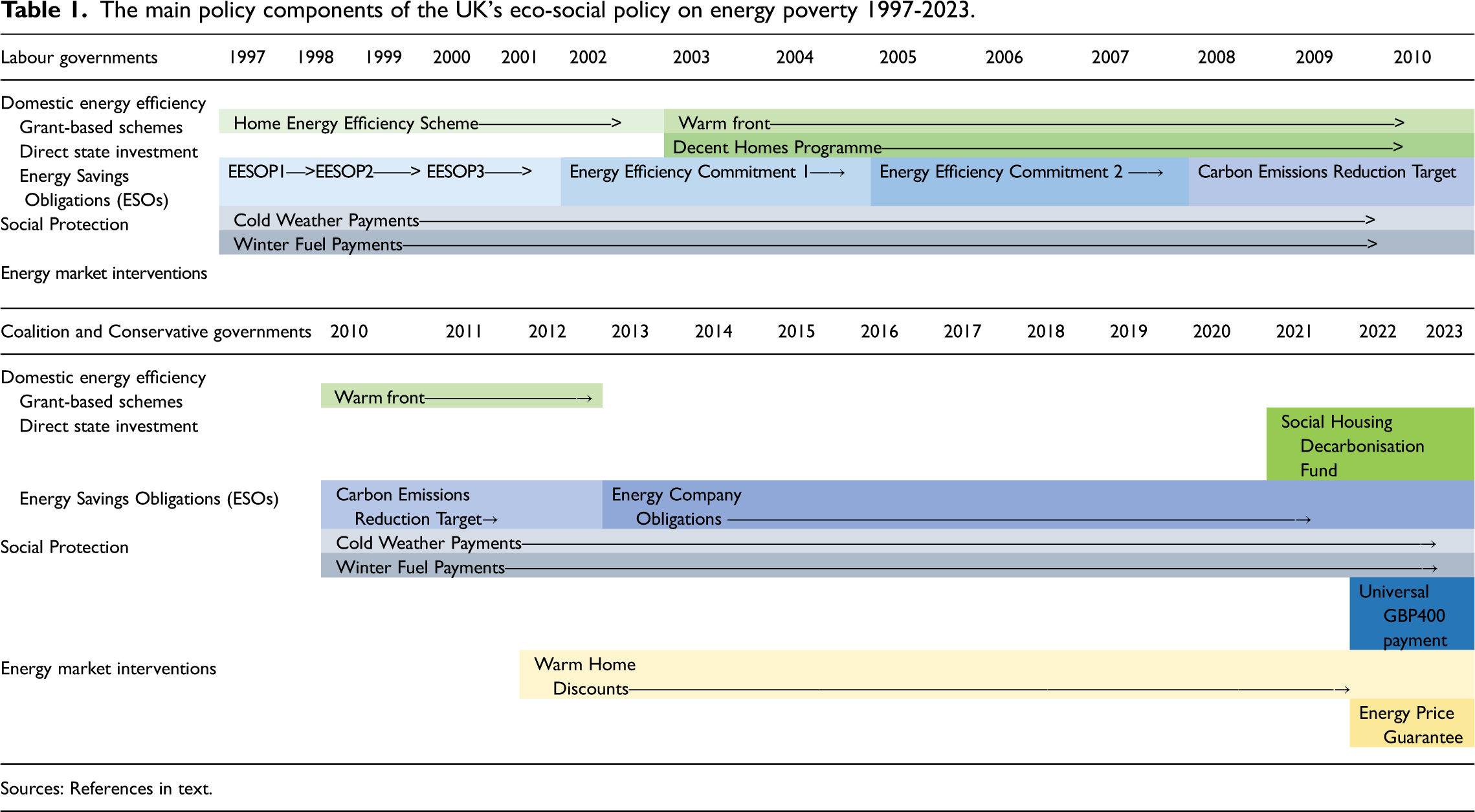
Given this liberal context, three main policy instruments have targeted energy poverty at various times since 1997, all aimed at improving domestic energy efficiency (see Table 1): a state-led system of targeted grants; direct investment in social housing; and a market-based energy savings obligation (ESO). The role of the latter system in addressing energy poverty has sometimes been disputed (see below; Powells, 2009; Rosenow et al., 2013). 3
The main policy components of the UK's eco-social policy on energy poverty 1997-2023.
Sources: References in text.
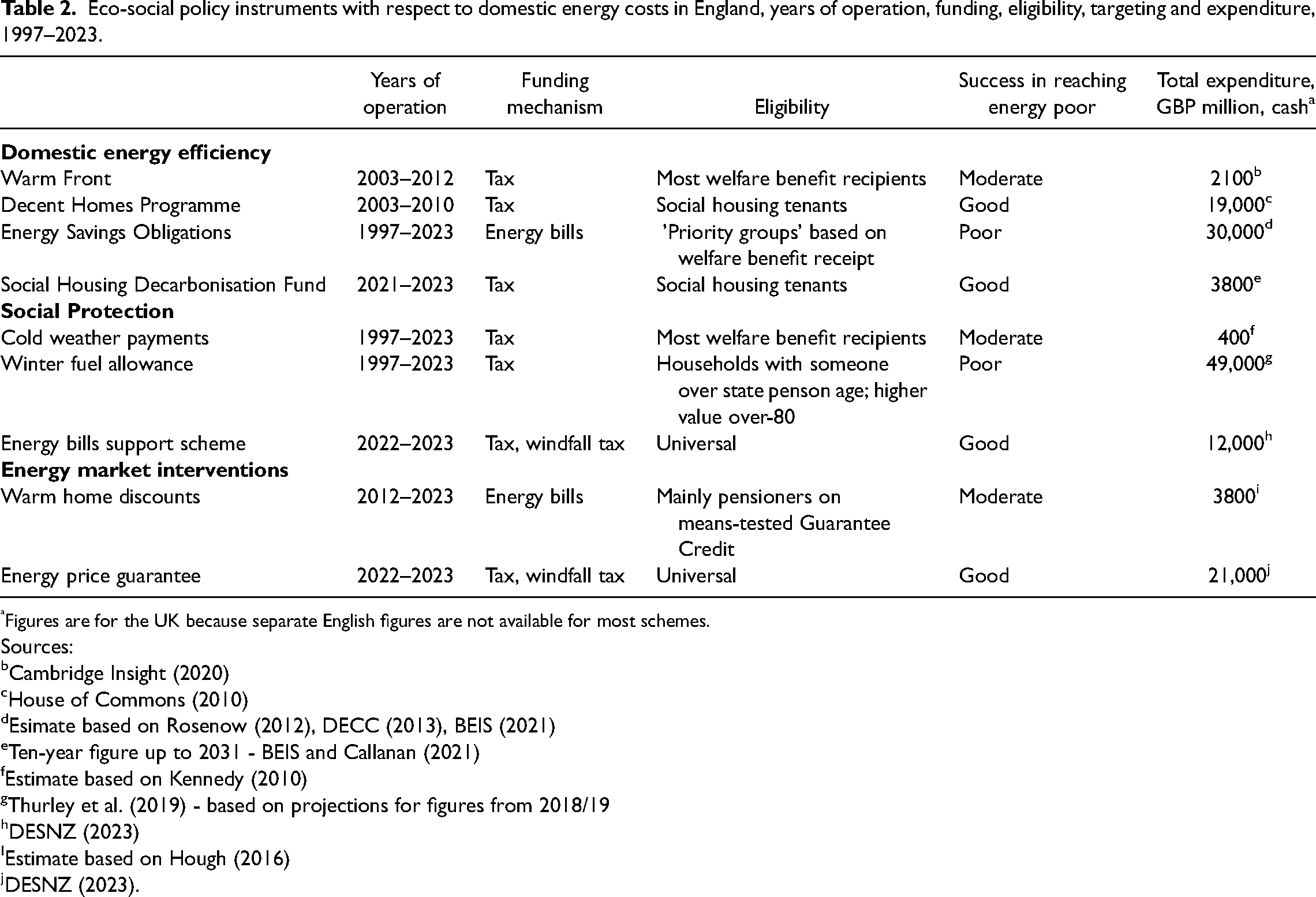
The first main tool, a system of government-sponsored domestic energy efficiency programmes, was ultimately known as Warm Front (DETR, 2000: para 12.15). This significantly expanded a previous grant-based intervention, the Home Energy Efficiency Scheme introduced by the Conservatives in 1990, involving three- or six-fold grant increases depending on family type (DEFRA, 2006) at a total cost of around GBP2.1 million over the ten years up to 2012 (see Table 2). Access to the scheme was targeted at specific types of household (60 or overs; with a child under 16 etc.), with a range of energy efficient heating and insulation measures provided to private tenure households in receipt of certain means-tested benefits (DECC, 2014).
Eco-social policy instruments with respect to domestic energy costs in England, years of operation, funding, eligibility, targeting and expenditure, 1997–2023.
Figures are for the UK because separate English figures are not available for most schemes.
Sources:
Cambridge Insight (2020) cHouse of Commons (2010) dEsimate based on Rosenow (2012), DECC (2013), BEIS (2021) eTen-year figure up to 2031 - BEIS and Callanan (2021) fEstimate based on Kennedy (2010) gThurley et al. (2019) - based on projections for figures from 2018/19 hDESNZ (2023) IEstimate based on Hough (2016) jDESNZ (2023).
The second main policy tool was new direct state investment in social housing to improve domestic energy efficiency. The ‘decent homes’ programme involved approximately GBP19 billion of improvements over ten years from 2001 (see Table 2; House of Commons PAC, 2010), available to all properties owned by public local authorities or the non-profit sector. Not all the money was spent on energy efficiency improvements, nor was it all spent on such interventions specifically directed towards energy poor households. However, because scheme entitlement was universally available to all social housing tenants, the money available for efficiency improvements was not targeted using the welfare system (NAO, 2010).
Finally, ESOs were market-regulatory devices which set time-specified regulator/government-directed targets for energy efficiency improvements by energy producers who met installation costs, but could pass them on in prices. These were particularly attractive in the UK's liberal context because they involved only an indirect state role and no taxation increase, with costs met by private market actors (Owen, 1997; Rosenow, 2012; Rosenow et al. 2019). This makes their funding method regressive because increased energy bills bear most, as a proportion of household income, on the poorest (Boardman, 2010; Bridgen and Büchs 2023). ESOs were first introduced in the UK in 1994, but ambitions were low. Only the electricity sector was included and supplier commitments amounted initially to only GBP25 million a year (OFGEM/EST, 2003), with annual energy saving targets set at low levels. 4 Under Labour, ambitions grew (see Rosenow, 2012). This involved gradual increases in the scale of the supplier commitments and energy savings in various iterations of the scheme up to 2010 (see Tables 1 and 2).
ESO's role in reducing energy poverty has been contested. They were included in Labour's 2001 Fuel Poverty Strategy toolkit (DEFRA, 2004) but government officials later rejected this link (Powells, 2009), a position reflected in subsequent government documents up to 2010 (Rosenow et al., 2013). Nevertheless, under all schemes between 2000 up to 2012, stipulations were included that at least 40% of interventions had to be targeted towards ‘priority groups’, with a ‘super priority group’ added in 2011 at which 15% of interventions had to be targeted (Rosenow et al., 2013). These groups were generally determined in relation to the benefit system and age of householder (see Table 2).
Of these three policy approaches, after 2012, only one survived in England – ESOs. The two tax-financed schemes energy efficiency schemes - Warm Front and the Decent Homes Programme – were abolished in 2012 (NAO, 2009; Watson and Bolton, 2013). 5 It was only in 2021 that direct investment in social housing was resumed, as part of the Social Housing Decarbonisation Fund (BEIS and Callanan, 2021), which promised GBP3.8 billion of investment over ten years. Even the retained ESO policy involved a much smaller scheme, Energy Company Obligations. This was targeted at reducing energy poverty despite the controversies about the scheme's role in this regard under Labour (DECC, 2012a). For more affluent households, a flawed, private sector-driven, ‘pay-as-you-save’ scheme, the ‘Green Deal’, was established to deliver small-scale interventions, but this collapsed within two years (Gillard et al., 2017; Rosenow and Eyre, 2013, 2016). A new scheme, Warm Home Discounts, was also introduced in 2012, offering up to a GBP120 yearly reduction in fuel bills, mainly for pensioners, funded like ESOs by fuel bills (Hough, 2016).
A partial synergy: the balance between environmental and social goals
How successful have these domestic energy efficiency policy interventions been in achieving environmental and social goals consistent with their declared eco-social purpose? Inspired by the symbolic policy literature (Slaven and Boswell, 2019), this section considers the substantive content of this policy, focusing first on outcomes across both dimensions; then outlining the main policy problems encountered and efforts to resolve them.
Environmental and social outcomes
In terms of environmental goals, there is a general consensus that before it was cut back after 2012, UK domestic energy efficiency policy was successful. In combination, Labour's three schemes raised insulation intervention rates, for example, on average by approximately 500,000, for cavity wall insulation, and 1 million, for loft insulation, during the peak years of the schemes from 2008 to 2012 (CCC, 2019b). Similar installations by energy companies, as part of the ESO schemes, achieved targeted energy savings almost all years (CCC, 2019b). Between 2003 and 2014, when Warm Front and the Decent Homes Programme had finally wound down, residential GHG emissions fell from 86.2 million tonnes carbon dioxide equivalent (MtCO2e) to 62.8 million tonnes. (BEIS, 2022) In contrast, during the Conservative-dominated period, insulation rates have fallen dramatically, by approximately 66% on average for cavity wall insulation from 2012 to 2017, and by more than 80% for loft insulation (CCC, 2019b). Residential GHG emissions have barely changed, amounting to 67.3 MtCO2e in 2015 and 66.3 in 2020, the most recent years for which figures are available (BEIS, 2022).
On energy poverty, assessing outcomes across the entire period is problematic given the three changes in indicator mentioned above (Bridgen and Robinson, 2023). These changes have de-emphasised in measurement the impact of energy prices on fuel poverty and instead focused evermore explicitly on the domestic energy efficiency standards of a household's dwelling (Hills, 2012; Middlemiss, 2017). Some commentators regard this shift as indicative in itself of the limitations of governments’ commitment to energy poverty reduction, regarding it as motivated by a desire to shift attention away from energy prices and low income as causes (see below). Certainly, as we shall see, only the most recent government energy poverty metric shows any significant indications of improvements in outcomes.
At the start of the period, ‘fuel poverty’ was operationalised as households needing to pay more than 10% of their full household income to maintain a satisfactory heating regime (Hills, 2012). Using this definition, energy poverty levels fell at the start of the period but then rose significantly throughout the noughties, only levelling off in 2011 close to the figure at which they started the decade (Figure 1).
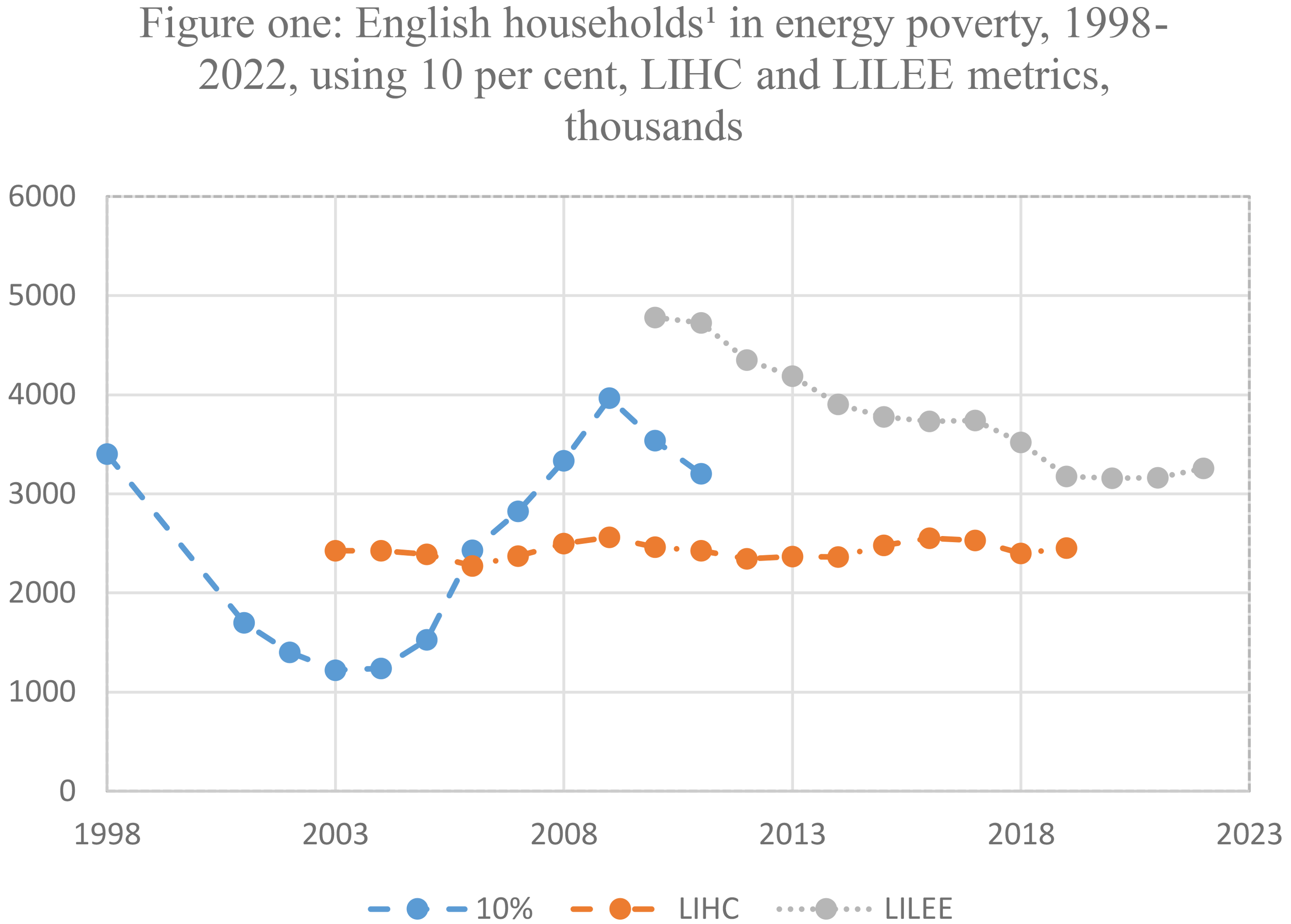
English households1 in energy poverty, 1998–2022, using 10%, LIHC and LILEE metrics, thousands.
Under the Conservative-dominated coalition government from 2010–2015, operationalisation was shifted to a Low Income High Cost (LIHC) measure. This was justified by claims the previous metric tracked too closely energy price changes and included many higher income households who, regardless of the proportion of their expenditure on energy, were easily able to afford their bills (Hills, 2012; Moore, 2012). Households were considered in fuel poverty under LIHC when they had fuel costs above average (the national median level), which, if met, left them with a residual income below the official poverty line (60% median income). On this measure, a small improvement in outcomes was achieved between 2003 and 2012, but since then levels have remained largely static (Figure 1).
Critics of LIHC argued it largely excluded energy price changes as a driver of energy poverty given higher costs were measured in relation to the national median (Middlemiss, 2017). Nevertheless, a further change in the measure in 2019 strengthened this approach. Energy poverty measurement since this time excludes any households living in a property with good energy efficiency ratings (band C or above, based on the government's fuel poverty energy efficiency scale). Households in dwellings with lower ratings are considered in energy poverty if, when they spend the required amount to heat their home, they are left with a residual income below the official poverty line. This is the most controversial indicator of the three because, as well as maintaining a limited role for energy costs, it also excludes households merely because the residents live in a more energy efficient home. This Low Income Low Energy Efficiency (LILEE) indicator is the only metric that shows a significant, sustained decline in energy poverty at any time during the period.
However, LILEE-based data have been treated with scepticism particularly given their limitations in reflecting rapidly rising energy prices since the 2022/23 energy crisis. Some scholars have reverted to the 10% measure to quantify the impact of the crisis. Based on this metric, using the UK Living Costs and Fuel Survey, work undertaken for the Child Poverty Action Group suggested a near doubling of UK households below the energy poverty threshold, to just over 13 million by May 2022 (Bradshaw and Keung, 2022a; see also Resolution Foundation, 2022).
Policy instrument problems
In summary, while there is good evidence domestic energy efficiency policy has achieved some successes in meeting environmental goals, particularly under Labour, evidence is mixed at best that it has had any significant impact on energy poverty outcomes. It is only using the government's controversial LILEE measure that any sustained decline during the period is evident. Two main policy problems have been suggested as the most likely reasons for these eco-social limitations: (i) difficulties in the prioritisation and targeting of energy efficiency improvements, particularly to meet social goals; and (ii) the limitations of efficiency improvements to reduce energy poverty caused by rising fuel prices and low income (Middlemiss, 2017; Rosenow et al., 2013).
Policy problem 1: prioritisation/targeting
Dealing first with household prioritisation and targeting, this issue has caused significant problems throughout the period, with particularly serious difficulties encountered in ensuring interventions reach energy poor households. Under Labour, Warm Front and the Decent Homes Programme were primarily designed for this task but, as has been seen, ESOs were also drawn in. Under Conservative-dominated governments since 2010, ESOs have been assigned the primary role, with the short-lived Green Deal meant to deliver more general energy efficiency improvements (Rosenow and Eyre, 2013).
Of these schemes, Labour's Decent Homes Programme seems to have been most successful. In terms of interventions, the programme installed more than a 1.1 million new central heating systems in social housing, with nearly 900,000 insulation upgrades provided between April 2001 and March 2008 (NAO, 2010). As a universal scheme for social housing households, many interventions were delivered to approximately 85% of tenants not in energy poverty (DECC, 2012b), but this approach also minimised entitlement obstacles for the more than 700,000 social housing households that were. Certainly, by 2010, social housing households in energy poverty had decreased dramatically, by just over half, from 30% of all social housing households to 16% compared to ten years previously (DECC, 2012b).
Warm Front was similarly successful in delivering energy efficiency improvements but less successful in reaching energy poor households. During the scheme's lifetime, 1.5 million households were assisted, many considered ‘hard-to-treat’ and thus unlikely to have received interventions in the programme's absence (DECC, 2014). However, estimates throughout the scheme's course suggest around 40% of energy poor households had no entitlement and that approximately 70% of interventions were received by households not in energy poverty (NAO, 2009). This was mainly because many on welfare benefits, which triggered entitlement, were not energy poor and vice versa.
ESOs’ role in delivering energy efficiency improvements to energy poor households has, as seen, been the most controversial, and widespread doubts about the scheme's suitability appear vindicated by the evidence. One study found only 24% of households receiving ESO-based priority group interventions were actually in fuel poverty (Sunderland and Croft, 2011). This was first because, like Warm Front, many older people and those on benefits included in targeted priority groups were not in energy poverty and vice versa. Secondly, targeting difficulties have been exacerbated by the impact on scheme operation of energy suppliers’ commercial incentives: because energy companies have strong incentives to keep costs low, there is evidence they have targeted easier-to-access priority group elements and concentrated on least expensive interventions and/or cost sharing with customers. On the former, evidence suggests, for example, neglect of private rented accommodation, where fuel poverty levels are higher (Rosenow et al., 2013). On lower cost interventions, this has led to neglect of more expensive improvements, such as solid wall insulation, which is particularly required in fuel poor housing (CCC, 2019b). Efforts by government to insist on the inclusion of higher cost measures have been resisted by energy suppliers, not least because government fears increased costs will be passed on in bills, thus worsening the regressive nature of the scheme (Lees, 2008). Despite these evident problems, under the Conservatives, the new ESO was assigned by itself the task of addressing energy poverty. Predictably, area-based evidence suggests interventions have not successfully targeted those in greatest need (e.g. Bridgen and Robinson, 2023).
Policy problem 2: energy costs
The second policy problem encountered with domestic energy efficiency interventions as an energy poverty reduction tool in England concerns their limitations in addressing increased energy prices, particularly when these rise rapidly. During the period considered, this has been a significant problem, on two occasions, between 2004 and 2014 and more recently as a consequence of the energy crisis from March 2022 (Figures 2 and 3).
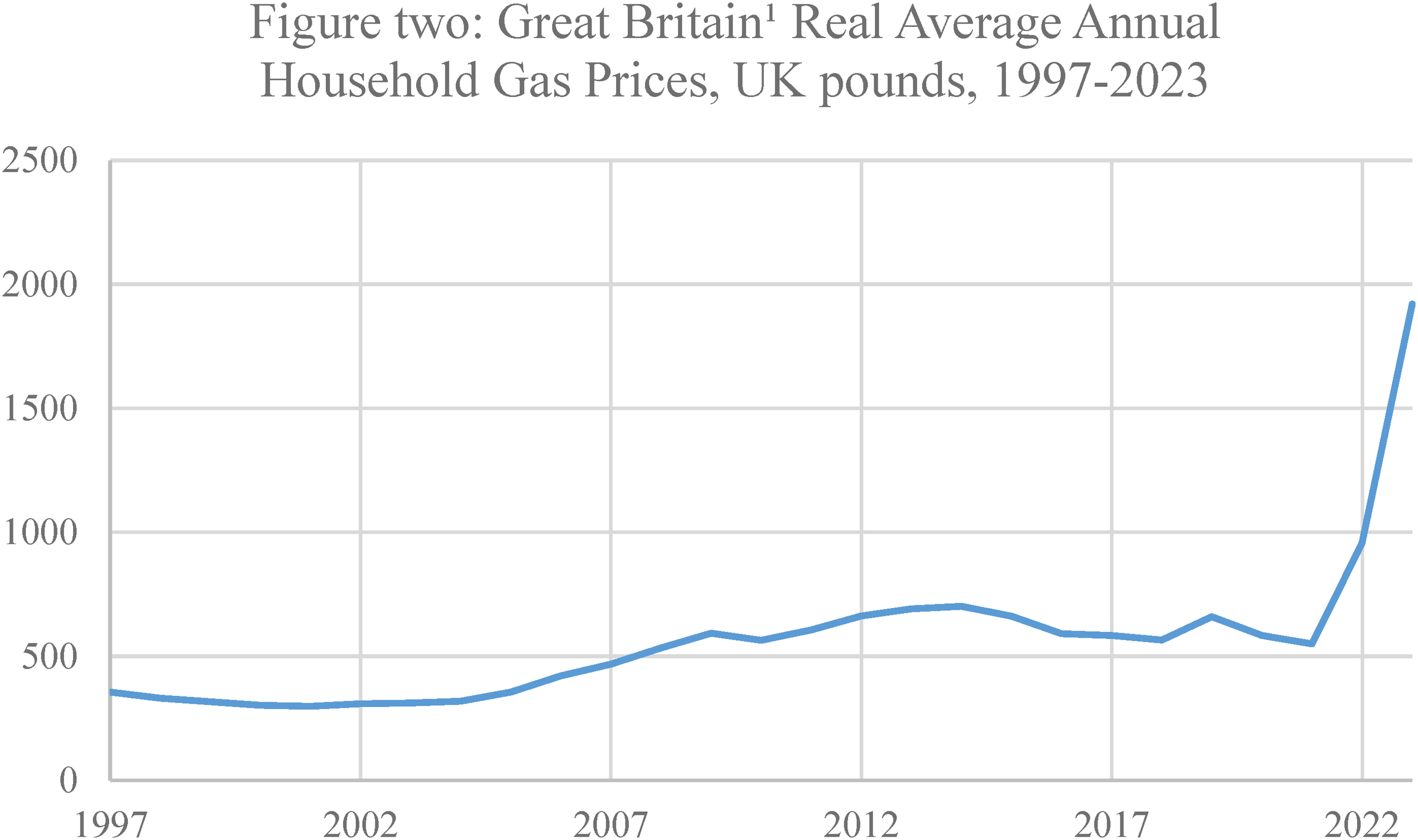
Great Britain1 Real Average Annual Household Gas Prices, GBP, 1997–2023.
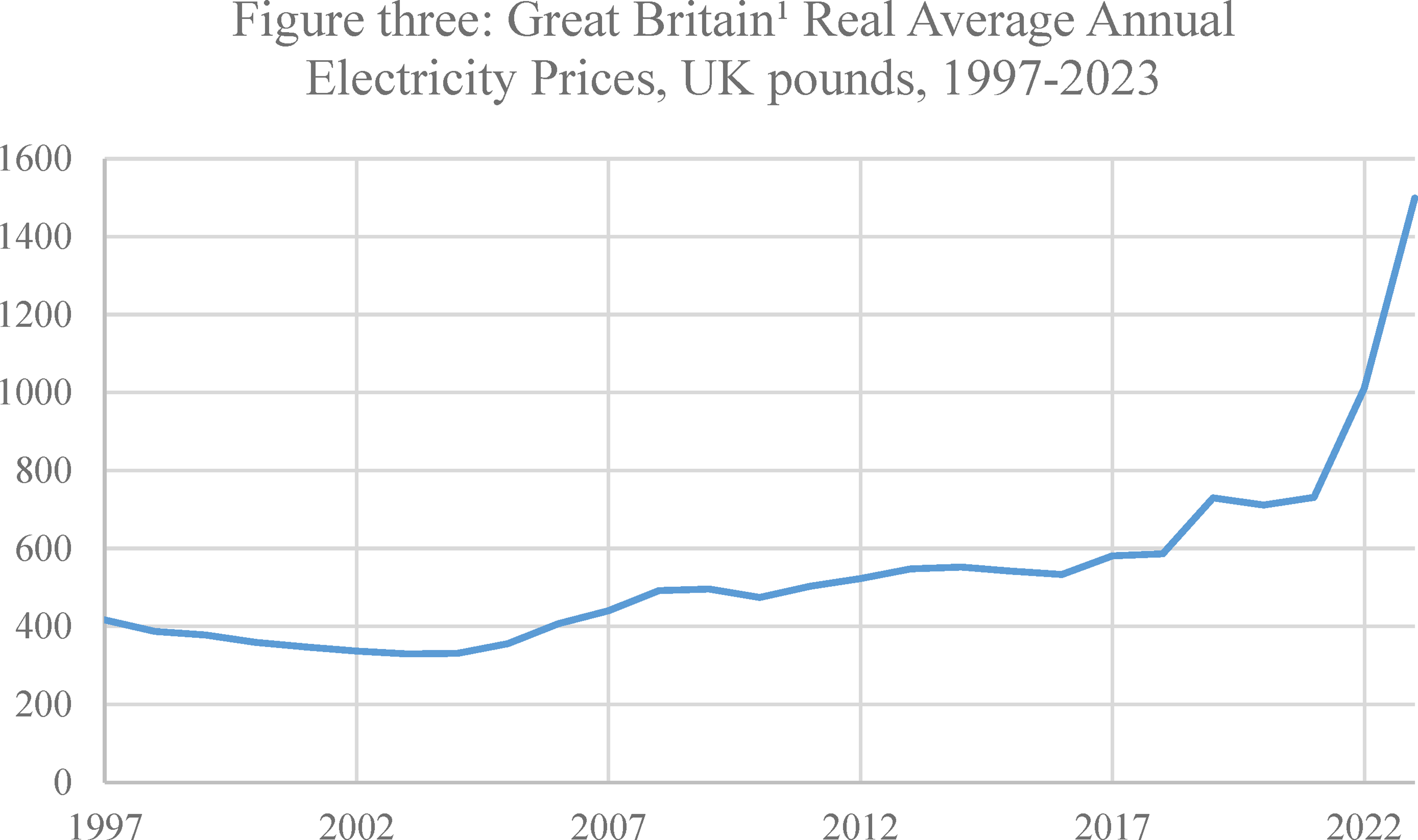
Great Britain1 Real Average Annual Electricity Prices, GBP, 1997–2023.
During the first price rise, annual gas and electricity bills combined increased by 93% in real terms up to 2014 (BEIS, 2019a, 2019b). Even the generally market-friendly energy market regulators pushed for increased intervention given incremental improvements in domestic energy efficiency could have only a marginal effect. In January 2008 they proposed a windfall tax on providers’ profits to limit the impact of price rises on low-income families, but Labour ministers resisted (Rosenow, 2012). Instead, the government increased the size of the existing ESO target by 20%, which risked compounding the energy poverty problem given its impact on bills. Under the 10% measure, energy poverty levels in particular rose precipitously during the early part of the period (Figure 1; DECC, 2012b; Hills, 2012: 11).
The Conservative-dominated coalition government's shift to the LIHC and then LILEE measure after 2012 effectively defined away the problem of rising energy costs. Energy poverty was re-problematised as primarily an energy efficiency, rather than income inequality or a fuel costs issue (Middlemiss, 2017), with the importance diminished in the process of improved, targeted social protection or direct market interventions as a means to address it.
The 2022/23 energy crisis has challenged this strategy, with extensive publicity given to the work showing energy poverty was spiralling upwards in the face of rising energy costs, using the old 10% definition (Bradshaw and Keung, 2022a). An emergency response has followed involving a time-limited price guarantee and a universal one-off payment (Gov.uk, 2022), thus temporarily laying aside UK government's reluctance to intervene in energy markets or use financial compensation mechanisms (see Table 2). The price guarantee sets a maximum price energy suppliers can charge for each kilowatt hour (kWh) of domestic energy used between October 2022 and June 2023, ensuring ‘typical’ annual bills do not rise above GBP2500. 6 The one-off payment amounts to GBP400 paid to all households on a six-month instalment basis from October 2022 (Gov.uk, 2022; HM Treasury, 2023). Both are funded by a windfall tax on North Sea oil and gas companies. However, there seems little chance these interventions will be extended beyond the crisis period.
Discussion
The English case study above highlights the utility of a symbolic policy framework for assessing the substantive content of eco-social policies. By comparing the discursive eco-social presentation of English domestic energy efficiency policy with its practical implementation and outcomes (Slaven and Boswell, 2019) it has highlighted the limited extent to which partial synergies have been addressed, with particular implications for the achievement of social goals. In doing this, the case study has raised significant doubts about domestic energy efficiency policy's credentials as an eco-social silver bullet for achieving simultaneously environmental and social goals. At best, it suggests such a policy offers partial synergies across these dimensions: it is generally better equipped as a tool for reducing GHG emissions than as a means for addressing energy poverty. On the latter, two particular policy problems have been identified relating to targeting and the limitations of approaches focused on housing infrastructure when broader socio-economic factors, high prices and/or lower incomes cause energy poverty to rise. These problems have caused repeated difficulties in England. They have been exacerbated since 2010 by a concerted return to neo-liberalism following the moderate social democratic experiments of the Labour period. The Conservative-dominated governments during this time have discursively reiterated an eco-social commitment to energy poverty reductions, but substantively, this commitment appears largely symbolic (Slaven and Boswell, 2019). The inadequacies of the current policy framework have been highlighted strongly by the 2022/23 energy crisis.
How typical is the English example, particularly in relation to developing EU policy? In this respect, the English approach has, as would be expected, been towards the more liberal end of the eco-social policy spectrum. However, in its emphasis on domestic energy efficiency as a means for addressing simultaneously environmental and social goals, and in its general rejection of energy market intervention and social protection systems as a means for reducing energy poverty, it is clearly very similar to the European Commission's energy poverty policy recommendations. England has, for long, operated the type of ESO scheme recommended as part of the EU's Clean Energy for All Europeans package.
The policy problems experienced in England should thus receive full consideration in the EU and elsewhere as attempts develop to use domestic energy efficiency policy as part of more general just net zero strategies. In this regard, in the EU, Member States are still in the early stages of responding to the European Commission's recommendations, and in many, policy development is embryonic. Many countries’ NECPs are beginning to make the type of eco-social links between energy efficiency, housing renovation policies and energy poverty recommended by the Commission. However, the most under-developed part of these proposals concerns the question of how interventions will be targeted at energy poor households (Bouzarovski et al., 2021). The English example suggests this is a crucial issue. It shows the complexities involved in such targeting, particularly the limitations of market-based devices such as ESOs and welfare systems as proxies to determine entitlement. Increasingly, English policymakers are considering more localised approaches to resolve such problems, but they are in their early stages (BEIS, 2021).
More generally, the English example might also embolden those EU Member States critical of the Commission's focus on domestic energy efficiency to address energy poverty (e.g. Denmark, Germany, the Netherlands and Sweden). The limitations of English efforts to significantly reduce the problem strengthens the case made by these countries for a continuing central role for social protection in this policy area. In this respect, the direct targeting of public financial support based on energy costs, as practiced in Denmark and Ireland, has been recommended as a possible model for other EU countries (Cludius et al., 2018). In England, the resources used for winter fuel payments could be better targeted to achieve this end (Committee on Fuel Poverty, 2020). Such an approach does not negate the need for improved domestic energy efficiency for poorer households. This remains essential, as a longer-term measure and to meet environmental goals. Rather, its purpose is to ensure the limitations of domestic energy efficiency as an eco-social tool for counteracting energy poverty are addressed .
Footnotes
Acknowledgements
I am grateful to Jayeon Lee for her comments of an earlier draft of this article. I am also grateful to the anonymous referee for comments and suggestions. All remaining errors and shortcomings are my own.
Data access
All data used in this article are publicly available online without cost.
Declaration of conflicting interests
The author declared no potential conflicts of interest with respect to the research, authorship, and/or publication of this article.
Funding
The author received no financial support for the research, authorship, and/or publication of this article.
