



Abstract
The social impacts of the climate crisis and the need for societal transformation to achieve climate goals require integrated research and design of environmental policy and social security. The article analyses the current state of research on eco-social policy and sustainable welfare. Based on a systematic literature review covering more than 1000 publications, the article identifies 20 research topics. Strong research progress has been made on social compensation for climate policies; economic inequality in the climate crisis; energy use patterns in housing, mobility, and nutrition; political conditions for eco-social policy; and varieties in eco-social country regimes. Future research activities should focus on the five bottlenecks detected in the emerging research topics: the reduction in the environmental burden through a change in demand structures by the welfare state; growth-independence of social security; support for socio-ecological transformations by altered financing of welfare states; eco-social insurance and institutions; and ecological mainstreaming in the domains of social security. Discussing the explanatory factors for past research activity and sketching the elements of sustainable welfare states, the article concludes with the historical importance of including ecological concerns in social security.
Introduction
The social impacts of the climate crisis and the requirement for societal transformation to achieve climate goals open up the need for integrated research and joint design of environmental policy and social policy. A separate analysis of environmental policy and social policy is no longer appropriate. Sustainable welfare is a new paradigm in social policy that ‘aims at making welfare theories, systems and policies compatible with principles of environmental sustainability by developing and promoting ways to meet human needs within environmental limits’ (Fritz and Lee, forthcoming). Eco-social policy covers the politics of and public policies for implementing environmental and social goals in an integrated way.
The article analyses the current state of research on eco-social policy and sustainable welfare and identifies peaks and gaps in the literature. A discursive change in eco-social policy and sustainable welfare can be observed: Whereas a few years ago it was still necessary to justify why social policy and environmental policy should not only be analysed separately, today an integrated view is legitimate. Instead of asking why eco-social policy is of interest, the question turned to how the two issues can be linked. This is also reflected in handbooks on social policy research, which – compared to earlier editions – identify the climate crisis as a future topic of social policy research. However, many publications still integrate ecological contingencies only as ‘climate cameos’ (Ian and Barral, 2021), which mention the climate crisis once as an overall trend or challenge without considering the profound implication for the research question of the publication.
Research on eco-social policy and sustainable welfare is still in its infancy although publications and research interest have strongly increased in recent years. In the rapidly growing research landscape, social policy scholars have so far been underrepresented, resulting in specific research gaps. While the effects of environmental policy on social goals are being analysed quite intensively, the impacts and design options of social policies to promote environmental goals are less explored.
Twenty research topics can be identified, of which the emerging topics are particularly important for bridging the research gap between today's knowledge base and that required for a sustainable welfare state and for implementing eco-social policies. The article identifies five priorities among the established research topics: social compensation of climate policies; economic inequality in the climate crisis; energy use patterns in application fields; political conditions for eco-social policy; and varieties in eco-social country regimes. For the emerging research topics, the article poses five bottleneck questions:
Can an expansion of the welfare state reduce the environmental burden through a change in demand structures? Can welfare states be stabilised independently of environmentally-damaging economic growth? How can a change in the financing of social security support a socio-ecological transformation? What (new) programmes and institutions are required to insure against eco-social risks? What changes imply ecological mainstreaming in the fields of social security?
Ecological considerations are far from present in the core of social security research in areas such as unemployment and disability benefits, pensions and basic security. Applying ecological considerations to the core areas of the welfare state will highlight which public provisioning systems are required for sustainable lifestyles and how social security and welfare benefits can reduce the environmental footprints of citizens. Promoting sustainable welfare, for example by mainstreaming climate protection into social policy programmes, provides opportunities to strengthen the welfare state. The change from a remedial and compensatory welfare state to a preventive and sustainable one could advance social security development beyond the national level. For example, new institutions and insurances at the European or even international level might emerge and the growing relevance of local transformations in housing, mobility and nutrition might lead to a relocalisation of welfare services. However, if the need for strong social security institutions in the climate emergency is detected too late and given the complexity of social protection systems, climate and biodiversity disasters might lead to underprovisioning by, and even the collapse of, social protection systems.
Conducting a systematic literature review, the article identifies 20 research topics with varying research intensities (section 2). The topics are described and subsumed into five established approaches and five bottleneck questions for future research (section 3). Based on these results, the article discusses explanatory factors for the variance in research (section 4.1) and contrasts the current state of social security with the essentials of a sustainable welfare state (section 4.2). The article concludes with considering the historical importance of including ecological concerns in social security (section 5).
Method: systematic literature review
The systematic literature review aims to identify the state of research at the interface of ecological policy and social policy and highlights promising new research directions. Therefore, it focuses on the five years preceding the year in which the study was conducted (2017–2021). Following established review methodology (Petticrew and Roberts, 2006: 27), the review seeks to ascertain whether there is rudimentary, basic, developed, or even extensive research in the topics and whether there is any specific focus in the research questions.
The systematic literature review consists of seven steps which can be divided into two main phases, which both included expert advice (for detailed method description, see Annex). In the first phase, the publication database was constructed by identifying publications through the individual consideration of all papers published between 2017 and 2021 in 17 international journals (English language) and ten national journals (German language), and complemented with a database on the research field made up by the researcher (including publications before 2017) and by considering relevant publications citing at least one of 19 key publications in the field that were identified using expert evaluation. Publications with a focus on migration or health were not included since these topics are also covered in more specialised journals and would, given the comprehensiveness of the field, justify a separate literature review. After the removal of duplicates, the publication database consisted of a total of 1073 scientific publications. In the second phase, all publications were assigned to the different research topics that were previously selected and coordinated with the experts. For the summary of the results, thematically neighbouring research strands with a similar stage of development were grouped, resulting in 20 research topics highlighting the peaks and gaps in the international research landscape. The research intensity reflected the number, depth, and scope of publications in the relevant research topic.
Results: 20 research topics and increasing research activity
Some publications locate in the periphery of eco-social policy, while others match the core of the research field. The research intensity of the 20 topics varies between rudimentary and extensive and is described for each topic separately. Although several impediments exist (see section 4.1), there is a growing number and quality of publications in the field of eco-social policy and sustainable welfare (Figure 1).
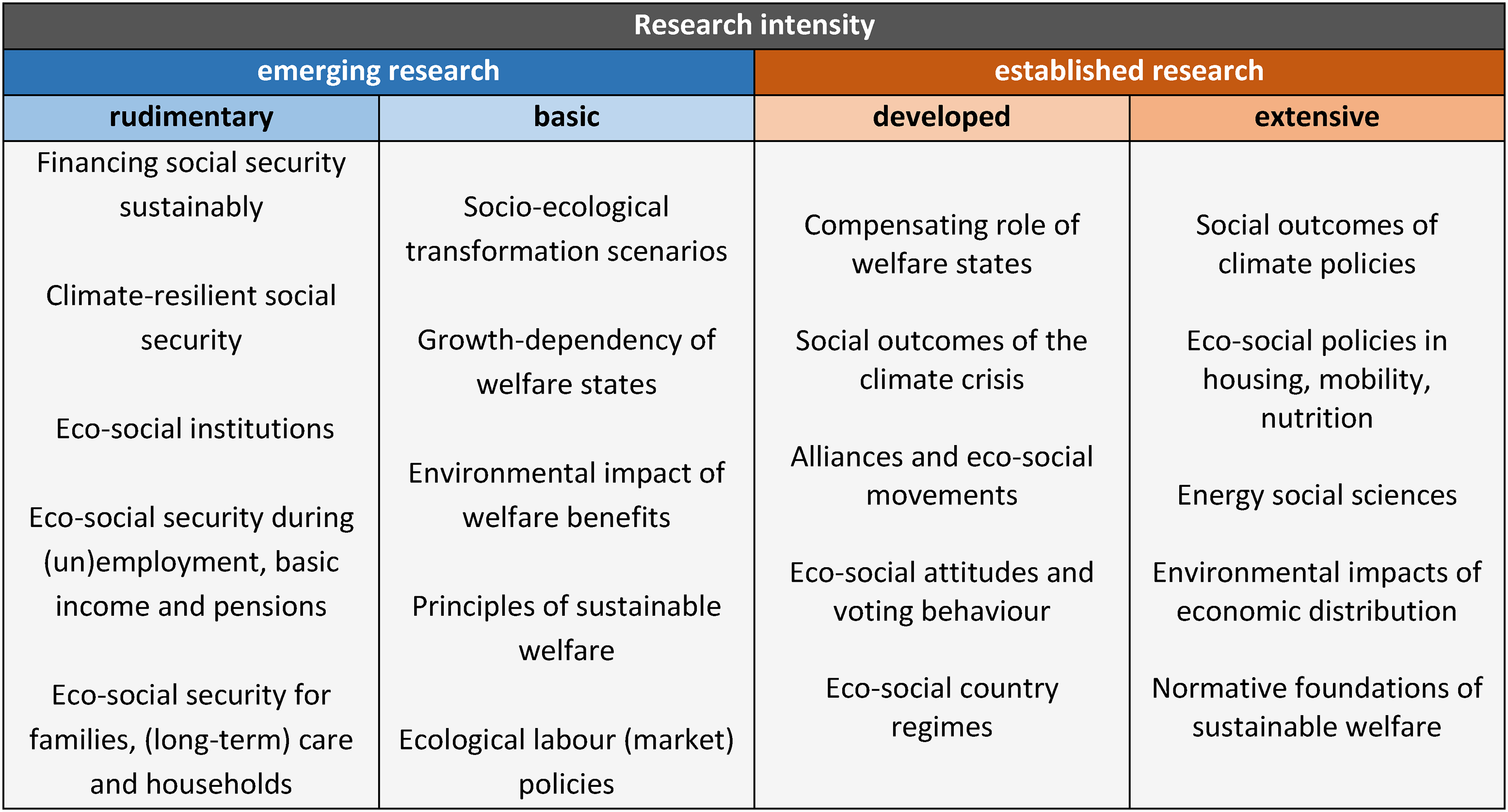
The 20 identified research topics and their classification in terms of research intensity.
Front runners: established research knowledge
Ten research topics can be identified for developed and extensive research. Together these research topics cluster into the following five main perspectives and peak observations:
Bottlenecks: emerging research questions
In contrast to the established research insights, five bottleneck questions can be identified for those ten research topics that are still emerging.
The welfare state, with its substantial share in the state budget, shapes the ecological impact of states. Developing consistent transformation scenarios would include links with the national welfare state and considering options for reducing the environmental impact through welfare benefits. Thus, the first bottleneck question is:
There is hardly any direct research on the principles of a sustainable welfare state. Even if there are criteria to decide when a certain social policy can be classified as sustainable welfare, quite little is known about concrete principles in the design of social policies. However, growth-independence is outlined as one essential factor for shaping the principles of welfare state design. Thus, the second bottleneck question is:
While the expenditure side of the welfare state is beginning to be analysed from an ecological perspective, there is little research on the environmental consequences of financing the welfare state. The design of social security contributions and taxation of labour income or capital income, and the resulting incentives for ecological decisions by firms, households, and groups of employees, have not been sufficiently considered yet. In practice, and given the important role of employment in maintaining the welfare state currently, this is closely linked to labour market policy. The third bottleneck question therefore is:
So far, the consequences of the climate crisis on the stability of the welfare states and the resilience of social security institutions have been almost completely ignored in social security research. Yet, research on the emergence of eco-social institutions is commencing. The fourth bottleneck question therefore is:
While eco-social instruments are becoming the new normal in policy domains like mobility, nutrition and housing, which have so far been resigned to the periphery of social policy research, eco-social considerations are far from present in the core of social policy, in areas such as unemployment and disability benefits, pensions or basic security. Climate mainstreaming requires bringing ecological considerations into all domains of the welfare state. Currently, this is already taking place in health policy with planetary health campaigns (Hensher et al., 2019), and in employment policy with sustainable work approaches (Barth et al., 2016). The starting point in other social security fields could be an analysis of the ecological footprint of existing measures and institutions, distinguishing direct environmental impacts through procurement, expenditure and infrastructure, and indirect impacts through incentives, opportunities and rules of the social security programmes. The fifth bottleneck question, therefore, is:
Discussion: history of eco-social research and the future of sustainable welfare states
Based on these results, this section outlines factors explaining the differences in the research intensities in the 20ntopics. By sketching the essentials of a future sustainable welfare state and contrasting them with the current state of research, the article draws conclusions on the research perspective required to bridge the research gaps for social security within planetary boundaries.
Research followed reality: explaining research peaks and gaps
The topics of eco-social policy and sustainable welfare are researched to varying degrees by different academic disciplines, and some research questions have been more successfully answered than others. So far, a Eurocentric perspective dominates in eco-social policy research, with variances among European countries. In the English-speaking countries, concrete fields of application, for example, energy poverty, are particularly strong. In the Scandinavian region, conceptual questions of institutionalising eco-social policy are widespread, and in the Southern European region, transformative approaches are more present. Little research exists from an Eastern European perspective, and continental regions focus on the meso-level of eco-social transitions, such as sustainable work or political alliances. Further factors explaining the current state of research and differences in research intensity are:
Research perspective of a rising paradigm: the sustainable welfare state
Ecological crises like climate change and biodiversity loss mark profound changes for humanity. From a historical perspective, the climate crisis will have been a major determinant of institutional changes in welfare states. The results of the literature review can be used to outline the essentials of a sustainable welfare state, translating into a new research perspective on eco-social policy.
New eco-social risks will add to existing social risks, forming a new category of risks that social security will have to handle. Only a tiny share of these risks will result from successful sustainability transitions, with the larger share resulting from environmental crises and the cracks this will cause in existing social security institutions. Welfare state performance will be judged by the ability to secure both new and old risks. Preventing these risks, instead of compensating for their consequences, is one major strategy for preserving the functioning of welfare states. While the prevention principle has been predominantly interpreted in social policy as the preservation of individual employability, societal prevention approaches will become more relevant in avoiding the emergence of eco-social risks through collective action. Ecological protection is the most cost-effective option for preventing eco-social risks.
The welfare state, with its immense leverage on lifestyles, consumption, and production, will need to contribute to ecological goals by greening the welfare state, its policies, and its incentives. Instead of compensating for changes in the status quo, the sustainable welfare state might be transformative. While overcoming the lock-in emissions of poor households, the focus of social policy will shift from poor households as the originators of traditional social problems, to rich households as the main causers of new eco-social risks. Curbing luxury emissions will bring back distributional questions to the core of welfare states. Welfare states might even become social tipping points for sustainability transformations.
In the 20th century, states sought to eradicate poverty and resolve distributional conflicts through economic growth, with employment providing the link to societal participation. With energy, material, and natural resources shrinking in the 21st century due to ecological crises, the risk of absolute poverty will come back onto the political agenda. A shift from instrumental income support and employment towards direct management and distribution of natural resources might take place. More essential goods and services might be provided in decommodified access and, as can already be observed in the energy crisis of 2022, new benefits might be granted on universalist principles to ensure basic human needs are met.
More frequent crises might shift social policy orientation from a productivity-enhancing and investive welfare state to resilient social security. An increasingly unstable environment might bring areas of social policy that are on the periphery, like mobility, housing or nutrition, back to the core of social security. The national level of the welfare state might lose institutional significance to local levels, where eco-social risks are experienced, and boost supranational levels, which can better insure against large-scale eco-social risks and coordinate ecological action. A separate installment of environmental policies and social policies might give way to integrated eco-social instruments. Policies that still appear radical today, might prove surprisingly popular for resolving eco-social crises and even strengthening the welfare state.
Currently, much research effort is spent on analysing eco-social research questions as they are discussed in media and everyday politics. Being based on these mindsets, studies often overlook what would be ecologically necessary to stay within planetary boundaries and lag behind what would be politically feasible. Along the sketched characteristics, future social security research could apply backcasting to derive the changes required to make welfare states deliver stable societies within planetary boundaries.
Conclusions
The climate crisis is only one of the ecological crises that will have to be managed in the coming decades. The social impacts of the ecological crisis and the need for social transformation to stay within planetary boundaries require integrated research and design. A rich research landscape has emerged in recent years around the concept of eco-social policy and sustainable welfare. However, social security experts have so far been under-represented in these activities, resulting in specific research gaps and a passive role of social security in sustainability transitions. The climate crisis confronts the welfare state with a systemic change: on the one hand, insufficient climate action threatens the established functions of social security institutions with collapse when existing social risks and the emergence of new eco-social risks intensify. On the other hand, according to the latest climate science, sufficient climate protection can only be achieved by applying not only technical solutions for the reduction of greenhouse gas emissions, but also socio-organisational strategies and distributional sufficiency policies.
The systematic literature review revealed five peaks in the established research landscape. (1) The social outcomes of environmental protection are frequently analysed and the welfare state is asked to compensate for the distributional changes of climate policies. (2) Economic inequality persists in both contribution to and the impact of the climate crisis and other ecological risks. (3) Studying energy use and energy inequality forms the basis for developing eco-social policies in housing, mobility and nutrition. (4) The political conditions for eco-social policy are formed by citizens’ attitudes and alliance building. (5) Variation in eco-social country regimes could explain the performance in sustainable welfare goals.
The literature review also highlighted specific gaps in the research landscape and identified five bottleneck questions that are essential for research progress: (1) Can an expansion of the welfare state reduce the environmental burden through a change in demand structures? (2) Can welfare states be stabilised independently of environmentally-damaging economic growth? (3) How can a change in financing social security support a socio-ecological transformation? (4) What (new) programmes and institutions are required to insure against eco-social risks? (5) What changes imply ecological mainstreaming in the fields of social security?
While social objectives are already considered in environmental policy, the integration of environmental objectives into social security is not yet evident. Yet, this integration could promote social security goals when eco-social instruments are chosen and the welfare state is strengthened by updating it with new eco-social institutions. Considering the ongoing global environmental change, the future of welfare states might be decided by the integration of ecological concerns into social security.
Supplemental Material
sj-docx-1-ejs-10.1177_13882627231214546 - Supplemental material for Peaks and gaps in eco-social policy and sustainable welfare: A systematic literature map of the research landscape
Supplemental material, sj-docx-1-ejs-10.1177_13882627231214546 for Peaks and gaps in eco-social policy and sustainable welfare: A systematic literature map of the research landscape by Katharina Bohnenberger in European Journal of Social Security
Footnotes
Acknowledgements
I would like to thank the German Institute for Interdisciplinary Social Policy Research for providing research funding for this study, my interview partners for their collaboration, and Sophia Heyne for her research support. A special note of gratitude goes to Frank Nullmeier, the editors of the special issue, and two anonymous reviewers for their diligent reviews and thoughtful feedback on previous versions of the article.
Declaration of conflicting interests
The authors declared no potential conflicts of interest with respect to the research, authorship, and/or publication of this article.
Funding
The authors disclosed receipt of the following financial support for the research, authorship, and/or publication of this article: This work was supported by the German Institute for Interdisciplinary Social Policy Research, (grant number Research grant for publication ISSN: 2748-7199).
Supplemental material
Supplemental material for this article is available online.
References
Supplementary Material
Please find the following supplemental material available below.
For Open Access articles published under a Creative Commons License, all supplemental material carries the same license as the article it is associated with.
For non-Open Access articles published, all supplemental material carries a non-exclusive license, and permission requests for re-use of supplemental material or any part of supplemental material shall be sent directly to the copyright owner as specified in the copyright notice associated with the article.
