



Abstract
The political agenda of eco-social policy seeks to create synergies between social justice and ecological goals, such as mitigating climate change. While the concept already has a strong theoretical foundation, and many concrete policy instruments have been proposed, support for eco-social policy is still insufficient to mobilize political action. We assume that one cause of this lack of action are the diverging interests and ideologies of different classes. In this article we apply a class perspective and conduct an empirical study to explore class support for and opposition to eco-social policy. We use data from a representative survey in Germany and identify nine class fractions, based on Bourdieu's concept of social space. We first compare the carbon footprints of the classes, to determine their varying degrees of responsibility for supporting political efforts to mitigate climate change. We then compare class support for eco-social policy, considering the dimensions of redistribution, regulation and rights. We find that the economic upper class – a fraction equating closely with the ruling class – and the old working class oppose eco-social policy the most. The cultural upper class are the strongest proponents of eco-social policy. The lower-class fractions showed considerable concern about the costs associated with eco-social policy. We conclude that a stronger focus on the social justice element when designing and advocating for eco-social policy could lead to greater support from the lower classes and help to build eco-social welfare states that offer protection in times of increasing social and ecological risks.
Introduction
The latest synthesis report of the Intergovernmental Panel on Climate Change has shown that limiting global warming to 1.5° at most is still possible, yet difficult to achieve (IPCC, 2023). While we already have all the tools that are necessary to overcome the climate crisis – effective policies, technologies, capital and knowledge – climate action is still insufficient. The reason is a lack of political will to enforce ‘rapid and deep and, in most cases, immediate greenhouse gas emissions reductions in all sectors’ (IPCC, 2023: 21).
Why is there such a lack of collective political action? Here we argue that the main reason is the close connection of the problem of climate change to gaping social inequalities. In the year 2019, the wealthiest 10% of the world population emitted nearly half of the global anthropogenic CO2 (Chancel et al., 2022), and the investments of the world's richest billionaires caused on average 3,000,000 tons of carbon emissions per capita and year (Dabi et al., 2022). Parts of this global elite have downplayed and denied climate change and used their power to influence politics to delay and prevent climate action (Klein, 2015; Latour, 2018). Moreover, many climate policies – for example CO2 taxes and green-growth solutions for ecological modernization, such as electric cars – disadvantage the poor, who cannot afford the rising costs and don their ‘yellow vests’ to take their protest against unjust climate policy to the streets (Martin and Islar, 2021).
Solutions to avoid unfair consequences and to simultaneously tackle climate change and inequalities are discussed in research on eco-social policy and sustainable welfare (Büchs and Koch, 2017; Schoyen et al., 2022). This new paradigm and research agenda in social policy is concerned with analyzing synergies between social and ecological goals. Integrated eco-social policies (Gough, 2013; Mandelli, 2022) are proposed to tackle the ‘double’ or even ‘triple injustice’ that arises with climate change and other ecological problems (Gough, 2017; Walker, 2012): the rich generate more emissions than the poor, they are affected less by ecological consequences and they can better afford the costs of mitigation and adaptation policies (Büchs et al., 2011; Wiedmann et al., 2020).
The terms ‘sustainable welfare’, ‘eco-social policy’ and ‘eco-social policies’ are all linked to the idea of integrating ecological and social goals, but refer to different aspects and have different definitions (see also the introduction to this special issue). While ‘sustainable welfare’ is a theoretically founded new paradigm in science and policy making, the term ‘eco-social policy’ is used for the political agenda and the aims that follow from it. It is clearly summarized in the following quotation:
‘Social policy would need to combine with environmentalism to forge a unified eco-social policy that can achieve ecologically beneficial and socially just impacts: by promoting new patterns of production, consumption and investment, changing producer and consumer behaviour while improving wellbeing, and ensuring a fairer distribution of power and resources’ (Gough, 2013: 197).
In this paper, we focus on the support for such a broad and general eco-social policy agenda. Eco-social policies (in the plural) are to be distinguished from this and are the specific measures implementing the agenda.
Criteria for such concrete eco-social policies have been proposed by Bohnenberger (2020): they must satisfy human needs, support social inclusion, respect ecological limits, leave freedom for individual decisions, must be economically viable and give transformative incentives. In a very recent contribution, Mandelli (2022) proposes a typology of eco-social policies and distinguishes between reactive, preventive, protection- and investment-orientated policies. There are also attempts to co-create eco-social policies by engaging a broader public, via deliberative citizen forums and participative workshops (Guillen-Royo, 2020; Lindellee et al., 2021). Examples of eco-social policies discussed in the literature include the Universal Basic Income (Dumont, 2022; Gielens et al., 2022; Van Parijs, 2004), Universal Basic Services (Coote, 2022; Gough, 2019), maximum income (Buch-Hansen and Koch, 2019) and working time reductions (Khan et al., 2022; Persson et al., 2022). 1
Yet, there has been no real progress on actual political implementation of an eco-social agenda. There is a need to better understand who supports and who opposes an eco-social policy. Given its combined social and ecological direction, it is unclear which parts of society and which political actors can be expected to provide support.
Previous research on attitudes to eco-social policy focused on individuals, and found that eco-social policy is more often supported by women, by politically left-oriented persons, persons with higher education and persons who hold universalistic values (Fritz and Koch, 2019; Otto and Gugushvili, 2020). Material self-interest also seems to play an important role, as ecological concerns are often trumped or crowded-out by competing needs to finance social benefits (Emilsson, 2022; Jakobsson et al., 2018). While such research into attitudes provides valuable knowledge about the personal determinants of certain opinions, there is also a risk that it will take on a behavioural perspective, suggesting how to educate or nudge individuals to ‘behave’ more sustainably; this ultimately shifts the responsibility for tackling climate change to individuals, and reproduces the neoliberal dogma of constant self-improvement. This misses the point that there is a lack of collective political action and that questions of (eco-)social policy are essentially political.
Taking account of the political nature of eco-social policy, this paper presents a first exploratory attempt to apply a class perspective to the analysis of support for eco-social policy. As current social protection systems are the outcome of class struggles and part of the class compromise between capital and labour, we assume that eco-social policy will also be enforced as a result of reconciling different class interests and ideologies. We use Bourdieu's relational understanding of social space as a field where class positions can be identified according to the amount and types of capital held by these classes. Two characteristics constitute the dimensions of social space: the degree of power and privileges, i.e. vertical stratification, and the mode of social integration, i.e. horizontal differentiation. Based on this concept, we distinguish empirically between three classes – upper, middle and lower – along the vertical dimension, and divide each class along the horizontal dimension into a cultural, a balanced and an economic fraction.
How does support for eco-social policy differ among the resulting nine class fractions? Do the class fractions which are responsible for higher carbon emissions also show higher support for eco-social policy, indicating some degree of commitment to the polluter-pays principle? Do classes prefer different kinds of policies? Which class oppose eco-social policy the most and can we even spot signs of an emerging ecological class (Latour and Schultz, 2022)?
To answer these questions, we carried out exploratory empirical analyses of representative survey data from Germany. The institutional set-up in Germany, with its coordinated market economy and corporatist welfare state, is, according to the ‘synergy’ hypothesis (Meadowcroft, 2008), comparatively well placed to reconcile social and environmental policies in an eco-social policy agenda. Moreover, prior studies found sufficient variety in public opinion to use the country as a case for investigating the links between class and support for eco-social policy (Koch and Fritz, 2020; Otto and Gugushvili, 2020).
We analyzed CO2 footprints and responses given to statements linked to three dimensions of eco-social policy: redistribution, regulation and rights. We found that most opposition to eco-social policy comes from the economic fractions of the upper and the lower classes, whereas the cultural upper class is most in favour of various types of eco-social policy. Eco-social policy regulation is supported by most class fractions, and statements involving a broadening of rights received a greater measure of agreement from the lower classes.
In the following sections, we briefly review previous studies on support for eco-social policy, and highlight relevant features of Bourdieu's relational class concept as a perspective which enables us to explore the reasons for insufficient political climate action. Thereafter, we describe our data, how we recorded CO2 emissions and conceptualized the three dimensions of eco-social policy, and how we constructed social space and identified classes. This is followed by a detailed discussion of the results, and by conclusions pointing to the need for greater consideration in future social protection systems of the role played by class in outlooks on eco-social policy.
Review of previous research on eco-social policy and the need for a class perspective
Previous research into support for eco-social policy
Prior studies on support for eco-social policy mostly involved attitudinal research, and investigated the effects of socio-economic factors such as education and income, as well as individual traits like political orientation and values. Empirical research based on international data has revealed a strong linkage with political ideology: voters of green and left parties and persons who describe themselves as politically rather left-oriented are more in support of eco-social policy; right-oriented persons are more likely to reject such policy (Fritz and Koch, 2019; Khan et al., 2022; Otto and Gugushvili, 2020). Other determinants of support found in these studies are education, gender and work: women and people with higher educational qualifications, as well as people in jobs with an interpersonal work logic tend to be more in favour of eco-social policy. Men, people who are less well educated and those in more technical jobs are rather sceptical. Moreover, Emilsson (2022) found that eco-social policy tends to be supported by low and middle-income groups, whereas high-income groups prioritize environmental policies without considering social justice concerns.
While the study of eco-social attitudes can be considered a relatively well developed research field today (see Bohnenberger in this issue), it remains focused on individuals, and neglects to some extent the deeply political nature of social and, perhaps even more so, eco-social policy. Given the above-mentioned eco-social injustices, there is a risk, in this case, that too much of the burden of resolving the climate crisis is placed on these individuals, thus reproducing neoliberal imperatives of personal responsibility and self-improvement. A concentration on individual attitudes also conceals the fact that the political will for more climate action is still largely absent.
Other lines of research reflect more clearly that tackling climate change is a political challenge for society as a whole, and explore ways in which political actors can promote an eco-social agenda. There are studies of the state in general which have identified significant potential for facilitating institutional action (D'Alisa and Kallis, 2020; Koch, 2020), as well as investigations of the potential of different types of (eco-social) welfare states (Koch and Fritz, 2014; Zimmermann and Graziano, 2020) to create synergies between social and ecological goals. However, while the state has, in principle, strong regulatory powers to implement eco-social policy, it is also a contested institution in which different political interests clash. Research on eco-social policy at the global level has shown how international organizations began to address the link between climate change and social policy (Kaasch and Schulze Waltrup, 2021; Lakeman, 2021) 2 and has analyzed how the need to reconcile social and ecological issues has shaped global policy fields such as agriculture and food (see Schulze Waltrup et al. in this issue). Nevertheless, the political influence of international organizations, via soft governance, is limited and takes effect only in the long term.
Social space and the relational class approach
Our review of research on support for eco-social policy has shown that there is a lack of studies considering the role of classes, as political actors with interests and ideologies. Such studies are, however, necessary to gain insights into how existing social protection systems can be adapted to cover the new eco-social risks. In the past, welfare and social protection systems emerged as part of a class compromise between capital and labour, that is, between the ruling and the working class (O'Connor and Olsen, 1998). The interests of classes were balanced through the (partial) redistribution of profits and the provision of social security for workers. This could only be achieved because workers emerged as a social class which generated political action and were willing to take up the fight for their rights. Similarly, we can assume that eco-social policy can only be established if there is a political class that fights for it. So far there is no such class in sight, although the conditions for the formation of an ecological class have recently been described (Latour and Schultz, 2022).
In this paper, we present a first attempt to view eco-social policy from a class perspective, and to explore how different classes and class fractions position themselves vis-a-vis eco-social policy. Is there a class whose interests and/or ideology include both social justice and environmental protection? Which class(es) oppose both goals and which are in favour of only one of them? To answer these questions, we draw on Bourdieu's relational understanding of classes: a class is characterized by homogenous living conditions according to how much and what kind of capital persons hold (Bourdieu, 1984). The two most important forms of capital are economic capital – such as financial assets, material possessions and income – and cultural capital – such as incorporated habits and skills, objectified educational degrees and knowledge about arts and high culture. The amount and composition of these two types of capital determine relative positions in a two-dimensional social space. The vertical axis of this space represents the total amount of economic and cultural capital combined. The horizontal axis reflects capital composition, with a preponderance of cultural over economic capital on the left side versus a predomination of economic over cultural capital on the right side. Bourdieu's class concept is relational because what counts are not the individuals’ absolute positions in social space, but the relations between them. His spatial concept of the social can be used to construct a fine-grained distinction between the upper or dominant classes at the top of social space, the middle classes, and the lower or dominated classes at the bottom, with cultural class fractions on the left and economic fractions on the right side for each of these three classes (see Figure 1 and also Flemmen and Haakestad, 2018; Flemmen et al., 2022). 3
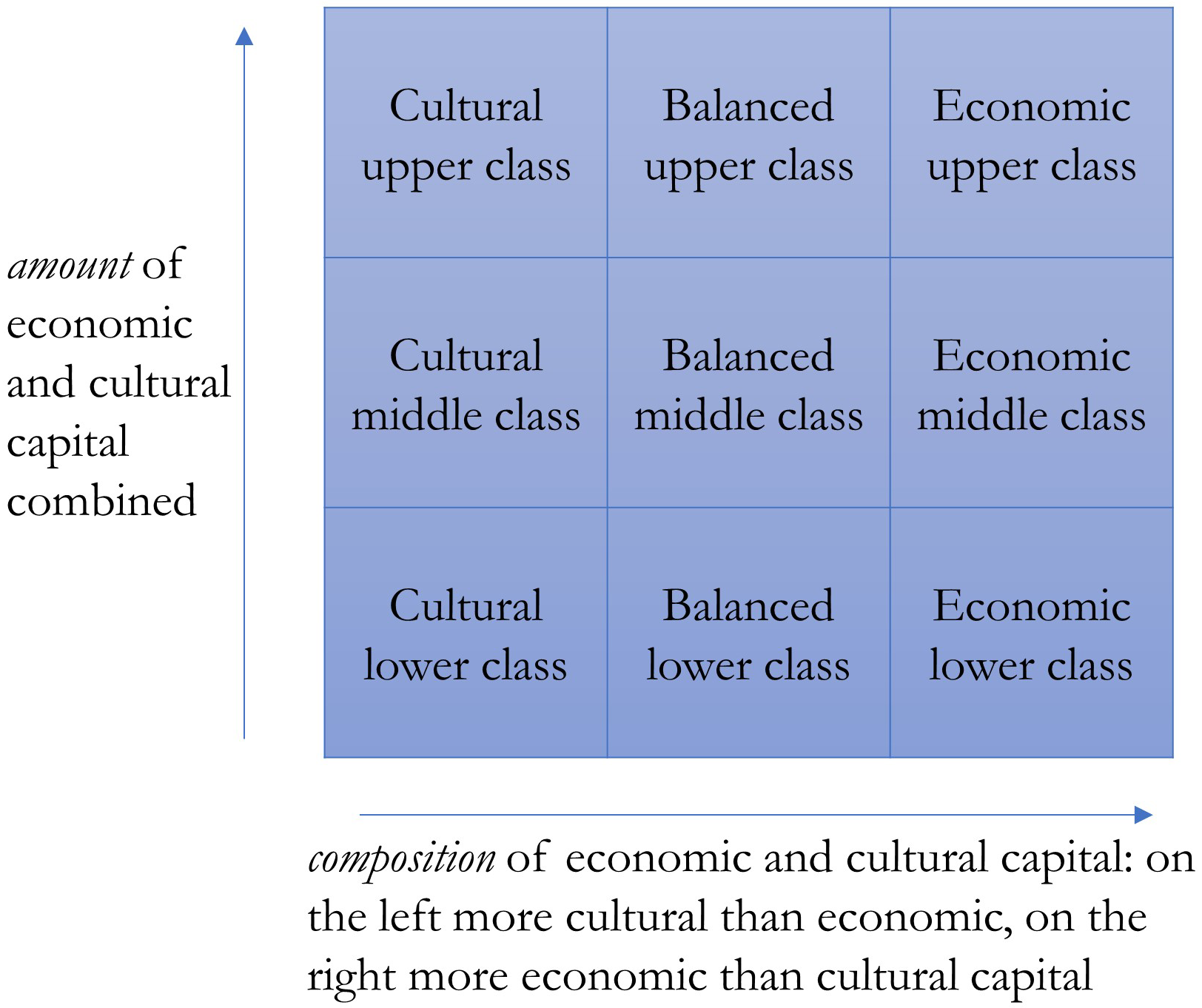
Classes in social space.
The vertical axis, reflecting the amount of capital, is a power dimension of societal stratification which represents the privileges held by people, their involvement in societal infrastructure and institutions and their potential to enforce their political will over others. The horizontal axis of differentiation reflects the mode of social integration, the kinds of profession in which people work and which logics underlie their social practices. A more economic logic prevails in technical jobs, instrumental work relations, a reliance on private resources and stronger market integration than the socio-cultural logic, which is characterized by interpersonal work and a stronger dependence on public infrastructure (Oesch, 2006). Social stratification and differentiation are not only connected to economic and cultural capital, but also to categories such as gender, race, ethnicity and religion. Modern intersectional theory shows that power relations are shaped by the interaction of such categories with economic and cultural capital and class (Collins and Bilge, 2020). A contemporary understanding of social space in the tradition of Bourdieu needs to include such categories.
The analytical differentiation into nine class fractions serves as a heuristic tool for the present empirical study. Our relational approach allows us to identify a ‘space of possibilities’ (Bourdieu and Wacquant, 2008) whose empirically charted upper margins, for example, come close to a representation of the ruling or dominant class. Moreover, the notion of a two-dimensional (at least) space including a power and an integration dimension offers sufficient complexity to describe and analyze societal reality. The relational approach also resembles political struggles and position-takings, which are likewise relational. Actors position themselves in such a way as to distinguish themselves from their political opponents; in political alliances, actors seek to reconcile positions which are close to each other. Classes are or can become political actors. An exploration of their positions on eco-social policy from a relational perspective reveals how the differences and similarities between them change gradually along the two axes of social space, and allows us to draw conclusions about opposition and possible alliances regarding eco-social policy.
In the following section, we describe how we apply the relational class approach to representative survey data, and present a system for analyzing eco-social policy.
Data, methods and operationalization
We collected data on eco-social attitudes and practices through a representative survey conducted in autumn and winter 2021/22 in Germany. The sample is representative of the German population in terms of age, gender, education and region and is made up of 4000 respondents. Half of these were selected by randomly generated telephone numbers (landline and mobile) and interviewed via telephone. The other 2000 were part of a representative online panel and participated in our survey by filling in the questionnaire online, either on a PC or on a mobile device. 4
The questionnaire was developed following a sequential exploratory research strategy (Creswell, 2009). Findings from field research of qualitative case studies in four European countries (anonymized reference) informed the selection of questions and statements on eco-social topics and the construction of the questionnaire. Besides respondents’ evaluations of eco-social statements, the data also contain detailed information on the respondents’ economic and cultural capital, in order to differentiate between classes, as well as information on their ecologically relevant practices, which were used to calculate CO2 footprints.
We first applied multiple correspondence analysis (MCA) to a set of 14 variables, 5 including 71 categories on the economic and cultural capital and intersectional categories of respondents. MCA is a geometric data analysis for categorical data which makes it easier to summarize and describe the most important information in the data (Greenacre and Blasius, 2006; Hjellbrekke, 2019; Le Roux and Rouanet, 2004). It helps to interpret the structure and associations in the data. The output is often given in graphical representations in which the data are points in a geometric space. Bourdieu (1984) used MCA to explore empirically and illustrate graphically his relational concept of the social space (see also Blasius et al., 2019).
We used the first two dimensions of this space – vertical power structures and horizontal differences in social integration – to identify nine class fractions. The factor scores on the first dimension were used to calculate weighted terciles, leading to a relational classification of a lower, a middle and an upper class. In line with theory, the classes are not defined by absolute thresholds (e.g. of poverty or luxury), but relationally, in terms of less or more cultural and economic capital. We divided the second dimension into three parts in the same relational way, resulting in the construction of an economic, a balanced and a cultural fraction. By combining the three classes and three fractions, we could identify nine class fractions which were then compared in terms of their social composition, CO2 footprints and views on different types of eco-social policies.
We calculated a carbon footprint for each respondent by applying the approach suggested by the German Federal Environmental Agency (Umweltbundesamt), developed for use in surveys such as the German Environmental Consciousness Studies (Geiger and Holzhauer, 2020). CO2 footprints are calculated from questions about meat consumption, frequency of flying, car use, size and energy efficiency of homes as well as from the type and extent of power consumption. The resulting figures underestimate the true values, because some aspects such as electric household devices or buying clothes as well as infrastructure-related emissions could not be considered. Nevertheless, the measures in our study allowed us to compare the average carbon intensity of the practices of the nine class fractions, thus enabling a relational analysis.
In order to use a systematic concept of eco-social policy, we applied, as a heuristic tool, the categories of redistribution, regulation and rights which are used in global social policy research (Deacon, 2007), adapting them to an eco-social approach. Eco-social redistribution extends the classical problem of how to fairly redistribute profits to questions concerning distribution of the costs of eco-social policy (e.g. higher prices, job losses), as well as emissions allowances. Eco-social regulation comprises the complete set of vertical and horizontal governance instruments, particularly bans, standards, targets and limits, which are either set by state authorities and/or agreed through democratic participation processes. Such eco-social measures aim simultaneously at securing the social floor and respecting ecological boundaries. Eco-social rights broaden the Marshallian civil, political and social rights that enable humans to participate in society by granting more rights to nature (Stone, 2010). They are designed to strengthen the position of non-human beings and natural entities and to acknowledge that these have intrinsic value.
The following statements were developed to apply the three dimensions of eco-social policy. Respondents expressed their agreement or disagreement with these on five-point Likert scales:
Eco-social redistribution:
The transition to an economy based on renewable energy is right even if it causes job losses. Persons who contribute more to societal prosperity should be allowed to emit more CO2. Plastic and fuel should become more expensive so that renewable alternatives can be established. Eco-social regulation:
Domestic flights should be banned in Germany to protect the climate. Environmental problems can only be solved if politics makes strict rules for the economy. After 2030, only organic farming without insecticides and other chemicals should be allowed. Eco-social rights:
I support giving more rights to animals. Humans have the right to alter nature according to their needs.
6
Results and discussion
Following Bourdieu's methodology, we conducted multiple correspondence analysis to construct a model of social space containing information about the cultural and economic capital and intersectional categories of the respondents. The first two dimensions of the model account for 58% of the explained variance. The first dimension (43%) represents capital volume, i.e. the amount of cultural and economic capital combined. The categories which contribute most to this dimension are: having a university education, being employed in a professional occupation and earning the highest household income vs. having lower educational qualifications, being employed as an unskilled worker and earning the lowest household income. In terms of class theory, this dimension marks the vertical extension of social space and stands for the degree of power and the privileges persons have at their disposal. The second dimension (15%) reflects the balance between cultural and economic capital. The categories which contribute most to this are: having few cars in the household, university education of the mother and living in a smaller home vs. having many cars in the household, lower education of the mother and living in a bigger home. This is the horizontal dimension of social space, which distinguishes between a predominantly cultural mode of social integration, defined as attaching greater importance to formal education, and a predominantly economic mode, characterized as attaching greater importance to private material possessions. 7
The social space of Germany: description of nine class fractions
In order to differentiate between classes and class fractions within the social space, we calculated weighted terciles for both dimensions. The resulting nine class fractions are representative images of the German population, subdivided into an upper, middle and lower class, each consisting of a cultural, a balanced and an economic fraction. 8
The
The
The
The
The
The
The
The
The
The difference between the cultural and the economic lower classes is very similar to the distinction between the so-called ‘precariat’ and the ‘old working class’ (Standing, 2015). The cultural lower class has characteristics typical of the flexible and insecure ‘precariat’: union membership is the lowest of all class fractions (10%) and short-term employment contracts are most widespread (24%). The economic lower class, representing the old or traditional working class, is more integrated in welfare systems and social protection: union membership is above average (21%, compared to 17% overall) and limited contracts are less common (10%, compared to 13% overall).
Responsibilities: the CO2 footprints of classes
The polluter-pays principle was introduced into international environmental policy with the Rio Declaration, in 1992. 9 We aim to compare how much the different class fractions (as polluters) contribute to CO2 emissions through their practices, and contrast the findings with their willingness to support eco-social policy (reflecting their willingness to pay). This approach reveals injustices between classes, instead of falling into the trap of individual footprint accounting, which can be criticized as shifting the burden of resolving the climate crisis too much onto individuals.
The total CO2 footprints of the class fractions are depicted in Figure 2. The differences between class fractions are highly significant and occur on both dimensions of the social space. The upper class emits more than the middle class, which emits more than the lower class; fractions which achieve social integration predominantly via economic means emit more than those in which integration is achieved mainly by cultural means. 10 As a result, the cultural upper class emits less than the economic middle class, and the cultural middle class less than the economic lower class, as is indicated by the colour shadings in Figure 2. The largest difference of all is between the economic upper class and the cultural lower class. The former produces nearly twice the emissions of the latter.
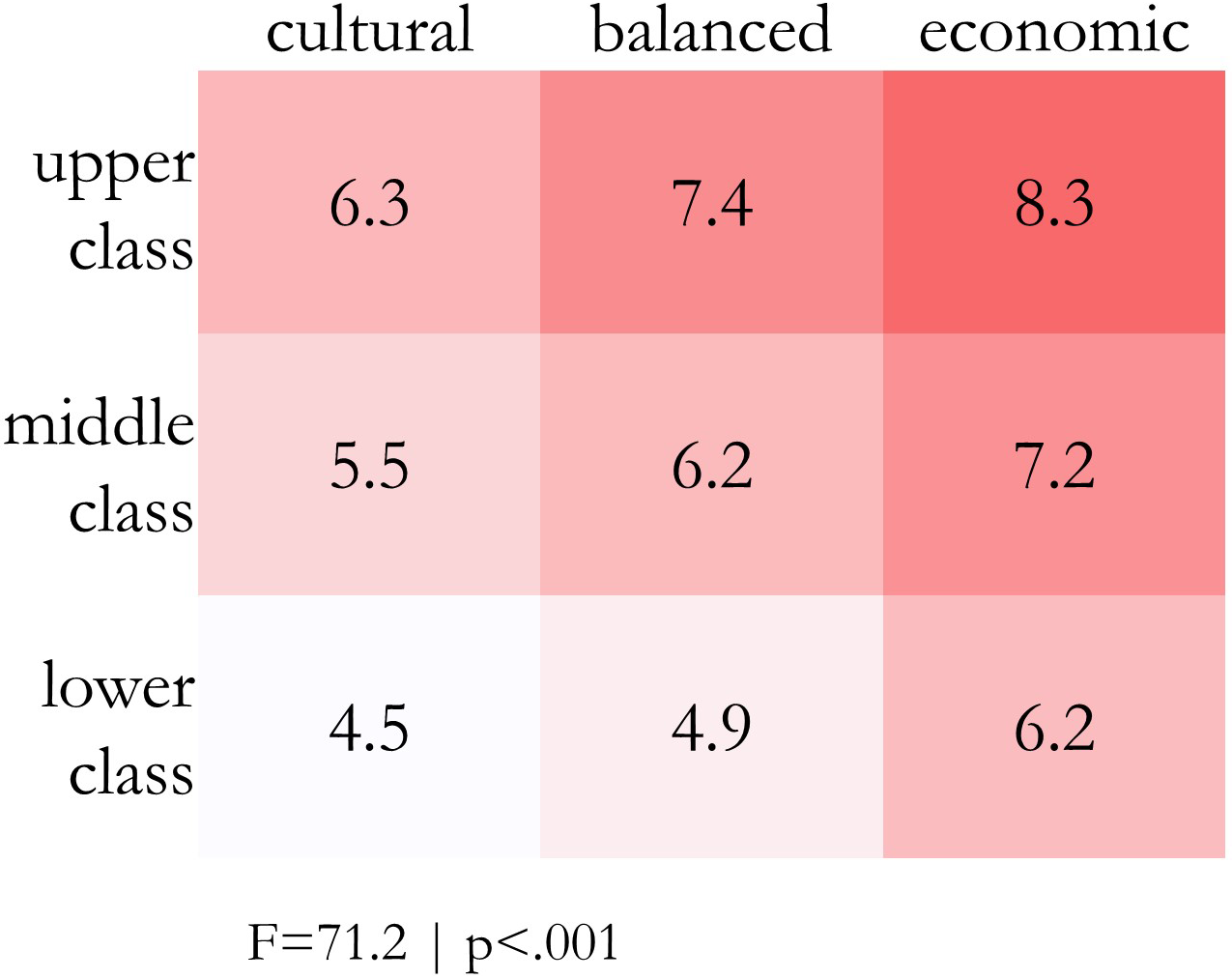
Responsibilities (average total CO2 footprints of classes in tons per capita and year), weighted analysis.
As the economic upper class turned out to be the polluter causing the highest amounts of climate-damaging emissions, we could ask whether members of this class are living up to their responsibilities? Are they more willing than others to support eco-social policy?
Support for eco-social policy: redistribution, regulation and rights
Regarding the
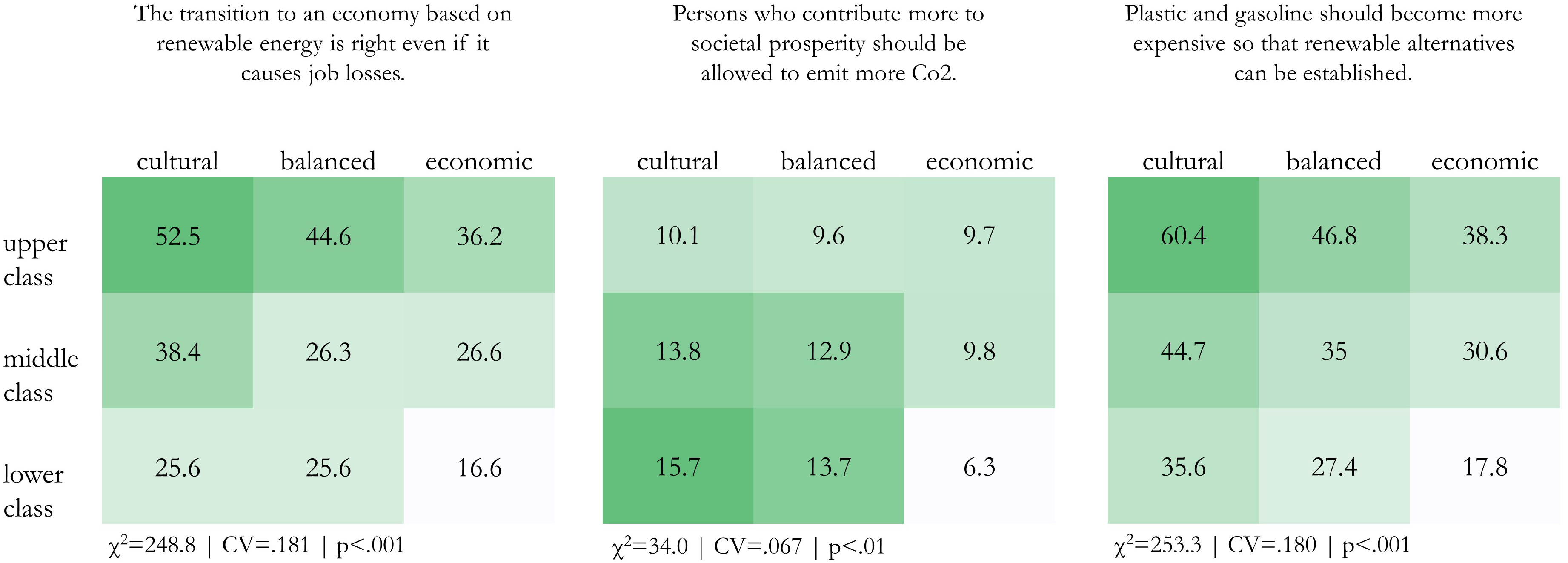
Agreement with three statements on redistribution (relative shares of ‘agree’ and ‘agree totally’ answers combined), weighted analyses.
These results point to a looming political conflict between the cultural upper class, the dominated-dominating class which is willing to achieve the transition at any cost, and the economic lower class, the old working class, which would have to bear most of the costs. Social protection systems that are intended to mitigate social risks, particularly for the most vulnerable lower-class fractions, should therefore implement eco-social policies that avoid additional costs or offer sufficient compensation. This will lead to more political support from the lower class and increase overall societal legitimation for eco-social policy.
The importance of social justice in eco-social policy is also demonstrated by the generally very low levels of agreement with the proposal to allow differing CO2 emissions on the basis of personal contributions to societal prosperity (however these might be determined). Only between 6-16% would support such a measure (Figure 3). This can be interpreted as reflecting a widespread moral understanding that everyone should be treated equally and that there should be no exceptions allowing some to emit more than others. The small but significant differences between class fractions, with higher support for unequal distribution in the lower left area, could indicate strong achievement orientation among the precariat, which is located in this part of the social space. Insecure and flexible working conditions drive the need for constant self-optimization, which may facilitate support for unequal distribution based on personal achievements.
In summary, the findings show that support for redistributive eco-social policy depends on class interests and their specific resources, but also on whether measures are perceived as socially just, in the sense of equality. The economic lower class, moreover, disagreed with all three statements on redistribution, indicating a general tendency to reject or even oppose an eco-social transition.
Support for eco-social policy
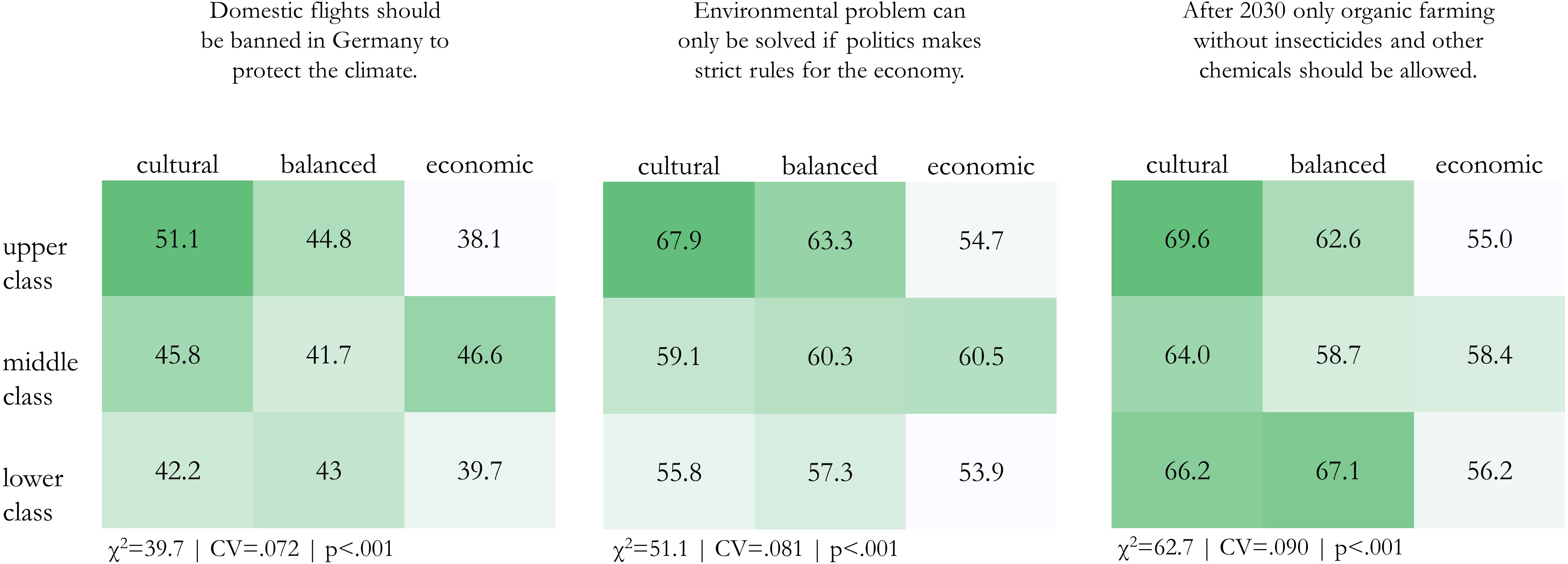
Agreement with three statements on regulation (relative shares of ‘agree’ and ‘agree totally’ answers combined), weighted analyses.
Strict rules on the economy, imposed by political measures, to resolve environmental problems were supported by an absolute majority in every class fraction. Support was again highest among the cultural upper class and quite high in the balanced upper class and in the middle-class fractions. The economic upper class and the lower-class fractions showed least support. A probable explanation is that the economic upper class – holding leadership positions in industry and business – are not very keen for politics to interfere in ‘their’ economic affairs. For the lower class, the same explanation may apply as for the ban on domestic flights: its members display a stronger distrust in politics than other classes and particularly reject vertical top-down regulation.
An absolute majority in every class fraction also agreed with the proposal to regulate agriculture and allow only organic farming. The highest level of agreement was again reported among the cultural upper class (70%). The three economic class fractions expressed the lowest rates of agreement. Members of these classes often work in industrial or technical sectors, in jobs which involve dealing with chemicals and practices that are non-organic and potentially harmful for biological beings. Thus, industrial farming may be perceived as ‘normal’ in this sector more often than elsewhere in society.
In summary, the strongest class-disagreement concerning eco-social policy regulation was within the upper class: the cultural fraction strongly supported eco-social regulation while the economic fraction showed least support. On the one hand, this reflects the well-known divide between political left-leaning positions, which argue for the need for strong (state) regulation, and positions on the right of the political spectrum, which tend to reject regulation and emphasize free markets. On the other hand, the divide points to a more deeply rooted structural problem specific to the eco-social transition: ecological problems are caused by economic activity and the energy-intensive production and manufacturing of material things. The parts of society that are most involved in these processes, the economic elites and the old working class, will lose some of the power and privileges that come with their social position. Transformation of the fossil sectors devalues workers’ existing job qualifications, and an overall reduction in production reduces the profits of the ruling class. The cultural fractions, on the contrary, are more engaged in social and symbolic work and would be less directly affected by changes in the mode and degree of material production.
We proposed two statements in our survey intended to gain an impression of class differences regarding the dimension of
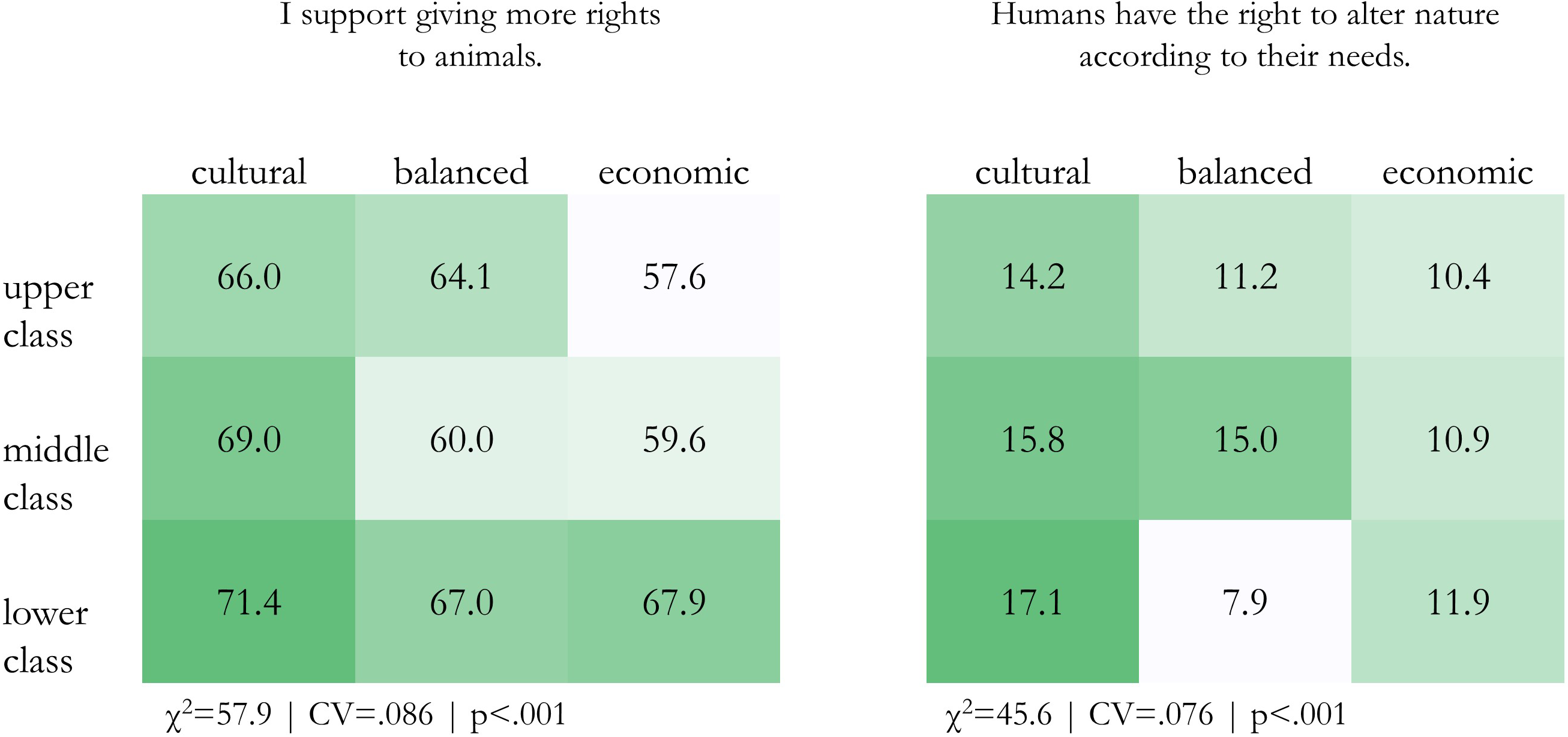
Agreement with two statements on rights (relative shares of ‘agree’ and ‘agree totally’ answers combined), weighted analyses.
This argument is supported by the findings concerning the second statement related to rights. This statement is phrased in an opposite way, and agreement reflects support for granting humans more rights to intervene in nature. Agreement with this statement was generally rather low, and ranged from 10% for the economic upper class to 17% for the cultural lower class. The statistically highly significant inter-class differences seem counter-intuitive, as for all other statements, the cultural fractions expressed more pro-ecological views than the economic fractions. But the empowerment argument again works as an explanation: while it is in the interest of the underprivileged to demand more rights, the more privileged do not see a need to further extend their access to nature. An exception here was the balanced lower class, where the level of agreement was lowest: only 8% said that humans have the right to alter nature according to their needs. The reason may be that the balanced lower class features the highest share of persons outside the active workforce (retired, permanently sick and disabled). Their experiences of dependence and their detachment from the world of work could encourage attitudes of humility and rejection of any demands for constant expansion, improvement and activity, including the right to alter nature.
Pulling together the results of the analyses of class responsibilities and support for eco-social redistribution, regulation and rights, the following picture emerges:
While the The The The The The Apart from relative differences between class fractions, in the
In the following conclusions, we summarize the approach taken in this paper and discuss how the findings can be further interpreted.
Conclusions
In this paper, we presented a first attempt to explore support for eco-social policy from a class perspective. The goal was to reveal how classes, as collective political actors, position themselves vis-à-vis eco-social policy redistribution, regulation and rights, and to unearth class conflicts as well as potential for a class compromise. We utilized representative survey data from Germany to apply Bourdieu's relational concept of social space, in which we differentiated between an upper, a middle and a lower class, and within each class identified a cultural, a balanced and an economic fraction. We then compared the CO2 footprints of classes, determining their responsibility for climate change, and their agreement with a range of statements on the three dimensions of eco-social policy.
We found that the cultural upper class expressed overall the highest support for eco-social policy, and that the cultural fractions expressed more support than the economic fractions. The cultural upper class and parts of the cultural middle class resemble what is known as the educated middle class or the dominated-dominant class. The fact that this intellectual avantgarde of society is most in favour of eco-social policy is no coincidence. Their relative social position provides a favourable constellation of interests and ideology. On the one hand, they live in existentially secure, largely prosperous conditions which leave room to absorb the financial burdens that they expect to come with eco-social transitions. On the other hand, their socio-cultural, rather than economic integration in society is related to stronger concern about societal challenges such as climate change and rising inequalities. Academic elites, scientific experts and the media all make up part of the cultural upper and middle classes and, as the latest IPCC synthesis report shows, they have been successful in developing and communicating the answers we need to resolve the dual crisis of climate change and inequality. However, this has not been translated into sufficient political action, which suggests that these classes do not (yet) have the power to enforce their political goals and that there are other classes which oppose them.
Opposition to eco-social policy comes mainly from two classes: the economic upper class, closely equated with the societal elite or the ruling class, and the economic lower class, also described as the old working class. Eco-social policy aimed at reconciling respect for ecological boundaries with the provision of social security is against both the interests and the ideology of the ruling class. As they focus on accumulating and defending private property and material wealth, they also support the economic mechanisms which enable their prosperous position: economic growth and expansive capitalism which need to constantly transgress limits and commodify nature to sustain the status quo. Moreover, they are sceptical about the idea of providing too much social security for the poor, since this would weaken their control and domination over a cheap labour force, as well as challenging the achievement orientation which operates as the ethical motivation of productivism.
One could expect that saving the natural foundations of our livelihood would also be in the interest of the ruling class. In the past, however, many within the ruling class denied or underestimated the extent and severity of climate change because they benefitted so much from it and could outsource ecological damage. Now, climate change is already taking place and the most affluent members of the societal elite are seeking protection from its dire consequences in gated communities, on secluded islands or on Mars. Others who have retreated less from society are promoting green growth solutions which aim for carbon neutrality but maintain the capitalist logic of expansion. While the ecological feasibility of this approach remains highly questionable, it also lacks serious efforts to mitigate social inequality. Overall, this leads us to the conclusion that it will only be possible to realize eco-social policy against the wishes of the current ruling class, who are actively working to prevent it.
How can the resistance of the ruling class be overcome and how can a compromise be struck between the classes? In the past, class struggles occurred between workers and employers, and resulted in the building of welfare and social protection systems which redistribute profits and provide security. But today, workers, i.e. the old working class, seem to agree with entrepreneurs, the economic upper class and parts of the middle classes, in rejecting eco-social policy. They not only fear the costs that are associated with eco-social policy, they are also less supportive of eco-social regulation in the form of bans and state intervention. The reason is that, unlike the precariat (cultural lower class), who are also concerned about the costs but express higher support for eco-social policy, particularly the aspect of rights, the old working class benefitted from climate-damaging productivism and corporatist welfare and pension systems, and have established comparatively secure, materially affluent livelihoods. They are not interested in changing the status-quo.
Overall, the struggle for eco-social policy mostly seems to take place between the cultural upper class, which support such policy, and an undeclared, yet sometimes observable (think of Trump or Brexit) union between the ruling class and the old working class, which oppose it. In a further interpretation of our results, we see the following possible levers for increased support for eco-social policy within a broader alliance between classes:
1. Eco-social policy could receive more support if the components of social justice, security and meeting of basic needs were more developed, and if the concepts that already existed were communicated more clearly, perhaps even prioritizing the social effects of eco-social policy over its ecological goals. We assume that this would increase support in the lower class, particularly within the precariat.
2. As support for eco-social regulation in Germany is already comparatively high, future proposals for eco-social policies could concentrate on possibilities for improving and granting more eco-social rights. Our results indicate that this would fall on fertile ground among many parts of the population, because people may perceive it as an extension of the range of options and the establishment of justice. Strengthening the legal basis for and granting political, civil and social rights contributed significantly to the building of the current welfare states and social protection systems; the addition of ecological rights may now lay the foundation for building eco-welfare states, as the institutions which implement eco-social policy. A focus on eco-social rights would also resonate very well with the basic-needs focus in sustainable welfare theory and the proposal for universal basic services (Büchs, 2021; Büchs and Koch, 2017; Gough, 2017). Granting the members of society, for example, the right to free education, free health care, free public transport etc. would enable wider participation and reduce social inequalities, and would also weaken the ecologically damaging focus on accumulation of private wealth and excessive overconsumption.
This exploratory study was a first attempt to empirically analyze class support for eco-social policy, and there are consequently some limitations which should be addressed in future research: First, the construction of the classes in social space could be criticized as a rather technical ad-hoc solution, which reflects our wish for a relational approach but could not fully consider specific class characteristics developed further in modern class theories. Future studies could, for example, try using cluster analyses to find internal homogenous classes, or add an indicator whereby respondents self-assess their class position. Second, the results for Germany cannot be fully transferred to other countries. Although similar classes identified as relational with regard to their economic and cultural capital can be assumed to exist in other Western European countries, the institutional context of Germany as a coordinated market economy and corporatist welfare state needs to be considered when interpreting the results. Support for eco-social regulation will probably be lower in liberal market economies; the old working class will be less strong in non-corporatist welfare states. Finally, the consideration of eco-social policy should be improved. Instead of studying single items on the three dimensions of eco-social policy, future research should seek to develop more reliable measurements in the form of scales. This was not possible with the data we had at our disposal, and there is a general lack of surveys on eco-social policy referring to different facets in greater detail. In particular, the development of a comparative international survey on eco-social policy would be of most benefit to further research on the topic, and would provide politically relevant knowledge about the differences and similarities between countries, regarding their class struggles for a just and sustainable future.
Supplemental Material
sj-docx-1-ejs-10.1177_13882627231208929 - Supplemental material for Support for eco-social policy from a class perspective: Responsibilities, redistribution, regulation and rights
Supplemental material, sj-docx-1-ejs-10.1177_13882627231208929 for Support for eco-social policy from a class perspective: Responsibilities, redistribution, regulation and rights by Martin Fritz and Dennis Eversberg in European Journal of Social Security
Supplemental Material
sj-xlsx-2-ejs-10.1177_13882627231208929 - Supplemental material for Support for eco-social policy from a class perspective: Responsibilities, redistribution, regulation and rights
Supplemental material, sj-xlsx-2-ejs-10.1177_13882627231208929 for Support for eco-social policy from a class perspective: Responsibilities, redistribution, regulation and rights by Martin Fritz and Dennis Eversberg in European Journal of Social Security
Footnotes
Acknowledgements
We are grateful to two anonymous referees for their comments and suggestions. All remaining errors and shortcomings are our own.
Data access
The data are primary data that originated from the authors’ research project. These data will be made publicly available in a data archive towards the end of the project.
Declaration of conflicting interests
The authors declared no potential conflicts of interest with respect to the research, authorship and/or publication of this article.
Funding
The author(s) disclosed receipt of the following financial support for the research, authorship and/or publication of this article: The work for this paper was funded by the German Federal Ministry of Education and Research as part of the work of the junior research group ‘Mentalities in Flux’ (flumen) (2019–2025, Grant number 031B0749).
Supplementary material
Supplementary material for this article is available online.

Notes
References
Supplementary Material
Please find the following supplemental material available below.
For Open Access articles published under a Creative Commons License, all supplemental material carries the same license as the article it is associated with.
For non-Open Access articles published, all supplemental material carries a non-exclusive license, and permission requests for re-use of supplemental material or any part of supplemental material shall be sent directly to the copyright owner as specified in the copyright notice associated with the article.
