




Abstract
In downsizing organisations, redundant workers suffer from insecurities about work and income. Social security provides income security to the unemployed in the event of job loss. The role played by employers in unemployment prevention for redundant workers, and the effects on unemployment spells and transitions on the labour market, are neglected in both the social policy and HRM literatures. This article addresses the following question: Which factors play a role in the decision to offer job-to-job support and in determining its effect? This article provides the context for the theoretical assumptions regarding why employers initiate job-to-job measures for redundant employees and distinguishes the different types of measures based on a literature review. Secondly, this article contributes to empirical knowledge in the field of unemployment prevention among employers and the effects of job-to-job activities facilitated by employers on redundant workers’ unemployment spells. A two-wave study was conducted on a sample of 2,258 Dutch redundant workers. The study shows that age, breadwinner status and gender are important predictors of unemployment duration after involuntary dismissal. The findings show that investing in the human capital of redundant workers by providing training and education and individual coaching, for example, are associated with a reduced unemployment spell. In our model, in which we controlled for other variables, we found that when one received training, education or individual coaching shortly before or after the dismissal, one was unemployed for an average of almost three months less.
Keywords
Introduction
Companies restructure their organisations in response to crises, globalisation, increased competition, and new technologies, often resulting in downsizing. Market pressure to increase the profit margin is an additional reason for company restructuring. In these times, redundant workers face tension and uncertainty regarding work and income (Shoss, 2017). The global financial crisis resulted in organisational retrenchment strategies focused on downsizing and restructuring and caused mass unemployment in many countries. Now, after the crisis, the relevance of unemployment prevention has taken on a new dimension. The coronavirus has had a major impact on the labour market over the past year. Some sectors have been hit hard and jobs are at risk, making the results of this study even more relevant given the expected major impact on the global economy. It is not only cyclical developments that cause jobs to change or disappear, but increased global competition and technological innovation, too (e.g., Frey and Osborne, 2017). It is important that redundant employees make a smooth transition to new jobs to avoid long-term unemployment, which stresses the significance of unemployment prevention, training, and education.
It is beneficial for employees, organisations, and society when redundant workers make the transition from the current job to a job with another employer in the event of involuntary dismissals rather than becoming unemployed. The new job not only provides income and work security, but also decreases the emotional stress of employees at risk (Jahoda, 1997; McKee-Ryan et al., 2005). The benefit for society is that redundant employees rely less on unemployment benefits or avoid using them altogether when the period between two jobs is as short as possible. Other advantages are lower risk of long-term unemployment and additional negative effects, such as the poor health issues that are associated with unemployment. For organisations, the benefit of smooth job-to-job transitions is financial as the labour costs decrease when redundant employees are no longer on the payroll, i.e., when the transition starts before the notice period ends. Another benefit is a positive effect on the employer’s reputation. Reducing skills depreciation is an additional benefit for employers and workers.
Combatting long-term unemployment is a major public objective in the European Union and its member states. Over the past decades, active labour market policies (ALMPs), which promote the employability and labour market participation of unemployed people, have been on the agendas of governments in European countries (Bonoli, 2013). However, these ALMPs apply to people who are already unemployed and do not focus on workers who might lose their job in the near future. In response to the economic crisis in 2008, governments introduced measures to cushion the impact on the labour market and support workers who lost their jobs (Heys, 2013). The European Commission encouraged Member States to ensure that the measures were in line with the ‘flexicurity’ concept, i.e., a shift from ‘job security’ towards ‘employment security’ by exchanging more flexible dismissal regulations for greater investments in ALMPs, modern social security systems and lifelong learning opportunities (Bredgaard, Larsen and Madsen, 2005; Bredgaard and Madsen, 2018; Madsen, 1999; Muffels, Crouch and Wilthagen, 2014; Wilthagen and Tros, 2004). This implies a major role for employers in the prevention of unemployment. ALMPs focus on the supply side and generally neglect employer participation (Orton et al., 2019; Sinfield, 2007; Van Berkel et al., 2017). From an ALMP and social security perspective, it is interesting to involve employers. Investing in the unemployed in line with existing demand may have positive effects on lower levels of benefits expenditures (Borghouts and Freese, 2017; Van der Aa and Van Berkel, 2014). Van der Aa and Van Berkel (2014) also argue that including employers may lead to transferring re-integration costs to employers, e.g., costs related to employability of workers already in the workplace. Employers offer jobs, and employers can use government incentives to increase the labour market participation of vulnerable groups, e.g., through wage subsidies. However, the role played by employers in unemployment prevention and the association with unemployment spells and transitions in the labour market are neglected in both the social policy and the HRM literatures (Orton et al. 2019; Van Berkel et al., 2017).
Job-to-job activities in downsizing organisations can be classified into two types (Alewell and Hauff, 2013). The first group refers to professionally designed services targeted at redundant workers to find a new job and a new employer, such as training for writing applications, psychological counselling to cope with job loss, direct placement and job-search activities and legal counselling regarding labour or social security law. The second type of support activities refers to activities targeted at those who remain in the organisation after downsizing: ‘the survivors’. In this article, the focus is on the first type of support, i.e., job-to-job support to redundant workers in the phase that they are under notice and are aware that their careers with the current employer will end soon. This phase is also referred to as the secondary unemployment prevention phase (Evers, Wilthagen and Borghouts, 2004: 16).
The issue of job-to-job transitions is relevant for European welfare states in the context of an increasingly flexible labour market and the policy focus on ‘employment security’ rather than ‘job security’ (Wilthagen and Tros, 2004). Based on the Transitional Labour Market theory (Schmid 2015, 2017a) and previous work of Gazier (2007), Schmid argues that ‘external employment mobility is often the only way to solve problems related to structural change due to new technologies and new product markets’ (Schmid, 2017b: 8). Although the scope and principles of corporate policies differ from those of public welfare, they may both contribute to the pursuit of public value related to social issues, such as unemployment prevention (Van Berkel and Leisink, 2013). Social labour market policy that is aligned with a broader perspective of strategic HRM can lead to social innovation in supporting redundant employees to move to another job outside the company and to prevent social security claims.
Hammarström and Janlert (2005) review the development of unemployment research and conclude that research should reorient to unemployment prevention and ‘incentives for reducing unemployment must be discussed not only at the individual level, but at the organisational and societal level as well’ (774). Only a few studies examine the impact of (preventive) interventions, i.e., how organisations respond to layoffs and how they can support those affected by job loss (Gowan, 2014; Greve, 2006; Wanberg, 2012). Empirical data on the results of job-to-job activities for redundant employees are scarce (Borghouts, 2012). Empirical research on job loss and unemployment thus far is conducted at a macro-level (encompassing such topics as job creation and unemployment insurance policies) and micro-level (emphasising the individual experience of unemployment and outplacement perspectives) (Doherty, 1998; Gowan, 2014; Wanberg, 2012).
This article provides context of the theoretical assumptions regarding why employers initiate job-to-job measures for redundant employees and which types of measures are distinguishable based on a literature review. Secondly, this article contributes to empirical knowledge in the field of unemployment prevention among employers and the association of job-to-job activities with unemployment spells of redundant workers. The following research question is addressed in the empirical study: Are job-to-job activities initiated by Dutch employers associated with shorter unemployment spells?
In this article, the relationship between job-to-job measures facilitated by organisations and the unemployment spell after redundancy is investigated, based on a longitudinal study, with data from the Netherlands for 2,258 redundant employees. The Netherlands is an interesting country to examine in the light of unemployment prevention. It was hit hard by the financial crisis and suffered from stronger unemployment growth compared to other European countries (De Graaf-Zijl et al., 2015). It also had a high incidence of downsizing and restructuring in 2015 compared to other EU-28 Member States (Eurofound, 2018). The Dutch Social Economic Council recommended putting prevention of unemployment and smoother transitions from endangered jobs to new jobs higher on the policy agenda in an advisory report to the Minister of Employment and Social Affairs (Sociaal Economische Raad, 2015), and a legal transition payment was introduced. These Dutch experiences are relevant for other countries, certainly in the light of COVID-19, which deeply impacts on enterprises and causes redundancies in many European countries.
In the remainder of this article, we will first address the motives of employers to support work-to-work in the event of redundancy via a literature review. Section 3 describes the Dutch context of job-to-job support. The results of the empirical study are discussed in Section 4. Finally, Section 5 puts the findings into perspective and discusses limitations and directions for future research.
Employers’ motives to invest in unemployment prevention
The concept of unemployment prevention is not yet recognised as a core theme in the strategic human resource management (SHRM) literature. Nevertheless, there are clear reasons for human resource management (HRM) to invest in unemployment prevention and initiate job-to-job activities for redundant workers. In the organisational and HRM literature, these activities are referred to as ‘outplacement activities’. Although the initial use of outplacement was grounded in the need for a pragmatic response to manage the exit of mainly senior individuals from an organisation, outplacement has become an integrated part of redundancy management and HRM (Doherty, 1998).
Derived from economic theory and based on an extensive literature review, Alewell and Hauff (2013) distinguish several motives behind outplacement activities: (1) financial motives (saving monetary or transaction costs); (2) negotiation-related motives (related e.g. to the role of works councils or other types of workers’ representatives, agreements in ‘social plans’, or collective agreements); (3) information, economic or signalling motives (safeguarding the image of the firm and positive publicity); and (4) gift exchange or efficiency wage motives (aimed at the remaining staff by expressing the employer’s willingness to invest in individual workers). A fifth argument for employers to invest in outplacement activities is that downsizing not only impacts redundant employees, but also the remaining employees. Downsizing is associated with mainly adverse work organisation and health outcomes for those who remain in the firm (Eurofond, 2018) and impacts the remaining employees’ attitudes (i.e., employee morale, commitment and trust) (Brockner et al., 2004; Kawai, 2015; Shah 2000). When dismissed colleagues are treated fairly, the remaining workers take comfort from that and assume they would be treated likewise if ever a new downsizing event were to take place (Eurofound, 2018).
In addition to the economic motives, organisations may invest in job-to-job activities from a social responsibility perspective, despite the forced dismissals in the event of redundancy. Alewell and Hauff (2013: 481) argue that if organisations ‘rate motives related to social responsibility as relatively important, they engage in placement activities or use transfer agencies. Social responsibility is obviously interpreted as avoiding job loss for former employees and placing them in a new job. Hence, social responsibility calls for placement services and transfer agencies’. In their view, downsizing companies can be regarded as socially responsible in terms of preventing an employee’s unemployment even when the firm engages in downsizing. This view fits with an upcoming new stream in HRM literature, coined ‘inclusive’ HRM. Inclusive HRM (Borghouts and Freese, 2017; Offerman and Basford, 2014) is an HRM perspective that provides an extended HRM angle to study the benefits of measures designed to mitigate unemployment risks for redundant workers. Inclusive HRM refers to HRM activities that aim for social legitimacy by creating a smooth transition from inactivity to work, from job to job, and from school to work. Inclusive HRM is a broader perspective of HRM, which extends beyond the boundaries of the organisation and considers the interests of vulnerable workers and people who are not (yet) part of the organisation as valuable resources (Borghouts and Freese, 2017). Inclusive HRM focuses on a continuous process in which HRM contributes to various transitions for vulnerable (potential) workers, i.e. the transition from inactivity to work, from contract to contract (for flexworkers and self-employed), from job-to-job in the event of forced dismissals and transitions and support in jobs at risk in the future e.g. as a result of automation and robotization. In this article, we focus on interventions related to forced job-to-job transitions in the event of redundancy.
Based on the theories elaborated above, the motives employers may have to support work-to-work transitions in the event of redundancy were identified. It remains unclear whether employers’ engagement in job-to-job support is effective and leads to shorter unemployment spells. Although a lot of employees participated in outplacement schemes, very few quantitative studies have examined their effectiveness (Westaby, 2004). In recent years, scientific research has been conducted on the results of outplacement and the quality of the next job in the event of mass redundancies in the Netherlands (Deelen, Graaf-Zijl and Van den Berge, 2014), but empirical studies are still very scarce. Moreover, the research by Van den Berge (2013) estimates the effects of the offer of outplacement – i.e., the intention of treating - and not the actual effect of job-to-job activities in the Netherlands. Previous research shows that there are small or zero effects of outplacement in the Netherlands, and that elderly workers seem to benefit most from outplacement offers (Van den Berge, 2013). However, the research by Van den Berge (2013) only estimates the effect of the offer of outplacement, which means that the actual effect might be underestimated. In this article, we focus on the actual interventions related to job-to-job transitions in the event of redundancy.
Setting the scene: job-to-job support in the Netherlands
The largest share of job-to-job activities in the Netherlands results from ‘social plans’; social pacts negotiated by employers and trade unions - or the works council in the case of mass dismissals - usually at large employers. In the event of collective dismissals, the council directive 98/59/EC of 20 July 1998 on the approximation of the laws of the Member States relating to collective redundancies applies, which is also laid down in the Dutch Collective Redundancy Notification Act. This act regulates that an employer who wants to dismiss at least twenty employees in a certain area within a three-month period is obliged to give reasoned notice to trade unions. The aim of the Collective Redundancy Notification is to consider whether dismissals can be prevented or mitigated, and whether a social plan can be drawn up in which accompanying social measures, inter alia, help to redeploy or retrain workers who are made redundant.
In a study among Dutch employers, it was found that cost efficiency is strongly decisive in whether job-to-job support is offered. Safeguarding the organisation’s reputation and awareness of the negative consequences of redundancies for workers were also mentioned by Dutch employers (Borghouts et al., 2019). The Dutch ‘social plans’ stipulate the type of support that is offered by employers to redundant employees, including active and financial support. An interesting aspect of social plans in relation to offering job-to-job activities is that employers may deviate from the required Dutch legal transition budget via an equivalent provision in the collective agreement (CLA). An equivalent provision is a cash and/or in-kind allowance, which is comparable to the transition payment to which the employee would be entitled. If employers make serious efforts to support redundant workers and invest in job-to-job activities, this may be a facilitating factor for job-to-job transitions.
In the Netherlands, one in five organisations participates in purposefully designed job-to-job transition programmes as part of a social plan or the organisation’s broader HRM policy (Putman, 2019; Van Echtelt and Voogd-Hamelink, 2017). Large organisations develop policies and apply job-to-job programmes more often than small companies (Van Echtelt and Voogd-Hamelinck, 2017). In summary, job-to-job policies and activities are developed in the Netherlands mainly because of agreements in social plans. However, not many employers engage in job-to-job programmes, and support is offered at a late stage when redundancies are unavoidable. Only in the event of large layoffs - which have a major impact on the region and a high risk of damage to the organisation’s reputation - are serious initiatives to invest in job-to-job transitions at an early stage.
Empirical study
This empirical study investigated whether the job-to-job activities initiated by Dutch employers are associated with a shorter unemployment spell of redundant workers.
Method
Two-wave study
A two-wave study was conducted among 2,258 redundant workers in the Netherlands who had been employed in firms in which dismissals were announced between 2014 and 2017. Redundant employees who participate or have participated in a job-to-job programme were approached via private organisations that offer these job-to- job activities (such as Randstad, Restart, etc.). The organisations were informed of the survey through the Federation of Private Employment Agencies (ABU) and Organisation for Vitality, Activation, and Career (OVAL). In 2016 and 2017, a total of nine outplacement organisations had distributed the questionnaire on behalf of the researchers to redundant employees who had made use of the job-to-job programmes offered by these parties. Redundant workers were asked to fill out the questionnaire twice, with a period of six months between both measurements. Measurement 1 (T1) was used as the starting position (and included such information as the characteristics of the job before redundancy, the desired job transition, and the job-to-job activities). To establish the association of job-to-job activities with unemployment spell, the data acquired at measurement 2 (T2) were analysed and included information on whether a new job had been found and the quality of the new job.
Sample
The sample of the quantitative study consisted of individuals who received job-to-job support from their employer via an outplacement service provider. These employees were employed in firms where dismissals were inevitable. The employer started the dismissal procedure, and the employees were given notice. Candidates who received job-to-job-support from one of the fifteen outplacement service providers involved in the period 2014-2017 were invited to take part in the study by filling out a questionnaire in 2016 and 2017. At the time of the first measurement, participants could still be employed with the original employer, be unemployed, or have found a new job. Each invitation was followed by a reminder in case of non-response. The ethical guidelines of the American Psychological Association (APA) were followed. The participants gave their informed consent and were informed that they could stop participation at any point of the study.
Response
Of the 15,187 redundant workers who received an invitation to participate in the study, 2,258 fully completed the first questionnaire (T1), resulting in a response rate of 15%. Although relatively low, email surveys commonly suffer from a continuing decrease in response rates (Fan and Yan, 2010; Yun and Trumbo, 2000). Redundant workers who received job-to-job support for up to two years ago were approached. The respondents of the first wave were asked to fill out the second questionnaire. In total, 1,198 redundant employees completed the first and second questionnaires. The non-response bias of the second questionnaire was analysed. Those who participated in both measurements were older (M = 51.7, SD = 8.13) than those who completed the questionnaire only at T1 (M = 50.0, SD = 8.61, t(1919) = -4.67, p<.001). Those who filled out both questionnaires were less likely to be re-employed (at T1) (69.8% versus 87%, χ2(df) = 6.55 (2), p = .038), had lower quality jobs if re-employed (T1 and T2 M = 2.05, SD = .41; only T1: M = 2.09, SD = .42, t(1120) = 1.698; p = .090) and were, on average, unemployed for longer (at T1) (T1 and T2 M = 14,69, SD = 8.13; only T1: M = 12.92, SD = 11.03, t(498) = -.172, p = .087) than those who filled out the questionnaire at only T1. Both groups did not differ regarding gender, education level, or the number and perceived usefulness of the job-to-job activities in which they engaged. Only one-third of the respondents indicated the name of the organisation at which they had been declared redundant, as this was not a mandatory field in the questionnaire. Anonymity reasons may have been a cause for this low response rate, especially for small businesses. More than 300 different organisations were mentioned.
Measures
Background variables
The background variables were assessed at T1. In addition to age and gender, the respondents were asked if they were the main breadwinner in their household (no (0) or yes (1)). Education was assessed by translating the highest achieved education level in the Dutch educational system to the International Standard Classification of Education (ISCED) 2011 (UNESCO Institute for Statistics, 2012). Education levels were then grouped: low = ISCED 0 (early childhood education) through 2 (lower secondary education); intermediate = ISCED 3 (upper secondary education) through 5 (short-cycle tertiary education); high = ISCED 6 (Bachelor or equivalent level) through 8 (Doctoral or equivalent level). For regression analyses, the variable was dummy-coded.
Job-to-job activities
Job-to-job activities were measured in three different ways. First, to measure the overall association, the total number of job-to-job activities in which the respondents had participated was assessed at the individual-level. This indicated whether the association of job-to-job activities with the unemployment spell was stronger when participants took part in a greater number of different activity types. Second, the overall association of job-to-job activities with the unemployment duration was assessed by measuring the perceived usefulness of activities. For each individual, an average perceived usefulness score was calculated based on their perceived usefulness of each of the activities in which they took part. Third, to measure the association of each activity with the unemployment spell, participation in this specific job-to-job activity was measured (no (0) or yes (1)).
Training/education
Training and education were composed of two variables. First, the respondents were asked if they had participated in training or education after a formal notice of dismissal had been given as part of an external job-to-job trajectory, and whether they received and used a budget for this. Second, the respondents were asked if they had participated in training or education either in the two years prior to T1, or between T1 and T2. The respondents who answered ‘yes’ to at least one of these questions were coded as having received training/education. Respondents who answered ‘no’ to both questions were coded as not having received training/education.
Unemployment duration
Unemployment duration was measured (in months) from the end-date of the respondent’s employment contract for the job for which they had received the work-to-work support until T2. Regarding the quality of the new job, 44% of the redundant employees who had found a new job, on average, had lost out in terms of job characteristics (i.e., when comparing such characteristics as salary or secondary employment conditions, the new job scored less well, on average, than the job held before dismissal). Most (78%) redundant workers who sought a new job had succeeded. The average unemployment duration was ten months. In our analyses, both those who were unemployed and those who were employed on T2 were included. Most of those who were unemployed on T2 did not yet have a job after dismissal.
Analyses
Descriptive statistics were derived from the dataset to report the use of job-to-job activities provided by employers. Firstly, a multiple linear regression was carried out to investigate the relationship between the job-to-job activities and the unemployment spell. In the first step, the following demographic variables were entered: age, gender, education level, and breadwinner status. In Step 2, variables covering the number and type of job-to-job activities and the perceived usefulness of the activities were added in separate analyses to measure the association of a single activity with the outcome variable. While people can combine several activities, this study initially explored the association of each activity separately with the unemployment duration. Then, in examining the effect of combining activities, we carried out an additional analysis which included all the job-to-job activities that had been proven as associated with duration of unemployment in the prior separate analyses.
When assessing the outcomes of job-to-job activities, it was important to consider the preferences of redundant employees. After all, not all redundant employees wanted to find a paid job again after dismissal, as some wanted to become self-employed or take an early retirement. However, most redundant employees wanted a paid job again after their dismissal (82% at T1 and 78% at T2).
Secondly, we applied survival analyses (COX proportional hazard model). Survival analysis is a statistical technique whereby the outcome variable is the time until an event occurs. In this study, the event is re-employment; and by time (survival), we mean the months from the beginning of the follow-up and until the re-employment occurs. This technique also takes account of censoring. Censoring occurs when data is available about individual survival time, but the survival time is not known exactly. The exact unemployment duration in our data is unknown for persons in our study who did not find new employment before T2. We only know that the person is still unemployed at T2.
Results
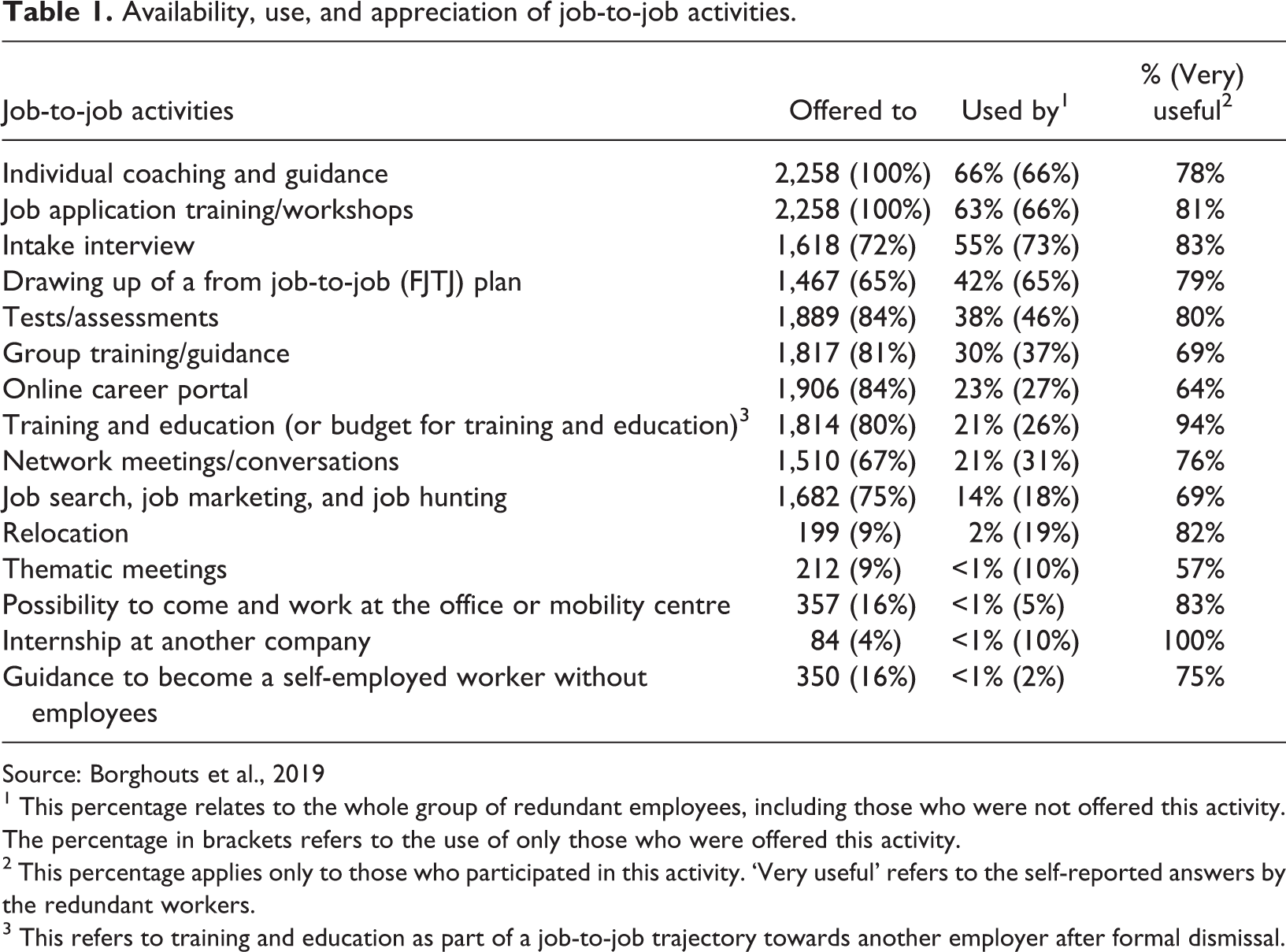
Most Dutch employers outsource job-to-job support to private outplacement agencies (Van den Berge, 2013). These various agencies offer redundant employees a wide range of potential support activities to participate in. These activities are presented in Table 1. The diversity is evidenced by the provision of fifteen different types of activities.
Availability, use, and appreciation of job-to-job activities.
Source: Borghouts et al., 2019
1 This percentage relates to the whole group of redundant employees, including those who were not offered this activity. The percentage in brackets refers to the use of only those who were offered this activity.
2 This percentage applies only to those who participated in this activity. ‘Very useful’ refers to the self-reported answers by the redundant workers.
3 This refers to training and education as part of a job-to-job trajectory towards another employer after formal dismissal.
The activities that were most widely used were: participating in an intake interview with an outplacement agency; making an individual plan; participating in individual coaching and guidance; attending workshops and training; and conducting assessments. Of the fifteen different types of activities, ten were used by more than 10% of the redundant employees. Not all the suppliers offered all activities. Such activities as job application training and workshops, individual coaching, an online career portal, training and schooling, group training and guidance, and tests and assessments were offered by most providers. Other activities, such as internships or thematic meetings, were offered by just a few providers. Most of the respondents positively assessed the usefulness of the job-to-job activities in which they engaged.
4.4.1 Results: regression analyses
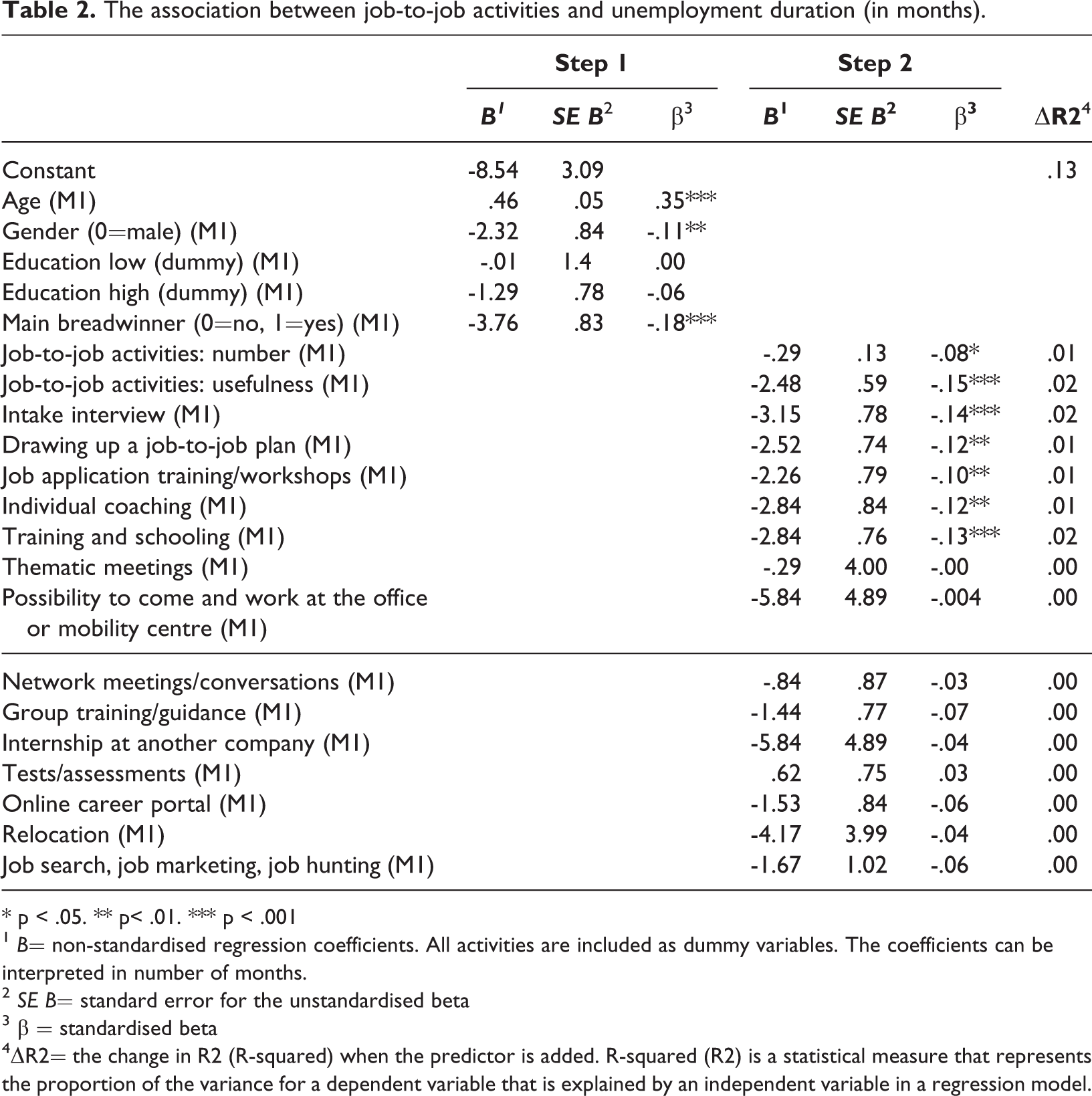
Table 2 contains the results of the regression analyses. In Step 1, the effect of the control variables on the unemployment duration for redundant workers was estimated. The following variables were controlled for: age, gender, education level, and whether the redundant worker is the main breadwinner. Step 1 explained 13% of the variance. Age was a significant predictor (β = 0.35, p <.001): older redundant employees were more likely to have longer unemployment spells than younger redundant employees. Being a breadwinner was also significantly correlated with unemployment duration: redundant workers who were the main breadwinners were more likely to be unemployed for a shorter period (β = -0.18, p < .001). Although there is no difference between men and women when it comes to finding a new job or not, the results showed that gender was associated with the unemployment duration: female redundant employees were more likely to have shorter unemployment spells than male redundant workers (β = -0.11, p < .01). The effects of the highest completed education level were not significant in relation to unemployment duration (Education low (dummy): β = 0.00, n.s.; Education high (dummy): β = -0.06, n.s.).
In Step 2, associations between the job-to-job activities and unemployment duration were analysed, controlling for age, gender, education, and breadwinner status (see Table 2). The non-standardised regression coefficients can be interpreted in number of months of unemployment, as all activities are included as dummy variables. First, the unemployment duration was shorter among those who participated in more job-to-job activities (B = -.29, β = -0.08, p =.027). Second, the perceived usefulness of work-to-work activities affected unemployment duration: high perceived usefulness was associated with a shorter unemployment duration (B= -2.48, β = -0.15, p <.001). Furthermore, in Step 2, several specific job-to-job activities associated with unemployment duration. The unemployment duration of redundant workers was: shorter by three months for those who took part in an intake interview (B = -3.15, β = -0.14, p <.001) and received individual coaching (B = -2.84, β = -0.12, p =.001), shorter by 2.5 months for those who drew up a job-to-job plan (B = -2.52, β = -0.12, p =.001), and shorter by more than two months for those who participated in a job application training/workshop (B = -2.26, β = -0.10, p =.004) compared with those who had received some kind of transition support, but did not take part in these activities. Finally, participating in courses, training programmes or education in the period preceding or following the redundancy affected the duration of unemployment (B = -2.84, β = -0.13, p <.001). The unemployment spell for those who were trained or schooled in the period just before or after their redundancy was shorter than for those who did not participate in education or training. We can see from Table 2 that, after controlling for age, gender, education and breadwinner status, those who had been trained or schooled in the period just before or just after their redundancy experienced an unemployment spell that was shorter by 2.84 months on average compared to those who had not been trained or schooled in that period.
The association between job-to-job activities and unemployment duration (in months).
* p < .05. ** p< .01. *** p < .001
1 B= non-standardised regression coefficients. All activities are included as dummy variables. The coefficients can be interpreted in number of months.
2 SE B= standard error for the unstandardised beta
3 β = standardised beta
4ΔR2= the change in R2 (R-squared) when the predictor is added. R-squared (R2) is a statistical measure that represents the proportion of the variance for a dependent variable that is explained by an independent variable in a regression model.
When we added the quarter of becoming unemployed (B = -.89, β = -0.37, p <.001) as a control variable in Step 1, the association of training and education with the unemployment duration was still significant (on average, unemployment was 2.36 months shorter than for those who had not been trained or schooled in that period; see Table in Appendix B). In both cases (i.e., with and without the addition of quarter as a control variable), only training and schooling turned out to be significant when corrected for the other significant activities (B = -2.31, β = -0.12, p <.001) (See Table in Appendix C).
Because the effect of age on unemployment duration may be altered by job-to-job activities, we analysed the interaction of age and other activity-related variables. In doing so, we found that participating in training or education changes the association of age with unemployment duration. The association between age and unemployment duration (i.e., the older the person is, the longer the unemployment duration) is less strong when one has received training or education (B = -.27, β = -0.68, p =.013). No other significant interaction effects with age were found.
Results: survival analyses
We used a Cox regression model to examine which factors have an impact on the hazard for the unemployment spell to end. In this study, the hazard ratio refers to the chance to find re-employment. The results of the Cox regression analyses are shown in Appendix D. The associations between the variables of age, gender, and breadwinner and the unemployment spell are highly significant. The re-employment chances (hazard for the unemployment spell to end) were 28% higher for unemployed redundant women than for men. With increasing age, the hazard was reduced by 4% each year, signifying decreasing re-employment chances. Breadwinners had approximately 50% higher re-employment chances compared to non-breadwinners.
When looking at the job-to-job activities, only perceived usefulness was highly significantly associated with the ratio of employment chances. Although the results of individual coaching and training/schooling were (only just) not significant in our survival analyses (sig value = .05), we did observe higher employment chances for those who have participated in individual coaching (26% higher chance) and in education and training (21% higher chance) than for those who did not participate in these activities. The other job- to-job activities were not significant in this model.
Discussion and conclusion
This article has addressed the following question: Which factors play a role in the decision to offer, and the effects of, job-to-job support? Based on economic theory and the HRM literature, different organisational motives behind outplacement activities were discussed in this article. There are four main types of unemployment: 1) cyclical unemployment during a recession; 2) seasonal unemployment, when the demand for labour decreases with a change in the season; 3) structural unemployment, referring to a mismatch between the skills needed by employers and the skills that employees have; and 4) frictional unemployment, which is the time when an employee is searching for new employment in between two jobs. Leaving old jobs can be voluntary or forced. This article is about forced dismissals and mainly focuses on frictional unemployment. For employee representatives, employers, and the government, it is relevant to know whether job-to-job activities are associated with shorter unemployment spells. The results of this study indicate that, among redundant Dutch employees, there is a relationship between the job-to-job support provided by employers and the unemployment spell. The unemployment duration is shorter among workers who participated in larger numbers of activities. However, the number of activities does not seem to affect the chances of getting back to work. The perceived usefulness of job-to-job activities was also associated with a shorter unemployment duration and higher re-employment chances.
In our study, age had by far the largest impact on the unemployment duration. An additional year of age decreased the chances for re-employment by 4%. This is a well-known phenomenon: employers view older employees as less attractive than younger employees, as they assume that older employees have lower productivity and may soon retire (Van Dalen, Henkes and Wang, 2015). This raises the question regarding whether older redundant workers should receive special treatment or job-to-job activities tailored to the challenges faced by this age group in becoming re-employed. The association between age and unemployment duration (i.e., the older the redundant worker, the longer the unemployment duration) is less strong when one has received training or education. Other individual factors of importance are breadwinner status and gender. Redundant workers who are the main breadwinner are more likely to find a new job in a shorter period than those who are not breadwinners. A possible explanation is that for breadwinners, there is a financial sense of urgency. Gender is also associated with the unemployment duration. Female redundant employees are more likely to have shorter unemployment spells than male redundant workers. It is expected that training and education - as part of a job-to-job trajectory, in the event of redundancy - will contribute to finding employment more quickly. Our findings show that investing in the human capital of redundant workers via, for example, providing training and education and individual coaching, is associated with the unemployment spell. In our model, in which we controlled for other variables (age, gender, education and breadwinner status), we found that when one received training, education or individual coaching shortly before or after the dismissal, one was unemployed for a period that was shorter by almost three months on average. The survival analyses also seem to indicate an association of training, education and individual job-coaching with the re-employment chances; however, in our data, it did not quite reach the 5% threshold for statistical significance.
Linking the SHRM literature and social policy literature is a fruitful direction for exploring effective labour market functioning, which is an important issue for social policy, employers and (redundant) workers. This topic is becoming increasingly relevant because (temporary) unemployment is no longer tied to economic downturns but is becoming a more continuous phenomenon. The labour market has become much more dynamic over the last twenty years, and employment relationships and careers are much more flexible and less predictable. Technological developments, such as automation and digitalisation, trigger the development of new business models, and globalisation and geopolitical shifts alike play important roles in this process. This means that the abilities of workers to maintain work or keep the same job for a long period have decreased. Combining the stream of public social policy and HRM literature and future interdisciplinary research between these fields can contribute to more innovative insights that deliver solutions to the challenge of combatting unemployment in the future. What do employers, redundant workers and welfare states need from each other to tackle the risk of unemployment in the event of redundancy? Welfare states traditionally focus on tertiary prevention, meaning preventing long-term unemployment once people have lost their jobs. During the financial crisis, governments with existing short-time working schemes (i.e., work-sharing while also providing income support to workers whose hours are reduced due to a shortened workweek or temporary lay-offs) promoted the use of these schemes, while other countries introduced these types of programmes. This is one way in which governments can help employers preserve jobs (secondary prevention) and thus human capital in times of recession. Investment in the early phase of unemployment prevention may pay off because fewer redundant employees will claim benefits if job or employment security is provided through the effective interplay between employers and government.
Limitations and future research
Causal identification requires random allocation to various treatments and control groups. To claim a causal effect, it is important to compare those who received job-to-job assistance versus those who did not. Because only individuals who were offered job-to-job support could be included in the study, we could not compare the impact of taking part in work-to-work support activities compared to receiving no support at all. All respondents in our sample did receive work-to-work support. Therefore, we assessed the association of work-to-work support with the unemployment spell using both the number of activities participated in and their perceived usefulness as proxies. Furthermore, because redundant employees who had received support for up to two years before measurement were approached, it is possible a degree of recall bias is present. The sample contained a good variance in age, educational level and sector of employment; however, it is possible that employees of small companies are underrepresented, as these are less likely to receive job-to-job support. An association between job-to-job activities and the unemployment spell can be (partly) due to selection bias. In the current research setting, we could not account for motivation bias. Those who participated in more job-to-job activities may also be those who were more motivated or able to find jobs in the first place. Adding a motivation variable in future research is recommended to account for this selection bias. In addition, early retirement or becoming self-employed might cause a self-selection. However, this study accounts for this bias, since only redundant employees who indicated that they would like to make the transition from work to other paid work after losing their jobs were included. Those who answered that they would like to make the transition to early retirement or self-employment were not selected in this study.
To get a picture of the gross effect of job-to-job assistance, this article looked at differences in (work) outcomes across a group of redundant employees who had participated in a job-to-job programme according to the specific job-to-job activities in which they participated, the total number of activities in which they participated, and the perceived usefulness of these activities. Future research can address the net-effects issue by comparing respondents of this study with redundant employees who did not receive any support. If future research shows that redundant workers who do not receive support from employers are unemployed for longer periods, then this could be a consideration for welfare states to make early investments in job-to-job transitions before workers become unemployed and start claiming social security benefits.
In addition, it is recommended that future research investigates the effects of the different types of training on job-to-job transitions. The effects of job-skills training and fully-fledged retraining programmes may greatly vary in terms of helping redundant employees find new jobs. Future studies may also address unobserved variables not measured in this study, such as occupation and labour demand. Another recommendation for future research is to analyse the relationship between job-to-job activities with age to study variations in effectiveness.
Another recommendation for future research is to investigate inclusive HRM activities in an earlier phase of unemployment prevention. Do inclusive HR activities and practices, such as stimulating mobility and employability, increase the employment outcomes and income security of employees in the long-run? If so, how? This kind of research would involve a large-scale, longitudinal panel that monitors job and training statutes and the activities of workers from the moment they enter the organisation until their departure.
Supplemental material
Supplemental Material, sj-pdf-1-ejs-10.1177_1388262721995209 - Unemployment prevention: The role of Human Resource Management in job-to-job transitions in the event of redundancy
Supplemental Material, sj-pdf-1-ejs-10.1177_1388262721995209 for Unemployment prevention: The role of Human Resource Management in job-to-job transitions in the event of redundancy by Irmgard Borghouts – van de Pas, Mark Bosmans and Charissa Freese in European Journal of Social Security
Footnotes
Acknowledgement
We are grateful to two anonymous referees and Dr. T. Goedemé for comments and suggestions. All remaining errors and shortcomings are our own.
Declaration of conflicting interests
The author(s) declared no potential conflicts of interest with respect to the research, authorship, and/or publication of this article.
Funding
The author(s) disclosed receipt of the following financial support for the research, authorship and/or publication of this article: This work was supported by Instituut Gak, the Netherlands (grant number 2015-67, 2015). This institute contributes to the improvement of social security and the Dutch labour market by funding amongst others independent academic research on social policy, and it sponsors endowed professorships on social security and labour market issues.

Supplemental material
Supplemental material for this article is available online.
References
Supplementary Material
Please find the following supplemental material available below.
For Open Access articles published under a Creative Commons License, all supplemental material carries the same license as the article it is associated with.
For non-Open Access articles published, all supplemental material carries a non-exclusive license, and permission requests for re-use of supplemental material or any part of supplemental material shall be sent directly to the copyright owner as specified in the copyright notice associated with the article.
