




Abstract
Despite intense public and policy debates about the termination (and re-instatement) of sanctions in cases such as Iran, Cuba and Russia, research has hitherto focused on sanctions imposition and effectiveness, directing little attention towards their removal. Existing work has been constrained by a lack of adequate data. In response, we introduce a novel dataset that contains information on the termination of all EU, UN, US and regional sanctions between 1990 and 2018. In contrast to previous datasets, which rely on media reports, the International Sanctions Termination (IST) dataset systematically codes official governmental and intergovernmental documents. It contains information on the design of sanctions – including expiry dates, review provisions and termination requirements – and captures the gradual process of adapting and ending sanctions. The article describes the data collection process, considers IST’s complementarity to and compatibility with existing datasets, and discusses the newly captured variables, exploring how they affect the termination of sanctions. The results indicate that changes in the sender’s goals and investments in monitoring devices lead to significantly longer sanctions spells. By contrast, clearly stipulated termination requirements decrease the expected duration of sanctions.
The overlooked importance of sanctions termination
Sanctions are one of the most popular foreign policy instruments for addressing violent conflicts, human rights abuses and authoritarian rule worldwide. While some sanctions regimes, such as the Western arms embargoes against China, have remained in effect for decades with no sign of relief, most are eventually lifted. Of the 399 sanctions cases that were either already in place as of 1990 or imposed thereafter, more than 73% had been lifted as of 2018 according to our newly gathered data. However, research on the termination of sanctions remains scarce. This is even more surprising when one considers the issue’s key empirical, conceptual and practical relevance.
With the proliferation of sanctions after the end of the Cold War, their termination has also become a ubiquitous phenomenon. Yet, researchers have paid little attention to the causes, processes and consequences of ending international sanctions (for notable exceptions, see Krustev & Morgan, 2011; Attia, Grauvogel & von Soest, 2020). The few existing studies on the varying duration and termination of sanctions (Bolks & Al-Sowayel, 2000; Dorussen & Mo, 2001; McGillivray & Stam, 2004) do not capture sanctions termination in the 21st century, as they rely on older datasets. Theoretically, this lack of scholarship on the termination of sanctions limits our understanding of sanctions as a key foreign policy tool. For example, we do not know whether design features of sanctions – such as expiry dates, review provisions and the specificity of termination requirements – influence how long sanctions last and when they are lifted. Furthermore, we need to adequately conceptualize the gradual nature of sanctions adaptation and termination as the increasing use of targeted sanctions has facilitated the incremental removal of people and companies from so-called blacklists. Sanctions senders must regularly decide if they want to hold on to ‘unsuccessful’ measures or lift them, as only 53% of all imposed sanctions ended with some degree of target compliance. Consequently, policymakers struggle with the fact that imposing sanctions is much easier than ending them (Biersteker, Eckert & Tourinho, 2016).
Research on sanctions termination has been hampered by a lack of comprehensive data. First, existing datasets heavily rely on English-language media sources, which do not cover the termination of sanctions as comprehensively compared to their often more newsworthy imposition. As a result, some end dates are missing or imprecise. Second, large-N datasets have focused on questions of sanctions imposition and effectiveness. While they also demarcate end dates of sanctions cases, they do not differentiate goals and termination outcomes across senders, nor do they capture design features of sanctions that may affect termination processes. For example, the EU increasingly applies ‘sunset clauses’ to its restrictive measures. Such provisions, which ensure regular assessment of sanctions, may influence when sanctions end. Yet, this cannot be tested using existing datasets. Third, qualitative studies have produced valuable insights into sanctions-termination processes, inter alia by highlighting adaptation and the gradual lifting of measures (Luengo-Cabrera & Portela, 2015). However, as they tend to focus on high-profile cases, we lack systematic information on whether this is representative for the entire universe of sanctions.
Our key motivation in creating the new International Sanctions Termination (IST) dataset was to provide information on all EU, UN, US and regional sanctions in place between 1990 and 2018, focusing on variables that account for their varying duration and termination. In contrast to the most widely used sanctions datasets coding media reports, we relied on (inter)governmental documents. This approach has two distinct advantages. First, it allows us to capture more comprehensive information on sanctions termination, dates and outcomes. Second, it enables us to capture information on review provisions, expiry dates, oversight institutions and the clarity of terminations requirements, which can be coded only by using original documents. As a result, the IST dataset allows users both to revisit longstanding questions like the outcome of sanctions cases with up-to-date data and to examine new ones on sanctions termination which could not be hitherto addressed.
In addition to these possible empirical applications, our dataset makes conceptual and practical contributions: understanding when, why and how sanctions end can contribute to theorizing on other processes of ending foreign policy interventions – for example, the cessation of peacekeeping operations, where the literature suffers from a similar bias of focusing on implementation and effectiveness (Karlén, 2017). Understanding sanctions termination is also crucial from a policy perspective because sanctions can impose economic, political and diplomatic costs on the sender. Yet, few sanctions regimes are imposed with a clear road map for their removal. The Western sanctions against Russia are a case in point: the attainment of the initial goal, the reversal of the annexation of Crimea, appears unlikely, but no alternative strategy for ending these sanctions exists.
Description of the dataset
The dataset is composed of the entire universe of sanctions imposed by the EU, UN, USA and regional organizations 1 in the period from 1990 to 2018, including those that were already in place by 1990 and those still ongoing. We focus on the EU, UN and USA as they impose the majority of all sanctions worldwide. 2 To these, we add sanctions by regional organizations, which have become increasingly active (Charron & Portela, 2015). 3 Sanctions by regional organizations differ from measures by other senders insofar as they target their own member states. Moreover, their intergovernmental decisionmaking processes (which also applies to the UN) set them apart from unilateral senders. In that sense, the EU constitutes a ‘strange beast’: the imposition of sanctions in the framework of the Common Foreign and Security Policy requires unanimity, but its measures – unlike those of other regional senders – are usually directed towards non-member states (Hellquist, 2018). Including different senders with diverse decisionmaking procedures in the same dataset allows us to scrutinize differences in sanctions design that potentially impact the termination process.
Definition of a sanctions case
Sanctions are defined as government-led restrictions implemented to promote political objectives vis-à-vis another country, its leadership and entities directly associated with it. We also include sanctions against de facto governments that control the state after a coup d’état. By contrast, we exclude sanctions exclusively directed towards rebel groups, terrorists or nongovernmental entities.
The dataset structure is dyadic, and the core unit of analysis is a sanctions case. The latter starts with the first imposition of sanctions by one sender against one target to address a specific political context and ends when the respective sender removes all previously imposed measures over the same issue. If several senders impose restrictions on the same target, we create a separate case for each sender. This allows us to provide sender-specific information on key variables such as costs, goals or outcomes, which can vary across sanctioners. Likewise, if a sender imposes sanctions against multiple targets, a new case is created for each target. A case can contain multiple measures and goals. 4 However, if a sender imposes parallel sanctions on a target that address entirely different political contexts, these are coded as different cases for clear discernibility (for a more fine-grained episodes approach, see Biersteker et al., 2018; Eriksson, 2007).
Restrictions are understood as including both economic and non-economic measures. However, measures of commercial defence imposed in the framework of trade disputes do not qualify as sanctions for the purposes of this dataset, as they follow a trade policy rather than a political rationale (Morgan, Bapat & Krustev, 2009; Weber & Schneider, 2022). The dataset does not include threats either. Threats often just ‘fade away’ (Morgan, Bapat & Krustev, 2009: 97), and even if they end due to target compliance at the threat stage, they are not officially revoked in many cases. This makes it hard to pin down an end date or to precisely gauge the causes and processes of ending them.
Data sources and coding procedure
Our main sources of information are (inter)governmental documents that stipulate the implementation, extension, adaptation and removal of sanctions. Long-running cases usually comprise dozens of documents. Most notably, US sanctions are often based on a complex system of partly complementary and partly overlapping executive and legislative acts. Our coding is based on a systematic analysis of all original documents for each case. This enabled us to code several aspects of gradualism, namely whether goals were adapted, whether sanctions were progressively removed and whether a de facto end date preceded the official lifting of sanctions. Moreover, it ensures that the measures, goals, review provisions, expiry dates and oversight institutions added over time are also detected. We provide references to these original documents in our dataset to enhance transparency. 5
In the first stage of the coding process, we identified the universe of cases. Following best practices established by the TIES dataset, at least two people generated the candidate list of cases independently. This list comprises cases from existing datasets 6 in addition to new cases not covered in any existing dataset that we identified through keyword searches using the online search engine Factiva. 7
In the second stage, research assistants coded the identified cases using original documents. We hired research assistants who were fluent in Arabic, English, French, German, Portuguese, Russian, Spanish and Turkish to be able to code documents in these eight languages. Following in-depth training, the research assistants only began coding if they had successfully completed test cases with an intercoder reliability score above 90%. If imposition documents did not provide sufficient information on ancillary variables such as negotiations over the termination of sanctions or international political assistance to the target, we relied on further research and secondary literature.
In the third stage, each variable was independently recoded by one of the principal investigators (PI). The other PI served as a reviewer to interrogate the assessment once more, so that the data could be cross-checked for consistency. Despite these extensive quality controls, there is variation in the reliability of different coding decisions given the number of documents that had to be consulted (on similar challenges, see Biersteker et al., 2018). We have high confidence in the quality of the coding of all variables based on (inter)governmental documents. This comprises information on the sender, target, imposition and termination dates, gradualism, (adaptation of) goals, measures, expiry dates, review provisions, termination requirement specificity, issue salience and institutional investment. Data on ancillary variables such as negotiations over the termination of sanctions, which required additional information, are potentially less reliable. However, the coding threshold for these data is very high, because the presence of a variable is indicated only if verifiable sources from high-quality outlets support that.
Key new variables
In addition to providing missing or more accurate information on termination dates, IST’s reliance on original documents allowed us to capture novel aspects of gradualism and key design features of sanctions. In the following, we introduce the definitions and coding rules of these variables. The coding definitions for all other variables can be found in the codebook.
Adaptation of goals: This is a dummy variable that is coded as 1 if the sender adapts his goals over the duration of the sanctions case by adding, removing, or altering one or several of the originally stated goals.
Expiry date and review provisions: These two dummy variables 8 denote if the imposition document stipulates an expiry date or specific review provisions. Review provisions are coded as present when the sanctions documents clearly state regulations, provisions and/or a date for the review process. By contrast a standard commitment to review, which is included in most of the sanction cases, does not qualify as a sufficiently specific review provision for this variable. 9
Institutional investment: This is a dummy variable that identifies investments in the institutional structure for sanctions oversight. It takes the value of 1 if a sanctions committee, a panel of experts and/or a task force were created to accompany the sanctions upon their imposition or later. The narrow definition of institutional investment disadvantages senders with designated bureaucracies that handle sanctions. 10 However, we consider it useful for two reasons. First, even the United States – which appears to be the prime example of a sender relying on a designated bureaucracy for sanctions oversight, namely the Office of Foreign Assets Control (OFAC) – introduced committees in 23% of all cases. Second, and more generally, we argue that the creation of specific oversight bodies is qualitatively different as it constitutes institutional investment in a particular case or issue-area.
Overview of the data
The IST dataset covers 399 sanctions cases that were imposed by the world’s key senders between 1990 and 2018. In line with earlier research showing that the USA initiates the largest share of sanctions worldwide (Morgan, Bapat & Kobayashi, 2014), our data indicate that having initiated 245 cases it remains the world’s most active sanctioner among those senders that we include. The EU (83 cases), the UN (32 cases) and regional organizations (39 cases) each resort to sanctions less frequently. Senders differ not only in the frequency of their use of sanctions but also regarding the geographic scope and duration thereof. US sanctions have broad international geographic coverage compared to other senders (see Figure 1).
Our dataset highlights several trends in the use of sanctions (see Figure 2). The mean duration of terminated sanctions is approximately 58 months, whereas approximately 28% of these terminated cases ended within the first 12 months. A comparison of senders shows that the average duration of UN and US sanctions is longer compared to those of the EU and regional organizations (see Figure 1 in the Online appendix). We also find evidence of multilateral cooperation in sanctioning processes, with about 50% of all cases being shaped by the interaction of various senders in the onset and removal of sanctions (see Figure 3 in the Online appendix). Turning to the African continent, we find that regional actors are quicker when it comes to the removal of sanctions, with ECOWAS measures against Sierra Leone in 1997 being the only case in which regional sanctions lasted longer than those of the UN and Western counterparts.
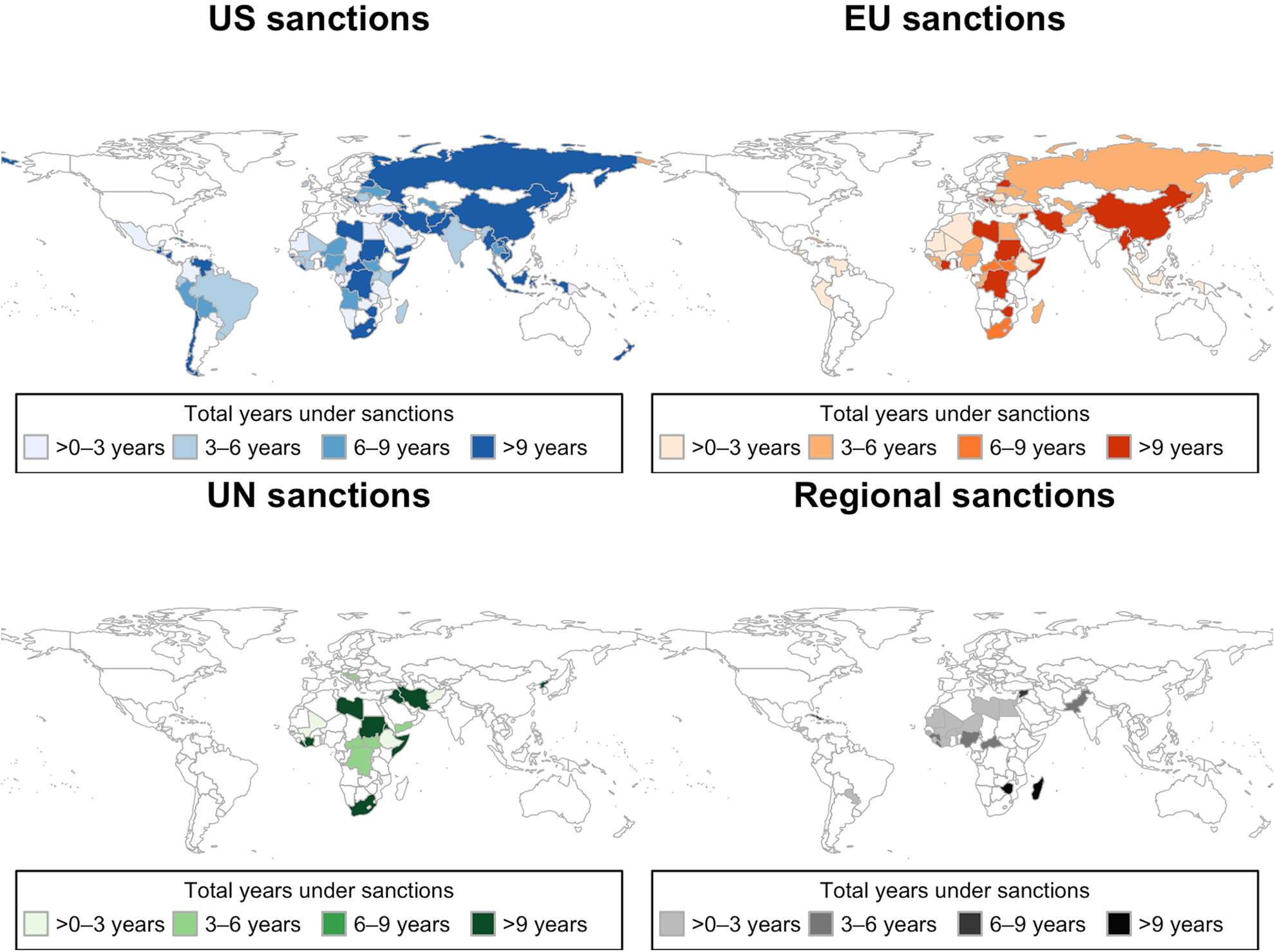
The duration and geographic scope of sanctions
Our dataset also allows us to assess how sanctions end. We find that only approximately 26% of imposed sanctions are lifted in response to complete target acquiescence. This means that capitulation by senders despite the failure to achieve the prescribed goals is common. The IST dataset also underlines that sanctions termination is often a gradual process. Case studies on Iran and Zimbabwe showed that sanctions were lifted progressively and that goals were adapted repeatedly (Eriksson, 2007; Grauvogel & Attia, 2019). Like the EUSANCT dataset (Weber & Schneider, 2022), we also find cross-national evidence for the gradual nature of sanctions termination: more than 43% of the cases in the IST dataset are lifted gradually, including 42% of the EU, 50% of the UN and 48% of the US sanctions. 11 In addition, our data provide the first systematic account of another aspect of gradualism: namely goal adaptation, which occurred in 12% of cases. Thus, our understanding of sanctions should move from a static conception that views the decision to remove sanctions as a binary event towards a more dynamic understanding that accounts for the gradual nature of this process.
Comparison with existing datasets
Existing large-N sanctions datasets have provided major impetus to the study of sanctions effectiveness (for a descriptive comparison of the number of coded cases, see Figure 2 in the Online appendix). The IST dataset, by contrast, focuses on the removal of sanctions and fills a gap in research that has not yet fully considered the entire lifecycle of sanctions. Going beyond the emphasis on sanctions termination, IST adds to previous data collection efforts through its dyadic data structure, its Duration of terminated sanctions cases Overview of sanctions datasets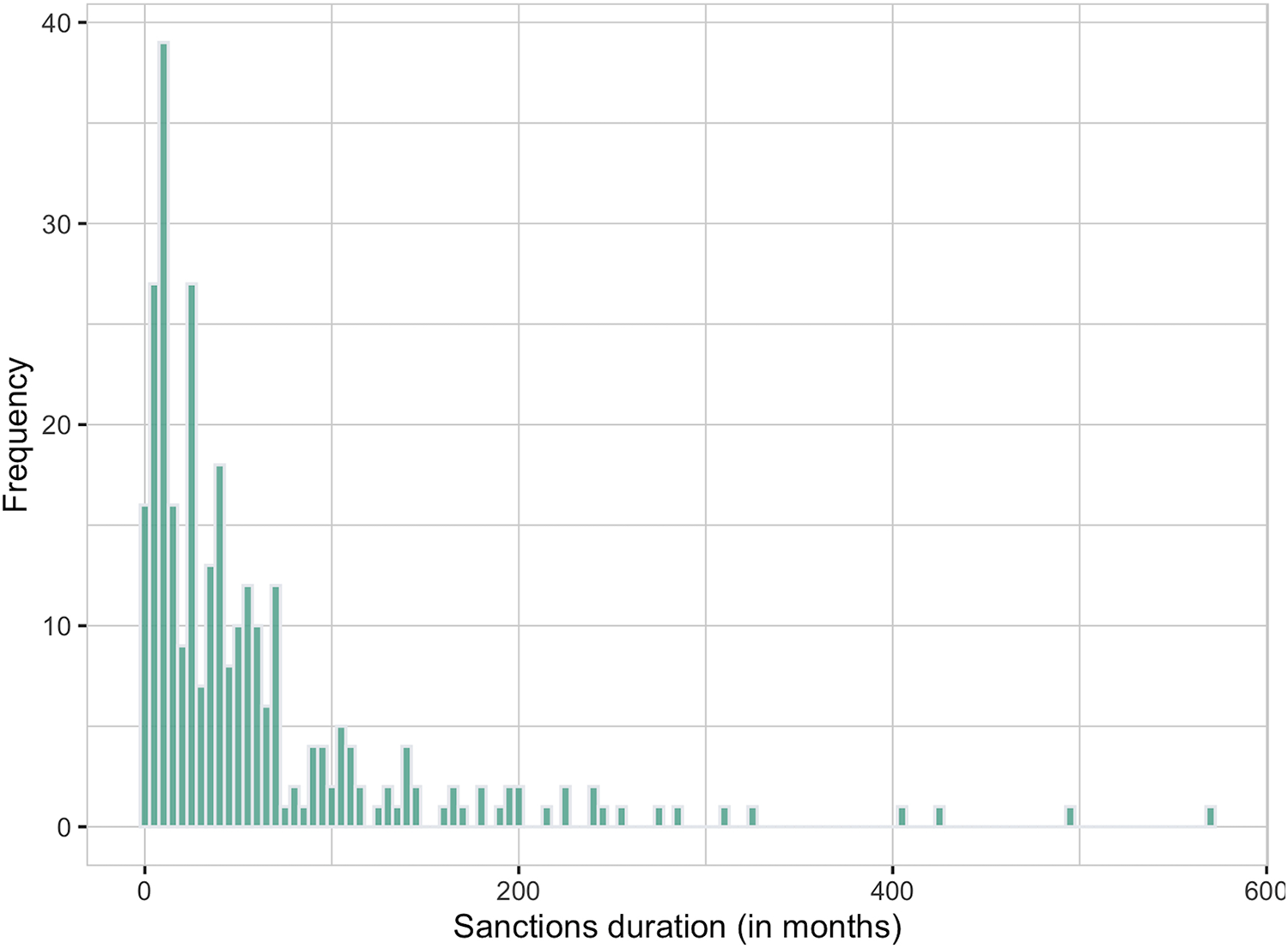
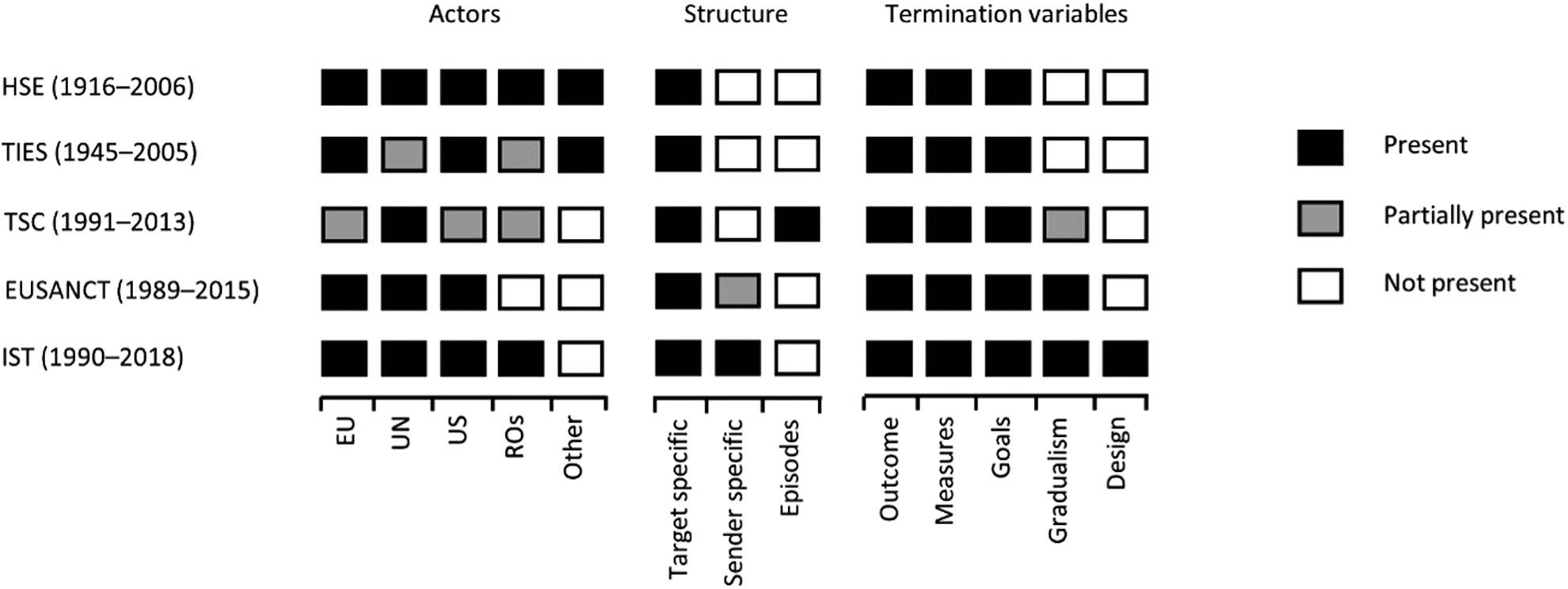
First, our dataset has a dyadic structure, allowing each sanctions case to include target- and sender-specific information, whereas TIES, HSE and to some extent EUSANCT combine the parallel existence of multiple senders within one case. This has implications for the coding of sender-specific variables. In the case of TIES, key information on the sanctions’ measures, issues, goals, costs and outcomes are provided only for the primary sender. By contrast, the IST dataset contains sender-specific information on all variables. We capture the start and end dates, goals, costs and outcomes for each individual sender-target dyad. Sanctions imposed by multiple senders against a single target are not necessarily lifted simultaneously (Grauvogel & Attia, 2019), which we account for. The sender-specific nature of the IST dataset also adds nuance to the coding of the ‘final outcome’ variable, because it differentiates across senders. Sanctions against Guinea-Bissau illustrate the value added: ECOWAS lifted sanctions in June 2012 after only two months in response to the establishment of transitional organs, even though the accomplishment of the major goal – the return to constitutional normality – was still pending. Hence, we code this as ‘partial acquiescence’. By contrast, the EU removed its sanctions against Guinea-Bissau only after the completion of general elections in 2014 that marked a return to constitutional order – that is, in response to full target acquiescence. Coding the same outcome for both senders would mask these differences.
Second, IST is the only dataset that captures all regional organizations as autonomous sanctions senders. While both TIES and EUSANCT include EU sanctions, systematic data for other regional organizations remains scarce. TIES and TSC account for some sanctions imposed by other regional organizations, but only to the extent that they complement existing sanctions. We go beyond their approach, and qualitative data gathered by Charron & Portela (2015) on African regional sanctions, by providing information on sanctions imposed by all regional organizations worldwide. For example, IST is the only dataset that accounts for ECOWAS sanctions against Liberia in 1992 as an autonomous case, and not only as a supplement to other UN or unilateral measures.
Third, IST includes new variables that should theoretically influence sanctions termination – most notably, design features of sanctions. At the same time, IST captures several key variables also contained in the other datasets such as sanctions outcomes, measures and goals. This ensures the compatibility of IST with existing datasets. We follow the coding rules of TIES and EUSANCT to code some of the most widely used variables – namely, sanctions costs and outcomes – to facilitate integration with these datasets. We also indicate whether an IST case is captured in EUSANCT, HSE or TIES. Moreover, IST contributes to the harmonization of existing datasets regarding key measures. The coding of the sender and target economic cost variables compares information provided by EUSANCT, HSE, TIES and TSC and resolves contradictions by drawing on additional monetary figures and news reports.
Our dataset offers the most up-to-date information on sanctions for the period until 2018, whereas HSE covers sanctions through 2007, TIES through 2005 and TSC runs through 2013. The IST dataset is thus more suitable for analyses of current trends in sanctioning, and further expands the time frame compared to other recent initiatives aimed at updating existing datasets (especially, Weber & Schneider, 2022). Overall, IST neither subsumes nor aims to replace existing datasets. Rather, it complements them with the most recent sanctions data while adding new senders and further variables.
The impact of sanctions design on termination processes
With the IST dataset, we capture novel aspects of sanctions design, because existing theories and anecdotal evidence suggest that they should affect how long sanctions last. To begin with, review provisions or expiry dates force policymakers to actively decide to maintain sanctions while taking political developments in the target states into account. Including review provisions in the design of sanctions should make dormant or forgotten sanctions – measures which are no longer applied in the absence of a formal decision to lift them (Hellquist, 2012: 104) – less likely.
Similarly, investment in oversight institutions compels senders to regularly monitor the imposed measures, which presumably affects when sanctions end. The creation of sanctions committees, task forces or panels of experts for a specific sanctions case or issue-area sends a strong signal of commitment (on commitment strategies, see Dorussen & Mo, 2001), which can increase the chances of target-state compliance early on. Yet, in line with sunk-cost arguments (Bonetti, 1994), senders should become more reluctant to remove unsuccessful sanctions if they have heavily invested in the institutional setup.
Finally, senders’ termination requirements, which are formally spelled out in the decisions imposing the measure, vary in their degree of precision. Ambiguous goals undermine the clear signal necessary to convince the target to enact a policy change (Nephew, 2018). Moreover, a failure to clearly define termination requirements can result in strikingly different perceptions of what the target needs to do to have sanctions lifted, thereby complicating decisions on sanctions relief (Nephew, 2018). The Iran case constitutes a prominent example here: while the EU slowly lifted its sanctions in response to the gradual advancement of the nuclear-deal negotiations, the United States – and in particular Republicans in Congress – viewed Tehran’s concessions as insufficient for sanctions relief (Everett, 2015).
The IST dataset reveals that expiry dates, review provisions and institutional investment are common features of many sanctions cases, while also showing that the design and oversight of sanctions differ from sender to sender (see Figure 4). The UN is the most ‘disciplined’ sender in the sense that most of its cases include both review provisions (75% of the cases) and clearly The design and oversight of international sanctions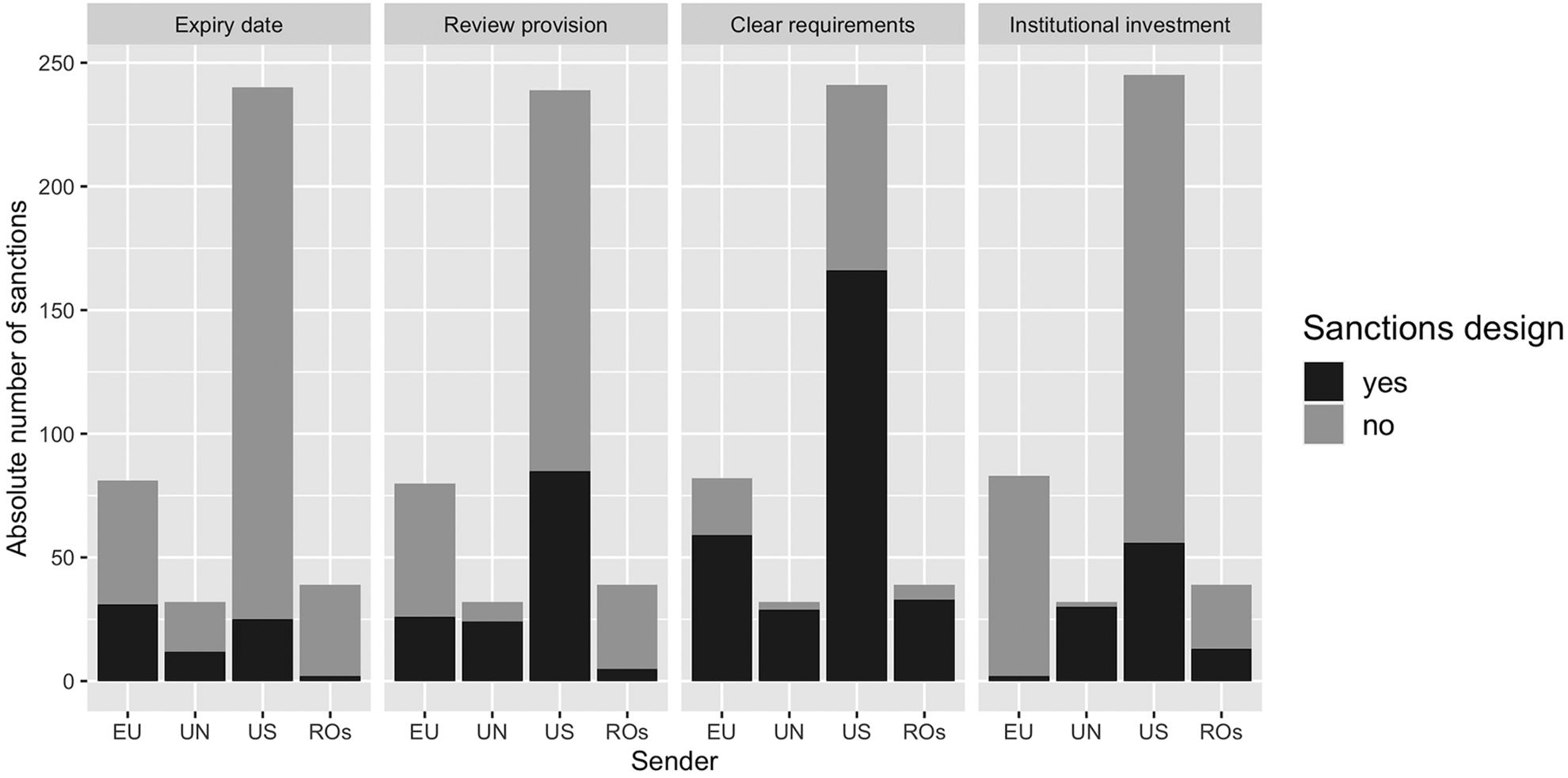
Do these design features also affect the duration and termination of sanctions? To provide initial answers to this question and sketch out potential applications of our dataset, we present simple bivariate relationships that explore the impact of key IST variables on when sanctions end. The results should be interpreted with caution because we do not include different operationalizations of key factors, alternative model specifications or control variables.
The IST dataset contains variables for the start and end of a sanctions case allowing us to investigate when sanctions end (duration in months). As the indicators for sanctions design are all qualitative in nature, we follow common practice for empirical analyses by first running log-rank tests and plotting the Kaplan–Meier curves for all the categorical predictors (see Figure 5). Then we extract the factors that show significant variations in their survivor functions and use them to run simple bivariate analyses investigating sanctions termination.
The explorative analysis 12 suggests that sanctions with clearly stipulated termination requirements have an average duration significantly shorter than that of sanctions with ambiguous provisions, which appears to support Nephew’s (2018) claim that the former send a clearer signal to the target that increases the likelihood of compliance and results in the earlier lifting of sanctions. As for the remaining characteristics of sanctions design, we find that sanctions with review provisions, expiry clauses and institutional investments last significantly longer.
As the Kaplan–Meier estimator cannot deal adequately with censoring, we conduct bivariate tests to check whether the identified factors remain significantly related to the duration of sanctions. We opt for the Cox model here because it allows for a further simple test that does not rely on any assumptions about the distribution of the survival times while simultaneously dealing with censored data. 13 The results of the simple bivariate output are in line with the earlier results (for the regression output, see Tables I and II in the Online appendix).
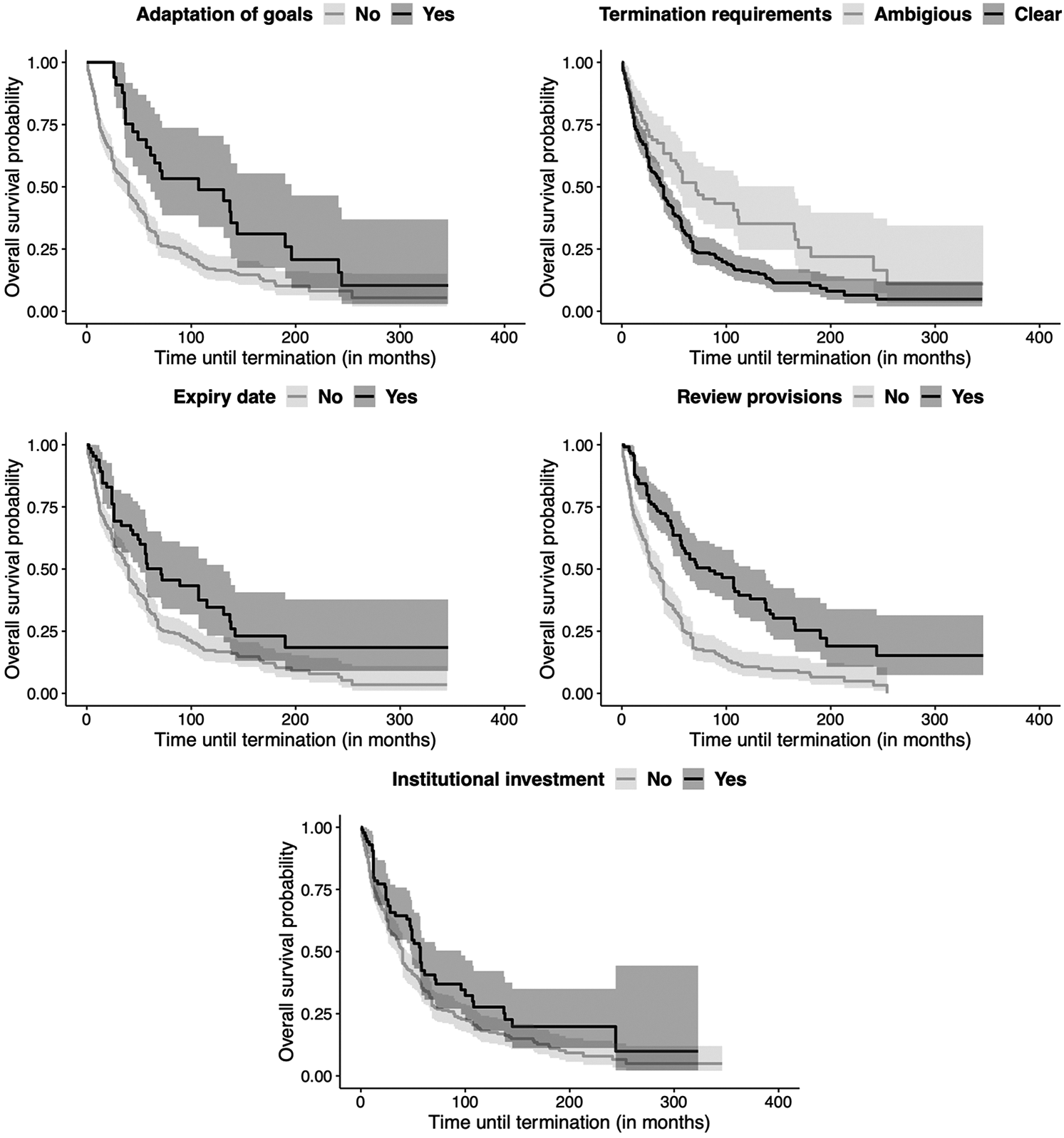
Kaplan–Meier curves of significant indicators
The results of the bivariate analyses show that overall sanctions cases characterized by changes in sanctions goals by the sender decrease the likelihood of sanctions termination, while clear termination requirements increase the likelihood of termination. By contrast, institutional investment and the presence of review provisions and expiry dates significantly increase the duration of sanctions (see Table I in the Online appendix). While the results for institutional investment in oversight bodies are in line with the sunk-cost argument introduced above, we do not have a comprehensive explanation as to why – contrary to our expectations – review provisions and expiry clauses do not reduce the duration of sanctions. We suspect that selection issues could be driving these initial results. Senders may be more likely to include review provisions and expiry dates for ‘difficult’ cases over highly salient issues because they expect these cases to last longer, and thus seek to ensure assessment at specific points in time. We find that the inclusion of review provisions and expiry dates in sanctions decisions is indeed positively and significantly correlated with our indicators for sender and target issue salience. The correlation surpasses the minimum threshold of 0.10, which indicates a substantive association between the two variables (see Table III in the Online appendix), yet more systematic analyses are needed.
Conclusion
The IST dataset expands and improves upon previous datasets demarcating when sanctions end. It represents the first attempt to quantify key aspects related to the termination of international sanctions that previous datasets have not captured, thereby complementing qualitative narratives on sanctions removal. Our initial analysis suggests, first, that monitoring and oversights regulations influence when sanctions end, and, second, that sanctions termination is better understood as a gradual process.
EUSANCT, HSE, TIES and TSC will continue to be key tools in research, and we recognize some distinct advantages of each dataset – especially their extensive time frames (in the cases of HSE and TIES) and their inclusion of variables that we do not capture because they are less relevant for sanctions termination. The fact that IST covers the most recent cases will make it useful for studying the contemporary development of sanctioning practices in a way that addresses the entire lifecycle of sanctions, including their removal.
Studying the termination of sanctions sheds light on how external pressure works more generally. In conflict research, studies on the end of civil wars (e.g. Toft, 2010) have significantly expanded our understanding of conflict processes. Similarly, the nature and type of sanctions termination – including the question of whether measures end with target compliance or sender capitulation (Attia, Grauvogel & von Soest, 2020) – and sanctions success are inseparably linked. However, these factors only become visible once we explicitly examine the termination of sanctions.
Methodologically, the focus on original documents by sanctions senders as the key source for coding the cases complements existing datasets predominantly relying on media reports. This approach not only yields more precise information on when sanctions end but also allows examination of how sanctions’ design features affect the termination of sanctions. Equally important, the IST dataset’s sender-specific data structure enables new research on some longstanding questions – for instance, the relationship between targets and senders and how this affects sanctions outcomes.
In addition to these empirical and methodological applications, the dataset also makes a conceptual contribution. It offers a starting point to better capture the volatile nature of sanctioning processes. While the existing literature has started to acknowledge the ‘evolutionary and dynamic processes’ (Bolks & Al-Sowayel, 2000: 243) of sanctioning, research still tends to operationalize sanctions as a singular event with a binary outcome (see, for example, Cox & Drury, 2006). Our variables – capturing de facto termination, gradualism and goal adaptation – offer new insights into the incremental process of removing sanctions. Future research should move towards further disentangling the gradual nature of sanctions termination.
Footnotes
Replication data
The dataset, codebook, and do-files for the empirical analysis in this article, along with the Online appendix, are available at https://www.prio.org/jpr/datasets/ and at  . All analyses were conducted using R.
Acknowledgments
We thank our research assistants Hannah Brandt, Diana Elagina, Sena Evren, Konstantin Jannone, Dylan Johnson, Laura Martin, Annalena Rehkämper, Eileen Roth and Silvia Rojas Castro for their excellent work. We also thank Susan Allen, Belén González, Christian von Soest and the participants of virtual workshops ‘New Perspectives in Peace and Conflict Studies’ at the German Institute for Global and Area Studies and ‘Empirical Peace and Conflict Research’ at the Hertie School of Governance for their valuable comments. We appreciate the highly constructive comments from the three anonymous reviewers and the editor.
Funding
This research was funded by the German Research Foundation, project no. GR 5141/1.