




Abstract
Recent scholarship shows increasing interest in gender, ethnic or national representation within regional and international organizations. In contrast, language as a criterion of representation has rarely been scrutinized. We argue that this constitutes an important oversight for two reasons: (1) language is an important identity marker; and (2) language regimes in international public administrations can uniquely address representativeness relative to both member states and groups of citizens. Our article explores language representation in the Economic Community of West African States, and pursues a twofold objective: first, it extends the applicability of representative bureaucracy theory to the issue of language; and, second, it broadens the scope of representative bureaucracy studies by providing the first study on a prominent West African regional organization. As such, we develop avenues for future research on other regional and international organizations.
Points for practitioners
The article is of particular relevance for managers in multilingual international and regional organizations. Organizations tend to overlook the role and impact of languages on their functioning, often considering them as a technicality. Taking the example of the Economic Community of West African States, the article argues that linguistic regimes are important for the performance and the legitimacy of the organization in terms of acceptance by both citizens and its member states.
Keywords
Introduction
In any regional organization (RO) or international organization (IO), staffing issues are of paramount importance to the member states and the organization. RO/IO member states generally expect that their nationals fill a certain amount of posts within both the overall administration and the segment of strategic staff positions (Murdoch et al., 2020). The aim is to achieve a degree of geographical equilibrium based on predefined criteria reflecting, for instance, financial contributions or a fair representation of smaller states (Badache, 2020; Parizek, 2017). Smaller states are thereby often over-represented, which reflects the negotiated fairness principle as a fundamental norm of any given RO/IO. 1
Under Weberian models of public administration, geographical balance cannot affect decision-making. In practice, however, staff composition impacts belief and value patterns, which, in turn, can affect decision-making. This is the core idea behind the theory of representative bureaucracy, which posits that bureaucracies’ socio-demographic composition (in)directly influences their outputs (Bishu and Kennedy, 2020; Riccucci and Van Ryzin, 2017). Currently, four types of bureaucratic representation are distinguished in the literature: passive and active (Mosher, 1982), symbolic (Theobald and Haider-Merkel, 2008), and linkage/instrumental representation (Gravier, 2013; Meier, 2019). 2 This article focuses on passive representation in the Economic Community of West African States (ECOWAS) bureaucracy, which Mosher (1982: 15) theorized as ‘the origin of individuals and the degree to which, collectively, they mirror the whole society’.
Recent scholarship has started to apply the theory of representative bureaucracy to international public administrations (e.g. Badache, 2020; Christensen, 2020; Gravier, 2008, 2013). This emerging literature studies a limited set of organizations (mostly the European Union (EU) and United Nations (UN)), specific aspects of staff recruitment, and staff composition in terms of nationality, gender or ethnicity (e.g. Ban, 2013; Christensen et al., 2017; Gravier and Roth, 2020; Parizek, 2017). In this article, we offer two main contributions. First, we analyse language as a representation criterion. Although language has long been suggested as a possible ‘variable’ (Kim, 1994; Subramaniam, 1967), only a very small number of studies focus on it (Bishu and Kennedy, 2020). Most of this work analyses three multilingual states: Belgium, Canada and Switzerland (e.g. Kübler et al., 2011; Turgeon and Gagnon, 2013). 3 Despite the intrinsically multilingual nature of IOs/ROs (e.g. the African Union and UN recognize six official languages, while the EU recognizes 24), language has been overlooked in the context of these organizations. This is surprising because language is critical to any form of communication and collective memory. Often, it also reflects very precarious sociocultural cleavages (Ordeshook and Shvetsova, 1994). Yet, this omission reflects that ‘management literature devotes little attention to questions of language use’ even if ‘language and communication styles are management challenges, particularly in international and multinational organizations’ (Ban, 2013: 202). Indeed, multilingualism raises issues of translation and interpretation, which affect all stages of policymaking, legislation and coordination. We maintain that these aspects make language of fundamental importance from a representative bureaucracy perspective.
Our second contribution is empirical. We explore the origins, evolution and implications of language representation within ECOWAS. This organization has not attracted the attention of many international public administration scholars (Gänzle et al., 2018). Yet, the extended period of colonial rule in West Africa led to states being clustered ‘into different language blocks’ (Ukaigwe, 2016: 3), legal regimes and educational systems. These jointly point to language as a potential tool of representation. ECOWAS also provides a particularly interesting setting because its organizational aims induce it to pay attention to both geographical and linguistic representation. While ECOWAS formally aims to develop trade and economic integration, as well as security cooperation, it has an additional informal agenda: to build bridges between, in particular, francophone and anglophone states in West Africa (Ajulo, 1985, 2001; Ojo, 1980); and to support the native West-African languages spoken in its 15 member states. This provides a unique opportunity to study how linguistic representation among the ECOWAS administrative staff acts as a ‘possible instrument of legitimacy in heterogeneous or multi-national polities’ (Gravier, 2008: 1028).
In the following section, we present the analytical framework within which we operate. We then describe the case organization, ECOWAS and the data collected. The fourth section is dedicated to our empirical analysis. We discuss and conclude our study in the fifth section.
Representative bureaucracy and the role of language
The theory of representative bureaucracy was developed to understand how the staff composition of national bureaucracies relates to their outputs in terms of democracy, legitimacy, accountability and efficiency (Kingsley, 1944; Mosher, 1982; Pitkin, 1967). The key idea is that bureaucrats who share socio-demographic and cultural backgrounds with citizens are likely to share their values and policy preferences. Therefore, bureaucratic decisions tend to better reflect citizens’ preferences. In turn, increased representativeness leads to more responsive, effective and legitimate bureaucracies, as well as better organizational outcomes (Pitts, 2009; Selden, 1997). A vast body of literature has studied the drivers, procedural aspects, implications and importance of bureaucrats’ representation of a specific constituent population (Bishu and Kennedy, 2020; Riccucci and Van Ryzin, 2017). Most articles thereby focus on one characteristic, such as gender (e.g. Meier and Nicholson‐Crotty, 2006), race (e.g. Wilkins and Williams, 2008) or ethnicity (e.g. Meier and Hawes, 2009).
Most studies applying the theory to IOs/ROs focus on nationality. Gravier (2008, 2013), for instance, shows that national representation and ‘geographical balance’ already receive significant importance at the initial stages of recruitment in European institutions. Christensen et al. (2017) argue that emphasis on national representativeness during recruitment may reduce attention to educational qualifications, thus undermining the availability of specialized knowledge and expertise. Parizek (2017) and Badache (2020) show that nationality representation in UN organizations at least partly reflects countries’ population size and wealth, resource contributions, and UN operational locations.
While nationality is a logical focal point because only states can be members of ROs/IOs, other features of representation are also relevant. Language matters since, in particular, international bureaucracies are characterized by multilingualism. Yet, language has received little attention in representative bureaucracy studies. Only a few multilingual states have been studied (e.g. Turgeon and Gagnon, 2013; von Maravic et al., 2013) even though language constitutes a core aspect of national and personal identity (Ajulo, 2001; Edwards, 2009). Language and identity are closely linked because language is ‘the primary medium through which … communication of cultural information occurs’ (Noels et al., 1996: 248). This directly ties language to individuals’ culture and heritage, and makes it hold particular value and prominence for their sense of self. Language therefore becomes an easily observable, relevant and often precarious line of division across population groups. Empirical research has shown, for instance, that linguistic diversity within a country is associated with a larger number of political parties contesting elections (Ordeshook and Shvetsova, 1994). This highlights that linguistic groups often desire political representation, and that languages have relevance as a political instrument (Ajulo, 2001). Therefore, one would expect states to also care about their linguistic group’s bureaucratic representation in international bureaucracies.
Further, language is central to any form of communication or social interaction (Timpson, 2006). Without a common language, communication becomes extremely challenging. Sharing a language literally gives individuals and groups a voice and possibility to be heard: language is the instrument of representation par excellence. Hence, the languages chosen for communication in bureaucracies determine the (lack of) access available to linguistic groups. This holds both for external communication (e.g. contact with citizens, member states and other stakeholders) (Badache, 2020) and internal communication (e.g. between departments or institutions). Still, the significance of bureaucracies’ language regime goes beyond mere accessibility because speaking the same language signals peer group membership (Collins and Clément, 2012). Therefore, it affects the possibility for bureaucrats to ‘successfully claim to represent some group or larger set of social interests’ (Saward, 2005: 179; emphasis added).
Extrapolating to the context of international bureaucracies, language regimes have the potential to increase not only their perceived representativeness, but also the (perceived) possibility for member states to see their interests better represented in decision-making processes. Thereby, they contribute to enhance legitimacy and efficiency (Gravier, 2013; Murdoch et al., 2018). Thus, while classical scholarship analyses the impact of nationality and professional socialization (Barnett and Finnemore, 2004), the theory of representative bureaucracy paves the way for studying a disregarded socio-demographic criterion and instrument of representation: language. For international bureaucracies, this leads to the hypothesis that language may well be as important as nationality in achieving legitimate representation. Concerning our case organization (ECOWAS), we therefore put forth the following expectation: language is taken into account in its staffing policy and during recruitment to ensure at least passive representativeness. Building on Badache (2020), we expect this concern for language to present itself in both an internal dimension (i.e. between departments or institutions, and as a matter of institutional efficiency) and an external dimension (i.e. relative to external stakeholders). Our data do not allow concluding on other forms of representativeness; however, since these all require passive representation as a foundation, showing that the ECOWAS language regime, staffing policy and actual staffing figures reflect the criteria of passive language representation is a necessary first step.
ECOWAS: case, context and data
ECOWAS
ECOWAS was established by the Treaty of Lagos in May 1975. Its primary objective as ‘an economic union’ is to ‘raise the living standards of its peoples, and to maintain and enhance economic stability, foster relations among Member States and contribute to the progress and development of the African Continent’ (Article 3(1), 1993 ECOWAS Treaty). As substantial tensions persisted between anglophone and francophone West-African countries in the 1960s and 1970s (Ojo, 1980; Onwuka, 1980), the ECOWAS idea of integration across linguistic divides did not go without difficulty (Penouil, 1975). Today, ECOWAS consists of 15 English-, French- and Portuguese-speaking member states: Benin, Burkina Faso, Cape Verde, Cote d’Ivoire, The Gambia, Ghana, Guinea, Guinea Bissau, Liberia, Mali, Niger, Nigeria, Sierra Leone, Senegal and Togo. 4 It is one of the most important regional economic communities in Africa, as well as a paramount security actor. However, some ECOWAS interventions (such as the operation in Liberia in the early 1990s) were overshadowed by ‘the temporal reawakening of regional rivalries along French–English linguistic lines’ (Bah, 2013: 92). This is noteworthy for our purposes since it reveals the persistence of the language divide in this region.
ECOWAS is a particularly interesting case for three reasons. First, it is one of the most established systems of regional integration on the African continent. Yet, throughout its history, it has been marked by pronounced linguistic divides. Language remains highly relevant to this day, as witnessed by references to the linguistic background of staff members and member countries permeating ECOWAS documents, for example, ‘Francophone and Lusophone Member States’ (Annual Report, 2008: 59) or ‘French-speaking ECOWAS countries’ (Annual Report, 2017: 124). Nonetheless, while language continues to present a significant challenge throughout the ECOWAS institutions (see later), both documentary evidence and interviews indicate that this divide may no longer be as strong as it was around the start of ECOWAS.
Second, beyond the central role of languages introduced during the period of colonization, ECOWAS explicitly aims to recognize the hundreds of native West-African languages spoken in its 15 member states (such as Ewe, Fulfulde, Hausa, etc.). This adds an additional linguistic dimension to the union. Closely related, while English is a globally leading language and often dominant within IOs, this is less obviously the case within ECOWAS (and ROs more generally). Third, moving beyond the customary focus on EU or UN institutions provides an important opportunity to assess how well concepts travel. Few studies have hitherto embraced ECOWAS from the perspective of public administration, with the exception of articles on the ECOWAS structural reforms during the 1990s and 2000s (e.g. Lokulo-Sodipe and Osuntogun, 2013) or its staff’s role perceptions (Gänzle et al., 2018). The issue of language representativeness within its bureaucracy has not been addressed yet.
Data
We brought together four types of information. First, we collected legal and documentary evidence related to the objectives of the ECOWAS staffing policy (or ‘policy design’). This is essential to verify whether ECOWAS values representativeness when recruiting staff, and along which dimensions (such as nationality, gender or language). We accessed documents including the Treaty of Lagos (both the original text of 1975 and the 1993 and 2011 revisions), the ECOWAS Official Journal (consulted in English and French for the years 1979–1991, as well as 1996, 1999, 2005 and 2006), the official staff regulations (including its 1983, 1991, 1999 and – most recent – 2005 revisions) and the human resources (HR) department’s 2016 report to the ECOWAS president.
Second, we collected data on both staffing and working practices (or ‘policy implementation’), which allows judging the passive representativeness of the bureaucracy. We obtained information from annual reports (1997–2018), financial and audit reports (2010–2018), organigrams of all ECOWAS institutions, and several reports on organizational reforms. These documents provide statistical data concerning the breakdown of staff by language group (as well as nationality, gender, etc.) and some information on language use within ECOWAS.
Third, we complement these data with transcripts from 17 semi-structured interviews conducted in October 2017 with officials from ECOWAS institutions, the EU delegation to the African Union and an EU member state embassy. The interviews were conducted face to face, recorded and transcribed (Gänzle et al., 2018). They covered internal institutional dynamics, inter-institutional relationships within ECOWAS, staff role perceptions and decision-making processes. Although this was not their original focus, some interviews brought to the fore insights on the role of language, in particular, inside the ECOWAS Commission.
Finally, we exploit detailed discussions of the history and development of ECOWAS in academic research by African scholars. This literature often provides in-depth discussions of tensions and issues within ECOWAS (e.g. Ajulo, 1985, 2001; Bah, 2013; Lokulo-Sodipe and Osuntogun, 2013; Ndhlovu, 2008; Ojo, 1980; Onwuka, 1980).
Analysis and findings
ECOWAS staff composition
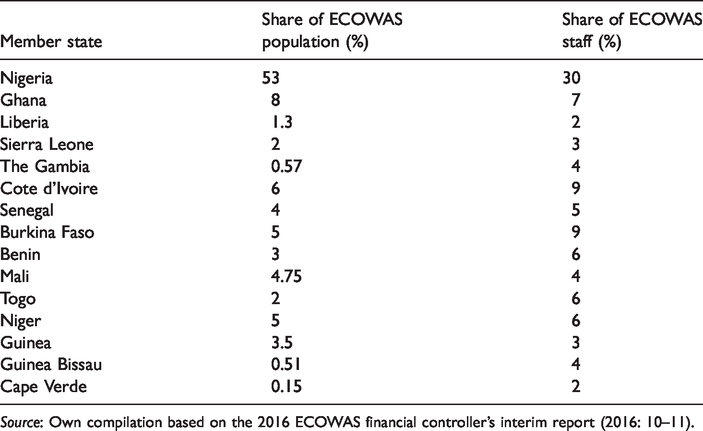
At the end of 2017, ECOWAS employed 1081 staff members (72% male; 28% female). The ECOWAS Commission is the largest employer, with 726 staff members split over 16 statutory employees (appointed by the member states (see later)), 355 professional staff (including 40 directors) and 355 local staff (Financial Controller’s Annual Report, 2017). Table 1 presents the distribution of the ECOWAS professional staff by language group over the period 2011–2017 (the most recent data available), while Table 2 displays the staff structure in June 2016 in relation to population and contribution levels.
ECOWAS professional staff by language group, 2011–2017.
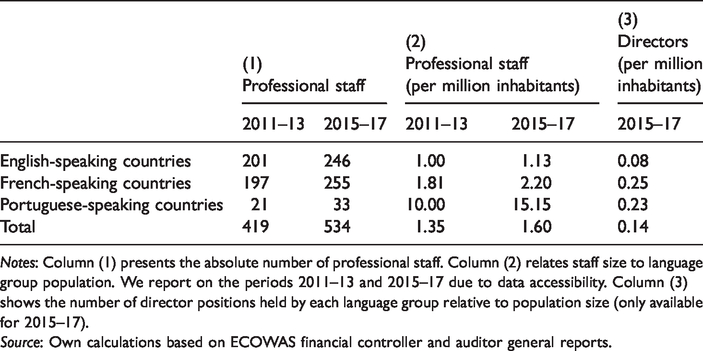
Notes: Column (1) presents the absolute number of professional staff. Column (2) relates staff size to language group population. We report on the periods 2011–13 and 2015–17 due to data accessibility. Column (3) shows the number of director positions held by each language group relative to population size (only available for 2015–17).
Source: Own calculations based on ECOWAS financial controller and auditor general reports.
ECOWAS population share and staff structure in 2016.
Source: Own compilation based on the 2016 ECOWAS financial controller’s interim report (2016: 10–11).
Overall, as perceived by a former ECOWAS commissioner, ‘each country is looking how to get a place … at all levels’ (interview, 16 October 2017). At the level of professional staff, ‘equitable geographical distribution of posts among nationals of all Member States’ is an explicit consideration (Article 18(5), 1993 ECOWAS Treaty). Table 2 shows, however, that an important imbalance remains even when comparing countries of similar size (e.g. Togo and Sierra Leone, or Ghana and Cote d’Ivoire). In contrast to nationality, language is not explicitly mentioned in the treaties or the staff regulations as a criterion to be considered during recruitment. Yet, in general, job advertisements only require fluency in written and oral expression of one ECOWAS official language, though working knowledge of another official language is an advantage.
While anglophones are the largest language group in terms of population size (about 65%), Table 1 shows that they are a minority within the ‘professional’ staff employed across ECOWAS institutions (46–48%). In fact, francophone countries have, on average, nearly twice as many professional staff members per million inhabitants compared to anglophone countries. This disparity increased slightly over the 2011–2017 period. Focusing more narrowly on director positions in column (3), the distribution is skewed even further in the favour of francophone countries (0.25 versus 0.08 directors per million inhabitants). The two small lusophone countries are massively over-represented in terms of professional staff relative to the two other language groups (see also Table 2). Their over-representation also increases over time. Although not officially taken into account during recruitment, the results in Table 1 suggest that, in practice, language probably plays at least some role when hiring professional staff. 5
Our interviews provide tentative evidence in line with this proposition. For instance, when asked whether nationality plays a role within the ECOWAS Commission for staff decisions, including promotions, one of our respondents answered ‘not nationality, but language’ (interview with a project officer in an EU delegation, 12 October 2017). Another respondent likewise argued that the role of nationality is no longer ‘as strong as it used to be … even though there’s still a little bit of language’ (interview with a commissioner in ECOWAS, 9 October 2017). Several respondents also describe how ECOWAS organizes, for instance, its maritime coordination centres and its monitoring of economic activities by language zone and competence (interview with ECOWAS Commission staff member, 10 October 2017). As interdepartmental mobility is ‘virtually non-existent’ (interview with advisor for programme support to the ECOWAS Commission, 8 November 2018), many of these positions must, in practice, involve language-specific hiring. 6
Aside from the staff positions allocated via competitive hiring procedures (i.e. directors, professional and local staff), ECOWAS member states can also fill 27 ‘statutory’ positions. These include the (vice-)president of commission, 13 commissioners (one per ECOWAS department), auditor general, head of the West-Africa Health Organization (WAHO), head of the Inter-Governmental Action Group against Money Laundering in West Africa (GIABA), speaker of the Parliament, president of the court and court judges. Interestingly, statutory positions are allocated across member states on a rotation system taking into account the alphabetical order of country names, language and previous professional experience (Supplementary Act A/SA.14/12/12; Decision A/DEC. 1/6/06). ECOWAS rules also explicitly state that ‘the President and Vice-President shall not be chosen from the same linguistic group’ (Article 2, Regulation C/REG1/06/06 of 1 June 2006; Article 6, Supplementary Act A/SP. 14/02/12 of 17 February 2012). Likewise, the ECOWAS Parliament’s rules of procedure state that in appointments to standing committees, ‘due regard shall be given to linguistics, gender balance and nationality’ (Rules 24 and 29, 2016 ECOWAS Parliament rules of procedure, emphasis added). Therefore, language is explicitly taken into account alongside nationality when dividing central positions of power within the ECOWAS institutions. This may result in situations where the incumbent administrative leaders of the ECOWAS Commission seem not to have sufficient knowledge of the other’s main languages (interview with a member of a diplomatic representation, 12 October 2017).
Languages in ECOWAS
The treaty clearly states the foundation of the ECOWAS language policy design. The treaty’s original version mentions two categories of languages: first, indigenous West-African languages; and, second, two languages introduced by the former colonial powers (English and French). The treaty furthermore distinguishes two uses of languages: official languages and working languages. Indigenous languages, though mentioned first, are not considered working languages. This may explain why the treaty itself was drafted in only two authentic versions: English and French. Although the 2008 meeting of the Ad-hoc Committee in Charge of Monitoring Cultural Programmes deliberated ‘on an indigenous working language for ECOWAS’ (Annual Report, 2008: 105), this proposition was never implemented. Therefore, it appears that West-African languages are prominently positioned in the treaty for largely symbolic reasons but, in practice, not really used within – or by – the organization.
While Portuguese was added as the third official and working language in Article 87 of the 1993 revised treaty, it does not appear in the 1975 original version of the treaty. This corroborates the idea that ECOWAS was primarily an attempt to bring together French- and English-speaking West-African states. Portuguese did not belong to this ‘project’. Portuguese was also less visible since it was in use as an official language in only one of the founding member states, namely, Guinea-Bissau. These two aspects suggest a spirit of representation limited to only the ‘big’ players at the onset of ECOWAS. Yet, this language divide (or competition) between the two lingua francas was more important in the early decade of ECOWAS, and gradually faded away. As one of our respondents reported: It was and is interesting for me to observe who spontaneously speak to each other during the breaks and how national leaders and regional officials gather together during informal moments. The language divide was so evident (my last ECOWAS meeting was in January 2008), with Portuguese speaking countries joining the Francophone group. Today with the growing expansion of English language in Francophone countries and among officials, perhaps this phenomenon is not so obvious. (Former minister, member state, written correspondence with authors, 18 April 2017)
Analysing how issues of language are mentioned in relation to the ECOWAS institutions, one sees two types of conceptions at play. The first conception relates to languages as tools of institutional efficiency. Annual reports and internal documents frequently mention what we can call insufficient language capacity for French (sporadically) and Portuguese (repeatedly) in the Court of Justice and in the Commission. The 2014 Annual Report, for instance, states that: The Court has not been able to publish the French and Portuguese versions of the reports due to translation difficulties. In this regard, the Court draws the attention on the inadequate number of Translators and Revisers, a situation that causes delays in the translation of court processes. (Annual Report, 2014: 125) And the way we do it, because of the language structure in ECOWAS, of the language differences in ECOWAS, [is that] the anglophones are involved in monitoring economic activities in anglophone countries, while the francophones are involved in monitoring for most of the economies of member states in the francophone region. (Interview with ECOWAS official, 17 October 2017)
Still, three important findings arise from this first dimension of language. First, references to languages as tools of institutional efficiency indicate the de facto domination of one language (i.e. English) over the others. Second, they reveal growing efforts to correct this imbalance, thus establishing the increasing awareness and concern for language of ECOWAS. Third, they highlight the importance of languages, particularly for the Court of Justice. This differs from the situation in the EU, where language capacity is more closely tied to the European Parliament than the Court of Justice of the European Union (Gazzola, 2006). This could indicate that in ECOWAS, the Court of Justice is expected to have visibility vis-a-vis the public. In contrast, the European Commission and (increasingly) the European Parliament are the visible faces of the EU (Gattermann and Vasilopoulou, 2015). This, in turn, has theoretical and methodological implications for the study of language as a feature of representation in ROs/IOs: organizations may have different uses of both language and institutions to achieve representativeness.
The second conception of languages revealed by our data is more interesting for the purpose of representation. First, this is explicit in appointment rules to positions with representation and symbolic dimensions, such as standing committees in the Parliament or the statutory staff and top positions in the Commission (see earlier). Moreover, during public parliamentary debates, ‘the Speaker shall call a Representative to speak, ensuring as far as possible that speakers of different political views and languages are heard in turn’ (Rule 52, 2016 ECOWAS Parliament rules of procedure, emphasis added). Second, a linguistic representation is also reflected in the ECOWAS decision to develop an official anthem in its three official languages (English in 2001, French in 2003 and Portuguese in 2007) or the revision of its information and communication policy towards using national languages to improve information dissemination (Annual Report, 2000). Third, the annual reports often mention languages in close combination with discussions of ECOWAS visibility or the accessibility of its information for the citizens of its member states. A key example relates to the ECOWAS library. The annual reports mention the acquisition of volumes, the (future) accessibility of these volumes to citizens and the fact that the volumes have been acquired in the three community languages. The 2016 Annual Report, for instance, explains that: The library has painstakingly accumulated a diverse inventory of 4,000 reference materials, mainly books, periodicals and other publications in the three Community languages that will assist the Court in the discharge of its mandate(s). The operations of the library are also being computerized to improve access for staff and citizens in anticipation of a future when it would be opened to the public. (Annual Report, 2016: 134) The website, which is now also available in the three official ECOWAS languages, has also been revamped with a feedback mechanism that allows visitors to share information and opinions. In order to consolidate its online presence and increase visibility, the Commission also tapped into major social media platforms including Facebook and Twitter which enables a wider reach for information dissemination and a window for feedback from community citizens. (Annual Report, 2016: 114)
From an analytical perspective, these examples highlight two things. First, they exemplify how language is used as a tool of representation in both political (Parliament, anthem) and bureaucratic (Commission, Court of Justice, library) institutions. Second, they indicate that the ECOWAS language policy has two dimensions: the internal dimension concerns the way languages are managed within institutions and the way language capacity conditions their work; and the external dimension concerns the way languages are used and promoted within member states’ civil societies. This external dimension is arguably of particular importance in terms of representative bureaucracy. It points to the applicability of the notion of passive representation to the ECOWAS language policy because ECOWAS bureaucratic institutions intend to ‘mirror the whole society’ (Mosher, 1982: 15) from the point of view of language use.
Concluding discussion
This article has argued that language can be a relevant feature of bureaucratic representation, using ECOWAS as a case in point. Earlier studies have shown the applicability of the theory of representative bureaucracy in the context of ROs/IOs. To date, such studies have mainly focused on the EU and the UN, as well as the issue of nationality. We show that for ECOWAS, language complements features of representation such as nationality in several ways. Therefore, language appears to be an important additional criterion of representation. The historical context of the creation of ECOWAS shows that language has indeed been a birthmark for this organization and publications confirm that the language issue has been important in its development. However, owing to the specific theoretical tool we use, we can argue that languages and relations between language groups are at the heart of staffing policies and working practices. Hence, we hypothesize that this can account for the power of language as a prominent cleavage in the ECOWAS context, which makes it a significant feature of representation.
Our analysis highlights that ECOWAS has made repeated efforts to live up to the treaty dispositions, at least as far as the working languages are concerned. Even so, one of our initially puzzling findings is that while English-speakers are clearly dominant in the region in absolute terms, civil servants from francophone and lusophone countries are disproportionally represented in the ECOWAS bureaucracy. This holds even beyond what one could expect from the perspective of safeguarding the position of smaller countries. We thus observe that the largest member states – Nigeria and Ghana – seem to accept the over-representation of smaller member states in ECOWAS staff, which is consistent with what studies on the EU’s bureaucracy show. These observations suggest that language relations and representation (in terms of power balances) are, in practice, taken into account, at least to some extent, when hiring professional staff. As such, our study leads us to assume that ECOWAS has a more or less elaborate language policy and strategy even though we would need more data to delineate its contours with precision. We explain this, first, by the concern for language, which presents itself as a policy with two dimensions: one internal dimension (mainly in terms of institutional efficiency) and an external dimension (involving communication with and visibility for community citizens as well as the ECOWAS civil society). Second, we cannot rule out the possibility that the recruitment system may have a built-in bias towards the educational systems of francophone and lusophone countries. This point would require further research.
Overall, our findings show that the ECOWAS language policy serves purposes of representation and allows us to contend that it can usefully be interpreted using the theory of representative bureaucracy. Comparing our results to those of studies on the EU and the UN confirms the relevance and potential of this theory in the context of international and regional bureaucracies. It also stresses the need to give external (historical, political) and internal (institutional) contexts a much greater importance than often seen in representative bureaucracy studies.
Our study faces several limitations. First, we focused on passive representation. Future studies need to advance our knowledge on other forms of representation potentially at play in the ECOWAS bureaucracy. Linkage/instrumental representation seems of particular interest given that it is more likely to have relevance in the context of ROs/IOs. Second, our focus on language does not imply that nationality is not an important criterion for recruitment at ECOWAS. Thus, in future work integrating intersectionality premises (Meier, 2019), attention should be paid to the ways ECOWAS articulates and balances concerns of geographic and linguistic representation. Third, data gathering proves a challenge in ROs where reporting and archiving remains imperfect. This makes the current study of an exploratory nature, and this should be taken into account when transferring the research results of our study to other organizations, such as the African Union or the Association of Southeast Asian Nations (ASEAN). While a careful approach is thus critical, studying similarities and differences across distinct sociocultural contexts would provide a crucial contribution to the development of what might be termed ‘comparative international/regional public administration’. This new research agenda would require developing a methodological toolbox capable of addressing key challenges – including access to information – associated with research on bureaucratic representation in international and regional public administrations. Finally, we did not address the outcomes of representation in the ECOWAS context, but questions about the impact of representation should be central to the future representative bureaucracy literature.
Footnotes
Acknowledgements
We thank the editor, three reviewers, Kathryn Nash and participants at the 77th Midwest Political Science Association (MPSA) Meeting (Chicago, 2019), as well as the ‘Staffing Regional Organizations in the Global South’ workshop (Paris, 2019), for insightful feedback. Our sincere thanks also go to the interview respondents for their time and the information provided. All interpretations remain our own.
