




Abstract
An essential part of the restructuring of the European security order after the Cold War is the Eastern enlargement of the European Community (EC). This article provides the hitherto missing explanation for the integration of the German Democratic Republic (GDR) into the EC. In alignment with neoclassical realism, I claim that high politics took precedence in this exceptional enlargement. Established theories underestimate the importance of security and power and, thereby, fall short in accounting for the fast-track accession of the GDR to the EC. I argue that the Federal Republic of Germany (FRG) pressed for a rapid reunification including the automatic accession of the GDR to the EC. Motivated by internal factors, the FRG’s government ventured a take-it-or-leave-it-offer that the other EC states acquiesced to under the threat of a German withdrawal from the EC with unforeseeable geopolitical consequences. The analysis builds on recently declassified, original documents collected from different archives.
Keywords
Introduction
The fall of the Berlin Wall on 9 November 1989 constitutes a watershed moment in contemporary history. After the opening of the inner-German border, cracks in the Iron Curtain developed into seemingly unstoppable dynamics of change in the European and global security structure. The collapse of socialism in Europe was followed by Eastern enlargements of the North Atlantic Treaty Organization (NATO) and the European Community (EC). The integration of the former German Democratic Republic (GDR) and its 16 million inhabitants into NATO and EC is the first expansion of these organisations to the previously socialist hemisphere. Given its completion within less than 1 year on 3 October 1990, the GDR’s enlargement case is outstanding and puzzling at the same time.
National and international negotiations towards the reunification of Germany, such as the 2 + 4 negotiations and NATO enlargement, have received extensive scholarly attention and are well understood. The opposite is true for the European dimension: the regional integration and enlargement literature treats the GDR’s accession to the EC due to its specific circumstances as an outlier case not deserving further consideration. The few existing publications miss out on recently available evidence and neglect theoretical explanation. I address the research gap concerning this exceptional case by theorising and then systematically unpacking the historical evidence.
I challenge existing narratives that attribute the GDR’s integration into the EC to a horse trade between France and the Federal Republic of Germany (FRG) or view it as an afterthought of reunification, generally perceived as a fortunate turn of history. Aiming at an explanation with more theoretical rigour, I develop a new synthetic model for EC enlargement in alignment with neoclassical realism. The use of realism is innovative in the regional integration literature, which is so far dominated by the International Relations’ (IR) grand theories of constructivism and liberalism (Moravcsik, 1998; Schneider, 2009; Sedelmeier, 2005).
My central argument is that enlargement is foremost a high politics exercise related to a state’s core national interests, I claim that the GDR’s fast-track accession was the consequence of the FRG’s harsh negotiation strategy including a daring take-it-or-leave-it-offer ruling out regular accession procedures. Whereas internal factors undoubtedly influenced the FRG’s government, its overarching objective was territorial expansion while maintaining its ties to the Western alliance. In pursuit of these goals, the FRG threatened to opt out of the Community. This threat links back to a central pillar of the European integration project, the pacification of Germany. Faced with the prospect of jeopardising this hard-worn achievement, the other EC member states acquiesced to the FRG’s terms.
Archival research is indispensable to test these claims. Like no other type of data, archival files enable accurate process tracing and avoid shortcomings of other commonly used material such as interviews or memoirs (Frisch et al., 2012; Klein, 2024). After decades under lock and key, classified files have only recently become accessible. For this article, I studied a large number of documents (more than 400) that are of greatest relevance for the GDR’s accession to the EC. They constitute new evidence of interest to historians and social scientists. The findings in the analysis are in favour of the argumentation, which enlightens and alters the prevailing understanding of this exceptional enlargement case that shaped Europe’s path after the Cold War. I present novel evidence for hard bargaining sessions, in which the FRG threatened to withdraw from the Community and pursue reunification with the GDR even if the EC did not consent. This threat was countered with a reference to reactivating the occupational rights over Germany. Furthermore, I demonstrate that the West German government’s successful engagement in the GDR’s election campaign, 1 along with support from the United States and USSR, critically influenced the EC’s decision to approve rapid enlargement.
The article’s findings inform our understanding of Europe’s encompassing change in the 1990s and 2000s. The GDR’s accession coincides with the intensification of the European integration project 2 including the EC’s transformation to an ‘ever-closer’ political European Union (EU) (Baun, 1995) and following enlargement rounds. Against the background of Russia’s full-scale invasion of Ukraine in 2022, the connection between security and enlargement is increasingly recognised (Anghel and Džankić, 2023). Meanwhile, Ukraine, Moldova and Georgia are enlargement candidate countries, allowing the findings of my article to inform revitalised enlargement debates. 3
I proceed as follows. In the first section, I review the existing literature on the GDR’s integration into the EC and identify three insufficient narratives. The second section engages with constructivist and liberal intergovernmentalist enlargement theories. Since I claim that integrating the GDR was an exercise of high politics, I leave these theories behind and develop a neoclassical realist explanation. In the article’s fourth section, I analyse the archival documents and construct a historical narrative tracing the events. The results confirm the new synthetic model for enlargement. The discussion part reassesses the performance of the established enlargement theories in light of the presented evidence. In the conclusion, I address possible implications for contemporary enlargements.
Existing literature on the GDR’s integration into the EC
Even though the reunification of Germany has received considerable attention from contemporary historians, the implications for the EC have not yet been sufficiently explored. Within the existing literature, three persistent narratives about the GDR’s integration into the EC can be identified. As the article’s analysis will show, these narratives fall theoretically and empirically short of delivering an encompassing account. According to the first narrative, the reunification of Germany was a fortunate turn of history. The narrative suggests that fate was catching up with Europe in 1989. ‘Chance [was] a helper’ (Von Plato, 2003: 90) so that ‘history was unfolding’ (Gehler and Jacob, 2019: 506) at a ‘breath-taking speed’ (Toepel and Weise, 2000: 178). Politicians were lagging behind the ever-accelerating events and forced to improvise (Morgan, 1992). Eventually, promoters of the narrative conclude that Germany’s reunification including the integration of the GDR into the EC ‘has been an unusually smooth process. It did not stir many waves’ (Falke, 1994: 164).
The second narrative argues that Germany’s reunification, including the GDR’s integration into the EC resulted from a horse trade. ‘France and West Germany made kind of a deal’ (Spohr, 2000: 878) à la trading enhanced European integration for reunification. The substance of that deal is often reduced to the creation of the European Monetary Union (EMU) (e.g. Baun, 1995; Marsh, 2009; Rödder, 2004; Weidenfeld, 1998), leaving the causal link to the integration of the GDR into the EC open. The horse-trade narrative remains persistent even though the situation was much more complex (Schabert, 2021; Wirsching, 2022).
According to the third persistent narrative, the integration of the GDR into the EC is a neglectable and unavoidable by-product of the German reunification. Since the enlargement lacks formal accession negotiations and did not follow standard procedures, it is an ‘unusual instance of EU enlargement’ (Duttle et al., 2017: 415). As it seems this serves as the justification in the social-scientific enlargement literature to disregard the GDR’s integration into the Community. Influential and encompassing contributions overlook this enlargement case (e.g. Moravcsik, 1998; Schimmelfennig, 2003; Schneider, 2009). Even though the integration of the GDR is an outlier case, 4 there are good reasons to argue that the integration of the GDR was not simply a by-product but the outcome of separate negotiations between the FRG and the EC. The chosen solution was neither pre-programmed nor without any alternative. The ignorance of the literature towards the GDR’s EC integration might be related to the difficulties of established models concerning the GDR case. For instance, in Schneider’s (2009) model, member states bargain with the applicant, which was not the case for the GDR’s integration.
Theoretical approaches to enlargement
Scholars of horizontal integration have developed enlargement theories based on IR’s grand theories. Surprisingly, a realist integration theory is absent. After introducing constructivist and liberal intergovernmentalist theories in the following, I develop a new synthetic model for enlargement in alignment with neoclassical realism.
Identity and norms – constructivism
Constructivist enlargement scholars understand the EC as a Community of liberal, democratic states with common norms and values. The member states share a ‘collective identity’ (Sedelmeier, 2005: 9) or ‘kinship’ (Sjursen, 2002: 495). Authors aligning with this form of constructivism argue that the shared identity and related norms are decisive for enlargement. Accordingly, consent for enlargement builds almost exclusively on whether the applicant state shares the EC’s norms. Enlargement occurs even though it might be related to high material costs (Sjursen, 2002).
When deriving testable expectations and later in the empirical analysis, I draw on the constructivist theory developed by Schimmelfennig (2003), which deviates to some extent from the approaches of Sjursen and Sedelmeier. Schimmelfennig (2003: 3) emphasises that ‘liberal values and norms’ are decisive to enlargement rather than material factors. Both NATO and the EC identify themselves according to these values and norms, which they formalised as ‘constitutive organizational rules’ (Schimmelfennig, 2003: 4). These include domestically ‘social pluralism, the rule of law, democratic political participation and representation as well as property and a market-based economy’ and internationally ‘democratic peace [. . .] and multilateralism’ (Schimmelfennig, 2003: 4). Whereas Schimmelfennig shares this understanding with the previously discussed constructivist approaches, he rejects that norms are ‘ends in themselves’ (Sjursen, 2002: 508). In accession negotiations, therefore, states’ preferences are not informed by norms but rather by ‘material environmental conditions and egoistic interests’ (Schimmelfennig, 2003: 5). 5
As a consequence, the EC is not expected to integrate an applicant only because it internalised the EC’s liberal-democratic values. On the contrary, if at least one member state expects material costs, enlargement prospects are clouded. It is then still possible with ‘rhetorical action’ (Schimmelfennig, 2003: 5), which is at play if either the applicant state or the proponents of enlargement within the Community manage to link ‘their claims for enlargement on the collective identity and the constitutive liberal values and norms’ (Schimmelfennig, 2003: 5) of the EC. If successful, the initial opponents of enlargement find themselves ‘rhetorically entrapped’ (Schimmelfennig, 2003: 5). The entrapment is initialised through shaming the opponents of enlargement in referring to the ‘constitutive organisational rules’, which the applicant has internalised. Moreover, the opponents can be shamed for not acting along their previous statements and behaviour in other enlargement rounds.
Economic and commercial interests – liberal intergovernmentalism
For liberal intergovernmentalism, European integration results from negotiations between governments forming their preferences endogenously. The preference formation of governments is ‘issue-specific’ (Moravcsik, 1998: 50). Since European integration often concerns economic issues, 6 such as the market or agriculture, economic interests are generally assumed to dominate preference formation. While liberal intergovernmentalism tends to emphasise economic factors, it does not overlook other influences, such as geopolitics (Moravcsik, 1998: 24–50; Moravcsik and Vachudova, 2003; Moravcsik and Vaduchova, 2005). More recent scholarship has further relaxed the theory’s economic focus, with Moravcsik, (2018: 1652) acknowledging that ‘[s]ometimes non-economic concerns may even dominate national preference formation’.
In response to the criticism that liberal intergovernmentalism received concerning its difficulties in explaining the EU’s Eastern enlargement, Schneider (2007, 2009) created a comprehensive answer. In line with standard assumptions of rational choice models, ‘Governments are rational actors who aim at maximizing the aggregated welfare of the country they govern and thus, always choose a strategy guaranteeing their survival in power’ (Schneider, 2007: 88). Each member state will calculate its expected ‘net utility’ (Schneider, 2009: 88) from expanding the EC if a possible enlargement is on the table. On the one hand, each state can expect ‘basic cooperation benefits’ (Schneider, 2009: 88) if another state joins the Community, for instance, due to removed trade barriers. On the other hand, member states face costs, particularly if the applicant state is economically weak and eligible for EC funds. A fast accession occurs only if all member states expect a positive net utility. Given the heterogeneity of member state preferences, this scenario is unlikely. 7 Therefore, enlargement negotiations are linked to ‘distributional conflicts’ (Schneider, 2009: 5). These can be resolved in two ways. Either the applicant state accepts temporary exemption from membership benefits, for example, by renouncing access to EC funds. If this is insufficient to convince the opponents of enlargement, the proponents can offer the ‘redistribution of enlargement costs and benefits’ (Schneider, 2009: 6) to their disadvantage. This might, for instance, imply increased payments of the proponents to the EC budget.
Based on these two redistribution options, Schneider (2007: 90) defines four possible outcomes of enlargement negotiations: ‘non-membership, differentiated membership, [. . .] inner-union redistribution, [. . .] unconditional enlargement’. Thus, the liberal intergovernmentalist explanation of enlargement offers two possible ways out of a gridlock situation. We can expect enlargement to happen if all member states expect more benefits than costs from it (if necessary after compensation of the opponents).
Enlargement as high politics – neoclassical realism
According to constructivism and liberal intergovernmentalism, enlargement is predominantly a low politics exercise. 8 Both theories overlook essential and often dominant features of enlargement processes related to geopolitical matters. I claim that integrating new states into the EC is foremost a high politics exercise related to a state’s core national interest, which is survival in the international system. Low politics such as economic questions are not irrelevant but ‘second-order concerns’ (Hyde-Price, 2006: 222). They are subordinate to security (Mearsheimer, 2001: 46–48). In joining the EC, states transfer parts of their sovereignty and become partially dependent on EC decision-making. In the Community, a security problem of one state always affects all member states. Therefore, applicants consider if membership could create geopolitical problems. Existent member states will only consent to enlargement if this does not threaten their security. All member states will have to agree that their core national interests are not violated for enlargement to occur. In cases like the Northern enlargement, core national interests were not concerned so that second-order concerns dominated. The opposite was the case with the GDR, and currently with Ukraine, where enlargement is a matter of war and peace.
I develop this argumentation building on realism, hitherto under-represented in the regional integration literature (Skalnes, 2005; see volume by Wiener and Diez, 2009). Often realism is used as a ‘straw man’ (Hyde-Price, 2006: 219) to be knocked down in favour of other theoretical approaches with the notable exception of studies investigating the European defence and security cooperation (Dyson, 2010, 2015; Turpin, 2019).
Neoclassical realism builds on the core principles of neorealism (Waltz, 1979), which asserts that the international system is anarchic. The primary motive of states, the units in the system, is survival. To achieve security, states balance against major powers by enhancing their capabilities and cooperating with other states. 9 Based on these foundational tenets, different neorealist subtypes were developed. Defensive and offensive realists, for instance, take opposing stances on the issue of whether states can attain a satisfying level of security or whether they continuously strive to accumulate relative power (Mearsheimer, 2001; Van Evera, 1998). Further variation exists concerning the question if states balance against power or threat (Walt, 1987). While any of these variations of neorealism could serve as the ‘baseline’ (Ripsman et al., 2016: 114) for a neoclassical realist model, I focus on the core principles that all variations of neorealism share. Although this approach may limit the ability to account for the full range of systemic variables developed by different strands of neorealism, it is most appropriate to distinguish neoclassical realism from constructivism and liberal intergovernmentalism. In addition, this more general approach aligns with a key objective of my article, which is to further integrate neoclassical realism into the regional integration literature.
Compared to neorealism, neoclassical realism is more inclusive towards the previously discussed constructivism and liberal intergovernmentalism. Neoclassical realists agree with neorealists that the ‘system should be the starting point of any analysis’ (Rathbun, 2008: 307). Changes in the international system constrain or incentivise state action. For neoclassical realists, the state is not a ‘black box’ (Rose, 1998: 148). In the neoclassical framework, internal factors intervene between systemic incentives and outcomes. The influence of domestic variables and ideas is not assessed at the systemic but at the unit level. How do these internal factors look in practice? First, decision-makers’ perceptions matter (Rose, 1998: 157–161). This corresponds to ‘cognitive filters’ and refers to state leaders ‘possess[ing] a set of core values, beliefs, and images’ (Ripsman et al., 2016: 62). Since leaders have different personalities and filters, it matters who is in power. Second, the relationship between the state and society is a possible intervening variable (Rose, 1998: 162–165). Decision-making is, thus, impacted by domestic factors such as the institutional setup but also popular opinion (see also Ripsman et al., 2016: 58–79). In the short term, internal factors may impede decisions the systemic incentives call for. In the long term, leaders cannot act against systemic pressures, or they are deemed to fail (Rathbun, 2008: 317).
Applying the neoclassical realist framework to the GDR’s integration into the EC, the outcome to explain (dependent variable) is enlargement. ‘Systemic Stimuli’ (Ripsman et al., 2016: 19) are considered independent variables providing states with incentives or constraints. It is only due to systemic change, in the underlying case expressed through the fall of the Berlin Wall, that the reunification of Germany and the related EC enlargement became an issue. For decades, the bipolar international system had prevented change. The return of the German Question in 1989 could not be ignored by states and called for reaction. States needed to evaluate how accessing the GDR to the EC would impact their security and position in the international system. In fact, the integration of the GDR would lead to a shift in the balance of power in favour of Germany. If a state assesses that enlargement undermines its core national interests, it is expected to veto.
Since internal factors intervene, state decisions on the GDR’s integration are not only driven by security concerns. Leaders’ personal views and the popular opinion can, for instance, influence how the fall of the Wall is perceived. It is conceivable that internal factors exert such strong influence that a leader may support enlargement, even when it is at odds with the state’s core national interests. Since states cannot turn against the dynamics of the international system, the consequences would be severe.
Process expectations for the GDR’s enlargement from the three theoretical lenses
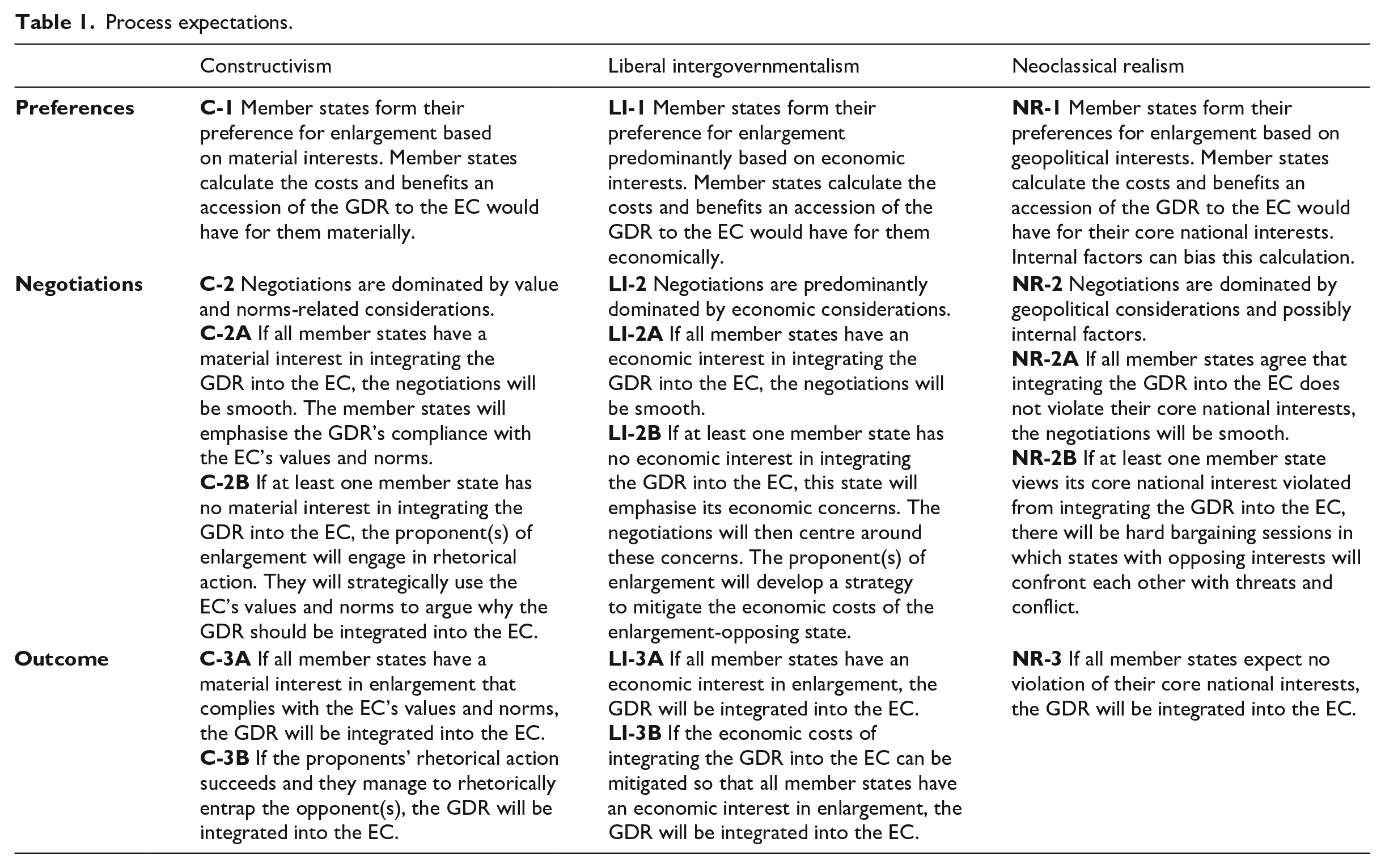
The three discussed theoretical accounts for EC enlargement generate different implications for the GDR’s integration into the EC. The differences are condensed in the process expectations of the below Table 1. Process expectations allow assessing competing theories against case-specific, empirical evidence (Bennett and Checkel, 2015). They capture what should be expected to observe if a specific theory holds. The expectations are structured along three central stages of every enlargement process: preference formation, intergovernmental negotiation and outcome (compare Moravcsik, 1998).
Process expectations.
Research design: Analytical narrative of the GDR’s European integration
The article’s research design is an ‘analytical narrative’ consisting of a rich and in-depth narrative based on theory (Bates et al., 1998). Analytic narratives are a special form of process tracing analyses. They are, however, actor-oriented and less variable-oriented (Levi and Weingast, 2016). My analysis is designed along Bennett and Checkel’s (2015) best practices. I focus not exclusively on my promoted neoclassical realist explanation but also consider alternative enlargement theories. In addition, I incorporate recent advancements in process tracing methodology concerning Bayesianism (Fairfield and Charman, 2022). Thus, I assume that the inferential value of different pieces of evidence may vary when tested against process expectations. I focus on identifying observations that constitute ‘doubly decisive’ or ‘smoking gun’ evidence (Bennett and Checkel, 2015: 16–17). 10
The analysis is foremost informed by archival research. After decades under lock and key, strictly confidential documents from government headquarters and ministries have become available that prior publications could not draw on. 11 Hence, my findings are likely to amend or even challenge existing findings. Scholars have so far relied on sources such as politicians’ memoirs, interviews or newspapers. ‘Hard primary’ (Moravcsik, 1998: 80) archival evidence outperforms these other types of sources. Files from archives are trustworthy and reduce bias due to their original confidentiality (Klein, 2024; Trachtenberg, 2006: 147).
Archival research is essential for revealing causal mechanisms and holistic understandings of outcomes. Still, social scientists rarely visit the reading room of an archive. My use of archival evidence within the regional integration literature is, particularly, innovative. The analysis of archival documents was linked to extensive field trips to the Historical Archives of the European Union (HAEU), the German Bundesarchiv (BA) and the National Archives of the United Kingdom (NA). I have analysed more than 400 relevant files with each file consisting of several hundred pages. If the bias in ‘soft primary sources’ such as memoirs is assessable, I also use them as evidence. Moreover, insights from the secondary literature serve the purpose of triangulation. The downsides of archival documents are that content tends to be selective, and occasionally, files disappear (Beach and Pedersen, 2013: 213–222). Furthermore, I use historical poll data from the Politbarometer West dataset (Jung et al., 2019). For pragmatic reasons I focus on the FRG, France and the United Kingdom (cf. Moravcsik, 1998).
Empirical analysis
The sudden return of the German Question
The prompt opening of the inner-German border turned the German Question into the dominant issue of world politics, raising questions to which politicians had no answers prepared. Under which circumstances could Germany be reunited? How fast could a reunification happen? What would happen to the FRG’s membership in the alliances NATO and EC? Initial reactions from the European capitals welcomed the change in East Germany. 12 At the same time, concerns were arising that the events in the GDR could create a domino effect and overthrow the post-war order. The states recognised the fall of the Berlin Wall as an indicator for a changing international system and were concerned about consequences for their core national interests in the field of security. In response, the EC states developed status quo-oriented preferences as for decades the division was a convenient solution to prevent German great power aspirations. 13 Still, public statements of French government members officially welcomed the developments pointing to the Germans’ right of self-determination. Against the background of a possible reunification, France emphasised that Germany must remain part of the West and, relating to the EC that there is ‘no choice to be made between the Community and the GDR’. 14 The fact that France explicitly mentioned the EC at this moment demonstrates that it perceived the FRG’s membership in the Community as a crucial factor in ensuring stability. This evidence challenges the third narrative presented in the second section of the article, which suggests that the question of EC membership for East Germany was merely an afterthought of reunification not paid much attention to by decision-makers.
A similar interpretation emerges from the study of UK documents. One week before the fall of the Wall, the United Kingdom was ‘fundamentally opposed to German reunification’. 15 London was distraught that too rapid change in the GDR would inflate a large-scale fire in Eastern Europe. The government aimed at the ‘possibility of delaying “reunification” for some time [. . .] for the next two/three years’. 16 Like France, the United Kingdom had a ‘major interest in a steady pro-Western foreign policy in Bonn’ precluding the possibility of a neutral, reunified Germany and preferring a Germany tied to the West. 17 This end could be achieved through ‘trade and cooperation agreements’ with the socialist East including the GDR. 18 This evidence supports NR-1 as geopolitical interests drive the EC’s preference formation.
Unsurprisingly, the FRG welcomed the events in the GDR. Shortly after the fall of the Wall, Kohl began exploring the possibility of reunification. 19 In line with the neoclassical realist premise, internal factors strongly influenced Kohl’s interpretation of the systemic incentive, which a neorealist framework would overlook. Throughout 1989, Kohl’s cabinet witnessed increasing numbers of GDR refugees and recognised them as a threat to internal stability. 20 31% of the West German population identified GDR immigrants as the most important political problem in October 1989 (Jung et al., 2019). Kohl hoped that soft signals towards reunification would reduce emigration. Furthermore, Kohl aimed at satisfying his electorate as he was facing elections in 1990 (Spohr, 2000). At the same time, the Chancellor firmly believed that a reunified Germany could only thrive within NATO and the EC. 21
In light of a rapidly changing environment, the French President convened a special EC summit for 18 November 1989. Given Kohl’s challenging internal situation, the meeting was of great significance. The Chancellor was ‘not looking for decisions’ but a ‘political gesture of solidarity among partners and of support for reform in the GDR’. 22 In his speech, Kohl demanded that ‘the people of Germany must be allowed to determine their future for themselves’ but also emphasised the FRG’s commitment to NATO and EC. 23 This did, however, not relax the concerns of the others. Thatcher claimed it was not the right time to talk about reunification since this would ‘open a Pandora’s Box of border claims through central Europe’. 24
Kohl’s gamble
The EC’s extraordinary Paris summit left Kohl in a difficult situation. Against all efforts, the member states opposed any reunification aspirations. The following passage from Kohl’s (2005: 988) memoirs captures the dissatisfaction with the status quo and the Chancellor’s lesson from the summit. Moreover, the quote highlights Kohl’s awareness of the far-reaching implications the fall of the Wall had on the international system: I took the special Paris summit as a warning. Even my friend Francois Mitterrand did not seem to be reliable. The British attitude hardly surprised me. However, the sharpness with which the British Prime Minister behaved towards me was more than disconcerting. After all, I now knew how to behave. Whether they liked it or not in government headquarters, with the fall of the Berlin Wall, the German Question had overnight become the big issue in international politics.
Due to the disappointing Paris summit, combined with the worrisome domestic situation, the FRG government felt compelled to seek a change in the status quo. The following evidence supports the neoclassical realist framework as it demonstrates the strong impact of internal factors, particularly re-election concerns. Migration from the GDR remained high in November 1989 and was considered the most important political problem by half of the West Germans. The unsatisfactory Paris summit was used by the opposition to blame the government’s inability handling the crisis. Opinion polls from November 1989 recorded that Kohl’s party was lagging 11% behind the Social Democrats compared to October (Jung et al., 2019). In response, Kohl’s inner circle started working on a strategy to regain leadership in the German Question (Teltschik, 1993: 53). Kohl presented the resulting 10-point programme on 28 November. The programme formulates the geopolitical aim to overcome the separation of Germany and culminates in saying that ‘unification will appear if the people in Germany want so’. 25 The Chancellor’s speech was a take-it-or-leave-it offer. After declaring the goal of reunification, Kohl could no longer deviate from this promise without losing face and, probably, office. The programme tied Kohl’s hands in international negotiations but was more than just a costly signal. After Kohl’s speech returning to the status quo became impossible. The FRG would not accept any outcome less far-reaching than reunification that should occur including the automatic accession of the GDR. The importance of Kohl’s 10 points is uncontested but points 6 and 7, in which Kohl emphasises the interdependence of the national reunification process and European integration, have received less attention. Accordingly, the reunified Germany shall be part of the EC, which underlines the FRG’s preference for the automatic integration of the GDR into the Community in that case. Furthermore, the launch of the 10-point programme precluded other options concerning the future relationship between the GDR and the EC. There were two other at that time realistic scenarios. First, official accession negotiations at the end of which the GDR could become the Community’s 13th member. Second, less far-reaching integration in the form of trade/association agreements. 26
The 10-point programme was an unprecedented move prepared under secrecy to ensure a surprise effect. Apart from a narrow circle around Kohl, nobody was informed about the programme. 27 The 10-point programme is a prior example of the neoclassical realist premise of how internal factors can influence how leaders perceive systemic incentives. Kohl’s memoirs confirm that the Chancellor felt a strong demand for sending out a signal to the electorate that reunification would occur without giving up the FRG’s Western integration. Moreover, Kohl (2005: 988–993) states that he intended to send a message of hope to the GDR citizens and thereby reduce emigration. Despite these internal motivations, the 10-points’ kernel is geopolitical. Thus, the programme carried the potential to overthrow the European security order confirming NR-1.
Reactions to the 10-point programme
On the domestic level, the 10-point programme was a major success for Kohl by narrowing the distance in the polls to the opposition. Moreover, Kohl shifted the public’s attention from the migration problem to reunification, which was suddenly considered the most important issue by 57% (Jung et al., 2019).
In the international arena, the programme caused outrage. British assessments confirm that the 10-points were perceived a take-it-or-leave-it-offer making the status quo ‘begin to look unattainable’. 28 Hence, alternative paths such as negotiations about a trade agreement or official membership negotiations between the GDR and EC were no longer a realistic option. Due to his domestic situation, Kohl could pose a credible ratification threat for any outcome less far-reaching than the 10 points (Putnam, 1988). In this sense, Kohl acts as the agenda setter with the power to move the status quo beyond the German separation. This fait accompli-like move constitutes ‘reversion point politics’ (Johnson, 1998: 55) as the EC is brought in a position to accept an outcome far from its preferred one. In fact, Kohl was taking a great risk in launching the 10-point programme as his proposal left little room for negotiations. Either reunification would be accomplished together with the automatic integration of the GDR into the EC or Germany would seek reunification single-handedly and trigger a major crisis with potentially drastic consequences for the EC. To achieve reunification, a one-sided decision of the GDR under Article 23 of the FRG’s constitution to join the Federal Republic was sufficient. 29 It was beyond the allied powers’ control to prevent this. 30 Consequently, the reunited Germany could opt out of the EC to achieve reunification. During the ratification of the Treaties of Rome, the FRG had officially declared to assume ‘the possibility of a review of the Common Market and EURATOM Treaties in the event of German reunification’. 31 That this could imply a German opt-out was notified by the other signatory states with ‘no contradiction’. A German withdrawal from the Community would drastically affect the European security order. Moreover, a fundamental pillar of the European integration project, the pacification of Germany, would be questioned. In response, the EC could cut the FRG from beneficiaries of membership. Furthermore, the EC could push the United Kingdom and France, as former occupational powers over Germany, to restore their occupational rights.
That Kohl’s proposal included this risky escalation threat can be explained from a neoclassical realist perspective (expectation NR-2) as it resembles a situation where a leader attaches great importance to the domestic level and is at risk of being punished by the system (Rathbun, 2008: 317). The punishment could imply negative consequences for the FRG’s security. Even if reunification can be achieved without the EC’s consent, Germany would pay the price of being isolated or face the restoration of its occupational status. This again would affect Germany’s core national interests related to security.
There are three explanations why Kohl’s interpretation of the systemic incentive was biased and why the 10 points were, therefore, a risky take-it-or-leave-it offer. First, Kohl was facing federal elections in 1990, in which his re-election prospects were considerably greater as ‘Chancellor of Unity’. Second, Kohl had just been confronted with an inner-party coup so his standing was damaged. 32 The ambitious 10 points were, thus, also a signal of strength to the party. A third explanation is the support of the United States which was crucial to the FRG as a cabinet meeting proves. 33 Kohl reinsured himself of President Bush’s support in regular phone calls. Directly after the presentation of the 10 points, Bush assured Kohl to be ‘on the same page’. 34 Certainly, Kohl would have acted differently without Bush’s support.
The Chancellor’s speech generated significant disruptions in the relationship with the EC. None of the member states was pleased about the programme’s content.
35
France’s main concern was that the FRG would turn its back to the EC and jeopardise Mitterrand’s attempts to advance European integration. The United Kingdom was similarly reserved.
36
The first confrontation between Kohl and his colleagues occurred at the Strasbourg Council in December. Evidence from this and ongoing negotiations disconfirm process expectation NR-2A. Several EC member states saw their core national interests violated by a high-speed resolution of the German Question, including the fast-track accession of the GDR into the EC. Thatcher and Mitterrand were both concerned about the situation and, in particular, Thatcher repeatedly mentioned the Four Power arrangement to stop reunification ambitions. Thatcher was worried that reunification would just come about. If that were to happen all the fixed points in Europe would collapse [. . .] we would probably face a fait accompli. This is why she thought we must have a structure to stop this happening and the only available one was the Four Power arrangement.
37
The French President agreed with the fait accompli nature of the 10 points but was less certain about available measures to hold the FRG back. Still, Mitterrand was deeply worried that a German solo run would overthrow the post-War order and agreed with his British counterpart that this outcome would be a very costly one. 38
He [Mitterrand] was very critical of Chancellor Kohl’s ten points plan and speech [. . .] Kohl was speculating on the national adrenalin of the German people and it seemed that nothing could stop him [. . .] Mitterrand continued that the German people were in a process of motion and we did not have many cards to stop them. Nor could the Russians do much. It seemed the United States did not have the will. All that was left was Britain and France. He was fearful that he and the Prime Minister would find themselves in the situation of their predecessors in the 1930s who had failed to react in the face of constant pressing forward by the Germans.
39
The Strasbourg Council (December 1989) saw hard bargaining sessions, as expected by NR-2B. German government officials found themselves isolated in a ‘frosty, irritated atmosphere’ (Genscher, 1995: 663). 40 After ‘tribunal-like questioning’ and ‘heated exchanges’ (Kohl, 2005: 1011–1012), the EC states emphasised the Germans’ right of self-determination, which was a partial success for Kohl. 41 In the aftermath the atmosphere remained unrelaxed with France and the United Kingdom developing different strategies but both driven by geopolitical concerns.
France: Integration must continue
France’s position was that the German Question should not be resolved at the cost of halting vertical European integration (Schabert, 2021: 238–251). After Kohl presented the 10 points, Mitterrand worried that the FRG would turn its back on Europe. Mitterrand emphasised that he could accept reunification if it would not happen at the expense of the EC. He recognised a clear connection between geopolitics and enlargement and argued that the GDR should be automatically accessed to the EC in case of reunification, which would guarantee a stable European security environment. 42
Before the EC’s Strasbourg summit, there had been tensions between France and the FRG concerning the Economic and Monetary Union (EMU) (see Wirsching, 2022). The dispute was settled last minute as Mitterrand gained trust in the FRG’s rhetorical commitments that German reunification and European integration go hand in hand. An internal document reveals that the ongoing German rhetorical commitments pro Europe were instrumental, in fact a ‘political-psychological safeguard’ 43 for the geopolitical aim of reunification while retaining membership in the EC.
In the following weeks, France and Germany were developing a common position. In an informal meeting in January, 1990, Mitterrand and Kohl agreed that the answer to the fall of the Iron Curtain must be ‘a close connection of Germany, France and Europe’. Moreover, ‘German and European unity should be pursued simultaneously’. 44 This solution satisfied the geopolitical aims of both states. The FRG would gain territory by reunifying with the GDR, and France’s security concerns would be relaxed by tying Germany closer to the EC. Due to this general agreement, France was willing to acquiesce to Kohl’s take-it-or-leave-it-offer. This corresponds to the process expectations NR-3, according to which enlargement occurs if it is in line with states’ core national interests. The French President assured Kohl that there would be no French veto. 45
These findings speak against the second narrative mentioned in the article’s second section that France and the FRG made some ‘kind of deal’ (Spohr, 2000: 878). In all archives I have visited I found no material backing the horse-trade narrative à la unification for more vertical European integration. Instead, the Franco-German engine, which had stalled due to the 10 points, was restarted in early 1990. 46 Projects that had already been in the pipeline served as fuel for the engine, such as the political Union. For the latter, a common proposal was presented in the run-up of the Dublin Council, at which the automatic integration of the GDR was also decided on. 47 This relaxed Mitterrand’s security concerns and reassured France’s perception of the EC as tool to prevent German great power ambitions. At the same time, it demonstrates that for France the EC membership of the reunified Germany was more than just an afterthought of reunification but essential part of the European architecture.
United Kingdom’s (unsuccessful) attempts to preserve the status quo
The United Kingdom not only rejected all proposals that foresaw further vertical European integration but also disliked the French position (see also Wirsching, 2012: 61–72). Thatcher argued that progress in European integration would allow the Germans to dominate the EC; she ‘did not accept that the right way to prevent Germany’s dominance was to integrate Europe more closely [. . .] An integrated Europe would be a German Europe’. 48 This is a striking example of how leaders’ cognitive filters influence their perception of systemic change, confirming NR-1 and NR-2. Whereas Mitterrand had a good relationship with Kohl and generally supported European integration, the opposite was true for Thatcher (1993: 257).
The United Kingdom considered the reactivation of the four-power rights a legitimate instrument to prevent rapid progress and hoped to ally with the USSR. 49 The United Kingdom was status quo-oriented and convinced that ‘a binary German confederation would be the best form of German unity’. 50 Thatcher rejected a fast-track reunification and openly accused Kohl of destabilising Europe. 51
Amid of these tensions, Kohl’s close advisor Teltschik met with Thatcher’s Private Secretary Powell on 9 February 1990. 52 The records of the meeting reveal a German threat to leave the Community, which was previously unknown and disproves the first narrative presented in the article’s second section that the integration of the GDR into the EC ‘has been an unusually smooth process’ (Falke, 1994: 164). During the meeting, Powell emphasised the United Kingdom’s dissatisfaction with Kohl’s ‘heady’ behaviour that was lacking ‘sensitivity and consideration’ towards others. The United Kingdom was not generally opposed to reunification but would demand an ‘orderly process’ with encompassing negotiations about the implications for NATO and the EC. Eventually, Powell threatened to activate the four-power rights: if the FRG was ‘not prepared to consult collectively with us, then we would have to talk to the others, including the Russians, without the Germans’. Teltschik responded that the FRG was not acting unilaterally but reacting to ‘an ever-worsening crisis in East Germany’, which was close to collapse due to the migration ‘exodus’. In the prospect of the upcoming elections in the GDR, Teltschik emphasised that the elections could yield a result in which the new GDR government might declare its accession to the FRG under Article 23 of the FRG’s constitution. Teltschik stated that in this case, ‘the German government would be unable to refuse’, which is the threat to pursue reunification unilaterally with unclear consequences for NATO and EC. This dialogue between the two high-level advisors is evidence of what has been predicted under NR-2B. Moreover, it proves that both, a unilateral move by the FRG and the reactivation of the four-power rights were realistic. The European Commission found that ‘the worst scenario would be one in which the Federal Republic had to choose between the constitutional call for unity and its commitment to European integration. In strictly legal terms the former would have precedence’. 53
Green light from Dublin
In early 1990, the efficiency of Kohl’s 10-points-programme became increasingly clear. The persistence of the status quo was impossible so that the question was less if the German separation should be overcome but how. Kohl supported the Article 23 solution and opposed neutrality as, for instance, promoted by the opposition. 54 Kohl’s following tactic to pose a neutralisation threat was already rooted in the take-it-or-leave-it-character of the 10-point programme. In a phone call, Kohl reminded Mitterrand of the drastic geopolitical consequences a neutral Germany would have. 55 The minutes from a conversation between French foreign minister and UK officials prove that both sides were impressed by Kohl’s rhetoric and very concerned about a neutral Germany. 56 Still the United Kingdom upheld its resistance. 57 For Thatcher, it was impossible that the GDR, ‘which has been either communist or nazi since the 1930s’ would be accessed to the EC straightaway. 58 This is evidence that also for the United Kingdom the accession of East Germany into the EC was not just an afterthought of reunification but distinct issue of concern.
Eventually, a row of diplomatic initiatives launched by the FRG convinced the United Kingdom, in accordance with NR-3, that the integration of the GDR did not violate the United Kingdom’s core national security interests. Instead, the enlargement would be in line with them, in particular, compared to the alternative outcome. The United Kingdom’s consent was strongly influenced by the USSR expressing its support for reunification, which the FRG achieved on 10 February. 59 With both superpowers supporting reunification, the FRG possessed a strong bargaining chip. A second instance is the FRG’s diplomatic engagement against the conclusion of a trade and cooperation agreement between the EC and the GDR. Whereas the FRG had supported the negotiations (started in December 1989), there were worries shortly before conclusion that ‘the envisaged ten-year duration of the contract sends an untimely signal’. 60 Accordingly, the agreement could be misunderstood as a signal that a fast-track accession of the GDR into the FRG and the EC is no longer desired. 61 The FRG managed to delay the initialling of the agreement and negotiated the addition of a clause in the treaty that precluded ambiguities with regard to reunification. 62 The third instance concerns the GDR elections in March 1990. The victory of the ‘Allianz für Deutschland’ ensured the fast-track reunification as favoured by Kohl. In the electoral campaign, Kohl’s party had shown massive engagement in the electoral campaign by initialising district partnership or rallying across the GDR (Gibowski, 1990; Kohl, 1996: 288–298).
Eventually, the EC decided at the extraordinary Council in Dublin (28 April 1990) that the GDR shall be integrated into the EC as soon as the German reunification is realised. 63
Discussion of alternative explanations
Following the introduced constructivist approach (Schimmelfennig, 2003), states form their preference regarding enlargement based on material considerations. Allowing geopolitical motives to fall under ‘material’ interests, expectation C-1 can be confirmed based on the above evidence. The finding that the FRG and EC have different material interests rules out C-2A and C-3A so that we would expect what is captured in C-2B and C-3B. The FRG in its role as the proponent of enlargement should aim at rhetorically entrapping the other member states based on their previous statements. The FRG should refer to the EC’s liberal-democratic values and put a shaming mechanism at work so that the other states consent to the enlargement, even if it is against their interest. Throughout the Cold War, leaders from all member states of the EC were constantly reassuring their will to overcome the separation of Germany. In June 1989, Thatcher declared that the United Kingdom aims to overcome Germany’s separation. 64 The French foreign minister confirmed on 7 November 1989 that ‘the Germans’ quest for rapprochement is legitimate’ but that the ‘development in the German Question depends on the development of Europe’. 65 The United Kingdom’s foreign minister took a similar position one day later. 66 Internal documents prove that the FRG was aware of the tactical usefulness of these previous statements. 67 The first EC summit after the fall of the Wall shows the first German entrapment attempt. After harsh criticism by Thatcher, Kohl referred to her earlier statements in support of reunification (Weidenfeld, 1998: 88–96). At the same time, the FRG tirelessly emphasised that the EC should have an active role in the reunification process. Evidence from the Chancellery demonstrates that this was instrumental. 68 On all occasions, publicly or in exchange with colleagues, FRG officials referred to the importance of European integration. 69 In fact, FRG officials adopted a language that inextricably linked German reunification with the ‘constitutive values and norms’ (Schimmelfennig, 2003: 7).
These observations support the process expectation C-2B. After several EC states voiced opposition to reunification and the GDR’s direct integration into the EC, the FRG government engaged in rhetorical action. It attempted to shame resistant member states for their opposition to enlargement based on their previous statements concerning the German Question. The constructivist theory of Schimmelfennig (2003) is, therefore, useful to understand why the FRG constantly referred to the importance of common European values and norms. However, I do not find evidence for the FRG’s rhetorical action being successful. The FRG’s references to past statements and EC norms did not drive the EC to consent to the GDR’s immediate EC accession. Instead, as revealed by the empirical analysis, this decision was driven by geopolitical concerns. Therefore, I reject C-3B. Constructivism struggles to fully account for the GDR’s integration into the EC.
One limitation of the article lies in the limited scope, which makes it difficult to comprehensively present the full range of theoretical approaches. As outlined in the theoretical section, Schimmelfennig’s (2003) constructivist theory represents just one variation, differing from those that allow ideas and values to shape preferences directly (Sedelmeier, 2005; Sjursen, 2002). Under the neoclassical realist premise, it is also possible for values to shape preferences, though through a different causal mechanism, where values are intervening variables. This suggests, nevertheless, that there is a potential for neoclassical realism to accommodate constructivism. Further research on the dialogue between these two theoretical camps is needed. 70
Liberal intergovernmentalism expects states to form their preferences predominantly on economic considerations (LI-1). Since the GDR is a market of 16 million people with high growth potential, all states should economically benefit from integrating the GDR. In the short term, the integration is rather costly. The GDR would be eligible to aid making an extension of the Community’s funds necessary. I find no proof for member states making these considerations. Instead, security concerns dominate supporting my realist premise that security trumps economic interests. The evidence speaks against LI-1 and already dismisses liberal intergovernmentalism as the explanation for the GDR’s accession. If the FRG’s interest in accessing the GDR to the EC was economic, it would have no reason to insist on a fast-track solution but also be d’accord with medium/long-term accession. The take-it-or-leave-it-nature of the 10-points-programme is also difficult to understand from an economic perspective as it included the risk of overturning the EC and losing all economic benefits. 71
Conclusion
The article has provided a hitherto missing link in the understanding of the EC’s role in restructuring the European security order post-Cold War: the integration of the GDR into the EC. Explaining this enlargement is only possible due to the recent declassification of confidential documents previously under lock and key in archives for three decades.
In a nutshell, the article leaves established regional integration theories behind as they have difficulties accounting for this outlier of EC enlargement. In alignment with neoclassical realism, I develop a new synthetic model to argue that the integration of the GDR was an exercise of high politics with core national interests of security and relative power at stake. I claim that EC’s consent to integrate the GDR into the Community was driven by a confrontative take-it-or-leave-it-offer that precluded conventional accession procedures. The EC was forced to consent to a fast-track accession of the GDR to prevent a German opt-out from the Community that would create a security threat. The empirical analysis does not only confirm the neoclassical realist explanation but also supports the theory of ‘nested games’ (Tsebelis, 1990: 1). Accordingly, the GDR’s accession to the EC was not negotiated in a vacuum but influenced by dynamics from other ‘games’ such as the FRG’s negotiations with the United States and the USSR about reunification.
The article contributes empirically to the literature in explaining a so far disregarded enlargement case. Even though the article explores enlargement in a special context, the findings carry important implications for ongoing enlargement debates. Historically and in the present, enlargement rarely follows a ‘standard’ path. A case is at hand with the Northern Ireland question, for which the GDR’s integration could resemble a precedent. Article 3 of the Irish Constitution is comparable to the former Article 23 of the West German Constitution, as both outline a path towards peaceful reunification. 72 The reunification of Cyprus and the subsequent integration of the island’s northern part would also closely resemble the GDR’s EC accession. Returning to the security dimension of enlargement, the GDR’s case demonstrates that EC and NATO enlargement must not co-occur. Whereas the integration of the GDR into the EC was agreed on by April 1990, its NATO integration was subject to the 2 + 4 negotiations concluded in September. Eventually, both enlargements were executed on 3 October 1990, but for a long time, the expansion of NATO to the former GDR was unclear. Thus, the unified Germany could have been part of the EC in its entirety but no NATO member or only Germany’s West (Von Plato, 2003: 394–410). In current enlargement debates concerning candidates with contested internal borders, such as Ukraine, Moldova and Georgia, EU membership appears more feasible than NATO membership.
The article contributes theoretically to the literature by emphasising that enlargement is a high politics exercise. Realism’s explanatory power concerning the enlargement of international organisations is underscored. Going forward, academic inquiry should consider the full range of realism, and more specifically, the plurality of neoclassical realist approaches. Contemporary debates address the evolvement of neoclassical realism and its role in the ‘end of IR debate’ (Dunne et al., 2013; Meibauer et al., 2021). A central debate revolves around the nature of neoclassical realism as a theoretical framework and the direction in which it should evolve (Juneau, 2023). While some view it as a mid-range theory for foreign policy analysis (Rathbun, 2008; Rose, 1998), others have more recently advertised its development into a theory of international politics (Ripsman et al., 2016). The findings of my article, in fact, support both approaches as neoclassical realism provides an explanation for states’ strategic foreign policy but also broader implications of systemic change. The development into a theory of international politics should be encouraged as this can also help neoclassical realism to address ongoing criticism of overcomplicating realism and misusing liberal variables (Meibauer et al., 2021: 275).
Future research will have to deliver the complete account of the GDR’s integration into the EC. My article focuses on the political decision of the extraordinary European Council in Dublin on 28 April 1990, according to which the EC decided that the territory of the former GDR was to be integrated into the Community as soon as the reunification of Germany comes into effect. As a result of the Dublin Council, the European Commission gained the mandate to prepare the GDR’s integration into the Community. Since the Council’s decision precluded the change of primary law, the integration was about to be arranged through the flexible application of the acquis communautaire 73 to the GDR’s territory. Given the GDR’s preconditions and the immense time pressure, this task constituted a Herculean effort.
Footnotes
Acknowledgements
I thank Dirk Leuffen, Gerald Schneider, Max Heermann, Pascal Horni, Morgan Young and all members of the Kölsch Combo for their constructive feedback. I am particularly greatful to my parents and Lieke for always believing in me.
Funding
The author(s) disclosed receipt of the following financial support for the research, authorship, and/or publication of this article: Publication funded by University of Konstanz.
